Category Archives: Book reviews

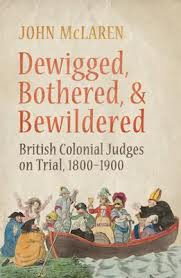
‘Dewigged, Bothered and Bewildered’ by John McLaren

mclaren

2011, 303 p plus notes

John McLaren ‘Dewigged, Bothered and Bewildered: British Colonial Judges on Trial 1800-1900’.

The title Dewigged, Bothered, and Bewildered is a play on the show-tune with a similar title, (Bewitched, Bothered and Bewildered). It examines the careers of several 19th century judges of the British Empire who, for various reasons, found themselves removed or ‘dewigged’ from their positions.  The title reflects the tone of this book- light and jocular at times- but it belies the sheer breadth of knowledge of individual colonies that it covers.   Its author, John McLaren, is professor emeritus in the Faculty of Law at the University of Victoria (Canada)  and as Bruce Kercher’s endorsement on the back cover says “John McLaren is the only person I know with sufficiently broad legal historical knowledge to attempt such a huge task, and he succeeds at it remarkably well”.

It  might seem strange that a book about 19th century judges  starts with an analysis of judicial tenure in the seventeenth century.  It was during the constitutional maelstrom of Charles  and James and the Glorious Revolution that two competing mechanisms for appointing and controlling judges emerged.  The ‘Cokeian’ model, associated with Sir Edward Coke, drew on the rhetoric of the Ancient Constitution and the ‘rights of freeborn Englishmen’ to  argue that the King, like other mortals, was subject to the law, and that he and his officers were subject to the jurisdiction of the stewards of the Common Law, the judges of the King’s Bench, Common Pleas, and Exchequer.  The rival ‘Baconian’ model, expounded by Lord Francis Bacon, emphasized the Divine Right of Kings and emphasized that judges must be the loyal servants of the monarch.  Hence, under the Cokeian model, judges should be employed ‘during good behaviour’ where, as long as there was not actual judicial impropriety, the judges were independent of the Crown.  The Baconian model, on the other hand, employed judges “at His Majesty’s pleasure” and kept the judges under the control of the King and his government.

All this might seem far removed from a judge in Port Phillip, Sierra Leone, Newfoundland or Upper Canada 150 years later, but McLaren argues that this 17th century argument about the independence of the judges, abuses of power by the government,  and local control over the judiciary was played out  over again, this time in the colonies.  In this book, McLaren uses group biography to examine how these battles were exemplified through the careers of a number of colonial judges from Upper Canada, New South Wales and Van Diemen’s Land, Sierra Leone, Newfoundland and the West Indies.

Judge Willis has a starring role here: we meet him in the opening pages, and he is featured in two chapters.  He is, however, not the only judge in this book who appears as a trouble maker in two separate colonies.  Jeffrey Bent, well known in Australia for his struggles with Macquarie, reappeared in Grenada, where he again clashed with the governor.  Robert Thorpe, who was a ‘radical’ judge in Upper Canada prior to Willis’ appointment, also had trouble in Sierra Leone, and Sir John Gorrie seemed to be shifted from place to place when he fell out with various people in Fiji, the Leeward Islands  and  Trinidad.  There are a number of troublesome judges whose travails were restricted to one colony alone: Boothby in South Australia; Sewell and Monk in Lower Canada; Montagu in Van Diemen’s Land; Beaumont in British Guiana.

The chapters are arranged thematically, but chronologically and geographically as well. For example, the chapter ‘Courting Reform in a Counter-Revolutionary Empire 1800-1831’ deals with Robert Thorpe and Judge Willis in Upper Canada, where the judges’ reforming zeal clashed with conservative local interests.  It is followed by a chapter that makes the argument in the opposite direction for other British North American colonies  ‘Ultra Conservative Judges in an Era of Developing Reformist Sentiment in the British Empire 1810-1840’.  It covers similar years to the first chapter, but this time switches the focus around.  It  examines the  cases  of Sewell and Monk in Lower Canada and Henry Boulton in Newfoundland,  where conservative judges fled  the radical colonies for the protection of the home government.

Chapters 6-8 are focussed on Australian examples.  Chapter 6 ‘Guarding the Sanctity of the Common Law from Local ‘Deviations’ in Convict Colony 1800-1830’ examines the career of Ellis and Jeffrey Bent in New South Wales, followed by Ch 7 ‘English Legal Culture and the Repugnancy Card in the Australian Colonies 1830-1850’ which follows on chronologically in examining Montagu and Pedder in Van Diemens Land, and Willis in Port Phillip.  The term ‘repugnancy’ refers to the tenet that colonial law should not contradict English law.  Part of a colonial judge’s role involved analysing local laws drawn up in the colony and advising the governor whether the law was ‘repugnant’ or not.  Chapter 8 takes up the repugnancy question in Australia after 1850 with Benjamin Boothby in South Australia.

Chapters 9 and 10 examine judges in the slavery colonies in the West Indies and West Africa, with George Smith in Trinidad,  Thorpe in Sierra Leone and Jeffrey Bent in Granada between 1800-1830 in Chapter 9.   In Chapter 10 the time frame shifts to 1834-1900 with Joseph Beaumont in British Guiana and Sir John Gorrie in Mauritius, Fiji and Trinidad.

The final chapter draws together themes that emerge throughout the stories.  In a way, this chapter subverts, or at least challenges, the structural logic of the other chapters because some of these judges, Willis in particular, are not easy to pigeonhole.

As McLaren points out, it is important that troublesome, contrary, complex and contradictory judges should not be committed to “the ashcan of historical ephemera”.  We gain a view of empire from them that is not available from ‘don’t rock the boat’ jurists, and we must never lose sight of the fact that law is never a sideshow. Instead, it was an important instrument in the extension of imperial authority, infused with and supported by the constitutional and legal values of the English-speaking world of the previous two centuries. (p. 273, 274)

It is the PhD student’s nightmare that a highly prominent, esteemed and widely published academic release a book on one’s very topic while you are still working on- or worse, just as you finish-  your thesis.  I became aware of John’s work while I’ve been working on Willis myself, and it was with a mixture of trepidation and curiosity that I read his book.  I gained much from it, particularly in being able to compare Willis with other judges in similar situations, and it’s with relief that I can see where my own  more  bottom-up work can fit under his broad umbrella of judicial misbehaviour and discipline.

A group biography, like this one, has challenges beyond that of the individual biography.  There’s a danger that so many situations and people are introduced that the whole thing breaks down in confusion, but there’s also the advantage of being able to better define the exceptional.  I think that a sign that McLaren has succeeded so well is that on encountering a particular judge a second or even third time, there is a rush of recognition.  His judicial characters are so well drawn that when the final chapter draws together observations from across the work as a whole, there is no need to check back to see ‘now, who’s he again?’  The book is suffused with a lightness of touch and a sure grasp of the contours of so many different colonies that comes from the author’s long, deep immersion in colonial legal history.

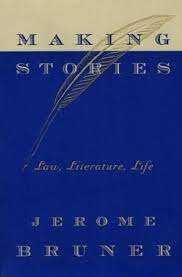
‘Making Stories: Law, Literature, Life’ by Jerome Bruner

Image

Good grief, I thought- is Jerome Bruner still alive? I remember reading his work  back in my educational designer days.  But there he was, in 2002 at the age of 87,  giving the first Lezioni Italiane of the new millenium- a lecture delivered at the University of Bologna by a foreign visitor on a topic of his or her choosing.

Image

2002, 107 p. & notes

The lectures formed the basis of this book and although they might not say anything new, they form a distillation of Bruner’s life-long fascination with narrative and its relation to identity and literature. According to his webpage, Jerome Bruner in 2011 (by then aged 96) was still recorded as a Senior Research Fellow in Law at New York University.  Although at first glance this seems an odd position for a cognitive psychologist and educationalist,  in this book he brings together the idea of story and the law.

The book consists of four chapters, each about 25 pages in length.  I’m not sure if he gave four separate lectures, but certainly these chapters, with their discursive and yet easily-followed narrative thread, read  as if they might have been self-contained presentations at some time.

In Chapter 1 “The Uses of Story” he commences by noting that we are all adept at narrative, which is almost as natural as language itself.  Stories commence with a breach in the expected  or peripeteia– a sudden reverse in circumstance, and the tension between what was expected and what came to pass. The story goes on to explore efforts to cope or come to terms with this breach and its consequences. A story often closes with a coda, a retrospective evaluation of what it all means.

In the second chapter of the book “The Legal and the Literary”  he turns his attention to legal stories, told before a court of law within a tight set of procedures that keeps them within recognized bounds.  Such stories, when told by lawyers for the prosecution or defence, are always partisan and adversarial, but it is our confidence in the legal process that sanitizes them.

The law has evolved over the centuries not only to render just and legitimate verdicts between two opposing narratives but to do so in a way that removes the risk of precipitating a cycle of revenge after the verdict has been pronounced.  To achieve this dual objective, the courts must be accepted as authoritative and legitimate, and they must also be seen as fair and disinterested, capable of rising above the self-serving and adversarial narratives by which cases are presented. (p. 37)

As with other stories, legal stories are also based on peripeteia.  The tension between what is possible and what is established is built into the texture of Anglo-Saxon common law.  The common-law writ is itself a plot summary of an actionable offence against what is customary and established. (p. 58).

He then turns to literature, even though courts and judges would bristle at the thought that law and literature could be coupled together in this way. He distinguishes literature from other forms of story in the intent that lies behind the fashioning of a literary narrative.  Legal stories aim at making the world self-evident, whereas literature evokes familiar life with the deliberate aim of disturbing our expectations.

The challenge of literary narrative is to open possibilities without diminishing the seeming reality of the actual (p. 48)

The third chapter “The Narrative Construction of Self” turns to the role of story in our telling of our self to our self. He argues that there is no such thing as an intuitively obvious and essential self, sitting there ready to be portrayed into words.

Rather, we constantly construct and reconstruct our selves to meet the needs of the situations we encounter and we do so with the guidance of our memories of the past and our hopes and fears for the future.  Telling oneself about oneself is like making up a story about who and what we are, what’s happened, and why we’re doing what we’re doing. (p. 64)

This self-telling accumulates over time and is patterned on the conventional genres privileged by our specific culture.  The narrative we create about our self must create a conviction of autonomy where we have a will of our own, but it also has to be related to a world of others- our family, friends, institutions and the past.   He notes that most autobiographies and self-tellings have turning points, which are themselves influenced by culture. He suggests that once a person becomes unable to tell a narrative (through, for example, Alzheimers or Korsakov syndrome) then they have virtually lost self-hood.

The final chapter ‘So why narrative?’ returns to the themes of the earlier chapters. We see more of Bruner the academic here, as he explores the anthropological origins of the ability to tell stores, and the features of language that make it possible.  He cites one of my favourite books on language, Shirley Brice Heath’s Ways with Words which examines the language practices of white and negro children in North Carolina and the way that education privileges the “just the facts, ma’am” narrative structures of white children over the imaginatively elaborated tales of white children.  He closes with a discussion of the importance of narrative in medicine and rehabilitation.

I’m not quite sure yet what I’m going to do with this and how I’m going to use it in my own work.  I’m thinking about narrative and the ways of telling a life …but I haven’t quite worked my thinking out in my own head yet.  I’ll leave with a paragraph that I think sums up Bruner’s argument across these four lectures:

For better or worse, it [narrative] is our preferred, perhaps even our obligatory medium for expressing human aspirations and their vicissitudes, our own and those of others.  Our stories also impose a structure, a compelling reality on what we experience, even a philosophical stance.  By their very nature, stories take for granted that their protagonists are free unless ensnared by circumstances.  They also take for granted that people know what the world is like, what can be expected of it, as well as what it expected of them.  In time, life comes not so much to imitate art as to join with it.  It is “ordinary people doing ordinary things in ordinary places for ordinary reasons”.  A seeming breach of this ordinariness is required to trigger the rich dynamic of narrative- how to  cope with it, to domesticate it, to get things back on a familiar track. (p. 89)….Story making is our medium for coming to terms with the surprises and oddities of the human condition and for coming to terms with our imperfect grasp of that condition. (p. 90)

As it happens, I’ve just found a lecture based on this book and echoing its title given  by Inga Clendinnen who is right up the top of my Favourite Historians list.  The lecture, ‘Making Stories, Telling Tales: Life, Literature and Law’ was delivered as the 18th Lionel Murphy Memorial Lecture in 2004. It’s a wonderful presentation that references this book, Janet Malcolm the biographer, Helen Garner’s Joe Cinque’s Consolation . It’s beautifully crafted, as Clendinnen’s work always is, and well worth reading.

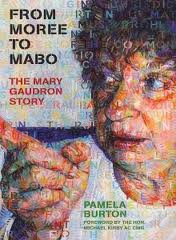
‘From Moree to Mabo: The Mary Gaudron Story’ by Pamela Burton

burton

2010,  401 p. & notes

I think that most of us would be hard pressed to name the judges on the High Court of Australia- I know that I would be.  Occasionally a judge ‘cuts through’ into the mainstream- Michael Kirby comes to mind (perhaps even more since retiring from the bench than while on it?), as does William Deane (although probably more as Governor General than judge)- and Mary Gaudron is another.  Mary Gaudron was the first female High Court judge in Australia- just one of the many firsts in her career.  As the title of this book highlights, she was one of the judges involved in the Mabo decision, arguably one of the most important judicial decisions in Australian history (although- fascinating parlour game- no cheating on Google- who were the other judges in the Mabo case???) Continue reading

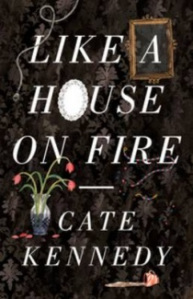
‘Like a House on Fire’ by Cate Kennedy

like-a-house-on-fire

2012, 277 p.

Like a House on Fire is a book of short stories.  If you’ve followed my blog for any length of time, you’ll know what’s going to come next.  I’m going to say that I don’t know how to talk about a collection of short stories.  That I don’t know how to read them- one at a time and feeling short-changed, or moving on to the next one and feeling bloated.  That they finish before I have time to engage at any level with the character.  That I just don’t like them.

Well, none of that is true with this book.

Perhaps, after 15 years of being able to indulge my love of reading more fully, I have finally learned how to read a short story.  My discovery: one story at a time ONLY , then go on to read a non-fiction book instead. The  single story has enough space to expand; it’s not squashed down to fit the next one in.

Or perhaps, these are very, very good short stories.  They have all been published elsewhere in journals and magazines as is often the case in compilations like this. Every single one of them is memorable, and for me that’s a big thing.  All too often I find myself reading the next story in a collection because the last one has been too insubstantial: the term ‘meh’ fits exactly.

But with these stories, each one is memorable in its own right, and I found myself recognizing their truths in other places.  The story ‘Five Dollar Family’, for example, where a new young mother, exhausted, drained,  looks to her dead-beat young partner and is stiffened into resolve to move beyond him- surely I saw the story lived out in an episode of ‘The Midwives’ a few weeks ago where a young single mother in Manchester likewise grew up, almost before your eyes, through the act of giving birth.  Or the story ‘Cake’ where a new mother returns to work for the first day, torn by the act of leaving her child at creche, feeling as if she is play-acting a pre-baby life that she has moved beyond- even if you haven’t been in that situation, I think we’ve all felt the way that  workplace routine comes a sepia filmreel, a nothingness, after some big, life-changing event.

Many of these stories involve bodies: most particularly women’s bodies and medical intervention-  the night before a breast biopsy; the waiting room before a miscarriage is diagnosed. Others are told from a male or a child’s perspective.  The story which gives the collection its title is about a young father with back-ache and it is so well told that you find yourself arching your own back in response, while at the same time suppressing the suspicion that he’s exaggerating.  The opening story, ‘Flexion’  which takes in  a longer timespan that many of the other slice-of-life stories in this collection do, traces a wife’s ambivalent response as her leathered, laconic farmer husband recovers after a tractor accident.

For me, it says a lot that I can flip through the book, glimpse the title at the top of the page and instantly recall what the story was about.  I don’t think that I’ve ever enjoyed a collection of short stories so much.  I wouldn’t feel in the least disgruntled or short changed should it win the Stella Prize for which it has been short-listed.

My rating: 9.5/10

Sourced from: Yarra Plenty Regional Library

Read because: it was long listed for the Stella Prize.  Reviewed for the Australian Women Writers Challenge 2013

awwbadge_2013

‘Emancipation and Apprenticeship in the British West Indies’ by W. L. Burn

slavery

If you had placed this book into a shiny new coloured cover, I would never have picked it for being written in 1937.  It has all the things that I look for in histories that are being written around me today:   exploration of big themes through grounded, personalized examples; a sense of place;  careful attention to detail through the sources; an attempt to step up out of those same sources into a more literary style; decisiveness in coming to a pithy conclusion,  and a judicious use of the presence of the historian him/herself as researcher and commentator.

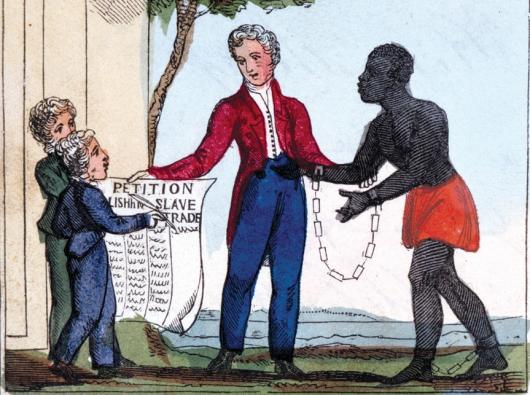
It’s also a book that attracts my interest as a politically engaged citizen concerned about what a former Prime Minister described as “the greatest moral challenge” of our time- climate change.  In reading about the abolition of slavery I’ve been again and again reminded of the parallels between the two.  Both climate change and the abolition of slavery involve/d self-inflicted economic pain for a higher long-term purpose; both involve/d  well-organized pressure groups with powerful media access; both provoke/d  fears that international competitiveness would be hampered; both campaigns stretch/ed out  over decades.  It may well be that climate change policy, like abolition, may have to accept a compromised ‘solution’  in the short-term as part of a bigger, long-term picture- although of course, in climate change  the earth and the systems of its climate will follow their own trajectory, whatever the politics.  In the case of the abolition of slavery, the compromise was the Apprenticeship System.  Continue reading

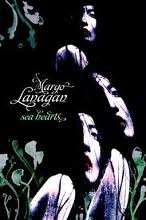
‘Sea Hearts’ by Margo Lanagan

seahearts

2012,  343 p.  Also published as ‘The Brides of Rollrock Island”

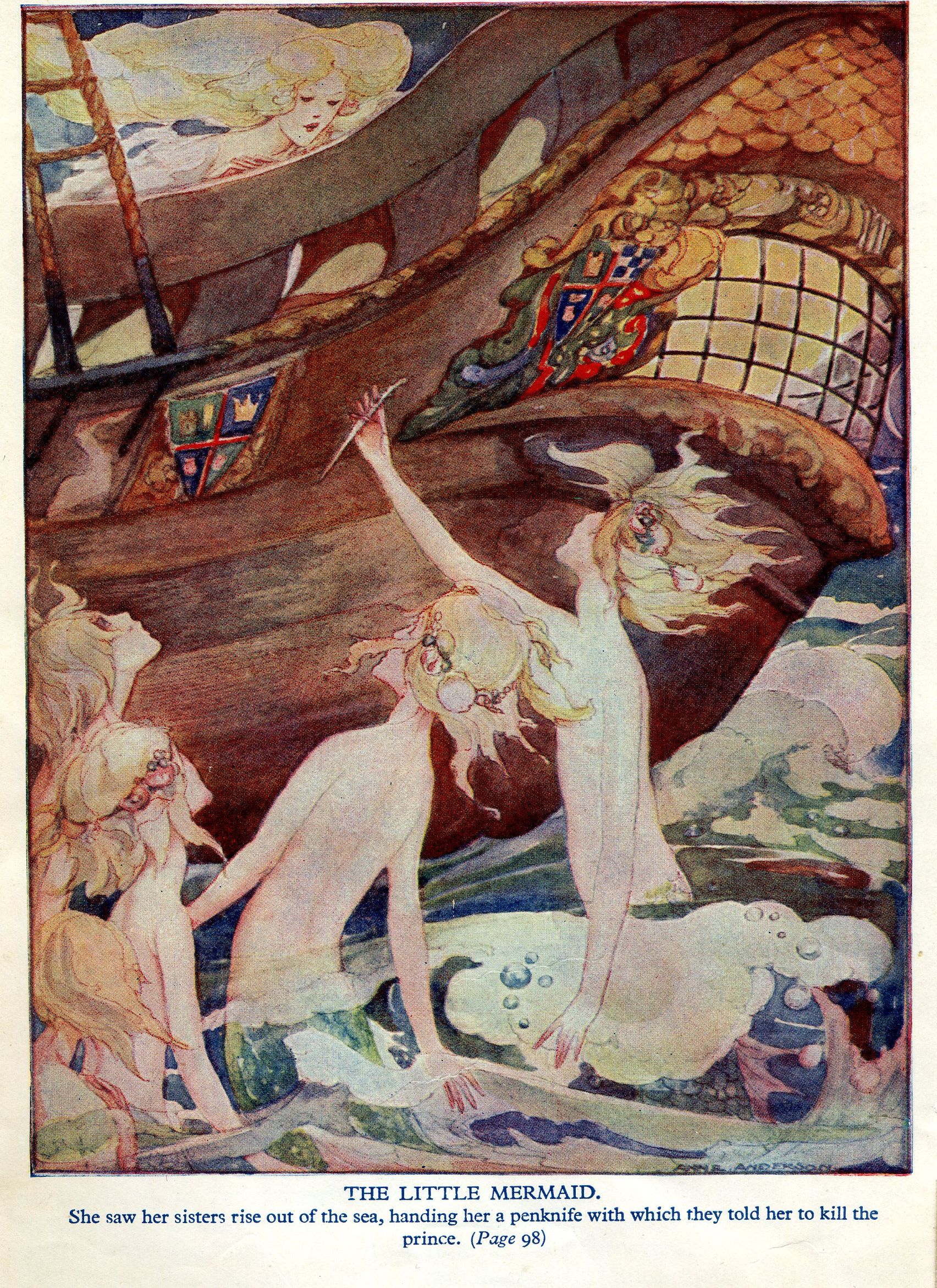
I’ve always loved stories about mermaids and selkies.  As a child, it was a special treat for me to read a book that had belonged to my mother called “The Children’s Treasure House” by Alfred Noyes, copyright 1935.  It has beautifully rendered coloured plates, black and white art-deco line drawings and it is indeed a treasury of stories and poems including Hans Christian Anderson, The Brothers Grimm and simplified retellings from the works of Charles Dickens, Victor Hugo, Shakespeare etc.  I see through Trove  http://trove.nla.gov.au/ndp/del/article/47810432b  that it cost 5/- with 1/- for postage, and was available through the Women’s Weekly.  I had two favourite stories in the book.  One was the Snow Queen, and the other was The  Little Mermaid- the REAL Little Mermaid:  no Disney-saccharine Ariel, Flounder and Scuttle the Seagull here-  but the proper story, with its pain, yearning and sad, sad ending.

mermaids

Whenever I’m in a boat travelling across clear, shallow water and I see those glistening threads of sunlight in the water or foam on the edge of waves, I think of this picture.

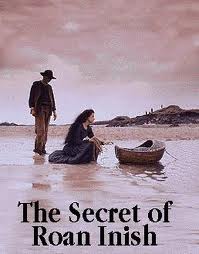
Selkies are more confronting, given their connection with seals, but fascinating none the less. According to the legend (which of course has many variations), male selkies are handsome, powerful and seductive but can only remain a short time before returning to the sel. Female selkies  will stay on land as long as their sealskins are hidden from them, and even have children with human men, but will return to the sea as soon as they find their skin again.  Often their own children unwittingly help the selkie to find the skin that has been deliberately hidden from her, and either the selkie forsakes her husband and children to return to the waves, or takes the children with her. Several years ago,  I fell in love with the movie The Secret of Roan Inish with its selkie and the little lost boy. I liked it so much so that I watched it two days in a row when it came to a local theatre. Again- yearning and loss, and a beautiful, windswept setting.

roaninish

So when I read that Margo Lanagan’s book Sea Hearts is about selkies, I wanted to read it.  Off to the library I toddled, only to find that it wasn’t on the shelves even though the catalogue claimed that it was.  Ah- silly me- it’s in the Teenage section

I really don’t know what distinguishes ‘teenage’ from ‘adult’ here.  It’s a beautifully told story, spun out over several generations. It is set on remote Rollrock Island, with its village of fisherfolk and small cottages.  The  chapters are of varying lengths, told in the first person in a curious, lilting accent.  Each chapter focuses on a different character and time elapses between generation to generation.  One of the longest and most compelling chapters is told by Missakaella, an awkward young woman, shunned by the villagers, drawn to the sea and especially the seals in the bay.  They are attracted to her, too, and her mother forces her to wear an apron with crossed strings, that somehow keeps the seals at bay.  It is through Missakaella that the age-old meeting between selkie and human is reconsummated.  It is a powerful and evocative piece of writing that I found oddly, and breath-holdingly erotic.  That’s quite a narrative feat: to not only be lulled into suspending disbelief about the physicality between seal and woman, but to actually stir a response to it as well. But actions have consequences: obsession becomes possession; love becomes loss; something taken can take in return.

This is a handsomely presented book, with each chapter separated by a black-and-white illustration that evokes seaweed, bubbles and deep cold water.  I must admit, though, that I found the front cover rather sinister and disturbing.  The book itself is not.  Instead, it’s a haunting love story, too good to be left to teenagers.  It has been longlisted for the Stella Prize  but if it were to win, it would be an usual, rather ‘brave’ choice.

My rating:  8.5/10

Sourced from: The ‘teenage’ section of the Yarra Plenty Regional Library (hah!)

Read because: several people had reviewed it on the Australian Women Writers Challenge in 2012; I noted that it had been shortlisted for the Stella; and because I’m fascinated by selkies!

awwbadge_2013

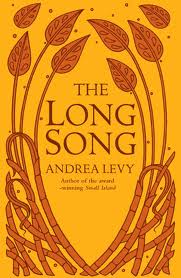
‘The Long Song’ by Andrea Levy

levy_longsong

2010, 310 p.

After reading the very dissatisfying, Booker Prize winning The Finkler Question, I mused that if that won the prize, then the rest of the 2010 Shortlist must have been duds.  Not so.  Andrea Levy’s The Long Song is much the better book, and unlike Finkler, which I am sure will sink into literary oblivion, it’s an important book as well.

Levy’s earlier book Small Island, which won the Commonwealth Writers Prize and Orange Prize in 2004-5  is an important book too, in terms of framing and claiming British West Indian identity in modern Britain.  The Long Song follows in this tradition, but takes a step further back to early 19th century Apprentice-Era Jamaica.   For us, in our policy-comprised times, it’s an interesting era:  the Apprenticeship scheme was a political ‘fix’ that ostensibly abolished slavery in British colonies by introducing ‘slavery-lite’.  The Apprenticeship System, as it was known, transformed former slaves into compulsory ‘apprentices’ who would work set hours on their former masters’ plantations for six years (although as it happened, the apprenticeship period ended earlier than that).   It was a highly unpopular measure, strong-armed into legislation by the British government using the stick of executive action if the colonies didn’t create their own enabling legislation locally , and the carrot of ‘compensation’ payments that flowed, not to the slaves, but to the proprietors of the plantations.  But it did very little to change the basic  relations between masters who were able to leverage power through rents and working hours, and their ‘apprentices’ whose ‘freedom’ consisted of merely a quarter of their own time.

Levy uses an interesting structure for this book.  The fly-leaf opens with an explanation:

You do not know me yet but I am the narrator of this work.  My son Thomas, who is printing this book, tells me it is customary at this place in a novel to give the reader a little taste of the story that is held within these pages.  As your storyteller, I am to convey that this tale is set in Jamaica during the last turbulent years of slavery and the early years of freedom that followed.

The narrator, July, was born in Jamaica, the daughter of a field slave Kitty as the result of a rape by an overseer.  July was taken from her mother by Caroline Mortimer, a white woman from the ‘big house’ on the plantation and renamed ‘Marguerite’.  The pattern of forced sex and maternal loss continued into the next generation.  July’s son, Thomas, learned his trade in Britain after July left him as an infant on the minister’s doorstep.  That same Thomas,  Jamaican publisher-editor in 1898,  then writes his own foreword:

The book you are now holding within your hand was born of a craving.  My mama had a story- a story that lay so far within her breast that she felt impelled, by some force which was mightier than her own will, to relay this tale to me, her son.  Her intention was that, once knowing the tales, I would then, at some other date, convey its narrative to my own daughters.  And so it would go on….

I explained to my dear mama, once spoken these precious words of hers would be lost to all but my ears.  If, though, committed to a very thin volume, I could peruse her tale at my leisure and no word would be lost when my fickle mind strayed to some other purpose.  And better, for the excess books which would be produced from the press could be given for sale, taken around the island so others, far and wide, might delight in her careful narration…

…So I was able to assure my precious mama that I would be her most conscientious editor.  I would raise life out of her most crabbed script to make her tale flow like some of the finest writing in the English language.  And there was no shame to be felt from this assistance, for at some of the best publishing houses in Britain- let me cite Thomas Nelson and Son, or Hodder and Stoughton, as my example- the gentle aiding and abetting of authors in this manner is quite common place.

And so the book is the gentle, good natured to-and-fro of mother and son, jointly constructing the story: the mother July with her humour and resilience;  the editor son with his careful, somewhat stilted prose.  I loved it when July’s voice took up the story again, as if a nudge to remind me that it is her story after all.  And all the pomposity of Thomas’ voice would drop away, at times, when the sheer humanity of the story became overwhelming.  It’s wonderful, well-sustained writing.

The energy  and inventiveness of  Levy’s  narrative voice obscures the fact that this deceptively-easy book is actually very well researched indeed.  In her acknowledgments she lists the historians and other writers who have assisted her, and a list of 16 sources, both primary and secondary, that she drew upon in writing this book.   I’ve read several of them myself, and when I see their traces  here, and the use she has made of them,  it only increases my admiration for the fictional power of this book.

Take, for example, this description of the manuring process as part of plantation production, from Burn’ s very good  history Emancipation and Apprenticeship in the British West Indies:

When the holes had been prepared manure was placed in them and on top of the manure a few shovelfuls of light mould. (p. 42).

And here is Levy:

Some of this mess is taken from the pen to be shovelled into baskets and slung either side of a mule.  The mule then, unaware of the load it carries, trots off as happy with this weight as with any other.  But the wicker dung-baskets- overflowing and spilling- that Kitty carried to the cane pieces of Dover, Virgo, or even as far as Scarlett Pondes, were borne in the way of most slave-burdens, upon her head.  The weight was no sufferance, for Kitty could carry much heavier, much further.  Come, it is true, the smell would see our white missus faint clean away with just one sniff.  But the Lord, in making the nose, fashioned a shrewd organ; although so renk that upon Kitty’s first breaths the solid odour did choke her at the throat, after mighty cough and a few strong inhalations, all the air about Kitty, be it sweet or bitter, came to smell like shit, so the offence was lost… And if this dung did find its way into her eyes- for the brown juice from this waste matter did ooze through the weave of the basket to slipslide all down Kitty’s face- then, oh! Its sting did well up such tears as to leave her blind (p. 123).

I think that Levy’s book exemplifies all the good in historical fiction:  lightly worn research;  fidelity to the voice and perspective of primary sources (with all their flaws);  characters and dialogue bounded by and consistent with knowledge at the time;  a plausible plot, and imagination and creativity in its narrative framing.  As for the Booker?  Levy was robbed.

‘Babes in the Bush: The Making of an Australian Image’ by Kim Torney

torney

2005,  241p.

I feel as if the McCubbin image that graces the front cover of this book has been hanging in the corridor of every school I have ever attended.  Just looking at it evokes for me the smell of squashed sandwiches and pencil cases.  Likewise, the mere mention of the “Lost in the Bush” story in the primary school reader brings back memories of brave little Jane Duff, struggling with her brother to carry their baby brother through the ravines of the endless bush, tenderly covering him with her cotton dress at night.  Of course, that’s the whole power of an image:  just a glimpse or uttered word evokes a cascade of remembrances and associations. And as the title of this book suggests, the lost child in the bush is a particularly durable and potent Australian image. Continue reading

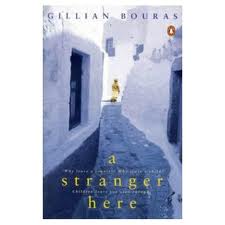
‘ A Stranger Here’ by Gillian Bouras

a_stranger_here

1996, 247 p.

The Age, my daily newspaper (which is, unfortunately, becoming less and less pleasurable- did you hear that the Guardian is coming to town?) no longer has its regular columnists who let you into their lives over an extended period of time.  I suppose that Martin Flanagan writes within that tradition, and the much-missed Kate Holden did too on the back page of Saturday’s Age.  The late Pamela Bone was good; so was Sharon Gray; and I remember Gillian Bouras as well. As I recall, she was a Melbourne teacher who went to live in a Greek village, and she continued to write her column from Greece.  She  has mined her life for novels, too, and this book  continues this tradition.  Is it fiction or non-fiction? I have no idea.  I think that I’d classify it as memoir and biography dressed up as fiction.

It is written in three alternating voices of three women, overlaid by an invisible third-person omniscient narrator :  first, the Greek peasant mother-in-law Artemis;  second, the friend Juliet; and finally the writer Irene (who may, perhaps be the omniscient narrator writing in first person).   Australian-born Irene now lives in England, self-exiled from Greece where her youngest child still lives after the breakdown of his parents’ marriage.  She doesn’t want to return to Australia and she cannot bear to be too far from her youngest son whom she loves perhaps too unhealthily.  Her mother-in-law Artemis, addled by dementia, has always resented Irene, and the friend Julie, herself British-born, has stayed in Greece, turning a blind eye to her husband’s infidelities and she is rather impatient of Irene’s indecisiveness and passivity.

I received this book as part of my book-group’s Kris Kringle: we each anonymously wrap up a book of our own that we have enjoyed and put it wrapped into a basket and choose another.  Over the Christmas break we read the book, then at our first meeting we return it, speak about our response to it, and try to guess who ‘gave’ it.   It doesn’t at all surprise me that this was a book given by one middle-aged woman to another middle-aged woman, and it has been interesting reading this and My Hundred Lovers in such close succession, because there is a similarity between them.   They are both very female books, written by older women, who have been scarred, chastened and emboldened by experience.  Both books do not have a clear-cut beginning and end point, and while driven by the elapse of time and the waxing and waning of relationships, do not have a plot as such.

While identifying with it, I did become a bit impatient at the ‘stuckness’ of the narrator in this book and was relieved that it didn’t go on for much longer, even though I was enjoying reading it.  I do wonder if  the author takes the  adage “Write what you know” a little too seriously: can any one person’s ordinary life carry the burden of so many novels???

My rating: 7.5/10

Sourced from:  well- who knows???  I think Sue, but I’m not sure.

Read because: it was the 2012 book group Kris Kringle.  And she identifies herself on her website as “An Australian Writer Living in Greece” so I’ll include her on the Australian Women Writer’s Challenge.

awwbadge_2013

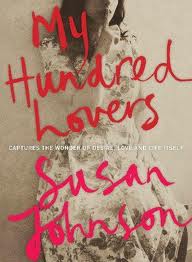
‘My Hundred Lovers’ by Susan Johnson

myhundredlovers

2012, 262 p.

I must admit that the whole Fifty Shades  phenomenon and its innumerable offshoots leaves me cold.   So it was with some trepidation that I borrowed My Hundred Lovers, hoping that a writer that I’ve enjoyed in the past would not betray me with a fleeting and warped assertion of empowerment through a string of  hot-breathed, moist, look-away sex scenes. I need not have feared. This is a beautifully written book, expanding love and sexuality to encompass the whole of life and being human.

It is written as one hundred chapters, each very short consisting rarely of more than four pages, and sometimes as little as a paragraph.  The hundred lovers here (such a daunting number!) are the spark between sensuousness and embodiment (in the sense of being in the body) and the whole range of a woman’s experiences.  There is  much for the fifty-year old reader to reflect and identify with here: the ambiguity of father/daughter physicality; the childhood sex play that I find myself looking back on and wondering about;  explorations of changing adolescent bodies; self-exploration;  sex for all the wrong reasons; sheer experimentation.  But sensuousness and being in the body is more than genitals and crevices: it’s also luxuriating in water, sand, heat; buttery croissants; it’s buildings and houses and landscapes; it’s friendship and companionship.

Unlike the sweaty, fervent erotic fiction that its title evokes, this book champions an older, wiser, more lived-in view of love.  It’s a view of love that  a fifty-year old reader does not feel disqualified from- if anything, it affirms and confirms what it sometimes takes fifty years to learn:

Love arrived smaller and more humble than advertised.  Love turned out to be plain, quotidian… She preferred herself now, less succulent and more loving, humbled, loved. (p.261)

This book is more than a list, it’s a life-story with relationships, losses, pain and confession, all measured out against the beat of passing time.  In fact, counting and taking measure is prominent here.  As she tells us in the opening sentence, romance between the average couple dies two years, six months and twenty-five days into marriage.   Most of us will live for a thousand months.  There are one hundred experiences in this book, numbered off in a countdown, and given that the book could have finished anywhere really, I found myself counting too…98, 99, 100.  Biography (including fictional biography as in this case) relies on the countdown of years and the elapse of time for its shape; unlike memoir which is an intellectual construction where time can be squeezed, stretched and compressed like clay.  This book combines the two- it is basically chronological in its structure, but events and reflection are intertwined and the whole  “100” framework is a literary and arbitrary construction.

The writing is crystal-sharp: quite an achievement in a genre that even has its own award for failure and mis-steps in the Bad Sex Awards– a dubious ‘honour’ that must surely shrivel up the juices of any writer.  Although it is completely self-contained in its own right, the author’s highly-acclaimed earlier work The Broken Book, a fictionalized biography of Charmian Clift, sits alongside it as a close companion.   They are both beautifully written, intelligent books.

My rating: 10/10

Sourced from: Yarra Plenty Regional Library

Read because:  I’d heard of it and very much enjoyed the author’s earlier works.  And I’ll backtrack a little and  count it for the Australian Women’s Writing Challenge 2013

awwbadge_2013