Category Archives: Book reviews

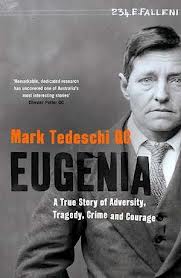
‘Eugenia’ by Mark Tedeschi Q. C.

eugenia_tedeschi

2012, 236 p & notes

I must admit that I don’t very often come away from the ANZLHS Law and History Conference rushing  to my library website to look up a book.  I did, however,  with this book last December only to find that it already had multiple reservations.  I put a hold on it in December and finally received it in May.  Perhaps they should buy another copy….

You’ve probably seen or hear of Mark Tedeschi  QC, even if you don’t know you have.  He’s the NSW Senior Crown Prosecutor, and he has been involved in a slew of important and famous criminal trials: Ivan Milat’s Backpacker Murder; the trial of the men who murdered the heart surgeon Victor Chang;  the trial following the assassination of politician John Newman; the Gordon Wood case over the death of Caroline Byrne at The Gap; and Counsel assisting the Coroner in the 2007 trial into the killing of the Balibo Five.  It was in his role as Senior Crown Prosecutor that he addressed a gathering of former and present Crown Prosecutors gathered at NSW Parliament House in 2005 to celebrate the 175th anniversary of the appointment of the first Crown Prosecutor,  Frederick Garling, in 1830.At that presentation he listed a number of extraordinary, complex and bizarre trials, and first on his list was that of Eugenia Falleni. In the introduction to this book he writes:

In the intervening years, I have come to consider that the trial of Eugenia Falleni in 1920 should be viewed as the single most important criminal trial of those 175 years.  Its prominence is not because of any  lasting effect that the trial had on the law or the administration of criminal justice, but rather because of the multitude of legal and social issues that Eugenia’s life and trial throw up for us to consider, so that we can use them as a yardstick to ask ourselves what we have learned and how far we have progressed since then.” P. 228

So who was Eugenia Falleni?  I’m wary of spoilers, so I’ll cite from the publicity on the back cover.

Eugenia Falleni was a woman, who in the 1920s was charged with the murder of her wife.  She had lived in Australia for twenty two years as a man and during that time married twice.  Three years after the mysterious disappearance of Annie, her first wife, Eugenia was arrested and charged with her murder.  This is the story of one of the most extraordinary criminal trials in legal history anywhere in the world.  The book traces Eugenia’s history: from her early years in New Zealand, to her brutal treatment aboard a merchant ship and then her life in Sydney, living as Harry Crawford- exploring how Harry managed to convince two wives that he was a man, culminating with Annie’s death, the police investigation, Harry’s second marriage to Lizzie, and then arrest for Annie’s murder three years after she had disappeared.

The book is written in three parts.  The first, ‘The Search for Love’ takes us up to the trial.  Many chapters start with a paragraph identifying the year and listing a number of events that occurred that year.  It reminded me a bit of the technique in the film Same Time Next Year where each new encounter was separated from the last by a film clip of significant events.  So, in this book Chapter 5 is set in 1913, marked by Roland Garros’s flight from France to Tunisia, Emily Pankhurst’s jail sentence and the commencement of work on Canberra.  It’s rather repetitive and overt, but on the other hand I could actually name the years in which events took place instead of just having a vague idea after a single date is given at the start of the book , then not mentioned again.

The book is written using fictional techniques, but it is not fiction.  There are conversations in the book, and frequent internal dialogues where the author suggests the thoughts of various characters.  Despite the spoiler on the back cover, there is little foreshadowing of events that will unfurl during the story.

In his introduction, Tedeschi  signals how he is going to deal with his sources.  He writes:

The historical facts of Eugenia Fallini’s story that I have related in this book, including quotations from newspaper reports and evidence from her trial, are based upon contemporary public records, press reports, court transcripts and other written accounts, as well as subsequent recollections of people who had direct contact with the main personalities.  I could have provided footnotes or endnotes for the historical facts, but I believe that including numbered notes in a text creates a visual and psychological hurdle for the reader to overcome.  For this reason, I have instead included a bibliography at the end of the book and I have only inserted numbered endnotes in the text  where they are essential for an explanation.  Where I have referred to personal thoughts and emotions, these are generally inferred by me from the background factual circumstances in which they occurred.  Most conversations are taken from police statements or evidence given in the committal proceedings and the trial.  In those two instances (in chapters 1 and 8) where, in the absence of established facts, I have engaged in conjecture about significant events, I have clearly indicated that this is the case and stated the basis for my supposition. P. xiv.

I didn’t find this particularly satisfactory.  The bibliography at the end of the book is divided into legal documents, newspaper articles, obituaries and family histories, and secondary sources.  The legal documents, which are probably the most important, include the transcript of the trial, the judge’s trial notes, the register of post mortem examinations , NSW female penitentiary records and a police statement.  Yet in the text itself, there is no indication which document a particular fact draws upon and thus no way of the reader weighing the authority and interests that the statement reflected.  The footnotes are more like explanatory notes e.g. conversion of imperial measures into decimal, biographical details of minor characters, or references to tangential legal cases.  Occasionally, though, there are footnotes directly related to the narrative.

He makes many assumptions about his characters’ state of mind without indicating the basis for his reconstruction .  For example:

 Over the long weekend, Harry languished in his kitchen over a bottle of whisky, agonising about what would become of Annie’s fourteen-year old son, and indeed himself, without Annie.  When the boy returned from his long-weekend holiday at Collaroy with the Bone family, how was he to break the terrible news to him that his mother had gone off without telling him or even leaving a note, leaving him with his stepfather? He felt great sorrow for this boy who had lost his father when he was very young and who now faced being informed that his mother was gone.  P 66

There is no indication of the evidence he used for deducing Harry’s feelings about his stepson, or whether this ‘terrible news’ of Annie’s desertion  was clearly thought through rather than an excuse conjured up on the spot. We do not know whether this reflects Eugenia (Harry’s) own confession, the step-son’s testimony, or Tedeschi’s assumptions- and surely that matters.

In his introduction, he particularly signposted Chapter 8 as a section where he was creating his own explanation.  I cannot fault the care with which he does so in the opening paragraphs of that chapter:

There were only two people who knew exactly what happened next in the clearing at the Lane Cover River Park: Harry Crawford and his wife, Annie.  Neither of them was in a position afterwards to give an account, for reasons that will become apparent.  What follows is therefore a possible version of events, re-created by the author, that is entirely consistent with all the known facts that later emerged, but interpreted with the benefit of today’s superior knowledge in the forensic sciences and unimpeded by the considerable prejudice that existed at the time for someone in Harry Crawford’s predicament  (p.55)

What follows is a narrative that is highly sympathetic to Harry Crawford (Eugenia).  It is very much the sort of legal narrative that a defence counsel could create, but it is oddly placed in Part I, which is a straight chronological account.  The author gives no indication of the evidence from which he has drawn up the scenario, and once created, it skews the rest of the narrative.    What would I have done, were I writing this book?  I think I might have created this narrative, and then immediately created a counter-narrative.  Perhaps I would have put it in Part II where Tedeschi writes as a lawyer, or perhaps at the end of the book.  I would certainly, at least identified the sources for my explanation here, if not elsewhere.  This chapter has no notes at all.

It is in Part II of the book  (“Legal  Proceedings”) that Tedeschi really hits his straps.  Using his legal knowledge, he examines the investigation and trial from beginning to end, noting discrepancies and anomalies and distinguishing changes in the law from the early 20th century to today. He notes flaws in the Crown’s case and is particularly scathing of Harry’s defence lawyer.  You’re very much aware of the lawyer at work here.  He creates a long list of fifteen alternative questions that the defence layer could have but did not ask, and embroiders the narrative with the rhetorical flourishes that a lawyer in full flight might use: for example,  a succession of paragraphs that each end with the sentence “it has not always been so” or in another section listing things that the defence lawyer could have done “but would he do so?”  Whatever my misgivings about the first part of the book, only a barrister could write this second section.

Part III, “Incarceration and Release” examines Eugenia’s life after she has been released from prison. Here he quotes more directly from medical reports, oral histories and newspaper articles, and I felt as if I was on surer evidentiary ground.  It is only a short section and rather sad.  He concludes with a retrospective that reviews the trial from a 21st century perspective.  It’s an interesting chapter.  Finally, there is an appendix that follows up on the main characters and what happened to them later, and the places and institutions in which events occurred.  I’m not really sure that it was necessary as an appendix because the story stood well on its own two feet.

The book addresses the issue of sex and gender directly.  It’s a fairly human response, I suppose, for us to wonder “But surely his wives would have known that she wasn’t a man?!” and Tedeschi goes into quite a bit of detail about the object coyly referred to in the court cases as “the article”.
eugenia_246x550

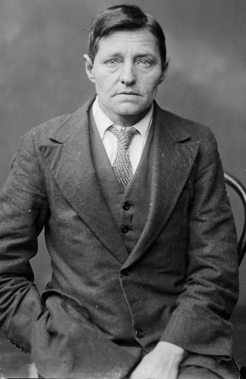
I found myself returning again and again to the police photograph of Harry on the front cover.  It was taken immediately after his arrest.  Not only had he been charged with the murder of his first wife, but his second wife now knew about his false identity.  He was afraid that he would be placed in a male prison with his identity as man/woman common knowledge.  There’s cockiness and yet sorrow in his face, and he had every reason to be fearful.

It’s a compelling story and, quite apart from the narrative itself, this book has raised so many methodological questions for me that I want to read more. How would a journalist deal with the story, or an historian?  Tedeschi acknowledges his debt to Suzanne Falkiner’s book, and I know that the historian Ruth Ford has written about her as well.  I haven’t finished with this story yet.
‘The Mountain’ by Drusilla Modjeska

mountain

2012, 426 p.

There are spoilers in this review.

Why would an acclaimed non-fiction author ‘go over’ to fiction?  Perhaps there’s something about the personal meaning of the material for the author that makes it easier to deal with fictionally. Perhaps there are ethical challenges in grappling with it, where the story is based on real-life, still-living people? Perhaps there’s squeamishness about ownership of the story: whether the story is the author’s to tell.

The Mountain  is Drusilla Modjeska’s first book of fiction, although none of her work fits neatly into defined categories. Her non-fiction has always straddled the genres of non-fiction, memoir and imagination.  In this book, too, I sense that it is not ‘straight’ fiction and I felt almost deceived when reading her acknowledgements at the back of the book that elide the fact that she, herself, was the young wife of an anthropologist in New Guinea in the 1970s. She has made no secret of the fact in her interviews after the writing of the book, and even before, and yet there is this strange distancing of herself from the narrative in her acknowledgements in the book itself.

The book opens with a prologue set in 2005.  Although called a prologue, it is actually at the chronological fulcrum between Part I, set in 1968-73 and Part II set in 2006.  As such, it was largely incomprehensible at first, although I found myself flipping back to it several times while reading the book as the characters became (somewhat) more settled in my own mind.  The book closes with an epilogue in 2006 that largely mirrors the opening prologue.

Part I, told in the past tense, focuses on Rika, a young Dutch woman who accompanies her older husband, Leonard, an Australian ethnographic film-maker to New Guinea.  Set in 1968, she is absorbed easily into a mixed-race, expatriate social milieu gathered around the university.  Her husband Leonard goes ‘up the mountain’ to film villages and their inhabitants, and in his absence she falls in love with Aaron, who has come ‘down the mountain’ and is acclaimed as a future leader when Papua New Guinea achieves  the independence which is on the horizon.  Rika, racked with guilt but also determined in her love for Aaron, travels ‘up the mountain’ to tell Leonard personally of her decision and returns to take up her life with Aaron leaving Leonard heart-broken.  However, as time passes and Aaron becomes increasingly caught up in the politics of independence, Rika does not fall pregnant and  is thus unable to be fully accepted as Aaron’s wife by the villagers.  When five-year-old  Jericho is sent down the mountain, Rika realizes that Jericho is actually Leonard’s son by a village woman up the mountain.  She adopts him and he too becomes part of this large, mixed-race expatriate community, viewing Rika and her friend Martha as his two mothers.  I was engaged by the love story between Rika and Aaron, but found myself bewildered by what seemed like an endless succession of men with biblical names coming ‘up’ and ‘down’ the mountain and their wives.

My bewilderment and confusion carried over into Part II when Jericho, now a grown man, returns to PNG in 2006. There had obviously been a rupture: he had been brought up in Oxford where Leonard still lived; he was still in contact with Rika who was now a famous photographer but alienated completely from all contact with PNG and those who still lived there, and Aaron was dead.  The hopes and optimism of independence had soured, and the threats of palm oil plantations, mining leases and ecological exploitation were ever-present.  I actually managed to read about 50 pages into Part II before realizing that I had confused Aaron and Jacob (there’s those biblical names there) and had to go back to re-read once I realized my error.  Inattentive reading on my part, to be sure, but obviously the characters weren’t etched sufficiently into my own reading to survive the time-gap of thirty years between the two sections.  Part II is told in the present-tense and it largely revolves around solving the mystery of the rupture between Rika and the expatriate and village communities she had been trying  so hard to join.  At this level, the book is essentially a story of relationships against a wider political and ethical backdrop.

Although the book is fiction and centred on fictional characters, it is very much a book of ideas and it’s the ideas that I take away from the book.  There are poetic word-pictures of the beauty of the jungle and the garishness and incongruity of modern development.   Betrayal and alienation and being ‘hafkas’ (half-caste), and the multi-layered issues of colonialism and independence, exploitation, superstition and development are all explored with intelligence and nuance.  The focus on art and representation evokes Modjeska’s work in Stravinsky’s Lunch, and there are layers upon layers of thought  in the book that speak to the influences that Modjeska makes reference to in her Acknowledgements.   The book has been short-listed for many awards, including the Miles Franklin, and despite the Miles Franklin’s (sometimes disregarded) restriction to Australian works ‘in all their….’, this is very much a book about Australian colonialism as well.

I’m not sure, though, that I was completely satisfied by the book.  I recognize its depth and the importance of the ideas it carries but I don’t know if fictionalizing was a solution to the problem of how to represent them.

My rating: 8/10

Sourced from: Yarra Plenty Regional Library

Read because: it has been shortlisted for several awards, and as a review for the 2013 Australian Women Writers Challenge

awwbadge_2013

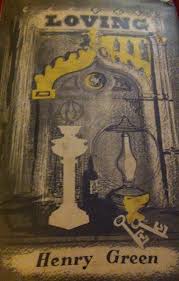
‘Loving’ by Henry Green

loving_henrygreen

229 pages, 1945 (my version 1965)

Apparently Time magazine listed this book as one of their ‘100 Best English-Language Novels from 1923-2005’.  I must admit that I had never heard of it, or the author, until Lisa wrote a glowing review of Loving several days ago.  “Goodoh!” I thought,”a book set in an Irish Country House during WWII – that’s the book for me!” anticipating a mixture of Elizabeth Bowen, Sarah Waters (as in The Night Watch) and Molly Keane.  I have to admit to being disappointed.

Eire was neutral during WWII, and so those Irish with loyalties to Britain had mixed feelings about their place in the war: aware of the Blitz and the hardships suffered across the sea; relieved not to be part of it; guilty that they felt such relief; fearful of the Germans and fearful of the Irish Catholics who would not resist a German invasion.  There’s a sense of ‘meanwhile’ and unreality that pervades the book, with the war going on ‘over there’, heightened further when Mrs Tennant, the mistress of Kinalty, a large Irish Country house, leaves the servants to keep things going while she slips over to England to visit her son. In her absence, in spite of coal rationing,  the servants (most of whom are also English) relax in front of the fires roaring in the grates to keep the pictures on the wall in good condition.  They eat well; they play hide-and-seek in shut-up wings of the house that enclose rooms built as reproduction Greek Temples, and they loiter around the dovecote built as a miniature Leaning Tower of Pisa.

Nothing much happens in this book.  There is a lost ring, jealousies and spitefulness between servants, and a love story that emerges probably more from proximity, convenience and lack of other opportunities than any great sweeps of passion.  Those ‘upstairs’ are vapid, languid and hypocritical, and probably more reliant on the continued employment of their servants than the servants are themselves.

To be honest, I found the book really hard to follow.  I thought that perhaps it was because I was reading it last thing at night after some fairly draining days.  The dialogue is rapid-fire, and there is much of it, often without identifying the speaker.  Scenes would change from sentence to sentence, without even a paragraph break, and there are no chapters to speak of- just a slightly larger white space on the page. It brought to mind a radio play, where the listener has to do the work in distinguishing one character from another, and there are no visual cues to a change of setting or speakers.

But then I started to wonder if the writing itself was just bad.  Take this paragraph, for example, which I had to re-read several times (and yes, I have checked that I haven’t omitted any words or punctuation):

When a few days later as she lay in bed Miss Swift was paid a call by Miss Burch she was able to cut short the thanks having expressed what was necessary on the first of two visits of sympathy Miss Burch had already paid. But on the subject of her symptoms she left nothing out.  (p. 118)

I found it quite hard to distinguish the characters, who seemed to come in pairs, and having two characters called Albert only added to the confusion.  It was all rather a muddle to me.  Nonetheless, many others including Rachel at Booksnob, Lorin Stein at the Los Angeles Review of Books,  Sebastian Faulks is a big fan,  A Penguin a week liked it and there are several links on Stu’s Dad’s blog as park of his Henry Green Week that alerted Lisa who alerted me!

But I’m not completely alone: Lit Matters didn’t think much of it, and there were both glowing and dismissive reviews on Goodreads.

However, I must admit that after reading a truncated chapter of The Big House: Reality and Representation through Google books, there are symbols and observations here that I missed completely.  I don’t think, though, that I want to re-read the book to admire them better.

My rating: 6.5/10

Sourced from: La Trobe University Library

Read because: Lisa at ANZLitLovers wrote a review that interested me.

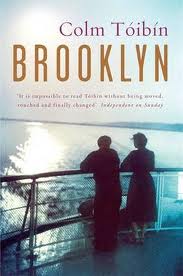
‘Brooklyn’ by Colm Toibin

brooklyn

2010, 320 p.

There are spoilers in this review

There used to be an online bookgroup called “Who chose THIS book?”, the wail set up after a bookgroup has read a book that members didn’t like much.  When I met Kay from my bookgroup in the supermarket, she didn’t have to ask the question because everyone knew that, yes, I had chosen this book.  And no, they didn’t think much of it.

I had heard good reviews of it and had read Toibin’s “The Master” about Henry James.  I must confess to getting mixed up between Colm Toibin and Colum McCann (whose book This Side of Brightness I absolutely loved) so, yes, perhaps I was confused when I selected this book.

Personally, I didn’t think that it was too bad.  It is set in the  dank, depressed 1950s in Dublin when young Eilis is encouraged by her older sister Rose to emigrate to Brooklyn where there are more employment opportunities.  She goes and lives in a boarding house in Brooklyn, finds a job in a department store and gradually overcomes the homesickness that, even though she doesn’t recognize it for what it is, hollows her out.  She meets Tony, an Italian plumber and becomes swept up into his large, impoverished and noisy family.  When she receives sad news from home, she marries Tony before returning.  He fears that she will not return, and so they marry as a guarantee that she will come back.

Tony was right to fear.  Once she returns to Ireland, it is as if she has never left.  Even though she has been changed by the vitality and relative prosperity of America, bit by bit it all drops away from her as she slots back into the social life of the village.  Employment seems to find her this time (with the help, perhaps, of her mother who wants her to stay), and she starts going out with Jim Farrell.  No one knows that she is already married to Tony, back in Brooklyn.

The book is told in a very Henry Jamesian fashion.  There is no back story; small events are told simply and in detail; every little act is described by a narrator who seems to be hovering up in the corner of the room, watching everything.  There is no interiority, only action, and they are the domestic, quotidian small actions of ordinary life.  In spite of this- even perhaps because of this?- I found myself swayed, just as Eilis was, by the slow unfolding of a good-enough life.  At first I was angry at her family and friends at home for wanting her to stay in Ireland: by the end of the book, I didn’t know whether she should leave or not.  I felt sad no matter which way she moved.

So, even though I enjoyed the book and was moved by it, certainly the rest of my bookgroup didn’t feel the same way.  It was too long, they said; nothing happened, they said- and both these things are true.  But “who chose THIS book?” Well, I did.  Given another chance, I might not have chosen it for a bookgroup, but I’m glad that I read it for me.

My rating: 7.5/10

Sourced from : Council of Adult Education book groups

Read because: I had read good reviews (and I got a bit confused….)

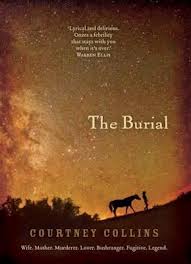
‘The Burial’ by Courtney Collins

theburial

2012,  288

One of the fundamental and potentially riskiest decisions that an author makes is the narrative voice that s/he adopts to tell the story.  It doesn’t come much riskier than this:

Morning of my birth, my mother buried me in a hole that was two feet deep. Strong though she was,  she was weak from my birth, and as she dug the wind filled the hole with leaves and the rain collapsed it with mud so that all was left was a wet and spindly bed… I opened my mouth wide to make a sound, but instead of air there was only fluid and as I gasped I felt my lungs fold in.  In that first light of morning my body contorted and I saw my own fingers reaching up to her, desperate things.  She held them and I felt them still and I felt them collapse.  And then she said Shhh, shhh, my darling. And then she slit my throat.

I should not have seen the sky turn pink or the day seep in.  I should not have seen my mother’s pale arms sweep out and heap wet earth upon me or the white birds fan out over he head.

But I did.  (p. 9)

A newborn baby as narrator rather does your head in if you think about it too much.  In Courtney Collins’ hands, though, the baby-narrator can see all things, know all things, and be as one with the sky, the earth, the universe.  It also frees the author for some beautiful, lyrical writing that would perhaps be too baroque and overwrought otherwise.

The Burial is based on the true-life story of Elizabeth Jessie Hickman, a bushranger who ranged around the Wollemi area in the 1920s.  A ‘wanted’ poster (which I assume is authentic??) for here can be seen here  and a brief account of her life by her granddaughter can be found here.  Both in fact and in this novel, Hickman was a circus performer, cattle rustler and rider.

This post about the real life Jessie Hickman here mentions her marriage to the brutal Fitz, thus opening up the space for Collins’ story as Jessie escapes Fitz into the bush.  She is pursued by many men, chasing her for many different reasons: her Aboriginal lover Jack Brown, the opium-addicted Sergeant Barlow, and the violent gun-happy posse of local farmers bent on revenge and punishment for the theft of their cattle.  The feeling of them closing in on her drives the narrative, and it comes almost as a shock when the baby-voice narrator interposes itself again.

Collins has many balls in the air here: the dead but all-seeing baby, the circus back-story, a somewhat superfluous story of a cattle-rustling gang that she joins with in the folds of the mountains, an encounter with a Chinese prostitute and a love story.  While they were perhaps necessary to the knitting together of the plot, just the escape and the flight would have been enough for me.

This book has been likened to Cormac McCarthy’s work (indeed, the  frontcover is rather McCarthy-esque) and was eagerly anticipated after acclaim in its manuscript form.  I can see the parallels with McCarthy, but what I liked in this book was the theme of thwarted maternity- both Jessie’s own and that of the few women she meets- and that’s something you don’t get in McCarthy, whose books explore masculinity so well.

A rather petty quibble: I was irked by the author’s name on the top of each left-hand page.  Whose decision was that, I wonder? Possibly not the author’s. It made me feel as if I were reading someone’s homework.

This book was shortlisted for the Stella and the NSW Premier’s Award under the UTS Glenda Adams category for new writers.  It has been optioned for a film, and I can certainly see how easily it would translate to the screen as it is already composed of a series of ‘shots’- a technique that I’m not particularly fond of and which betrays, I think, an author’s difficulty in wrangling the disparate elements of a  story  into a flowing narrative.

And what about that baby as narrator?  Well, I think that the gamble paid off. It liberates her to write lyrically and, given that I often only take a broad-sweep memory of a book with me, I think that it makes the book stand out.  I’m not sure that she sustained it throughout- or even if I would have wanted her to have done so- but it was a brave move and one that this new author handled well.

My rating: 8.5 /10

Sourced from: Yarra Plenty Regional Library

Read because: it was short-listed for the Stella and I want to use it as one of my Australian Women Writers Challenge reviews.

awwbadge_2013

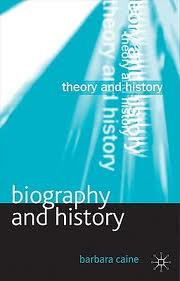
‘Biography and history’ by Barbara Caine

caine

2010,  124p & notes

This is only a small book and would have fitted well into that ” Very Short Introduction to ….” series put out by Oxford University Press.  As it is, it is part of Palgrave Macmillan’s series on ‘Theory and History’ which aims at introducing undergraduate students to themes like transnationalism, gender, narrative, postmodernism etc. and history.   It is very clearly written, and while the experience of reading it is enhanced if you are familiar with some of the biographies that she describes (as I am) , it stands in its own right as a review of the methodological and narrative questions raised by the relationship between history and biography.

Barbara Caine was Professor of History at Monash University and is now at the University of Sydney.  Many academics working in biography come from the literary studies area, rather than history.  Her projects and publications testify to her long and deep experience with biography, autobiography and history, and the ways to approach an individual life as an exercise in historical methodology. Continue reading

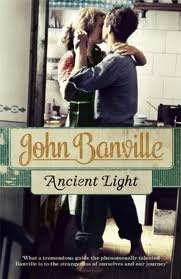
‘Ancient Light’ by John Banville

ancientlight

2012, 245 p.

To be honest, I wonder if I’m clever enough to read John Banville.  I’ve read other books of his and admire his smoothness, his archness, his reflexivity and most of all, the control he has over his writing.  It seems that recently I’ve been reading books which, though enjoyable, are a bit flabby and undisciplined.  Banville’s neither of these things.   I’m increasingly feeling that transitions are the litmus test of good writing, and Banville can shape up a long chapter and switch between time periods and plot lines almost without you noticing. He’s good.

There are two main narrative lines in this book.  The narrator is Alexander Cleave, in the autumn of his acting career who has unexpectedly been called up to make a film “The Invention of the Past” about Alex Vander, based on a script written by J. B.  He is rather flattered and surprised to be approached for the part, but his mind is really not on the film.  His adult daughter has committed suicide some time earlier and he can hardly bear to think about it, so his mind skitters off to other thoughts.

Instead, he reminisces about the affair he conducted as a teenaged boy in a small town in 1950s Ireland with his best friend’s mother.  He calls her Mrs. Gray throughout the book, as they indulge in furtive couplings in the laundry and in the midst of the fug of domesticity, and in a rundown cottage in the woods.  You know that they are going to be caught eventually: he tells you as much, and so each time he goes back to describing the illicit gropings and the fervent pumpings, you feel quite nervous for them both.

Banville switches between the two narratives quite effortlessly, while undercutting your faith in the fidelity of the narrator’s memories.  Alexander himself admits that the memories are probably wrong: he has the impression that it was raining during a particular event when he knows that it was a hot and dusty day instead; the details are somehow skewed in his memories and he can’t quite work out what’s wrong with them.  Banville has been leaving hints throughout the book that Alexander can’t be trusted, and finally when Alexander mentions Gary Fonda in The Grapes of Noon I eventually acknowledged that, despite his urbane demeanour and smooth narration, Alexander is a very unreliable narrator.

But that’s not the only thing that made me feel rather stupid in reading this book.  His daughter’s suicide was obviously fundamental to the story, and yet it seemed such an underdeveloped plot line.  In the back of my mind I had something about Cass and a suicide into the ocean below a castle…and Alex Vander, he sounded familiar…  Was there something that I should know that I didn’t?

Well, yes.  This book is actually part of a trilogy and I’ve even read the other two books without realizing that they were all related!!! In fact, I didn’t realize it at all: I had to read it in reviews of the book by people who are obviously more astute than I am. The allusions to the other books and the reflexivity on Banville’s own performance as a writer and puppet master were being piled up higher and higher at the end of the book- and because he is the brilliant writer that he is, they didn’t  sink the whole endeavour as they would in less skilled hands.

Then there’s the vocabulary! I’m no slouch vocabulary-wise but I’d never heard of ‘brumous air’ ‘caducous leaves’ etc. etc. I started writing them down to look up later, but there were too many.  Doesn’t matter- it’s good for me to realize that someone has a vocabulary that far, far outstrips mine.  I wonder if Banville actually has those words in his consciousness all the time, or whether he’s playing a game of word one-upmanship here.

So, while this book made me feel rather abashed and stupid when I finally realized what was going on, I did enjoy it.  The story of the obsession and selfishness of young love stands on its own two feet and doesn’t even really need the other Alexander/Alex Vander  thread at all. Ah, but then it wouldn’t be a Banville, would it?

My rating: 9/10

Sourced from: Yarra Plenty Regional Library

Read because: I wanted to read a book with chops.

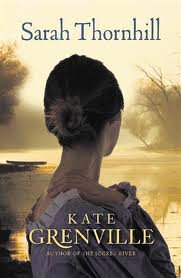
‘Sarah Thornhill’ by Kate Grenville

sarahthornhill

2012, 304 p.

An author writing a book that is part of a series has to write for two audiences.  The second and later books of a series need to stand alone for readers who are coming to it without having read the other books, and yet those who have read the other books will look for, and hopefully find, larger themes that carry across the work as a whole.

Sarah Thornhill is the final book in what is known as Grenville’s ‘Colonial’ Trilogy.  It picks up the story of William Thornhill that Kate Grenville explored in the first of the trilogy, The Secret River, published in 2005.  William Thornhill, a lighterman on the Thames had been transported to NSW in 1806 for theft, and after his sentence had  been commuted ‘took up’ land  on the Hawkesbury River, with all the consequences for the original inhabitants that such an innocuous term as ‘took up’ elides.

The second book of the trilogy, The Lieutenant  steps even further back in time to the years immediately following the First Fleet, which arrived in 1788. It is based on William Dawes, the astronomer, and his friendship with a young Aboriginal girl, Patyegarang.

This final book in the trilogy returns to the Thornhill family and is told by Sarah Thornhill, William’s youngest daughter who was born in 1816 in the colony as a ‘currency lass’.  She knows no other home

They called us the Colony of New South Wales.  I never liked that.  We wasn’t new anything.  We was ourselves. (p. 3)

This sense of this new, native-born generation of British Australians being ‘themselves’ is captured beautifully in this book.  John Molony has written about this generation in his book The Native Born (Google preview here) and  it is examined in Portia Robertson’s work The Hatch and Brood of Time.

One of the real triumphs of this book is the narrative voice that Grenville has crafted in her character Sarah.  She is illiterate but quick, and her voice is ungrammatical and conversational.  It is not an act of ventriloquism like Carey’s True History of the Kelly Gang, but instead she echoes the cadences and slips of the spoken conversation of an unlettered woman, talking to someone she knows well.

At heart, it is a love story.  Sarah grows up alongside and loves Jack Langland, the son of a white man and an aboriginal mother who is marginally accepted by the white settlers in the surrounding district.  But when Sarah, as a white woman, declares her love for Jack, she runs into the intolerance and cast-iron proprieties of white society and the relationship ends abruptly.  Heartbroken, she marries  the settler John Daunt as a second-best, and gradually comes to love him.  If the book does nothing else, it tells this story well.

But Grenville has another purpose in this trilogy as well.  She has clearly identified ‘reconciliation’ as one of her driving passions in her life as well as in her writing, and I think that it’s the theme that holds the three books in this trilogy together.  The first book grapples with the question of how a good man does terrible things; the second wonders whether there wasn’t another way; this third asks, what can we do if it can’t be mended.  Sarah (and Grenville’s?) answer is to tell the story; say what you know.

How will I ever find a way to tell everything that brought me here?…Of those things left undone that ought to have done, and those things done that we ought not to have done?

Rippling away into all those lives, down along the fathers and daughters and granddaughters. Generation after generation, the things joining us and the things cutting between us.  All made by something done so long ago….If there was anything I could do to mend things, I’d do them…. I’m never going to be able to tell what it was all about… I can only tell what I know. Cruelties and crimes, miseries on every side.  But of all the crimes done, the worst would be to let the story slip away.  For what it’s worth, mine had best take its place, in with all theothers (p 313, 304)

If you follow the public conversation about the nexus between Australian literature and Australian history at all, you will know of the controversy over The Secret River  between Grenville as author and the historians Inga Clendinnen and Mark McKenna.   Grenville’s take on the controversy can be found here on her own website.  She notes in the introduction that she had previously removed this response from the site, but was constantly asked for copies of it.  So, at the risk of giving oxygen to it again, she replaced it on the site.

I do not at all have a problem with authors having a larger message, a deeper purpose, or a moral, political and intellectual impetus for driving for their work. I do have a problem, though, when it warps the logic of the narrative, and I think that this happens here.  Quite simply, I found the ending of the book implausible in terms of the range of behaviours open socially to the characters in the mores of the time and  I was not convinced by the drive that impelled their action.

Nor do I completely believe Grenville’s insistence that the beat-up belongs in oblivion.  In a cheeky little ‘last word’ right at the start, she has an epigraph.

It does not follow that because a mountain appears to take on different shapes from different angles of vision, it has objectively no shape at all or an infinity of shapes.

And where does this come from?  None other than E. H. Carr’s What is History? p. 21.

Some other responses I’ve enjoyed.

Marilyn at Me, you, and books.  http://mdbrady.wordpress.com/2012/07/31/sarah-thornhill-by-kate-grenville/

Lisa at ANZLitLovers  http://anzlitlovers.com/2012/03/25/sarah-thornhill-by-kate-grenville/

Alison Ravencroft’s Meanjin article http://meanjin.com.au/articles/post/the-strangeness-of-the-dance-kate-grenville-rohan-wilson-inga-clendinnen-and-kim-scott/

My rating: 7.5 /10

Read because: it was my book group’s selection for March 2013.

Sourced from: CAE book groups

awwbadge_2013

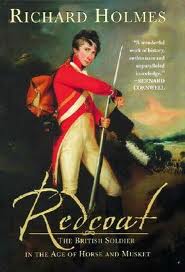
‘Redcoat’ by Richard Holmes

redcoat

422 p. & notes, 2001

I spent all of Anzac Day and most of the following day reading about soldiers.  Not Australian ones, but British ones.  I was originally spurred to read this book by a question in my mind about the wives of officers in the British Army, but I then realized that British regiments have been just off-stage in the three British colonies that I’ve been studying (Upper Canada, British Guiana, New South Wales).  In fact, they’ve been ON the stage all along but I just haven’t been looking there.

Richard Holmes is one of my favourite biographers- as you can tell here and here. This book, however,  is written by the OTHER Richard Holmes- the military history one (who died in 2011) .  But his opening page certainly started well, and could well have been written by ‘my’ other literary-biography Richard Holmes:

He has not shaved this morning.  And from the look of things he shaved neither yesterday nor the day before.  Ginger stubble sprouts from a sun-tanned face, with red-rimed blue eyes and a mouth whose teeth stand anyhow, like a line of newly raised militia…. His name is Ezekial Hobden, Hobden to officers, NCOs and most private soldiers but Zeke to a favoured few….(p. 3)

Military history is most definitely not my favourite genre.  I dislike the deference, the lionizing of ‘great’ men,  the pernickity attention to details about battles and uniforms and regiments,  and the “well done those men!” tone of it all.  But as Holmes says in his preface

This is not a book about great, or even non-so-great generals, though both feature in it from time to time.  And it is not about battles either, even if we are rarely very far away from them.  Instead, its concern is for the  raw material of generalship and the pawns of battle, the regimental officers and soldiers, (and their wives, sweethearts and followers of a less defined and sometimes rather temporary status) that served in the British army in a century when it painted the world red. p. Xv.

Holmes makes no secret of his admiration for the British Army- he even declares his love (and he uses that word) for  “its sheer, dogged, awkward, bloody-minded endurance.”  The army he describes in this book existed with relatively little change between 1760 and the eve of World War I.  It had two functions: the continental one, with an emphasis on formalism in drill and dress and the scientific aspects of warcraft, and a colonial function where practicality outranked precedent, and dress and discipline were looser.  It is this colonial British Army that I have been encountering in my studies without quite acknowledging it.  Holmes examines both threads of the British Army, both at home and in deployments in the American War of Independence, the Peninsular campaign, in India and particularly the Indian Mutiny and finally in the Crimea.

His emphasis is on the experience of the officers and soldiers of the British Army, rather than the battles as such.  He speaks of recruiting,  food, clothing, camaraderie, punishment, equipment, wounds and drunkenness.  It is a particularly human account, with only one section on weaponry and its use in battle that had me squirming a bit and wondering why I was reading it.  He relies heavily on memoirs from soldiers of all ranks and campaigns, and there’s humour in there, alongside the waste, the waste, the waste.  We meet several of his soldiers again and again in different chapters- perhaps he could have had an appendix at the end to remind his readers of who they were when you met them again. But perhaps they’re better left as living, talking men in their memoirs, rather than a cut-and-dried obituary.  In fact, he says something like this in his closing pages:

There are moments when a memorial has come as an unexpected shock, for the man it commemorates has featured prominently in the memoirs that have formed so much a part of my working life for the past two years and, ridiculously, I know, it is hard to think of him as being dead. (p. 420)

This is a strangely emotional book for a military history with  humour and love written into it.  I enjoyed it a great deal.

‘Sufficient Grace’ by Amy Espeseth

sufficientgrace

2012, 322p.

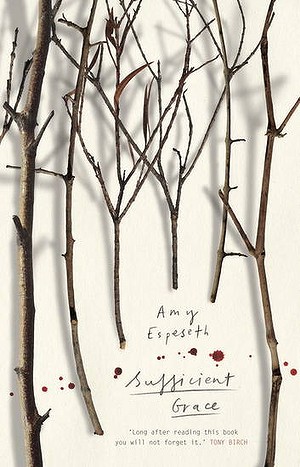
The cover of this book is well chosen: stark twigs against whiteness, tracked with blood.  The novel is set in the deep frozen woods of Wisconsin, where the narrator 13 year old Ruth lives in with her extended family in a Pentecostal fundamentalist community.  There are secrets and sin in this community, and the children of the family are victims and increasingly, co-keepers of these secrets.

Although the book is set in the recent past where young girls can wear moon-boots and  attend the local school, theirs is a claustrophobic, simple life without television and consumer goods, resonant of a nineteenth century existence.  Hunting, fishing and farming are fundamental to their lifestyle, and they are closely attuned to the passing of seasons and their relationship with the food they eat- the changes in the ice, the viscerality of hunting, the harvesting and husbandry of the earth.  The family live close by to each other and worship together, with the exception of Uncle Peter, who is estranged from the religion that binds the rest of the family together in such suffocating ties.

The narrative is set over five months, with each month forming a separate section of the book and it is told in Ruth’s voice and from her perspective.  Ruth is a watcher, hiding in cupboards and under tables, and while in a way she sees much more than her religion-blinded relatives, she also does not completely understand what she is seeing.  As readers, we see before she does.  Her narrative is supplemented by the  hymns that shape her world view, and their simple God-based certainties of their lyrics highlight further the sweaty, murky fug of human relationships inside cabins and barns, with the stark and chilled landscape outside.

This is a layered world, with fundamentalist Christianity laid over an earlier dalliance with Amish religion; with Native American and Norwegian heritage lying underneath as well.  Ruth’s cousin Naomi has been adopted from the nearby Native American mission and Ruth’s grandmother too has Native American heritage that her children largely ignore, covered as it is by her deep religious faith.

I was very impressed with the sheer confidence with which this book is written.  Much of this might spring from the author’s own life, which largely mirrors Ruth’s experience. Her descriptions are poised and beautiful, and in her creation of Ruth’s voice she combines the majesty of the King James Bible and the shy, naive knowingness and yet innocence of a young girl approaching womanhood, uncomfortable in her body, and already blinkered to other options in the world outside.  The title is taken from Corinthians 12:9

And He has said to me, “My grace is sufficient for you, for power is perfected in weakness.”

This is not an amazing grace; instead it is a stripped down one- merely sufficient. The biblical reference is apt because at its heart this is a story about power and weakness.  At times the biblical allusions threaten to engulf the story- the Ruth/Naomi pairing; Samuel as the much wanted child and prophet etc- but there is enough weight in the descriptions of landscape, the all-encompassing faith and the murkiness of sin to balance the biblical metaphors out.

This book won the Victorian Premier’s Award for an Unpublished Manuscript in 2009, long listed for the Stella Prize and  short listed for the UTS Glenda Adams Award for New Writing.

My rating: 8.5/10

Sourced from: Yarra Plenty Regional Library

Read because: it was long-listed for the Stella.

awwbadge_2013