Category Archives: Book reviews

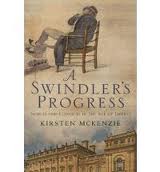
‘A Swindler’s Progress’ by Kirsten McKenzie

Image

2009, 303 p. & notes

A couple of weeks ago I thought that I had finished the best book that I would be reading during 2013.  I was premature in my declaration.  This is the best book that I have read this year, and in this case, I have no qualms at all about the  behaviour of its author as a professional historian.  Kirsten McKenzie’s earlier book Scandal in the Colonies is one of the books that has shaped my approach to my own research.  Her portrayal of colonial life in the early nineteenth century as a criss-crossing of networks and connections between different colonies across the globe rings true for ‘my’ judge and the other officials that he encountered during his career, as a quick glance through the Australian Dictionary of Biography will attest.  She writes clearly, with humour, and interweaves human stories into a robust and insightful theoretical framework.  She’s the sort of historian I wish I could be.

In fact, as she explains in the epilogue,  it was her concern as a professional historian with the accuracy of her footnotes just as Scandal in the Colonies was about to roll off the press that brought her to writing this book.  As part of the History Wars of the Howard era, Keith Windschuttle challenged the historiography of aboriginal/settler conflict, largely on the basis of the accuracy of footnotes.  Like many historians, I should imagine, McKenzie became increasingly “twitchy” (as she puts it) over her own footnotes, and so, suffering “footnote paranoia”,  she returned to the story with which she opened Scandal in the Colonies and found it even more fascinating than when she encountered it the first time.  It was the case of  the putative Viscount Lascelles – in reality, the implausibly but actually named John Dow- a convict who served out his time in Van Diemen’s land after being transported for swindling using yet another false identity. On the expiry of his sentence, he traversed the NSW interior, claiming that he had been commissioned by the Secretary of State to inquire into the proper treatment of assigned convicts.  He claimed that he was the eldest son of the second Earl of Harewood- a claim haughtily denied by the Earl back in England whose eldest son, in fact had been disinherited after making a series of disastrous liaisons. As part of his ruse as Commissioner of Inquiry, ‘Viscount Lascelles’/John Dow eloped with a young woman and ended up in the Sydney Supreme Court in an unsuccessful attempt to rescue her from her parents who had reclaimed her, only to see her married some time later to the nephew of the future Chief Justice Dowling who heard the case. He was subsequently returned to the Supreme Court after his deception was discovered- where, yes! he encountered ‘my’ Judge Willis!  In Scandal in the Colonies, the anecdote takes less than two pages. In A Swindler’s Progress it effortlessly fills 300 pages.

The distance and dislocation of the colonies gave scope to false identities and reinventions.  There are many famous ones both in literature and in real life: Robyn Annear’s book The Man Who Lost Himself about the Tichborne Claimant springs to mind. But this book is much more than the story of an antipodean imposter. McKenzie shuttles between the real Earl of Harewood and his son, bringing in parliamentary politics in 1807, West Indian plantation ownership, elopements and disinheritances, and the imposter son Viscount Lascelles and his deceptions in England, Scotland and New South Wales.  The real skill of her book is integrating the two stories, on opposite sides of the globe to explore the way in which the British world was convulsed in this period by debates about identity, wealth, demeanour and masculinity.  Note that it is “the British world”- an arena which interweaves both metropole and peripheries as a conceptual transnational whole:

As I began my hunt for Dow and the Lascelles, scholars of empire were calling for histories that recognised that developments in British and colonial societies were part and parcel of the same process.  The problem was: how to write it? How could this miracle of synthesis be achieved in anything like a readable manner?  How could you show it was happening? And how could you show what it was like to be caught up in these interconnected events?  Here I had the story of two men: of one who had come to vanish, and another who had stolen that identity to pursue his own ends.  But their fates were part of far bigger events. (Epilogue, p. 296)

Her earlier book Scandal in the Colonies is a tapestry of such stories, woven between Sydney and Cape Town between 1820 and 1850.  It has many theoretical insights that make you stop, reread, and realize that things are falling into place.  In this second book, she makes this theory come alive as she meanders along a story that crosses years and oceans, looping back on itself, with deceptions and evasions and disappointments and anxieties in multiple settings.  It is not necessarily a straightforward chronology, first in one country, then the other, although the structure of the book does support this rather simplistic approach.  The book is far more discursive than this, stopping to explore phenomena and events only tangentially connected with the main narrative thread. It is far more a ‘life and times’ of a phenomena than a biography of Lascelles in both his authentic and false identities.

Her epilogue betrays a slight defensiveness about her use of narrative to explore these all-too-human responses in the face of sweeping social change:

Is narrative simply a way for historians to smooth over the mess that is the past; to re-arrange it into comfortingly familiar patterns that have beginnings, middles and ends?  and yet, for all our scholarly suspicion of the neatening effects of stories, they still possess a powerful explanatory energy.  What was it like to be buffeted by those forces that were transforming so profoundly the British imperial world in the late eighteenth and early nineteenth centuries? Those caught up in them would not live their lives according to the synthesising arguments of scholars.  Rather, they would act according to the dictates of narrative and plot: finding opportunities, being thwarted, experiencing greed, hope despair.  To follow these twists and turns is to highlight the way their world was changing.  It is luck and chance and swindles and lies and unexpected opportunities that direct lives and fates. (p.298)

She need not be defensive.  She is a master storyteller who uses the human to enliven the theoretical, and the insights of the scholar enrich her narrative of lives lived with contingency, imperfection and incomplete endings.  This is the best book I’ve read all year.

My rating: A big fat, unequivocal 10

Read because: I enjoyed Scandal in the Colonies so much and I can reassure myself that at least I’m reading about the 19th century British empire this time

Sourced from: my shelves- a Christmas present from my husband in 2009.  Hmmm…… it took me a little while to get round to reading it.
awwbadge_2013This will be, I think, one of my last postings to the Australian Women Writers Challenge for 2013.
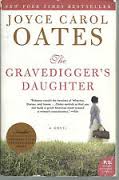
‘The Gravedigger’s Daughter’ by Joyce Carol Oates

gravediggersdaughter

2007, 582 p.

There are not many authors whose novels listed on the inside pages take up two pages- and they’re not even all listed there!  Joyce Carol Oates is an amazingly prolific American writer: she has over 117 books (novels, essays, poetry) under her belt.  I like her.  I’ve read several of her books both under her name and under pen-names and I’ve always found her a good, if disturbing, read.   But I’m not so sure about this one.

A young woman, the daughter of an abusive man meets a stranger on the canal path.  “Are you Hazel Jones?” he asks.   She wasn’t Hazel Jones then, but she was to become Hazel Jones in the future after marrying  an abusive man of her own.  Embracing this new identity, she leaves behind her own family life, her liminal status as a refugee and her unhappy marriage to become a woman she had never met and possibly never existed.

The story is based on Oates’ own grandmother’s story, which is rather a departure from her usually rather gothic and event-driven plots.  Perhaps that’s why I didn’t particularly warm to the book. Even though she has written books based on real-life characters (Blonde, for example, is based on Marilyn Munroe), her reason for creating her Rebecca Schwarts character is emotional rather than narrative.  I wonder if she was hamstrung by a commitment to honour her ancestral connection instead of letting her rather vivid and convoluted imagination take flight to enrich the book enough to carry it through nearly 600 pages.  Quite frankly, not a lot happens.  The ending, based on a chapter published in a magazine as Oates is wont to do,  seems completely disconnected with what has come previously and just sits there, resolving nothing.

All in all, rather disappointing.

My rating: 6/10

Sourced from: Yarra Plenty Regional Library, then La Trobe University Library when I was not able to renew it because I’d taken so long to read it!

Read because: I felt like a long, meaty read and I’d enjoyed JCO in the past.

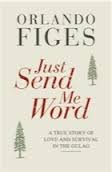
‘Just Send Me Word: A True Story of Love and Survival in the Gulag’ by Orlando Figes

figes

 2012, 303 pages & notes.

For someone who should be deeply immersed in nineteenth century colonial history, I seem to be spending rather a lot of time in twentieth century Stalinist Russia.  I was there a few weeks back with Sheila Fitzpatrick, who gave an outsider’s view of living and studying in Moscow during the 1960s, and here I am back again.  This time, I’m in the company of insiders – people who could not in any way be described as dissidents, who  lived and died in Russia- but one of them,  Lev Mischenko, became a physical outsider when he spent eight and a half years on the extreme edge of Russia in one of the gulag camps in the Arctic Circle.

Orlando Figes- where do I know that name?  I’ve read some of his books before: Natasha’s Dance and A People’s Tragedy.  In this book he brings his deep knowledge of Russian history and society to contextualize the archive of almost 1300 letters that were written between Lev and his partner Svetlana Ivanova while he was imprisoned in the gulag, working in the wood-combine generator that powered the timber works in the frozen forests at Pechora Labour camp.  Figes does it well.  There are maps, photographs, explanations and he explains not only the minutiae of labour camp life, but also the sweep of Soviet politics on the outside during the time that Lev was imprisoned.

But the real, real strength of this book is Lev and Sveta’s story, and the beautiful, nuanced, tender letters that they shared over this time.   They met at university and went out together for three years.  When war was declared, he rushed to enlist but was soon taken captive by the Germans.  He was able to speak German, and as a prisoner-of-war, used his linguistic skills to translate camp orders.  When the prisoner-of-war camp was liberated, he was arrested almost immediately  and falsely accused as a ‘fascist collaborator’.  The trial was a farce, he was tricked into a confession, and sentenced to ten years at Pechora.  For the first few years, he struggled silently to survive in the cold and deprivation.  It was only then that he dared to write to an aunt and asked, almost in passing, whether Svetlana and her family had survived the war. Svetlana, who had thought that he was missing in action, wrote immediately on learning that he was still alive.  And so the correspondence began.

Prisoners, on average, were allowed to write and receive one censored letter per month.  And so it seems almost incredible that they could write so many letters, but his relatively favoured position as a skilled engineer in the generator-room brought him into contact with the indentured and free workers who lived and worked side-by-side with the prisoners.  These friends acted as intermediaries and passed their letters to and fro, at great risk to themselves.  I was surprised to learn that people lived and worked in the labour camps by choice, and in this regard, I was reminded of John Hirst’s work in describing a gulag of a lesser sort: the penal colony of New South Wales.  As Hirst explains it, as soon as free settlers were included on the First Fleet, the solely-penal nature of Botany Bay was compromised.   It is just not possible to have free and unfree together without allowances, incentives, slippages and concessions.  And so too, Pechora Labour Camp required some skilled workers and guards, and some ex-prisoners, completely alienated from the world they had left behind, chose to work there for wages after their sentences had expired.

But it was a tenuous and fragile position nonetheless.  Lev’s his greatest fear was that he would be sent into the forests at a moment’s notice to wade in the frozen rivers, pushing logs along the river and loading them onto trains for transport out of the forest.   Even more striking was Sveta’s determination to visit him.   At this point, with the organisation of the logistics of her visit, and the deceptions that she had to practice to hide her trail, I found myself feeling quite sick with anxiety.  I eyed the number of pages left in the book:  was it a good or a bad thing that I was barely half way through?  I don’t want to tell any more.  Their letters, and Figes’ exposition, do it far, far better than I ever could.

But where did I know the name Orlando Figes? I found myself bemused by the rather wooden epilogue, penned by Irina Ostrovskaya, the director of Memorial, the organization that is custodian of this priceless and unique archive.  Given that in a narrative,  the epilogue is often the emotional touchstone of the whole book, it struck me as odd that it would be turned over to such a stilted and redundant piece of writing.  Then, on reading some reviews of the book, I remembered where I knew the name Orlando Figes.  It seems from this Guardian article that this book has been attended by controversy as well. I wrote about it here.

“No one knows what to do with you… Professor Figes” wrote Maria Tumarkin in her 2011 Meanjin essay (available here), and I must admit that I don’t know what to do with the knowledge of the academic murk that swirled/swirls? around his reputation either.   These letters don’t need an academic to introduce or explain them: they stand strong as beautiful literature and testaments to love and humanity in their own right.  That said, I believe that they have been enhanced by Figes’ contribution.  But then, academic integrity is a hard-won and cherished attribute.  The academic world can be unforgiving.  How does a writer gain redemption? What agenda was at play in the inclusion of the epilogue?  I must admit that I don’t know what to think.  I do know that I closed the book and announced “That’s the best book I’ve read all year”.

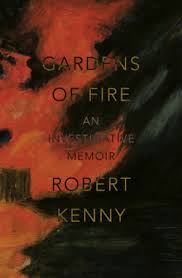
‘Gardens of Fire: An Investigative Memoir’ by Robert Kenny

kenny_gardensoffire

2013, 245 p.

I must confess to feeling silenced by this book.  I finished it about a week ago, and have been turning over in my mind how, and whether, I should respond to it.   I’m proceeding on the basis that the act of publishing one’s writing is, on the author’s part, some form of invitation to engagement and response, and so write  I will, even though I feel inadequate to do so.

Robert Kenny is a historian formerly based at La Trobe University and now at Deakin.  I know him by sight only.  He read the opening pages of the book at a seminar earlier this year, and it seemed that the whole room held its collective breath, not just because of the beauty of the writing but also because of an awareness that we were being offered a perspective from the heart and from the head.

Fire.  When I that that word now I see a crazed red dancer surging up the slope, at whose feet I train the hose of spraying water to no effect.  Its dance mocks me.  As I face it, it has personality.  Wilful. Contemptuous.  It is the enemy at the my gate.  Literally at my gate, for I am standing at the gate of the high metal fence that protects the north side of the house.  I can feel the searing heat on the parts of my face not covered by mask or goggles.  And the flame producing the smoke provides the only light.  A dreadful light.  The wind pushes heat into me.  All there is is this fire and, behind me, my house, and inside that house my cat.  The rest of the world has gone.  (p. 4)

The fire at Redesdale that destroyed Kenny’s house on Black Saturday is told over the first hundred or so pages of this book.  But it is not told as a continuous narrative.  Instead, almost as if it is too painful to touch, Kenny steps towards telling of the physicality of the  fire, then steps back into abstractions – history, philosophy, reflection- before venturing again to try to put into words the experience of being inside the fire.  On one level, I found it frustrating that he was inching through the narrative in this way, but in many ways it reflected his own emotional response to the experience: that it was too hard to face head-on again.

These digressions are not merely distraction, however.  Instead they are the ‘investigations’, as the title suggests, of a well-read, insightful reader and historian as he ranges across European and Aboriginal mythology, colonial history, art, environmentalism and philosophy.   It is an argument, built incrementally, of the relationship between man and fire: that it is fire itself that makes us human.

Halfway through the book, the fire has ravaged and passed on.  The Redesdale fire was capricious, taking one house and leaving another.  Because the township was spared, the fire doesn’t have the public profile of  Strathewen or Marysville, where the whole town was wiped out.  His narrative shifts to the emotional and community aftermath of a fire and runs the gamut of grief, resentment, bewilderment, poor judgment and shaken pride.

Robert Kenny was well prepared for this fire.  A fire nearby some years earlier had shown him how quickly this grassland could catch, and he kept a whole fire-fighting kit beside the back door in readiness.  When I recall how oppressively and drainingly hot Black Saturday was, I can only admire his foresight and discipline in dressing himself in long trousers, woolen socks, heavy shirt, jumper and beret before venturing out with the pump and hose that was to let him down so badly.  When I see footage of people dwarfed by flames, fighting for their houses dressed in shorts and thongs,  I forget that to be better protected would involve deliberately covering up in heavy clothing before the fire was anywhere near.  My head would tell me I should, but I don’t know that I would have the determination to actually do it before it was too late.

There is bitterness in this book, and it is his anger against the co-option of grief and commemoration by people who lost nothing that makes me feel hesitant to write this response. Do I, as an outsider, kilometres away from these fires, a spectator only,  have the right to say anything here?   I found myself shaking my head in disbelief at the perverse logic that planned a community ‘celebration’ to reclaim fire for good instead of loss, so prematurely amongst people literally seared by Black Saturday.  I shift uneasily at his vehemence against commemoration by the community at large who have lost nothing and yet vicariously appropriated the trauma of Black Saturday for themselves.

This book is also the work of an academic and writer who uses his intellect and knowledge to try to make sense of an experience that is almost beyond words.  In this regard, it reminds me of John Tulloch’s book One Day in July about the London bombings that I reviewed here.  Kenny’s exegesis on the Strutt Black Thursday fire painting  is masterful, especially in comparison with Edmund Capon’s weak and cliched commentary in the recent Art of Australia documentary.  It’s offered as just one of the many  ‘investigations’ that thread throughout this book.  You are very much aware that you’re reading the work of a historian.  He engages with the recent debate elicited by Bill Gammage’s controversial and acclaimed recent book The Biggest Estate on Earth, which challenges the settler fantasy of an untouched country.  He juxtaposes Gallipoli and the multiple commemorations of fire (Black Thursday, Red Tuesday, Ash Wednesday, Black Saturday) as an expression of national identity within place.  He attends conferences; he gives papers; in the midst of his own ruptured world he is awarded the Prime Minister’s Prize for Australian History, among other accolades, for his book The Lamb Enters the Dreaming.  He has the book-lover’s grief for his library and the impossibility of replacing the spatial layout of his book collection and the memories of buying that particular book in that edition.

My books no longer survive. It is as simple as that.  I have no catalogue of what was on those shelves and what I remember is fragmentary.  Even if I could recover in my memory all the titles of those books, and manage to find copies of them all, they would not be the same books, they would not have been the physical things I handled so often over the years, and this is important. Colleagues offer me books they no longer need.  I am grateful, but puzzled- don’t they know how personal a library is? How it is the history of encounters? What would be the point of shelves of strangers’ books? (p. 161)

This is a very human book. He makes bad choices, he responds brusquely and angrily.  He is clear-sighted and yet blinded at the same time.  The fire has burnt off layer upon layer.  I can’t do the book justice. Read it.

A tale of two memoirs

By chance I found myself reading two memoirs concurrently over the last week.  The first, Unpolished Gem was for my bookgroup and the second, The Lucy Family Alphabet was just a bit of fluff to read on nights when I was too tired to read anything else before going to sleep.

I must admit that I’m not completely sure of the difference between memoir and autobiography.  I think of a memoir as being a more consciously constructed thematic work than an autobiography.  A memoir mounts (perhaps a bit strong– suggests?)  an argument and the experiences written about are selected to support the overarching theme that the author/narrator has chosen.  There’s often a central motif that drives the work (gem, alphabets…)  I wouldn’t want to be held too strictly to the distinction between the two, though.

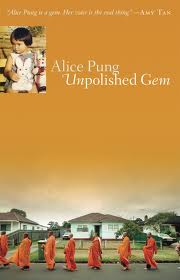
unpolishedgem

Alice Pung: Unpolished Gem, 2006, 280 p.

“This story does not begin on a boat. Nor does it contain any wild swans or falling leaves” announces the blurb on the back cover.  Well, thank heavens for that, say I.  The world certainly doesn’t need yet another Asian three-generation book written by a Westernized daughter.

Alice Pung was twenty-five when this book was published to great acclaim. It tells of growing up in Braybrook as the eldest daughter in a Chinese/Cambodian family who had arrived in Australia in the wake of Pol Pot’s Killing Fields.  Her father owns a nearby Retravision store and her mother is an outworker making jewellery which she sells to retail stores.  Her paternal grandmother lives with them, Alice has several younger sisters and brothers, and there are blood aunts and other nominal ‘aunties’ within the Vietnamese/Cambodian  community in which they live. Interwoven with her own chronology of primary school- secondary school- university there are flashbacks to her parents’ early experience in Australia.  She is very conscious of her status as eldest daughter in a family fighting hard to find their own place in a new society.  As a daughter, she is an ‘unpolished gem’ compared to the highly polished lustre given to eldest sons, and during her final year at high school she suffers a breakdown under the pressure of her own high educational expectations, the drudgery and imposition of looking after her younger siblings, and her own attempt to fit in with her Australian peers and yet remain the ‘good’ girl.

This was the second time that I have read this book.  I had been rather lukewarm about it when I read the first time,  just after it had been published, and I wouldn’t have chosen to re-read it except that it was a bookgroup selection.  I think that I appreciated her writing more the second time around. Her story is told with insight and humour, although I (again) found myself becoming increasingly annoyed at the italicized internal dialogue as she grew older.  Just as I did the first time, I  again thought that the epilogue was clunky and rather too mannered in an attempt to bring what is truly an unfinished memoir to a close, given that the author was only several years older than the self she was writing about in the closing pages.  And so…. to the other memoir.

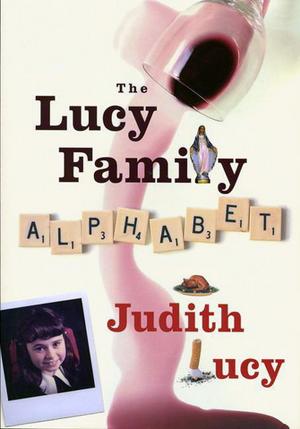
The Lucy Family Alphabet by Judith Lucybook cover.

Judith Lucy: The Lucy Family Alphabet , 2009, 296 p.

I don’t really know why I picked this book up, given that I’m not particularly keen on the comedic persona that Judith Lucy has created.  I must admit that I find the exaggerated, world-weary drawl rather wearing, and the constant mining of her own life for material a little tedious and self-indulgent.  So to willingly subject myself to more seems rather perverse.  On the other hand, the chapters were short (most about 2-3 pages in length) and not particularly chronological, so that I could dip into it at will.

Like all good Alphabets, the book starts off with A…. for adoption, and the chaotic Xmas family dinner at which she learned that she was, in fact, adopted. Normally in a straight autobiography this bombshell would come near the end of the book but she plops it onto the reader in the opening pages, then shuttles back and forth around this revelation, letting the letters of the alphabet supposedly drive the narrative rather than chronology.  The alphabet structure is rather artificial- there are, for example, six letter ‘A’ stories- and although the stories seem random, the longer you stay with the book, the more layered her anecdotes become.  There is more of an ending than just reaching the letter ‘Z’.  And even though the narrative voice is just the same as that distinctive drawling voice you’re likely to hear on a comedy show on the ABC, there’s more than just a string of acerbic, pointed anecdotes.  At times it is poignant and yes- wise (even though Judith Lucy the comedian would probably snort at such a description).

Judith Lucy wrote her book at about the age of 40; Alice Pung would have been in her early twenties.  Can an author write a memoir in her twenties, I wonder? I tend to think maybe not.  Or, rather, even though it might lose its immediacy,  I think that perhaps it would be a better memoir left to marinate for a few decades more.

awwbadge_2013Two memoirs- two Australian women writers.  I must add it to the Challenge!

‘The Ivory Swing’ by Janette Turner Hospital

ivoryswing

1982 (1991 reprint)252 p.

I don’t tend to think of Janette Turner Hospital as an Australian writer. She has lived in Canada and America for many years,  and is claimed in Canada as a Canadian writer- in fact this book won Canada’s $50,000 Seal Award for Best First Novel in 1982.  To be rather petty, even her name doesn’t sound particularly Australian (and it’s not a pseudonym: she married Clifford Hospital in 1965).  She is Melbourne born, and taught in outback schools in Queensland, but moved with her husband to Canada and then America, living at various times in Britain, France and also spent a year in India where her husband undertook study leave.  She’s not particularly part of the Australian writer’s circuit of  literary festivals and writer’s talks, even though she visits Australia frequently in a private capacity.

The Canadian/Indian connection emerges from the pages of this book.  Juliet has married her older, academic husband David partially out of -frustration with the non-commitment offered by her tom-catting lover Jeremy.  With David she shifted to Winston, Ontario as a faculty wife, where she had two children, feeling increasingly oppressed by the small-town life and the weight of expectations of the other faculty matrons.  When David went to India for study purposes, she and the children followed.  Jeremy remains in her consciousness as the road not travelled, always off to the corner as a possible option for another way of living.

In India they encounter the stolidity of patriarchal gender roles and the uncompromising rigidity of the caste system.  In their rented house, Juliet tries to challenge them by including a young servant Prabhakaran as part of her family, and both she and David take an interest (for different motivations) in Yashoda, a beautiful young widow who is at the mercy of her wealthy and tradition-bound brother-in-law Shivaraman Nair.  Juliet’s sister Annie arrives, untrammelled by family and commitments and living the life that Juliet still years for.  Where Juliet and David are wary of blundering in with Western values, Annie is fearless.  All of them, in their various ways, trigger consequences that fall more heavily on others.

This is a very ‘interior’ book, with page after page of internal dialogue as Hospital shifts her attention from one character to another.  I found myself wondering whether I even wanted to be inside these characters’ heads, and the short answer is ‘no’.  The narrative is an insistent voice-over, and as a reader you become so deadened by its drone that when action occurs, you need to stop yourself and re-read to work out what is actually happening.  Hospital’s descriptions of setting are very good and capture well the lassitude and sticky humidity of their environment, and it is mirrored in the pace of the novel as well….slow…very slow.  The imagery of the Ivory Swing is heavy-handed and at times the writing is overwrought.

This was a book-group selection.  One thing about a bookgroup is that you read books that you wouldn’t choose yourself, which can be a good and bad thing.  Many of the books in the CAE catalogue (like this one) are fairly old, which means that they outlast the frenetic marketing merry-go-round of modern bookselling.  I’ve read books that have largely disappeared from bookshops and library shelves (with their rather ruthless culling these days) and been glad to have done so.  But without my sense that I  ‘should’ struggle on with the book as a commitment to my fellow book-clubbers , I probably wouldn’t have finished reading the book. I wouldn’t rush to recommend it.

My rating: 6/10

Sourced from:  CAE bookgroup

Read because: it is our October book for bookgroup.  Who chose THIS book, I wonder?

awwbadge_2013This is a book by an Australian woman writer, so I’ll count it towards the Australian Women Writer’s Challenge.

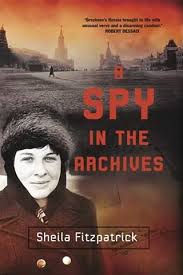
‘A Spy in the Archives’ by Sheila Fitzpatrick

fitpatrick

2013,  345 p.

I have been the first person in my immediate family to go to university, although several of my cousins did as well.  I find it hard to imagine what it would be like to grow up as the child of academics and intellectuals. Part of my fascination with this book was reading about the child of historians becoming a historian herself.  Sheila Fitzpatrick’s father was the left-wing historian and public intellectual Brian Fitzpatrick and her mother Dorothy Fitzpatrick taught history at Monash University.

This book is the second memoir written by Sheila Fitzpatrick, noted Soviet Historian, and now Honorary Professor at the University of Sydney after a long academic career overseas. Her first memoir was called My Father’s Daughter  which, from the title,  I assume explores the generational issue further.

In this second memoir we are taken on the first steps of the author’s academic journey as she travels first to Oxford University to undertake her doctorate in Russian history. Her dissertation topic was Anatoly Vasilyevich Lunarcharsky, the Russian author and politician who was appointed Commissar of Enlightenment between 1917 and 1929.  Her thesis was titled ‘Lunarcharsky as Philosopher  and Administrator of the Arts’ and it ended up being published by Cambridge University Press as The Commissar of Enlightenment in 1970.  It was the stepping stone to Fitzpatrick’s eminent career as a historian of Russia.

It was not surprising that a daughter of Brian Fitzpatrick would be attracted to such a topic, but she claims that “Becoming a Soviet historian wasn’t a foregone conclusion, even with a left-wing father and a bit of Russian” and that from the age of about 13 she had become “less of a true believer in my father’s causes than earlier” (p.7).  Fitzpatrick’s father had died by the time she embarked on her academic career, and yet one senses that she continued to have an intellectual argument with him in her head at least.  The book is not so much a ‘ coming-of-age ‘story , as a story of  ‘coming-as-historian’ as she finds her own mentors and develops her own confident intellectual stance as a historian.

In the 1960s it was common for first class honours students in history to undertake their doctorates overseas, and so she trod a well-worn path. She was not terribly impressed with St Anthony’s College at Oxford and the supervision she received there.  In 1966 she applied for a British Council exchange scholarship to enable her to live in Moscow and to use the archives there for her research. Her application was refused initially but eventually received after she embarked on a rather utilitarian marriage to a fellow British student.  As part of the preparation for her stay in Moscow, she and her cohort of fellow researchers were warned against spies- indeed, against friendships with Russian people, full stop.  Like her fellow students  she ignored this advice, and this book describes her friendship with Igor, a middle-age friend of the now-dead Lunarcharsky, and Irini, Lunarcharsky’s daughter,  that developed as she delved deeper into her research.

This book emerged from a long article that she wrote in the London Review of Books, and you can get the flavour and much of the content from reading this article alone (which is often the case with LRB articles).  In fact, it’s such a detailed article that you barely need to read the book!  I must admit that, with little knowledge of post-revolutionary and Cold War Russia (or at least, I’ve forgotten what I ever did know), I found the content aspects of this article easier to follow than the book.  But it’s well worth going to the book itself because her research is only one facet of her story: it’s also about friendships, authenticity, insecurity in a clandestine world, and history-writing.

She writes of the joy that all historians feel when working in archives, but to her, working in the Soviet archives was particularly pleasurable- in fact, she pitied those British historians who would roll up to the PRO, ask for a file, and have it handed over instantly.  In Moscow, not only was there the challenge of even getting access to the archive,  but once admitted, there were strict limits on what was made available because the thesis topic is treated like a straitjacket.  There’s no chasing off down rabbit holes and false leads and serendipitous rainbows here: if a file was not directly related to the topic as you first conceptualized it, then you couldn’t see it.  Foreign researchers were not given access to catalogues,  so there was no way of knowing what to ask for.  Contact between foreign researchers and  their Russian counterparts was strictly forbidden, and the archivists held enormous power over what you could see and what you could not.  It all became a bit of cat-and-mouse, albeit playing with a cat with sharp eyes and sharp claws that you could not always assume would remain sheathed.

However, one aspect in the book that does not come through in her article is the process of the historian writing a memoir.  She mentions at one stage that one of her husbands had returned the letters she had written to him, in order for her to write this memoir.  She uses the correspondence between her mother and herself as well, triangulating it against the diary that she wrote at the time.  She often says that she cannot remember certain events that are documented, and is often nonplussed to explain things that she had written at the time.  As a result, it is a careful memoir that has a sense of distance between the writer and what she remembers  (or does not remember)  about the events she experienced.

And was she a spy?  In the end the Soviets thought so and clumsily ‘outed’ her, and she herself is not completely sure. She certainly was not an MI6-type spy but, as she admits, it would have been plausible for her to have turned out to be one after all:

Was I, in some sense, a spy? If the Soviets couldn’t make up their minds, it’s not surprising that I had trouble.  I can certainly recognize some spy-like characteristics in myself, starting with my intention to find out everything about Soviet history, including the things that the Soviets wanted to keep hidden.  If a spy is a chameleon who can speak two languages and doesn’t know what his ultimate allegiance is, that partly fits. (p. 342)

I enjoyed this book, and the undercurrent of Cold War tension that runs underneath it. I liked the reflexivity of her writing and the caution with which she treats the memoir genre.  I wish that I knew more about Russia, because I did find the details of her research rather overwhelming at times but not so much that I was ever tempted to give up.  I resisted the temptation to Google, trusting her to take me on the journey, and she did not let me down.

awwbadge_2013I’m posting this to the Australian Women Writer’s Challenge under the History/Memoir/Biography section- and, for this book at least, it fits all three categories!

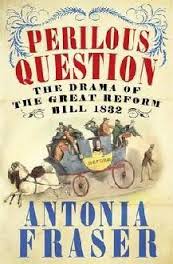
‘Perilous Question’ by Antonia Fraser

perilousquestion

Perilous Question: The Drama of the Great Reform Bill 1832,

2013, 278 p.

By coincidence, I have been reading this book during the week that the world was watching with bemused concern as the American economy seemed as if it were going to jump off a cliff through the single-minded intransigence of the Tea Party wing of the Republican party.  Will they/won’t they? What if..? Surely not?  It strikes me that much the same questions could have been framed by the political commentators after the 1830 election. For as Antonia Fraser reminds us, just as the financial world hasn’t known quite how the brinksmanship in Congress was going to work out, so too those watching the negotiations and brinkmanship over the 1832 Reform Bill didn’t know how it was going to work out either.

I have borne in mind the words of F. W. Maitland, which are at the heart of writing history: ‘We should always be aware that what now lies in the past, once lay in the future’: that is to say, we know the Reform Bill will pass, but the people who fought for it did not (p. xiii)

It was customary that an election be held after a monarch died. In the election held after William IV came to the throne, the Tories, who had been in power for nearly 60 years scraped in with a bare majority.  In a country already heaving with unrest with the Captain Swing riots in the wake of rapid industrialization,  Prime Minister Wellington declared in the House of Lords his trenchant opposition to any reform of the outdated voting arrangements for Parliament.  As a man whose political career  was founded on his military success after the French Revolution, he only had to look across the Channel to France where in the wake of the 1830 Revolution King Louis-Phillipe had abolished the hereditary upper house in 1831.  And so the stage was set:  the House of Lords bitterly resisted any reform that would challenge the personal control of parliamentary seats, but in the House of Commons, amongst the Whigs in both houses, and in the streets and fields outside, the momentum was on for reform.

It took two years, a fall of government, another election, and the threat of the King creating additional peers before  the Reform Bill was finally and grudgingly passed by  the House of Lords.  What followed was a decade of political swings and roundabouts, with governments changing, falling, and resurrecting in rapid succession.  From a colonial Australian perspective, you can see it in the succession of Secretaries of State for the Colonies who came and went in the 1830s and 1840s so often that Governors must have hesitated over addressing their despatches lest the recipient be ousted by the time it was received.

This book marks somewhat of a departure for Antonia Fraser, who is probably more famous for her books on individual French and English royals- Marie Antoinette, Henry’s wives, Mary Queen of Scots etc. (although she has also written on Cromwell, women in 17century England and the Gunpowder Plot). It’s the first of her books to be set in the 19th century as distinct from the 17th, but like all of her other books she looks at individuals within wider political movements.  This book centres on the action in and around Parliament in the two years that it took the Reform Bill to finally pass, and ‘the people’ (a much less threatening description than ‘the mob’) are a shadowy presence outside Parliament.  It’s a book about Lords a-plenty, both Whig and Tory, supported by Thomas Attwood, the middle-class banker from Birmingham who agitated the middling classes, and the so-called ‘Radical Tailor’ Francis Place who kept ‘the people’ as a restless weapon at the ready.

It’s always confusing reading British Parliamentary History because although the titles remain constant, the men who bear them change as fathers die and sons shuffle up the chain of titles to take their place.  So I was startled to read that Earl Grey was an old man when he stood up in Parliament in 1830 to push for Reform- and yet he was Secretary of State in the 1840s- how could this be? – until I remembered that there was a 2nd and a 3rd Earl Grey, and that Howick and 3rd Earl Grey were the same man. I must admit that I hadn’t realized that the House of Commons was such a holding-pen for sons waiting to succeed their fathers in the House of Lords, and that socially, the two houses were so intertwined. There’s many familiar names- Brougham, Lord Althorp (3rd Earl Spencer and Princess Diana’s forebear), Sir Robert Peel, Lord John Russell, Durham (of Canadian history fame), Queen Adelaide (the capital city of South Australia, the wine) and even court reporter Charles Dickens.  Fraser does well to give this huge cast of characters clear identities and a visual image, and if you do forget who’s who, the index is very helpful.

Because the interest of this book is based so much on the debates and tensions in Parliament, it’s a book dominated by politics and individuals.  In this way, it’s quite similar to the journalism that has surrounded the machinations in Congress over the passing of the debt ceiling in the last week.   It’s a book for political junkies of the 19th century, but it has lessons for us today as well. For those of us who want quick fixes through Parliament, it’s a sobering lesson.  When those who hold power are being asked to vote against their own interests (think the Abolition of Slavery, the Reform Bill, putting a price on carbon), things take time.   Change is often incremental, as well.  After all the debating, the pressure, the muffled threats of popular dissent, the Reform Bill of 1832 made only relatively small changes. The number of electors increased from 478,000 to 813,000 out of population of 24 million.  It took two further Reform Bills, then the final acknowledgment of female suffrage after WWI, before universal voting rights were achieved.

The subtitle of the book is “The Drama of the Great Reform Bill”.   For those of us who like reading about politics, it is drama indeed.

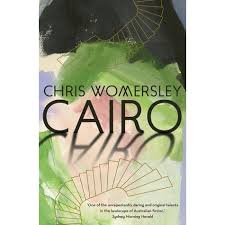
‘Cairo’ by Chris Womersley

cairo

2013, 295 p.

There’s a special pleasure in reading a book set in your own home town.  You recognize streets and places, and you paint them in your mind with the descriptions of weather that any book about Melbourne will provide, because it is Melbourne!  But in this case, my pleasure in reading this book was multiplied because I’ve even been in the flats that give the book its title and also experienced the feeling of other world-ness and even superiority of being in such an exotic, hidden-in-plain-sight place that the narrator of the book describes so well.

‘Cairo’ is located directly across the road from the Exhibition Buildings and Melbourne Museum in Nicholson Street.  You could drive past it a million times and not notice it.  It’s a C-shaped set of two-storey flats that surround a lush, chaotic jungle of greenery.  There are some excellent before-and-after photographs at Fitzroyalty blog.  You can click on the photos below to enlarge them.

We had a friend who lived in one of the units closest to Nicholson Street. It was a tiny flat, although I think that it might have been larger than these ones on real estate agents’ pages here and here.   As it happens, he was an artist as well.  My overwhelming impression was one of light, flooding through the large windows, suffused through the green of the leaves outside. It was as if Cairo was a secret place, with the world rattling past outside, oblivious.

In Womersley’s Cairo this is very much the way that young Tom Button found it too, shifting down to Melbourne Uni from a small country town and taking up residence at Cairo in a small flat formerly owned by his now-deceased aunt Helen.  He never did make it to uni.  Instead, he fell under the spell of his older, more exotic neighbours, and their round of parties, gallery openings and cafes.  In this, the book is very much a coming-of-age novel where, on the cusp of adulthood, other peoples’ lives and relationships are laid out for the observing and there is almost a sense of disbelief that space is being opened up for you to join in as well.  Drinking too much; falling in love with unattainable women; the fascination with heroin; the lack of responsibility of being eighteen again – they’re all here.

The second, very Melbourne theme revolves around the theft of Picasso’s Weeping Woman painting from the National Gallery of Victoria in 1986.  The “Australian Cultural Terrorists” claimed responsibility for the heist of the gallery’s recent $1.6 million acquisition, demanding increased arts funding and dubbing the benighted Arts Minister, Race Matthews,  the “minister of Plod”, “a tiresome old bag of swamp-gas” and a “pompous fathead”. There was poor old Patrick McCaughey in his bow-tie, frantic at its loss,  then beaming away again when it was returned a fortnight later, wrapped in brown paper in a locker at Spencer Street railway station.

I’ve read several of Womersley’s books (The Low Road and his more recent Bereft). Their settings vary markedly, but there are similarities in their themes of escape and masculinity.

I thoroughly, thoroughly enjoyed this book- I just wanted it to go on and on (even though I predicted the ending).  Like the middle-aged narrator, looking back on this period of his youth, I felt an affection tinged with deep anxiety for the lad.  It’s a beautiful, authentic depiction of Melbourne and the 1980s, told with love.

My score: 10/10  (but hey, I’m a middle-aged Melbourne woman who grew up with all this)

Sourced from: Yarra Plenty Regional Library.

Read because: I’m a middle aged Melbourne woman who grew up with all this.

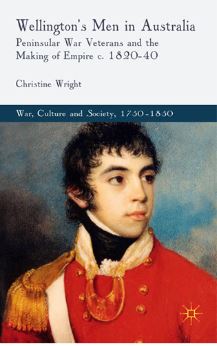
‘Wellington’s Men in Australia’ by Christine Wright

Wright_Wellington

Wellington’s Men in Australia: Peninsular War Veterans and the Making of Empire c1820-1840 by Christine Wright

2011,  178 p and appendices

I often found myself closing the book while I was reading it to look closely at the striking image on the front.   It’s a miniature of James Thomas Morisset (1780-1852), painted when he was about eighteen years old.  Those who loved him must have later regarded it with wistful sorrow, because he was shockingly disfigured at the battle of Albuera in 1811 as part of Wellington’s Peninsular campaign at the age of 21.  He is such a beautifully formed boy, and not at all like the description that the second in command, Foster Fyans, gave of his commandant on Norfolk Island some thirty-odd years later:

The Commandant, a gruff old gentleman with a strange face, on one side considerably longer than the other, with a stationary eye as if sealed on his forehead; his mouth was large, running diagonal to his eye, filled with a mass of useless bones; I liked the old gentleman, he was friendly and affable, and thought time might wear off his face affliction, which was most revolting: the one side I could only compare to a large yellow over-ripe melon  ( Fyans, ‘Memoirs Recorded at Geelong’ cited on p. 169)

Morisset is one of the men that Christine Wright deals with in her prosopographical study of men who served during Wellington’s Peninsular campaigns on the Iberian peninsular from 1808 to 1814.  Prosopography  was defined by the historian Lawrence Stone in a foundational article as “the investigation of the common background characteristics of a group of actors in history by means of a collective study of their lives”.  As such, it falls half-way between rather sketchy biography and a more statistical analysis.  I’ve read several legal prosopographies, and one or two about bureaucrats: it seems to be used mainly in the context of writing about careers (although it could just as easily be applied to any group of people).  It is well suited to Christine Wright’s endeavour. When reading local histories sited in the British colonies during the 1820s, 30s and 40’s you come across ex-military figures again and again, and in this book Wright takes this cohort of soldiers, bonded by their experience in the Peninsular campaigns, and traces the rest of their careers throughout the empire.

During the Napoleonic Wars the need for manpower rendered the old system of purchasing of commissions inadequate.  Young soldiers of limited means, who would not normally have had the capital to purchase their  positions not only had a career pathway open up for them during the war, but also were eligible for half-pay and land grants after the war.   As veterans, they were able to draw on the networks of influence to gain positions across an empire which was calling out for their skills in logistics, engineering and surveying.  The half-pay entitlement was insufficient to live on in Britain which drove veterans to look for employment overseas, and from the British Government’s point of view it was a way of cutting the cost of numbers on the half-pay list while filling appointments with skilled men and their families.

In the colonies, veterans in garrison regiments and ex-soldiers who had sold their commissions fitted particularly well into the military structures of early NSW and Van Diemen’s land.  As the colonies evolved away from penal settlements to free colonies, these ex-military men were well placed to take up civil positions of power and authority in the community.  They obtained large grants of land complete with convict labour and accrued the status that accompanied being a landowner- something that they probably never would have been able to achieve in Britain.

But the army had given them more than just military skills.  The drawing and surveying skills developed during the war were put to use in colonies that were still exploring their spaces.  Beyond their practical uses, these skills flowed into art as well, where ex-veteran painters, alert to the stark light and harshness of the Spanish terrain, were able to capture the light of  Australian landscape  in a way not seen amongst painters who had spent all their lives in the soft lights of England or wooded European settings.  Accustomed to making written reports, many of the veterans wrote their memoirs of the Peninsular campaign but extended their memoirs into their new settings as well.

Veterans were often deployed on the frontier in various roles: explorers, magistrates, Mounted Police, Border Police and as military commandants of penal stations.  The term ‘frontier’ means different things to different groups: there were different frontiers depending on whether you are talking about ‘big man’ sheep farms, ‘small man’ cattle farms and agricultural mixed farming. Some historians prefer the term ‘contact zone’ rather than ‘frontier’. Missionaries saw it as the advancement of civilization.  In military terms, though, the frontier was

a strategic boundary, a defensive line, and the front  line of colonial order.  The military saw it as the shifting boundary of British civilisation that had to be defended. (p. 152)

On this basis, Wright gives an insightful re-reading of the Waterloo Creek massacre from a strictly military viewpoint. The British Army ceased fighting on the frontier in the latter half of 1838 and it was left to the settlers or to Border or Mounted Police which, although joined by many ex-soldiers, were not counted as part of the British Army regiment numbers.  She suggests that this changed the nature of frontier ‘clashes’ and not necessarily for the better.

The real grunt-work of this book comes in the appendices which lists influential British Army Officers in the Australian colonies who were veterans of the Peninsular War.  They are listed by name, regiment, date and place of arrival, place of death, with a brief summary of the military and civil positions they occupied in Australia.  There’s many familiar names there: several governors (George Gawler in South Australia; Governors Darling, Brisbane, Gipps, Bourke, in NSW), explorers (Sturt, Major Mitchell, Lockyer), commissariats (Logan up in Moreton Bay, G.T.W.B Boyes in NSW and VDL) and commandants (Thomas Bunbury, Joseph Childs, poor damaged James Morissett in Norfolk Island), surveyors (Light in South Australia,  and many magistrates and crown land commissioners (Fyans).

The chapters are arranged thematically, each headed by a quote:

  1. ’emigration is a matter of necessity’: The aftermath of the Peninsular War
  2. ‘they make Ancestry’: Veterans as Officers and Gentlemen
  3. ‘we are in sight of each other’: The Social Networks of Veterans
  4. ‘attached to the Protestant succession’: The Religious Influence of Veterans
  5. ‘an art which owes its perfection to War’: Skills of Veterans
  6. ‘with all the authority of Eastern despots’: Veterans as Men of Authority
  7. ‘in the midst of the Goths’: The Artistic, Literary and Cultural Legacy of Veterans
  8. ‘to pave the way for the free settler’: British Soldiers on the Frontier.

The book emerges out of the author’s PhD and I think that it is still detectable there.  At times the language was a little stilted and the author’s interventions rather forced. I was mystified by the capitalization (or lack thereof) of certain names, especially the Duke/duke of Wellington.

The reader meets many of these veterans in several chapters in different guises.  The backgrounding for individual characters comes in various places.  For example, Archibald Innes’ background story comes at p. 44;  G.T.W. Boyes’ comes at p. 132 even though they have been mentioned briefly in many other places.  While spreading her net wide, there is no one place where she introduces key figures as, for example, Inga Clendinnen did in Dancing with Strangers. I found myself wondering if perhaps this might not have been a better strategy:  I found myself more interested in characters once I’d been formally introduced to them.  Certainly the ‘networked’ aspect comes through clearly as people are appointed to one position after another, often through the sticky web of the Darling/Dumaresque connections in Sydney, or through the good graces of Secretary of State for the Colonies Sir George Murray in London, himself a Peninsular veteran.

It is telling that the book takes such a short timespan  (twenty years) as its period of analysis.  By 1840 the militarized nature of Australian society had been overlaid by move towards civil appointments, bureaucratic rather than martial procedures and even representative government.

As often happens, once you’ve been alerted to a phenomenon, you tend to see it everywhere, and this is the case with this book.  If you flip through the entries for early settlers in the Australian Dictionary of Biography you’ll see the military connections with new eyes and wonder why it wasn’t more apparent before.

awwbadge_2013I am posting this for the Australian Women Writer’s Challenge under the History/Biography/Memoir section.  It is an academic text, and needs to be read that way.