Category Archives: Book reviews

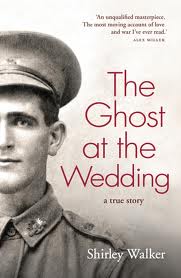
‘The Ghost at the Wedding’ by Shirley Walker

walker_ghost

2009, 247 p

It has often struck me that I am part of a blessed generation that has lived in a time of peace and ,with only a few blips of recession, continued economic growth.  My father was too young to have fought in World War II, my brothers too young for Vietnam, and unless world war breaks out within the next ten years, my son is unlikely to have to fight (and indeed, I find it hard to imagine the scenario that would prompt him to volunteer to do so).  An earlier, blighted generation, however,  experienced World War I,  the Depression and World War II again in what must have seemed an almost never-ending succession of difficulties and disasters. Jessie Walker, who is the subject of this book, stood at the pier to wave off her brothers and their friends in World War I and then sent off her own sons and younger brothers to the Second World War.  It is a war story, but told from the point of view of the women left behind.

The author, Shirley Walker, describes this book as “a memoir of my mother-in-law, Jessie and… an imaginative reconstruction of her family’s truth“. She has used letters, diaries, service records and family documents but she writes “the inner life of each character, especially that of Jessie” from the imagination.  She draws on the existing paintings that Jessie created in later life as a way of reconstructing Jessie’s inner life, but imagines and describes other paintings never made.  The mother-in-law and daughter-in-law relationship is often tentative- it is, after all, the love of the same man in the different guises of son and husband that links them-  and you sense Shirley Walker’s sensitivity to the wider family in writing this book. She has changed some names to protect some family members.

The book opens in 1983 with Jessie in a nursing home, and from here the  chronology of the book skips back and forth.  The author (the daughter in law) identifies herself as “I” and Jessie’s story is told in the third person.  There is limited dialogue. Although Jessie is the focus of the book, it also describes at third-hand or through letters, the war experiences of sons, fathers, nephews and uncles. It is a book very much grounded in Jessie’s life with her husband and sons on the peninsular island that emerges from the waters of the Clarence River, but it traverses much further.

It is a beautifully written, lyrical book.  The men of the Walker family were alive to the sights and sounds around them, and it comes through in Shirley Walker’s retelling. The book comes with high praise from the novelist Alex Millar whose blurb reads:

An unqualified masterpiece.  The most moving account of love and war I’ve ever read.

I must confess, though, that even though I was saddened by the book and the thought of so much death across several generations, I was not moved to tears.  Perhaps it was the author’s restraint in telling another’s story, or perhaps it was the ethical distance that her relationship with the subject imposed on the author, already a published academic.

Like Lisa at ANZ Litlovers, I would have appreciated a family tree, as different generations were named after their forebears.  I’m still a little perplexed by the title, which does not seem to refer to any particular wedding, but perhaps that is intentional.  The story here of one individual woman is a generational story, and as such, one that I hope women yet unborn never have to experience.

We are sure to read many biographies and histories of World War I this year, and next year, the centenary of Gallipoli which has assumed such importance in popular Australian historiography.  There is, among some historians, an uneasiness about the overwhelming prominence given to ANZAC -hence the Honest History website which notes:

There is much more to Australian history than the Anzac tradition; there is much more to our war history than nostalgia and tales of heroism. Honest History is being set up to get those two messages across. Our approach is ‘not only Anzac, but also [many other strands of Australian history]’. We see history as complex with many interwoven, competing evidence-based strands. This sort of history should be the mainstream; hyperinflation of a particular strand is an anachronism.  Editorial and moderation policy, Honest History website

The bookshops already seem to be stuffed full of Big Books of War, generally written by men, many of whom have a journalistic background. I’m thinking Les Carlyon, Peter Fitzsimons etc. and of course, the author of the biggest Big Book of War of them all, Charles Bean.   Where women have written about war, the focus tends to be less on battles and more on the men themselves; less on valour and bravery and more on loss and suffering. (I must confess to not having read Patsy Adam-Smith’s The Anzacs, and so I don’t know whether this holds true for her book or not). The Ghost at the Wedding fits into this more person-centred approach that encompasses both the warfront and the homefront, those who stayed behind and those who returned.

My rating: 8.5/10

Sourced from: Yarra Plenty Regional Library

Read because: I want to post it to the Australian Women Writers Challenge 2014.
awwbadge_2014

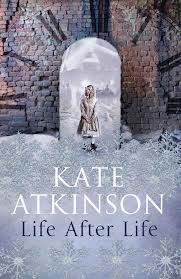
‘Life after Life’ by Kate Atkinson

lifeafterlife

2013, 477 pages.

Spoiler alert

This should be my absolute favourite, top-of-the-list read for 2014, even though the year has just started.  After all, it’s written by Kate Atkinson, an author whose books, across various genres, I really enjoy.  It’s a time travel book and I love those too, even though it feels a little bit adolescent. It has the Sliding Doors/Groundhog Day thing going on as well, which is also good, although my enjoyment of these two movies became a bit rocky when I began thinking “But hold on, how….?”  and questioning the logistics of it all.  In terms of subject matter, much of this book is based during the Blitz, which has attracted me ever since I read Sarah Waters’ The Night Watch.  So, all in all, it should have been a 10 out of 10 winner.

Spoiler alert

The reason why it isn’t a 10/10 winner confronted me on the opening pages.  On November 1930 Ursula enters a German cafe and joins a table laden with cakes where a blonde woman is draped over a fleshy, “softly repellent” man.  She places her handbag under the table and settles amongst the others at the table, then reaches down for a handkerchief from her bag.  She pulls out a gun and shoots the Fuhrer dead. Darkness falls.

This is the first of multiple deaths that Ursula experiences in this book, each marked by the appearance of snow before darkness falls.  She is strangled by her umbilical cord at birth: or she is not.  She catches Spanish influenza: or she does not.  She is beaten to death by a brutal husband: or she is not.  She is killed in an air-raid attack during the Blitz: or she is not.  It takes a little while to adjust to these constantly-reset scenarios, and by the end of the book I found myself turning frequently to the table of contents that lists the dates of the different episodes.  Once I’d realized what was happening, I was happy to go along with the premise and there were few times when the death, or not-death, did not seem completely natural or plausible.

With the exception of the Hitler scenario which opened the book, that is.  I found the whole scenario that placed Ursula in Germany unconvincing, and by tying this fictional character to a real-life historical figure Atkinsin rather clumsily and half-heartedly opened up the ’what-if’ historical can of worms. She doesn’t really DO anything with this historical question (which I do enjoy rather guiltily as an historian) and the book as a fictional work doesn’t really need to venture into historiographical waters.

Most of the scenarios are fairly short, until she reaches 1939-40. The Blitz takes up a large proportion of the book and I found myself wishing that Atkinson could get herself out of this narrative quagmire somehow.  She does, with the same sleight of hand as she does elsewhere in the book, and even though I like Blitz stories, I was glad that she could leave them behind eventually.

By the time I finished this fairly lengthy book, I found myself pondering just how well Atkinson had developed Ursula as a character.  The old writing adage is “show, don’t tell” as far as character development is concerned, and certainly the plot-driven structure of this book means that there is a lot of showing, again and again.  Ursula’s responses to these various scenarios all ring true, so Atkinson must have succeeded in creating enough of a character for me, as reader, to judge fidelity against.  This is character revealed through events, and through events that occur to Ursula alone. Do we become ourselves only through the events that befall us, I wonder?   I found myself wishing that the spotlight could shift away from Ursula for a moment, to encompass the views of other characters as well.

And so, my enjoyment of this book that seems at first sight to tick all my boxes, is somewhat alloyed.  I still very much like Kate Atkinson as a writer, and the book brought me a great deal of pleasure.  But a 10 out of 10?  Probably not….

My score:  8.5/10 ???

Read because:  CAE book group selection.  I missed the meeting- I wish I’d been there to discuss it further!

Sourced from:  CAE Bookgroups.

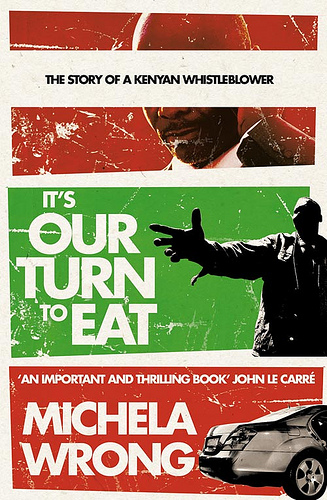
‘It’s Our Turn to Eat’ by Michela Wrong

books-our-turn-to-eat-300

2009, 368 p.

Amazon preview here.

Before I went to Kenya my son told me that I had to read this book in order to understand Kenyan society and politics.  Already rather anxious about his two-year stint in Kenya, I was not encouraged to find that a book that I expected to be about politics and history had been catalogued by my library as ‘True Crime’!

“Our turn to eat” refers to a Kenyan view that when you’re in a position to take advantage, you should do so because others have done so before you, and will do so again once you are no longer ascendant.

The book is written by a British journalist who sheltered the Kenyan whistle-blower John Githongo when he turned up on her London doorstep in 2005 after abruptly leaving his position as the Permanent Secretary for Governance and Ethics.

As the head of Transparency International, Githongo had been appointed to the position by President Kibaki, who had been elected to office on an anti-corruption platform.  He found that  instead of being empowered to challenge corruption, the position muzzled him.  Once safely in England, he blew the whistle on Kenyan corruption, most particularly the Anglo-Leasing Scandal  which, although started by an earlier government, was carried over into the new administration as well.

I was vaguely aware of the 2007 election violence and the international nervousness that it would be repeated during the 2013 election.  (It wasn’t).  Kenya was catapulted in Western consciousness with the Westgate Mall terrorist attack last year. [ John Githongo has written an interesting article about the official response to this attack, which draws on his arguments that are presented in this book.  It’s worth a read here.   ]  He argues that underlying the newsworthy, big-headline events Kenyan politics is a longer-running and more disturbing story of corruption that continues almost irrespective of the political party in ascendance at the time.  Because “it’s our turn to eat”, parties that campaigned against corruption in opposition will themselves embark upon it in the sure knowledge that they have only a short window of opportunity to do so.

Although  Githongo is the main character, the book is clearly written by Wrong and is  fast-paced, compelling  and very easy to read.  It provides a wealth of historical and social history about the tribal divisions in Kenyan society which were played out in the  violence that followed the 2007 elections.  It also presents a very pessimistic view of Kenyan politics: that corruption is endemic, and that there is no end in sight.  The fault lies with Western countries as well (particularly Britain) which turn a blind eye to money laundering and facilitate ongoing corruption through their banking, procurement and insurance practices.

As the epilogue explains, the book was boycotted by booksellers which  almost guaranteed its success.  The boycott was circumvented by a PDF version made freely available on the internet and an  NGO which gave away copies of it.  Apparently even today the book is not often found on the open shelves of Kenyan bookshops

After reading this book, I found myself more able to make sense of the politics that dominate the print media and news reports in the Kenyan public sphere.  I must admit, though, that it didn’t really reassure me. Perhaps it’s not the best book for a young ex-pat living in Kenya to recommend to his mum.

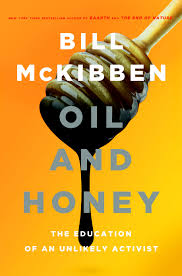
‘Oil and Honey: The Education of an Unlikely Activist’

mckibben

272 p. 2013

What turns someone from an interested observer into an activist?  I think that we all have our hot-button triggers, where something enrages us so much that all of a sudden we make the political personal.  For me, it was seeing slimy Alexander Downer talking about the Greater Sunrise oilfield and, smiling sweetly, excusing Australia’s reprehensible behaviour in denying East Timor the riches that would flow from it  with the comment “well, that’s what foreign aid is for, isn’t it?”  At that point, I vowed that I needed to know more about Australia’s actions in the immediate neighbourhood and speak out (however ineffectually).

Bill McKibben is the founder of 350.org, a global environment group that aims to reduce the amount of CO2 in the atmosphere from its current level of 400 parts per million to below 350 ppm.  He is a writer and journalist who has written on environmental issues before.  But with the mooted approval of the KeystoneXL pipeline that would carry tar sand  soil from Alberta Canada to the Gulf for processing, he stepped over the line from writer and commentator to activist.   It would be hard not to, I should imagine, having researched this arrogantly destructive, short-sighted proposal, backed by big business and the geo-political cheersquad for American supremacy.  But, moving beyond emailing and pressuring politicians and doing television interviews, he went one step further. He led a civil disobedience campaign that resulted in him spending three nights in jail, along with many other activists

It’s a rather unusual book.  I found myself wondering if there was an earlier book that I should have read first, because I felt as if I’d been dropped into a conversation half-way through.  However, when I look through the summaries of his books on his Wikipedia entry, I see that many of them are semi-autobiographical, and that many seem to use the overarching structure found in this  book as well: the juxtaposition of the personal and the political.

In this case, the juxtaposition is between the life of his friend Kirk Webster, who keeps bees in Vermont, and his own experience in exerting direct political action over Keystone.   A rather long and laboured metaphor for organization, the bee sections are interesting in their own right as a microcosm of the complex interconnections between life and environment.  The activist sections I found rather less enchanting.  He doesn’t particularly lecture about climate change or environmental degradation but instead describes the change in his life since becoming an activist as well as commentator.  I found myself bridling against the rather syrupy name-dropping, which reminded me a bit of military writing: that need to give every man and woman his due.

I was, I must admit, just a bit disappointed in the book.  I was expecting something punchier, but this is instead a gentler enterprise.

My rating: 7/10

Read because: it was there on the shelf

Sourced from: Yarra Plenty Regional Library

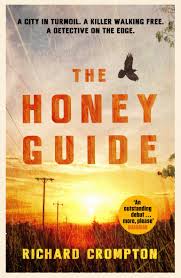
‘The Honey Guide’ by Richard Crompton

honeyguide

2013, 320 p.

I was standing in a Nairobi bookshop with my son.  “Show me a best-selling Kenyan book” I said, and he handed me this one, all wrapped up in clear cellophane as Kenyan books tend to be.  It’s the debut novel of Richard Crompton, a former BBC journalist and producer who has lived in East Africa for several years.  I think that you can tell his BBC credentials in the writing of this book: he is hoping to create a series of books and I can just see this one as a three-part BBC series in the future.

Mollel is a Masaai policeman based in Nairobi, which immediately marks him out as an outsider. Masaai’s as a rule, do not seek careers in the police force, and Mollel takes no part in the Kikuyu-Luo rivalry that is implicit in Kenyan politics today.  He has his own tragedies, and he has only just returned to the force after a lengthy period of leave.  The case which opens the book involves a prostitute who has suffered a violent recent genital mutilation.  The trail leads to a powerful evangelical church minister, dodgy adoption practices and corruption at the highest levels.

But for me the real appeal of this book is the setting of Nairobi itself.  The action takes place in the days leading up to the 2007 election which led to an estimated 1300  deaths and widespread internal displacement as people fled their homes to what they perceived as safer regions where their own tribal group is more numerous.  In fact, the refugee camps of these internally displaced Kenyans still exist, seven years later.  The action is sited in actual places ( I’ve been to them!) and he captures well the sense of shock as things falling apart in what had, until then, been perceived as an operational-enough democracy.

I’m not usually into police procedurals in the books I read, although I am rather partial to the Friday night crime-fest of BBC programs on the ABC each week.  I think that the writer’s intention in creating a series is a little too blatant here, as he piles on the back-story in this first book.   In a series, this background personal information would be drip-fed in a  more subtle way over multiple episodes and even multiple seasons.   (Although, apparently the manuscript languished in his bottom drawer for many years.  Perhaps he’s only aspired to a series since the Ladies Detective Agency success!) The plot is rather over-egged, I think: just one or two of the multiple plot lines would be sufficient.  But as a creative and narrative response to the 2007 election it is well worth reading, and it has been even more enjoyable reading the book in Nairobi itself.


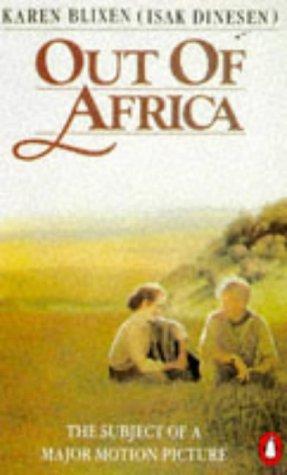
‘Out of Africa’ by Karen Blixen

blixen

1937, 271 p.

I don’t often read the book after I have seen a movie but as I’m in Kenya, it seemed particularly appropriate that I do so in this case.   I saw the movie many, many years ago and can barely remember it, but it seemed to me that the Robert Redford character was rather dominant in it.  Obviously the screen writers were drawing on other source material  in scripting the film, most particularly her letters I expect, because the Denys Finch-Hatton section is minor in the book and certainly not the main theme.  In the book, it is a rather chaste relationship, and she says nothing about Baron Blixen (her husband), adultery or syphilis.  She says little about the white settler Happy Valley set, and is even rather dismissive of them.

I confess that I was struggling a bit at first.  It is very much a book of its time and colonial mindset, and I found myself bridling at her patronizing ethnographic commentary and the see it-shoot it attitude that pervades the book.  She asserts a oneness with Africa and with her workers,most particularly Kamante the cook and Farah her overseer,  but it is shot through with a strong sense of noblesse oblige.  Nonetheless, she is critical of other people’s colonialism, but not her own.  Yet in many ways she comes over as an anti-colonialist that we might want to identify ourselves with today.  She comes to regret her participation in hunting; she lobbies the government for a reserve for the Kikuyu people and she recognizes that both white and native are obsessed with their own worldview and oblivious to the ‘other’:

The tales that white people tell you of their Native servants…If they had been told that they played no more important part in the lives of the Natives than the Natives played in their own lives, they would have been highly indignant and ill at ease… p. 186

There is not really a strong narrative line at all: it is more a series of connected and roughly chronological short stories.  One chapter ‘From an Immigrant’s Notebook’ is exactly that: vignettes that feel a bit like writing exercises that could be taken from a scrapbook.

My reading of this book has been completely shaped by my experiences while reading it.  I had commenced it in the knowledge that we would be visiting Karen Blixen House, and having been there, I have a much greater appreciation of the book.  Her life here centred on her farmhouse and  she describes events within the various rooms and places: writing in her sitting room, meeting with her workers on the round stone tables on the west porch,  working in her kitchen.  I’ve been there now, and can see her there.  But it also reinforces for me the strong sense of possession she proclaimed as colonist – ‘her’ kitchen, ‘her ‘ house, ‘her’ natives.

OLYMPUS DIGITAL CAMERA

The writing  is evocative and beautiful, deeply imbued with a sense of place.

The geographical position and the height of the land combined to create a landscape that had not its like in all the world.  There was no fat on it and no luxuriance anywhere; it was Africa distilled up through six thousand feet, like the strong and refined essence of a continent.  The colours were dry and burnt, like the colours in pottery.  The trees had a light delicate foliage, the structure of which was different from that of the trees in Europe; it did not grow in bows or cupolas, but in horizontal layers… (p. 15)

However, I must admit that had I not visited the house, I would have closed the book thinking that it had been a rather insipid, dated and slight story.  And I must say that this book and the film seem to have very little connection at all.

OLYMPUS DIGITAL CAMERA

Postscript: I’ve just read an article that compares the book and the film which argues that Blixen’s voice and viewpoint in the film has been twisted completely out of shape to emphasize the Denys Finch-Hatton character as the romantic and anti-colonial lead.  If you can access it (try State Library perhaps), the citation is:

Cooper, Brenda, and David Descutner. ““It had no voice to it”: Sydney Pollack’s film translation of Isak Dinesen’s out of Africa.” Quarterly Journal of Speech 82.3 (1996): 228-250.


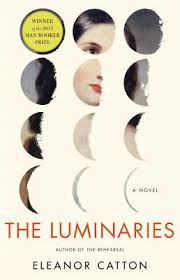
‘The Luminaries’ by Eleanor Catton

catton

832 p., 2013

832 pages is a lot of reading in anyone’s language.  I have been busy reading The Luminaries every chance I could to avoid a hefty overdue fine at the library. I thought that I had succeeded in avoiding reading any reviews of it before I finished, but there was one that did get through my defences: Jane Sullivan’s review in The Age a fortnight ago.

And there it was-

That’s one of the main objections to the book: that it’s too long.  Others, variously, are that it shouldn’t be written in ponderous Victorian style; that it has too many characters and we don’t care about them; that the astrology framework doesn’t enhance it; and that the story, clever as it is, doesn’t add up to anything much.

Well, that’ s pretty much written my review for me.

I was reminded many times of Wilkie Collins’ The Woman in White while I was reading this book.  Both are long; both are mysteries; both are about switched identities, and both involve deception for financial gain.  But the difference is that The Woman in White was highly original at the time, and is today viewed by many as the first mystery novel, and the first and finest ‘sensation’ novel.  What a gulf there is between being the first and being merely a pastiche.

For Victorian pastiche this is, complete with convoluted (but always well controlled) sentences, the summary at the beginning of each chapter, and the opening scenes on a dark and stormy night.  As in  most Victorian novels conceived in the serial format of a periodical (think Dickens, Collins…), there is a huge cast of characters who swarm in and out of view,  with false starts and red herrings, and the need for the author to draw breath and offer the occasional recap to the bemused reader lest everything threaten to spiral out of control.

I find myself admiring many things about the book.  Her characterization is excellent, and I found myself becoming engaged by each vignette as actors  gravitated around one another.  Her characters are complex beings,  each with a back story, dreams and regrets.  The conversation is pitch-perfect.

Her description of place is excellent, too. You could see, hear and smell Hokitika, and as an historian of 19th century colonial towns (ah, always an historian!) it rang true in every regard- not a single false note.

The plotting is painstaking and detailed as well. So many characters, so many intersecting motivations and lifestories.

And her control of time is impressive too.  The first long chapter starts on a particular day, the second less-long chapter jumps ahead slightly, etc. etc. with occasional chapters jumping back a year or more as the book progresses until it ends up on the day with which it opened.  Each chapter gets shorter and shorter- somehow mirroring the astrological schema that runs through the book.

But, but, but… how to put it all these vignettes  together? How did this story fit in with that story? Who is this character again?  Had I forgotten this bit of information, or has she only divulged it now, half way through the chapter?  I don’t understand the overarching conceit of the astrological chart that she has superimposed over the story. It was not explained and, to my way of thinking, is not necessary either.

I think that, in spite of my admiration for the parts, I begrudge the length of the whole.  As others have mentioned, the action of the book really picks up at about page 575.  Page 575?  What an act of faith in one’s readers and confidence in one’s abilities as a writer to hold out for so long!  And at the end of it all, the actors take their bow, but it doesn’t really mean anything.

When I finished reading War and Peace, I couldn’t read another fiction book for days.  I felt the same way about Hilary Mantel’s Cromwell books ( here and here) that preceded this book as Booker Prize winners.  With these books, I had been transported to another world and  whatever book I read immediately after would be diminished after I had been immersed so thoroughly by these big, ambitious books. After reading The Luminaries I feel rather short-changed.  I put so much time into something that, despite its technical brilliance, has very little at its core.

Other reviews:

Sue at Whispering Gums  was reading it at much the same time and beat me to the end. In spite of some ambivalence, the depth of Catton’s characterization won her over.  Lisa at ANZLitLovers was underwhelmed.

The Guardian review by Kirsty Gunn makes similar observations to what I have written above, but sees that as part of the book’s artistry and brilliance. I’m not convinced.

My rating: 7/10

Sourced from: La Trobe University Library

Read because: it was sitting all shiny and new on the ‘New Books’ shelf  and because I knew that it had won the Booker.  In other years I’ve tried to read the shortlist before the announcement but The Thesis got in the way this year- so straight to the winner this time.

Mr Muo’s Travelling Couch

drmuostravellingcouch

2003 (2005 translation from French), 264p.

Well, that’s 264-pages-reading-time that I’m not going to get back again.

Dai Sijie is the author of Balzac and the Little Chinese Seamstress, and there are similarities between the two books.  Both books revolve around the power of European literature (Balzac in the earlier book; Freud in this book); both refer to the ‘re-education’ policies of the Cultural Revolution; both books involve journeys.  But where there was the theme of innocence and awakening in his first book, the major plotline of this novel is that Mr Muo, recently returned from France where he qualified as a psychoanalyst, needs to find a virgin to offer as a bribe so that his girlfriend can be released from prison.  All rather grubby really.

He speaks (albeit almost casually) of post-Cultural Revolution and post-Tienanmen Square China, and I did find that interesting.  I was wondering when it was going to expand into a full-blown critique, but it remained very subtle- unless it passed completely over my head.  I know very little about Freudianism but the author’s use of it all seemed rather obvious and simplistic.  I am, however, very ready to concede that there might be nuances and critiques of Freud here that may have also passed completely over my head.  (I’m wondering if Freud in Oceania has read it?)   I kept waiting for this book to DO something, but alas it never did.  In fact, I don’t know if anything happened at all or whether it was all a dream after all.

Even more disconcerting were the blurbs front and back that described it as ‘hilarious’ and  ‘amusing charming read with a sharp, satirical edge’ and ‘allusive, intelligent and very funny’.   I obviously have a different sense of humour from such readers.

My rating: 3/10

Read because: it was a bookgroup choice for February (even though I won’t be there for the meeting).  Boy, I’m glad I didn’t choose THIS book!

Sourced from: CAE

‘Someone’ by Alice McDermott

someone

2013, 232 p.

I hadn’t heard of the book; hadn’t heard of the writer. Don’t know why I picked it up from the library shelf, but I’m really glad that I did.  It’s a very auspicious way to start my reading year.

‘Someone’ is such an ordinary, anodyne term. “Who’s going to love me?” asks the main character, Marie, after she has been dumped by her boyfriend. “Someone,” says her brother “Someone will.” 

‘Someone’ sounds interchangeable and generic, but what we have been given in this book is a very particular consciousness within an otherwise ordinary, unremarkable person.  We first glimpse Marie as a child, in thick glasses, sitting on the stoop of her Brooklyn home in the 1930s, waiting for her father to emerge from the subway on the way home from work.  We see her life in shards, rather than one continuous narrative.  We see her as an old woman, new mother, worker in her first job, middle aged sister.  She is utterly, lovingly human.

Such beautiful writing.  Here she is, frantic with grief as her first boyfriend breaks up with her:

I sat on the edge of the bed.  I wanted to take my glasses off, fling them across the room.  To tear the new hat from my head and fling it, too.  Put my hands to my scalp and peel off the homely face.  Unbutton the dress, unbuckle the belt, remove the frail slip.  I wanted to reach behind my neck and unhook the flesh from the bone, open it along the zipper of my spine, step out of my skin and fling it to the floor.  Back shoulder stomach and breast.  Trample it.  Raise a fist to God for how He had shaped me in that first darkness: unlovely and unloved. (p. 79)

Darkness and light are motifs that are touched on in several places in the book.  Blind Bill Corrigan sits on a chair out in the street as the children play around him, and Marie herself suffers from poor eyesight and nearly goes blind herself.  Afraid of the dark as a child, the light is left on while she falls asleep and she wakes to “the soft-edged geometric patches of streetlight on the ceiling, across one wall.”  Woken by a bad dream as an adult, “the walls of the room were lit with lozenges of streetlight, long rectangles and a thin cross”.

Marie does not travel far in her life: from Brooklyn to Long Island.  Place has bound her to people forever as they move in and out of her life.  When blind Bill Corrigan dies, a childhood friend- more than a childhood friend really,- reappears at the wake and recalls Bill Corrigan sitting on the chair:

“Remember that chair he sat in every day?”

I nodded. “I was just thinking about it” It might have been the first time in my life I understood what an easy bond it was, to share a neighbourhood as we had done, to share a time past. “It’s still there, ” I added, as if this should amaze him. “At least it was there this morning.  No one’s had the heart to take it in.”  (p 140)

In some ways the book reminded me of A Tree Grows in Brooklyn with the Irish-American family in the same neighbourhood.  However, this book shucks off any attempt to be chronological as it jumps from childhood to old age, back and forth.  Events occur, sometimes foreshadowed and other times echoing on. McDermott’s control of the narrative is masterful- there’s not a word wasted, and connections emerge as discoveries, unforced and unlaboured.

It’s only a short book- just over 200 pages.   It says much, but it is stripped down and pure.  Beautiful.

My rating: Is it too early on 1 January to give a 10?

Sourced from: Yarra Plenty Regional Library

Read because: it was just there on the ‘new books’ shelf.  What a find!

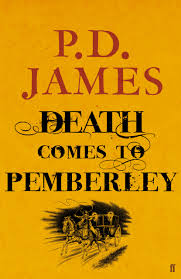
‘Death Comes to Pemberley’ by P.D.James

pdjamespemberley

2011, 310 p

I can remember as a (much) younger reader experiencing a kind of grief when I finished a book where I had fallen in love with the main characters.  What pleasure I took in series of books where you could meet up with them again! I must admit that I rarely feel that way today (one exception is Kate Atkinson’s Jackson Brodie character) and I’ve decided that I can’t remember characters well enough between books and their sequels to read them in real time – I’m better off waiting until a trilogy is done and dusted and then gorging on it in one big reading feast.

But the frequent re-reading of classics is another matter entirely and Jane Austen in particular rewards frequent re-reading. And, as many canny authors have found, there are rewards in re-writing Jane Austen as well.  I’m not particularly attracted to the Jane Austen zombie mash-ups (or mash-ups of any kind, for that matter) but when one comes from the pen of P. D. James, that’s different.  Although I am not, admittedly, a great detective fan, P. D. James herself is a great Jane Austen fan, as she explains in this video.  James’ own introduction to the book reflects her sense of humility and presumption in even endeavouring to marry her love of Jane Austen and the murder investigation genre in the book that follows:

I owe an apology to the shade of Jane Austen for involving her beloved Elizabeth in the trauma of a murder investigation, especially as in the final chapter of Mansfield Park Miss Austen made her views plain: ‘Let other pens dwell on guilt and misery.  I quit such odious subjects as soon as I can, impatient to restore everybody not greatly in fault themselves to tolerable comfort, and to have done with all the rest.’ No doubt she would have replied to my apology by saying that, had she wished to dwell on such odious subjects, she would have written this story herself, and done it better.

The scenario is this:  Darcy and Elizabeth have been happily ensconced at Pemberley for the past six years where Elizabeth has duly delivered two Darcy heirs.  It is the eve of the traditional Pemberley ball instituted by Darcy’s mother Lady Anne.  Sweet Jane and Bingley have arrived early, Darcy’s sister Georgiana is fending off two suitors in Colonel Fitzwilliam and the young lawyer Mr Alveston,  the silver is being polished and the house is crackling with anticipation. Suddenly the preparations are disrupted by Elizabeth’s younger sister Lydia Wickham, arriving unannounced and hysterical, shrieking that Wickham has been murdered in the nearby wood.  He hasn’t , but his friend Captain Denny has.  I shall go no further: if you have read the book, you’ll enjoy John Crace’s ‘digested read’ from the Guardian here.

I was interested to see how (and if) P.D. James was going to pull this off.  The need to provide background information entangled the book in several places. She starts by a prologue that briefly encapsulates Pride and Prejudice should there be any reader absent from planet Earth in the last forty years who has missed both the reprints and the frequent film versions- does such a soul exist?  The backgrounding completed, she then launches into her own trajectory, in a voice that echoes Austen’s writing with long, convoluted but controlled sentences but a sad dearth of the cutting, clear-eyed quip that Austen-readers so enjoy.   There are sly Austenesque references to Austen’s own oeuvre, most particularly Mansfield Park, and nods and winks to the original book, but often the clumsy backgrounding sections make you aware as an Austen-savvy reader that you are eavesdropping on a rather laboured explanation to other readers that you’d rather not have to sit through.

Conversely,  there is also P.D. James’ need as a  writer to mould the expectations of her own crime-writing fans by warning that the timing of this book predates the rise of the detective and a paid constabulary.  And so we see Darcy, who was himself a magistrate and surely familiar with such matters, intently listening to the lawyer Alveston’s explanation of the courtroom procedure and strategies and again, as a reader, you become aware of the backgrounding nuts-and-bolts that James is tightening as author.

However, as an aspiring historian of nineteenth century English legal practice- and does a historian ever stop reading as a historian?- I was impressed by her fidelity to the role of the magistrate in pre-Peelite policing days and her sensitivity to early 19th century  courtroom procedure, most particularly the nature of evidence and Wickham’s statement to the court.  All of this involved James relinquishing those stand-bys of the modern crime genre and as such, testifies to her careful research, no doubt bolstered by her work on the true crime non-fiction book The Maul and the Pear Tree which she co-authored with historian T. A. Critchley.  The crime itself and its motivations, while rather insipid by modern standards, faithfully reflect 19th century moral standards .

My qualms come not with P. D. James as crime writer, but with P. D. James as Austen fan. I was perhaps most disappointed by the flatness of the relationship between Elizabeth and Darcy and wondered if, perhaps, Elizabeth HAD been taken over by a zombie after all.  The Elizabeth Darcy of this book admits that she would not have married a poor man, and weights young Georgiana’s choices between love and status equally on the scale of marriage choices.  She’s an insipid shadow of her feisty self.

This all sounds rather negative, which I don’t intend.  The thing that I enjoyed most about this book was the sense of  rather wicked glee that comes through when P.D. James reveals herself as Austen fan, talking back to Jane Austen herself.  Here she is, as Elizabeth thinks back to Darcy’s two proposals: the first rather insulting proposal, and the second request for her love, made a day later, just after she had learned of Lydia’s elopement:

It still surprised her that between Darcy’s first insulting proposal and his second successful and penitent request for her love, they had only been together in private for less than half an hour… If this were fiction, could even the most brilliant novelist contrive to make credible so short a period in which pride had been subdued and prejudice overcome?  (p.50)

It’s a question that James herself seeks to answer in the epilogue as Darcy unburdens himself over the same issue: “But how could you believe me altered? How could any rational creature?” (p. 307).  I don’t know if James’ answer satisfies completely, but I enjoyed the interchange.

I received this book in my face-to-face bookgroup (AKA ‘The Ladies who Say Ooooh”) where at our December meeting we anonymously lend a book that we have enjoyed, knowing that it will be returned to us. After giving our response to the book, we then try to guess who donated it.  I think I know who donated it.  I’ll say that in spite of my qualms, I enjoyed reading this response to Pride and Prejudice written by an honest fan, who brings her own wealth of literary skill (and sound historical research) to the challenge.  I don’t think it will propel me towards the zombies though.

Other reviews:  Hah! Try to find a review of the book when the mini-series has been screen just days earlier!!  Probably the best review that I’ve read is by our own Whispering Gums, a true Janeite!