Category Archives: Book reviews

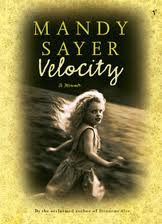
‘Velocity’ by Mandy Sayer


velocity

2005, 302

As it happens, I finished reading this book at about 4.30 a.m.  Some hours later, over breakfast, I read that Maya Angelou had died.  I haven’t read any of Angelou’s work, but I was interested to see that she had written six memoirs, covering the period of time up until she turned 40.  My, I thought, what sort of a life would sustain six memoirs?

I had had the same thought when I finished Mandy Sayer’s book, and saw that she had won the National Biography Award and the Age Non-Fiction Book of the Year for an earlier memoir, Dreamtime Alice.  I read this current book, Velocity mainly because I was interested in reading her new book The Poet’s Wife.  I’m wedded enough to chronology to want to read the earlier book first, both in its production and in its time span.  However, my response to Maya Angelou’s prolific memoir output could apply here as well: what sort of a life sustains three memoirs with how many more to follow? One that has rootlessness and dysfunction at its core, it would seem, along with a strong vein of intelligence and a sense of self that somehow sustains the writer to endure it.

This is not to say that I didn’t find it engrossing, because I did.  I read it in two middle-of-the-night reading gulps, when I’m not wanting to read anything too taxing.  Nonetheless, it was probably an odd choice.  In many ways it’s a “look-away-I-can’t-help-looking” type of book, where one bad choice leads to another, and where you’re almost crying out in pantomine-audience style- “don’t do it!”. The violence, both physical and emotional, is not exactly bed-time reading.

Each chapter starts with an italicized episode which acts as a sort of preview for something that will arise later on.  It was quite an effective technique, although it usually made my heart sink.

The rootlessness is laid down in her life right from the moment of conception.  Her parents are drifters and party-animals, and after their marriage breaks down, her mother embarks on a series of toxic relationships that culminate in the controlling and violent Hakkim, a younger Lebanese man who Mandy fears.  Mandy is shifted from one school to another, as her mother keeps being drawn back to alcohol, depression, helplessness and this evil man.

One constant throughout all this is her father, Gerry the jazz musician.  It was interesting to read her response to her father’s cleft lip and palate (although she uses the older and more hurtful term ‘harelip’) as I have the same condition myself.  She mentions it several times in the opening chapter, and reminds us of it again after she reconnects with him after a long period of time.  In fact, at one stage she’d been away from him so long that she found it hard to understand his speech again.  Even though she stays with her mother and is dragged from one toxic or vulnerable environment to the next, her father seems a constant source of security, even though he disappears from her life for years at a time, and is in truth just as rootless and unsuccessful as her mother is.  Mandy bathes him in an idealized golden glow that he does little to merit.

This might sound like a misery-memoir, but it’s not at all.  It’s told in a clear-eyed fashion, and while not underplaying the abuse and danger, it does not wallow in it either.  I’m certainly up for reading her other memoirs as well.

awwbadge_2014I’ve added this to the Australian Women Writers Challenge 2014.

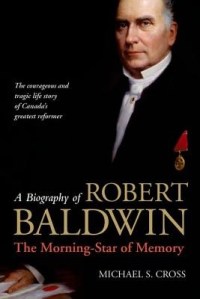
‘A Biography of Robert Baldwin: The Morning-Star of Memory’ by Michael S. Cross

cross2

Michael S. Cross A Biography of Robert Baldwin: The Morning Star of Memory, 2012, 367 p & notes

The first chapter of this biography begins with a jolt. It opens a month after the main protagonist’s death, with four men gathered around his corpse: his son, his brother, his brother in law and a surgeon. The surgeon cut across the abdomen to replicate a caesarean scar, and Robert Baldwin’s final wish was complete. His wife had died from long-term complications of a caesarean twenty-three years earlier, and Robert Baldwin was now to meet her in heaven bearing the same scar.

This opening chapter sets the tone for this biography, which seeks to unite the personal and emotional with the political. Australian readers are probably not familiar with Robert Baldwin, who is lauded as one of the founding fathers of self-government and who, along with Louis-Hippolyte La Fontaine, headed the Reform party in joint Anglo-Canadian governments in Canada between 1836 and 1851 . In Australia, with an overwhelmingly British 19th century population, we are not particularly alert to the nuances of an Upper Canadian politician championing the political equality of the French Lower Canadian province. It was a luxury of mono-culturalism that Canada did not share.  Conversely, our own historiographical emphasis on self-government (in, for example Peter Cochrane’s Colonial Ambition) tends to see Canada as an example to emulate as a more constitutionally-advanced sibling, rather than a fellow colony going through much the same battles with the Colonial Office within the same time frame.

Robert Baldwin was born in Upper Canada in 1804. His father, Dr. William Warren Baldwin was one of those multi-talented colonial gentlemen who combined a career as medical doctor, school teacher, attorney and politician. W.W. Baldwin was wealthy, forthright and dominant, and Robert was very much in his father’s shadow. He was admitted to the bar and was eventually elected to  the Assembly, but he was no orator, often speaking in barely a whisper.  He married his cousin Eliza, initially against the wishes of his family, and was heart-broken when she died nine years later. Even though he had chafed against his father as a son, he became very much like him with his own children: critical, cold and domineering.

The author, Michael Cross, keeps the emphasis strongly on the psychological and emotional aspects of Robert’s personality. He was a son overwhelmed by the dominant presence of his father; he was prone to depression; he loved deeply and mourned obsessively. Each chapter begins with an italicized and imagined epigraph that counts down the years since Eliza’s death.

The triumph that the first Reform government had seemed to represent was melting away. He was beset on all sides as death had gain reached out and into the family. Only in memory could he find relief. Eliza had been dead for eight years. It was April 1844 (p.158)

Or another one:

It would be prudent and fitting to stop here, now that responsible government was accomplished. Little more was needed than to fill up the great achievement with the few institutions of national culture that would complete it. How proud Eliza would be. She had been dead nearly twelve years. (p. 230)

I can see what Cross is doing here, chapter after chapter, (using Eliza as a touchstone; using Eliza’s death as a tethering-point to the chronology) but it does become rather contrived and mawkish. He makes a good case for this extended grieving for Eliza being a bedrock emotion, fundamental to Baldwin’s personality, by keeping it running throughout the narrative, rather than consigning it to an early chapter and not referring to it again. But I think I would have appreciated a widening of context here. To our eyes his obsession with Eliza’s death seems morbid and bordering on phobic. Was it? I’ve been aware of similar, disabling, obsessive grief expressed by fathers in World War I- was that a new phenomenon or was there an older tradition of overwhelming masculine grief? Was Baldwin’s grief another (albeit earlier) version of that exemplified by Queen Victoria in 1861? Or was it aberrant even at the time?

Alongside this ongoing drum-beat of Baldwin’s emotional and psychological state, Cross writes a political biography that traverses many of the big issues of 19th century Canadian history: the 1837 Rebellion, the Durham report, the Montreal Riots of 1849, Irish immigration after the famine and the rise of the Clear Grits. I must admit that most of my reading about Upper Canada has petered out at 1841 with the Act of Union that combined largely- English Upper Canada with largely-French Lower Canada, but I was able to follow the political narrative fairly easily (if uncritically).

As an Australian historian, I’m interested that in the lead up to responsible government, Baldwin was so comfortable with what we would call party politics. In Australia at the time, there was still an aversion to ‘party’ as being something disreputable and compromising.

I have the advantage, I suppose, of familiarity with both Canadian and Australian history of the time that enables me to detect the empire-wide issues that each government had to grapple with. I found myself surprised that Canada was not, as I had believed, constitutionally streets ahead of New South Wales, which still felt itself hampered by its ‘penal colony’ origins. Instead, politicians in both colonies were tussling with the same Colonial Office personnel who had far more of an empire-wide perspective than can be detected when dealing with one colony alone.

I came across Robert Baldwin in my own work through his friendship with my research interest, John Walpole Willis. Cross does not spend a great deal of time on the 1820s, which preceded Baldwin’s election to the Assembly, although Willis’ dismissal became a rallying cause to the reform-party dominated government in the early 1830s.  The chronological weaving of this book is interesting and unconventional, with the 1837 Rebellion dealt with rather cursorily at first, but referred to several times in retrospect in later chapters.

Willis did not appear to make many firm friends in his life.  In Upper Canada, his main friendships seemed to be with John Galt and Robert Baldwin,  although Willis tended to downplay his social connection with Baldwin later. Although of a similar social background and education to the ‘Family Compact’ elite, Robert’s politics put him firmly in the Reform camp, and his actions as a barrister in Willis’ courtroom during his brief tenure in Upper Canada, meant that they were both oriented towards the same political direction. I was interested to see whether there was a similarity in political beliefs between the two men beyond the convenience of a common cause at the time. There probably was. Although Baldwin was staunchly in favour of responsible government, and devoted his whole political career to its attainment, he was no democrat. He was firmly committed to British institutions and declared that he hoped to die a British subject (p. 314). Like many of the British reform politicians who had supported the 1832 Reform Bill, he found that his Upper Canadian colleagues were not content to stop at responsible government, but wanted to push further.   He wanted change, but not rapid change; he wanted popular participation but not democracy, and he wanted to preserve the best of the gentry-dominated past (p. 284).

I find myself indulging in a flight of–‘if history’. If Willis had stayed in Upper Canada, would he have gone on to voice many of the political opinions that Baldwin later did? I suspect that he would have.



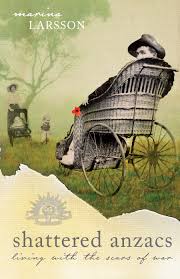
‘Shattered Anzacs’ by Marina Larsson

larsson

2009,  281 p. & notes.

There’s a striking pamphlet reproduced in the opening pages of Marina Larsson’s book Shattered Anzacs.  It’s a recruiting  leaflet for WWI, enticingly titled “Free Tour to Great Britain and Europe”.  You can see it here.   It spruiks “A Personally Conducted Tour whereby you can see the world and save money at the same time” and advises of the wages and separation allowances provided.  In best Fawlty Towers tradition, it doesn’t mention the war: only the ‘Great Adventure’.  But adjacent to the breezy exhortation to join the tour, it also has a chart of the pensions payable on return to the soldier, his wife and children should there be disablement or death.  The consciousness of injury and life afterwards was there right from the start and became even more sobering as men began arriving home.  For those who survived, it was most often literally ‘home’, to parents, wives, siblings and children who, as the subtitle of this book notes,  found themselves “living with the scars of war”. Continue reading

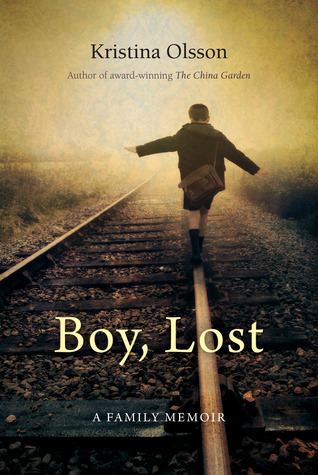
‘Boy, Lost’ by Kristina Olsson

olsson

2013, 255p.

Some books seem to shift shape while you’re reading them.  Sometimes it really is the book that changes direction during its narrative, but other times it’s because you, as a reader, adjust your concept of what it is you’re reading as you go along.

Boy, Lost was such a book for me.  To be honest, I started reading it thinking that it was a fiction book narrated in the first-person, beautifully told, with the crystalline clarity of authenticity.  It was only when some facts seemed so concrete and so banal that I started to wonder if it was non-fiction instead.  I turned to the back cover, and sure enough- there it was, ‘Non-fiction/Memoir’.  And I obviously don’t look hard enough at the front covers of the books I read, because under the title, there it is again: “A Family Memoir”.  At the end of the book, Olsson explains how she came to write this book that she felt was not hers, initially, to write.  It is her mother’s story, and her brother’s, and yet even untold it affected the whole family. In this book she is piecing it together and telling it for her family, with their blessing and at their request.  In the closing pages she broadens her perspective beyond her family’s story to reflect on the historical and sociological phenomenon of ‘lost’ and stolen children  among unmarried mothers and aboriginal mothers more generally.

Olsson’s mother Yvonne marries young- too young- to Michael, a Greek post-war immigrant. He takes her to far-north Queensland, where the veneer of a sensual, confident older man soon fractures to reveal a cruel, rigid and controlling man.  In 1950 after enduring three years of marriage to him, the pregnant Yvonne takes her infant son and flees on the train. But Michael appears, takes their son from her arms, snarls a warning to her and leaves.  Yvonne will not see her son for another forty years.

She remarries; she has other children.

This is the story my mother never told, not to us, the children who would grow up around it in the way that skin grows over a scratch.  So we conjured it, guessed it from glances, from echoes, from phrases that snap in the air like a bird’s wing, and are gone.  Fragments of a legend, that’s how it seemed, and it twisted through our childhood like a fiction we had read and half-forgotten; a story that belonged to others, not to us, and to another, long-ago time.  As if the woman at its centre was not really our mother but a stranger, an unknowable version of her…. (p 3)

This is what we didn’t understand, not then: that the past had gripped and confounded her, stalked her dreams.  That every day of her life after her son was taken, she would sift through the memory of it, every terrible second.  Turning each in her hand, looking for ways she might have changed them.  But always she would be stuck at the image of the man, her husband, the terrible smile as he entered the train carriage, walked towards her, pulled Peter from her arms.  When she dreamed of her lost son she would dream of his father.  He would always be walking towards her, wearing that smile. (p. 4)

She was deflected from taking action by people who told her that her infant son  would have a better life with his father than he would with her, a single-mother and waitress. He would live like a little Greek prince, they said, basking in the glory of being a Greek son during the 1950s. He didn’t.  Instead, Peter had a spare, sad life.  He was too young to remember his mother, but the past had gripped and confounded him and stalked his dreams, as well.

I very much enjoyed this book, even though it utilizes two of the stylistic techniques that I usually dislike: very short chapters and use of the present tense.   The stories of Yvonne and Peter are alternated, moving forward chronologically, but not touching each other for much of the book.  Interwoven between their two stories are Olsson’s own reflections on the childhoods of Sharon, her older half- sister (full sister to Peter) and several brothers, as they circle warily this fracture in their family.  Each section is only a few pages in length.  I usually dislike such a ruptured narrative, seeing it as a cop-out from having to tie the narrative together in a logical and pragmatic sense, but in this book it works.  There are abrupt stops, loose ends and silences throughout all their stories, and the structure reflects that well.

The present tense is perhaps more problematic.  In her ANZLitLovers blog Lisa Hill recently referenced some observations by the writer Dorothy Johnston about the ubiquitous use of present tense in recently-published books.   I acknowledge that the present tense brings a sense of immediacy and contingency to the writing, but I find it rather suffocating and anxiety-producing.  This book IS, however, an anxious, hand-wringing book, and I think that the present tense works well here.

The author has inserted herself into the narrative the whole way through the book, but in the closing pages she steps into the light completely. She is at pains to answer the question that has tortured both her mother and her brother: why didn’t her mother try harder to get him back? Her mother’s story of the lost – no, taken- child was replicated in the stories of unmarried mothers, not good enough mothers, Aboriginal mothers.  I think that she provides as good an answer as can be made: that, in L.P. Hartley’s words, the past was a different country, and they did do things differently then.

But that is somewhat of a get-out clause.  While recognizing the pressures and constraints that might have caused people to act as they did, she does not downplay the deep sense of loss that exists at the heart of her family.  Things and people can be re-located and re-identified,  but events have moved on and the past cannot be recaptured. Some losses are never truly found again.

My rating: 9/10

Sourced from: Yarra Plenty Regional Library

Read because: Australian Women Writers Challenge 2014.
awwbadge_2014


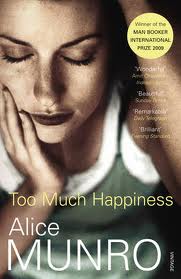
‘Too Much Happiness’ by Alice Munro

munro

2009, 320 p.

Alice Munro was awarded the Man Booker International Prize in 2009 not so much for any particular book but for the entire body of her work over several decades. In 2013 she received the Nobel Prize for Literature.  I must admit to having only read one Alice Munro (Lives of Girls and Women) about fifteen years ago, and that was a novel rather than a collection of short stories, a genre for which she is more commonly celebrated.   I seem to be rather re-thinking my response to short stories (wink to Whispering Gums) and reading more of them on my own initiative, but this was book group selection, which raised its own challenges.

Most of the stories in this collection are set in or around Ontario, which has its own appeal to me now that I’ve been there. Interestingly, the only one with a markedly different setting is the final and longest one which is set in late 19th century Russia, and it is this rather (to my mind, disappointing) final story that gives the collection its name. Even though the action occurs in different decades over the last 40 years and her narrators include men and women, there is a middle-class, softly liberal leaning to the narrative voice in most of the Canadian stories.   A number of motifs arise repeatedly: women seem to wear kimonos over their underwear; first wives are usurped by younger women, and there is a curious preponderance of devilled eggs. I was wondering if there was a talisman link between them, but if there was, I couldn’t find it.

There is, however, an edge to these stories which are at the same time domestic and yet transgressive. There are disturbed children, sexual deviants and murderers here amongst the minutiae of North American small town and suburban life.

Her endings are rather curious and abrupt, but this didn’t worry me. In fact, I resisted the rather decisive, pat ending in ‘Dimensions’, otherwise one of the strongest stories in the collection and chillingly evocative of some recent crimes that have occurred in Melbourne in the last few years. She has certainly mastered the art of the narrative time shift, even in the short story. Sometimes I wonder if writers restrict themselves to short stories because this is so hard to do in a longer novel, but it’s obviously not the case here. She packs so much skill into 20-30 pages.

I find it very hard to review a collection of short stories. There is no point in summarizing the different stories beyond an aide-memoire for myself (perhaps not an altogether unworthy rationale), and a short story is shrivelled by being reduced to its bare bones. As I mentioned, this was a book group selection, and similar issues arose during our discussion as well. We seemed to spend a lot of time in silence, flipping through a short story to remind ourselves what it was about. Through our discussion I did, however, find nuances and alternative meanings that hadn’t occurred to me reading the stories alone.

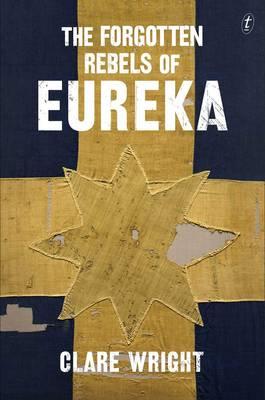
Congratulations ‘Forgotten Rebels’

the-forgotten-rebels-of-eureka

Congratulations Clare Wright on winning the Stella Prize for her book  The Forgotten Rebels of Eureka.  You can read my review here.

And well done her, too, for donating $2500 each to the Indigenous Literacy Foundation and her local high school, Northcote High.  This is the second time this week where I’ve read of donations/fundraising going to public schools- the other was an article yesterday about leading chefs contributing to  school cookbooks for local state-run schools.   This is the cultural (as well as financial!) capital that private schools trade on and government schools lack.  Good on them.

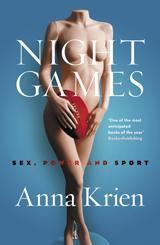
‘Night Games’ by Anna Krein

krein2

This book sits comfortably on the shelf that holds Helen Garner’s Joe Cinque’s Consolation, Chloe Hooper’s The Tall Man and indeed, Krein’s earlier book Into the Woods.  Like them, it starts with a court case as its springboard.  Here, it is the trial of Justin, a VFL player who hasn’t quite made it to the AFL standard, who is accused of rape after one of those numerous footy gang-bangs we read about.  They bubble up into the news, meet with momentary tut-tutting and ‘boys will be boys’ then submerge again until the next dreary occurrence.

Like Garner and Hooper before her, Krein sits in the courtroom, observing the procedures, watching the protagonists and their families, feeling her own sympathies being twisted and swayed by what is playing out before her.  “Playing” is the operative word here, because as observer, she is privy to what the jury is not: the blokey negotiation of what can and can’t be said in the court, and the effect of the enforced silences on the narrative that can be made to explain the events on the night of the crime.

For Justin may have been hanging around with the Collingwood Football Club big boys, but he wasn’t one of them.  At first the courtroom bulges with Eminent Legal People because there is a chance that Collingwood stars will be caught up in it, but once the involvement of The Club is negotiated, they depart.  Justin’s whole family will pay financially and dearly for the legal representation they are left with.

Justin’s family feel that Krein is on “their” side, but she is not completely.  Sarah, the rape victim, does not engage with her at all (as is her absolute right), but it does mean that the narrative of the book is somewhat slanted.

But Justin and Sarah and what happened that night are only one part of the book as it spins off into a broader exploration of sex, rape, power, celebrity and permission.  This is very much a join-the-dots exercise, as she narrates a series of sexual scandals that have arisen over recent years involving both AFL and NRL, all too many of which involve my own football team, St Kilda.  She teases out these threads even further by examining the treatment of women journalists in sporting culture (for example, Caroline Wilson on The Footy Show) and the ubiquitous Wives-and-Girlfriends who have their own reflected celebrity status.

In many places, she can find no definitive answers, only more questions. She often refers to “shades of grey”  (denoting uncertainty rather than That Book) both in her own response and in the issues that arise.  I must say that I found this rather frustrating.  Both Garner and Hooper, in their fore-mentioned books, also admit to “shades of grey” but somehow manage to come to some sort of definitive statement.  I don’t know that Krein ever does: she can say that there are connections and injustices here, but I’m not sure that she ties them together into an argument that you can take issue with.  You sense that she is dodging what she expects to be brickbats from feminists and football supporters, by raising questions and admitting uncertainty as a pre-emptive defence.

In recent weeks, the questions raised by this book have resurfaced with the publication of an article by The Secret Footballer, where he very much voices the arguments of the sporting fraternity: they (the women) are scrags and ask for it; what about permission etc. etc. etc.  [Interestingly, the article itself seems to have disappeared, but a commentary on the article survives here]. He says that what is driving change is not all the behavioural programs imposed by the clubs, or wider societal change, but fear of exposure through social media.  He never was involved in gang-bangs himself, he says, because he never did like to share his toys.  It’s rather chilling to hear all this voiced so definitely.  It reinforces everything that Anna Krein has written about in this book.

There’s a very good review of the book by Deb Waterhouse-Watson here.

I have posted this review on the Australian Women Writers Challenge website.

awwbadge_2014


‘Reflections on Biography’ by Paula R. Backscheider

backscheider

2001,  235 p. & notes

It’s not hard to find biographers writing about the act of researching a biography.  One of my favourite biographers, Richard Holmes has done it here and here, and there’s a whole literature on the theory and practice of biography. This book, however, looks at the writing of biography, rather than the researching of it. It concentrates on the creation of the biographical text as completed artefact, rather than the ‘journey’ that the biographer undertakes in an attempt to understand and convey the subject’s inner life.

In her preface, Paula Backscheider notes with frustration that reviewers of biographies often retell the subject’s life gleaned from the very biography that they are reviewing without engaging in questions of selection, organization or presentation. These questions are the focus of this book. Continue reading

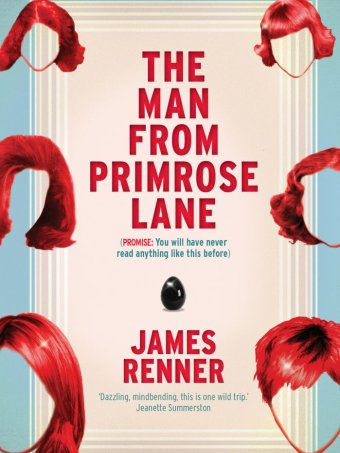
‘The Man from Primrose Lane’ by James Renner

manfromprimrose

2012, 400p.

I’m going to be very old-fashioned and curmudgeonly, but I REALLY didn’t like this book.  I really can’t talk very much about it without divulging spoilers.

Oh, alright – just the start then….an old recluse is murdered.  He had been shot in the stomach and his fingers had been cut off and minced in the blender.  He always wore mittens and seemed to have no friends or family.  David Neff, who had written a best-selling true crime book some years earlier is alerted to the case by his publisher, who is concerned that David is spiralling into depression after the apparent suicide of his wife four years earlier.  Who is this old man? Why does he always wear mittens?…..and then you’ll have to read the rest (if you still want to after this review).

The book is a mash-up, I suppose, of several different writing genres.  It’s all very self-referential and tricksy, but at the end of it, that’s just how I felt- tricked. Call me thin-skinned, but having the author jeering at the reader for wanting some sort of resolution at the end is a bit rich.

It is, apparently, going to be made into a film and it will probably work better on the screen than it does on the page.

The book is a one-off.  The blurb on the front brags that ‘you’ve never read anything like this before!’.  Well, that’s for sure and I certainly won’t in the future.  It’s the equivalent of a sight gag: it only works the first time.

My rating: 3/10

Sourced from: CAE bookgroups.

Read because: it was a bookgroup selection with The Ladies Who Say Oooh. In this case, the Ladies Said “Eeewwww”. Boy, I’m glad that I didn’t choose this book!


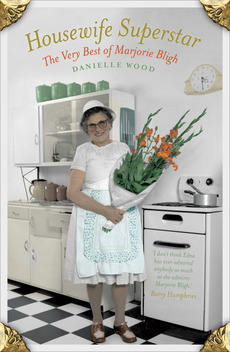
‘Housewife Superstar’ by Danielle Wood

housewifesuperstar

2011, 209 p.

I happened to hear Shannon Lush on the radio the other day- she of the handy household hint and stain removal. How Olde Worlde, I thought: household advice on the ‘wireless’! It brought to mind my mother, who listened religiously to Martha Gardner on the radio. My mother was of the class and generation of women for whom ‘housewife’ was a conscious career choice, a source of pride, learning and improvement. There were new products to try and master, old skills to polish and pass on, recipes to experiment with, and new trends and fashions to encompass. The household hint genre of newspaper columns, books and radio and television programs fed right into this view of housework.
I have never heard of Marjorie Bligh, who seems to have been a Tasmanian phenomenon. I guess that each Australian capital city had their own version. Tasmania’s Marjorie Bligh is said to have been the origin of Barry Humphrey’s Edna Everage, before she became a Dame (humph!) and while she was still Norm’s wife, Valmai’s friend and Kenny’s mother. One of the author’s quests in this book was to probe this claim.


Marjorie had three authorial name changes from Marjorie Blackwell to Marjorie Cooper to Marjorie Bligh as she moved through three marriages. It is a sign of her own individual presence and what we would now call her ‘brand’ that her followers recognized her and followed her through these different guises. Her first marriage was an unhappy one ending in divorce, something more devastating and noteworthy then than now, and she was widowed twice. The author, Danielle Wood, treats these marriages with respect but with a clear eye as well. She allows Marjorie to tell her own story, to withhold and to embellish, but it is quite easy for the reader to fill in the silences and to imagine the other perspectives that others in her story might tell.
Marjorie Pearsall was born in 1917 in Ross, in the Tasmanian midlands. The convict architectural heritage of the town would not have been a tourist drawcard at that time. Her father died when Marjorie was three. Marjorie, as she told it in her own autobiographical writings, was always an industrious homebody, making money for the straitened family through running errands for the teachers, cleaning the school room, knitting and sewing. She was a perfectionist and had ‘stickability’ (p. 31). After leaving school she worked as a ‘help’ until she met her first husband Cliff, whom she married in 1938. In a world seemingly untouched by war, they shifted to Campbelltown.

It was there that she set her sights on the Agricultural Show. In 1958 she surpassed her record of the preceding two years, winning prizes in seventy-eight categories. Her passion was the creation of her dream home, Climar (the combination of Cliff and Marjorie’s names), an Art-Deco inspired brick house, now on the Heritage register (for all the good that will do, as Banyule has taught me) and rather oddly dated for its completion date of 1955. My ex-husband’s family lived in a very similar house that was built in the late 30s-early 1940s- perhaps architectural trends took longer to reach Tasmania?  You can see a photo of Climar here (there are many other photographs related to Marjorie Bligh on this site as well.)

There seems to have been a falling out with the Agricultural Show committee in 1958 over the awarding of the W. T. Findlay cup for most points awarded, and she withdrew from exhibitions in 1960, 1961 and 1962 and in this hiatus in her show career she turned to writing. Marjorie Blackwell at Home was her first book, published in 1965. It was to be republished in three editions . In 1973 under the name At Home with Marjorie Cooper, and then again in 1998 as At Home with Marjorie Bligh. The first edition was 310 pages in length, comprising 44 sections covering food, flowers, gardens, children’s parties, pets and stains. “All these things” Marjorie wrote assertively in the foreword “are dear to the heart and the majority of all women.”

“Assertively” is the operative word here. Danielle Wood’s book is sprinkled with the dictates and aphorisms of Marjorie Blackwell/Cooper/Bligh, gleaned from this and her other publications. There’s a rather threatening confidence in the way that Marjorie frames her advice implying that of course you would WANT to prevent the cock from crowing (by placing a lath above his head so that his comb brushes against it) or WANT TO walk to country dances wearing a rubbish bag with two holes cut in it, drawn up to your waist with the pull-tie to protect the hem of your gown from the mud.

They’re small slices of life from another world. Some examples:  try putting sticky tape on your toddler’s hands and watching ‘him’ being delightful as he tries to pull it off; use a slice of beetroot to rub on your cheeks if you run out of rouge; make a nice apron for yourself by sewing together nine men’s ties. Her worldview is that of “wilful waste brings woeful want” (a family aphorism that I grew up with as well) borne not only from straitened circumstances but also almost as a form of resistance to the deluge of manufactured consumerist goods that now engulf us. However, I still struggle to imagine WHY you would want to crochet a cover for a 5 litre icecream container (so handy for transporting small cakes and scones) out of used bread wraps.

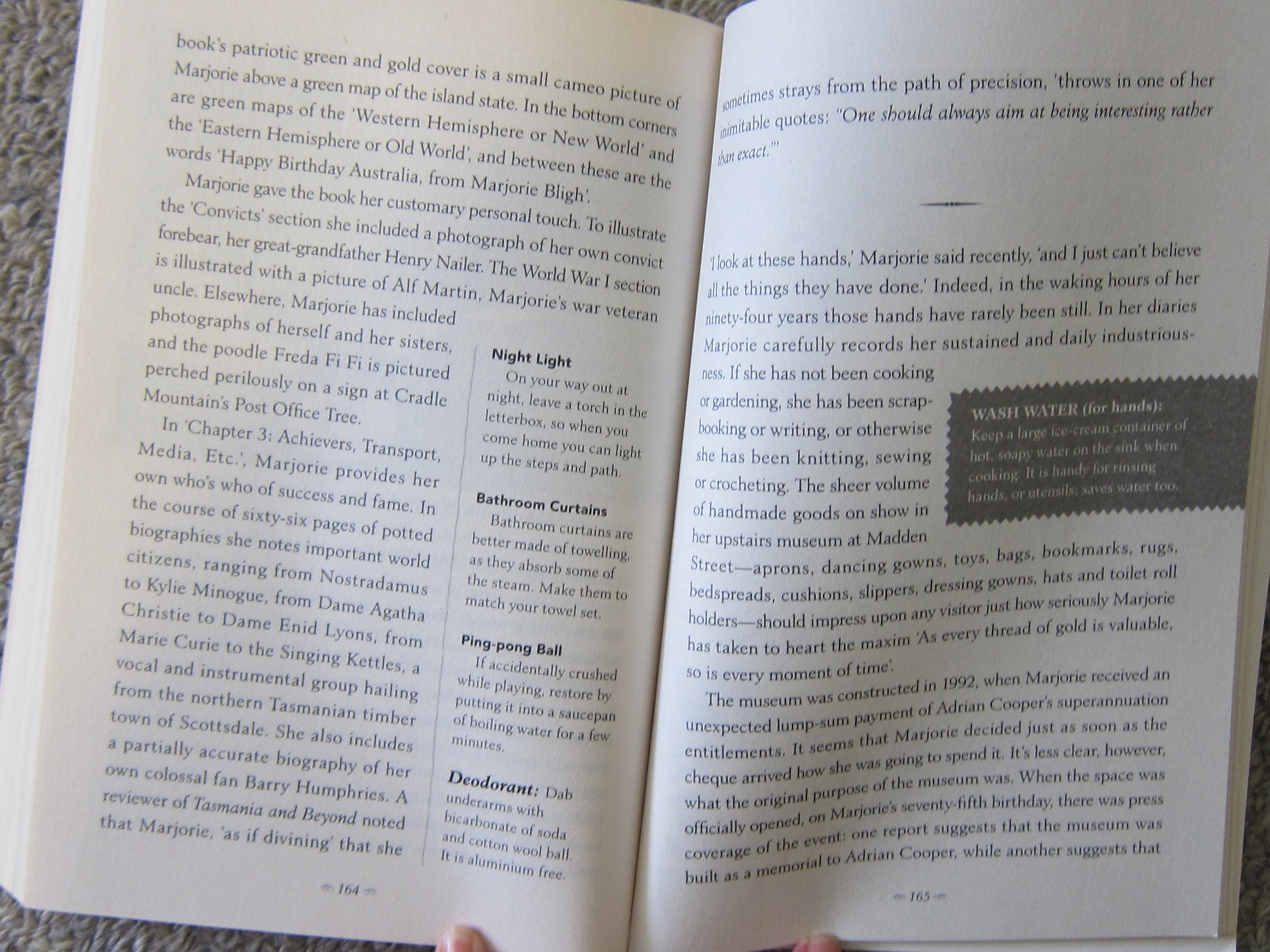
Wood (or her publishers) have decided that these excerpts from Marjorie’s writings drawn from her books and autobiographies should be inserted throughout the book. Hence, as well as small break-out boxes on the side of the text, the narrative is interrupted for pages at a time with a lengthy extract. I’m not sure if I liked it or not. I found myself distracted by reading the excerpt, but on the other hand it captured well this nagging, insistent soundtrack of what I perceived as Marjorie’s imperious, bossy narrative voice.

IMG_0935
By the end of Marjorie’s long career, I think that she had become an unwitting parody of herself. Danielle Wood obviously has great affection for her, but is somewhat wary of her as well. In the foreword, she describes her as “formidable”.

 As I write, she is ninety four years old, and almost certainly muttering into her coffee cup about the dire consequences that will befall me if I fail to finish this book before she dies.

She did. The book was published in 2011 and Marjorie died in September 2013.
In her conclusion, Wood reflects on her own ambivalent feelings about Marjorie (p.206)

Though I have spent hundreds of hours with her books and diaries, and talked with her, I still struggle to get a fix on Marjorie. At times on the page, I have found her difficult to warm to. But while she is often self-serving in her explanations of past events, she is also honest enough to supply the facts that allow readers to construct alternative understandings. In person, I have always enjoyed her frankness, humour and generosity. But I have always known, too, that she would have me on toast in a flash if I vexed her or let her down. It has been difficult to reconcile the written Marjorie with the living one, and simultaneously to understand the multiple versions of Marjorie that have manifested during her ninety four years.

The book is lightly written and yet insightful. It’s quite a difficult task to render gently and with respect someone who has, with the passing of time, almost become a spoof. Wood lets Marjorie speak for herself, and lets the reader fill in the silences and omissions. Ironically, with the return to ‘natural’ products and deep-green environmentalism, Marjorie could become an unlikely poster-girl for sustainability, and some may wish that there was an index to this book to locate an unlikely household hint. It is a book which chuckles to itself, but quietly.

awwbadge_2014I’m posting this review to the Australian Women Writers Challenge 2014.