Category Archives: Book reviews

‘Ghosts of the Orphanage’ by Christine Kenneally

This review includes references to physical and sexual violence against children.
2023, 324 plus notes

I remember a conversation between two women my age, both lifelong Catholics, whose children had all attended Catholic schools and whose extended family rhythm moved along the course of baptisms, first communions, confirmations and weddings. Their sense of outrage by these revelations of predatory priests, shifted from church to church by the hierarchy and the secrecy and obstruction which had hidden it for decades, was almost palpable. There was a gender element to it as well: that ‘good women of the parish’ had been betrayed by powerful men into handing their children over to a dangerous situation, where the authority of the priest was so paramount that no questions could be asked for a long time.

One step further again, though, is the accusation that nuns, too, perpetrated acts of physical and sexual violence against the children in their care. Not the angry, strap-happy sister of the local Catholic school -and let’s face it, many State school children have memories of shrieking teachers, the ruler and the cuts too- but the constellation of nuns and chaplains who surrounded children in church-run orphanages, where there was no escape to home, family or outside influences. Yet this is what Christine Kenneally encountered, skeptically at first, when writing first about Geoff Meyer, who lived at Royleston at Rozelle Bay in Sydney (you can read her 2012 essay The Forgotten Ones from The Monthly online) which led her on a ten-year search that took her to Vermont U.S., Canada and Scotland. Looking back, she realized that she had brushed against the system herself when she as a Catholic schoolgirl, attended a theatre camp run by Father Michael Glennon, later convicted of sexually abusing 15 children in court cases that spanned 25 years, who regularly visited a boys’ orphanage called St Augustine’s, Geelong. She was not a victim: but many other traumatized adults that she found as part of her search across Western orphanages were.

This book is the story of this search, with particular attention paid to St Joseph’s Orphanage in Burlington, Vermont, an institution run by the French-Canadian Sisters of Providence that operated from 1854 to 1974 which the author, Australian-born Christine Kenneally (no, not the Canadian-born Australian ex-parliamentarian) exposed in a Buzzfeed article in 2018 We Saw Nuns Kill Children. Her report drew heavily on the account of Sally Dale, who lived at St Joseph’s between the age of 2 and 23, with a short period where she lived happily with a family until she was returned to the orphanage. She claimed that she had seen a boy die after being pushed out of an upper-story window by a nun; that she had been forced to kiss a boy in a coffin who had been electrocuted by an electric fence when trying to escape; that a little girl who was tormented by the nuns to make her cry later disappeared; and that she had seen a boy drown after being rowed out onto the lake by nuns. So many deaths- surely there’s something wrong with this woman? I found myself thinking, and although finding her a compelling witness Christine Kenneally did at time too. That was until she stitched together details from other St Joseph’s children, along with death certificates and snippets of information from depositions and courtcases that seemed to go nowhere. There is so much violence reported here by multiple children: a boy deliberately locked outside on a freezing night, a girl with her hand held over fire, an ‘electric chair’ type of contraction, locked cupboards, an attic…. it just goes on and on, and I must confess to becoming confused about who told what.

Although the book focusses on St Joseph’s, she found what she describes as “an invisible archipelago” across the Western world, marked by large, dark manor houses, most 2-4 stories in height, looming large and solitary.

…they belonged to an enormous, silent network. In fact, between St Augustine’s in Victoria, Australia and St Joseph’s in Vermont, United States, existed thousands of other institutions like them: Smyllum Park orphanage in Lanarkshire, Scotland; the Bon Secours Mother and Baby Home in Tuam, Ireland; the Mount Providence Orphanage in Montreal, Canada.

p. 13

She found that the same abusive practices recurred in a litany of pain: bed-wetters having their cold sheets draped over their heads while they were paraded among jeering classmates; beatings; imprisonment in small dark places, and being forced to eat their own vomit.

I finally began to see not just one or two or ten of these places, but an entire fantastic world, a massive network, thousands of institutions, millions of children connected to one another if not by an explicit system of transport or communication, then by the overwhelming sameness of their experiences: the same schedules, the same cruelty, the same crimes committed in the same fashion, then covered up by the same organizations.

p. 15

This is a difficult book to read, and Kenneally is honest about the doubts that she, along with some of the lawyers who prosecuted cases against the church, held at times. The number of cases is numbing and overwhelming, and I began losing track a bit until I found the excellent index at the back of the book. The book raises questions of the nature of traumatic memory, and highlights the use of such questions by the defence lawyers contracted by the Catholic Church to refute the claims. By about 3/4 of the way through the book, the whole situation seemed impossible: there were too many inconsistencies, too many dead-ends, too many failed prosecutions. But in best narrative fashion, Kenneally writes about a turning point when, after years of accumulating public records, journals, legal transcripts and interviews, she gained access to a cache of documents which in turn led to the forging of a series of links that convinced her, me, and the wider public, of truths that had been there all along. I was left feeling angry and betrayed- just like the two women with whom I started this review- that the church, “one of the – if not the-most formidable entities in the world” (p. 314) has used its money and authority to garner the obedience and loyalty of its followers to protect itself alone.

All this time, survivors have been pursuing justice, but the goal of the Catholic Church is unrelated to the causes and ideals of individuals. The goal of the church is suprahuman and is measured in centuries: it has been working to control history.

p. 315

Perhaps, finally, that control is slipping.

My rating: 9/10

Sourced from: Yarra Plenty Regional Library
‘Memoirs of Hadrian’ by Marguerite Yourcenar

Translated from the French by Grace Frick in collaboration with the author.

2000 (original English translation 1954), 288 p

As it happens, I have read two books in a row about a real-life historical figure presented as if the subject was writing his or her memoirs. The first was Isabelle Allende’s Ines of My Soul about Ines Suarez, the conquistadora of Chile, and this second one is Marguerite Yourcenar’s Memoirs of Hadrian. Having been left somewhat disappointed by the contrived and rather clunky nature of Allende’s book (my review is here), within a few pages of the Yourcenar book I knew that I was in the hands of a master writer. Where with Suarez, I felt as if the events were shaping the narrative, with Yourcenar I felt as she was inhabiting the Emperor Hadrian from the inside out. Perhaps this was a result of the long gestation for this novel- she started writing the first (soon discarded) draft in 1924 when she was in her early twenties, and finished it in 1951 at the age of forty-eight after several false starts. The most striking thing about the book is Hadrian’s voice, and as she said in the author’s note at the back – cleverly depicted in a reflective chronology-:

Portrait of a voice. If I have chosen to write these Memoirs of Hadrian in the first person it is in order to dispense with any intermediary, in so far as possible, even were that intermediary myself. Surely Hadrian could speak more forcibly and more subtly of his life than could I.

p. 275

However, I must confess that perhaps my ease with Yourcenar’s book was that I wasn’t coming to it completely ignorant of its main character. I consciously chose not to Google Inez Suarez, but allowed the book to tell me all that I needed to know. Allende’s book certainly did that, but that was almost its weakness: it became a rather didactic, fact-driven narrative that made you suspect that Allende still had her notes beside while she was writing. Yourcenar’s project could not have been more different. Although I myself have come late to Roman History, many others have not, and most people would have heard of Hadrian’s Wall, if nothing else. For myself, I have listened to the whole Mike Duncan History of Rome podcast, and I’m enjoying the LaTrobe University Emperors of Rome podcast series. I had just finished listening to the episodes on Hadrian (Episodes Episode LII – Hadrian the Little Greek to Episode LVII – Little Soul, Little Wanderer, Little Charmer cover Hadrian’s life) before reading this book, so I was familiar with Hadrian’s life. Hadrian did in fact write a memoir, but it has been lost. This book imagines this lost memoir in the form of a letter written by the elderly Hadrian to his adoptive grandson and eventual successor “Mark” (Marcus Aurelius).

And because Hadrian could assume that his adopted grandson already knew about him, Yourcenar pretty much assumes that you know about Hadrian too. The Hadrian she depicts in this putative ‘memoir’ is not a man of facts and events, but instead of feelings. She is not out to make an argument about events in Roman history (as Robert Graves did in his depiction of Livia in the I Claudius books- it’s interesting that Graves also adopts this fake-memoir narrative frame) but instead to imbue emotions and judgements into the facts. As a result, you probably need to know the bare bones of Hadrian’s life for it to make sense, because she’s not going to tell you. For example, Hadrian neither confirms nor denies that Trajan’s wife Plotina manipulated his nomination as Trajan’s successor; we do not learn the events that led to the death of Antinous, his favourite; and the assassinations of enemies that marked the beginning and end of Hadrian’s reign are referred to obliquely. Instead, what we have are his reactions to events. We see him as a soldier sickened by the bloodshed and violence of the Sarmatian Wars, leading to his abandonment of Trajan’s policy of imperial expansion. We see a man who delights in the architecture and learning of Greece as a form of intellectual fulfilment. Unfamiliar as we are with the forms of love between men in Roman culture, we see a man who bathes the young Antinous in adoration and wonder, while remaining opaque about the sexual side of that relationship. We see a man shattered by grief, who loses all joy in the world around him after Antinous’ death, which he comes to understand as a form of sacrifice to him. We see a man increasingly ground down by illness and depression, longing only for death.

Do you need to know about Hadrian before reading this book? I think that perhaps you do, but in some ways it’s not about Emperor Hadrian at all; instead its about Hadrian the man (albeit, as an emperor, he’s not Every Man). I think that it’s a book that as a reader, you would grow into, and I think that an older reader would appreciate it more than a younger reader would. It’s certainly a book that would bear re-reading again and again. The text is rather dense, and there are no reported conversations, so in less skilled hands, it could be rather dry. But it’s not: it is beautifully written, and I think that it deserves the appellation of “masterpiece”. I loved it.

My rating: 10 out of 10

Sourced from: purchased from Readings.

‘Beyond Belief: How Pentecostal Christianity is Taking Over the World’ by Elle Hardy

2021, 262 p & notes

It seems rather hard to believe now, at fifty years’ remove, but as a 16 year old I was ‘born again’ and converted to evangelical Christianity. The early 1970s was a time of Jesus People, Larry Norman and Hal Lindsay’s book The Late Great Planet Earth. I’m not sure whether that would have counted as ‘Pentecostal Christianity’ as Australian journalist Elle Hardy describes it in this book because, although there was an emphasis on the Holy Spirit and although I was often in the presence of people who spoke in tongues (without ever doing so myself), it was also ‘It’s Time’ for the Labor Party after twenty-three years of conservative government in Australia. The Christianity I subscribed to had little to do with the prosperity gospel of much (not necessarily all) Pentecostal religion today – in fact, it leaned more towards anti-materialism and environmentalism- and I could see no conflict at all between progressive political ideas and Christianity, indeed I think that Christianity demanded it. I don’t think that the Pentecostal religion she describes here would have room for those views today.

Hardy’s book is divided into two parts: Part I The Good News: The Unstoppable Rise of Pentecostalism, and Part II Spiritual Warfare: The Battle to Build Heaven on Earth. She traces the modern manifestation of Pentecostalism back to 19th century America, disregarding, rather short-sightedly I believe, older British and European manifestations of Pentecostalism. Instead she identifies three founding figures: Charles Fox Parham, who preached in Kansas, Texas and Oklahoma; William J. Seymour, an African-American evangelist who was encouraged by Parham to bringing this new form of Christianity to the Black Community through the Azusa Street Revivals of 1906 to roughly 1915; and Aimee and Robert Semple whose speaking in tongues as part of their baptism in the Holy Spirit encouraged them to go to China (they believed that they were speaking Chinese) where Robert died. His widow married Harold McPherson, thus becoming Aimee Semple McPherson. All three ended up being embroiled in scandals of various types- a harbinger perhaps of the scandals that have dogged and continue to dog many Pentecostal ‘celebrities’. The Pentecostalism she describes distinguishes itself from other forms of Christianity in its heavy emphasis on the Holy Spirit, and its manifestation through speaking in tongues, miracles and healing. Rather ironically, some of the major ‘brands’ of Pentecostalism have distanced themselves somewhat from the speaking in tongues element (it is a bit unnerving).

She then embarks in Part I on a world-wide tour of Pentecostalism in its various guises across the globe, reflecting the sub-title of her book. She travels to Rock House Holiness church in Alabama, an ‘old-style religion’ type church that features snake-handling, but which also reflects the origin of much of the rock music that emerged in the 1950s where singers like Rosetta Tharp, B. B. King, Elvis Presley and the Righteous Brothers (of course!) made their start from their Pentecostal churches. The emphasis on music, most particularly through the Hillsong empire, continues today and often distinguishes Pentecostal worship, with its concerts, rock bands and lighting, from other forms of Christian worship.

Chapter 3 takes her to North Korea, where the Pyongyang Revival before the 1949 Communist Revolution saw 100,000 people converted, usually by American missionaries, to the extent that Pyongyang was dubbed ‘The Jerusalem of the East’. The North/South border between the Koreas is not just political: it is also the demarcation between Christianity and non-Christianity. Across the border, in South Korea, megachurches like the Yoido Full Gospel Church with its 200,000 regular attendees describe themselves as Presbyterian, but 85% of them are actually Pentecostal. It is quite common for defectors from the North to find themselves at these churches where, if they make their way to Seoul, they find themselves overwhelmed by the noise, competitiveness and discrimination they encounter there. They find that their conversion narrative becomes a form of ‘currency’ where churches provide scholarships, free health services and donations through their congregations, in return for these stories of redemption and conversion. A similar scenario is found in in the UK, where in Chapter 6 she finds large numbers of Travellers (gypsies) converting to Pentecostalism, where being a practising Christian makes an outsider more accepted in post-Brexit Britain. In fact, there are now 17,000 Pentecostal churches in the UK (one congregation for every 2 pubs!), with branches of international Pentecostal Churches e.g. Hillsong, the Universal Church from Brazil, and West African churches, not only ministering to their diaspora, but also engaging in a form of reverse mission, pushing back against ‘liberal’ Christianity and its acceptance in particular of gay marriage.

She visits the Universal Church in Brazil, where celebrity Pentecostalist Flordelis, politician and mother of 55 children (over 50 were adopted) , achieved media-wide coverage when she was jailed for conspiring to kill her younger husband. Indeed, Brazil is the most Pentecostal nation on earth, with the percentage of Pentecostalists rising from 3% of the population in 1980 to 30% in 2020. As she points out, the prosperity gospel preached by Pentecostalist churches is not a fallacy. Once people get their lives together through conversion, often leaving behind crime and addiction, and are encouraged to branch into small businesses which are patronized by the large number of fellow-congregationalists, people do become wealthier. Likewise in African nations. In Zimbabwe, half of the population belongs to an African Pentecostal Church, eclipsing 40% in South Africa, and one third in Kenya. African Pentecostalism often combines pre-Christianity and Pentecostal beliefs, reflecting the ability of Pentecostalism to shape-shift according to the culture. These churches often combine fasting, rituals, healing and miracles.

Part II then explores how this plays out in political trends. She starts off in Chapter 7 at Bethel Redding church in California, one of the largest and best known of the Pentecostal Churches in America. Despite being in a state dominated by liberals (in the American sense of the word), this is the heartland for the Christian Dominionist Project, better known as the Seven Mountains Mandate. This arose from about 1974 when Pentecostalists moved from the idea of The Tribulation which would presage the Second Coming, to the idea that Christians themselves would have to create the conditions of Heaven on Earth before Jesus could return by moving into the Seven spheres of education, religion, family, business, government, arts and entertainment and media. Within the U.S. the Seven Mountains Mandate has led to direct involvement in government administration, as for example in Brazos County, Texas, where the Jesus Said Love movement is contracted and paid to run ‘john’ schools as an alternative to fines or incarceration for men arrested for procuring the services of a prostitute through a ‘sting’. The related ‘Unbound’ movement, which purports to be anti-trafficking, is a way of stamping out prostitution completely (rather than legalizing it, which is another approach). It’s not surprising that this has morphed, for some people, into the QAnon child-trafficking conspiracy, and into links with the 6 January 2021 uprising.

In countries like Guatemala the rise of Pentecostalism, spurred by the arrival of US missionaries in the 1960s, has led to a rejection and even persecution of Mayan priests: a different situation from the Liberation Theology of Vatican II which encouraged a form of Mayan Catholicism. Indeed, Guatemalan Catholicism itself today can largely be described as Charismatic Revival, a reflection of Pentecostalism. Likewise in Nigeria, with its Muslim North and Christian South divide, Islamic mosques are finding themselves adopting Pentecostalist-type practices both as a way of distinguishing themselves from Islamic fundamentalism (e.g. Boko Haram) and as a way of stopping the drain of their adherents to Pentecostal Christianity. Similarly, the Jews for Jesus movement, a form of ‘Messianic Judaism”, adopts Pentecostalist- practices even though it is not recognized by the major Jewish denominations. She highlights the importance of Israel to the End Times narrative of Pentecostalism, with its ardent Zionism and support of Israel, Trump’s shift of the U.S. Embassy from Tel Aviv to Jerusalem (and Australia’s craven pretense to do the same) and the popularity of package tours to Israel amongst Pentecostalists.

I had thought at first that she had over-reached in her subtitle ‘How Pentecostal Christianity is Taking Over the World’, given the numerical growth of Islam and the increased prominence of Hinduism in India. But when she lists politicians like Duterte in the Phillipines, Orban in Hungary, and the push towards Pentecostalism in both Ukraine and Russia, and describes the adoption of Pentecostalist practices in Catholicism and some forms of Islam and Judaism that are competing in the same ‘market’, perhaps there is more truth in it. I’m not sure that she actually explained why there is this political link between Pentecostalism and populist conservatism: to me, there doesn’t seem to be anything inherent in Pentecostalism that dictates that the two be aligned.

This is a broad-ranging book, truly international in its scope, written in an engaging style with enough personal vignettes to keep the human interest in what could have otherwise been a rather turgid exploration of theology. But really, it’s not about theology at all: it’s about a phenomenon that acts as an antidote to marginalization in both First World and Global South countries, and about Pentecostalism’s link with right wing politics, power and money.

My rating: 8.5

Sourced from: Yarra Plenty Regional Library, and read after hearing the author speaking on the New Books Network podcast.

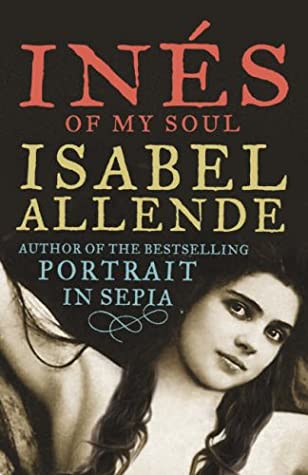
‘Inés of my Soul’ by Isabel Allende.

Have you heard of Inés Suarez? I hadn’t, and from Isabel Allende’s Author’s Note at the end of the book, it seems few other people have either, because she was “nearly ignored by historians for more than four hundred years”. She was a Conquistadora born in 1507 in Spain, and along with her partner Pedro Valdivia, and then later with her husband Rodrigo de Quiroga, she established the city of Santiago that is today the capital of Chile.

After marrying Juan de Málaga, she was left in Spain for years as her husband travelled to the New World in search of riches. When he did not return, she received permission to go in search of him. She arrived in Peru in 1538, where she learned that he had been killed. As the widow of a Spanish soldier, she received a land grant and and encomienda rights to a number of Indians. Her land was adjacent to that of the Spanish conquistador Pedro de Valdivia and they became lovers. When Valdivia decided to push into the territory now known as Chile, she accompanied him, ostensibly as his domestic servant, to avoid the strictures of the Church. After a harrowing trip down through the Andes and the Atacama Desert, they arrived at the valley of the Mapocho river, in December 1540, some11 months after leaving Cuzco and established Santiago. The indigenous Mapuche people resisted the invaders over several battles. The Mapuche destroyed Santiago on September 11, 1541 (what is it about that September 11 date?). Vastly outnumbered, the Spaniards retreated to the plaza, where Inés decided to decapitate seven Mapuche hostages who were being held for ransom, arguing that the Mapuche were calling out encouragement to their kinsmen. She threw the heads into the crowd, who fled. However, Santiago itself was in ruins, and the settlement almost starved until it was able to re-establish itself. Meanwhile, her lover Pedro de Valdivia was summoned back to Peru to face charges levelled against him by his enemies. He was found innocent of all charges, except that of living with Inés Suarez in the manner of man and wife. He was forced to break off with her, and bring his own Spanish wife (who had also been left in Spain while he was off adventuring) to Chile. He arranged for Inés to marry one of his generals, Rodrigo de Quiroga, whom he left in charge of Santiago while riding off to try to subdue the Mapuche. She was much younger than Rodrigo, but they fell in love. After the death of Valdivia, Rodrigo became Governor twice, in 1565 and 1575. She and Rodrigo died in Santiago in 1580, within months of each other.

Well, there’s certainly enough in that life to fill a book, and I’m a little surprised that others had not done so before Isabel Allende’s book (there are some earlier attempts, but not very well known). As a well-known Chilean writer, she is well placed to popularise Ines’ story, and she says in her afterword that she spent four years researching her. It’s a shame, then, that the final product is so flat.

Part of the problem is Allende’s choice of a memoir, supposedly written to her daughter, as the frame story. As a result, it is a book with little conversation (as Alice in Wonderland might have complained) and when there is conversation, it seems rather implausible that it would be remembered verbatim. As a historian, I acknowledge and salute Allende’s determination to stay within the boundaries of the history, but it doesn’t necessarily lead to a riveting story. Allende imagines herself into Suarez’s emotional life with her lovers, but the most dramatic scene of her life story (if, indeed it is true- some historians question this) is where she executes the seven hostages, and this is merely reported, with little anguish or regret on her part, and without rich – if gory- description. The narrative voice of Suarez, recounting her memories, is rather stilted and academic, and it was difficult to suspend disbelief enough to go along with the conceit that it is Suarez talking. I can understand that, as a woman writing about another woman, Allende would want Inés Suarez to tell her own story, but I think that a better frame story might have been told from the point of view of an observer.

So all in all, a bit disappointing, especially from a writer with the profile and reputation of Allende.

My rating: 6.5 (There was an Amazon Prime series made of her story, based on the book. It is on YouTube (Ines Del Alma Mia) but the subtitles are only in auto-generated Spanish).

Sourced from: the little library in Macleod Park.

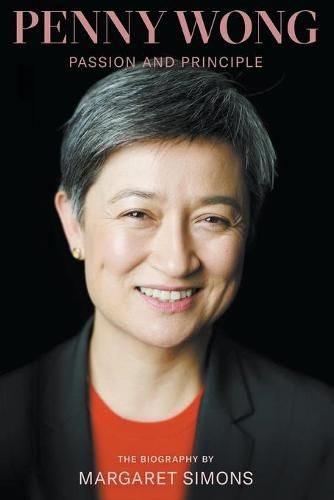
‘Penny Wong: Passion and Principle’ by Margaret Simons

2019, 318 p.

There are special challenges in writing about a current politician. While there are plenty of informants, there is also the spectre of defamation and the whole vexed issue of whether a biography is authorized or not. The political fortunes of the subject may change dramatically, and today’s policies and stances can be rendered obsolete by tomorrow’s developments. Margaret Simons’ biography of Penny Wong was written in 2019, while the Labor Party was still in opposition. Wong was reluctant to be involved in the biography and when she did finally agree to be interviewed, the sessions were conducted in neutral spaces (no empty fruit bowl for her!) with strict limits on what could and could not be discussed. I wonder if she would concede to be involved today, now that she is minister for Foreign Affairs: I suspect not.

Penny Wong is very much aware that she is the first Asian, gay, female Parliamentarian and it was largely because of these adjectives that she decided to run for the Senate with its statewide vote rather than the more geographically concentrated House of Representatives where a targeted negative campaign could cruel her chances. Because she is a Senator, and unlikely to change to the House of Reps, there has been little anointing of her as ‘the next female Prime Minister’.

She has never wanted the Asian/Gay label to define her, but that has happened anyway. I was surprised to learn that her mother’s family, the Chapmans, were an old Adelaide family with a much longer pedigree than many of those who told her to go back to where she came from. She was born in 1968 in Borneo, of Hakka heritage, a group originally from central and southern China, who had emigrated to Borneo to take up land offered to Chinese labourers by the British North Borneo Company. Her father Francis Wong came to Australia in 1961 under the Colombo Plan to study architecture, and he and his wife returned to Sabah, where he became a leading architect and minor public figure. She and her brother Toby were born in Borneo and brought up in a ‘cultural, religious and ethnic melange’. Her much-revered grandmother Lai was Buddhist, her father Catholic and her mother nominal Methodist, and the family celebrated Christmas, Chinese New Year and Muslim religious festivals. In 1976, Penny’s parents split up, and the siblings moved to Australia with their mother, although they returned often to Kota Kinabalu for school holidays. She was unprepared for the racism that she encountered in Adelaide: a neighbour yelled at her to ‘Go back to where you came from, you slant-eyed little slut!’ and anti-Asian slogans were spray-painted on their driveway. She was verbally and sometimes physically bullied at primary school. It was at primary school that she resolved not to show her hurt, and this restraint has followed her into her adult, political life, as has -unfortunately- the racist bullying. Racism seems to have formed an invisible straitjacket around her, and continues to constrain her.

This was less true of her sexuality. I was surprised to learn that she had been in a relationship with later premier Jay Weatherill before embarking on a relationship with Dascia Bennett, a woman eight years Penny’s senior with two children, who Wong considered as her step-children. She was later to meet and have two children with Sophie Allouache. As she says:

It is always about the person first. You fall in love with the person…I hope I have some empathy for those whose coming-out experience was really formative, but that wasn’t my experience. I was who I was in most ways before I decided I was in love with a woman. I was formed much more by an awareness of race than sexuality.

p.83

Once she was elected to the Senate, she and her political advisor John Olenich were debating ‘how to deal with the sexuality issue’. She protested that she had never been in the closet, and therefore she did not need to come ‘out’ but they agreed to a profile about the two new female Senators written by an acquaintance from university days, Samantha Maiden, which had a single reference to her sexuality: “In Labor circles, it is also well known Senator Wong is gay, a fact she would prefer to leave as a private manner. It was not an issue during her preselection to Labor’s highest ranks.” (The Advertiser, 10 August 2002)

After attending Scotch College where she proved herself to be an outstanding student, she attended the University of Adelaide, and this is where she became involved in student politics as a representative of the Students’ Association and the Adelaide University Union board. She was not necessarily fated to be attracted to the Labor Party. She could have just as easily become involved with the Liberal Party as the Labor Party, until John Howard moved to the right with his racist dog-whistling to attract Pauline Hanson-type voters. It was while she was protesting outside a Labor convention that was debating a graduate tax – and the vote was tied- that she realized the importance of ‘being in the room’, and this has become one of the touchstones of her political stance. At many times- and most particularly during the multiple futile attempts to change Labor party policy on same sex marriage- she remained in the room, even though she was then forced to publicly adhere to a policy that she did not agree with. But for her, the important thing was that the debate was still had, inside the room. But should she have openly opposed Labor policy? In reporting her interview over this topic, Margaret Simons observes that Wong was “defensive and combative”. Wong tells her:

I had a decision to make at that time that I could either resign in a blaze of glory or I could stay and fight. And I did make that decision in 2004- that I would make sure that we changed the party platform one day, and that ultimately we would change the country.

p. 149

It was to take twenty-three bills introduced into parliament, usually by minor parties, until marriage equality was finally achieved in 2017. With her hands covering her face and brushing away tears, the country had finally been changed.

Quite apart from the areas of race and sexuality, which are of personal importance to Penny Wong, I had forgotten that she had been responsible for the Water and Climate Change portfolios – two intractable policy areas, both of which were caught up in the toxic politics of entrenched interests and grandstanding. She was not particularly successful here – indeed, has any politician been successful? – although her pursuit of buybacks in the Murray-Darling scheme have turned out to be more successful than the infrastructure improvement approach which followed her tenure, with little evident improvement. As Climate Change minister, she got caught up in the international politics of the COP meetings and Kevin Rudd’s declaration and then retreat from ‘the greatest moral challenge of our time’. Her political judgement was astute but largely behind-the-scenes: she was the only colleague to raise the question of the electoral implications of Rudd’s back-pedalling.

Written in 2019 (an updated second edition is due out this year), Margaret Simons was witness to Labor’s defeat in an election that many thought was an assured Labor victory. It meant that Wong remained a shadow minister, but her work in preparing to be Foreign Minister was prodigious, and was evident (after the book had been published) in Wong’s quick spring to action as soon as Labor won office in 2022. Despite Paul Keating’s withering putdown of her for Penny Wong for “running around with a lei around [her neck] handing out money” in the Pacific, I think that she is very capable and her quiet, polite demeanour has enhanced Australia’s reputation, as well as her own.

I know that Adelaide is a small town, but I hadn’t realized how closely intertwined (dare I say ‘incestuous’?) Adelaide politics were, and probably still are both within the Labor Party and in the political arena generally. In the interplay between student politics, the legal/political profession and across formal political parties, allegiances and enmities were formed and continued over time, including when the participants moved onto the national stage. Wong established a firm friendship with Mark Butler, and a combative relationship with Don Farrell, both of whom are Adelaide representatives and current ALP ministers.

Simons makes no secret of the fact that Wong is a political animal. She has played political games and made political judgements, and not all of them do her credit. She has displayed loyalty, particularly to Kevin Rudd long after others had moved away, and to Anthony Albanese, whose time has come. She has made enemies too.

Simons has chosen as her subtitle ‘Passion and Principle’. Apart from the obvious alliteration, I wonder why she chosen “passion” in describing Penny Wong. Her demeanour is deliberately passion-less – her breaking down in tears after the same-sex marriage plebiscite notwithstanding- and Simons points out the ‘Wongisms’ that she uses to keep control of her language e.g. her low, quiet delivery; her expressive eyebrows to suggest skepticism; her vocal tics like ‘the best of our generation’ and ‘let me just say this’. It came as a surprise to read some of her lectures and addresses (e.g. the John Button Memorial Lecture) where she spelled out her beliefs and priorities and I found myself thinking “You are really good” in a way that doesn’t come through in other forums. While not indulging in ‘what-if’ thinking, Wong entertains counter-factuals as part of working out her position, and she eschews the idea of binary thinking, always looking for an alternative.

Her passion seems to have been constrained by the second ‘p’ of the subtitle: principle. In deciding to ‘stay in the room’ she steadfastly abided by cabinet solidarity outside it (something that I am criticizing pro-Voice Liberal front-benchers for doing), even when it went against her own interests. This came through most clearly to me at the 2011 South Australian Labor convention where the question of a conscience vote for same-sex marriage would come up for debate. She warned Julia Gillard (who opposed a conscience vote) that she would publicly support a change to the party platform. As the most senior South Australian member, she held Julia Gillard’s proxy, and knowing on principle that she couldn’t use it, she gave it to Don Farrell, thus giving her opponents an extra vote and opening up a space for Farrell to give an incendiary ‘no’ speech. (p.231) Given how important the question of same sex marriage was for her, that’s principle.

Margaret Simons is not an invisible presence in this biography. Coming from the press ranks herself, she affords an influence to the media that perhaps a political scientist or historian would not.She has had to actively pursue Penny Wong, and the long list of nearly forty named informants at the end of the book and an extensive bibliography and index reflect her diligence in writing this book. At times it reads like a tussle between two feisty interlocutors: she often challenges Wong’s assertions, and Wong pushes back. Penny Wong has been firm about the ‘no-go’ areas (e.g. her brother, her children). This is no hagiography: instead, as with other good interviewers (I’m thinking her of Janet Malcolm) Simons is reflecting on her own practice as a biographer and refining her own ideas about politics and politicians. In the final pages, Simon says:

…as the book had proceeded I had come to think of it as being about politics itself: how hard it is, the price that is paid in the struggle to make change, and both the necessity and inevitability of compromise, even when- as with climate change- such compromise may do us in. I was thinking that perhaps, as with a tragic play, the audience might leave with a greater understanding of the human affairs it depicted. Perhaps they might also grasp the humanity behind the headlines- and what it meant for a person of talent, passion and principle to devote herself to delivering the service of political representation.

p 317

I think that Simons achieved this admirably.

My rating: 9/10

Sourced from: own copy

Read because: Ivanhoe Reading Circle selection for April.

‘Nothing Bad Ever Happens Here’ by Heather Rose

2022, 236 p.

SPOILER ALERT

I enjoy reading memoirs, but they are a strange beast. First, there are the events that the memoirist decides to include or exclude. Second, there’s the voice that the writer adopts, and here Heather Rose adopts a present-tense, unadorned voice with short sentences. And then there is the structure that the writer chooses to shape their memoir. Heather Rose’s memoir is subtitled ‘A Memoir of Loss and Discovery’ and she uses the loss/discovery dichotomy as the fulcrum on which her memoir balances. Despite the title, you have the sense that for sure something bad is going to happen here.

It starts idyllically enough. Born in the 1965, Heather Rose grows up in a new subdivision, close to the River Derwent and under the watchful shadow of Mount Wellington. Her earliest memory, as a two-and-a-half year old, is of her mother climbing a ladder to hose down the roof during the Hobart Black Tuesday fires on 7 February 1967. Their house was spared, and she continued to grow up in Hobart, ensconced in a family with loving and present grandparents. Her maternal grandfather, Grandad Burgess, built a tiny shack on the Tasman Peninsula, 120 kilometres from home, five minutes from the beach and on the shores of a tidal bay. They spent all Christmas holidays, Easter, long weekends and school holidays at the shack where they ran wild, going fishing with their Grandad, and rather intimidated by their intelligent but imposing Nan Burgess. They had even more contact with their paternal grandparents, who lived across the road from the primary school they attended. As the family lived more than a kilometre from the school, the children would go across to Nan and Pa Rose’s house for a home-cooked lunch every day, and return there after school until their mother picked them up. When Heather Rose was eleven, her grandfather died suddenly of a heart attack, and she learned that

Grief is when nothing can be done and there’s no going back to fix it, and there’s no going forward without knowing that it can never be fixed.

p.15

She is to learn even more about grief the following year. A boating tragedy sees her family rent apart after her brother Byron and Grandad Burgess drown when their fishing dinghy overturns in Lime Bay, half an hour from their beach shack. It is in the wake of this tragedy that she has her first visitations – or whatever you want to call them- from the spiritual realm. The morning before the tragedy, she dreamed that her brother was drowning, and she blamed herself for years for not rousing her parents, convincing them to do something – that it could not be fixed. On seeing her brother leave for the fishing trip, she saw a white light around him as if he were glowing; after his death she saw Byron in their house, sitting in the chair by the bookshelf, standing in the open door. But the family is broken: no-one mentions Byron’s name; her remaining brother becomes moody and volatile; her sister becomes quieter. And

A bitterness sets in between my parents. There are silences at the dinner table, arguments, fights and long cold spells in which Mum and Dad do not speak to one another. I want everyone to be happy. If only, I can make everyone happy, maybe it will be okay. Years later, when my own marriage unravels, I experience the same sense of defeat. I have failed to keep everyone happy.

p. 28

The shack is sold, her parents separate, her mother remarries and her father ‘retreats into a monkish solitude’.

She leaves Tasmania in 1984 to travel around Asia; the backpacker’s rite of passage. She catches typhoid in Java, heads into Thailand, visits opium dens in Malaysia, then becomes addicted to heroin in Thailand. It is the midst of a heroin stupor that she goes looking for death, finding it as an old door mounted in the wall of a cave, that she only has to push open. Then she hears a small voice that says “No. Not this way. Not here. Go back. Go back. Not now.” It is this experience that propels her towards a monastery in Bangkok, opening up the second pillar of her memoir: discovery.

Then follows a long section on her spiritual journey, which takes her from monasteries to Native American sweat lodges and the grueling Sun Dance ritual. Here I felt as if I should be enjoying this memoir more than I was. I am a spiritual person, and attracted to that yearning and questioning that hums under my day-to-day life. But I found myself recoiling in bemusement from the physical extremity and bizarreness of the rituals she describes (appropriates?) as part of her spiritual source. Perhaps there’s a reason why words fail in the face of spiritual experience. How to distinguish the earnestness of this spiritual search for the sublime and transcendent from an unhealthy obsession with the self and the sidelining of other people and issues?

This emphasis on the ineffable dissipates in the chapter near the end of the book titled ‘Elephant’. She has mentioned in passing her diagnosis of ankylosing spondylitis, a crippling hereditary chronic arthritis that brings flare-ups and periods of remission. She uses her hard-won skills in meditation and supplements, but also drugs, supplements and medical cannabis. After many pages describing her own spiritual journey, she becomes frustrated by the remedies, diets, rituals and meditations prescribed in books by Eckhart Tolle, Louise Erdich, the Dali Lama and a long list of other authors. She spells out a long list of forty-nine therapies she has undertaken over the last forty years, from physiotherapy to a whole shopping list of New Age rituals, and any number of food regimes: no starch, low starch, paleo, candida elimination, vegetarian, vegan, no fruit, no sugar no fats, no red meat, raw food, the fast diet. (p 214) As she gradually has fewer flare-ups, perhaps associated with age and menopause, she takes nothing for granted. This chapter, although it seems inconsistent with all the spiritual exegesis that takes up the central part of the book, almost gives the sceptical reader an escape-route: she has undergone all this mortification of the flesh but she needs to heed it, in the end.

She returns to the theme of loss in the closing chapter. Some forty or more years after Byron and Grandad Barnett’s drowning, she tracks down a copy of the coroner’s report on their deaths. Her parents had never seen, or requested, it. She resists the word ‘closure’, but she notes that reading the report eases something in both her parents, to know that there had been multiple attempts to save them. It is when she returns to swim in the bay where they died that she realizes that, for Grandad and Byron, it was what happened. But nothing bad ever happens; that every life is perfect in its own way. She closes with some learnings about memories and their place in our life that reflect, although couched in a bit of ‘woo-woo’ery, both age and experience:

There are memories to acknowledge if we are to learn to live with ourselves, events we revisit over and over, wondering who we are, and why we made those choices. There are always parts too painful to either forget or surrender, and parts that remain unknown until something or someone comes along who offers an invitation. Trauma is a form of haunting. In the darkness of life, there is an invitation for expansion…I’ve come to accept that what I perceive as myself is actually something malleable, prone to change, to shed and reconstruct, and to blossom at unlikely moments and for unlikely reasons. That seems to be the nature of being human. We become what we are story by story, piece by piece.

p, 233, 234.

My rating: A bit too hardcore spiritual and flaky for me. 7.5/10

Read because: I had read ‘Bruny’ and was interested to see what she would do with memoir.

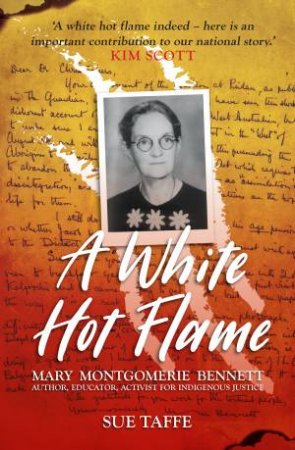
‘A White Hot Flame: Mary Montgomerie Bennett, author, educator, activist for indigenous justice’ by Sue Taffe

2018, 468 p.

“What’s with all the Mary Montgomerie Bennett?” you might be asking yourself, as my other recent post dealt with Alison Holland’s book Just Relations: The Story of Mary Bennett’s Crusade for Aboriginal Rights. Well, March being Women’s History Month, I often volunteer to give the talk during March at my small Melbourne Unitarian Universalist Fellowship group as an opportunity for myself to research a woman whose ideals and values propelled her into activism. In this year of the Voice to Parliament referendum, and perturbed by the splintering of opinion amongst ‘progressives’ and the hardening of attitudes on the right, and stung by criticisms by some among the Blak Sovereignty movement of non-indigenous people acting as ‘white saviours’ I wanted to look at a woman who had been involved with aboriginal activism as a non-indigenous person (as I am). Hence my reading of two books in close succession about Mary Montgomerie Bennett. You can read my talk here.

In many ways I wish that I had read this book first. Although it was published later than Holland’s book, its approach is much more readable and more focussed on biography rather than political ideas. Fundamental to Bennett’s work, she argues, is the conflict and dissonance between her hagiography of her pastoralist father and romanticization of the relationship between blacks and whites on the family station ‘Lammermoor’, and the reality of the impact of government policy on aboriginal lives which she fought all her adult life to challenge.

Perhaps it’s my own leaning towards biography, but I felt as if I had a much fuller picture of Bennett (or Mimi Christison as her maiden name was) through Taffe’s emphasis on her childhood influences and adult experiences, rather than ideas. There are many paradoxes in her life: her emphasis on family in Aboriginal culture and yet her own fairly sterile family life once her much-adored father had died; her entirely correct assertion of the centrality of land to Aboriginal identity and yet her own rootlessness (the amount of travelling that this pre-air-travel family undertook is amazing) and her deep devotion to the Wongatha people of the goldfields of Western Australia and yet lack of action for the Dalleburra of northern Queensland on whose land Lammermoor stood (perhaps out of a feeling of guilt?) Taffe has relied heavily on family correspondence to give a fuller picture of Bennett/Christison’s childhood and London life, and on correspondence with fellow activists both overseas and interstate as she became increasingly critical of government policy. It was much of this correspondence that was seized after Bennett’s death, but Taffe has a more benign explanation than that suggested by Holland.

After an introduction, Taffe’s book is arranged around four main sections, ending with an epilogue:

Introduction

PARENTS AND CHILDREN

  • Ch. 1 Parents: A pioneer Scots pastoralist and a London artist
  • Ch. 2 Mimi’s Childhood

FROM AUTHOR TO ACTIVIST

  • Ch. 3 Mimi Christison: Art student and young English lady
  • Ch. 4 Christison of Lammermoor: Romance burdened by reality
  • Ch. 5 M.M. Bennett: Emerging activist

THE EASTERN GOLDFIELDS OF WESTERN AUSTRALIA

  • Ch. 6 Learning about Western Australia: ‘My eyes open and my mouth shut’
  • Ch. 7 Mrs Bennett, Teacher: Mount Margaret Mission
  • Ch. 8 Commissioner Moseley and Chief Protector Neville
  • Ch. 9 Disillusionment

BELONGING, IDENTITY, COMMITMENT

  • Ch. 10 Dora and Gladys: Wartime London and a return to Australia
  • Ch. 11 Families: Peter Pontara and Human Rights for Aborigines
  • Ch. 12 The Wongatha people of Kalgoorlie
  • Ch. 13 Final days

Epilogue

Perhaps it was the ease of reading, or perhaps Taffe’s emphasis on people, but I came away with a much clearer view of the sheer bastardry of Chief Protector Neville’s ‘absorption’ policy than I had gleaned from Holland’s book- and hence her call for justice as much as ‘rights’. The two books cover the same material (naturally) but I was attracted more to the biographical than political/philosophical approach. They complement each other, but I’d certainly read Taffe’s book first.

My rating: 8.5

Sourced from: e-book borrowed from State Library of Victoria.

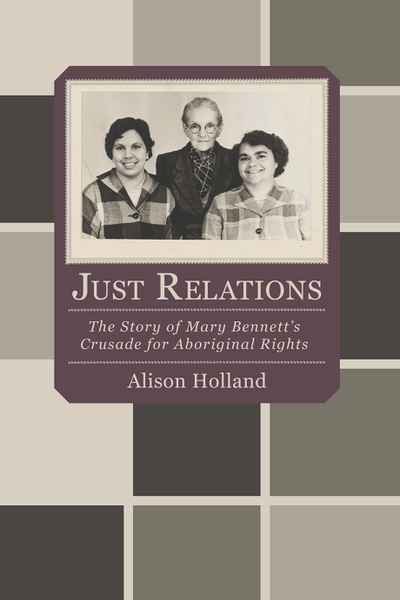
‘Just Relations: The Story of Mary Bennett’s Crusade for Aboriginal Rights’ by Alison Holland

2015, 382 p. plus notes

Books are a bit like buses: there can be nothing for a long time, and then two arrive together. This book Just Relations was published in 2015 and three years later Sue Taffe’s A White Hot Flame was published, both of them dealing with Mary Montgomerie Bennett, aboriginal activist (1881-1961) active from the 1920s through to her death in 1961.

Mary Montgomerie Bennett was a most unlikely activist. She was born in London, the daughter of a Queensland pastoralist and an East End actress mother and she spent most of her early life in England, her way eased by the wealth generated by the Queensland holding ‘Lammermoor’, near Townsville and Bowen. She lived in Australia between for the first six years of her life, but not on the station but instead in Stanthorpe and Tenterfield, Sydney and Hobart. She returned to England with her mother for another five years, before returning to Australia again for a further five years. This time, she would spend vacations between the ages of 12 and 17 with her father on Lammermoor, returning again to sell the property with her father in 1910. Yet Lammermoor, and her idealized view of her father’s own interaction with the Dalleburra people whose land it was, shaped her writing and politics throughout her adult life.

While in London, she became involved with the London-based Anti-Slavery and Aborigines Protection Society and was also confronted in her views by the outspoken Aboriginal activist Anthony Martin Fernando, who stood outside Australia House with skeletons pinned to his coat to protest the treatment of Indigenous people in Western Australia and Australia generally. After her husband’s death she travelled to Australia in 1932 and began working on Mount Margaret Mission, near Kalgoorlie, as a teacher. She continued her lobbying work, both in London and in Australia. She particularly fought against the Western Australian Aboriginal protector A.O. Neville whose blatant policy of ‘absorption’ and ‘die out’ was adopted by other state governments, to be replaced after WWII by ‘assimilation’, which continued the policy of child removal. Over time, she shifted her emphasis and political allegiances from humanitarianism to human rights, and from feminists to activists and internationalists.

Alison Holland’s Just Relations: The Story of Mary Bennett’s Crusade for Aboriginal Rights is a fairly academic book that examines her connections with various networks and lobbyists over time, as Barnett’s emphasis shifted from humanitarianism as a political project, to human rights as an international campaign. Holland contextualises her discussion of Mary Bennett’s ideas within Michael Barnett’s discussion of this philosophical shift from humanitarianism to human rights in his Empire of Humanity: A History of Humanitarianism (2011). This emphasizes the international context of Bennett’s work as she developed networks with other people working in the political space. Although originally working within the ‘missionary’ mode, with an emphasis on education and the rights of aboriginal mothers, near the end of her life she joined with other political indigenous and non-indigenous activists, especially from the southern states, working to raise the profile of government policies and their abnegation of human rights, an increasingly potent international idea. This narrative is very much a political one, as was Bennett’s own writing, and it ranges across international, state and national levels. It was very much a crusade in writing and discourse mode, as she collected evidence, wrote submissions, appeared before commissions, maintained correspondence and wrote articles. Anthony Martin Fernando may have had his coat with toy skeletons: she had her files and her pen.

The book starts with a discussion of dissent at both imperial and Australian levels (with an emphasis on the former), then moves to a more chronological survey of Bennett’s life and the change in her emphasis over time. The chapters are

  • Introduction
  • Chapter 1 Contextualizing Dissent: Humanitarians and the Aboriginal Problem
  • Chapter 2 Defining a Reform Agenda: Mary Bennett and the Humanitarian Moment
  • Chapter 3 Freeing Women: Righting the Wrongs Done to Aboriginal Women
  • Chapter 4 Domestic Rules: Ignoring the Rights of Mothers
  • Chapter 5: Mt Margaret: Promoting Adaptable Education
  • Chapter 6: An Inhumane Dictatorship: Challenging Policy in Western Australia
  • Chapter 7 Hunt and Die: Saving the Race from Extinction
  • Chapter 8 Defending Fathers and Sons: Human Rights for Australian Aborigines
  • Chapter 9 Demanding Justice and Freedom: Critiquing Assimilation
  • Chapter 10 At War with Evil: Dying in the Fight
  • Conclusion
  • Epilogue

Holland starts her book with the rather startling scenario of Bennett’s papers being confiscated by government officials after her death in 1961, highlighting the government’s discomfort with her life-long and increasingly internationalist activism. She returns to this scene in the epilogue, and suggests that it may have been part of ASIO surveillance as part of the ‘fabric of the times’. In any event, Holland argues, by confiscating her papers (which were returned but later lost), it was a

profound personal violation because her papers were inextricably connected to Bennett’s spirit and self-definition. They were deeply rooted in her own past and family story as they documented those of others, and they were critical to her crusade because, above all else, she was a writer…There is no doubt that Bennett’s crusade was a mental fight and her pen her sword which never slept. She saw her task as the pursuit of truth and the evidence of the department as it (ab)used its power to defeat Aboriginal lives.

p. 381

This is a fairly dense book, very much embedded in the politics of activism and political groups. The list of abbreviations at the start of the book was much appreciated as her action moved increasingly into the political sphere. It is, as the subtitle denotes, the story of a campaign and issues, many of which have been vindicated and are still relevant today.

My rating: 7/10

Read because: I did a talk at the Melbourne Unitarian Universalist Fellowship about Mary Montgomerie Bennett to both celebrate Women’s History Month and in the context of current debate about the Voice Referendum

Sourced from: purchased second hand.

‘Statements from the Soul: The Moral Case for the Uluru Statement from the Heart’ Shireen Morris and Damien Freeman (eds.)

2023, 288 p.

Although the Uluru Statement comes ‘from the heart’, it is not hard to sense its moral force. Religion does not have a monopoly on moral thinking, but this particular volume contains essays from people of faith, speaking about their moral response to the Uluru Statement and talking about the elements of their own faith that have brought them to that position.

In many ways, this is a further step from the statement issued in May 2022, the fifth anniversary of the Uluru Statement, when the leaders of Australia’s major faith communities passed a joint resolution supporting a Voice, and the referendum to bring this about. The statement said:

As leaders representing diverse religious communities, we declare our support of the Uluru Statement and its call for a First Nations Voice guaranteed by the Constitution. We endorse this reform as necessary, right and reasonable. Indigenous Australians must now be afforded their rightful place in the Australian Constitution…We call on political leaders to take immediate bipartisan action to hold a referendum on a First Nations voice.

p. 12-13

As Shireen Morris says in her introduction:

The joint resolution signified the advent of religious communities uniting to speak with one voice on this issue. The significance of the essays in this collection lies in the unique ways in which these different voices advocate. It is important to hear both the unity and diversity of their messages. They reach the same conclusion – support for a First Nations constitutional voice- but through different and illuminating paths.

p. 14

Then follows a series of essays, most about 8-10 pages in length by religious figures writing from their own religious tradition. Many of them come from multi-cultural backgrounds, which reflects the diversity of Australian society. From within Australia there is:

  • Shireen Morris, Fijian-Indian and former ALP candidate, director of the Radical Centre Reform Lab *
  • Stan Grant, Wiradjuri journalist and writer
  • Kanisha Raffel, British-born Australian Anglican bishop of Sri Lankan descent and Anglican Archbishop of Sydney
  • Peter A. Comensoli, Catholic Archbishop of Melbourne
  • Antonios Kaldas, Parish Priest of Archangel Michael and St Bishoy Coptic Orthodox Church
  • Sabah Rind, lecturer at the Centre for Aboriginal Studies at Curtin University, fourth generation descendant of a Baluch Afghan cameleer and a Badimaya-Yamatji Aboriginal woman*
  • Fiona Jose, CEO Cape York Partnership with indigenous/Torres Strait Islander/Portuguese identity whose family were Latter Day Saints (Mormons)*
  • Ajmer Singh Gill, Sihk and President of the National Sihk Council
  • Prakruthi Mysore Guraraj – Hindu *
  • Sheik Wesam Charkawi, director of Abu Hanifa Institute, NSW muslim
  • Ralph Genende, Jewish
  • Bhikkhu Sujarto, Theravada Buddhist monk
  • Russell Broadbent, Liberal MP, Christian
  • Karina Okotel, former federal Vice President of Liberal Party*

International contributions are provided by

  • Anthony Ekpo, Rome-based, Vatican
  • David Saperstein, Past President of World Union for Progressive Judaism
  • Rowan Williams, Archbishop of Canterbury.

The collection closes with a conclusion by Damien Freeman, Australia Catholic University

Among such a diverse group of writers, some draw on their own biography; others use the history of their own cultural group in Australia (e.g. connections with Muslim Makassans) while others concentrate more on the teachings and principles of their faith that bring them face-to-face with the moral questions raised by the Uluru Statement. I must confess to feeling a bit uncomfortable about Prakruthi Mysore Guraraj’s somewhat presumptuous claim to insight through the welcome offered to her by the Gunggari Nation, which did not sit well with the other contributions in the book. I found conservative Liberal Party contributor Karina Okotel’s essay rather partisan and mean-spirited, but I enjoyed Liberal MP Russell Broadbent’s contribution interweaving the Beatitudes from the New Testament tradition with the Uluru Statement.

I suppose that any book that draws on ‘major faith traditions’ will, by the nature of formal and often patriarchal religious structures, feature more men than women. But I found the representation of only five women contributors amongst the 18 essays to be very unbalanced. (I have asterisked the female contributors).

And as we head towards this referendum, I guess that it reflects the deeply-regrettable intrusion of the culture wars into something that need not necessarily be partisan. These are generally voices from the conservative side of politics, but as it turns out the question has splintered on both conservative and progressive sides.

For me, the referendum is a moral question, and an appeal to the soul just as much to the heart and head. I can see what this book is doing by appealing to religious leaders, but other groups in society have their own moral response as well. I hope that we hear more of that too.

My rating: 7/10

Sourced from: Yarra Plenty Regional Library
‘Honk if You Are Jesus’ by Peter Goldsworthy

1992, 290 P.

SPOILER ALERT

This book might have seemed far-fetched when it was published in 1992, but it doesn’t any more on a day when meatballs have been created from the DNA of long-extinct mammoths . Nor do resort-like Bible Colleges seem implausible in a post-tele-evangelist world. This book is a fairly light-hearted approach to topics like artificial insemination and DNA recovery, set on the Gold Coast in Queensland when middle-aged Dr Mara Fox, lecturer in obstetrics and authority on in-vitro fertilization is head-hunted to work in a research department attached to an American-evangelical-style Bible College. She’s not the only academic import: there is also another scientist Scanlon, who has been working on recreating long-extinct animals like dodos and thylacines. She learns that Scanlon’s work has involved scraping religious relics for possible traces of Jesus’ DNA, and she comes to learn that her reason for being attached to the Bible College was to perform some off-campus artificial insemination on the wife of the founder of the Bible College, Hollis Schultz. I think you can probably see where this is heading….

The book is fairly predictable and the ending, although ambiguous, is rather predictable too. Still, this is not high literature and I found myself willingly going along for the ride. I thought that Goldsworthy captured the studious, naive Dr Fox well, whose work had consumed her life and for whom romance just never happened.

I’m not quite sure why it’s called what it is, but no doubt it echoes those ‘Honk if You Love Jesus’ bumper stickers that used to be around (in fact, what has happened to bumper stickers? Perhaps they don’t stick on plastic…) It’s a gentle satire and enjoyable enough.

My rating: 7/10

Sourced from: my own bookshelves, but obviously purchased second hand somewhere for the princely sum of 20c. It is certainly worth more than that!