Category Archives: Book reviews

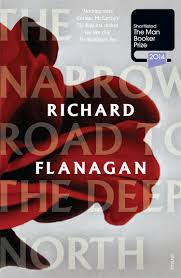
‘The Narrow Road to the Deep North’ by Richard Flanagan

flanagan_narrowroad

2014, 480 p.

There are spoilers in this review

I haven’t been writing this blog long enough for it to capture my deep admiration for Richard Flanagan. Only his recent book Wanting has made it into this blog.  Over the last twenty years I’ve read all his books, with the exception of The Unknown Terrorist, which I have on my shelves and which may surface as part of my #TBR20 challenge (once I start it!). For me,  Gould’s Book of Fish is right up near the top of my list of best Australian novels.  So I was delighted that Flanagan won the Booker Prize for this book, although I must admit that my praise of it is not completely unalloyed.

The main character in The Narrow Road to the Deep North is Dorrigo Evans, met in the opening pages as an elderly, famous doctor, lionized for his role in tending to the men on the Burma Railway.  He is uncomfortable about the acclaim that has attached to him but not enough to eschew it completely.He enjoys women and has had a series of extramarital affairs throughout his life. He doesn’t really like himself very much.  One’s mind turns immediately to  ‘Weary’ Dunlop – the iconic war-hero doctor of the Thai-Burma railway-  although I’m in no position to know how closely the fictional book parallels the real-life.

We follow Evans from his childhood in Tasmania, his move from humble beginnings  into ‘society’ as the handsome young medical student and then his sudden encounter in a bookshop with Amy- a young woman who, he later learns, is his uncle’s wife. Interwoven with this love story is the muddy, oppressive heat and downpours of the Burma jungle as Evans,  now a Prisoner of War, is placed in an unsought leadership position because of his medical skills.  He holds the power to order men to stay in the rudimentary camp hospital, but he is forced into a nightmarish bargaining ritual with their Japanese captors who demand men to work on the railway.

Flanagan is a writer of images, and in all his books (and particularly in this one) he luxuriates in the visual and the visceral.  We can envisage the gnarled gums that the young Dorrigo sees above him as he lies back in a horse-drawn dray, jolting through the bush as he joins his older brother in a bush camp.  We see the golden dust-motes swirling in the still air of a first-floor bookshop when he first sees Amy; we hear the sigh of the waves outside the beachside pub that Amy manages with her husband.  We can see – and our imagination flinches away from –  the mud, pus and shit of the Burmese camp.  Parts of the book are disturbingly violent: so much so that I found myself unable to sleep after reading some sections of it.

The book is consciously literary, with small extracts of Japanese verse separating the different parts of the book. The Japanese guards are monsters: the Japanese guards are also cultured men.  It is this paradox that he explores in the latter part of the book, as the war ends and somehow these men- both Australian and Japanese- are somehow meant to rejoin life again.  Memory smooths and distorts; men on both sides grapple with questions of goodness and evil.

I mentioned that my praise is somewhat tempered in this book.  There are too many coincidences, and too much squeezed into the last quarter of the book. Flanagan himself in interviews said that he had started with the scenario of two people who had been lovers long ago catching sight of each other in a crowd, and I felt as if this scenario, which appears near the end of the book,  was a writing exercise in its own right.  So, too, the bushfire scenes near the end felt like a self-contained piece of descriptive writing, undertaken as a set piece and not particularly germane to the narrative. I found that the ending was messy- almost as if Flanagan wanted to tie everything up and yet couldn’t quite bring himself to bring the book to a close either.

That said, these are just qualms and not at all the demolition job that Michael Hofman unleashed in the London Review of Books.   No-  I was overwhelmed by the bigness of the book and its themes.  The love scenes were tender, physical, and finely crafted, and so too, paradoxically,  were the war scenes: both part of being human.  In interviews, Richard Flanagan seems to think of this as the book he’s been driven to write, all along throughout his writing career. I think he might be right.
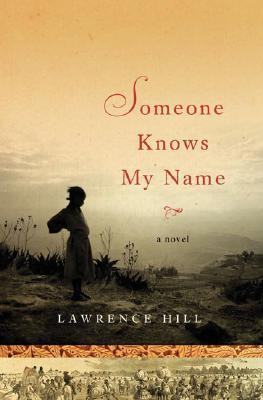
‘Someone Knows My Name’ by Lawrence Hill

someoneknowsmyname

2007,  486 p.

After too many times being blindsided by spoilers, I have made it one of my little rules to never read the Introduction to a fiction book until I’ve finished it. Maybe I should also make it a rule to read the Acknowledgments and ‘About’ section that comes at the end of a book before I read it. Perhaps it’s the historian in me craving footnotes and references, but I think that it’s more that I like to know whether the author is dancing exuberantly on a wide stage, or whether instead I’m reading a closely-embroidered canvas with careful attention to each stitch.

Someone Knows My Name falls into the first category, where the author has taken an artefact and a situation and woven a story around it.  In this case, the artefact is the “Book of Negroes” compiled as a list of 3000 former slaves who had fought with the British during the American War of Independence and who thus qualified for removal to Nova Scotia Canada after the war.   In reality, although it is known that the 150 page book was compiled by a British officer under the orders of the Governor-General of British North America, no-one is sure about how or by whom it was written.  As was common practice for colonial documents at the time, there are two versions: one now in England, the other in America.

Lawrence Hill, however, has created a female protagonist to be the author of the Book of Negroes. Aminata Diallo, the daughter of a Muslim jeweller father and midwife mother, was kidnapped at the age of 11 from her village in West Africa and forced to walk to the coast. After the horrific middle passage voyage, she was sold in poor condition to an  indigo plantation in South Carolina from which she escapes when her master takes her to New York.  She is illegally taught to read and write, a skill which the British put to use in recording the names and details of Black Loyalists in preparation for the evacuation to Nova Scotia after the war.  Aminata travels to Nova Scotia, hoping that her husband, with whom she had conceived two children- both taken under varying circumstances- will be there as well. She follows John Clarkson, a young humanitarian  British officer charged with encouraging a further shift to Sierra Leone where, in theory, the Black Loyalists could create their own community.  The final phase of her journey finds her in England, agitating for her people.

I hadn’t encountered the story of the Black Loyalists and the settlement of Sierra Leone until I read Simon Schama’s book Rough Crossings Hill’s book traverses the same territory in a fictional vein, with a nod to 21st century sensibilities through his literate, Muslim, female protagonist.  There are some anachronisms- I’m sure that no-one ever thought of a church as a ‘community centre’, for instance- but the book is well-researched and has garnered much praise, including the Commonwealth Writers Prize om 2008.  If at times the story seems too incredible, there are the nuggets of similarly extraordinary fact that tether it in the historical realm: the slave narrative of, for example,  Olaudah Equiano   published in England in 1789, the blighted betrayal of the promise of Sierra Leone (‘Liberia’), and the very existence of the Book of Negroes itself. Hill does not resile from the psychic trauma of slavery, but nor does he indulge in gratuitous violence either.  Has he been too squeamish in avoiding rape and punishment,  I wonder? Or, like the convict trope in Australian history, is there a more banal experience of slavery, less about blood, but more about deprivation, exhaustion and indignity?

It’s interesting that the book was published under the title ‘Someone Knows My Name’ in America because of sensitivity over the word ‘Negro’ and yet the television series which screened in both Canada and the United States went under the name ‘Book of Negroes’.  This rather self-reflexive detail in itself reminds us that this is a book that is written from a twenty-first political consciousness, with both the insights and infelicities that such a perspective carries.

My rating: 8.5/10

Read because: I read a review of it somewhere (who knows where….)

Sourced from: Yarra Plenty Regional Library

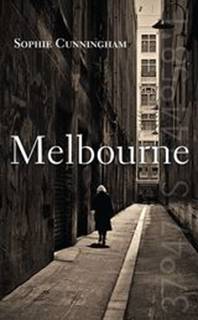
‘Melbourne’ by Sophie Cunningham

cunningham

2011, 272 p.

This book is one of a series published by New South where an established author  is given an open brief to write a ‘travel book where no-one leaves home’  of about 50,000 – 60,000 words about their own town.   There are nine in the series: Peter Timms (Hobart); Matthew Condon (Brisbane); Delia Falconer (Sydney), David Whish-Wilson (Perth); Kerryn Goldsworthy (Adelaide); Paul Daley (Canberra), Eleanor Hogan (Alice Springs);Tess Lea (Darwin) – and this one, Sophie Cunningham’s ‘Melbourne’.

As the commissioning editor Phillipa McGuiness said:

the inspiration for this series was literary, not some pointy-headed urge to make a grand statement about Australia’s cities….While people may read local histories, or dispassionate general histories about where they live, we rarely get the chance to read about our own cities in a way that resonates with our own experience and resurrects memories….So I wanted to ask some of our best novelists and writers to write non-fiction about the cities they lived in – or have adopted – in a way that would evoke intense sense memories for people who are familiar with them and give those who aren’t a sense of what it’s like to live in Brisbane or Adelaide or wherever.

In this book, Sophie Cunningham uses the seasonal year as her organizing structure, starting off with summer and moving through the seasons until finishing up with summer again.  Of course- in a city that is obsessed with weather- too hot, too cold, too dry, too wet- and famously has “four seasons in one day”, what other device could you use?  In particular, she uses the year 2009-2010, reflecting no doubt the date of commission, but that year was also a particularly memorable one for weather.  The summer of 2009 saw three days of excruciating heat (I wrote about it at the time, here) that culminated in the Black Saturday bushfires (that I also wrote about here) that razed Marysville and Kinglake.  I think that the fact that I can so easily link to four posts in this blog (and there are more than I could have linked) demonstrates how deeply these events are gouged into the consciousness of a Melburnian.

Cunningham’s book is consciously literary. Not only is she a writer and likely to bring a writer’s consciousness to the task, but the book was written in the wake of her resignation from Meanjin, a literary journal deeply embedded in Melbourne’s cultural identity.  She may have left Meanjin under contested circumstances, but her frequent citations of articles from Meanjin commissioned and published under her editorship suggest a continued identification with – and even a lingering sense of grief over- Meanjin.

For readers who are familiar with the city being discussed, there’s an internal comparison at work – “Would I have written the book this way??” Cunningham’s take is very much based on the inner suburbs of Melbourne, and a much younger perspective than I could bring.  She is gay, without children, and part of a literary milieu that as a mere reader, I can only observe from outside the window.  I think that if I were writing it, I’d be harking back to an older liberalism (all those Victorian worthies who in their way were quite radical), more architecture and possibly more politics.  I think I’d have to roam outside into the suburbs beyond the inner city, because I see Melbourne very much as a suburban city too.

The book is only small and beautifully produced- it fits well in your hands. It is by turns personal, historical, anecdotal and observational.  I did have a frisson of dissatisfaction near the end which seemed to have too many Melba-esque (pun!) farewells.  It was probably more the sense of rounding-off too many times, rather than the ending itself: in fact, I could have happily read another fifty pages more.

An interesting concept, and a really enjoyable read.

My rating: 8.5

Read because: It was on the library shelf

Sourced from: Yarra Plenty Regional Library

aww-badge-2015-200x300I’ve read this as part of the Australian Women Writers Challenge 2013.

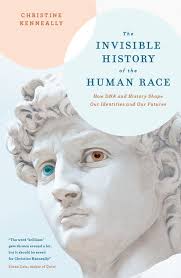
‘The Invisible History of the Human Race’ by Christine Kenneally

kenneally

2014, 320 p & notes, Black Inc

The DNA Gods play a highly visible form of roulette with my family. Twenty-nine years ago I sat in a genetic counsellor’s office and had the statistic 11 to one batted around.  Eleven to one? That’s not too bad I thought….  Thirty years later my son sat in a genetic counsellor’s office, asking the same question but the answer he received was different: depressingly so.  How could that be? I wondered.  In many ways this book by Christine Kenneally explains why.  Our understanding of DNA has exploded since about 2000, with phenomena we have thought of as being cultural or idiosyncratic increasingly being exposed as being genetic in origin.  At the same time, there has been an explosion of interest in family history, turbo-charged by the Internet.  This book explores the inter-twining of these two forces.

Herein are studies from psychology, economics, history, and genetics, anecdotes and data from business, science, and the lives of many fascinating individuals.  They all exemplify in some way what gets passed down over the generations, and they all provide insights that resonate with one another.  As I hope to demonstrate by the end of the book, the concept of ancestry can bring genetics and history together fruitfully; perhaps ancestry will lead us to a place where we can make use of these different kinds of data in a more unified way. (p ix)

I’m not a science-y person at all.  The Introduction made me wonder if this book was going to be too science-heavy for me, but it actually started off with history, then prehistory, before moving onto DNA. Even the more science-y chapters started off with a human anecdote which tethered the content in the everyday before moving into more theoretical waters.

Early chapters explore the phenomenon of family history in the Internet age, its enormous popularity and yet its marginal status in relation to ‘academic’ history.  Family history also has its dark past:  eugenics has a sharp edge; the Third Reich deployed genealogy amongst its adherents to demonstrate their Aryan purity, and the Lebensborn clinics ensured that SS soldiers fathered more Aryan children.  Other regimes have silenced ancestry: we have the Stolen Generation and the brutalized children of orphanages whose identity has been stripped from them;  the Chinese government turned on the reverence for ancestors during the Cultural Revolution and insisted that centuries-old records be destroyed.  There’s an unsettling edge emerging with the hoovering-up of government and church archives into internet-based companies like Ancestry.com and the extensive databases owned by the Mormons who have their own religious imperative to posthumously baptize family members so that they can enter into eternal life.   The prospect of Anne Frank being posthumously claimed and baptised I find downright offensive.

The crossover of commercial genealogical companies into genetic analysis is also unsettling, and it leads Keneally into her exploration of genetic technology. Companies like Family Tree DNA, 23andMe and AncestryDNA.com offer a selection of DNA tests and genealogical connections to the general public.  The banks of genomes held (owned?) by such companies become, in effect, crowdfunded and immensely valuable privatized libraries.  It is no surprise that much of this activity is based in Salt Lake City, the base of the Mormon Church where James LeVoy Sorenson, the wealthiest man in Utah and one of the richest men in the world sought out the possibility of analyzing the DNA of every individual in Norway to find his ancestors who were hidden from the documentary record.  The academic from Brigham Young University that he approached deflected Sorenson from the Norway proposal by a different plan whereby they would analyze the genome of 200 individuals from each of 500 different populations around the world. That collection of 100,000 genomes would form a microcosm of the human race, and would yield information about four generations of family history for each person.  In effect, “they would use science to personalize history”. (p 205)  First they started in Utah, then went to Africa, Asia, Kyrgyszstan on their quest to acquire more than 100,000 samples from all over the world.  DNA analysis can reveal the sweeps of migration across the globe over time, thereby interweaving the individual and personal with the large pulse of mankind over millennia:

In the same way that looking back into our immediate family’s past may change how we think about time and history and our place in it, so too does taking on the idea of our more distant ancestry.  Once upon a time, history was living memory plus all the increasingly fuzzy spans of time that came before it.  Now we may use written records and the artifacts and fossils that came before records.  Using all of these sources of information with DNA teaches us simultaneously about human history, the forces of evolution, and ourselves. Ancestry brings together history and science without any artificial seams between them.  It explains our immediate family in the context of the human family and vice versa. (p 262)

DNA analysis can ruthlessly strip away family story and patchy documentation, leaving the human individual to cope intellectually and emotionally with the overturning of what had appeared certainties.   There had been claims about Thomas Jefferson fathering six children with Sally Hemings, but DNA scotched the alternative scenario of the involvement of Jefferson’s nephew that had been offered by those wishing to protect Jefferson’s reputation.  But the Woodson family, who also had a powerful oral history tradition linking them to the Jefferson and Heming family were devastated to learn that the connection was not there.  One family was vindicated by DNA; another family felt stripped naked by it.

Christine Kenneally is a journalist who has written for the New Yorker, The Monthly and New Scientist, and it is her contribution to  this latter publication that encapsulates the flavour of this wide-ranging book.  My husband subscribes to New Scientist, and each week there is a deluge of new studies  that often disrupt older knowledge across the whole spectrum of disciplines.  There are footnotes to this book but they are not marked in the text at all (I didn’t find them until after I’d finished it) and many of them are very recent publications. Indeed, many of the examples in this book may already be negated or made redundant by new studies.

I feel completely at sea in assessing this book- it ranges so far and so idiosyncratically that I wonder if anyone could be as familiar with the material as she is.  In her treatment of things that I do know about (the Founders and Survivors project, for example) her narrative is sound, if somewhat simplified and compressed to support the argument that she is making.  I can only assume that her treatment of other material is likewise.

This is a big book about big data and its effect on knowledge, from the broad sweep of history right down to the micro-level of genes and cells. It engages and teases with ideas, without swamping the reader.  Occasionally I wondered if I was losing the thread, but then she’d give an anecdote or example that brought me back again.  The fact that it may already be outdated in places is a perfect illustration of the paradox that she is illustrating: that the very new can shed light on the very old.

aww-badge-2015-200x300I have read this as part of the 2015 Australian Women Writers Challenge.

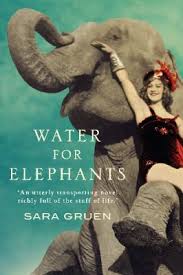
‘Water for Elephants’ by Sara Gruen

gruen

2007, 350 p.

To run off with the circus is a common escapist trope, and this book too is sheer escapism. Jacob Jankowski is a veterinary science student at Harvard University in the 1930s.  His world falls apart with the death of his parents in an accident and  what had appeared to him to be financial security  unravels quickly in the wake of their deaths. Stunned by the rapid change in his life he suffers, in effect, a nervous breakdown during his exams, walks out and- yep, joins the circus.

The circus is a little self-contained world with its own castes and hierarchies. It is owned by Uncle Al, a ruthless, avaricious entrepreneur who cannabilizes other circuses that fall on hard times during the Depression, picking the best of their artists and animals to join to his circus.  One of the animals is Rosie, an apparently intransigent elephant and she, like the other animals in the circus, comes under his care.  The equestrian director, August, is cruel to both the animals and to his wife Marlena but, as with many cruel people, can be charming and obsequious as well.  And, as you might expect, Jacob and Marlena fall in love.

The story has two alternating narrative threads.  Ninety-three year old Jacob is now a widower in a nursing home, frustrated by the infantalizing and brusque treatment he is receiving.  He’s a difficult but alert  [im]patient and Gruen has written this part well.  Sometimes when there’s a double narrative like this, I find myself inwardly groaning when it switches to the thread I’m less keen on, but this didn’t happen in this book.  The circus section is obviously well-researched (and only occasionally a little too obviously well-researched) both in terms of the times and circus lore.  Our edition was liberally sprinkled with archive photos which can be seen here.

There’s also a YouTube video advertising another book that has interesting images too.

Water for Elephants is a light read; it was on the best-seller list for ages; it was turned into a film starring Robert Pattinson and Reese Witherspoon,  and I gather from all the plot summaries online, must be set on school reading lists.  The goodies are good; the baddies are bad and the ending is nicely tied up.

My rating: 8/10 for a very light read

Sourced from : CAE Book Group for the Book Group Ladies a.k.a. ‘The Ladies Who Say Oooh’

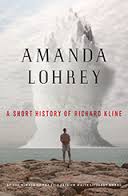
‘A Short History of Richard Kline’ by Amanda Lohrey

richardklein

 2015, 259 p.

The blurb on the back of this book describes it as “a pilgrim’s progress for the here and now”.  I can see the likenesses: Pilgrim’s Progress has Christian, its everyman character not unlike the eponymous Richard Kline in this book; Christian and Richard are both on a spiritual journey and quite frankly, just as with Bunyan’s book,  not everyone is going to want to go along the path with Richard Kline either.

Richard Kline starts his memoir by explaining that he is recording” a strange event that intervened in my life at the age of forty-two”. He is Australian and married with a young son. He has grown up and the computer industry has grown up alongside him, providing him with an affluent enough lifestyle to travel, eat out and go to conferences.  He is healthy. Yet

…I confess that for most of my life I was bored. It’s an unattractive word, boredom, and I flinch from it now, but for a long time it was the only word I could summon to describe my condition. Today I would say that for much of my life I suffered from an apprehension of lack, but one that I found difficult to put into words.  In essence it consisted of a feeling that nothing was ever quite right; something was always missing. How many of us have been dismayed by that feeling? And ashamed of it at those very moments when we ought to feel happy? We ask ourselves: what is the flaw in our being that gives rise to this discontent? (p. 3)

Peggy Lee once sang “Is that all there is?” and this book is almost that song put into prose. He’s a dessicated man, and no wonder he never cried. He is aware that he’s not feeling what other people do, and he feels cheated by that.  He turns to antidepressants in a desultory fashion, he dabbles in psychotherapy and holistic therapy. He takes up a free program in stress management offered through his work where he’s given a mantra and begins meditation. It is only when he stumbles into the Chatswood Community Centre on a Saturday morning that he encounters a Hindu saint and spiritual teacher from Tamil Nadu, Sri Mata, that he starts to thaw and to see reverence and meaning in the world around him.  He retains his scepticism and his empiricism, but he’s also confronted by what he has experienced from meeting Sri Mata.

Am I uncomfortable with this? Yes, and no.  I am myself a Unitarian Universalist, a spiritual tradition that is firmly based on the idea of lifelong searching. Therefore,  I’m open to exploring meaning- but I’m not sure that there really is ‘truth’. I liked this distinction between ‘belief’ and ‘faith’:

Belief is clinging to a set of doctrines, usually based on what someone else has said. Faith is opening the mind, without preconceptions, to whatever comes along. Faith is a plunge into the unknown. Faith is what underpins any science that’s not dogmatic. Faith accepts that we cannot know everything and can control only a little. We surrender our need for certainty (p. 210)

But I found myself squirming at this confessional genre, which  evoked for me memories of ‘witnessing’ in my born-again Christian past. It’s all there- the elation; the waves of emotion; the backsliding; the doubts. The book itself is quite simply written with short sentences. The chapters alternate between first and third person, taking the reader into Richard’s interiority then moving back to a more observational, externalized perspective. Lohrey kept me reading quite happily enough for 3/4 of the book.

At one stage the Richard character wondered if only men felt the way he did, and I wondered that too. The book is a nuanced exploration of  middle-class, white, westernized, educated masculinity, and I gaze at some of the men that I know well and wonder if they, too, are like Richard.  I think they might be.

Was he ever going to extricate himself from this quicksand of self-absorption and pique that he might be ‘missing out’? Was his wife going to leave him? Would the book take a very dark turn?  The last 1/4  is where the thread broke for me. In meeting Martin Coleby, his spiritual guide,  all of a sudden the book turned into Sophies World – a didactic text draped with characters who were merely devices. It seemed, in the end,  such a me-centred quest. I closed the book, disappointed. I really don’t know what to think about it.  It’s a brave thing, to write about meaning, emptiness, searching- or maybe that’s the easy part-  the really brave thing is to write about the answer without smugness and to take your reader along with you.

Lisa at ANZLitLovers has written a thoughtful review that I encourage you to read.  There’s another review by Deborah Stone at ArtsHub too

My rating: 7

Read because: Lisa’s review and because I’m interested in Amanda Lohrey’s work

Sourced from: Yarra Plenty Regional Library

aww-badge-2015-200x300I have read this as part of the 2015 Australian Women Writers Challenge.

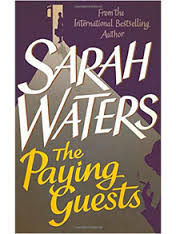
‘The Paying Guests’ by Sarah Waters

payingguests

Whenever I open up a book by a favourite author, my anticipation is edged with anxiety that perhaps -alas- this might be the book that does the literary equivalent of jumping the shark.  I’ve loved every one of Sarah Water’s books and  her last,  The Little Stranger marked such  a departure from her earlier work that I wondered if I’d seen the last of the Sarah Waters I’ve enjoyed so much. I need not have feared.  She’s back to her plots that involve lesbian relationships, and as with all her earlier books, she combines careful but lightly- worn research with intricate plotting and multi-layered characters.  I shut the book with a very satisfied sigh and no, she hasn’t lost it one little bit.

SPOILER ALERT

The Paying Guests is set in post WWI London, in a society still raw with grief at so much loss of young life.  Frances Wray has returned to her widowed mother’s empty house,  her two brothers having died at the Front, and in their straitened circumstances, mother and daughter shift into a couple of rooms on the ground floor and let the upper rooms of the house.  The rooms are taken by Mr and Mrs  Barber, who after initial awkwardness they come to call ‘Leonard’ and ‘Lilian’. The domestic details are captured so well: the embarrassment as Leonard clatters through the kitchen to the toilet outside, the unaccustomed creaks and thumps as the Barbers move around in their upstairs room and just the change in the air of the house as new people move into it.  This is a Sarah Waters book, you’ll remember, so it’s no surprise that Frances and Lilian become close – very close.  It happens slowly, with every movement suffused with the significance of new and uncertain love, and it takes almost 200 pages.  I felt apprehensive: this isn’t going to end well… (and besides, there’s another 250 pages to go)

Abruptly the novel changes pace as two crimes take place. It’s probably a bit of a stretch to compare this book with Dostoevsky’s Crime and Punishment but as a reader, I found myself feeling  the same cover-your-eyes, sick-at-the-pit-of-my-stomach emotions. By turns nightmarish, then banal, this tension is sustained over two hundred pages as Frances  begin to doubt Lilian and the details of the crime itself.    Lilian is always a bit of a mystery, but Frances is a nuanced, grounded, character and completely believable.

Waters captures so much here: the tenderness and tentativeness of new love, the gradations and details of class difference, the leached-out greyness of 1920s London as if worn down by grief for sons, brothers and lovers who did not return and the betrayals felt by those who did.

I need not have feared.  This book is vintage Sarah Waters, and she’s just as good here as in her earlier books.

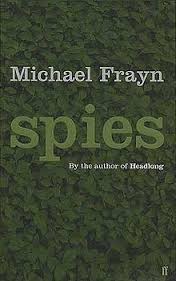
‘Spies’ by Michael Frayn

Spies_Frayn

2002, 213 p.

For Proust it was a madeleine.  For the narrator of Spies it was the cloying, heady smell of a flower in a suburban garden, and it took him back to a wartime summer, a hideout in the garden hedge, secrets, fantasies and ambivalent shame.

Stephen Wheatley was small and unpopular, with ears that stuck out. His friend Keith was unpopular too, but he lived in a big house, his toys were kept in pristine condition in their boxes, and the afternoon teas dispensed  by Keith’s mother were Blytonesque, even if she did so without ever quite acknowledging Stephen’s presence.  Stephen was drawn along in Keith’s wake and when Keith announced that his mother was a German spy, well, then- yes, perhaps she was.  After all, there was her diary with the odd crosses once a month in keeping with the phases of the moon (for night-time spying duties, of course), and she seemed to spend a lot of time going into the village posting letters (to the German authorities, of course) or pretending to shop for her sister who lived down the street.  So the boys  snooped in her writing desk and followed her, and found more than they had bargained for.

This is a beautifully told story.  It has that wistful, golden glow of L.P. Hartley’s The Go-Between or Ian McEwan’s Atonement, and as in those books, the narrator in Spies also sees too much and yet doesn’t know what s/he is looking at.

Frayn’s control of the story is masterful, especially in the switch between present tense and reminiscence, which can be clunky in less sure hands. This was the second time that I had read the book, but I think even the first time I quickly cottoned on to Stephen’s misconstructions – just as Frayn, I think, intended his readers to do.   The story is told with humour and humility, and the adult Stephen is affectionately kind to his younger self and withholds judgment from him.  Little details fit together so cleverly- the play on ‘privet’ for example- and the last chapter colours in much of what had only been sketchy or incomplete previously.

I really liked this book, just as much on the second reading as on the first. You’re in the hands of a master writer, and you know it.

‘Olive Kitteridge’ by Elizabeth Strout

kitteridge

2008,  270 p

Thank heavens. After reading two stodgy books that cried out for the slash of an editor’s pen, here was a collection of short stories with crystal clear writing and every bit of fat decisively cut away.  I’d starting reading a review of the recent series of Olive Kitteridge showing on television until I realized that it was Pay TV, which we do not have and will not have.  It sounded like something I thought I would enjoy, but given that I wouldn’t be seeing it any time soon, I stopped reading the review after a few sentences.

So I was surprised to find that it was set in Maine, and not England, which for some reason I assumed  (from the rather stodgy name ‘Olive Kitteridge’ perhaps? It sounds English to me).  Nor was it set in the 1940s, which I also assumed.  It is a series of short stories and Olive appears in each one of them- sometimes as the main character, sometimes just as a walk-on figure in the background.  Olive is a large, acerbic, retired teacher who has lived in her small town for many years and taught mathematics to every young person in town.  She’s brusque and clumsy, and you can see why her son has distanced himself from her and why people don’t really like her very much.  Some of the stories are set in the near-present (9/11 has already occurred) and the stories skip around in time.  Nonetheless, they’ve been well compiled with a scene in the opening story matching a similar scene in the last story in the book- a pleasing sense of symmetry.

These are short stories as I really like them (yes, Whispering Gums, I LIKE them!) with connections between them, but standing alone as well. Perfect length- about twenty pages, and just enough of them.

It’s absolutely just right.

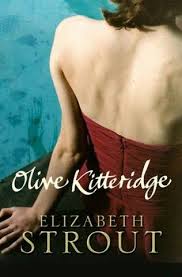
Except for the cover. What is it with women’s backs?  Stock images, no doubt. But this cover had absolutely nothing to do with any of these stories.

My rating: a resounding 10/10. Loved it.

Nothing much happened and I loathed/loved it

I was about to write two blog posts about two separate works- a book and a film- until I realized that they were in many ways very similar.  For both of them, I’d have to say that not much happened, really.  Yet I had a totally different response to them: the book I loathed with a vengeance; the film I loved and even now will probably put right up top of the films I’ll see in 2015. The loathed one first….

Mcgregor

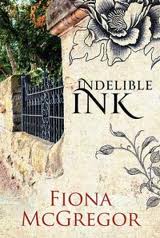
Indelible Ink, Fiona McGregor, 2013, 464 p.

My heart sank when this book was announced with a flourish at my book group as our next read.  I have read it previously and disliked it.  After reading it a second time, (now that’s dedication)  I dislike it just as much.  I didn’t blog about it the first time, even though I was doing the Australian Women Writers Challenge.  Although my little review would not make any difference to anything, I didn’t feel right about bagging out a young novelist and so I just let it subside without trace on my blog. But it’s two years on, now; the dust has settled and I don’t have the same qualms about being critical.

I just didn’t buy the premise of this book from the start.  I don’t need to like the characters in a book (and I found them all completely unlikeable) but in the midst of a contemporary, realist book I need to be persuaded that there’s a core of plausibility in the actions of the characters.   The book has been likened favourably to The Slap and -how ’bout that- Christos Tsiolkas provided the front-cover blurb- and I can see the parallels of a family story, set in Sydney rather than Melbourne, with all the left-leaning, Radio National-type anxieties of affluent and self-absorbed inner suburban life.  All of that’s true of Indelible Ink as well, but at least The Slap moved from character to character, and there was enough variety that you’d find one person at least that you’d recognize (and probably dislike).   I think that it was the banality of the conversation that I bridled most against. Who’d want to be around these people?  I felt that the author was looming over all, pressing all the ‘luvvie’ hot-buttons, just to get a rise out of her reader.  Once again I found myself wishing that someone had ordered ‘cut! cut!’ by about 150 pages because this is a 300-page plot that doesn’t have 460 pages in it.

I know that many readers I respect have enjoyed this book- Lisa at ANZLitLovers thought highly of it; reviewers at the Australian Women Writers Challenge liked it; dammit, it even won the Age Book of the Year for 2011.  I am so outnumbered here than I was relieved to find that Marieke Hardy from the First Tuesday Book Group and I are as one on this  – thank God I’m not alone!

And so, on to what I loved….

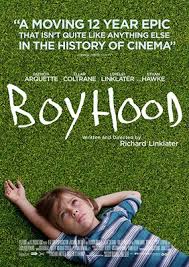
boyhood

I’d heard this book mentioned in all the pre-Oscar hype and couldn’t quite see how you could make a film over twelve years. Well, you can – because here it is. It’s not like the 7-up series, where there are clear breaks between filming schedules.  Instead, the boy Mason grows imperceptibly older, changing before your eyes.

Nothing happens, and yet much does.  Perhaps it says something about my pessimistic, anxiety-driven nature but I kept expecting something to go wrong to impose some sort of narrative arc onto the film.  I will confess that I did find myself checking my watch a few times during the film, although that was largely because I was wondering how much longer it would go before there was a climax of some sort.  There was something rather omnipotent about looking down, watching time elapse, mistakes occur and resolve, expectations rise and subside, plans falter and opportunities arise.

My enjoyment of this film was confirmed the next day when I heard friends talking about their little grandson, who is determined to be one of the first kids at school each day.  I thought back to the young Mason, and his little ways, and found myself washed over with affection both for the film character and for this little boy I’ve never met who wants to get to school early.  I’ve thought of the film many times, as if I’ve lived someone else’s life.  Quite apart from the hook of the twelve-year span, it was an intimate epic- big and small at the same time- and right up there as one of the best films I’ve seen in ages.