Category Archives: Book reviews

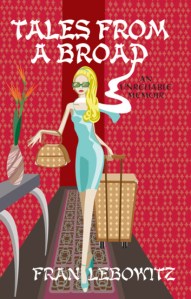
‘Tales from a Broad: An Unreliable Memoir’ by Fran Lebowitz BUT BEWARE!

tales-from-a-broad-an-unreliable-memoir

2004, 346 p.

Well, that’s five hours wasted, never to come my way again.

I read an interview conducted with Fran Lebowitz in the Age. Apparently she’s coming out to Australia, and I liked the sound of her sardonic humour. “A modern day Dorothy Parker” they said.  So I looked up the library catalogue and they had one book by Fran Lebowitz. I borrowed it.

What a mistake – on all levels.  A mistake to borrow it.  A mistake to persevere with such a vapid, self-absorbed book. A mistake not to ditch it and move onto something more enjoyable or uplifting or educational or worthy.  And worst of all: it wasn’t even THE Fran Lebowitz!

The plot (huh!): A New York literary agent and her husband shift to Singapore for his job, which was initially for a three-month stint, but extended into a three-year undertaking. Fran and Frank are absorbed into the expatriate community there, where they grapple with maids and sit around pools and bars drinking and gossiping.  Colonialism is alive and well….

It’s too silly to write any more. I feel robbed, on all levels.

Sourced from: Yarra Plenty Regional Library e-book

Read because: I made a mistake

My rating: 2/10

‘Australian Churches at War: Attitudes and Activities of the Major Churches 1914-1918’ by Michael McKernan

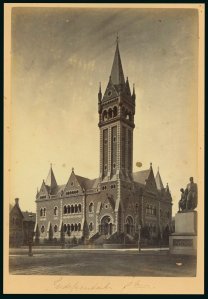
Independent Church Melbourne Vic.

Independent Church, Melbourne (now St Michaels). The Burke and Wills statue to the right of the church is in the middle of the intersection, its original location.. It’s a well-travelled statue. SLV image

Churches tend to sprout exhortations of “Peace!” especially at Christmas time, and it’s quite a jolt to read of the bellicose and jingoistic approach taken by the major Christian (and especially Protestant) churches during the First World War.  Michael McKernan’s book Australian Churches at War published in 1980, is based on his PhD thesis and is probably not easy to find today. However, there’s a (relatively) more recent transcript of an interview with McKernan on the now-defunct ABCRN program ‘The Religion Report’ that you might be interested in here.

The 1911 census which was the closest one to the outbreak of WWI showed that 98% of white Australians claimed to be Christians at the time. Only .24% of the population claimed to have ‘no religion’.  One of the immediate responses of the declaration of Australian’s ready involvement in WWI was a call to prayer, and to the churches the people flocked. What they heard there in those early weeks of war was to become the stance of the major Protestant churches throughout the war: the view that the war was God’s way of calling people to the churches for a moral awakening.

It is the argument of this study…that churchmen had synthesised war and Christianity so that support for the war effort became an act of high Christian virtue … churchmen accepted the war as part of God’s providence for the world; through sacrifice, suffering and devotion to duty men would be renewed, lifted to a higher, more thoroughly Christian plane. Their concern was not, primarily, for the welfare of the Empire; rather they hoped that war would transform Australian society. (Ch. 8)

It was this hope for moral transformation through sacrifice that brought the major churches to the forefront in encouraging enlistment, and later conscription.

The Catholic Church, at the start of the war, also encouraged enlistments amongst their parishioners in what they saw, along with the Protestant churches, as a ‘just war’, and as a way of proving their loyalty as part of Australian society.  During the first conscription referendum in October 1916, the Catholic Church hierarchy advised that it was a political matter, and one in which the church would not be involved.  Mannix, still under the authority of Archbishop Carr, spoke out only twice.  One was a three minute speech where after congratulating Prime Minister Hughes for allowing the referendum, he said that Australia had suffered enough. The other occasion was at a fete in Preston on 22 October, where he defended his right to speak, at a secular place, at a secular function and in his personal capacity. This, he said, contrasted with the Protestant laity who spoke from the pulpit, week after week.

However, Catholic opinion hardened against the war by the time of the second conscription referendum on 20 December 1917. This is generally attributed to the influence of the newly ordained Archbishop Mannix, and as a response to the Irish rebellion, but McKernan suggests an additional theological motivation. Once  the Allies had shifted from a position of checking Germany’s aggression to one of  jockeying for economic advantage by destroying Germany’s economy and industry, Mannix no longer considered it a ‘just war’. Moreover, Mannix was enormously popular amongst working-class Catholics, and the laity pushed the church into a stronger anti-war and anti-conscription position.

Chaplains were appointed in accordance with the religious affiliations reported in the 1911 Census. They only had to serve for one year, which gave them a different perspective to that of the troops they served. Some chaplains accompanied soldiers on the ‘voyage only’, others were embedded with ‘their men’, especially in Egypt.  Catholic chaplains maintained their focus on providing the sacrament by ensuring that there was a chaplain available at each point of an injured soldier’s progress through ambulance station and hospital.  Among Protestant chaplains, sectarian lines often became blurred, and instead of  insisting on ‘moral regeneration’ as was the stance ‘at home’, many chaplains came to realize a man, outwardly irreligious, could do good things. Such chaplains were welcomed by their troops and the army hierarchy: those who wanted to maintain the sectarian divisions that were rife back in Australia were given short shrift.

There were exceptions to this generally pro-war stance amongst Protestant churches, but not many.  One of them was Rev Leyton Richards, of the Collins Street Independent Church shown above, who argued for the role of conscience.  Congregationalists, a small number of Methodists, one or two Baptists, Rev Charles Strong from the Australian Church and Rev. F. Sinclaire from the Free Religious Fellowship were among those who spoke out.  The Unitarian congregation, from whom Sinclaire had split, was pro-war (a stance I did not expect).  McKernan notes that pacifists with an appeal to conscience won the tolerance and respect of their fellow-ministers, but not those whose opposition sprang from the political realm, outside the church.  They tended to be ostracized and demoted.

Even when peace was declared, the major Protestant churches had not moved on from the ‘moral regeneration’ stance that they had adopted during the first weeks of the war. The sectarian rigidities that had emerged during the war were to grow even firmer and last for the next fifty-odd years.

McKernan concludes his study thus:

It has been the argument of this book that clergymen never broke themselves clear of the events, never gave themselves the opportunity to see events in perspective so that they were ever reacting rather than acting. Their initial response to the war determined their position until peace was declared… In 1917 and 1918 Australian clergymen took no part in the growing worldwide discussion about a negotiated peace; instead they merely repeated their belief that peace would not come until the nation had reformed. And so they concentrated on reform, personal and national. They were always spectators of the course of the war, fussing with the side issues but refusing to come to terms with the main drama. (p 172-3)

It’s impossible to know, of course, how Christian churches would respond to a world war today, especially one where the ‘enemy’ was not Christian.  As Judith Smart has noted in relation to the pro-conscription women’s movement, it’s not particularly fashionable to look at the conservative, establishment view of WWI. Probably as a reflection of my own politics, while reading this book I found myself bristling at the patronizing moral stance of the major Protestant churches, and cheering those courageous enough to really grapple intellectually and spiritually with the question of war and peace. McKernan does us a service, however sobering, in highlighting just how rare this was.

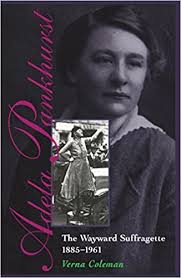
‘Adela Pankhurst: The Wayward Suffragette’ by Verna Coleman

wayward_suffragette

1996, 176 p.

As I might have mentioned once or twice, I’ve been involved in a street opera project called Serenading Adela. This event commemorates the centenary of the march of about 300 women to Pentridge Prison on 7 January 1918 to sing songs to anti-war activist Adela Pankhurst, who was imprisoned there on charges arising from a speech given on the steps of Parliament House the previous year.  The Pankhursts were a well-known family involved in the fight for women’s suffrage in Britain, but Adela’s political history went beyond that in Australia.  She had been sent to Australia by her mother Emmaline in 1914 on a one-way ticket with twenty pounds, some woolen clothing and an introduction to Vida Goldstein, whom the Pankhursts had befriended back in 1911.

In Australia Adela Pankhurst was well-known  as a speaker against war and conscription, a member of the Victorian Socialist Party and a foundation member of the Communist Party of Australia. From that she moved to the Australian Women’s Guild of Empire, and from there to the far-right Australia First movement.  She was interned following the bombing of Pearl Harbour. for her pro-Japanese sympathies in World War II.  While this shift from the extreme left to the extreme right is not uncommon, it does seem bewildering.  Lives are rarely lived randomly, and biographers look for a unifying thread, some continuity in world-view that makes sense to their subject, no matter how inchoate it may look from the outside.  So how does Verna Coleman characterize Adela Pankhurst?

A clue can be found in the subtitle: “the wayward suffragette”. The first third of this book deals with Adela’s life in England, as part of an intellectual, politicized family dominated by her mother Emmeline and her eldest daughter Christabel.  According to Coleman, Adela became increasingly uncomfortable with the militancy, violence and extreme feminism of the suffragette campaign, even though she herself was involved as speaker and activist. After a physical and emotional breakdown, and ensnared within the jealousies of her sisters, Adela left the suffragette battlefield and acquiesced to her mother’s demand that she not speak in public in Britain again, and agreed to go to Australia instead- just about as far away as she could get.

Adela arrived in Melbourne in March 1914 and was immediately welcomed by Australian suffragists.  She spoke out as a pacifist right from the start of the war, and sympathized with Germany as the underdog dominated by Britain and France (p.63)- a rather dangerous stance at the time. She was welcomed into the pacifist socialist group that was drawn to editor of the Socialist, Robert Ross; a group which included Bernard O’Dowd, Jack Cain, John Curtin and unionist Tom Walsh.  Pankhurst was to marry Tom Walsh, and together they moved politically across the spectrum from communist to anti-communist. It is rather galling to see that Adela’s entry in the Australian Dictionary of Biography is shared with her husband Tom Walsh, with his lifestory told first. One would have thought that she deserved a stand-alone analysis.

Many of the chapters of the book- but not all- start with a fictionalized, italicized word-picture of Adela. It’s an interesting touch, and I was disappointed that it was not sustained throughout the text. Coleman draws on Adela’s own autobiographical writing, letters in the Pankhurst-Walsh and David Mitchell archives, and newspaper articles.

Coleman’s book traces Pankhurst-Walsh’s  philosophical and political shifts, but although she recounts the trajectory, she does not very well explain it.  Analysis comes in a short chapter near the end of the book titled ‘Renegade, ratbag…or romantic enthusiast?’ In these few pages, she suggests that perhaps Adela tried to recapture the romantic fervour of her youth, constantly needing excitement as she shifted from one cause to another.  “Like many a reformer”, Coleman states “Adela was driven by egotism as well as by altruism”.  However, the adjective “wayward” in the title seems infantalizing and I don’t think that it does Pankhurst justice as a political actor in her own right.

In an article in Australian Historical Studies (25, 100 p.422-436) from 2008 called ‘The Enthusiasms of Adela Pankhurst Walsh’ Joy Damousi does a better job, I think, of detecting a coherent thread throughout Pankhurst-Walsh’s political journey. It was concern for children growing up in slum conditions, Damousi suggests, a concern that could be just as easily  (indeed, more) accommodated  in the politics of the right as of the left.  Once I read Damousi’s article, I saw that Coleman has in fact referenced this abiding passion of Pankhurst’s throughout. But by characterizing her as the ‘wayward suffragette’, Coleman highlights her deficits as a ‘wayward’ Pankhurst daughter rather than as a thinker of agency with a continuity of passion that took her from one extreme of the political spectrum to the other.

aww2017-badge

This will be my final review for 2017 for the Australian Women Writers Challenge.  I’ll be back in 2018 to start the challenge all over again.

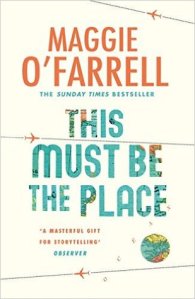
‘This Must Be the Place’ by Maggie O’Farrell

O'farrell_thismustbetheplace

2016, 483 p.

I’ve long had a rather ambivalent relationship with Maggie O’Farrell’s books.  I looked back in my reading journal to the first O’Farrell I read, After You’d Gone (2000).  I scored  a 10/10 (so I obviously liked it a great deal), but I also wrote:

I couldn’t work out if the author was sloppy and undisciplined or very very good…The book teetered on the edge of Mills and Boon but the strength of the writing anchored it.

Coming now to my fourth Maggie O’Farrell, I still feel much the same way, but I’m not as generous this time round.  I’ve since read My Lover’s Lover (2002) and Instructions for a Heatwave (2013) and I think that I’m starting to tire of O’Farrell’s repeated themes of disappearances and the fragility of relationships and her stylistic technique of multiple narrators and tenses.

They are all here in this book. The plot circles around the marriage of the two main characters: Daniel, an American linguist and Claudette, a famous film star who stages her own disappearance at the height of her fame.  After Daniel encounters Claudette and her stuttering son Ari on the side of the road with a broken-down car, they fall in love and he leaves his American wife and eczema-crazed son and doomed daughter to marry her. Both are flawed characters, being willfully absent at times and veering between oblivious and judgmental. They are surrounded by a wider constellation of other characters – mothers, siblings, children, a woman on a bus in South America -and complicated backstories. The book is set over 70 years, but most of the action takes place between 2010 and 2016 in Ireland, London and America. As well as a mixture of present and past tense narrative, it has a breakout section in the form of catalogue, and a chapter in the form of an interview.

The book seemed to take an inordinate time to get going, and this kaleidoscope of characters is too big to keep in mind. They swoop in and out of the narrative, and I found myself flicking back to see if I could find where they last appeared, cursing the absence of a contents page.  I used to think that jumping around in time and place required masterful plotting. It probably does, but I’ve come to value more highly writing that can take responsibility for time shifts through the narrative, instead of just plonking the reader into the middle of it and expecting them to make the connections. I don’t mind having to work hard as a reader, but I need to feel that it’s not because the author is being lazy.

I simply didn’t care enough for any of the characters to sustain me over such a lengthy book. It has received good reviews from readers who enjoyed its narrative skittishness, but with this particular writer, I’m finding it a bit stale.

My rating: 6.5/10

Read because: CAE bookgroup (The Ladies Who Say Ooooh)

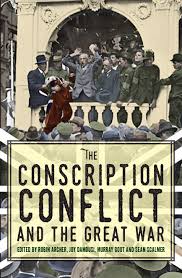
‘The Conscription Conflict and the Great War’ ed. Robin Archer, Joy Damousi, Murray Goot and Sean Scalmer

conscriptionconflictandthegreatwar

2016, 210 p.

Today is 20th December, the centenary of the second referendum held in Australia over the question of conscripting men to serve overseas in World War I.   So it is “meet and right” (to quote the Book of Common Prayer) that I should post this review today.

The Conscription Conflict was released last year, in preparation for the centenary of the first of the conscription referendums. As is made clear in both the foreword and conclusion of this collection of essays, the concept of asking the people about conscription is unique to Australia. It was not undertaken in any other country, and when Australia did introduce conscription during WWII and again in the 1960s, it did not make the mistake (as a government intent on introduction might view it) of asking the people again.  Not only was seeking the agreement of the people exceptional, what is even more striking is that the people answered ‘No’, in the midst of wartime emotion and censorship, and against the exhortations to vote ‘Yes’ from the Federal government, the major Protestant Churches, municipal councils, chambers of commerce, nationalist organizations, conservative women’s groups and almost all of the press.

This book is similar in scope and content to the La Trobe Journal I reviewed earlier, with one author and themes in common. This book, too, emerged from an expert workshop held at the University of Melbourne in 2015, sponsored by the Academy of the Social Sciences. It takes a much more international and philosophical approach than many of the  analyses of the referendums in the past.

Part I of the book starts with an exploration of the concept of liberalism held in Britain, and the changing response to conscription by various political brands of liberalism: the Gladstonian Liberals, ‘New Liberals’ and Liberal Imperialists.  I found this chapter, written by Douglas Newton (who also featured in the first chapter of the La Trobe Journal) rather difficult as I am not particularly knowledgeable about the nuances of British liberalism. Chapter 2 by Robin Archer (the historian, not the actor!) explores the philosophy of liberalism in Australia among Labor anti-conscriptionists at the time (the terminology is confusing because our current opposing political parties are Liberal and Labor- even though the Liberal party is also conservative).  The unions feared that compulsory industrial service would be introduced alongside military conscription, with workers allocated to jobs where pay and conditions would be determined by the military.   Their fears were lent credence by the increasingly authoritarian environment and rhetoric introduced by Prime Minister Hughes. In face of criticisms of their loyalty, Labor anti-conscriptionists emphasized the British liberal tradition, thus taking us back to the argument of Chapter I.

Part II deals with the anti-conscription campaign and results. Frank Bongiorno explores the varied organizations which made up the opposition to the referendum  and their ideological positions. He addresses the two referendums chronologically, and picks up again on the argument in Part I of the book that anti-conscriptionists drew on the idea of liberty and freedom as  fundamental principles. I’ve been studying the conscription referendums as they played out in Heidelberg and Ivanhoe, and Bongiorno’s final paragraph rang true to me when I considered the program of meetings at a local level, both pro- and anti-, which existed alongside those larger Melbourne-based rallies.

The campaigns over conscription were imbued with the grief and anxiety of a society at war, yet they were also colourful and exciting, occasions for marching and singing, for rallies, concerts and torchlight processions, for compelling oratory, for the display of banners, placards and buttons, for the sporting of sandwich boards bearing clever slogans, and, among women were increasingly at the heart of the enterprise…Such occasions could sometimes be a little frightening; yet they contained the pleasures of joining with others in a common cause, and the frisson of facing a little but not too much danger while fighting for freedom and democracy (p. 91)

Chapter 4, by Joy Damousi deals with the pro-conscription side by looking at the contribution of the academics at the University of Melbourne, a staunchly pro-conscription organization.  As she notes, for some of the academics involved, this was the only political question on which they campaigned publicly throughout their career.  In particular she focussed on the prominent law professor, William Harrison Moore, who along with the classics lecturer, Jessie Webb, published a set of arguments in support of conscription. He also toured the suburbs and country areas, preparing leaflets and addressing meetings.  Both went on to work with the League of Nations after the war.

Chapter 5 by Murray Goot re-examines the statistical results of the two referendums, placing them alongside the results of the elections of 1914 and 1917. He emphasizes the importance of the turnout, which in both referendums was larger than a ‘normal’ election, but warns that aggregate data are of little use in weighing the behaviour of the individual voter.

Part III  makes comparisons.  John Connor’s chapter asks ‘Why was it easier to introduce and implement conscription in some English-speaking countries than in others?’ He argues that it was easier to introduce conscription early on in the conflict (as America did soon after entering the war), and that passing legislation was more effective than asking the people. In the case of Australia, the labour movement, both political and industrial, was more powerful than it was in other countries. He takes a chronological approach, tracing through the “conscription conversations” of Britain, New Zealand and Australia in 1916, with its varied outcomes; then the United States, Canada and Australia in 1917 where, again, Australia said ‘no’ when the other countries did not; and finally Newfoundland and Ireland in 1918.

In Ch.7 Ross McKibbin compares Britain and Australia in more detail. He concludes that Britain’s political, industrial and military situations favoured the adoption of military conscription, and that because of a trade-off that saw the introduction of a quasi-civil conscription, Britain enjoyed a higher degree of political stability than other conscripting countries in the Empire.  He notes that the Labour Party in Britain emerged strengthened from the war, where as in Australia, the Labor Party was much weakened. Although both countries were sectarian and racist, this took a different form in each; and in Australia the failure to introduce conscription opened up the bitterness between those who volunteered and those who ‘shirked’.

The book finishes with Part 4: Legacies.  I very much enjoyed Sean Scalmer’s chapter that challenges an interpretation by Jeremy Sammut, a critic of Labor mythology,  who has posited that the left and the ALP have developed the  myth that the defeat of conscription saved Australia from a military dictatorship. Scalmer shows that the victors of the conscription battles did celebrate their collective achievements in the years following WWI, but this ‘legend’ was undermined by the actions of later Labor governments. The battle over conscription came to be seen as a Pyrrhic victory that brought about disunity, bitterness and division. Scalmer, however, argues that the conscription campaign was an important episode in the history of Australian democracy, and notes that “[b]y the respect granted to popular opinion, the primacy of the democratic principle was confirmed.” (p. 210)

And so, how did you spend the Reinforcements Referendum Centenary? I spent it outside Brunswick Town Hall, along with the cast of the Serenading Adela street opera. It will be performed on 7th January  to celebrate the centenary of the women’s march to Pentridge prison to ‘serenade’ Adela Pankhurst, who was incarcerated there for her anti-war activities prior to the second referendum.  But more of that anon.

https://www.facebook.com/search/str/serenading+adela/stories-keyword/stories-public

 

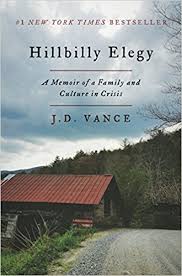
‘Hillbilly Elegy: a Memoir of a Family and Culture in Crisis’ by J. D. Vance

Vance_hillbillyelegy

2016,  257 p.

I  put a hold on this book at the library months and months ago when there were about 60 people in line ahead of me, and finally it arrived.  It’s worth the wait.

J. D. Vance grew up in Middletown Ohio, but his cultural roots were in Jackson, Kentucky. “Middletown Ohio!”- it sounds like a Billy Joel song. Even his name, which is unexceptional at first glance, tells his story. ‘Jay Dot Dee Dot’ is what he called himself, but the names which the letters abbreviated changed, as did his surname, as his mother churned through a series of marriages that ended in failure. The real anchor in his life was his grandmother, Mamaw (pronounced Ma’am-aw), who along with her husband Papaw, made the trek northwest to join the steel-manufacturing workforce in Ohio in the post WWII boom. His grandparents had had a rocky marriage but hostilities had ebbed, and of  all their children, it was J.D.’s mother (Mom) who was probably the most troubled. She was a nurse, but fell in and out of addiction to prescription drugs, and bounced quickly from one marriage to another, dragging her children Lindsay and J.D. with her. It was only when J.D. finally settled with his grandmother Mamaw on a permanent basis that he had enough structure in his life to settle at school, eventually gaining entry to Yale Law School. It is from this vantage point – the kid who escaped – that he writes this book that makes sense of, but does not excuse, the hillbilly culture that is dying around him.

He writes of  a world of truly irrational behaviour.

We spend our way into the poorhouse. We buy giant TVs and iPads…We purchase homes we don’t need, refinance them for more spending money, and declare bankruptcy, often leaving them full of garbage in our wake.  Thrift is inimical to our being. We spend to pretend that we’re upper-class. And when the dust clears – when bankruptcy hits or a family member bails us out of our stupidity – there’s nothing left over (p. 147)

Homes are a mess; family members scream at each other. They don’t study and don’t make their children study.

We choose not to work when we should be looking for jobs. Sometimes we’ll get a job, but it won’t last. We’ll get fired for tardiness, or for stealing merchandise and selling it on eBay, or for having a customer complain about the smell of alcohol on our breath, or for taking five thirty-minute restroom breaks per shift. We talk about the value of hard work but tell ourselves that the reason we’re not working is some perceived unfairness: Obama shut down the coal mines, or all the jobs went to the Chinese. These are the lies we tell ourselves to solve the cognitive dissonance- the broken connection between the world we see and the values we preach. (p. 147)

And there we have The Donald, with his orange skin and long red tie, telling them exactly the same thing- that Obama shut the coal mines, and it’s all the fault of “Ji-na”. This book was embraced last year as the Trump phenomenon rolled on, and it is a political book in that it explains and gives coherence to political allegiances that seem self-defeating to Australians. As he explains, most Middletonians viewed Barak Obama with suspicion, and George W. Bush had few fans in 2008. Many loved Bill Clinton but many saw him as a symbol of moral decay, and Ronald Reagan was dead.  They loved the military and the space program.

Nothing united us with the core fabric of American society. We felt trapped in two seemingly unwinnable wars, in which a disproportionate share of the fighters came from our neighbourhood, and in an economy that failed to deliver the most basic promise of the American Dream- a steady wage. (p. 189)

His solutions? He doesn’t really have any, but he can see the problems, and he can draw policy lessons as a way of “putting a thumb” on the scales of life chances. “We can adjust how our social services systems treat families like mine” (p. 243) and the definition of a family can be expanded to include the grandparents, cousins, aunts and uncles who are overlooked by child services.  “The most important lesson of my life is not that society failed to provide me with opportunities” (p. 244). His schooling was adequate, he had low-interest schooling grants and never went hungry. Instead “the real problem for so many of these kids is what happens (or doesn’t happen) at home…. Can you change this with a new law or program? Probably not. Some scales aren’t that amenable to the proverbial thumb”. (p. 246)

I don’t know what the answer is, precisely, but I know it starts when we stop blaming Obama or Bush or faceless companies and ask ourselves what we can do to make things better. (p. 256)

This book is, in effect, a survivor story and an ethnographic report from an insider/outsider.  It reminded me a bit of Shirley Brice Heath’s Ways with Words (1983), also about Appalaccian school children in two adjoining towns, Roadville and Trackton, and their use of language and its relationship with school success.  Vance is a Republican, and he remains angry at “welfare queens” amongst his own people.  However, this is not a call for more individualism or personal responsibility. It’s a shared cultural response, a choice taken as an extended family and community.  It can’t be imposed from outside, and even though he doesn’t mention Trump by name, a politician might capture the anger but will not be the solution.

It would be nice if one single book could offer a solution to the world’s ills. That’s not going to happen, and its not going to be this book.  But in terms of setting out a coherent, if unfamiliar worldview held by important voting-blocs in America, this is an instructive and fascinating report from the other side.

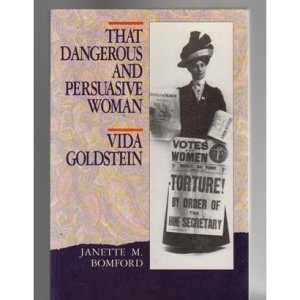
‘That Dangerous and Persuasive Woman: Vida Goldstein’ by Janette M. Bomford

Bomford

1993, 226 p & notes.

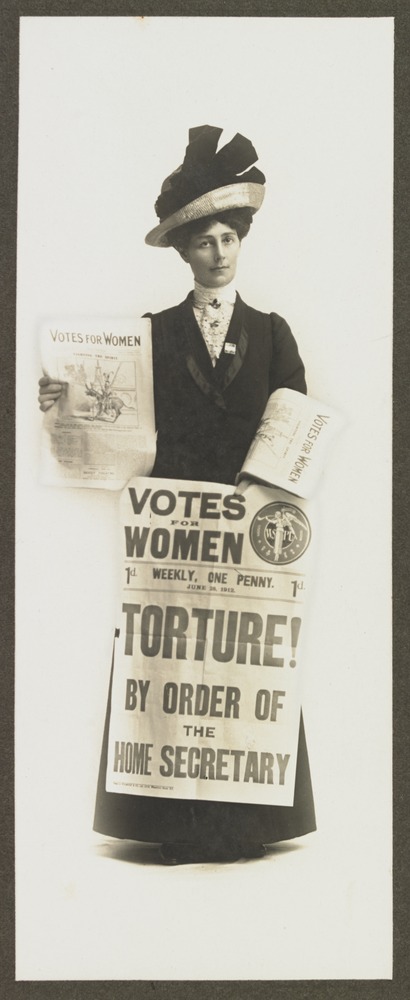
Vida Goldstein is remembered as a suffragist, social reformer and pacifist. The picture on the front Bomford’s biography encapsulates what we tend to think of as the quintessential first-wave feminist, in her Edwardian clothing and earnest demeanour. It’s a photograph of Vida Goldstein, taken by T. Humphrey and Co Photographers, holding a placard dated 28 June 1912 about the English suffragist campaign. At this time, Vida Goldstein would stand in the Melbourne streets – a shocking sight- posters pinned to her skirt, selling the newspaper ‘Votes for Women’ and her own  ‘Woman Voter’ publication.

Vida Goldstein selling Votes for Women newspaper.

Vida Goldstein selling “Votes for Women” newspaper. State Library of Victoria, Maurice Blackburn, Papers, MS 11749, http://handle.slv.vic.gov.au/10381/360742

Vida Goldstein’s internationalism was just one aspect of her life that Janette Bomford highlights for us in this biography. At a time when women elsewhere in the Empire were still fighting for the right to vote, New Zealand and Australian women (who received the vote in 1893 and 1902 respectively) were feted in suffragist circles as an example of the new world to come (similar I suppose, to the way that Irish pro-marriage equality campaigners have advised during the current wrong-headed same-sex marriage ‘survey’).  She travelled to America as Australian delegate to the International Woman Suffrage Conference Fed 1902, aged 32 and was the delegate from the NSW chapter of National Council of Women to the Conference of International Council of Women, held immediately afterwards. She was elected Secretary to the International Woman Suffrage Committee,  serving alongside the 82 year old American feminist Susan B. Anthony who was President. While in America she undertook research into youth justice and criminology, two interests that she was to pursue throughout her life.

Nearly ten years later Vida Goldstein travelled to England in 1911 as a guest of the Pankhursts and the Womens Social and Political Union, spoke to 10,000 people in the Albert Hall and organized a contingent of ‘overseas’ women in the Great Suffrage Procession in June 1911. As Bomford points out, her contact with the most eminent suffrage workers in the United States and Britain brought her a sense of sisterhood and camaraderie that she never quite felt in Australia (p.219)

Goldstein’s commitment to women as voters and politicians in their own right dominated much of her public career. Born in 1869 in Portland Victoria, her mother had been involved in the Victorian Womens Suffrage Society in 1884, and young Vida cut her teeth as a committee member and organizer with the United Council for Women’s Suffrage and the Women’s Federal Political Association.  It was this last group, later renamed the Women’s Political Association that proclaimed itself to be unaligned to any political party, a stance which probably cost Goldstein electoral support in her three attempts to stand for the Senate as a Victorian representative, and two attempts at the House of Representatives seat of Kooyong.  She was the first woman in the Empire to stand for political office, even though she was never successful.  During the election held between the two Conscription referenda in 1916 and 1917, she was accused (with good reason) of splitting the anti-conscription vote, even though she was herself an ardent pacifist.

Her commitment to pacifism split the Women’s Political Association in the early years of the war, when there was strong support generally for Australia’s involvement. It led her to split with the Pankhursts in England, despite her involvement in the suffrage campaign there  less than five years earlier. It brought her into the spotlight of public attention as she campaigned with the Women’s Peace Army, of which she was a founding and highly visible member (I’m sure that her selection of the same initials as the Women’s Political Association was no accident- and it made taking notes on this book a nightmare!) She was mainstream middle-class, stylishly dressed  and a very capable public speaker, and she spearheaded the ‘No’ case during the Conscription referendum campaigns.

In many ways, the different aspects of her political life often clashed up against each other: the support for militant suffragism and yet strong pacifism; her determination not to align herself with a political party, even though it hurt the left of politics to which she more naturally leaned. As Bomford explains, she was a strong but inflexible character. Her parents had given her a good education, first at home with a very capable governess, and then at PLC. However, in a foretaste of what was to come, the family split over the issue of women’s suffrage when her parents publicly took diametrically opposed views. Through her parents, she became involved in the Charity Organisation Society of which they were founding members, which took a ‘case study’ and causal approach to poverty, and championed dignity in work rather than handouts to ‘deserving’ cases as practised by the Ladies Benevolent Society.  It was to her family that she looked for emotional sustenance, living with her sisters and brother-in-law in South Yarra for the last thirty years of her life.  Despite her name (which she always pronounced with ‘eye’ in both her first and surnames) she was not Jewish. Her religious and spiritual life was nurtured through Rev Charles Strong’s ministry first at Scots Presbyterian and then the Australia Church, and increasingly through Christian Science, to which she devoted her passion post WWI.

As Bomford explains, with Vida Goldstein there is no cache of personal papers for the biographer to mine. Fortunately, her correspondents often did keep her letters, most particularly her friend Stella Miles Franklin.  As a result, Bomford has had to rely on newspaper reports, Vida’s own writing in her various newspapers and speeches, and the reports of the government censors and security organizations. The constraints of material have constrained Bomford to write mainly of Goldstein as a public figure.  Nonetheless, I think that Bomford does a good job in giving an internal logic and unity to Goldstein’s politics, even though her inflexibility so often worked against the causes she believed in, and cost her many allies.

This is an academic text, with quite a few initials for organizations, which is just as much part of the territory in discussing political activism today as it was at the turn of the twentieth century.  It takes a strictly chronological approach, and most of the character analysis takes place in the ‘Afterword’ that closes the book.  It is probably not widely available today, given the ferocious culling of texts in libraries and short shelf-life of books in bookshops, but Vida herself has taken on even more prominence with the recent interest in the conscription debates of WWI and the toxic politics around Julia Gillard’s Prime Ministership.  ABC’s Hindsight program had an excellent episode about her in 2009 which is available as podcast and transcript here . Claire Wright also discusses Vida on a Podcast from La Trobe University’s Biography series available at https://player.fm/series/biography/vida-goldstein  (the text is similar to Wright’s entry on Goldstein at the Encyclopedia of Women and Leadership in Twentieth Century Australia).  She also wrote a very good essay ‘Birth of a Nation?’ in Griffith Review 51 available here.

aww2017-badge

I have posted this review to the Australian Women Writers Challenge 2017.


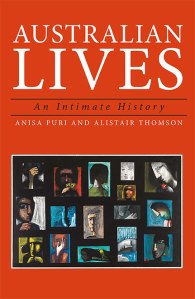
‘Australian Lives: An Intimate History’ by Anisa Puri and Alistair Thomson

thompson_puri

2017, 425 p.

It’s hard to know how to review this book and, indeed, it was hard to know quite how to read it, too. It is the print-based outcome of the Australian Generations Oral History Project, a collaboration between historians at Monash and La Trobe Universities, the National Library of Australia and ABC Radio National. It has been well-mined by the various partners, with the ABC producing five episodes on their much-missed Hindsight program and a rich page produced on Monash University’s Arts Online portal.  Much of the base material can be accessed through the National Library of Australia site, where by accessing the ‘Related Records’ field of the catalogue entry, you can listen to the original oral histories and read the entire transcripts, subject to the access conditions stipulated by each interviewee.

So why then would you bother to read the book, if it’s all online? Well, apart from the portability of a book, the 300 life histories produced as part of the project have been curated here into a more manageable 50, all of which have permissions allowing access to the sound file and transcript now (rather than at some future date) on the NLA site. They are arranged in chapters of two types. The first type are life course chapters (Ancestry, Childhood, Youth, Midlife and Laterlife) and the other chapters are thematic (Faith, Migrants, Activism and Telling My Story). Within each chapter, there are further subdivisions that group oral histories by topic.

There is a chronological spread of interviewees, spanning from one born in  1923 through to participants born in 1989. There are indigenous respondents, Australian-born respondents and participants from many other places: Bosnia, Batavia, Cairo, Malta and Sudan.

The interviews are arranged chronologically within each chapter, but it’s not always the same subject.  It is possible to follow through the same character by looking them up in the Narrator Index, where there is a very brief synopsis of the character and a list of the pages of the book where you can find their interviews. However, I read the book straight through, in the order in which it is published. At first I wondered how I was going to keep all these people straight, but fortunately each extract has a small italicized prompt, providing brief contextualizing information.

Each chapter starts with an overview, written by the authors, which provides a twentieth-century historical context and points towards the salient contributions in the interviews.  I enjoyed these as a way of giving shape to the volume.  Alistair Thomson is well-known as one of Australia’s pre-eminent oral historians, and Anisa Puri is President of Oral History NSW and a PhD candidate.  In the acknowledgements you can see the wide range of historians who have participated in the project.

If you’re the sort of person who likes listening to people tell their stories, then this book may well appeal. It’s the sort of book that you can pick up and put down quite easily. There is no overarching argument, beyond the diversity and uniqueness of each person’s story and the  interactions between individuals and society.  This comes through the extracts that they have selected:

…we selected extracts that illuminate change and continuity and how individuals lived with and against the economic forces, cultural expectations and legal constraints of their times.  We also chose extracts that highlight how different types of Australians – male or female, city or country, poor or prosperous – have managed their lives and faced distinctive challenges and opportunities.  And, of course, we picked stories that evoke the humour, drama and pathos of human life. (p.xii)

Sourced from : Yarra Plenty Regional Library


aww2017-badge

I have recorded this on the Australian Women Writers Challenge website.


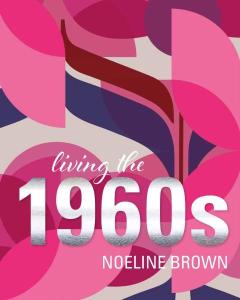
‘Living the 1960s’ by Noeline Brown

living-the-1960s

2017, 177 p. NLA Publishing

In choosing Noeline Brown to write this book, the NLA was obviously going for popular culture and a dry sense of humour- and they got it. I can remember Noeline Brown in the Mavis Bramston show : indeed, she was Mavis Bramston in the pilot and first five shows. When she went off to England (as most 1960s show business and music people did) she was  replaced by Maggie Dence who became better known as the face (and hat) of Mavis Bramston.

I must confess that this slap-stick style of humour doesn’t really appeal to me, and Noeline Brown’s career, most of which was on commercial television, mostly passed me by.  I remember her in Gough Whitlam’s ‘It’s Time’ advertisement and I was aware of her in the support that she gave to Graeme Kennedy as his health failed. She has been an Ambassador for the Aging, and recently received a lifetime achievement award from Actors Equity.

There are eight chapters in the book: politics, the arts, music, fashion, family life, our town, women and sport. The text is conversational in tone, and interweaves  Brown’s own personal anecdotes between snippets of information.  It’s largely a young-person-at-the-time’s guide to the social life of the 1960s, and as might be expected from a stage and television personality, very much based in the realm of music and the popular arts.  It’s a very light touch, with no theoretical framework or bibliography at all. It’s an easy and undemanding read and the sort of book that can be picked up for a chapter or two, then put down.

The book is generously illustrated with images from the National Library’s collection, and includes political ephemera, photographs by Rennie Ellis and Wolfgang Seivers, and magazine advertisements and photographs ( drawn most particularly The Australian Women’s Weekly). The layout is beautiful, as is the case with most NLA books. There are small breakout boxes of timelines and facts, and page-length featured topics, but the photographs do most of the work. It focuses mainly on Sydney and Melbourne, is probably more focused towards women, and rural life is barely touched at all.

The book, with Brown’s narrative as voice-over, felt very much like a back-to-the-sixties television documentary, full of nostalgia and wry amusement.

Source: NLA publishing review copy through Quikmark Media

aww2017-badge

I have posted this review to the Australian Women Writer’s Challenge site.

[P.S.  A little plug for something close to my heart:  If you’re interested in local history of the ’60s in Melbourne, and if it’s still November 2017, why not visit Heidelberg Historical Society’s ‘Remembering ’67’ exhibition? It’s open on Sundays 2p.m. – 5.p.m on 12th, 19th, 26th November at the Heidelberg Historical Society Museum, Jika St Heidelberg, entry $5.00]


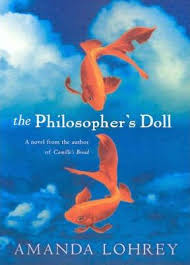
‘The Philosopher’s Doll’ by Amanda Lohrey

Lohrey_Philosopher

2004, 306 p

It’s a strange thing, re-reading a book. You’re not the same reader that you were the first time and the context in which you’re reading the book is often very different. I read Amanda Lohrey’s The Philosopher’s Doll soon after it was released back in 2004, straight after reading two big, fat books: The Sotweed Factor and Tristam Shandy. At the time I leapt on it because it was local, domestic and female in comparison to the two hefty tomes that preceded it. Now, twelve years later I’m reading it again, this time for my face-to-face bookgroup. I didn’t view it quite as kindly the second time round.

The book is set in Northcote  with social worker Kirsten trying to summon up the courage to tell her husband Lindsay about her pregnancy. Lindsay does not want children, (or at least, not yet) and Kirsten is aware that she has fallen pregnant in benignly deceptive circumstances. Her philosophy lecturer husband Lindsay, on the other hand, thinks that all she needs is a dog to settle her maternal urges and so he embarks on a secret plan to buy a pure-bred Chow, a breed whose aloofness appeals to him. The dog is not Lindsay’s only secret: he is also receiving letters from an infatuated doctoral student, Sonia,  that he just puts away for now, not telling anyone about them.

The book is presented in four parts, and this part of the storyline plays out in the first two parts over a matter of several weeks. It is told in the third-person present tense (a tense that I don’t enjoy much) and the two perspectives are interwoven. Then, abruptly, in the third section, the infatuated student Sonia is speaking in the first person, past tense, some ten or more years after the events first part of the book.  Things have changed, and we see them in their new form, but not how they arrived at that point. Coincidences may be more planned than they appear, some mistakes are replicated and new ways of being are learned and embraced.

This is a very Melbourne book, and as a resident of the northern suburbs, I could pinpoint almost to the street – James Street, Northcote do you reckon?- where Kirsten and Lindsay lived. In this regard, the book has Garnesque features, but it is burdened with a didactism that you don’t find in Garner’s work. Lindsay’s occupation as philosophy lecturer gives scope for digressions into the emotional capacities of humans v. animals, and the question of the rhetorics of the heart. The final section of the book launches into a discussion of stunt -no – precision flying that almost sinks the book, if the lengthy retelling of dreams hasn’t already done so.

Does the book need all this philosophy trowelled onto it? I tend to think not. I felt a little betrayed as a reader by the abrupt change half way through, and as if I were sitting through a boring, one-sided conversation in the philosophical parts.

Reading back on the review that I wrote on this book back in 2004 (before I started this blog), I didn’t mention any of these criticisms. Did I just read it as a Melbourne-based story, and did I skip the philosophy? Or did I enjoy the philosophy perhaps?  Have I changed since then? Or am I more conscious of Lohrey’s earnest spiritual intentions in writing now after reading A Short History of Richard Klein, which I found even more didactic than this book?

Sourced from: C.A.E. Bookgroup

Rating: 6.5/10

aww2017-badge I have posted this review to the Australian Women Writers Challenge site.