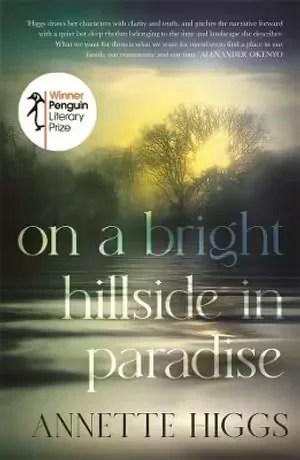
For many years the idea of having convict descendants was something to be ashamed of, but not anymore. ‘A convict in the family’ is now almost a badge of pride, although as the Founders and Survivors project on Van Diemen’s Land convict records has shown, the life histories of people transported to Tasmania were not necessarily the optimistic stories of redemption and upward progress that we might like to imagine. Annette Higgs’ book On a Bright Hillside in Paradise, set in 1874 takes a more clear-eyed view of Tasmanian rural life, where ‘collisions’ with the indigenous people and the ‘convict stain’ were still within living memory. Based on her own family history, this is the story of three generations of the Hatton family, eking out a precarious living on a small land holding on the west coast of Tasmania, in a place rather ironically called ‘Paradise’.
Into this ‘Paradise’ come two Christian Brethren preachers, a trope more familiar in American rural stories than Australian ones, who convert members of the Hatton family to varying degrees, along with many others from the Paradise community, in a mixture of faith, curiosity, lack of other excitement and life disappointment.
The story is told from five different perspectives. It starts with Grandmother Eliza whose convict father married her off to a fellow convict who was violent to her and fathered multiple children upon her. She now sits in the corner of her adult daughter’s house, watching the family, and she is full of stories and secrets from the past. We move to the oldest son, Jack, who is converted by the preachers, and stays on the family farm. Susannah is Eliza’s daughter and Jack’s mother, drained by her many children and too much sadness and death. Her son Jack’s brother Eddie, takes up the story, but he is the one who strikes out on his own, after falling out with his brother. Their sister Echo rounds out the book, sharing her brother Jack’s faith but still close to her brother Eddie.
Not much actually happens in the book. There is an ongoing rivalry with the Dunstan boys; the indigenous Coleman boys hold knowledge of older ways; there is a tragic accident and subsequent guilt; there are births and deaths. Small things are part of big things. The same events are told in each section, adding a little more detail each time, widening out each time and through another perspective to have other significances. These are the stories that are handed on through families, shaping later generations’ sense of family history.
Higgs captured well the sameness and the precariousness of farming life, and the narrowness of vision under the wide expanse of sky, mountain and bush. She has obviously done her research well, and it rings true. I did keep expecting something to happen more suddenly and randomly, but instead this is a slow unspooling of small events into a bigger meaning, with individuals placed against a wider backdrop of ‘history’. It is beautifully written, with a slow, even pace but I found myself anticipating a jolt that never came.
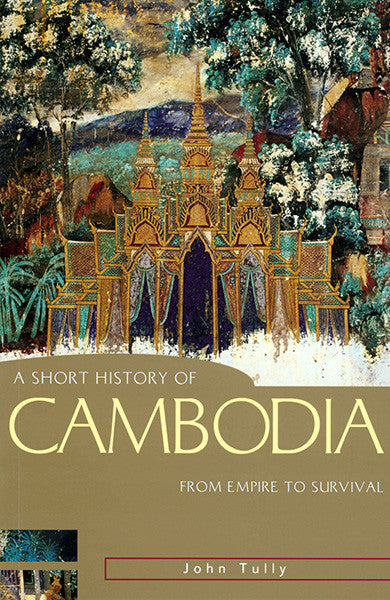
As I was visiting Cambodia, I wanted a short survey history of the country and this book, part of a series of ‘Short History of Asia’ series fitted the bill. John Tully was a professor at Victoria University (now retired), and as well as writing labour history, he also has written on Indo-China generally and Cambodia in particular. It’s a very accessible book, without footnotes but a reading list at the back. It was good start for a reader who wanted the whole sweep of Cambodian history, not just the Pol Pot era which tends to define our idea of Cambodia. He covers 2000 years, from the state of Funan, which predated Angkor right up to 2005, when the book was published.
Chapter 1 ‘The People and their Environment’ starts off with a geographical description of Cambodia, emphasizing its flatness in the middle and the huge Lake Tonlé Sap, the largest freshwater lake in Southeast Asia, and the Mekong River which breaks up into tributaries at Phnom Penh before flowing into the Mekong Delta in Vietnam.
I found Chapter 2 ‘Cambodia before Angkor’ fascinating. There was settlement of hunter-gatherers from the Stone Age onwards, and the Kymer-Mon people settled around 3000 BCE after migrating from the north. By the first century CE there was the Funan civilization, a literate, Indianized society which relied on the trade routes stretching from Persia to China. It was followed by the rise of Chenla, which may have been two principalities- Chenla-of-the-Land and Chenla-of-the-Water. The people spoke an archaic form of the Cambodian language, and they were the ancestors of the modern Kymers. It was king Jayavarman II who decided to shift his centre of power from the Mekong up to the Siem Reap region north of Lake Tonlé Sap.
Chapter 3 goes through the shift to Angkor, and the monumental legacy at Angkor Wat. He discusses how the temples were built, and the sheer manpower that it must have taken to construct them. He goes on to discuss what we know about the common people of Angkor from the inscriptions on the monuments, which detail punishments and provide information about the social structure, clothing and slavery. I thought that he did a really good job here in making Angkor a living, vibrant, populated culture, something which can be forgotten when you’re looking at ruins. He enters into the debate over water, and the contribution of ecological factors to the decision to move back to the Mekong quatre-bras region, although as he points out Angkor Wat was not abandoned as such. He emphasizes the arrival of Teravada Buddhism, displacing the earlier Sivaism and Mahayana Buddhism.
Chapter 4 ‘From Angkor’s End to the French Protectorate’ sees 1431, and the Siamese sacking and burning of Angkor, as a turning point. The Siamese in Thailand to the west (The Tiger) and the Vietnamese to the east (the Crocodile) both threatened to absorb the weakened kingdom completely. By the late 18th century, a Dark Age had descended on the country. The time of grand monument building was over. The road and canal system fell into disrepair, and village life predominated. Siam and Vietnam didn’t want to confront each other directly, so they used Cambodia as a buffer. Although there was a period of relative peace under King Ang Duang who set up his palace at Udong, increasing rivalry between the French (who had colonies in Vietnam) and the British (who had influence in Thailand) saw Duang’s oldest son, Prince Norodom, turn to the French for support in 1863.
The French protectorate lasted between 1863 and 1953 (Chapter 5). The treaty signed by Prince Norodom on 11 August 1863 gave France the right to station warships at the Quatre Bras (Phnom Penh), gave privileges to the Catholic Church, and granted free trade to the French throughout the region. The French embarked on a program of reform including the creation of private property in land, the abolition of slavery, cuts to royal spending, and legal and administrative restructure. I hadn’t really thought about the implications of the fall of France to Germany in 1940. The French Indochina Governor-General Admiral Jean Decoux supported Vichy and set up concentration camps, introduced the fascist salute and the goose-step and ritualized chanting of Petain’s name. He readily agreed to Japanese requests to station troops throughout IndoChina. Norodom Sihanouk came to the throne in 1941 as a baby-faced 19 year old. After the war, France granted some autonomy to Cambodia, but still maintained control over the military and foreign relations, finance and communications. There were elections and the start of political parties, and a constitution was ratified in May 1947. There was a coup in 1952, probably fomented by Sihanouk – Tully really doesn’t like Sihanouk- who assumed power directly and dissolved the democratically elected government.
Chapter 6 ‘Sihanouk, Star of the Cambodian Stage 1953-1970’ looks at Sihanouk more closely. Sihanouk likened Cambodia to an ant under the feet of two fighting elephants- the U.S. and the Soviet Union. He maintained neutrality- or perhaps it was more a matter of playing on both sides- and needed to maintain his own position at home while preserving the integrity of his borders. In 1955 he abdicated in favour of his father, and became more directly involved in politics. He introduced the idea of the Sangkum, a merger of political parties, into a one-party state which set the tone for politics for the next 15 years (and perhaps is still visible in Cambodia’s politics today too). When his father died, he allowed himself to be ‘persuaded’ to become head of state, introducing a form of ‘totalitarian democracy’. He spent heavily on education and health, introduced a series of 5-year plans and state construction. Although he tried to repress the Cambodian communists, his foreign policy moved sharply to the Left, moving away from U.S. support and towards China and Russia.
A brief five years as a republic, in Ch. 7 ‘The Doomed Republic 1970-1975’ saw a coup against Sihanouk, probably tacitly supported by the CIA. Sihanouk joined hands with his former Kymer Rouge enemies to removed the ‘usurpers’. Prime Minister Lon Nol was crooked and second-rate, but he served at various times as both prime minister and president (and later Field Marshall as well). By this time, Nixon had initiated an invasion under Operation Shoemaker, which included massive bombing, napalm and atrocities against civilians particularly (but not exclusively) by Vietnamese troops. Fighting continued, and the Kymers Rouges (Tully uses both in the plural) guerillas took Phnom Penh.
Then followed ‘Pol Pot’s Savage Utopia’ between 1975-1979 (Chapter 8). What I like about Tully’s book is that this four-year period, which so dominates our perception of Cambodia, is just part -albeit a horrific one- of Cambodia’s history. By highlighting the war and disruption prior to 1975, Tully goes some way to explaining why the Kymers Rouges were able to take power: the society and economy had been traumatized by five years of war. Prince Sihanouk became the figurehead of the new regime, although it was made clear to him that he was only a figurehead. The chapter is only 30 pages in length, but Tully captures well the madness and cruelty of the regime. The irony is that it was Vietnam, the traditional enemy, that put an end to ‘Democratic Kampuchea’, rescuing Cambodia from the nightmare.
Chapter 9 ‘Painful Transition: The People’s Republic of Kampuchea’ looks at politics since 1979. Here Sihanouk’s fear of being an ant under elephant feet was realized. The West had such a fear of Vietnam and China, that they continued to recognize the Pol Pot government despite knowledge of what had occurred during their regime. Over time, attitudes towards China thawed, and Vietnam was no longer seen as an expansionary communist regime. How slippery is Sihanouk! Now that Pol Pot was no longer embraced by the West, he started distancing himself from him. We see in this chapter the increasing presence of Hun Sen.
The final chapter ‘Towards an Uncertain Future’ starts with the 1993 elections, overseen by the United Nations Transitional Authority in Cambodia. Sihanouk tried to put himself as the head of a coalition government, acting of president of a council of ministers and commander-in-chief of the armed forces. However, he had to settle for returning to the throne as King Sihanouk, playing a ceremonial role in a regime dominated by Hun Sen, who had emerged as the undisputed strongman.. At the time of writing (2005) 50% of Cambodia’s budget came from overseas aid, corruption was rife, there was an AIDS/HIV pandemic, and a burgeoning ecological crisis. Although wanting to avoid being a Cassandra or an oracle, his conclusion was not particularly hopeful:
Looking back over the past quarter of a century (let alone the earlier Dark Age that beset Cambodia in the first half of the 19th century) it is difficult to imagine that anything worse could befall the Khmers. Cambodia has staggered from crisis to crisis since 1970 and in the absence of a developed civil society there is little check on the arrogance of government and the corruption of the administration. With entrenched rulers primarily interested in their own power and wealth, there seems little prospect of change in the future.
End of chapter 10 – (e-book)
I found this book really useful. It gave me the wide span of history that I wanted, and it was pitched at the right level for someone unfamiliar with the history. It had maps, and a list of acronyms, and it managed the balance between international and internal politics, and the day-to-day experience.
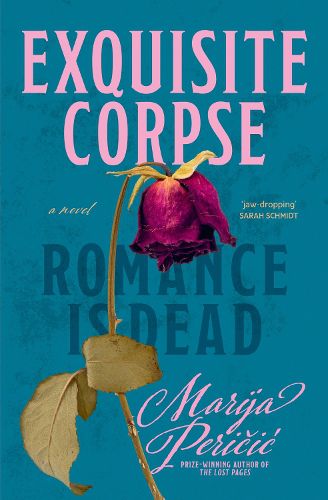
This unsettling novel is based on a true story. Set in Stockholm in 1930, Lina Dahlstrom is dying of tuberculosis and despite her sister’s misgivings, is drawn into the sphere of an eccentric doctor, Carl Dance, who claims that he can cure her. When she dies, his obsession with her grows stronger, and he embarks on a repugnant and criminal scheme to keep her as his own for ever.
I knew, from reviews that I had read of the book, that it was based on a true story, although there is only a single phrase “based on true events” on the back cover. I do wonder how that shaped my response to the novel, because its plot line is so visceral and distasteful that I would have otherwise put it aside as a form of torture porn. The knowledge it was “based on true events” meant that the plot could not be dismissed so neatly.
The story is told in four narratives, each roughly approximate in length, that move the story along chronologically. Part I is told by Greta, a young tobacco factory worker, who is frantic to get medical assistance for her sister Lina, who is floating through tuberculosis, rather indifferent to her fate – apparently one of the emotional manifestations of tuberculosis. With few resources, Greta urges her sister to accept the offer of help by Dr. Dance, even though she feels uneasy around him. Part II is told by Dr Dance as he becomes increasingly unhinged in his obsession with Greta’s corpse, and it is here that my scoffing at the implausability needs to be tempered by my remembrance that there is a kernel of truth here. I think that this is probably the most disturbing, and the best written part of the book. Part III is told by Lina’s corpse – hard narrative trick to speak on behalf of a corpse, but others have done it too- as the sheer perversion of Dr Dance’s actions are perpetrated on her. Pericic gives her a wry humour that is not apparent in the first section, through her sister’s eyes, but perhaps a sensibility that is more 21st century than 20th century. The final Part IV is told from the perspective of Dance’s wife Doris, as she is pressured both by Dance and his friends, into maintaining a veneer of support for Dance when he appears in court. Indirectly, we see another side of Dance here, as he wheedles and manipulates Doris, who is another of his victims.
Apparently ‘Exquisite Corpse’ is a form of drawing game- something that I only learned when looking up reviews of the book. It’s where players each draw a part of an animal on a sheet of paper, unaware of what the other players have drawn beforehand, leading to the creation of a weird, implausible monster-animal. In a way, the four part structure of the book replicates that, with each of the narrators unaware of what the others have said before them. It’s an interesting approach, but one that I don’t think Pericic carried off particularly successfully. Greta and Lina were both working-class girls, but I couldn’t hear their voices. Dance, although his actual profession is opaque in the book, is American and obviously possessed of a strong self-belief, but that does not come through particularly clearly. His wife Doris was presumably of a ‘better’ class and education than Greta and Lina, but that was not apparent.
I must admit, though, that despite the stomach-churning nature of the subject matter, I was drawn in by the book through a mixture of prurience and fascination. It reminded me a bit of Ebershoff’s The Danish Girl both in its time and setting, and also as a glimpse of something intimate that is so dissonant with the surrounding world.
My rating: 7.5 (hard to say)
Sourced from: Yarra Plenty Regional Library, and read because I was fascinated by some reviews.
In Australia, we’ve recently witnessed the unveiling of the official portrait of a former Prime Minister, Kevin Rudd, ten years after he quit Parliament. It’s certainly ‘different’- almost reminiscent of a Graeme Base picture book illustration with lots of small symbolic details and, yes, a cat. It must be odd, having your portrait painted- especially an official one, which is going to represent you for posterity.
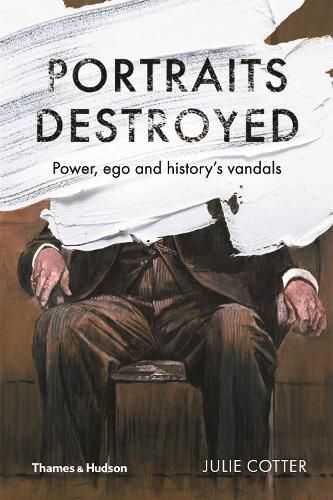
Art historian Julie Cotter’s book Portraits Destroyed looks at the official portrait, or representation, and its reception (generally negative) from either the sitter him/herself or their family, or by later generations. I was not surprised that she has worked on documentaries on Australian art previously, because this book and its chapter structure would lend itself very easily to a documentary series. I can already see her wandering around an art gallery as host.
She starts by considering Winston Churchill, whose now-destroyed portrait is represented on the front cover of the book. I only remember Winston Churchill as a fat, jowly old man and that’s very much the way that artist Graham Sutherland depicted him in 1954. It was unveiled by Churchill himself at Westminster Hall on 30 November 1954, on the occasion of his 80th birthday where he announced it “a remarkable example of modern art” (an ambiguous description, given that Churchill himself was a landscape artist of a very un-modern type).
He would have expected a portrait of a face that flickered with his life: a face that reflected the tumult, the devastation, the glorious victories, the might of the British Empire that the twentieth century had experienced. He would have wanted us to recognize ourselves in his portrait- to hear his speeches to the masses to keep fighting, to remain strong and unite against Hitler, to remember where we were when armistice was declared, to mourn those we had lost. He was his own muse, absorbed by his achievements
Instead, he was faced with the image of himself as a ‘down-and-out drunk who has been picked up out of the gutter in the Strand’ he concluded to his private secretary Anthony Montague Browne.
p. 37
After its unveiling, the portrait was never seen again. It was said that, after his death in 1965, his wife Clementine had burned it herself. This wasn’t strictly true: it was too big for her to take into the garden to set alight to it, and instead Churchill’s next private secretary, Grace Hablin, arranged for her brother to help her move it to his house, where it was burned.
It is fitting that the chapter about Churchill should be followed by a chapter about Hitler, given that they were arch-enemies. In this case, she hones in on an oil portrait painted by Dresden-born contemporary artist Gerhard Richter in 1962, who drew his portrait from an image showing Hitler at Nuremberg in 1934, “in a moment of strangulated shouting, hysterically commanding, his face elongated and distorted” with his right arm across his body (p. 44, 45) It was exhibited for the first and last time in 1964, and then Richter (who had since defected from East Germany) destroyed it himself, probably by cutting it to pieces. Richter himself had joined the obligatory Hitler Youth, and his schoolteacher father Horst, was drafted into the military in 1939. When he returned, he was a broken man, unable to teach because of his Nazi associations. Richter’s uncles were killed, his mentally ill aunt was killed under the Nazi’s T4 program of large-scale euthanasia. Cotter suggests that Richter’s destruction of his own work allowed “the release of a stultifying hatred”, but could also have been because of concern about the work’s impact in 1962, when Nazi ideology still circulated.
Chapter 3 ‘Presidents and Dictators’ looks at American presidents: Hayes, Roosevelt -who had two portraits, one he didn’t like by Chartran, and another which he did by John Singer Sargent- and Kennedy; Stalin; Mubarak in Egypt; and Mugabe. Chapter 4 ‘Royalty and Nobility” looks at English and French royal portraits; portraits of Imperial Roman women, especially Agrippina, and the Egyptian portrayals of Queen Hatshepsut. The Medicis used portraiture to express their power during the Renaissance, with an interesting portrait of Bianca Cappello, who bore The Grand Duke of Tuscany an illegitimate son. Then there are the portraits of Henry VIII, Queen Elizabeth I and the absent portraits of Lady Jane Grey. She then moves to the present day with over 150 official portraits of Queen Elizabeth II, including one by Lucien Freud, and the slashed portrait of Lady Diana Spencer which is now one of the National Portrait Gallery’s most popular exhibits.
Chapter 5 ‘Why Not Mao?’ returns to dictators, and I’m a little surprised that she didn’t place this chapter immediately after Chapter 2 which dealt with Hitler. As she points out, without wanting to lessen Hitler’s atrocities in any way, Mao was responsible for 50-80 million deaths if the Great Leap Forward is combined with the Cultural Revolution. Yet the West has not had the same resistance to displaying Mao’s image, and it is ubiquitous in China itself, (albeit, only by official portrait painters),looming over Tienanmen Square. She then explores Andy Warhol’s images of Mao, prompted by reading in Life magazine that Chairman Mao was the most famous person in the world. There has been little concern expressed about Warhol’s images, given the level of antagonism to portraiture of other leaders responsible for deaths on such a massive scale (p. 146)
Ch. 6 ‘Whitewash: Erasing Black History in the West’ examines the fraught issue of art representing black/white history. There was resistance to white artist Dana Schutz’s portrait of Emmett Till, murdered in the American South in 1955, when the rights of white artists to represent black people was brought into question. She explores the representation of Australian indigenous people by William Westall, who accompanied Matthew Flinders in 1801, and Tom Roberts’ representation of nineteenth century indigenous people in the Torres Strait. She discusses Mount Rushmore, U.S. Confederate statues, and John Batman’s statue here in Melbourne, and their removal or disfigurement, before moving on to the desecration of Eddie Mabo’s image on his grave (I did not know about this). Then there is the destruction of a mural representing indigenous political figures on the side of the Uniting Church’s Wayside Chapel in Bondi in 2016.
In her final chapter ‘Artists Destroy and Destroyed’, she looks at the disappearance of Benjamin Duterrau’s group portrait, the 5 metre long The National Picture, painted in 1840, which I had never heard of (I am familiar with his other paintings of Tasmanian indigenous people). She discusses the rivalry between Degas and Manet, and the reuse of canvases by Van Gogh and Picasso. She looks at the politically driven attacks on artwork, like Suffragette Mary Wood’s slashing of a portrait of Henry James by John Singer Sargent, and a similar attack by Anne Hunt on John Everett Millais’ portrait of Thomas Carlyle. Rolf Harris’ portrait of Queen Elizabeth II has disappeared from public view, along with his other portraits. Then we have the Spanish cleaning lady’s attempts to ‘touch up’ Ecce Homo by Martinez in a Spanish church, and the slow drip, drip of the wax portraits of Urs Fischer, created in order to be destroyed.
As you can probably tell, this is a discursive book that takes us to many paintings. Unfortunately, she has a limited of number of portraits included in the book, so you need to rely on her descriptions (I resisted the temptation to Google them). This was not as much of a drawback as you might think, because the book is more about the context and process of creation/destruction of the portrait, rather than the portrait itself. There is enough theorizing in the book to make it more than just a gallery-hop, and you are always aware that she is an academic/historian writing from a theoretical framework and informed knowledge. But thankfully it eschews the insufferable mumbo-jumbo that clags up a lot of writing about art, and is thoroughly readable and enjoyable. Now I just have to wait for the series on the ABC which I am sure will follow.
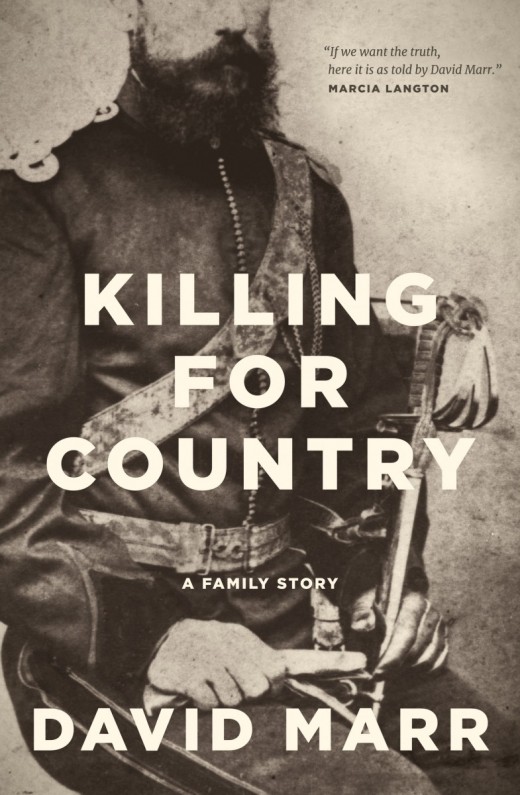
This is such a clever title. Subtitled “A Family Story”, the title works on several levels. “Killing“- who is killing here? Indigenous people killing families, shepherds and hutkeepers in defence of country as the waves of ‘settlers’ and ‘squatters’ sweep across the continent? Or the white officers of the Native Police who turn the other way and let their ‘boys’ of the Native Police loose killing men women and children of other tribes? Or the Native Police troopers themselves, far from ‘country’ and with no links to their victims? Or white squatters and settlers who ride alongside the Native Police, or who distribute poisoned flour and meat? “Country” as used by indigenous people as their spiritual connection? Or ‘country’ as used by white settlers as land to be used; or a political entity to be defined and defended internationally? And “a family story” – David Marr’s own family through genealogical connections of which he was unaware until relatively recently? Or ‘family’ as the protagonists sought and maintained their positions through the networks of connections which bound together the British Empire? This book is all of these and more.
I’m sometimes wary of biographies written by descendants, whose familial connection has been the impetus for the book, and whose depth of research imbues the topic with a significance that it might not necessarily have, in the big picture. In this case, though, Marr leaves the family connection largely to one side to write narrative history which is broad enough in its scope to draw on larger historiographical arguments, while maintaining its focus on his protagonists Richard Jones and the Uhr family brought into Jones’ family orbit through his wife Mary, without laboring (indeed, not even mentioning) the family link. These are important – if increasingly infamous (largely due to this book)- people in their own right, with entries in the Australian Dictionary of Biography.
Richard Jones was a merchant, who along with Alexander Riley, had a monopoly on importation to the early NSW colony, which made him for a time very wealthy and politically influential. Like other successful businessmen of the time, he invested heavily in sheep, which gave him an interest in squatter politics in the insatiable hunger for new lands, and which led to his bankruptcy during the economic downturn of the 1840s. However, with some canny land sales and disguise of his ownership in the names of his wife, brothers-in-law and children, he maintained sufficient wealth to support his inclusion in the Legislative Council of the day. There, despite his quietly spoken ways, he formed part of the conservative power-block that thwarted governors and exerted pressure on the Colonial Office to maintain the hold of the squatters on huge leased swathes of land.
It also gave him the connections to have his brothers-in-law and their families, and their sons placed in positions of authority as magistrates and, most importantly for this story, as Officers of the Queensland Native Police, as were Reg and D’Arcy Uhr, Jones’ grandsons. Instituted in 1848 on a model first established in Port Phillip, this force never numbered more than 100 at its peak, headed by 10-14 ‘gentlemen’ officers and half a dozen officer cadets. The officers would stay with the force for five years or so, where they were well inculcated into the methods and ethos of the Native Police, and were then appointed as magistrates, who drew on this knowledge in ensuring that the Native Police remained politically protected. Sometimes the Officers themselves were involved in massacres or ‘dispersals’, other times they would simply direct their troopers to chase down indigenous groups and would close their ears to the gunshots that would ring out in the bush. As a matter of policy, these indigenous troopers themselves were always sent far away from their own country, so that they would not see their victims as brothers and sisters, but as strangers.
What made them strange and dangerous to each other was being away from their own country, the country that made them who they were. Here was a deadly conundrum. While officially denying their connection to land, colonial authorities would rely on that profound attachment
p. 174
Marr does not even attempt to explain or explore the motivations of the indigenous men who joined the Native Police. As he says in his acknowledgements, this is “not my story to tell. I leave it in better hands.” (p. 415) He does say that they were often – but not always- trapped, kidnapped, threatened at gunpoint. Their desertion rate was high, and while settlers were happy to draw on their ‘services’, they were often feared and despised by white society. The legal position of the Native Police was left deliberately opaque by the colonial government and its courts: they were never issued with written instructions and euphemisms like ‘collision’ and ‘dispersal’ and ‘dealt with’ pepper the official correspondence. But it had its own inexorable, if legally dubious, logic:
…pioneer settlers are entitled to protection; blacks attack whites without reason; they grow more dangerous when left unpunished; imprisonment holds no fears for them; chastisement must be swift to be effective
p. 376
Bolstered by the political power of the squatter lobby, of which Richard Jones was a member, colonial governors did not enforce the leasehold and sale agreements that proclaimed that the indigenous people of an area retained right of access to pastoral land for hunting and sustenance. Each governor had protection of indigenous people as part of his instructions when he was sent by the Colonial Office: none of them managed to enforce it. The Colonial Office had stared down slaveholders and the slavery shipping interests elsewhere in the empire (largely through financial reparations which charged further colonial land acquisition), but they did not dare to take on the NSW squatters. There were landholders, ministers of religion and philanthropists who protested the actions of the Native Police, but they were largely ignored or silenced. The Uhr brothers, as officers of the Native Police, could draw on their family connections through their father and grandfather, and marriage connections with Premiers and politicians, to escape censure again and again and again.
Meanwhile, the voracious appetite of pastoralism, and later mining, was not to be sated. Land was eaten out by sheep, so the pastoralists kept moving ever outward, coming to further ‘collisions’ with traditional owners, as they moved across the map. Marr’s book is illustrated with pen and ink drawings of individuals, but also with excellent maps that showed the traditional owners of territory, with rivers and stations marked, often with a skull to show massacre sites spreading across New South Wales, Queensland, Northern Territory and even over into Western Australia right into the twentieth century.
This is excellent narrative history, told with Marr’s deft turn of phrase. It is well researched, with references cited according to page number at the back of the book. I regretted the absence of a bibliography: it’s just too hard to comb through pages of references to find the original publication. In her blurb on the front cover, Marcia Langton notes: “If we want the truth, here it is as told by David Marr.” In his afterword, Marr writes:
The maths is indisputable: we each have sixteen great-grandparents. Reg Uhr was one of mine. I don’t believe he’s tainted my blood. I don’t believe I am responsible for his crimes. But when I learned what he had done, my sense of myself and my family shifted… We can be proud of our families for things done generations ago. We can also be ashamed. I feel no guilt for what Reg did. But I can’t argue away the shame that overcame me when I first saw that photograph of Sub-Inspector Uhr in his pompous uniform….It embarrasses me now to have been reporting race and politics in this country for so long without it ever crossing my mind that my family might have played a part in the frontier wars. My blindness was so Australian.
p. 407,408
The failure of the Voice referendum notwithstanding, truth telling continues. This “bloody family saga” is Marr’s own contribution. He suggests that one day there might be a statue in Canberra to commemorate the Native Police, who are already recognized in the Australian War Memorial Act as a military force of the crown. A statue in bronze, perhaps, of a white officer and a black trooper. And on the plinth? ‘The Native Police in the conquest of this country killed untold thousands. We remember them’.
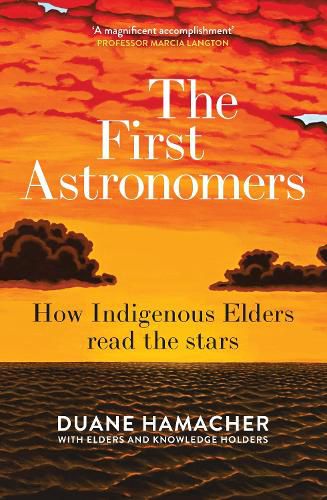
The very first sentence in the preface of the book puts its argument right there, up front. “The First Astronomers challenges commonly held views that Indigenous ways of knowing do not contain science” (p.1). For me, I don’t know if it achieved this aim, although as the most un-science-y person you could ever meet, I’m probably not the right person to discuss the philosophies of science, or philosophies of knowledge. I was not at all surprised that indigenous people have knowledge of the skies – that they ‘read’ (both in past tense and present tense sense of the word)- the stars,moon and climate phenomena. This is knowledge in terms of making sense of the universe and man’s place in it; of finding the rhythms of the universe, and of marking time and making predictions. But is it science? I guess it depends how you define ‘science’, and I probably lean towards the post-Enlightenment and western idea of science being replicable, falsifiable, separate from the individual, and systematic. I’m not sure that the knowledge Hamacher provides, through his indigenous informants, matches these adjectives. I find myself wondering if the question is not so much ‘Is indigenous knowledge scientific?’ but more ‘is our definition of knowledge broad enough?’
He uses ‘indigenous’ broadly supplementing the Torres Strait knowledge which he gathered as part of his own academic career, with indigenous knowledge drawn from cultures across the globe and history. Again, not surprisingly, there are similarities in the stories that pre-modern cultures world wide have developed and read into the star patterns- for example the ‘dark emu’ formed by the dark nebulae clouds of the Milky Way amongst Australian indigenous people is mirrored by the celestial rea (a bird similar to an emu) amongst the Tupi people of the Brazilian Amazon and the Moquit people in Argentina.
The book is simply written, which I appreciated in the more technical parts, although even then my eyes tended to glaze over. However, this simplicity also contributed a flatness to the narrative which, although broken up at times with Hamacher’s own anecdotes (e.g. losing his bearings in the outback despite being quite close to his base camp), felt rather prosaic and far removed from the splendour above that was inspiring his work.
The work is valuable in terms of presenting a breadth of knowledge that has been largely discounted as ‘myth’, and the exploration of the same phenomena explained by different stories across the globe highlighted our common humanity. But I feel as if he was trying too hard on proving its scientific (in the formal, academic sense of the word) credentials, instead of perhaps exploring whether the term ‘scientific’ is broad enough to capture the nature of knowledge more generally.
My rating: 6/10
Read because:Ivanhoe Reading Circle selection for September 2023. Their open meeting featured Duane Hamacher himself, attracting a large audience.
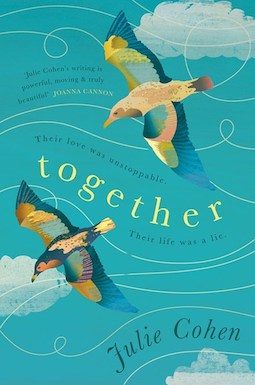
The book starts in Maine in 2016 with a death: that of eighty-year old Robbie, who awakes, untangles his limbs from those of his sleeping wife of decades, Emily, gets dressed, writes her a farewell note, then goes down to the ocean to die. He is a retired boat builder, father and grandfather, and his memory is failing him. He is confusing generations, losing things, feeling as if he is in a fog that descends without warning, obscuring all familiarities and, he fears, loosening secrets that he and Emily have held tight for years.
The book then goes backwards to 1990, when Emily’s mother dies and, despite years of rejection from her family, Emily returns to her native England for the funeral. Nothing has changed: the anger and hurt that has alienated her from her family still remains. While she is away, Robbie’s estranged, alcoholic son William returns, much to the delight of his younger teenaged half-brother Adam, who barely knew of his brother’s existence.
Another jump- this time to 1975-77 where the childless Emily and Robbie adopt Adam as a four-week old baby. Robbie has lost contact with his son William, from an earlier marriage, and as an obstetrician/gynecologist, Emily is heartbroken that they have no children. When an opportunity comes to circumvent the bureaucracy and waiting lists, they jump at it – only to find out that perhaps it is not what it seemed.
Back three years to 1972 when Emily and her first husband Christopher return from a stint of medical work in Bolivia, joining her family on a holiday in Florida. Suddenly she encounters Robbie, after nearly ten years separation and they are instantly drawn to each other, prompting huge changes in everyone’s lives.
And finally, back to 1962 where they meet for the first time and fall in love. It is an instant, overwhelming attraction that is to last for fifty years.
I can’t really say much about this book because of spoilers, but the backward trajectory of the narrative gave you an opportunity to get to know Robbie and Emily, from their old age forward, so that ‘the secret’, when it is revealed, needs to be held up against everything else that we have learned about their life together. I thought that she captured Robbie’s dementia well, and the powerful attraction that they exerted on each other, right from the start, is well described. It is a bit Mills-and-Boonsy – how could it be otherwise?- but I think that Cohen showed real skill in controlling the backward plotting which is such an important part of the book.
I think that my undergraduate degree was wasted on the 21-year-old that I was then. I know that I did a half-unit about the religious sects that emerged during the English Civil War, but I can remember virtually nothing about it, and I don’t know if even then I knew what happened after the Civil War. I wish that I could go back for a few hours now, and sit in on a lecture to see what it was that I was studying.
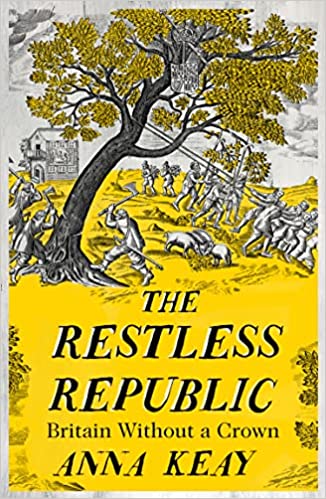
With all the ceremony surrounding King Charles’ coronation and its reference to antiquity and continuity, it is easy for forget that for eleven years, Britain chose to be a republic, without a King or Queen. It had a revolution one hundred years before the French Revolution; it had a republican government long before the American government, and it was what Australia struggles to be after two hundred years- a republic without a hereditary head of state.
What an amazing, frightening, disorienting time to have been alive! This book captures well the disruption of certainties, the knife-edge of political allegiance, the dangers of an army, the contingency of events and personality, and the instability of florid evangelicalism channelled into politics (something that is apposite today). It starts with the execution of Charles I in 1649, and ends with the restoration of Charles II in 1660, seen through the eyes of nine individuals – not necessarily in their words, but from their perspectives. The book starts with John Bradshaw, who oversaw the trial that led to Charles I’s execution and later became President of the first Commonwealth Council of State; it moves to religious visionary Anna Trapnel whose ‘gift’ of prophesy spurred the Fifth Monarchists and the radical religious fringes of society, and spends time with Charlotte Stanley, born Charlotte de la Trémoille who, as Lady Derby, headed a Royalist family with ancestral land on the Isle of Man, when her husband Lord Derby was executed by the Commonwealth. Then we have the L’Estrange family in Norfolk, who along with other noble families that prized their land and family property above all else, kept out of the fray as much as possible, anxious not to commit to one side or the other. Even here, though, we see brother against brother as the politics splits a family down the middle. The gadfly journalist, Machamont Nedham, played both sides and managed to pick the losing side every time in his editorial allegiances, while William Petty, famous for having ‘resuscitated’ a young woman who was hanged for infanticide, introduced surveying techniques in Ireland using Army surveyors that facilitated the dispossession of Catholic landholders to the West and the influx of Protestant, English families to Ireland. Cromwell – both Oliver and Henry- feature here, but Oliver is depicted as a man who measured God’s approval of his actions by success on the battlefield both in the United Kingdom and in Hispaniola in the Caribbean as part of the ‘Western design’. Henry, sent as Major General in Ireland, seemed to steer a middle path that neither his father nor brother Richard could find, setting up an intriguing what-if scenario had he succeeded his father instead of Richard. Then there is General Monck, and his low-born and possibly bigamist wife Anne, who as his closest confidante was sought by people who wished to get the ear of General as he charted his own course, betraying both sides in turn, in seeking the way through the politics, as many other people sought to do as well.
It is not a chronological history as such, and yet it moves forward chronologically, weaving together these networks of influence and connection, involving both men and women, in a time when the extremes at both political ends were unpalatable. I actually found it un-put-downable in the closing pages because, although I knew the eventual outcome, it was not clear how it was going to be reached. At a time in our own politics where the certainties of liberal democracy are shakier, when religious Dominionism beats out its own agenda, when the influence of drug gangs, coups and private militias makes states ungovernable, I found many resonances in events of four hundred years ago. This is a very readable history for a reader who knows little about the period, human in its scope, and a damned good read.
Translated from the Norwegian by Paul Russell Garrett
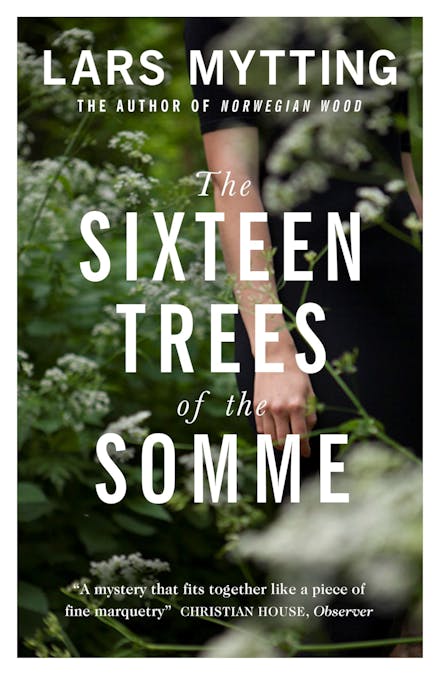
“Oh, a WW I book. Mud, blood and trenches,” I thought when I saw that this was on the reading list for the Ivanhoe Reading Circle. But it’s not at all. The events mainly take place in the early 1990s as twenty-something Edvard Hirifjell buries his grandfather Sverre. Grandson and grandfather had been potato farmers in rural Norway, living together since 1971 when at the age of three, Edvard’s parents had been killed. Their deaths were shrouded in mystery: they died of apparent gas poisoning from unexploded ordnance from WWI in a copse of trees on a former battlefield on the Somme. Edvard had been there too, but has no memory of what occurred: all he knows is that he turned up four days later over 120 kilometres away. As he begins to arrange his grandfather’s funeral with the local priest, he gathers snippets of knowledge of his family: that there was an estranged great-uncle Einar who fought with the French Resistance in WW2 while his grandfather Sverre served with the Germans on the Eastern Front; that his mother was born in Ravensbruck concentration camp; and most intruigingly, that his great-uncle Einar, a skilled timber craftsman, might not have been executed during WW2 as he thought, but may have instead having been living in the Shetland Islands until the 1970s. He had sent a beautifully crafted wooden coffin to Sverre in the small village of Saksum back in 1979 and when it is finally delivered to Edvard for his grand-father’s body over ten years later, it triggers in him an urge to make sense of his memories and his family history.
And so, his grand-father dead, and much to the frustration of his ex-girlfriend Hanne, Edvard travels to the Shetland Islands, and later to the village of Authuille in France, where his parents died, in his search for the past. On the peninsula of Unst, in the Shetland Islands, he finds strong traces of its Norwegian heritage and meets an enigmatic woman Gwen, who claims to be the caretaker for the nearby ‘big house’ Quercus Hall. Quercus indeed, the Latin name for the genus which includes oak and beech trees, because wood and trees play an integral role in the plot, both as a form of craftsmanship and as a motivation for deception and greed.
The book ends up in the Somme, but instead of focussing on World War I, it illustrates the legacy of war across succeeding generations. War on a global scale, but also war between erstwhile-business associates, and war between brothers.
In many ways, this book conforms with the conventions of the mystery novel. There are lots of name changes: Therese Maurel/Nicol Daireaux; Einer Hirifjell/Oscar Ribaut; Gwen Leask/Gwen Winterfinch. There is the big house. There are clues dropped, false leads and evasiveness on all sides. True to form, there is a cliff-hanger ending, which was rather too melodramatic for my liking. It’s a very cinematic novel. The only image I have in my mind of the Shetland Islands is that of the television series Shetland where the Scots influence predominates, but this is much more a European novel, despite the bleak, windy bluestone of the islands. It was not at all what I expected it to be, and it was probably the better for that.
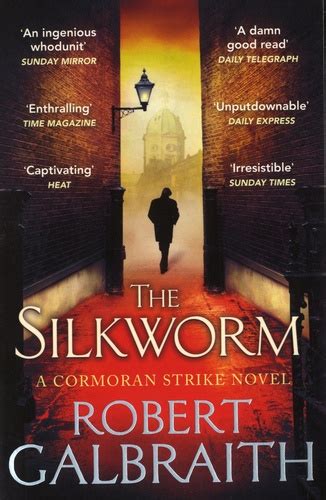
After ‘discovering’ Robert Galbraith through my bookgroup’s selection of The Cuckoo Calling, and after thoroughly enjoying the first season of the BBC series Strike, I resolved that I would read more of Galbraith’s books. And so I did- the second book in the series The Silkworm.
I’m always interested to see how an author picks up when continuing a successful novel into succeeding books after a gap of a year or more. The author can’t assume that the reader has read the first book/s and so some background needs to be repeated, but the narrow line has to be trod where readers of the earlier book are re-introduced to familiar and loved characters, without being bored witless. But of course, J. R. Rowling who uses the nom-de-plume Robert Galbraith, would be a past master of treading this narrow line, having sustained the Harry Potter series over a whole generation’s coming-of-age.
And so we meet again Cormoran Strike – and here we learn that ‘Cormoran’ is a Cornish name for ‘Giant’- an ex-military Special Investigations Branch private investigator, who lost his leg in Afghanistan. His assistant Robin Ellacott has stayed with him after the widely-publicized success of solving the murder in the first book in the series, although her fiance Matthew is still not happy with her working in a lowly-paid position with a scruffy private detective who now lives in the small flat above his office. Business has picked up since his earlier success, and one of the cases which comes through his door is the mousy, unprepossessing Leonora Quine, the rather unexpected wife of literary personality Owen Quine, who has not returned home for several nights. Owen Quine had achieved early literary success amongst the tightly-held and toxic group of English literary alpha-males, but the manuscript for his latest book Bombyx Mori, the Latin name for the silkworm, had been leaked after being deemed unpublishable for its violence, necrophilia and the venomous parodies of literary figures it contained. When Owen is found murdered in a ghastly scene foreshadowed in his book, suspicion falls on his wife and his associates who had read Bombyx Mori. The literary figures here are an unlovely group: insular and incestuous, jealous, egotistical and holders of long public and private grudges. (I can imagine J.R. Rowling having great fun writing these characters).
As with her earlier book, The Silkworm is embedded in a minutely-drawn London, this time blanketed in heavy pre-Christmas snow. And as with her earlier book, you are given some rather obvious but much appreciated checklists of possible suspects, and left with a clear sense of who- and why- dunnit by the end of the book. But I really don’t know how much longer she can draw out the obvious attraction between Cormoran and Robin, and I really do wish that Cormoran would go get some proper medical advice about his inflamed leg stump. All up, thoroughly satisfying and I’m up for the next one in a couple of months.

 The Resident Judge of Port Phillip