Category Archives: Book reviews

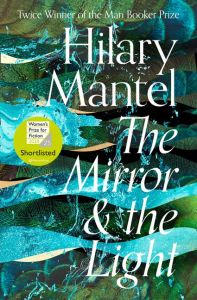
‘The Mirror and the Light’ by Hilary Mantel

Mantel_mirror_light

2020 875 p.

What does one say at the end of this almost 900 page conclusion to a trilogy? Just as I felt at the end of reading War and Peace, how could it be fair to turn to another fiction book straight away?

I purchased this book when I realized that the coronavirus lockdown was going to extend for weeks, if not months. I had intended reading it straight away, having already read (and loved) Wolf Hall and Bring Up the Bodies, but for the first weeks of the lockdown I felt too unsettled. Now that the doors are being opened again, and life is starting to resemble pre-coronavirus reality again, I realized that I might not have such an encumbered expanse of time to throw myself into such a long book and so I opened it up….

I must confess that I did find it hard to get back into, in spite of its compelling opening pages. That distinctive present-tense narrative viewpoint from a perch on Thomas Cromwell’s shoulder takes you immediately back to the earlier books but it still took me some time to get used to the “He, Cromwell,…” construction again. By 100 pages in, though, I was hooked again and found myself sitting up in bed at 1.30 to finish the last pages. How did Mantel manage to do this? After all, we all know how the story ends, and her fidelity to the history precludes any post-modern trickery at the end. You just know, through the consistency across all three books, that this is a carefully researched book and yet, with the exception of the occasional recitation of lists of food, Mantel does not labour its accuracy or parade her research.

While Bring Up the Bodies dealt with only a nine-month period, this book spans May 1536 to July 1540, starting Anne Boleyn’s beheading and Henry’s marriage to Jane Seymour and ending with Thomas Cromwell’s imprisonment in the Tower, facing execution. There were quite a few flashbacks, especially to Wolf Hall, in this book. I’m not sure whether that was to reinforce the unity between the three books, and to draw the narrative arc more strongly, or whether perhaps it reflected the tendency we (well, I, anyway) have with age to look to past events and now-absent people as a way of connecting where I am right now with the experience of getting here.

You look back into your past and say, is this story mine; this land? Is that flitting figure mine, that shape easing itself through alleys, evader of the curfew, fugitive from the day? Is this my life, or my neighbor’s conflated with mine, or a life I have dreamed and prayed for…

Within the constraints of the historic record, I loved the way that she laid out the narrative points so carefully. The trilogy starts and ends with the kicking he received from his father: this particular book starts and ends with a beheading. Very skillfully, she foreshadows the wives that are to come, after Thomas’ death.

Even though it could not have been her intention (given that she started on this project 15 years ago) I found myself drawing parallels with current day events. The acolytes of the  mercurial, prickly clown in the White House would need every one of Cromwell’s skills of soothing, distracting and evading- and, as we have seen, many of them have been sacked when they failed. Dominic Cummings in UK could be perceived as Boris’ Cromwell: seen as too powerful by an elite disgruntled at his power who want him removed.

In Mantel’s unreservedly sympathetic rendering of Cromwell, the few places where he actually voiced his ambition to take over as vice-regent came as a shock to me. More dismaying was the clear maneuvering of the noble families against him, the betrayal of one of his closest associates and the manipulation of events that you had read about previously to be used against him. I felt sick with dread at the thought of torture, and the interplay between him and his inquisitors is deft.

I listened to a podcast where actors read excerpts from all three books. It made me regret that I always read silently without subvocalizing, and therefore missed out on hearing the beauty of Mantel’s language. I’m not a great audiobook fan, but if you had the long stretch of hours required to devote to it, this would be a beautiful book to have read aloud to you.

So, is it going to win the Booker Prize again? I really don’t know how you could go past the beautifully crafted language, the distinctive “He, Cromwell” voice,  and the depth of research. Many writers have written of Henry and his six wives, but by shifting her gaze to the side, Mantel has brought us a new Henry and fleshed out and made human that square, dour figure at his side.

My rating: a big fat 10

Sourced from: Eltham Bookshop.

‘Friends and Rivals’ by Brenda Niall

Niall_friends_rivals

2020, 288 p.

In her most recent book Friends and Rivals, Brenda Niall has gone almost full circle. One of her early books was Seven Little Billabongs: The World of Ethel Turner and Mary Grant Bruce, published in 1979 and here she is, some forty years later with another group biography, this time linking “four great Australian writers”: Ethel Turner, Barbara Baynton, Henry Handel Richardson and Nettie Palmer. This book is more a quartet of essays rather than one integrated study. Indeed, it might be more appropriate to speak of two twinned biographies, as she was able to pinpoint a documented link between Turner and Baynton,  and likewise between Richardson and Palmer in a literary quest of degrees-of-separation.

I have come across three of these writers over my lifetime. We did not have a lot of books in our house, but my mother did give me three books from her childhood. One of them was the 1935 Children’s Treasure House, a book of 768 pages on very thin paper, full of English stories and full-length fairy stories, with beautiful Art Deco black-and-white illustrations and colour plates.  In Australia, the rights were reserved by the Australian Women’s Weekly and it cost 5/- plus 1/- postage to buy a copy. I still have the one my mother owned.

The other books she gave me were her copies of  Family at Misrule and Flower O’ the Pine– long since gone (unfortunately, because they were first editions I see, although of no great value).  These were both written by Ethel Turner, and I loved them. I borrowed Seven Little Australians from the library as well, and I can remember being heartbroken when Judy died.  I was never a Billabong girl- only ever Ethel Turner.

In contrast, I only encountered Barbara Baynton’s Bush Studies three years ago (my review here) and the stories are still etched in my mind, so different were they from the Bulletin/Lawson/Paterson nationalist bush stories of the turn of the twentieth century.  Elizabeth Webby’s introduction to the 1999 edition  really piqued my interest in this shape-shifting woman, whose final presentation of self was more fictional than her work was.

I read The Getting of Wisdom as a teenager, but was deterred from ever embarking on The Fortunes of Richard Mahony by a friend at the time who was made to read it at school (interestingly, she went to PLC – perhaps the school had forgiven HHR by then). She warned me that it was the most boring book ever written and to be avoided like the plague. I took her at her word, and did not read it until the summer of 2008, down at the beach. I just loved it, and it’s right up there on my list of favourite Australian novels.

Nettie Palmer I have only ever encountered as part of the two-for-one partnership of “Vance-and-Nettie-Palmer”, public intellectuals and champions of Australian literature. But I have encountered her often, through my interest in her uncle Henry Bourne Higgins, whose biography she was commissioned to write, and I’ve wanted to know more about her. In fact, it was Niall’s study of her that led me to read this book.

The book starts with an introduction ‘Women’s Work’, which I found a little lacklustre. The introduction didn’t explain why she chose these four women in particular (rather than others), because, as she points out, they did not make up a group, as such.

The lives of Turner and Baynton, Richardson and Palmer criss-crossed one another from the 1890s through the Federation period to the late 1920s. Their writing careers differ widely, as does the quality of their work. The writer of children’s books, the short story writer and the novelist, all were doing something new, as was Nettie Palmer, literary journalist and public intellectual. Their achievements, against the odds, were substantial and surprising. They didn’t make up a group; there were no groups for them to join. How did they do it?Each life story illuminates the others. (p. 10)

However, there were themes that arose her analysis of all four women. One such theme was that of reinvention. Ethel Turner was evasive about her childhood and parentage. There has never been documentary evidence of the man who was named as her father on her birth certificate, and she took the name of her stepfather, Henry Turner, a 39 year old widower with four sons and two daughters. Her mother had falsified both her own age, and the ages of her children. When Turner died her mother remarried quickly to Charles Cope, a bachelor ten years younger than her mother, and he was to take an unhealthy interest in his step-daughters. Niall observed that “Turner was strangely tolerant; it is as if she was blinkered to the sexual desire that he so plainly felt for her” (p. 35)

Barbara Baynton was even more evasive about her own history, giving her own family a completely fictional account of a Captain Robert Kilpatrick, who seduced Penelope Ewart away from her husband, and finally married her just before Barbara’s birth, thus rescuing her from illegitimacy.  No trace of this Captain Kilpatrick has been found. Instead, her father was a bush carpenter, and Barbara and her six siblings were all illegitimate, although her parents married later. She became a governess to the Frater family, close to Scone in NSW, and married her employer’s eldest son – shades here of My Brilliant Career. Her husband, however was a “shiftless, neglectful and unfaithful husband” (p.86) and she initiated divorce proceedings against her husband. She found security with her second marriage, to the elderly, wealthy Dr Thomas Baynton. Educated by her husband into the appreciation of furniture and porcelain, she took her place within Sydney social circles. When he died  in 1904, just after the publication of Bush Studies, he left her a substantial estate which she had a free hand in administering. She moved to London, and after WWI married Baron Headley, an eccentric peer but this was an unhappy marriage. When they divorced, she retained her title, and still had her money, and returned to Australia.

Henry Handel Richardson did not try to hide her background- indeed, she mined it heavily for The Fortunes of Richard Mahony, but she did manipulate her name. Ethel Richardson adopted the name ‘Henry Handel Richardson’ with the publication of her first novel, Maurice Guest as a sort of game – would anyone detect it as a woman’s work? Although married to the scholar J. G. Robertson, no one was allowed to call her Mrs Robertson, going by ‘HHR’ and ‘Henry’ amongst family and friends.

Nettie Palmer was probably the most straight-forward of them all, with an open and uncomplicated liberal Melbourne upbringing. She happily took her husband’s name, and was happy to be known in tandem with him.

When it came to publication, the three writers turned their eyes to British publishing houses, as was common at that time. Ethel Turner was probably the most put-upon amongst the three, with her publishers demanding a Christmas book each year, setting her up in competition with Mary Grant Bruce, and changing the endings and pruning the plots so as not to alienate a Sunday School prize market.

Baynton was already in England when she started looking to publish the short stories she had written back in Sydney, but even with her husband’s position in society, she could not find a publisher. Then, in keeping with her already fantastical life, she had the fairy-tale luck to be rescued from the slush pile at Duckworth’s publishing company through Edward Garnett (husband of the famous translator Constant Garnett), who had also discovered Joseph Conrad, John Galsworthy and D. H. Lawrence.  However, after this start, she struggled with her novel Human Toll, which received a few respectful reviews among mainly lukewarm ones.

Henry Handel Richardson began her first novel Maurice Guest while living in Strasbourg, and The Getting of Wisdom was also written and published overseas. Her husband took charge of most of the business side of publication, and was willing to pay for the publication of the third part of the Richard Mahony trilogy himself, when Heinemann rejected it. That volume,  ended up Ultima Thume being received with acclaim.

Most of Nettie’s work in reviewing books appeared in Australian newspapers and her survey of Australian writing in Modern Australian Literature 1900-1923  was published in Melbourne. She did, however, have a London publisher for her first book of poems The South Wind, followed by a second book of poetry in Shadowy Paths also published in London.

Another theme that comes through the essays is that of patronage and support. Both Barbara Baynton and Henry Handel Richardson had husbands whose interest and connections (and in Baynton’s case, money) supported their writing. Niall suggests that J.G. Robertson sacrificed his academic career for HHR’s writing success, and the incorporation of a young woman Olga Roncoronis into their household further left space for HHR’s own writing – (Niall leaves open the question of a sexual attraction between the two women). With Nettie Palmer, the tables were turned, with her assiduous promotion of her husband Vance’s work within literacy circles – a devotion which Niall feels to have detracted from her own career as critic.

A biography, if it is to be more than a chronology of facts and actions, is an argument or judgment, based on a reading of documents, conversations and actions. These are not necessarily accepted on their face value: sometimes they are ‘read against’ or set up in opposition to one another.  Especially when dealing with writers, there are not only the writer’s own works, and sometimes an autobiography written with varying degrees of deprecation or self-regard, but often there is also a body of correspondence with other writers, who in turn write to other writers. The retention of such correspondence is sometimes a matter of chance, at other times the target of ruthless culling or assiduous gate-keeping either by the author herself or her literary executors. For good or ill, these remaining letters are mined by biographers, giving them a life and significance far beyond the original intent.

The crafting of a biography as an argument is particularly apparent in a multi-essay volume like this one, where the same author deals with multiple and interlinked characters. Niall’s reading of Henry Handel Richardson is censorious, while she clearly admires Nettie Palmer and feels that she has not been sufficiently recognized as part of the Vance-and-Nettie-Palmer partnership. In dealing with Ethel Turner, she also examines the British-dominated publication culture of the day, and with Barbara Baynton she finds a paradox, interlaced with reinvention.  New material is always being uncovered, additional links discovered, and historical ‘turns’ invite historians and biographers to stand in a different place to re-evaluate their subjects. That is why there are no definitive biographies.

I admire Brenda Niall as a biographer. She is deft and efficient, and attuned to the nuances of relationships.  She paints a broad canvas for her subjects, but also hones in on details that give definition to her subjects, helping you understand why this particular person was distinctive.  That said, I was somewhat startled by the abrupt ending of this volume. In fact,  I felt a little short-changed by both the introduction and the absence of a conclusion. While I know that her focus is on her four subjects, I found myself wishing that Brenda Niall herself had come back on stage to draw out further the contrasts and commonalities in these four lives.

Sourced from: Yarra Plenty Regional Library

My rating: 8/10

aww2020

I have included this as part of the Australian Womens Writers Challenge 2020

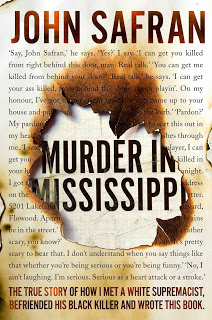
‘Murder in Mississippi’ by John Safran

safran_murder_mississippi

2013,  368 p.

I’m not really sure how this book ended up on my bookshelves, because I’m not a great fan of John Safran and nor do I particularly like True Crime as a genre. I think that I received it as part of a subscription to Crikey, which has always given John Safran a fair bit of support.

So who is John Safran, you might ask? He’s a Melbourne-based satirist, radio personality and documentary maker who has made religion and race his stalking ground. He often pranks the people that he interviews, and it was indeed one of these very stunts that set him off in the year-long pursuit of this story of murder in Mississippi, very far from Melbourne.

As part of his ABC documentary series Race Relations he cultivated a friendship with white supremacist, Richard Barrett, and found himself surprised that he actually liked him more than he thought he would. After surreptitiously obtaining Barrett’s DNA, he was invited by Barrett to say a few words at the Spirit of America rally that Barrett had organized. Microphone in hand – and completely unknown to Barrett- he announced that the DNA test results showed that Barrett had Afro-American heritage. As Safran left the meeting, exulting at his victory and with barely a twinge of conscience, he did not divulge to the startled audience or Barrett that any detailed American DNA test would show a trace of Afro-American heritage. We never got to see this episode. When Barrett threatened legal action, they pulled the show.

However, Safran’s  nose for a good story twitched when he learned that Richard Barrett had been murdered by a young Afro-American teenager. And,so he took himself off to Mississippi to chase the story.

In the early statements given by the murderer, 22 year old Vincent McGee, he did not deny the murder or the attempted arson of Barrett’s house to cover his traces. He did, however, claim that Barrett had tried to hit on him, and that in a flash of rage he had stabbed him after Barrett had gone after him. However, when the case finally came to trial, he changed his plea to guilty and was sentenced to 65 years jail. Why?

And this is what Safran is trying to find out. The trifecta of sex, race and power is a heady one, and Safran is not sure whether Barratt, McGee or both are exploiting it. He is drawn into McGee’s world, and it’s not clear just who is exploiting whom. Court files disappear; there are small deceptions that may mask larger ones; and the edges of the crime become murkier. Safran’s fantasy of being the journalistic avenger who is going to prove McGee’s innocence  soon disappears.

Reading this book was very much like listening to a podcast over about six episodes. That’s probably about how long it took me to read the book, and I’m not sure that there was any great advantage in reading it over listening to it: in fact, I think that it would be better as a podcast. There’s a lot of dialogue, and Safran’s narrative is very voice-over-ish. I didn’t really get a clear visual sense of the characters he features until I found the pictures in the middle of the book, and I often found myself trying to flip back to work out who was who (something that an index might have made easier).

I started this book just as the furore over George Floyd was spilling out into the streets across the world, including Australia. I had expected that I would be reading a book about injustice, but the book is not as clearcut as I expected it to be. It was well-received  and was awarded the Ned Kelly Award for Best True Crime in 2014. However, I think that I prefer my true-crime as a podcast.

My rating: 7/10

Sourced from: my own bookshelves.

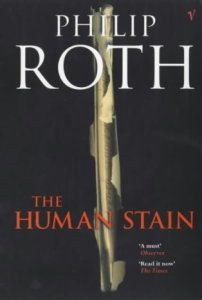
‘The Human Stain’ by Philip Roth

roth_human_stain

2000, 361p.

This book opens with two affairs. The first, that “everybody knows” about is that of Bill Clinton and Monica Lewinsky, an affair forever imprinted on my mind with the memory of his pointy, reddened face and jabbing finger as he declared that he “did not have sexual relations with that woman”. I’m glad that through her really-worth-watching TedX talk, Monica has left the blue dress and “that woman” behind. But with Trump’s “grab ‘em by the pussy” and now the accusations against Biden, it feels as if this ghastly American reality-show just keeps on going.

The second affair, the focus of this book, is between Coleman Silk, retired Classics professor and Faunia Farley, an illiterate cleaner half his age. Perhaps ‘affair’ is the wrong word: Silk is a widower, Faunia has fled a violent marriage, and they are both consenting adults. But Coleman Silk is already a disgraced man, as far as his employment at Athena College is concerned, from which he resigned in the aftermath of controversy over using the term ‘spooks’ to refer to two students who had never turned up to class. Although he was asking whether the students were invisible phantoms, ‘spooks’ had also, as a subsidiary, less-used meaning, a racist derogatory connotation as a term for African Americans. In what Silk (and Roth, for that matter) see as “political correctness gone mad”, Delphine Roux, a fellow academic in the humanities faculty, advocates for the young female student referred to as a ‘spook’, and then later for Faunia Farley whom she sees as the victim in an uneven power relatioinship.

Sex, race and religion are fracture lines in many societies, and in America in particular – and especially in its politics- they verge on being obsessions. Coleman Silk, successful, white Jewish professor, is not what he appears and in this book, the narrator Nathan Zuckerman, who appears in many of Roth’s books, decides to tell Silk’s story and reveal his secrets. Keeping secrets always has a cost, and in this book, Silk and his family carry the burden, in some cases even without knowing.

I have a love/hate relationship with Philip Roth. I can see the virtuosity of his writing but it is so wordy, so excessive. Sentences stretch on for a whole page and it is as if the narrative is being shouted at you. The fact that chapters go on at length doesn’t help. Too much, too much.

There’s a swaggering maleness about his writing, and the constant presence of sex as a prism for viewing the world makes me feel uncomfortable. In this book, Roth’s own conservatism is quite clear as, through Coleman, he fulminates against post-modernism, literary theory, education standards, affirmative action, political correctness and hypocrisy. But Roth also needles those sore points of present-day American society so acutely: the freedom to invent yourself, the American Dream, Jewishness in American society, sexuality, Vietnam and the biggest one of all, race. He’s brilliant. He’s insufferable. And somehow, he manages to do all these things in a very American, male, ‘look at me’ way that, almost despite yourself, demands that you do.

My rating: 8.5

Sourced from: CAE book groups.

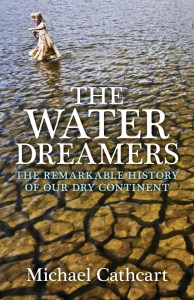
‘The Water Dreamers’ by Michael Cathcart

cathcart_waterdreamers

2009, 259p.

After seeing historians negotiating the publication marathon, I know that authors don’t always get to choose the name of their book.  Instead, it is often a decision of the marketing department of the publication company. However, if I were Michael Cathcart, I’d feel rather short-changed by the title of this book, which, even with its subtitle ‘The Remarkable History of our Dry Continent’ still doesn’t capture the nature of Cathcart’s question or approach.

The title ‘The Water Dreamers’ evokes for me poor old mad Sturt bashing around in the outback, Burke and Wills and the Dig Tree and C. Y. O’Connor suiciding before his Goldfields pipeline was pronounced a success.  All of these men- and it’s significant that they are all men- appear in this book, but it’s far more than that. Instead, Cathcart examines the way that Australia was imagined and written about in our  national consciousness and there is just as much about the ‘silence’ of the landscape as there is about ‘water’. I don’t know how you find a title that combines both these elements, but ‘water dreamers’ doesn’t do it. This is as much a book about cultural interpretation and literature as it is about engineering.

The book runs pretty much chronologically, starting off with the arrival of the First Fleet and those earliest transactions about water, a crucial concern for a ship’s crew that has arrived after months at sea and intent on forming a settlement. He features the now-invisible Tank Stream, so named because early engineering attempts imposed tanks onto its increasingly straitened flow, and the search for a better water supply which drove the the settlement towards the Parramatta and Hawkesbury Rivers. In the interests of Sydney-Melbourne balance, there is a similar chapter on the Port Phillip settlement, and the importance of the Yarra Falls as a barrier between the salt and fresh water needed by an infant settlement. He traces through the various expeditions that embarked from Sydney, Adelaide and the north western coast of W.A. in search of an inland sea or a large navigable river, and the various schemes proposed to turn the rivers inland (zombie plans that keep returning again and again). Drilling the Artesian Basin, and the construction of the Snowy River Scheme were both seen as ways of ‘solving’ the water problem. Engineering solutions have given way to market solutions, with water trading schemes abandoning Alfred Deakin’s long-standing philosophy that the water belonged to the river.

That’s one thread running through the book, and a fairly straightforward one at that. What gives nuance to Cathcart’s book is his parallel analysis of how the landscape was conceptualized. He points out that writers, from the very start, have commented on the “silence” of the Australian continent – whether it be the gibber plains or huge eucalypt forest- even though at the same time, they commented on bird calls, the crashing of timber, the howling of wild dogs, and the talk and shouts of nearby indigenous groups. Many early writers used the term “the howling wilderness”, a term from a 1662 North American poem ‘God’s Controversy in New England’, and one rather at odds with the supposed-silence that these Australian explorers deplored.

Cathcart is a pugnacious writer, and he takes on the popular view that explorers were obsessed with the idea of an ‘inland sea’.  While that is true of Sturt, Cathcart argues that explorers were instead seeking inland rivers, like the Mississippi, or the Amazon. Settlement occurred on the coast, not inland, and the first priority was to secure the coast, rather than penetrate the centre. Mitchell, Cunningham and Sturt heading off from New South Wales were looking for rivers, not seas, and they were often defeated by swampland rather than desert.

Cathcart also challenges the idea that exploring men conceptualized the land as a young virgin to be ravished and possessed. Instead, he argues, when Sturt, in particular, spoke of “lifting the veil” on Central Australia, it was the veil of mystery, not a wedding veil.

He identifies a stream of literature and reportage that he describes as ‘necronationalism’, exemplified by the disappeared Ludwig Leichhart, or Patrick White’s Voss, reaching its apogee in the public mourning and commemoration of Burke and Willis, who died beside a fresh water flow in a wet season.  ‘Hanging Rock’ and Lost Children are similar expressions of this necronationalism –  a nationalism based on death, which Cathcart argues would later be evoked in describing the ANZAC spirit.

Silence began to be conceptualized not as a sensory phenomenon, but a geographical zone that you entered and could leave, as you retreated back towards the coastline. It had a pictorial, representative aspect.  The ‘silence’ line largely followed the Goyder rainfall line in the 1860s.  Hubris in pushing beyond the Goyder line of the 1806s led to economic defeat when the seasons changed. This mapping of lines onto Australia was replicated sixty years later when the professor of geography at Sydney University, Griffith Taylor, published his own map that zoned Australia into ‘Useless’ ‘Sparse stock’ ‘Good Pastoral and ‘Fair Agricultural’ zones. This directly conflicted with the optimistic boosters of technology and engineering ‘solutions’ who looked to the construction of  dams, the reclamation of Lake Eyre and the development of irrigation schemes.

Cathcart spends quite a bit of time describing the Lemurian novels of the turn of the century, drawing on Theosophist ideas, that posited the hero Dick Hardwick as the explorer of a lost, fantastic Australia, before the time of the Aborigines. Such novels appeared across the Empire, but they were also distinctively Australian.

By now, it as clear that much of central Australia was occupied by a depressed desert, a void, an absence of nature. But the Lemurian novels held out the possibility that things had not always been thus. They invented a past based on one tantalising fact. At some unimaginably distant time, there really was an inland sea in Central Australia. Now, in the era of Victorian engineering, that sea was a blessing that the civil engineer could create. With this hope in mind, visions of this ancient inland sea swirled through the pages of the Lemurian novels. (p. 185)

And so, through literature and language, we can see the adoption of North American tropes of a ‘howling wilderness’, a ‘virgin’ land, and an empire- wide ‘lost civilization’ adventure genre all imposed onto the Australian landscape. We see the practice of drawing lines on maps to delineate arid zones disputed by the boosters of industrial and technological ‘solutions’.  Cathcart’s book is not just about explorers and schemes; it is also about literature and national consciousness, and concepts of geographical defeat and technological victory.  Does he succeed in melding the two? I’m not sure that he does, and he has the two threads running alongside each other, rather than interweaving them as a concise, integrated argument.

Nonetheless, this is a beautifully written cultural history that ranges across poetry, diaries and novels as well as nationalist stories of explorers and engineers. It tells a much more complex story about more than just water.

You can hear Michael Cathcart giving a lecture on this book (and you can read the transcript) from 2008 at https://www.abc.net.au/radionational/programs/archived/hindsight/the-water-dreamers/3255244

My rating: 8/10

Sourced from: My own copy.


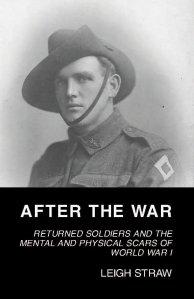
‘After the War: Returned soldiers and the mental and physical scars of World War I’ by Leigh Straw

Straw_After_the_War

2017, 205 p.

It’s a strong, handsome face that appraises us from the front cover of Leigh Straw’s After the War. When the author saw it from the front page of the muck-racking Truth newspaper, she was struck by its resemblance to her own husband. It accompanied a report of a murder-suicide in Collie in 1929 where an Andrew Straw had murdered Muriel Pope in the street by shooting her, before turning the gun on himself. Leigh Straw, a historian who is better known for work on the Sydney and Melbourne underworld from the 1920s (see one of my reviews here) had stumbled on her own real-life family crime, one that had been suppressed and altered in family lore.

Andrew Straw, returned WWI veteran, is just one of the West Australian men that Straw deals with in this book. There are fifteen main protagonists, with the brief appearances of another fourteen veterans, all of whom volunteered as members of the 1st AIF. Her book takes us through enlistment, fighting, and their return to Western Australia, with a particular focus on the difficulties they faced when returning to their families in a society limping through indifferent economic conditions towards the Depression.

Chapter 1 ‘When the Call was Given: A Nation at War’  summarizes the war experience from enlistment, Gallipoli, the Western Front and the Armistice. Here we meet many of the men who will reappear in later chapters. These are personalized further in Chapter 2 ‘Dad did his turn at the war’: War Experiences’.

Chapter 3 ‘Civilian Life’ brings them back to Western Australia. Arrangements for repatriation had been set in train right from the earliest years of the war, and injured men were being sent home long before the final demobilization at the end of the war. Of the 32000 Western Australian men who had volunteered for the war, 24,000 returned with 16,000 of them injured, invalided or incapacitated by mental or physical wounds.

Soldiers with tuberculosis faced years in and out of sanatoriums as shown in Chapter 4 ‘Isolated: Tubercular Soldiers’. Western Australian soldiers had the added complication that many of them had been miners, or lived in mining towns. At first the Repatriation Department (always keen to reduce ‘shirking’) raised questions about prior mining work and war service. However, most medical reports highlighted the war experience as a causal factor even where there was a work history in the mines.  Tuberculosis can sometimes take years to manifest itself, and gradually the policy of restricting payouts for tuberculosis to a two-year period after the war was eased to allow for later illness. The Woolooroo Sanatorium for tuberculosis patients in the general population was established 50 km outside Perth in 1915, just after Gallipoli, and it was expanded after the war with a military section.

Ch 5 ‘Unbalanced’: The ‘Mental Soldiers’ of War’ examines ‘shell-shock’, ‘war neurosis’ and what we would now call PTSD. As Marina Larsson points out in her book Shattered Anzacs (my review here),  families fought hard to have shell shock distinguished from ‘mental illness’ more generally. They advocated for separate facilities at Stromness Hospital and Kalamunda Convalescent Home to distinguish returned soldiers from the patients at Claremont Hospital for the Insane, but there was always cross-over between the two.

In Chapter 6 ”A Ruined Man’:Postwar suicide’, Straw turns to the newspapers to find details of this outcome of war that was so difficult to talk about by immediate families. West Australian government policy shamefully decreed the destruction of inquest reports after ten years, and so she needed to turn to newspaper reports when the inquest notes did not appear in the repatriation files. Using Trove, she sampled between 1915 and 1940,  after which point World War II reports made searching by keyword more difficult. She found that veteran suicides accounted for more than 10 percent of all registered male suicide deaths in the state- a number which was lower than I expected. However, as she points out, deaths reported as ‘accidental’ or through drowning allowed widows or family members to claim a war pension, when a finding of suicide did not.  Those that were reported as suicide generally (60%) involved fatal gunshot wounds, most to the head or chest. Almost one third involved poisoning. One distinguishing feature from the current-day veteran suicide statistics was the number of self-inflicted razor wounds. Nearly 40% of the suicides took place in the five years between 1925-1929, before the Great Depression, but when a large number of men reached middle age and struggled to find work. War pensions were increasingly questioned and lowered from 1925. Alcoholism featured heavily, and there were marital and family problems.

Chapter 7 ‘War’s Aftermath: Family stories’ turns to the oral histories given by family members, both to Leigh Straw herself and to earlier oral historians. For a number of these families, including Straw’s own, these stories went untold for years . ‘Conclusion: the men who came home’ summarizes the findings of the book, and a final epilogue ‘A Disordered Brain’ returns to Andrew Straw’s story – the man whose face is on the front cover, and who was the impetus for this book.

This book, written in 2017, locates itself and pays tribute to much of the work on war injury, repatriation and the effects on family which has been undertaken over recent years. There is much of it, and I found myself wondering why Straw chose to move out of her academic field of crime/social history of the early-mid 20th century when so many other historians have worked in the area of WWI repatriation before her. I’m thinking, for example,  of Marina Larsson, Joy Damousi, Stephen Garton and Alistair Thomson – all of whom have written about loss and return over the past twenty-five years.

I think that part of the answer lies in the event that prompted to her to write: the discovery of a close family relationship, that even travelled generations to manifest itself in the face of her own husband. Other books on the same topic tell individuals’ stories and use oral histories, as she has done. But in this book, she focusses on fifteen men whose stories re-appear across the various chapters of analysis, supplemented by other examples. It is an academic history, complete with footnotes and literature review, written with a family history focus.

A second aspect is its emphasis on Western Australia, rather than the more populous eastern seaboard. In this regard, it is no surprise that the book was published by  University of Western Australia Publishing. Western Australia’s commitment to the war effort was the highest in the country by proportion of population, with close to 10% of the state’s population enlisted in the war.  The state more strongly supported conscription than the other states, right throughout the war. Many of the enlistees from WA were relatively recent arrivals from Britain or Victoria attracted perhaps by the 1890s gold discoveries, with possibly shallower family connections. Schemes and plans for repatriation were implemented across the nation, but being so far distant from the other states, the Western Australian government worked largely in isolation.

This is an easy book to read, despite its difficult themes. It is an academic text, but with its grounding in the lived experience of men and their families, it wears theory and argument lightly. Beyond the photo of Andrew Straw on the front cover, it does not have any pictures, which is surprising given the co-operation the author received from many family members. But perhaps that is not the drawback it might appear.  Photographs, with their staging and smiles, do not capture the pain and struggle that is perhaps more apparent taken across the whole life span, and into further generations. That comes from stories, and this book is replete with them.

My rating: 7/10

Sourced from: Yarra Plenty Regional Library

After the War was joint winner of the 2018 Margaret Medcalf Award from the State Records Office of Western Australia.

aww2020I have included this on the database of the Australian Women Writers Challenge 2020

‘The Wooleen Way’ by David Pollock

pollock

2019, 362 p.

I sought out this book after reading an article in the November 2019 edition of The Monthly  (yes, I am just as, if not even more, delayed in reading The Monthly as I am in listening to podcasts.) The article was titled ‘Bait and Switch‘ about the contentious issue of dingo-baiting. At the end of the article it mentioned that one of the protaganists in the dingo/wild dog debate, David Pollock, had changed the landscape of his pastoral property in the Murchison River region, eight hours drive north of Perth. Where there had been dust, there was now grass and shrubs, and while he welcomed the dingoes, he had rid the property of kangaroos and goats, which cause the most damage to the landscape.  I was also prodded into reading this by Ross Garnaut’s recent book Superpower, where he argued that Australia could seize the opportunity to farm carbon-sequestrating plants as a deliberate agricultural and strategic choice.  It was only when I saw the ‘As seen on Australian Story‘ sticker on the front that I remembered seeing advertisements for the program about a farmer who had eschewed traditional practices and opinions of his neighbours in his quest to regenerate his land.

David Pollock is not a natural writer, and there is a self-consciousness about his writing that gives a slightly stilted and defensive tone. Nonetheless, he captured really well the experience of growing up on a remote pastoral property, where his mother’s hospitality in opening her house up to tourists meant that it teetered between profitability and ruin.  He did not necessarily intend to become a farmer, having spent much of his early adulthood travelling the world, and as the second son, it would have been more conventional for his older brother to step into his father’s shoes.  But his father, who was obviously a flexible thinker, asked both sons to spell out their vision for the property…and gave the management to David.

He then goes on to describe his decade-long experiment on returning the land to an earlier state. Unlike his neighbours, he chose to run cattle instead of sheep;  he greatly reduced the stocking rate; he embraced the return of the dingo as a sign of progress;  and he shot the kangaroos and goats that threatened to overrun the property and undo all that he had achieved. This set him up for conflict with his neighbours and with the local Land Conservation District and the Pastoral Land Board. He disdains bureaucrats and distrusts government, but is not backward in asking for welfare. Actually, he’s a pretty prickly fellow, and you can sense why he might alienate people around him.

In many ways, and as he admits, he was ‘saved’ by the publicity that he attracted from the ABC’s Australian Story program. After the screening of the program, money and interest came pouring in, and although he felt uncomfortable about it, Australian Story and the ABC returned several times. The television audience was drawn to the romance of his story, an angle that you feel he tolerates in order to get the larger story out to a larger public.

The book is repetitious in places, largely because he needs to fight the same battle over and over again. At 362 pages, it felt like a long book, and it could perhaps have done with tighter editing. On the other hand, it is his voice that booms through it. He becomes strident at times, which could be a reflection of his personality, or maybe a measure of his passion for Wooleen and his project.

My rating: 7/10

Sourced from: Yarra Plenty Regional Library

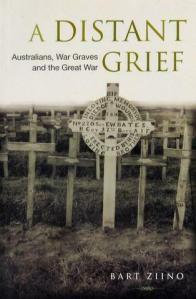
‘A Distant Grief’ by Bart Ziino

ziino_distant

2007, 191p & notes

In the time of coronavirus, we have seen funeral services stripped back to just ten people. It’s a cruel thing. Just those few people, sitting far from each other, unable to hug or comfort- those most human of responses to pain and grief.

A cruelty of a different sort was exerted on the families and loved ones of soldiers who died over in Europe during WWI (and the following war).  After some hesitation in the early months of the war, it was decided that none of the soldiers who died in British Empire troops would be repatriated to their home countries: not English, not Canadian, not South African and not Australian soldiers.  Apart from the practical difficulties of locating and shifting the remains (if any) of individual soldiers, this was seen as an expression of equality and solidarity amongst the countries of the Empire, with no soldiers seen as any more important than the others.  It was a big call. There was serious dissent against the policy in Britain by the 1920s.  I would imagine that for British families, it would have seemed to be merely bureaucratic inflexibility that prevented bodies being transported a relatively short distance. Canada was unhappy with the policy, especially when America managed to ship back 70% of their dead. (p.83)  But Australian families had few expectations that the bodies of their soldiers would be sent home. It hadn’t happened during the Boer War, and a recognition of the logistics involved meant that there was little public agitation for it to occur in WWI either.

Instead, the role of interring and marking the graves of Australian soldiers fell to the Imperial War Graves Commission. With the exception of the soldiers who fell at Gallipoli,  it was decided that each soldier should have an identical headstone marker, 81cm high, 38 cm wide and 8 cm thick. They were generally of white Portland stone and engraved with name, rank, unit, date of death and age. A religious emblem could be included if desired, and next of kin were permitted a personal inscription at their own cost. Where the identity was unknown, the headstone reads ‘A Soldier of the Great War. Known to God’. (p.3)

The Imperial War Graves Commission asked for 10 years to finalize the burial of WWI soldiers, and this book, which draws on the archives of the Commonwealth War Graves Commission, tells the story of the Commission, and the way that Australian reactions to death were defined by distance. Certainly, these deaths were of individuals – loved, mourned individuals- but without individual bodies, mourners had to take on more communal responses to their loss.

Chapter 1 ‘Imagined Graves’ examines the imaginative way that bereaved loved ones tried to understand soldiers’ deaths and make some connection between their lives on this side of the globe and the grave on the other. As Ziino writes:

Imagination, of course, could not function in a vacuum. From the first news of death, grieving Australians sought knowledge of what exactly had become of loved ones. They needed that knowledge to give substance to the mental images they were already developing. Relatives wanted to know that the last moments of life had been painless or that the dead had received the particular blessings of their faith. Ultimately, they wanted confirmation that the body had been buried and identifiably marked- an essential part of their imagining. Mourners wished that they had been there to palliate soldiers’ dying, to make the break between life and death personally- this was an important part of coming to terms with death. At home these people were removed from all but the fact of death, and detail was required to give structure to that event. (p. 15)

In the absence of a grave, ceremonies of farewell and release were carried out through the ‘In Memoriam’ columns of newspapers – sometimes for decades afterwards. Other families treasured photographs and relics of the dead that made their way home, while soldiers still serving at the front often served as a conduit between the front and the family by writing to and visiting bereaved families after the war.

Chapter 2 ‘The Sacred Obligation’  shows the way that Australian families, realizing that it was unlikely that they would visit the European cemeteries, turned to others to care for the war graves. The state stepped into this space. Public memorial services were held in Australia, while over on the front administrative responsibility was initially vested in the Directorate  of Graves Registration and Enquiries, and turned over to the Imperial War Graves Commission which came into being on 21 May 1917.

Chapter 3 looks at ‘Gallipoli and Australian Anxiety’. As the first large scale ‘Australian’ battle of WWI, there was particular concern that the bodies of fallen soldiers lay for three years in ‘alien’, non-Christian soil where there were no brother soldiers or officials to act for relatives. While the war was still underway, there were attempts by the British government to gain access to the cemeteries on the peninsula that the Turks had created. Not surprisingly, the attempt was rebuffed, but an Australian presence was quickly established at Gallipoli after the Armistice.  There was not, as they had feared, widescale desecration of the graves, although wooden crosses had been removed by Turkish soldiers for firewood. Almost immediately there were attempts to make a claim on the cemeteries, a difficult legal point of  sovereignty. It was decided that the cemeteries on Gallipoli would not have cruciform shapes visible from beyond their walls, and that the headstones would take the form of a low sloped stone, rather than upright headstones as in other Commonwealth War Cemeteries. Australians had to accept that Australian graves would rest on Turkish soil, which gives some context for the words purported to have been said by Mustafa Kamal (Ataturk) – an issue of recent controversy.

Chapter 4 ‘Agents for the Bereaved’ turns its attention to the Western Front and the way that families wanted an ‘Australian’ presence and identity on the former battlefields. The Australian Graves Service was established, with its headquarters at Australia House in London. It oversaw (rather than conducted) exhumations and concentrated on identifying Australian remains and maintaining records for the bereaved at home. They provided photographs of the grave for the families at home, and were seen as an ‘Australian’ presence even though there were serious questions asked about their behaviour. When it was disbanded in 1921, with its work subsumed into the Imperial War Graves Commission, there was dissatisfaction back in Australia not only amongst families, but also the RSSILA (forerunner to the RSL) and different public bodies.

Chapter 5 focuses on the Imperial War Graves Commission itself, and the way that its role changed over time. At first, it held itself aloof both physically and emotionally, from the bereaved of the Empire. It was essentially a political body, and as time passed the  Commonwealth War Grave cemetery, with its row upon row of identical headstones, came to have a different meaning for generations who had not known or loved the individual who was buried there.

In Chapters 6 and 7 focus returns to Australia, and the ways that Australians expressed their grief. Chapter 6 looks at the memorials erected, the photographs cherished and the nature of the 66-letter inscriptions that families were allowed to place on the gravestones. As returned soldiers began dying in Australia, the question of ‘official’ headstones in local cemeteries arose.  Lost sons began to be commemorated on their parents’ gravestones and horticulture began to be linked with commemorative spaces. The 1991 repatriation of an unknown Australian soldier in 1991 reminds us that grief carried across generations, although now it was imbued with other political and nationalistic themes.  Chapter 7 ‘Pilgrimage’ looks at the personal journeys that some families were able to make to the grave of their loved one. Most Australians at first accepted that would never make the trip to see it, and especially immediately after the war, the Government actively discouraged trips to the politically unstable Gallipoli. Those who travelled often had a keen awareness that they were doing something unavailable to most Australians, and many felt a personal obligation to share their experiences with other families through photographs and letters. A formal pilgrimage was organized in June 1929. And as we all know, a pilgrimage to ANZAC Cove has become a rite of passage for young Australian travellers- one that I find rather problematic, especially with recent Australian governments’ obsessions with creating memorials on other people’s land.

This book is an academic monograph, but a very human one.  The argument of the book is the juxtaposition between administrative efficiency and personal grief, and this is reflected in Ziino’s use of his sources. As well as the bureaucratic archives of the Commonwealth War Graves Commission and other bodies, Ziino draws on personal letters and communications in family archives, and the human stories found in newspaper articles.

As he points out in the conclusion, if physical distance marked the Australian experience of battlefield death, it is now a chronological distance that shapes our response.

Australians are no longer so distant from the graves of their dead. Modern transport has telescoped distance and made travel to the battlefields possible for thousands of Australians who now undertake such pilgrimages. Yet distance remains important to Australians’ relationships to the Great War. While it has contracted physically, distance has lengthened chronologically. Today’s generation is reconceptualising the legacy of that war…These modern pilgrims are expressing grief, but the nature and meaning of that grief is not the same as for those who endured it first hand. Time and further conflicts have intervened in their memory of war. (p. 190-1)

Source: My own copy

‘There Was Still Love” by Favel Parrett

parrett_there-was-still-love

2019, 210 p.

There is an unsettling synchronicity about writing a review of this book while our government is closing its borders and our lives are being upended and constricted by government fiat. The parallels between our current situation and the 20th century of Czechoslovakia are slim, however. I may not hold my grandchildren for six months, but the rupture in the lives of those who escaped the fall of the Iron Curtain and those who did not was far deeper. But, as the title says, there was still love.

There are three threads in this book. One of them takes place in Melbourne in 1980, with young Malá living in with her Czech grandparents, Mána and Bill, cocooned in the warmth of their love in a frugal and ordered household typical of many post-war refugees. At the same time, there is her cousin Ludek, also living with his grandmother Babi in Prague, completely unaware of his cousin’s existence. He yearns for his mother Alena to return from her tour of the West with a theatrical company, and doesn’t realize that the government is using him as the lure and tether to bring her back to Czechoslovakia.

It is only near the end of the book that you realize the link between these two stories of grandchildren, wrapped in the love of their grandmothers. The two grandmothers were sisters, and by sheer happenstance, one ended up in the West and the other in the East. Their lives diverged at that point, even though they ran along parallel lines.

There is no great build-up or denouement in the book, which is gentle and quiet. I will confess to finding it a little difficult to follow. The narrative swaps back and forth between Melbourne and Prague and across time, with the focus on different characters whose names rather too similar – Malá, Mana, Ludek and (admittedly, a surname, Liska). I found myself wondering why she chose to structure the book in this way. Perhaps it was to make more complex what was actually a simple, if profound story?

What comes through most in this book is, as the title suggests, love. Love between sisters separated by distance and ideology; love between mother and child, and most of all love between grandparent and grandchild – each time, flowing both ways.

My rating: 8.5/10

Sourced from: Yarra Plenty Regional Library.

aww2020I have included this in the Australian Women Writers Challenge 2020.


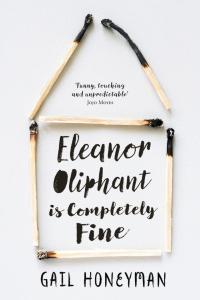
‘Eleanor Oliphant is Completely Fine’ by Gail Honeyman

honeyman_oliphant

2017, 383p.

Eleanor Oliphant is a lonely thirty-year old woman. Just not ‘self-contained’ or without friends, she is bone-achingly lonely:

There have been times when I felt that I might die of loneliness. People sometimes say they might die of boredom, that they’re dying for a cup of tea, but for me, dying of loneliness is not hyperbole. When I feel like that, my head drops and my shoulders slump and I ache, I physically ache, for human contact – I truly feel that I might tumble to the ground and pass away if someone doesn’t hold me, touch me. (p 269)

She works in the back-office of a design company in Glasgow, the only job she has ever had.  She is prickly, judgmental, oblivious and agonizingly awkward.  Nothing comes easily; she is suspicious and sees the worst in people, while affecting a supercilious superiority.  It is no wonder that she repels people, and becomes the butt of their jokes.  Except, perhaps, for Raymond from I.T., a disheveled ‘techie’ who calls for her help when a old man collapses in the street. In that act of kindness, Eleanor is gradually brought into a circle of other kind people – not saints, but just ordinary people acting with everyday kindness. Small things, like haircuts and a cat, gradually put some colour into a very bleak life.

We gradually put together Eleanor’s back-story. We learn that she has a burn scar on her face, that she has been the victim of domestic abuse, that she spent many years in foster care and  that she has weekly talks with her mother, who is a truly evil, cruel woman. Honeyman’s control of unfolding Eleanor’s story is masterful. At one stage I felt that it was all falling into place too easily, until a twist at the end that I will not reveal. Endings are often difficult, and I think that I enjoyed the first 3/4 of the book better than the last part.  I wish that the twist was explored more deeply, but on the other hand, I didn’t need it straightened out and explained either.

Eleanor’s voice is distinctive: arch and highly educated, it also reveals a sardonic but needy humour. Honeyman sustains this voice throughout, and as a reader you are both repelled and yet sympathetic towards her.

Although I normally avoid best-sellers that have stickers on the cover, I really enjoyed this book, and devoured it over a couple of days. I found myself laughing out loud in several places, and tears brimming just a few pages later.

My rating: 9

Sourced from: CAE bookgroups as our March 2020 read.