Category Archives: Book reviews

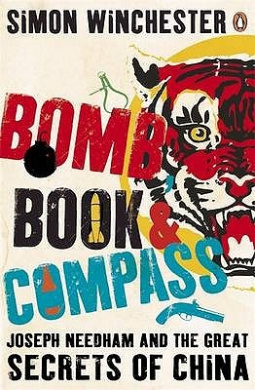
‘Bomb, Book and Compass: Joseph Needham and the Great Secrets of China’ by Simon Winchester

2009, 336 p.

I must confess that I had never heard of ‘Science and Civilisation in China’, a 24-volume (and counting) series described by its publisher, Cambridge University Press, as “one of the most remarkable works of scholarship in the twentieth century”. Nor had I heard of Joseph Needham, its original author. When I saw the title of this book Bomb, Book and Compass, I immediately thought of Jared Diamond’s Guns, Germs and Steel and expected that I would be reading a history of Chinese invention and technology. Joseph Needham, I assumed, would be a missionary/explorer type, perhaps from the 1840s after the Opium Wars, when China was opened up to British trade. But I was wrong on many counts. This is a biography of Joseph Needham, the Cambridge biochemist, who arrived in China in 1943 (100 years after I expected!) and began the research that led to this huge multi-volume work on China which is still continuing, even after his death.

Born in 1900, Joseph Needham was already established as a biochemist and academic at Gonville and Caius College Cambridge when three Chinese postgraduate students arrived at the university in 1936. One of them, Lu Gwei-djen, became his lover and through his fascination with the Chinese language and writing, he was chosen to be a director of the Sino-British Scientific Cooperation Office in Chongquing. This organisation, with its aim to provide practical academic support to Chinese universities during the Sino-Japanese War, gave him the opportunity to travel around central China to remote areas, collecting books and materials and exposing him to the history of invention and technological development in China which had been largely ignored by the Western World. On returning to Cambridge, he embarked on writing a book which expanded into a ten-year seven volume project, that ended up occupying him for the next six decades.

Tall, handsome, driven and charismatic, Needham also enjoyed nudism, morris-dancing and a radical form of Anglicanism at Thaxted parish church. That was not all that was radical about him. His wife, Dorothy, a fellow bio-chemist and his mistress Lu Gwei-Djen lived just a few doors from each other in a congenial relationship. Winchester seems rather sceptical that this relationship was warmly embraced by all three protagonists, but I suspect that this is his own morality at work here, and not necessarily that of Joseph, Dorothy and Lu Gwei-Djen. The arrangement seemed to be open knowledge.

Not only was Needham imbued with a very healthy ego (flattered no doubt by the women with whom he flirted throughout his life) but he also was observant and curious. He plunged headlong into learning Chinese, devising his own rigorous and methodical way of learning a difficult language. On watching a Chinese gardener grafting a plum tree on his first day in China, he recalled that an American missionary had confidently claimed that botany was wholly unknown to the Chinese. This, he realized was one of hundreds of techniques that the Western world discounted:

Needham felt he needed to write his new book largely to overcome ignorance like this and to purge the western world of prejudices against the Chinese that were based on such a wholesale lack of knowledge and understanding. Should a book ever be published, then observations like this, and the scores of others he now knew he would make…would be sure to be included….Everything he was about to see- how a Chinese farmer plowed, how a Chinese bridge was built, how iron was smelted in China, what pills a Chinese doctor handed out, which kinds of kites were to be found in a Chinese playground, what a Chinese siege cannon looked like, how a dam, a haystack, or a harness was built in China- was useful to him….The Chinese, he kept discovering again and again, had the longest imaginable history of invention, creation and the generation of new ideas.

p. 66-67

Certainly China gave Needham the experiences and practical examples to develop his project, but this was not a one-way street. He perused markets and purchased books and documents, and sent home a steady stream of documentation -some rare, some freely available- in diplomatic bags. Once he had returned home, he was the recipient of other material, sent to him from a supporter in China. He was aware that some of this material was sold out of desperation, and there is an element of safe-keeping, particularly during the Cultural Revolution. But part of me wonders whether this is not another form of Western culture-stripping, and whether any of it has been the subject of repatriation demands.

So what was his plan for all this material? The original proposal, reprinted in Bomb, Book and Compass, was for a book addressed to

all educated people whether themselves scientists or not, who are interested in the history of science, scientific thought and technology, in relation to the general history of civilisation, and especially the comparative development of Asia and Europe

p. 171

He identified his question early:

STATEMENT OF THE PROBLEM. What exactly did the Chinese contribute in the various historical periods to the development of Science, Scientific Thought and Technology? Why did their science always remain empirical and restricted to theories of primitive or mediaeval type? What were the inhibiting factors in their civilisation which prevented the rise of modern science in Asia? It is suggested that, apart from numerous theoretical and psychological factors which demand attention, the concrete factors which moulded asiatic civilisation differently from that of Europe are: a) geographical b) hydrological c) social d) economic

p. 171

I think that it’s important to remember that Needham was a biochemist, not a historian. The way that he went about answering his question, I believe, reflects this. He decided initially to make a historical list of every mechanical invention and abstract idea that had been first conceived and made in China. It took him five years. They were, as Winchester notes, “all about detail. They were assembled with a painstaking concern for even the smallest facts of Chinese life.”

The larger question, since dubbed “The Needham Question” was not answered in his own work. As Winchester notes:

Joseph Needham never fully worked out the answers. Perhaps it was because he was too close to the topic, seeing many trees but not enough forest. And though he makes an attempt at offering some answers in his final volume, he never seems fully convinced of his own arguments and never fully explains his reasons. It has been left to others to take up the challenge in his place.

p. 260

The initial volumes received acclaim even though there were many who, resentful of his discipline-hopping, willed them to fail. His work was seen by many as an eccentric folly, but this view was tempered once they became the jewel in the Cambridge University Press catalogue.

In many ways, the initial volumes salvaged his reputation, which had plummetted in the early 1950s. His interest and language skills may have snagged him the position with the Sino-British Scientific Cooperation Office in the first place, but he was now widely acknowledged as a China Expert. In 1952 he led an International Commission delegated by the World Peace Council to investigate the alleged use of chemical warfare by the US during the Korean War. A committed Socialist throughout his life, and a supporter of the Communist Party, he confirmed the Chinese claim that they had been the targets of American bacteriological weapons. The response of the Establishment was swift. He was declared persona non grata in the United States, his academic position became more tenuous, and the senior members of his college at Cambridge froze him out. He was excoriated in the press, denounced in Parliament and shunned by many.

His reputation was rehabilitated largely on the strength of Science and Civilisation in China, and he continued to champion left-wing causes. Even though he was dismayed by the drabness and conformity in Mao’s China when he visited in 1952, he does not seem to have gone through the same crisis of the soul that many left-wing supporters of the Russian Communist Party suffered when news of Stalin’s activities reached the West.

Simon Winchester is a master story-teller, and it comes through in this book. It is as if Winchester has walked around Joseph Needham, describing him from different perspectives: as an academic, as a sexual being, as a political activist, as a researcher. The maps are right where you need them, and they show you just want you want to know. The text is interspersed with photographs of Joseph Needham, which help you to fix him in your mind’s eye. However, I was a little alarmed at Winchester’s blithe acceptance that the Chinese ‘discovered’ Australia, mentioned in passing and without reference to Gavin Menzies, whom I am assuming Winchester is citing. Without footnotes – beyond his quirky asides at the bottom of some pages – the reader needs to put her trust in Winchester alone, something which never sits well with me.

However, both Needham and Winchester were prescient in asking about China’s historical role, and Winchester’s contribution to a better knowledge of it- especially since China is now so prominent in Australians’ sense of security. I found this book fascinating, exposing me to a person and his research that were completely unknown to me. A prolific popular historian/journalist Winchester, is obviously drawn to men who devote their lives to a passion – e.g. James Murray and the Oxford English Dictionary in The Surgeon of Crowthorne and William Smith in The Map that Changed the World. Joseph Needham was one such man, and I’m glad that Winchester introduced him to me.

My rating: 8/10

Sourced from: CAE Bookgroups. I read this with my face-to-face bookgroup.

‘Kristen Lavransdatter’ by Sigrid Undset – a look back

1920, 1921, 1922 1047 pages

I read Kristen Lavransdatter about twenty years ago, and I have never forgotten it. My enthusiasm for it built up over the three volumes in the trilogy, and I ended up viewing it as one of my favourite books of all time (FBOAT). I even ended up with two copies of the trilogy at one stage, because my face-to-face group decided that as a Christmas Kris Kringle we would each buy a second-hand copy of a book that we had loved during the year to put in the Kringle. My recipient returned it to me unread, because she said that it was just too long to be bothered reading. Ah- her loss!I can’t find the second copy now, so perhaps I have inflicted it on someone else.

To be honest, I don’t think I know anyone else who has read it – perhaps this posting will bring them forward?- and so I was very excited when I saw that the hosts of Lit Century, a podcast that chooses one emblematic book for each year of the 20th century, had chosen it for 1922. Their podcast on the book, hosted by Sandra Newman and Catherine Nichols, extended over two sessions. In the first, On Desire (and its Absence), they talk about Kristen Lavransdatter and whether it fits within the ‘romantic novel’ genre, given that it deals with 14th century Norway, with its medieval mentality. In the second episode On Catholicism and Doomscrolling they are joined by Timothy Paulson, whose great-grandfather won a Nobel Prize for Literature (as did Sigrid Undset, largely on the strength of Kristen Lavransdatter.) He is of Norwegian heritage, and first read the book as a Lutheran 13-year old. He spoke about the sense of betrayal that Lutheran readers felt when Kristen converted to Catholicism. They also discussed whether it was a feminist book back in the 1920s when it was released, given the emphasis on the whole life of a female character, and decided that it wasn’t.

So what I did I write about it back in 2001? I wasn’t blogging then, and my reviews tended to focus on the plot of the book, largely as a reminder to myself.

In relation to Part 1 ‘The Garland’, I wrote:

Set in medieval Norway Kristen is betrothed to Simon, but falls in love with Erland. Her father opposes the marriage because Erland has been living with a married woman by whom he had had two children. Kristen eventually marries him, pregnant and scared of her father finding out, and wracked with guilt over the murder/suicide of Erland’s paramour Eline.The story finishes at her wedding, where her father realizes that she is no virgin, but then he learns that his own wife, Ragnfrid, had not been faithful either. Sort of like Heidi meets Anna Karenina.

What an odd coupling- Heidi and Anna Karenina?- what on earth did I mean? Anyway, by January 2002 I was back for more with Part II ‘The Mistress of Husaby’. I wrote:

Second in the Kristen Lavransdatter trilogy. Kristen has not forgiven herself, or Erland, for betraying her father’s trust, and despite fifteen years of marriage and the birth of seven sons. Their marriage is tortured- she can see Erland’s shortcomings and lack of discipline. She holds grudges for literally years, and is quite a shrew. Both her parents die and her younger sister marries Kristen’s former fiance Simon. Erland is arrested for treason for plotting against the King, but Simon intercedes for him and gains a pardon for him at the cost of forfeiture of Erland’s goods.

In July 2002 I finished the final book in the trilogy ‘The Cross’. This time I wrote:

A long break between Volumes 2 and 3, and I found it hard at first to pick the story up again. Kristen is still a hard woman, ready to throw at the slightest provocation the criticism that Erland is not the man her father was; that he had cheated on her, and that he had lost their lands as part of his punishment for treason. Erland and Simon argue when Simon declares his lifelong love for Kristen, and the two families are estranged. Simon dies, with Kristen nursing him. Erland and Kristen also separate, with Erland going to a farmhouse in the mountains. As part of her promise to the dying Simon, Kristen goes to the mountain and reconciles with her husband and falls pregnant again. But neither will budge- Erland will not come down and she will not leave her children to go to him. When the child dies, she is devastated. She takes one of her sons to be confirmed and is confronted by the gossip that Ulv Haldersson (a long time servant) is said to be the father, and when set upon by the villagers who resent her return, Erland comes to the rescue. But he is injured in a fight for her honour and dies.

Kristen is left with fewer sons as they die, travel abroad and marry. When she feels usurped by her daughter-in-law, she decides to become a nun in Trondheim. She catches the Black Death and dies.

What I really liked about this trilogy is the unity of the medieval world view- family, Church and King. The language is archaic, and constantly maintained throughout the whole trilogy. Her characters are all flawed, and yet good- as in life- and act with an authentic mixture of wisdom and stupidity.

I admit that it all sounds a bit melodramatic, when you see it all laid out. Now that I’m older than when I read it the first time, I appreciate even more taking a woman’s life from childhood right through to old age. These are all complex characters, often governed by unworthy motives. I’m pleased to learn from the podcasts that Undset’s treatment of the historical background has held up well, informed by extensive research into Norse medieval culture and literature. I might even read it again if there is another lockdown (perish the thought!)

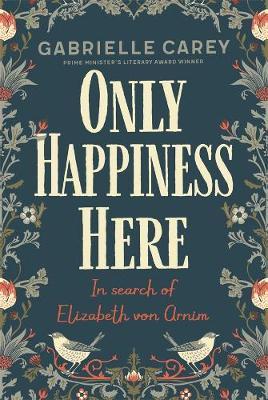
‘Only Happiness Here’ by Gabrielle Carey

2020, 248 p.

I gave myself a stern talking-to before I started reading this book. After all, the subtitle is ‘In search of Elizabeth von Arnim’. I have often grumbled here about biography-as-search books, especially once the biographer starts talking about their own clothes and lunches. “You know you’re going to be reading a biography-as-search book here, when it’s in the title” I told myself. “So NO grumbling about researcher-emoting, food or clothes”.

I didn’t need to be so hard on myself. This book does none of these things. Yes, the author is very much present but it’s more a biography-as-memoir if I need to think of a hyphenated term for it. She engages at an intellectual and emotional level with the writings and life of Elizabeth von Arnim (the two were very closely associated), relating them to her own life. You learn about Elizabeth von Arnim, but you learn about Gabrielle Carey as well.

Gabrielle Carey. Gabrielle Carey? Where did I know that name from? I was part-way through when I remembered that Gabrielle Carey was one of the co-authors of Puberty Blues, the 1979 coming-of-age novel co-written with Kathy Lette (in fact, she mentions this). She has since written about her parents and the writers Randolph Stow and Ivan Southall.

Carey’s fascination started with Elizabeth von Arnim’s own writings:

My quest to learn more about Elizabeth von Arnim was born of an intense admiration of her writing, especially her light touch when satirising the men who were continually trying to thwart her irrepressible spirit. I was also fascinated by her ability to love, laugh and mother five children, while also managing to write a comic novel, on average, every year. somehow she could do all that and still find time to enjoy picnics and read poetry in the sun. The truth was that I wanted to be her: talented, accomplished, funny and also, fairly regularly, rapturously happy

p.4

What attracted her was that von Arnim wrote about being happy – hence the title, which was the motto inscribed over the door of Elizabeth’s Swiss Chalet. At a time in her own life when she was not happy, Carey decided to re-read every one of von Arnim’s twenty-one books again:

The first time round I had read them for enjoyment and entertainment- because they made me laugh. This time I would read them with a question: what did Elizabeth von Arnim understand about happiness that no other writer I’ve ever come across did? And is it something I too might be able to learn?

p.7

So, the book is a search for Elizabeth von Arnim’s Principles for Happiness, which she nicely presents as a single page certificate at the end of the book. She finds nine: freedom, privacy, detachment, nature and gardens, physical exercise, a kindred spirit, sunlight, leisure and creativity. Each of these is discussed in turn throughout the book, appearing as a subheading in a book without chapters. This is not just a one-way distillation of wisdom from on high. Carey brings her own life to the search, particularly with the concept of ‘privacy’ which recent events prior to embarking on the book had brought to the front of her own consciousness.

Carey is not the first to write about von Arnim, and nor has she been the last, because Joyce Morgan’s The Countess from Kirrabilli (see my review here) has appeared even more recently. I had read Morgan’s book prior to this one, which probably took over some of the biographical heavy lifting for me. I’m not sure what it would have been like to read this book first, and then the Morgan biography.

Out of the two biographies, Carey gives a better feel for von Arnim’s writing, I think. Both writers quote from from von Arnim’s letters, but it was Carey’s book that propelled me to purchase an e-book of her collected works- and I’m loving it. Carey’s tone mirrors that of von Arnim’s: there’s a chuckle in her voice and an intimacy with the reader. I didn’t really get the sense from Morgan’s biography that von Arnim’s books were comedies, albeit dealing with some rather grim topics. Morgan has more about her relationships with her several daughters, while Carey focuses on her relationship with her estranged daughter Felicitas, making more overt the connection between the real life Elizabeth/Felicitas relationship, and the book Christine, written by von Arnim but published under a pseudonym.

It’s odd that I often, without meaning to, find myself reading books that address similar themes. I was reminded while reading this book, of Dale Kent’s The Most I Could Be (my review here). Both books share a clear-eyed assertion of sexual autonomy and an almost defiant ownership of decisions that others have criticized. And as for Carey’s wish to be Elizabeth von Arnim? Well, in her closing words, as she returns to her home in COVID lockdown after her research, she takes her lunch (hah! there’s food!) outside into the garden:

…as the world turned in turmoil, I lay in the dappled sunlight pretending I was Elizabeth von Arnim. And even though I was far from Elizabeth’s enchanted places- the Swiss Alps, the bay of Portofino, the south of France- I discovered that my own ordinary, unsophisticated suburban garden could also be a genuine place of enchantment

p.242

A garden, sunlight, leisure, freedom, privacy. Five out of von Arnim’s nine principles. That sounds pretty much like happiness to me.

My rating: 8.5/10

Sourced from: Yarra Plenty Regional Library

I have included this on the Australian Women Writers Challenge database.

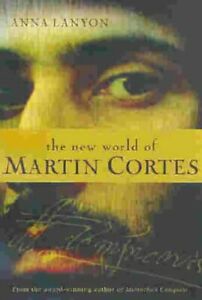
‘The New World of Martín Cortés’ by Anna Lanyon

2003, 260 p.

In January of this year I re-read Anna Lanyon’s Malinche’s Conquest (see my review here) and by the end of it I had resolved that I would read her follow-up book, The New World of Martín Cortés. Martín Cortés was the ‘natural’ son of Hernán Cortés and Malinche, thus making him one among the early mestizo children born in the New World. But he was not to stay in the New World for long, as his father took him back as a six-year-old to the Old World, Spain. This was part of the Conquistador’s attempt to seek forgiveness for, technically, being a rebel against the Crown when he embarked for Mexico against the orders of the Governor of Cuba. He also lobbied for recognition of his achievements and landholdings in the New World. Martín obtained a position in the court of Charles V and later, as a page to Phillip II. As part of embedding his respectability, his father arranged for him to be an initiate into the Order of Santiago. Both he and his father fought for the Spanish Crown in Algiers. Thus, this child of the New World, was integrated into the Old World, while his mother Malinche remarried and died within two years of her son leaving for Spain.

Just as she did with Malinche’s Conquest, Anna Lanyon presents this story as a search within the archives, and visits to significant locations, both in Spain and in Mexico. Perhaps my resistance to this way of narrating history is abating, or perhaps she spends less time in this book on journeying than in the earlier book: in any event, there is more about the archival search within the documents and less about travel.

The major complication Lanyon faced was that Hernán had three sons, and he named two of them “Martín”, a family name. He brought his first son Martín (Malinche’s son) back to Spain with him, but then had another two sons when he remarried in Spain, naming the first of those Martín as well. Hernán was appointed the Marqués del Valle de Oaxaca for his ‘discoveries’ in Mexico, and this title was handed to his second, legitimate Martín, whom Lanyon helpfully distinguishes from Malinche´s son by designating him ´the marqués´. Although Hernán went to considerable effort to have Malinche´s son and other three other natural children declared legitimate, the title and the wealth went only to the marqués.

It´s a pity that the wealth and title didn´t go to the older Martín. After Hernán died, all three sons returned to Mexico, to take up their father´s landholdings. Although the marqués was enjoined by his father´s will to provide for the older but illegitimate Don Martín, he did not do so. Moreover, the marqués became involved in the local South American politics, where the children and grandchildren of the original conquistadors were in dispute with the Spanish crown. By royal order, their right to enslave the indigenous people had been curtailed, and they could only inherit New World land to the second generation, after which it would revert to the Crown. When the marqués arrived, he was hailed by the conquistador sons as the leader of a resistance to these royal decrees that would undercut their patrimony. There were rumours of a rebellion, with the marqués at its head. When he went down, he took his brothers, half-brothers and friends with him, although luck continued to smile on him.

Lanyon knew the broad contours of Martín’s life before she started her research but even she felt sickened and saddened by the latter part of his life. Coming with no knowledge at all about Martín Cortéz, I felt that way too. Courage isn’t just found on battlefields: it is found just as much, if not more, in the dank cells of torture, where men are truly alone.

Both this book and Lanyon’s earlier Maliche’s Conquest have beautiful covers and black and white illustrations distributed throughout the text. I was intrigued by the handwriting embossed on the front cover, and which was watermarked on the opening page of each chapter. Lanyon did not have much direct documentary material to work with, and that which she did have was always complicated by the issue of exactly which Martín Cortéz she was reading about (don Martín or the marqués) but she did find his signature on one document- a tangible mark of his presence all those centuries ago. This is the handwriting that appears on the front cover and underlies the text.

The paucity of sources has forced Lanyon into a great deal of speculation and inference. She clearly marks this in the text through using modifiers like ‘perhaps’ and by framing statements as questions. She is aware of the danger of making such assumptions, such as when discussing Martín’s mestizo status in a community and time when ‘race’ was not necessarily the defining feature. For example, Martín may have been one of the first mestizo children to be taken back to metropolitan Spain, but it was a Spain with heavy Jewish and Muslim influences, and Martín may have looked no different from many other young boys there at the time. We are wrong to infer that he, or anyone else, might freight the issue of race with the significance it has now.

As with Malinche’s Conquest, I enjoyed this book that combined research, reflection and history-as-search. It’s a fairly easy read, and Lanyon is a gracious companion. And as with Malinche’s Conquest, she has settled on an ambiguous title. Martín Cortés may have been a child of the New World, but his upbringing and fate were moulded by the expectations and politics of the Old World, even in a New World setting.

My rating: 7.5

Sourced from: my own bookshelves

I have included this on the Australian Women Writers Challenge. Anna Lanyon studied at La Trobe University.

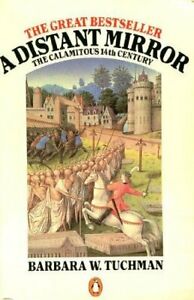
‘A Distant Mirror: The Calamitous 14th Century’ by Barbara Tuchman

1978, Penguin edition, 597 p.

When it became clear that Melbourne’s sixth lockdown was not going to be the ‘short sharp’ affair that was promised, I decided that if I was going to live in the most locked-down city in the world, then I should use the time to do something that I had intended doing for some time: take Barbara Tuchman’s A Distant Mirror off the bookshelf and read it.

Barbara Tuchman was an American narrative historian who was born in 1912 and died in 1989. Two of her books won Pulitzer Prizes: The Guns of August in 1963 dealing with the leadup to WWI, and Stillwell and the American Experience in China 1911-1945 in 1972 (never heard of it!). I have not read either of these books, but I did read The Proud Tower: A Portrait of the World before the War 1890-1914, which I very much enjoyed. She was not an academic historian, and relished the freedom of being able to write ‘popular’ history.

Her books tend to be long at over 500 pages and this book at 597 very closely-set pages is no exception. Although I read it in hard copy, my Kobo e-reader rather discouragingly told me that it would take 23-25 hours to read, and I can testify that it did. So why did I read it, and why now? Partially because I knew that, because the rest of life is on hold, such an opportunity to spend day after day reading a book will not come again (hopefully). But secondly, because in a time of pandemic, with increasing alarm about China, the rise of right-wing extremism, climate change, the underground rumble of the terrorism threat, the debacle of the Afghanistan pull-out and the tragedy for Afghanistan women who are left, and Trump lurking – why not read about another time when the world seemed to be going to hell in a handbasket too?

The 14th Century certainly qualifies as a ‘calamitous’ century. The Black Plague cut a swathe through the world population, peaking in Europe between 1347 to 1351, but it returned in 1360–63, 1374 and 1400. The Papal Schism between 1378 and 1417 saw two competing Popes, one based in Avignon and the other in Rome, each claiming to be the ‘true’ Pope. The Hundred Years War between 1337–1453 saw generation after generation of English and French dynasties leaching the wealth from their countries to embark on a bloody game of chivalry and honour, and where royal women were seen as bargaining chips and allegiances were swapped pragmatically. There were popular uprisings in both Britain and France: The Peasants’ Revolt in England in 1381 and peasant uprisings in Rouen and Paris. Returning soldiers formed gangs of thugs, robbing and raping their way around the countryside. Meanwhile, the Ottomans were at the Danube at Nicopolis, prompting another Crusade, paid for by taxes and imposts.

The map at the start of the book shows Europe in the 14th century and although the silhouette looks the same (of course), there are no hard borders, just regions. England at the time had holdings in France and the Holy Roman Empire dominated the present countries of Germany, Belgium and Switzerland. A century is a long and rather arbitrary measurement; indeed, historians often talk of the ‘long’ 18th century etc. to avoid the tyranny of the year OO cut-off. As a way of giving focus to such a large canvass, Tuchman decided to focus her attention on the life-span of one man: Enguerrand VII de Coucy(1340 – 1395), the last of his line. His ancestral home Coucy Castle, built in the 13th century, was located in Picardy in France. At the time it was a dominating feature in the landscape with an almost impregnable donjon (although WWI took care of that). There are no images of Enguerrand, and all that we know of him comes through the chronicles of the day, particularly through Jean Froissant the medieval author and court historian. Contradictions, exaggerations, slippery dating, and flattery/disparagement warp the histories that have come to us, and accords with her wry ‘Tuchman’s Law’ : “The fact of being reported multiplies the apparent extent of any deplorable to five-to-tenfold” (or any figure the reader would care to supply“. (p. xx)

None the less, Coucy was right in the centre of things. He first fought against the English at the age of 15 and he was one of 40 nobles taken hostage by the English in exchange for the release of the future King John II of France. He was in England for six years as a guest of the Royal Court (no fetid dungeon for him) and ended up marrying King Edward III’s daughter, Isabella of England. This gave him a prominent position as a negotiator and mediator between the French Crown and his father-in-law.

After his wife’s death he married Isabelle, the daughter of the Duke of Lorraine and threw his loyalties completely behind the French throne. In the schism between the popes, he took France’s side and was involved in campaigns in Italy against the Roman Popes’ allies. He was involved in putting down the Flemish uprising, and when the idea of a crusade against the Ottomans at Nicopolis was raised to try to heal disunity caused by the papal schism, he took a leading role. It was his last battle. Taken prisoner by the Ottomans, he died of bubonic plague in Turkey while waiting for a ransom to be paid.

By having one person as her focus, Tuchman solved the problem of narrowing her field, although her choice of subject was constrained. She could not choose a king or queen because they are, by their nature, exceptional; commoners and women were not documented; and clerics or saints were outside the limits of her comprehension. This limited her to a male member of the nobility. Nonetheless, by choosing one particular person as the vehicle of her narrative:

Apart from human interest, this has the advantage of enforced obedience to reality. I am required to follow the circumstances and the sequence of an actual medieval life, lead where they will, and they lead, I think, to a truer version of the period than if I had imposed by own plan.

p.xvi

However, even without this narrowing spotlight, this is still a vast canvas, stretching across regions and alliances. I couldn’t keep up with the detail – there is just too much – and I decided to just go with broad impressions and enjoy the story as it was right on that page, without trying too hard to connect it with other events. It is very much chronologically driven, with one thing happening after the next, and if there was a broader argument, I couldn’t detect it.

Despite the title ‘A Distant Mirror’, it is difficult to find our own reflections here, beyond the physical, corporeal connection of being embodied humans. As she points out:

Difficulty of empathy, of genuinely entering into the mental and emotional values of the Middle Ages, is the final obstacle. The main barrier is, I believe, the Christian religion as it then was: the matrix and law of medieval life, omnipresent, indeed compulsory. Its insistent principle that the life of the spirit and of the afterworld was superior to the here and now, to material life on earth, is one that the modern world does not share, no matter how devout some present-day Christians may be. The rupture of this principle and its replacement by belief in the worth of the individual and of an active life not necessarily focused on God is, in fact, what created the modern world and ended the Middle Ages.

p.xxi

However, this was not lived out in practice. As she warns us

There never was a time when more attention was given to money and possessions than in the 14th century, and its concern with the flesh was the same as at any other time. Economic man and sensual man are not suppressible. The gap between medieval Christianity’s ruling principle and everyday life is the great pitfall of the Middle Ages.

p. xxi

This is writ large in the huge, obscene disparities in wealth between the nobles, with their castles and tournaments and feasts and display, and the peasantry. The principle of chivalry as the dominant political idea of the ruling class is just as inscrutable to us today. Both mentalities confirm that as 20th and 21st century readers, we are not medieval and that this mirror, perhaps, will always remain opaque to us.

Because she focuses on the life of one very well-connected noble, her emphasis is mainly at the elite level, which is mostly what the sources gave her to work with. ‘The people’ get rather less attention, and the parts of the book that I enjoyed most were where she digressed to give small details as illustration. For example, the habit of displaying people in effigy on their sarcophagus as a 33 year old, no matter how old they were when they died (because Jesus was said to die at 33) gave way to showing them old, thin and decrepit as the Cult of Death advanced over the century. I found the chapter on the Black Death particularly interesting, as it was so indiscriminate in its toll. But overall, the book deals more with statecraft and rivalry, more than social conditions.

Did I feel any better about our current world by the time that I finished? Not really. But, believe me, if a time machine lands on my front lawn, I’m not choosing the 14th Century to visit.

My rating: 8/10

Sourced from: My own bookshelves where it has sat for years. Purchased 2nd hand

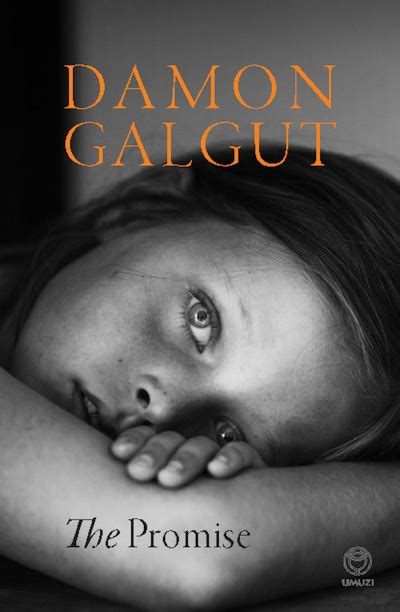
‘The Promise’ by Damon Galgut

2021, 293 p

SPOILER ALERT

For there is nothing unusual or remarkable about the Swart family, oh no, they resemble the family from the next farm and the one beyond that, just an ordinary bunch of white South Africans, and if you don’t believe it then listen to us speak. We sound no different from the other voices, we sound the same and we tell the same stories, in an accent squashed underfoot, all the consonants decapitated and the vowels stove in. Something rusted and rain-stained and dented in the soul, and it comes through in the voice.

p.221

At least the movie ‘Four Weddings and a Funeral’ had a wedding or two. This book has four funerals, held against the backdrop of South African political change, as members of the Swart family die -first mother Rachel, then her husband Manie, then daughter Astrid, son Anton- leaving just the youngest daughter, Amor. It is left to Amor to make good a deathbed promise that her father Manie made to her mother Rachel, thirty years earlier. Rachel had begged her husband to promise that he would give the old Lombard house – just three rooms- to Salome, the domestic servant who has nursed Rachel through a long illness that has stripped her of all dignity. But time has gone on and somehow the house never gets transferred to Salome who continues to work in the house, always present, mostly invisible.

The book is divided into four parts, each named for the protagonist who will die – Ma, Pa, Astrid, Anton – although I admit that I didn’t realize that until after I finished. What I was aware of was the corrosive effects of apartheid that did not disappear with its dismantling, in spite of the hope of the Mandela years and twisted by the disillusionment with the politicians who followed him. Corrosive at a macro-scale, but corrosive individually too, as superiority and resentment is turned inwards.

Religion has much to answer for here. The thin-lipped disapproval of Rachel’s late-life conversion back to Judaism by the family steeped in Dutch Reformed Church tradition gives way to the self-serving fanaticism of an evangelical church as Pa (Manie) carves off part of his land to donate to his new church. Astrid, living in a gated community becomes Catholic, a religion which allows confession without contrition, while Anton’s wife enjoys the indulgence of Eastern mystic religion as a hobby. When the promise to give Salome her house is finally fulfilled, it is not through any religious impulse, but because Amor is aware that it has been unjustly withheld by her family, through inattention and obliviousness to this invisible woman who had been so loyal to them for so many decades.

The narrative voice in this book is striking. You’re never really quite sure who is speaking: it is someone familiar with the family and their weaknesses, wry, somewhat judgmental. The narrative swoops from one character to the next, as if it is a camera on a boom, an all-seeing eye. It means that your focus can switch from scene to scene without any warning which is jarring at first. At times the narrator ‘breaks the fourth wall’ by turning around to address you, the reader. It’s a strange, but effective technique.

Deaths occur suddenly in this book, and they are almost skated over. The death itself is not as important as its implications for the people who are left. Meanwhile, the unfulfilled promise hangs over the family, almost like a curse. It is denied for too long, and then when it is finally conceded, it is almost a poisoned chalice. Salome’s son, most certainly, does not show the gratitude that other members of the Swart family might have expected. The land and the now-derelict house are now subject to a land claim under land redistribution, and Salome may well lose again.

I was rather surprised when this book made the shortlist for the Booker Prize, I must confess. In many ways, it’s a multi-generational family story, although it is strengthened by being placed against the political background. It’s real strength, for me, is the narrative voice. I wonder if its presence as a non-American book in a shortlist dominated by American writers (just as many predicted) might weigh in its favour.

My rating: 8/10

Sourced from: Yarra Plenty Regional Library

Read because: It is shortlisted for the 2021 Booker Prize.

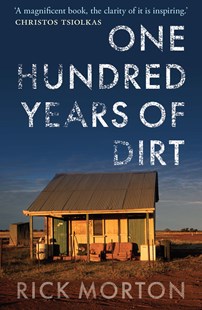
‘One Hundred Years of Dirt’ by Rick Morton

2018, 187 p.

There seems to be a deluge of misery-memoirs recently and from the title and the stark cover image, I expected this to be another one. However One Hundred Years of Dirt, although it has its share of pain and cruelty, is much more than this. It is a reflection on family patterns, addictions and mental health, class, and a love letter to Morton’s mother, Deb.

In telling his story, Morton turns back two generations to his grandfather, George, a pastoralist in remote far-west Queensland. A violent and cruel man, he abused Rick’s father Rodney, and Rodney in turn rejects his family, plunging them into poverty. It’s a pattern that is repeated from one generation to another, and Morton is aware that his father has shaped him as well:

To understand a person, you must understand his father. This is true of Rodney and it is true of myself, too. Ours is a trauma passed from one generation to another, family heirlooms that are bequeathed by the living. There is an emotional and financial poverty that flows from these wounds…Try as they might to contain the damage, it seeped through, father to son and father to son. Desolation moved like a slinky through them all.

p.29

When Rick’s brother Toby was horrifically burnt in a farm accident, his mother bundled Toby, herself and her newborn daughter into the Royal Flying Doctor Service aeroplane. Rodney, left alone on the station with Rick, turned to the governess. When the marriage broke up, he was ruthless. Deb and her children ended up impoverished, in a Housing Commission house where she brought up her children on an income that was measured to the last cent. A weekly hot-chocolate at a cafe with ‘the girls’ from work was a carefully-budgetted luxury.

Rick won a scholarship to the private Bond University on the Gold Coast, where he always felt out of place. His journalistic career started at the Gold Coast Bulletin – perhaps not the most illustrious of starts – but at the time of writing this book he was working at the Australian. He found himself out of place there too: a working-class kid in Australia’s conservative-leaning, national newspaper. He now works for the Saturday Paper and often appears on the ABC’s The Drum where, although the politics might be different, the intellectual and social milieu is still far removed from his childhood.

Now that being a Marxist seems something from undergraduate, 1970s student life, we don’t know quite how to talk about class. Or, at least, I don’t. Howard’s ‘battlers’, Scomo’s utes on the weekend, workers in the mining industry, immigration, the much-derided ‘McMansion’ – these have all confounded and complicated the idea of class. Morton’s view is more pragmatic and clear-eyed:

Class is access. To resources, to culture, to the conversations people are having about you. For the longest time, as a child, I had no idea the conversation about us and people like us was even out there. My ignorance was built on generations of accumulated concerns: survival, rent, food, repeat. No time to make the world big. No-one to make it big for you. That it happened to me is still a matter of confusion.

p.169

We don’t normally hear this from journalists from the Australian or from the Schwartz media stable either. For Morton, it’s not a matter of politics, but a matter of a new Great Australian Silence of class.

We don’t need more journalists from the right or from the left. It’s the wrong approach entirely. What the media needs- what it should desire, actually – is more reporters with the ability to understand their subjects. There is a small problem with the repetition of our egalitarian myth and that is this: repeating it doesn’t make it true. We never hear from the people for whom this myth failed and when we do, we feel instinctively that they are to blame.

p.161

When reading this book, I veered between viewing it as expansive and wide-ranging, or alternatively, undisciplined. He is narrating a story deeply embedded in his own experience and then – wham!- there is a dispassionate, rather abstract discussion about a particular report, or a collection of statistics. Is this the journalist in him coming out? – having to ‘tell’ and ‘inform’ us? Or is he signalling “Hey- look over there!” when something is getting too close to the quick, too painful? I don’t think so, because when he comes to the most intimate part of the book where he describes his depression and anguish over his sexuality, his loneliness, his hopelessness, there is no intellectualizing there: it is just straight, honest writing.

This book is much more complex than the misery memoir I thought it would be. It is funny in places, veined with pain, but suffused with love and generosity.

My rating: 8/10

Sourced from: Yarra Plenty Regional Library

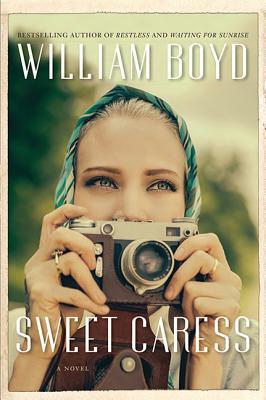
‘Sweet Caress’ by William Boyd

2015, 464 p.

SPOILER ALERT

I must confess that the first thing I did after finishing this book was to jump onto Google to see if there ever was a female photographer called Amory Clay. That’s how convincing this book was, with its mixture of real characters and events. I couldn’t tell whether I had just read a fictionalized biography or whether the whole thing was Boyd’s creation- and it was the latter.

The book is two narratives. One is Amory’s journal from 1977 when she is living in a small cottage on the Scottish coastline, within sight of the Isle of Mull. She is widowed, her daughters have left home, she has retired from her career as photographer, and she is getting old. (Not that old- “only 70”, says she for whom 70 is not too far away!) The journal entries are not long, and are more a springboard to her memories, the other narrative, which flow more or less chronologically.

Amory was born on 7 March 1908, her father a writer, and the eldest of three children. Her sister Peggy was marked out early as a musical genius, her brother Alexander (Xan) was a strange, fey lad who collected guinea pigs but later had a career quite unheralded by his childhood. Her father went to World War I and returned mentally unstable. She was sent to boarding school, which she resented, as neither of her siblings were sent away, and she only later realized that there was a financial reason for her exile. On a vacation at home, her father tried to drive them both into a lake, an act that precipitated his committal to an asylum for many years and which, naturally enough, made Amory distrustful of her father and hurt by his heedlessness. If one wanted to play amateur psychiatrist, one could argue that this betrayal by her father shaped her rather distant relationships with men, who were either unavailable, in the case of the wealthy but married Cleve Finzi, or ambivalent in the case of Charbonneau. The pattern was broken when she married Sholto Farr, becoming Lady Farr, but this ended up in a betrayal of both her and her two daughters, of a different kind.

From her adolescence, encouraged by her uncle, she embarked on a career as a photographer which took her to Berlin, New York and Vietnam, ending finally in her cottage on the Scottish coast. The book is both a professional and personal biography. It is liberally interspersed (like a Sebald book) with black and white photographs, mostly taken by Amory. It was probably these photographs more than anything else that made me question whether this was a real autobiography or not. Quite frankly, they are very poor photographs, in no way reflective of a professional or artistic photographer. They are just like the Box Brownie photographs your Uncle Les might have taken in the 1950s.

The narrative of Amory’s life is told against a backdrop of real events and people, not in a Forrest Gump way, but as incidental background, off at an angle. This helps to add to the verisimilitude of the narrative by not straining the reader’s credulity by putting her into the centre of the action but forming a context for the places and situations in which she found herself. It only broke down for me in the last part of the book where it seemed that the author was grasping for a plot development that would encapsulate the 1970s and chose cult-behaviour in America. I don’t know if it was because the book was running out of steam, but this final phase of Amory’s life, where she tries to ‘rescue’ her daughter from the clutches of cult leader Tayborne Gaines, seemed rather melodramatic and superfluous.

I read this as a bookgroup read (in fact, I chose it on the basis of Restless which I very much enjoyed when I selected it as an earlier bookgroup read). Some of us felt rather uncomfortable that a male writer was writing from a female perspective, particularly in sex scenes. This didn’t worry me at all – I don’t like where you end up when you prohibit people from writing from anything other than their direct experience- and I thought that he wrote sex from a female perspective particularly well.

So did I feel cheated when I found that Amory Clay was a figment of William Boyd’s imagination? No, not at all. He did it well enough to make me wonder, and he created a credible female character against a backdrop of world events.

My rating: 8/10

Sourced from: CAE Bookgroups

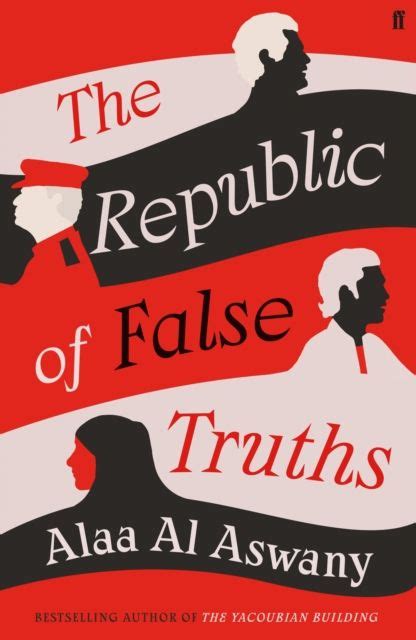
‘The Republic of False Truths’ by Alaa Al Aswany

2021, 464 p.

At the start of this year there were quite a few ‘Ten Years On’ -type programs looking back at the Arab Spring that swept across different Middle Eastern countries, reaching its high point with the fall of Muburak in Egypt in 2011. To be honest, I’m no longer clear in my own mind about what happened when and where and why. That’s where fiction, or a well-chosen journalistic non-fiction piece can come in, by humanizing and locating, at a small scale, those huge crowds that seem indistinguishable from each other on the nightly news.

Alaa Al Aswany makes no secret of his politics in this fictionalized account of the January 2011 uprising. He was there himself, and he was one of the organizers of the Enough! group that is mentioned in this book. He presents a group of alternating characters who represent different groups in Egyptian society who participated in different degrees to the uprising or its suppression. There is the devout General Alwany whose morning ritual is prayer, sex with his wife, then off to the office for some torture of political prisoners. His defiant daughter Danya is drawn into the protests and witnesses her friend Khaled shot by the military at point-blank range. Ashraf Wiffa is a dope-smoking failed actor who pursues an affair with his maid, only to find himself falling in love with her and increasingly involved with the protestors, to the disgust of his estranged wife Magda. The love affair of Asmaa, a teacher at a corrupt school, and Mazen, the son of a political prisoner and union organizer at a cement factory, is carried out mainly through letters. Nourhan is a television presenter who becomes the mouthpiece of the military forces, accruing more and more power as she uses her contacts to force a divorce from her former lover Essam, the manager at the aforementioned cement factory.

The narrative cycles between these different characters and different segments of Egyptian society: army, media, business, university. I often find that with a revolving cast of characters like this, I get confused between who is who and what they are up to. However, Al Aswany stayed with them long enough, particularly at the start of the book, to embed them in the reader’s consciousness as individual characters. However, as the book went on, the episodes became shorter. I use the word ‘episodes’ deliberately, because this is what they felt like: episodes in an afternoon soap-opera, with a cliff-hanger at the end before launching off into the next character. For me, this soap-opera feeling detracted from the novel and made it feel ‘junkier’ than it otherwise would have. I can’t help feeling that the characters were stereotyped (the army general, the maid, the idealistic young female student), with an almost Philip Roth-like emphasis on male sex.

I haven’t read any other books about the Arab Spring, and indeed this book is still banned in Egypt – a fact that speaks to its authenticity, I would say. However, there is a sameness about books about revolutions – I’m thinking of several South American books I have read, books set in the French Revolution, Nino Haratischvili The Eighth Life (for Brika) – as idealism gets swallowed up into betrayal, the torture becomes more vindictive and untrammeled, and the army and police embed themselves more deeply. This inexorable cycle is why books like this are important: to remind us that within the bigger historical forces, there are people who love, who wrestle with their consciences, who make decisions and live and die with the consequences.

My rating: 7/10

Sourced from: Yarra Plenty Regional Library

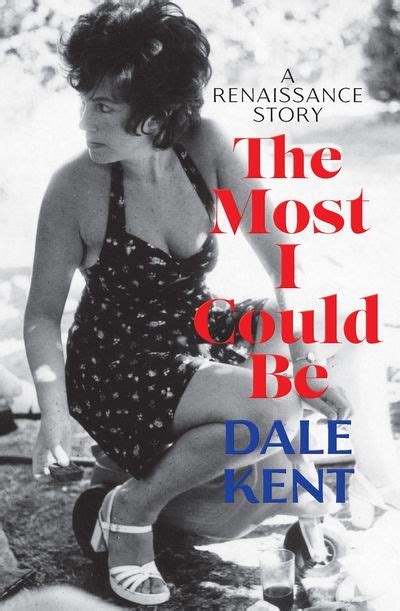
‘The Most I Could Be’ by Dale Kent

2021, 456 p

The name ‘Dale Kent’ seemed familiar. At first I thought that she might be an expatriate feminist that I had heard of sometime, but on learning more about this book I realized with a little jolt of recognition that I had been one of her undergraduate students at La Trobe University.

It was back in 1976 and I did two half-units of Renaissance History- one on Florence and the Italian Renaissance, the other on Medieval Italian Communes. To be honest, I have little memory of the content, but I do remember seminars in the rather-pretentiously named West Peribolos building, with the west summer sun slanting through the edges of the holland blinds drawn against the narrow full-length windows at afternoon seminars. I remember Dale Kent who struck me at the time as quite beautiful, vivacious, theatrical and rather awe-inducing, and I regretted that I did not have her as my tutor, having instead an M. Billington of whom I have no memory at all (I had to consult an essay I had kept from the subject, to find out her name). So I was attracted to this book because, not only is La Trobe “my” university but I expected that, as a historian, she would structure a good memoir. After all, Inga Clendinnen who was a colleague of Kent’s at La Trobe at the time, wrote Tiger’s Eye, one of the best memoirs I have ever read (see my review here) and I hoped that this might be similar.

For me, a memoir is a creative re-construction of a life structured and shaped around a motif. Despite the phrase ‘the most I could be’ which was repeated both as boast and self-exculpation in several places, this is pretty much a start-at-the-beginning-and-go-through-to-the-end sort of autobiography. At the end of the book she says “As a historian, I have kept the record” (p. 406) and this is the way that it read: as an act of recording rather than creating. I admit to being disappointed.

I found myself wondering who might be the intended audience for this book, beyond other historians (many of whom may be checking the index, because in all but one case she uses the full names of her colleagues). The history field in Melbourne is not large, and there were many familiar names. Her area of expertise was patronage during the Renaissance, with a particular focus on the Medici family. Certainly she led what now seems like a charmed academic life: scholarships to undertake her PhD at Oxford University, positions at Berkeley and Princeton, sufficient tenure at admittedly lower tier universities that nonetheless provided a salary and sabbatical and other leave to travel to conduct her research in Italy; and a string of prestigious just-in-time fellowships and projects that sustained a career of over 20 years in America.

All this was a long way from her childhood in Moonee Ponds, East St. Kilda and then Caulfield, as the daughter of Christian Scientist parents. Her father was an engineer, while her mother had left school early. Her working-class grandparents, Nell and Horrie came from Footscray. She was overweight (something that is hard to believe because she is absolutely beautiful in the photographs included in the book), she wet the bed as a child and had few friends at school. A whole new world opened up for her when she enrolled at Melbourne University, and she left Christian Science behind. She met her husband, Bill, who shared her academic interest in Renaissance Italy, and they built their careers together. As a young mother herself, at the age of thirty, she decided to ‘divorce’ her parents because they were too intrusive, and eventually left her husband Bill too, and embarked on her peripatetic international academic career. Her relationship with her only daughter was the price, and one that I hope has not been inflated by the publication of this book. Ironically, her comment about why she ‘divorced’ her parents – “they didn’t love me enough to make the slightest adjustment of their expectations to my needs, so that we could continue to be part of each other’s lives” (p.156)- could conceivably be said by her own daughter about her.

This is a long autobiography at over 400 pages, and it is very detailed, especially when it came to describing the clothes she wore and the food she ate (something that I usually view as the kiss of death for an autobiography/memoir). There were some small factual details that I found myself eying rather skeptically. A Unitarian Church in Collins Street ?(Uniting Church, yes, but not Unitarian). Flamingos in the lake at La Trobe University? (geese, ibis yes, herons maybe, but not flamingos). Small details, I know, but I wonder how many others there were that passed me by.

She is laceratingly honest about herself, her sexual neediness, her alcoholism. I was drawn to keep reading the book, but it was almost as if I was reading with my fingers over my eyes, apprehensive over what she was going to do or reveal next. Too much sex, too many unavailable or unsuitable men, heedlessness to boundaries, a sense of grievance, a quixotic and unrealistic search for a ‘soulmate’, a bewildering lack of insight – why would she want to publish this, thus inviting her readers to sit in judgment on her? There have been quite enough other people doing that : her colleagues, her ex-husband, her daughter, friends who eventually tired of having her sobbing on the telephone to them. She is speaking and telling her story, but it is not hard to see her through others’ eyes. The mismatch between the professional and the personal is stark.

I was interested in her early life, and the effect of her family’s Christian Science religion on her social and intellectual development. She gives an insight into the life of the young academic, particularly when she and Bill were writing their doctoral theses, and she describes the hierarchies and power games within university faculties. She captures well the arid suburban life for bright women in the 1950s and 1960s, and the testosterone-fueled arrogance and combativeness of the scions of Ivy-League and Sandstone Universities. What fails to come through at all is the love that she clearly must have for her interest in Renaissance Florence after all these decades: not in the visual sense (which any tourist could have), but as an historiographical challenge. She has published widely in her field, contributing books, chapters and reviews over many years. Her work sustained and saved her, as she herself admits, but you get little indication of it at an intellectual or emotional level. I’m a little tired of reading of historians emoting about their adventures in the archives, but there is little evidence of a passion of the mind here at all. The body – yes; and appetites for food, drink, new places, and the next project – but no curiosity, or obsession or joy. I wish that I had seen some of that.

My rating: 7

Read because: I realized my connection with her, and because I like reading historians’ biographies.

I have included this on the Australian Women Writers Challenge.