It’s always a bit arbitrary choosing my best reads for a year, but these are the books to which I awarded five stars on Goodreads. Many of them were published recently, which surprises me somewhat, as I usually borrow my books from the library and can’t always get new releases. There’s quite a pleasing spread between fiction, memoir and history, with more women writers than men.
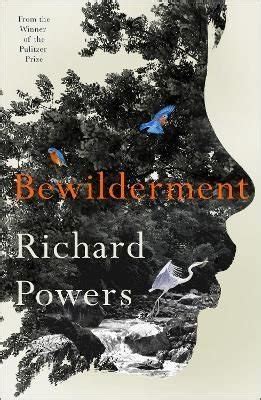
I must be getting cynical. You look at the headlines and peep over the edge of the cauldron of the bubbling social media brew, and you know that you’re going to see all this moulded into fiction within the writing-and-publishing lead time that drives the book industry. MeToo, neurodiversity, gender, bushfires, climate change: I bet that readers in the future will be able to predict the publication date of a book by its theme (although, I do wonder if that hasn’t always been the case). Capturing the zeitgeist, yes, but there’s a narrow line that separates it from a form of political bashing-over-the-head. Perhaps it was because I’ve just watched the contortions of COP26, or been listening to a series of podcasts on Australia’s response to the climate crisis, or because I read The Guardian, but Richard Powers’ Bewilderment felt too heavy-handed for me.
Theo Byrne is a widowed astrobiologist, working on a long-term government-funded project programming simulations of life on other planets, spinning tales of other forms of life and society amongst the immensity of space. These are the stories he tells his son Robin, a brilliant and neurodiverse nine-year old, whose obsessions and volatility have led to his threatened expulsion from school. Both father and son are left bereft by the death of Alys, an environmental activist, in a car-crash two years before the story starts. When the school issues an ultimatum about medication or expulsion, Theo turns to a family friend who is working on a technology called Decoded Neurofeedback. Cocooned into an MRI machine, Robin learns to control his mental waves to approximate those of another subject, who just happens, in an ethical WTF, to be his mother whose neural records had been retained from her participation in earlier iterations of the technology. He adapts quickly to the learning, and begins to draw on not only his mother’s emotional and intellectual brain waves, but also on her world view and even, at a stretch, her relationship with Theo, Robin’s father. Already attuned through his father’s work to the contingency and explosive variation of life – in all its forms – Robin’s awareness of the climate crisis is heightened to the point of anguish. Publicity about the Decoded Neurofeedback technology catapults Robin into social media celebrity which, driven by his mother’s environmental passion that he is now channelling, he uses as a platform for activism in a world hurtling towards climate oblivion.
I hadn’t noticed the ‘Science Fiction’ designation on the back cover of this book, and when I heard someone else talking about it, I had felt that it sounded a bit implausible. However, for me, science fiction is most accessible when it is written in near-time, with the emphasis on the human rather than the science. I know that neurofeedback is increasingly being drawn into the medical and psychological mainstream, and there are many characters in this book who are familiar: a Donald Trump-type President (maybe even the Real Donald Trump) who tweets in capital letters and exclamation marks, and a Greta Thunburg- type character, an “oval-faced girl in tight pigtails”, called Inger Alder, who inspires Robin to action. There’s a nice little twist in the title with the inclusion of “wild”, reflecting its environmental theme. Also running through the book are allusions to Daniel Keyes’ short story Flowers for Algernon, but perhaps these references should have come with asterisks and links to an online bookshop, because it is important to the plot which becomes patently obvious to anyone who has read Keyes’ story or seen the film ‘Charly’ which it spawned. Although, perhaps it would have been more powerful if you were unaware of these antecedents.
The book is written from Theo’s point of view, with both Robin’s and his wife Ally’s words in italics, as if they are coming from somewhere else. There are no chapters, but instead a series of short episodes, each marked by capital letters in the opening sentence, giving the book a filmic character. Emotionally it is powerful, just as Keyes’ short-story was, leaving you with a hollowness at the loss of passion and intelligence, as the world and the protagonists of the book subside into a dark silence.
Much of the science in this book passed me by, but it is a testament to Powers’ writing that, instead of repelling, its complexity helped build a cosmological imagination, against which our heedlessness and intransigence in relation to climate and the environment seems particularly bone-headed. I regret, though, that the book veered into telling and not showing. It was just a bit too didactic for me.
My rating: 8.5
Sourced from: Yarra Plenty Regional Library
Read because: I read this book because it was short-listed for the Booker Prize. It merits its place on the shortlist, but its inclusion validates my fears that the Booker Prize would lose its distinctively Commonwealth nature, as it is a very American book.
As I have grown older, and as more images flood our screens, many of the mental images I used to have of disasters have changed. I always thought of a tsunami as one of those enormous waves that big-wave surfers challenge themselves against, only to see in the Boxing Day tsunami that inexorable advance of water which, although not particularly high, just engulfed everything in its path. Bushfires I envisaged and saw as a roaring furnace, but not that blood-red, sullen sky of Mallacoota. Likewise with earthquakes. I knew about the shaking, the crumbled buildings and the ruptured roads but I had never heard of liquefaction. But liquefaction is here in this book:
Liquefaction is a fascinating, frightening seismic phenomenon. When it occurs over large areas it behaves as quicksand, a natural hazard capable of swallowing people and vehicles, and causing subsidence in buildings. It is a cruel epilogue to upheaval. Just as the survivor of a seismic event grapples with injury, damage and ongoing aftershocks, as they attempt to reel in their runaway panic and rush to check on children and property, as they disconnect gas bottles and grapple with what has just happened, within those hectic minutes a rising tide of liquefaction might come to lurk beneath the surface, seeking to pour forth a second wave of destruction….
What becomes of liquefaction after it has issued forth from the darkness beneath, into the light of the world? Like shame, it cannot survive being seen. In the heat of the sun, it dries to a grey powder as fine as talc and disperses on whatever current of air may find it, gentle zephyrs and howling gales alike, leaving only a scar in the earth where it emerged.
p. 277, 278
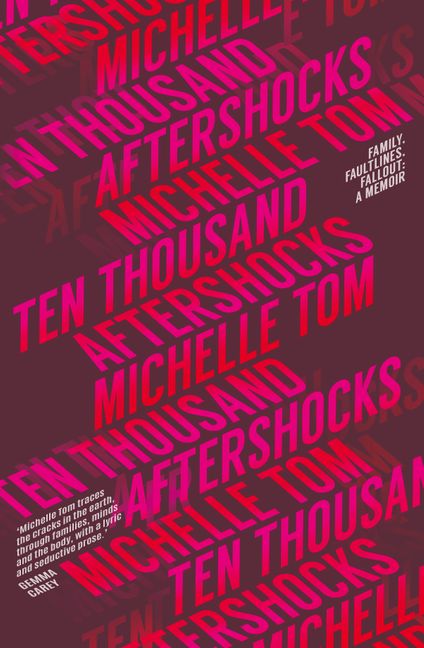
I knew from the title of this book that it was about the 2011 Christchurch earthquake. Tom uses the five stages of an earthquake as the organizing structure for her memoir, but only the fourth stage deals directly with 22 February 2011. The earthquake is a rupturing, all engulfing moment in the narrative, but it only part of Tom’s own memoir of her family, written as a promise to her forty-three year old younger sister whose burial occurs in the opening pages. Michelle is the eldest of three children, but both her siblings have died, Meredith through melanoma cancer and her youngest brother, Paul, through suicide after a long struggle with schizophrenia. Michelle is very much the ‘golden child’ and her sister Meredith the scapegoat, and all three children are damaged by the toxic, inexplicable and warped relationship between the parents.
The five stages of the earthquake frame Michelle’s telling of this family trauma: Stage One- the secret straining and warping long before; Stage Two – the replacement of water in the fissures of the rock by air ; Stage Three- the forcing back of water into the cracked, expanded rock and the accumulation of elastic strain; Stage Four- the rupture of the earthquake and the release of energy in seismic waves; Stage Five – aftershock, sometimes for many years afterwards, dangerous in their ability to bring down already weakened structures.
Within these stages, the narrative is presented as short, non-chronological bursts, almost like rocks that grind against each other. Each segment is at most ten pages long; sometimes only one or two pages, and they jump back and forth. It is as if the narrative itself is moving under the surface, squeezing, forcing, with the pieces rubbing up against each other. It is not an easy read, emotionally or in terms of sense-making.
In another review I read recently, I came across the term ‘authorial hand-holding’. I think of the vignettes in this book, put into groups under an overarching structure, but without any clear organizing principles. There’s certainly no hand-holding going on here, and I wonder if the writer has eschewed authorial responsibility altogether -with the exception, perhaps, of the fourth, ‘earthquake’ section. Each separate vignette is carefully written in very polished, introspective prose but it is the reader who puts them together into a narrative. For me, it is the connections and transitions across the whole of a narrative that mark out good memoir writing, and I tend to think that this mosaic-type, pointillist style of assemblage baulks at that final step of integration and creation.
Perhaps I’m getting too old. Not only do I find such splintered writing difficult to read, but I’m also more jaundiced and less empathetic, perhaps, at reading ‘family trauma’. Is it that as I get older, everything is flattening out? Or is it that with time I am more aware that everyone has their wounds, their secrets, their weaknesses, their uglinesses as well as their unfulfilled intentions and their failed attempts? I keep wanting to wriggle out of the author’s shoes, in order to stand in those of the people she is judging. With age, I am less deafened by the howl of the child’s pain drowning out everything else, and I am listening for those other mutterings, those other pleadings. I think, perhaps, that I need to put family memoirs aside for a while.
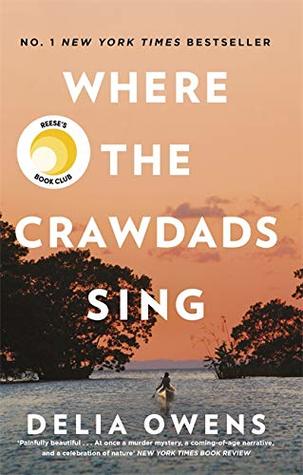
If I had been the person who identifies the genre in marketing a book, how would I have classified this book? It starts off with a murder, moves into a sensitive depiction of neglect and isolation, interweaves evocative descriptions of landscape and nature, shifts towards being a coming-of-age novel and ends up in a court case. It is like five books in one, and I’m undecided whether it is a skilful mish-mash of genres, or whether it is a genuine attempt to move beyond the murder/courtroom genre by providing a protagonist with nuance, depth and change over time.
The chronological narrative shuttles between a court case and the backstory starting back in the early 1950s, gradually moving forward until the two timelines converge in 1969 with the discovery of the body of footballer and small-town Lothario Chase Andrews in the swamp. Accusations mount against Kya, the ‘Marsh Girl’, who lives alone in a shack in the North Carolina swamp marshes. In 1951, her mother walked out one day in her crocodile-skin shoes, leaving her five children to their violent, drunken father. Gradually Kya’s siblings leave home, unable to cope with their father’s beatings and neglect. At the age of six, she is left to fend for herself as her father disappears on days-long benders until he, too, disappears leaving Kya as a ten-year-old to make her own way. Able to negotiate the inlets and tides of the swamp, she earns enough money from fishing to buy bare necessities, but she does not attend school and ekes out a precarious, lonely existence. She is very much a child of the marsh, attuned to the rhythm of the tides, the turning of the seasons and the wildlife that surrounds her. The people of Barkley Cove know that she is living there, and she is shunned as ‘swamp trash’ by the people of the town, but as she grows older, she attracts the attention of two boys – Tate Walker and Chase Andrews – both of whom show remarkable restraint (at least initially) with a young, feral, unprotected girl living on her wits. Tate teaches her to read, and opens up to her an avenue by which she can draw, and write about and study the natural world that teems around her. Wary and self-sufficient, she is slow to trust either man, and as a reader you feel the latent menace of them both. Betrayal comes, as you know it must, but in different ways. When Chase Andrews’ body is found near an abandoned fire tower in the swamp, it seems to justify many of the prejudices of the people of Barkley Cove.
Of this ‘five for the price of one’ volume, I liked the landscape writing most. Delia Owens has written non-fiction environmental writing before, and she does it well. Not for nothing has she been likened to Barbara Kingsolver. The swamp is depicted as a living, breathing, moving body, and Kya is closely attuned to its movements and changes. I thought that the author captured well the fear that Kya and her siblings felt in the face of her father’s rages and neglect, and the petty and oblivious cruelties played out on her by the people of Barkley Cove. So did the book need a murder as well? For me, Owens could have rested on these two themes alone.
But if Owens was determined to have a murder and court-case, then she did write it well, even though it marked an abrupt change in pace and intent. The court case sections reminded me a bit of To Kill a Mockingbird, with its small-town setting and the rejection of a Mayella Ewell-type character, albeit in very different circumstances. I found the book a real page-turner at this point. I often rail about being left at the end of a crime book wondering ‘So who did do it?’ but there was no danger of that with this book. I just don’t know if the whole murder and its aftermath was necessary.
The part was was least convincing to me – and it’s an important plot development – is Kya’s transformation from a feral, illiterate child into a writer/scientist, with published works under her belt, and sufficient experience of the world to want to purchase comforts to make her shack more habitable without changing the outward appearance. Kya the child is plausible: Kya the adult is less so.
And so, how do I assess this book? I admit to sharing Jonathan Franzen’s wariness of a book emblazoned with an ‘Oprah Book Club’ sticker, and knowing that this book was endorsed as part of Reese Witherspoon’s book club did not necessarily endear it to me. I hadn’t noticed Tic-Toc book reviews until I searched for this book. Certainly the book has achieved best-seller status. Was the murder and court-case added to appeal to a wider audience? Or is this a book that moved beyond the two-dimensionality of many crime/court novels, just as I have often craved for them to do? I felt as if I was being buffeted around by the different genres that the book drew upon, even though most of them were done well in their own right. Perhaps it was the amalgamation of different types of writing that disconcerted me, leaving me feeling stuffed with too much plot.
My rating….a difficult one. I’d have to rate a book highly that has me sitting up in bed until 1.30 a.m. to finish it. And yet, and yet…. let’s go for 7.5
I can remember when I was young, I sometimes deliberately stretched out the ending of a book because I feared that it was going to end badly for the characters. If I just left them there, suspended, the bad thing wouldn’t happen to them. Magical thinking, I know, but that’s very much the way that I felt when I only had about 50 pages of this book left to go. I would make excuses that my reading circumstances weren’t good enough- I was too tired, the light was poor, I’d enjoy it better tomorrow – but I know that it was because I feared the ending.
Over the last 18 months or so, I have been remediating my dearth of knowledge about American history by listening to Heather Cox Richardson’s history videos on Facebook. I really knew very little about the Reconstruction era: that 13 year period between 1863 and 1877 immediately following the American Civil War. The whole concept of a civil war chills me, with the contortions of morality and identity that must take place in order to be able to fight someone who shares language, place, experience. And then when it stops- what then? How do you step back from that?
Old Ox is a small town in Georgia, staunchly Confederate during the war, and resentful and broken afterwards. Emancipation has seen formerly enslaved people suddenly free, but without resources, money or plans. Many of them stay in Old Ox, some still living and working for their former owners, others building shanties under the eaves and in the alley-ways of the buildings in the town. Landry and Prentiss are hiding out in the woods where they are discovered by George Walker, a small-scale white farmer. They agree to work on George’s farm, planting peanuts, in return for shelter in the barn, food and a wage. They had been enslaved on a nearby plantation, and the cruelty of the owner, Ted Morton, had stripped Landry of speech. The brothers dream of finding their mother, who had been sold, and now that they can earn some money, they have a chance of doing so.
George’s sudden plan to plant peanuts is triggered by his need to turn his hand to something. He and his wife Isabelle are mute in their grief for their son, lost in the war. Never particularly close, now Isabelle in particular is engulfed by mourning, and largely oblivious to the two men in the barn, and George’s absence working the land by day.
Suddenly their son Caleb returns. He has sustained facial injuries, which we learn are not a battle injury, but instead meted out for desertion. His childhood friend- indeed, more than a friend- August had visited Caleb’s parents earlier to inform them of their son’s supposed death, and their secret sexual relationship starts up again. When they are discovered, a whole cascade of events is triggered, leading to George, Caleb and Prentiss fleeing north.
This is a beautifully told book. It has a slightly formal, 19th century lilt to the language and it’s hard to believe that the author is only 29. The characters have complexity, although George’s confidante, the prostitute Clementine, is less well drawn. It captures well this liminal time, when the gaping newness had not yet solidified into inevitability. It was long-listed for the Booker Prize, but it didn’t make the cut. It did make it as an Oprah Book Club read, for what it’s worth.
I really enjoyed it – once I had the courage to finish it.
Where has Elizabeth von Arnim been all this time? Or rather, where have I been? – because she was here all along, even though I had never heard of her until I read Joyce Morgan’s The Countess from Kirrabilli (review here) and Gabrielle Carey’s Only Happiness Here (review here) It was Carey’s book that finally nudged me to actually read one of her books, instead of just reading about them, and I’m so glad that I did!
Ingebord was the daughter of a bishop, and had been brought up to be his clerical assistant, as her mother had taken to the couch “ill” and her sister was busy on the marriage market. No-one in the family expected that Ingebord would be anything other than a clerical assistant until one day, sent into the city to visit the dentist for what was assumed would be a week-long procedure, she found herself free after just one day and standing outside a travel agent with money in her purse. On the spur of the moment, she bought a ticket to Lucerne. On her trip she met Robert Dremmel, a Lutheran pastor, and very shortly married him. But after traumatic childbirth experiences and the deaths of several children, she resisted Robert’s pressure to have more children. Angry at her intransigence, he plunged himself even further into his agricultural hobbies, and deliberately withdrew both emotionally and physically from her. When an English artist, Ingram, came to stay in their small village, she was swept up into an unwitting courtship that led to her accompanying Ingram to Italy. There she had to decide whether to follow her besotted but feckless lover, or to return to a stable but loveless marriage.
Ingebord is a frustratingly fey, innocent character. She is largely moulded by the people around her, and passively drifts into other people’s plans for her- until all of a sudden she breaks out for one of her abrupt, life-changing decisions. But she also hungers for beauty and happiness, and opens herself up to new people and experiences where-ever she can find them – quite difficult in a small German village, where she does not speak the language and is largely ignored.
This book was written in 1914, and it certainly has that slight archness of ‘old-fashioned’ writing. It is very wordy: rather ironically, it reminded me quite a bit of the more recent writing of Jonathan Franzen and Philip Roth in its panopticon vision of the thoughts and motivations of different characters, which are explained at some length. But it also has a Jane-Austen-esque wit, as if the author is winking at you. It’s a pleasure to read complex sentences that are so well-constructed, and which flow so smoothly. I often found myself chuckling away (more, in fact, than I did with Miriam Margolyes’ book).
Yet, although it might be styled as a ‘comedy’, there is a great deal of truth about human nature in this book. Von Armin captures so well the draining nausea and fatigue of early pregnancy; she writes sensitively about the sharp pain caused by another’s indifference, and as Gabrielle Carey notes, von Armin luxuriates in the glow that happiness brings. The Pastor’s Wife was far more perspicacious and witty than I expected it to be – thank you Gabrielle Carey for sharing your pleasure in her work with me!
Rating: 9/10
Sourced from: an omnibus e-book that still has lots of other Elizabeth von Armin stories to enjoy
Thanks to social media and CCT cameras, some visions are seared in our minds. Two boys in a shopping centre leading a little two year old away. A young woman tottering on high heels along the shop fronts in an inner-city suburb, unaware that on turning the corner she will be killed. A plane smacking into a building and that slow collapse of a skyscaper that even now you can’t quite believe. And the smudge of smoke from a port-side fire that explodes into a huge, thumping jolt that pulses out so violently that, even just watching it, you feel a punch in your chest. That last one was the explosion of 2,750 tons of ammonium nitrate on the dock at Beirut on 4 August 2020. As you open this small volume, you know that this is where the book is going to end up but its author, academic Charif Majdalani does not.
The English language version starts with a very useful preface ‘Lebanon: the lessons of complexity’ which provides a potted history of Lebanon over 9 pages. The nation of Lebanon, as distinct from the mountainous regions in the eastern Mediterranean, was created in the territorial carve-up that followed WWI. France secured the mandate over Lebanon, to the relief of the Christians who preferred France to Britain, and its borders were drawn to encompass as many Christians as possible, even though part of its population was Muslim or Druze. In obtaining independence in 1945, the Christian and Muslim communities defined themselves as a negative: not Western but not Arab either. Between 1945 and 1975 it was a democracy and liberal economy based on ‘confessionalism’, whereby all government posts were allocated approximately equally between religious communities. Fear of militarization of Palestinian refugees in Lebanon led to civil war from 1975 to 1990. The period following the war, known as the second Lebanese republic, is divided into two eras. The first, from 1990 to 2005 was dominated by Syria and its ruling class. The war chiefs-turned-political leaders seized control of the government and public sector and developed a system of governance based entirely on clientelistic mafia principles. In 2005 the Sunni Prime Minister Rafic Hariri was assassinated by the Syrians with the help of Hezbollah. The Syrians were forced to withdraw, but former allies stayed in power and formed new alliances, perpetuating the same clientelism and corruption as under the occupation. This led to the collapse of the economy in 2020- and that leads us to this book.
The diary entries start on 1 July 2020, with the author running from one bank to the other. Both he and his wife are employed, they have two children, and he has plans to buy a block of land -a hobby farm almost- out in the countryside, where he grew up. Their friends are professionals, and they continue to have dinner parties with long after-dinner conversations. They visit the nearby suburb of Gemmayze, in the old district, which has been gentrified with artists, hotels and restaurants. But it’s all falling apart.
Gemmayze in March 2019. You can select for English subtitles
Things break down all the time – the washing machine, the air conditioning units, the drinking water dispenser – echoing the dysfunction outside the walls of his home. Inflation makes a mockery of income and expenditure, there are power blackouts. He notes the return of the mosquito coil, and its distinctive smell, because the insect repellents plugged into power points are useless when there is no electricity. Businesses close, familiar shopkeepers and bank employees are laid off, never to return.
It feels like a bereavement, a muffled, almost muted bereavement, repetitive, exhausting.
p.45
His diary entries are interspersed with short explanatory chapters, which expand on the information given in the preface about corruption, protest, the piles of rubbish. The presence of COVID and the refugee influx are mere background details. Still the book inches closer to the explosion that we know is going to happen. When it comes, as Chapter 51, it has just five words
This afternoon, the rag-and-bone trader
p. 125
He cannot pick up his writing again until 10 August, and when he re-reads those words, it seems like a different time. It’s then that he goes back and fills in the details: his initial thought that the blast was an earthquake, the chaos in the hospitals, the blood. He can only write in lists, without a full stop:
Reina is in intensive care, criticially injured, Jad has a few superficial wounds, but no longer a house, Omar is injured, Karim had left the office before the explosion happened, and so had his employees, which is just as well because she went into the party headquarters’ kitchen at the moment of the explosion….
p.136
And the stories, just snippets:
And also this: he was lifted up and thrown against the TV, the couch flew up into the air and fell on top of her, I walked through the streets like a sleepwalker before I realized that everyone around me was injured, she was sitting on the stairs covered in blood, but I had no idea what to do to help her…
p. 138
And the figures:
In five seconds: two hundred dead, one hundred and fifty missing, six thousand injured, nine thousand buildings damaged, two hundred thousand homes destroyed, as well as hundreds of historic or heritage buildings and four hospitals, ten thousand retail stores, workshops, stalls, boutiques, restaurants, cafes, pubs, all reduced to rubble, scores of art galleries and studios belonging to painters, sculptors, stylists, designers, architects all swept away. In five seconds.
p.141
The cause? A ship stopped over in Beirut in September 2013 with its 2750 tons of ammonium nitrate bound for Mozambique. On being found unseaworthy, the owner refused to pay port fees, repairs or the crew’s wages; the cargo was offloaded and stored in Hangar number 12. Right from the start, people know it is there; it is ‘memoed’ up and down the hierarchies of the bureaucracy and no-one does anything. But, he suggests, the cargo was not forgotten as the amount that exploded was less than appeared on the manifest. It was being used, probably from the first day, and probably for military purposes. He points the finger at Hezbollah, which controlled the port.
Which would explain the silence of the port authorities, who would have turned a blind eye out of fear, collusion or corruption.
p.143
The blast has affected everyone. His wife Nayla, a psychologist, tells him that she had woken up in the middle of the night, with a heavy weight on her chest, wondering if something had changed that she could no longer remember. In the morning she was relieved to hear that there was nothing more, nothing new. The government falls, but nothing changes.
I was listening to a radio program about Beirut last week, and the commentator mentioned that after the civil war, the corruption, the protests, power shortages, inflation, COVID, – the blast in August was just the last straw and that people had just given up. This book tries to end on an optimistic note, but it rings rather hollow.
The international conference events industry has really been stripped bare by the COVID pandemic. I say ‘industry’ deliberately, because international conferences have very much become commercial events, leveraged and promoted by cities for tourism and reputational benefits far beyond any papers that might emerge from the conference itself. But this is perhaps not such a recent phenomenon as we might have thought.
This small collection of essays, edited by Lynette Russell looks at the annual conference of the British Association for the Advancement of Science, which was held in Australia in 1914. The ‘advance party’ for the conference arrived in Perth on 28 July 1914, the day that Austria-Hungary declared war on Serbia. Talk about timing! Right up to the official opening of the conference on 14 August, there was a question mark over whether the conference would go ahead, but it was decided that it would, as long as it didn’t interfere with the war preparations of the Commonwealth.
The British Association for the Advancement of Science was founded in 1831. It had always included the human sciences alongside geology, chemistry and the hard sciences, often included under headings of ‘Geology and Geography’ and ‘Biology’. By 1884, spurred by interest in archaeology and with links to humanitarian groups active on behalf of indigenous peoples in Australia and North America, a separate ‘Section H- Anthropology’ had been formed. When the BAAS organized its conference in Australia, it was concerned that it would have too much of an Australian focus, so it was decided to limit the number of Australian-themed topics to just 1/3 of all offerings – except for the Anthropology section. For anthropologists, the opportunity to travel to Australia and actually see ‘natives’, as distinct from reading about them from their armchair, or reading the untutored scribblings of local informants, was a real drawcard. Many took the opportunity – as you would – to extend their trip to the Antipodes for a bit longer to do some field research and catch up with old contacts.
The fairly new Australian Commonwealth Government made a hefty contribution to having this prestigious conference held in Australia. Over 155 scientists were fully funded by the Australian government, and they travelled on three ships especially contracted for this purpose (two of them were commandeered for war purposes after war was declared, making the return trip rather difficult). Another 200 scientists received subsidies and supported travel to the tune of 15,000 pounds (several million dollars in today’s terms). The conference participants visited Western Australia (where it started), South Australia, Victoria, New South Wales and Queensland. It had a prominent public focus. Five thousand people in total attended sessions, with two thousand of these in Melbourne alone. Melbourne, as the then-capital, played a particularly significant role with a number of scientific organizations, and many interested citizens, mostly -although not all- drawn from the wealthier suburbs, attended the lectures out of genuine interest.
I have gleaned most of this information from Lynette Russell’s opening chapter, ” A ‘Young and Vigorous Outpost of Empire'” where she emphasizes the unfortunate coincidence of timing with World War I and the significance of the conference for the newly federated nation. As an ‘anthropological historian’ she was the recipient of a fellowship undertaken with Oxford University, where the archives of the BAAS are housed at the Bodleian Libraries, with 200 linear metres of shelved material. A small seminar was held at the Royal Anthropological Institution, where these papers were workshopped.
As several of the papers in this volume emphasize, anthropologists at the time were operating under the stance of ‘salvage ethnography’ – the idea that ‘real Aborigines’ were about to die out, and that cultural change as a result of colonialism was invariably equated with cultural loss, culminating in an impoverished, corrupted and inauthentic culture. In Chapter 2 Ian J. McNiven explores the idea of ‘salvage ethnography’ more fully, where he describes the visit of Alfred Haddon and his daughter Kathleen to the Torres Strait immediately after attending the BAAS conference in Australia. Alfred was a Reader in Ethnology at Cambridge, a position he took up in 1909, and Kathleen, aged 26, was a Demonstrator in Zoology at the same university. Kathleen was a keen photographer. It was a six-week Papuan expedition, where Alfred returned to meet Maino, whom he had described as an ‘old friend’, who had been senior cultural consultant during previous expeditions in 1888 and 1898. When Maino was not able to explain the use of old shrines, Haddon attributed it to the ‘vanishing past’ trope that he had warned his professional and academic colleagues against. Although his approach to anthropology was seen to be rigid and outdated, ironically it was the observations and writings of anthropologists working in the ‘salvage ethnography’ tradition that formed the foundations of land and sea native title determinations in recent decades. The chapter closes with a lengthy extract from Haddon’s paper ‘The Decorative Art of Papua’.
The title of Chapter 3 “A Diary in the Loose Sense of the Term” is a play on the title of ethnographer Bronislaw Malinowski’s diary called A Diary in the Strict Sense of the Term, published in 1967 by his second wife. In fact, Austrian-born Malinowski was one of the participants in this conference and was detained when war was declared, but he was released with the assistance of a fellow anthropologist and allowed to carry out the research in the Trobriand Islands that established his career. But the diary in this chapter was written by Henry Balfour, the first curator of the University of Oxford’s Pitt Rivers Museum. And he had none of the self-reflection or emotional angst of Malinowski’s diary. Instead, it was always intended to be a souvenir, filled with inserts, drawings and cuttings – a bit like a scrapbook. In fact, it’s not very interesting at all. There is a page of ‘cartoonlets’ from the Western Mail commenting on the war, but it was only kept because there were portraits of some prominent BAAS delegates on the back. His encounters with the Noongar people of Western Australia involved them hauling their car out of a ditch when it got bogged; in Lake Alexandrina (South Australia) he enjoyed a show of boomerang-throwing, lunch at the hotel, and a corrobborrie [sic]. He went for a trip with local Melbourne collectors, including Alfred Stephen Kenyon (who lived in my own suburb of Heidelberg), and his diary occasionally mentioned objects that he collected or bought, although it’s not clear whether they were private purchases, or acquisitions for the Pitt Rivers Museum.
Jane Lydon contributed Chapter 4 “Taming the Territory: William Baldwin Spencer and Elsie Masson”. Baldwin Spencer is best known today as a building at Melbourne University, but he was actually the foundation chair of biology. He was one of the main architects for the conference itself, but in the years preceding the conference he had been appointed Special Commissioner and Chief Protector of Aborigines in the Northern Territory. During his year of service in 1912 he travelled throughout the Territory and submitted a report in 1913 which emphasized the ‘child like’ and primitive nature of the indigenous people there. A couple of years later, Elsie Masson (who went on to marry Bronislaw Malinowski) published An Untamed Territory, an account of a year spent as an au pair companion and nanny with the inaugural Northern Territory Administrator John Gilruth and his family in Darwin. The Masson and Spencer families were friends and neighbours on campus. She visited many of the places that Spencer had visited before her. Her book shared many of the racial views expressed by Spencer and his circle, but she gave it “a distinctively romantic, humorous, stereotypical inflection to her circle’s views, facilitating their reception by a popular audience” (p. 101) Her book concludes with the trial of nine Aboriginal men for the murder of a white trepanger, Jim Campbell. Although she satirizes the cultural misunderstandings during the trial, she also expressed sympathy for the Indigenous prisoners and the unfairness of the ‘justice’ system in which they found themselves enmeshed. She took photographs of the accused men’s wives and children, and the trepanning enterprise in which the murder took place.
The final chapter ‘The Notes and Queries, Gestures toward a Settler History’ is written by Leigh Boucher. In her introduction, Lynette Russell warned that “At first blush Boucher’s essay may not seem to obviously sit in its collection…” (p. 23). She’s right. However, ‘Notes and Queries’ was a questionnaire published in 1841 which was distributed to colonial informants to fill in and return to the BAAS in London. There were 89 questions dealing with
physical characteristics, language, individual and family life, buildings and monuments, works of art, government and laws, geography and statistics, social relations and religion (Queries Respecting the Human Race Address to Travellers and Others, 1841)
p. 125
The Queries were distributed to the British Museum, the Royal Geographical Society, Scientific Bodies, missionaries and travellers, and were reprinted in colonial newspapers across the empire. However, it seems that not many completed questionnaires found their way back to the learned gentlemen in London, because travellers and commentators preferred to write their own volumes about their travels and observations. Other colonial observers, like Daniel Bunce, used the thinking in Notes and Queries to inform their own investigations.
So why is a discussion of an 1841 questionnaire included in this collection of essays? Well, the questionnaire was periodically reviewed until 1951, and indeed practising anthropologists in the 1970s could still remember the questionnaire being used in classrooms to introduce them to taxonomies of anthropological thought. Each of those anthropologists in Section H at the BAAS conference in 1914 would have been steeped in the thinking of Notes and Queries.
Nonetheless, the tenuous connection between this essay and the others in the volume has prompted me to think about the construction of a book of papers on a theme like this. I really don’t know where I would have put this essay. Chronologically, it occurs well before the conference, but putting it at the start would deflect the reader’s attention from the conference itself which is, after all, the theme of the book. Yet putting it at the end leaves it dangling, not so much as an afterthought as an aside.
I’m a little sorry, too, that Russell herself didn’t come back with an afterword to pick up on the subtitle of the book: ‘The Scientific Event that Changed Australia’. She does address this in her introductory chapter, pointing out that a chair of anthropology was established at the University of Sydney. An Advisory Council of Science and Industry was established in 1916, and Kangaroo Island was proclaimed a government reserve to protect the fast disappearing native fauna. However, these observations about the changes that occurred in Australia as a result of the conference probably would have made more sense after reading the papers, rather than before.
Nonetheless, I found this an interesting little volume, although it is probably aimed at a niche audience. I had not heard of this conference before, and it casts a light on the scholarly mindset that underpinned the early writing about indigenous society, very much from a London-based perspective.
Sourced from: Yarra Plenty Regional Library
Because Lynette Russell is the editor, and because she has really taken the running in publicizing this book, I am including it on the Australian Women Writers Challenge database.
As our most recent lockdown dragged on, each day I looked more like Miriam Margolyes. When I caught sight of my bird’s nest hair, or ample bosom in a mirror, I would think “Oh Jesus, I’m Miriam…” Now, I enjoy watching Miriam Margolyes, but I don’t necessarily want to look like her. But physical similarity and a fondness aside, I really wish that I had not read this book.
“I’m quite sure you picked up this book hoping I’d make you laugh” she says in her opening pages, but I must say that I was largely disappointed in this regard. A wry smile occasionally, but no laughter. The book sounds like her, and you can almost hear her well-enunciated, fruity tones pontificating from on high, but on the page the words are just flat and self-conscious.
It’s pretty much a straight celebrity biography, starting off with childhood, moving through the phases of a career, riddled through with name-dropping. As she explains, it was written during lockdown, and it does have the feel of revisiting the past. I know that as one gets older, more and more of the people of your past drop away, but this had the feel of a long tribute to this dear friend, and that dear friend, and the other dear friend too. I found it more interesting once she reached her present day, where she explained her current politics, her attitude towards her Jewishness and Zionism, and her response to aging and bodily changes.
She was the only child of doting Jewish parents, who made sacrifices for her and encouraged her. Her mother, in particular, born in the lower middle class, was acutely conscious of class, pushing her daughter to meet the ‘best people’. She started her career on radio, doing voiceovers for advertisements and acting in that rather British institution, the radio play. I must admit that I was unaware of just how many stage, radio film and television programs she has acted in – just check out her Wikipedia entry.
There’s lots of saccharine praise, but she also dishes the dirt as well. She is scathing of the male members of the Footlights Club in Cambridge, especially those who went on to form Monty Python. When she doesn’t like someone, she says so. In the interests of telling all that she knows, she famously ‘outed’ her therapist over her role in Jacqueline du Pre’s death.
When I was contemplating reading this book, I checked out GoodReads. Many of the comments expressed thin-lipped disapproval of her obsession with ‘sucking-off’ men, even though she has openly acknowledged her lesbianism. Her relationship with her partner Heather is written with sensitivity and respect, and one of her lasting regrets is that she ‘came out’ to her mother. This revelation, she fears,led to her mother’s sudden death. I had vowed that I wouldn’t be so censorious and judgmental about the ‘sucking-off’ but there’s just too much for me. A wicked glee in being ‘naughty’ has its use-by date, and eighty years of age is well past it. It just felt a bit pathetic, and left with me with disturbing visual images of her. Especially when I looked in the mirror at myself. Thank heavens the lockdown is over, I have had my hair cut, and I look like me again.
My rating: 6/10
Sourced from: I actually bought it, full price, as an e-book.
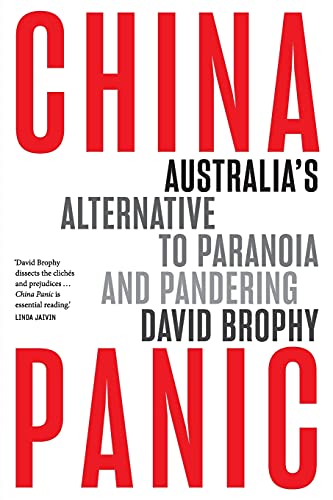
I don’t know what to think about China. I read Peter Hartcher and I see all those meticulously drilled soldiers parading in Tienanmen Square, and I feel very, very apprehensive. Then I read Hugh White or listen to Bob Carr or Paul Keating (albeit with increasing scepticism) and I think that we’re over-reacting. It seems that commentators on China have backed themselves into a particular position, and you almost know what they’re going to say before they start. And yet these commentators do not always come from the traditional left/right field. Clive Hamilton, for example, who is such a strong advocate for the environment and sustainability, is one of the most trenchant critics of China.
So who is David Brophy, and why should I listen to him over anyone else? He is a historian of modern Chinese history at the University of Sydney, and he wrote his PhD on Uyghur nationalism, and wrote UyghurNation. Increasingly he has found himself called upon to comment on current events in China, and was himself involved in demonstrations in support of Hong Kong at the University of Sydney in August 2019. Although I would by no means instantly give credibility to a historian over any other commentator, a historian is probably a little more likely to take a view longer than the last election, and has no party policy to conform with.
In China Panic, Brophy starts by identifing the different players in the China Commentary field. He points out that security agencies have led the way in Australia proclaiming itself ‘the canary in the coal mine’ regarding China’s rise. ASIO has taken on an increasingly public role, and the Australian Strategic Policy Institute has also talked up the risks. He notes that ASPI receives sponsorship from arms companies, and has received grants from Canberra and the US State Department. (p. 13). Then there are the parliamentary self-styled bipartisan Wolverines- Andrew Hastie, Eric Abetz, Kimberley Kitching (ALP), Raff Ciccone (ALP), James Patterson among others. Commentators more often found on the ‘left’ like Richard Denniss and Clive Hamilton,urge Australia to take a stronger role. Brophy points out that Fairfax Media and the ABC, in particular through ‘Four Corners’, have been major conduits for security warnings in relation to China.
But then there is Hugh White, who argues that as America’s pre-eminence wanes, Australia should accommodate China’s rise. The former secretary of the Department of Defence, Dennis Richardson warns that ‘national-security cowboys’ are endangering Australia’s interests. Angus Houston, chief of the ADF 2005-2011 maintains that China is a partner, not an enemy. (p. 15). The Australia-China Relations Institute at UTS continues to champion continued trade growth. Twiggy Forrest and the Minerals Council represent business that is keen to maintain trade links.
The book has eight chapters, which are topped-and-tailed with an introduction and conclusion. The chapters are: 1. China and the World 2. The US-China Rivalry Today 3. Influencing the Region 4. Interfering with Democracy 5. Cold-War Campus 6. Human Rights and Xinjian 7.The Battle for Hong Kong 8. Sovereignty, Values and Racism.
As you can see, this is a very current list. One of the dangers of writing a book so close to current situations is that events that have occurred subsequent to publication can change the trajectory of the argument. For example, the AUKUS agreement sees Australia very much throwing its hat into America’s ring, with all of the implications for our own sovereignty, all the while proclaiming that “it’s not about any one country!!” (as if).
So where does Brophy locate himself? As a historian of Uyghur nationalism he is, as you might expect, critical of Chinese policies in Xinjiang. As one of the convenors of the ‘Let’s Talk about Hong Kong’ Chinese-language forum at the University of Sydney, he is committed to providing a platform for debate and exchange amongst Chinese citizens in Australia themselves. However, he points out that Australia and America (in particular) hold China to international standards that they themselves hypocritically sidestep when it suits their purposes. In matters of undue political influence or academic freedom in Australia, he notes that curbs and oversight of these matters for all countries, not just China, would be of benefit to Australia’s democracy. He argues that the move to the Right in contemporary responses to China in Australia’s politics will only provoke a similarly nationalistic response from China. He suggests that instead, we need to live up to our profession of universal values (p. 20) and to strengthen our own democracy.
He concludes:
We need something very different. Not a politics that shies away from necessary criticism of China: that has no future in Australia. But we do need to remove today’s national-security lens and replace it with a more genuinely critical one. On that basis, Australia’s new consciousness of China as a global actor can still point to important truths about China itself, the global system of which it is a part and the deficiencies of Australian democracy…. We need an alternative that combines a vision of a better China with a vision of a better Australia.
p.230
I usually give a book a ‘rating’ but I feel at a loss here. I read the book precisely because I don’t know what to think, and I have no way of evaluating his material or mounting counter-arguments. But he says that the question is too important to leave to specialists. Instead,
…to get out of the rut into which Australia’s China debate has settled, we need to recentre it on the interests that ordinary people in Australia and across Asia share in both combating oppression and resisting warmongering.
p. 21
One of the more reassuring programs on China that I have seen recently was on Foreign Correspondent (yes, it’s on the ABC). Called China’s Future, it focussed on three young people who had rejected the expectations of their society, and the hopes of their parents, to choose a different future. One was a transgender young person involved in ‘Voguing’, a dance culture that started in New York in the 1980s queer scene. Another was a woman who had given up her career to return to organic farming in her home village, much to the disappointment of her mother. The third had been an editor with a renowned publishing house, but threw it in to become a shopkeeper with a small corner shop in the hutongs. While I wonder how they will fare in Xi Jinping’s increasingly interventionist society, there was something very human and relatable in their parents’ bewilderment at their children’s choices, set against their determination not to lose their relationship by rejecting them. Love, a future, safety, peace – things that ‘ordinary people’ crave. Perhaps this isn’t a bad place to start.




 The Resident Judge of Port Phillip