Category Archives: Book reviews

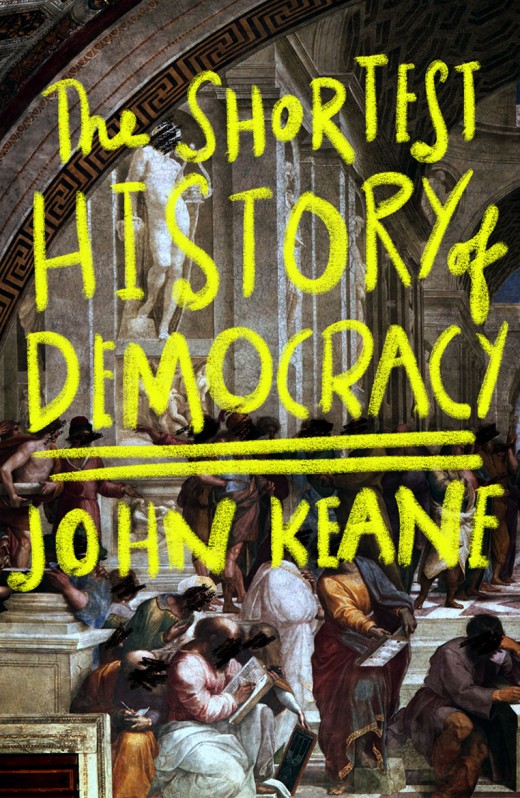
‘The Shortest History of Democracy’ by John Keane

2022, 240 p.

I must confess that this book would not have held much interest for me twenty years ago. But, although at the time I scoffed at Francis Fukuyama’s hubristic claim for ‘the end of history’, I would never have predicted that within thirty years we would see UK and US clutching at clowns, the rise of strong men across the globe and the bald-faced subversion and rejection of what had appeared to be stable democracies. I’m now more conscious of the contingency of democracy, and quite frankly, more fearful for its future. Suddenly, for me, this book is urgent reading.

Part of Black Inc’s ‘Shortest History’ series, this book is just what is claims to be- both short and a history- and although the last section took me from scepticism to despair, it does end with a claim for a radical democracy that can, perhaps, be “wisdom of global value”. This is a history that emphasizes change and contingency, upheavals and setbacks. As Keane notes in his introduction, “Democracy has no built-in guarantees of survival” (p. 6).

The structure of the book is foreshadowed by a very useful ‘Democracy’s Timeline’, where events drawn from across the globe flesh out the book’s three parts: The Age of Assembly Democracy; The Age of Electoral Democracy and The Age of Monitory Democracy. He starts off the book by debunking the misconception that democracy started in Ancient Greece. This idea, he says, was a 19th-century conceit, promulgated by people like George Grote, the English banker-scholar-politician who co-founded University College in London. Instead he looks back 2000 years earlier to early assemblies in Syria-Mesopotamia in 2500BCE, which were seen as an earthly imitation of the assemblies of the gods in a conflict-riven universe. The caravan routes spread the idea of assemblies to India by 1500 BCE, then on to the Myceneans and Phoenicians, taking root among the 200 Greek-speaking citizen states throughout the Mediterranean quite separately from its development in Athens by 507BCE. Not all these assemblies survived, falling victim to conquest, conspiracy or tyranny: threats that have always faced democracy. Although current day fans of direct democracy hark back to Athenian Greece, it too had a degree of deputation. There was a council of 500, for which every (male, free) citizen was eligible for a year’s service, and it in turn had a smaller group of 50 senators for day-to-day administration. As is often the way, those who were satisfied by assembly democracy rarely wrote about it, while the sources are replete with the criticisms of aristocrats with the leisure to write, who saw it as a form of mob rule. The depiction of ‘democracy’ as female that we see to this day in statues and demonstrations could have been a dig at the ‘female trickery’ of democracy. The dalliance of democracy and armed force proved fatal for Athens as a form of ‘democide’ – the self-destruction of democracy- that remains possible and indeed, is playing out, across the world today.

The narrative then jumps ahead 800 years to Electoral Democracy, landing in the 6th century CE with the birth of Islam where the practice of appointing wakil to handle distant legal, religious and commercial matters was customary. After Faroe Island and Icelandic assemblies in 930CE, there is a shift in the 12th century CE to the Atlantic region, starting with the birth of parliamentary assemblies in Northern Spain as a way for King Alfonso IX to gain the support of the nobles, bishops and money citizens to evict the Muslims. The timeline moves on to the Swiss cantons, the Magna Carta, and the British colonies in Virginia, the French Revolution, the Declaration of Independence, secret ballots and female suffrage. While this progression is noted, Keane does not dwell on any of them at length. Instead, he notes that representative democracy was seen as a territorial imperative in a large empire, and it was a way of keeping leadership on a leash. Most importantly, unlike assembly democracy, representative democracy recognized that social disagreements and conflicts were legitimate. “The people” was not a homogeneous body, and there was no longer an attempt to reach the ‘consensus’ of Athenian assembly democracy. There was always anxiety about ‘mob rule’ and universal suffrage, but this had abated by the early decades of the 20th century. Between World War I and II there was talk of ‘international democracy’ but this collapsed under the weight of war, influenza and the collapse of all continental empires. After 1918, hardly any European countries were blessed with governments that lasted longer than twelve months. Electoral democracy was destroyed by ‘purple tyranny’ (i.e. monarchs rolling back universal suffrage), military dictatorship and totalitarianism.

His third phase, Monitory Democracy dates from about 1945. In the wake of political catastrophe, war, dictatorship and totalitarianism, there was a realization that the fetish of elections and majority rule had to be broken, and a new commitment to democracy was understood as the protection of citizens from coercion, a celebration of diversity, a decrease in social inequality as well as free and fair elections. The crowning glory of the 1940s was the Universal Declaration of Human Rights.

By ‘monitory democracy’, he means

a form of democracy defined by the rapid growth of many new kinds of extra-parliamentary, power-scrutinizing mechanism: ‘guide dog’, ‘watchdog’ and ‘barking dog’ institutions…Within and outside states, independent and toothy watchdog bodies have begun to reshape the landscapes of power. By keeping corporations and elected governments, parties and politicians permanently on their toes, the new watchtowers question abuses of power, force governments and businesses to modify their agendas- and sometimes smother them in public disgrace.

p. 161, 162

The growth of monitory democracy was not inevitable. Despite Nelson Mandela, Nehru’s ‘Tryst with Destiny Speech,’ JFK’s Ich bin ein Berliner declaration, there were often setbacks. By the 1970s 1/3 of the worlds 32 functioning multiparty democracies that had existed in 1958 had become some kind of dictatorship (p.147).

Communication has always been fundamental to democracies. Assembly-based democracies relied on oral communication and messages by foot or by donkey. Electoral democracy required print, and indeed fell into crisis during the advent of early mass broadcasting media like radio. Fundamental to monitory democracy is the role of the multi-media as a way for citizens to track and resist the structures of power. Indeed, he asks, if the digital media ecosystem somehow collapsed, would monitory democracy survive? (personally, I doubt it).

At this point, drawing to the end of the book, he looks around at the health of democracy today. At first he strikes a rather optimistic pose. Even though we know about the manipulation of data, the distortions of algorithms, state surveillance and “other decadent trends”, he says, equally striking is the way that decadence, and the use of armed force breeds stiff public resistance. Environmental action has given the earth a voice again.

Democracy is redefined to mean a way of life that renders power publicly accountable through elected and unelected representative institutions in which humans and their biosphere are given equal footing

p. 181

At this point I found myself raising a skeptical eyebrow. Had the author not seen the kneecapping of climate action at COPs, most recently last year? What about January 6 in America? What about the blatant gerrymandering and attack on voter rights in US? What about the shadowy power of lobbyists? What about the rise of ‘sovereign citizen’ marches throughout the world? Had he not seen these things?

Ah yes- he had, as he goes on to talk about the fears for the fate of global democracy, the shift to executive rule and the use of gag orders and leak investigations, the appointment of heads of US government departments without legislative approval by Trump and the extended lockdowns enforced by governments during COVID. He notes the decline in commitment to democracy amongst younger generations. In India, the majority of citizens (53%) say that they would support military rule; in Latin America only 24% of people are happy with how democracy is working in their countries. New despotic regimes are arising in Turkey, Russia, Hungary, United Arab Emirates, Iran and China:

A new type of strong-armed state led by tough-minded rulers skilled in the arts of manipulating and meddling with people’s lives, marshalling their support and winning their conformity…They are masters of ‘phantom democracy’. They do all they can to camouflage the violence they use on those who refuse to conform. Using a combination of slick means, including calibrated coercion masked by balaclavas, disappearances and back-room torture, they manage to win the loyalty of sections of the middle classes, workers and the poor. They labour to nurture their willing subjects’ docility. Voluntary servitude is their thing. And they travel in packs. The new despotisms, led by a newly confident China, are skilled at navigating multilateral institutions to win business partners and do military deals well beyond the borders of the states they rule.

p. 189,190

So, he asks, what then are we to do? Should we just give in? He notes that it is not possible to retrieve and breath life into past justifications of democracy like Christianity, nationality, protection of private property and utilitarianism. Democracy doesn’t always bring peace (look at Israel) or “economic growth”.

Instead, he says, we need to reimagine democracy as the guardian of plurality, freed from the dictates of arrogant, predatory power (p. 195). We need to keep the problem of “abusive power” central to how we think about democracy. (Although at this point, I start thinking about vaccine mandates and those upside-down red Australian flags. Are there circumstances where coercion is justified? Where does the ‘sovereign citizen’ leave society?) But an emphasis on “abusive power”, he argues, is the shape-shifting power of democracy:

Thinking of democracy as a shape-shifting way of protecting humans and their biosphere against the corrupting effects of unaccountable power reveals its radical potential: the defiant insistence that people’s lives are never fixed, that all things, human and non-human are built on the shifting sands of space-time, and that no person or group, no matter how much power they hold, can be trusted permanently, in any context, to govern the lives of others…democracy shows us that no man or woman is perfect enough to rule unaccountably over their fellows, or the fragile lands and seas in which they dwell. Is that not wisdom of global value?

p. 197, p. 201

I must confess that, despite wanting to hold on to the optimism of his closing paragraph, I am still fearful, and am becoming increasingly so as I see COVID-related protests spreading around the world, drawing to themselves both conspiracy theorists and people who are deeply concerned about the over-reach of abusive power. I am grateful for another way of thinking about democracy, albeit an idealistic one, because I find myself backed up against a wall. In this book Keane takes a very long view, going back much further than Athenian democracy, and his three-part frame of analysis is useful for discussing democracy without getting bogged down in detail. The book is engagingly written, it even has illustrations, and it scoots along at pace. If one of the advantages of reading “the shortest history” of a concept is a brisk, informed analysis (as distinct from re-telling) and introducing a new way of scaffolding one’s thinking, then this one is well worth reading.

My rating: 8.5/10

Sourced from: Review copy from Black Inc.
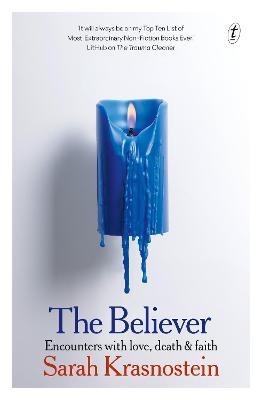
‘The Believer: Encounters with love, death & faith’ by Sarah Krasnostein

2021, 342 p

Sarah Krasnostein’s breakthrough book The Trauma Cleaner, the biography of the late Sandra Pankhurst was such a compelling telling of such a complex personality that it is Sandra, and not Sarah, who remains in my memory. But looking back on my own review, Krasnostein was obviously present in the narrative, something that I bridled against when I read it. In this most recent book of six different explorations on the nature of belief, I was very much aware of Krasnostein as journalist in what could, in a different configuration, be a series of six in-depth, long-form essays. Each one of them on its own merits is interesting, but I did find myself wishing that there was more integration and more of an overarching argument in the book. In the preface, Krasnostein writes:

You’re about to read six different stories, six different notes in the human song of longing for the unattainable. Their combination is the seventh note.

p.2

I’m not convinced that ‘combination’ in itself is a story, as such. Certainly the structuring of the text is very deliberate. The book is divided into two parts. Part I ‘Below’ is fronted with a quote W.H.Auden’s ‘The Hard Question’: And ghosts must do again what gives them pain. Part II ‘Above’ has an etymological description of the word ‘chord’, as both noun and verb.

Each of these two parts has three stories, but they do not appear one after the other but the narrative cycles from one episode to the next between them in turn. Extracting them from the intertwined narrative, the first story, ‘The Death Doula’ traces the involvement of a buddhist death doula Annie Whitlocke who is caring for Katrina, a bayside 59-year old woman who is dying of cancer. The second story, ‘Paranormal’, is where Krasnostein interviews and accompanies people who are looking for paranormal activity, some by sensation, others like Dr Vladimir Dubaj by looking for empirical evidence of the paranormal. The third story in Part I is ‘In the Beginning’, where Krasnostein visits the Creation Museum in Kentucky , the brainchild of Ken Ham, a former high school teacher from Queensland. He is the founder and CEO of Answers In Genesis, a fundamentalist evangelical ministry which reads the bible literally (including the ‘young earth’ creation theory that the universe was created 6000 years ago). These three stories appear in a regularly alternating structure throughout the 165 pages of Part I.

Part II (‘Above’) has three intertwined stories too. ‘Halfway Home’ tells the story of Lynn in America, imprisoned for thirty-four and a half years – half of her life- for arranging for the murder of her ex-husband who sought custody of his child. ‘Theories of Flight’ tells of Victorian pilot Fred Valentich who reported a mysterious craft and lights above his plane before it disappeared somewhere close to Cape Otway in October 1978. His disappearance, along with the sighting by many people of another unidentified craft in Westall in 1966 and the Roswell incident in 1947 (US), is still discussed and trawled through by ufologists whose meetings and lectures Krasnostein attends. In ‘The Kingdom of Heaven’, Krasnostein meets a community of Conservative Mennonites at the Light of Truth fellowship in New York, speaking mainly with the women whose conservative fundamentalist Christianity is more family-based than that of the Creation Museum in Part I. The structuring of these chapters is not as regular as in Part I, possibly because there is an imbalance in the length of the stories.

The book finishes with a Coda, which gives an update on ‘The Death Doula’, ‘Half Way Home’ and ‘The Kingdom of Heaven’. Interestingly, these stories were more centred on women, where her relationship with the ‘subjects’- is that the right word for her informants?- is closer.

Given that such care has been taken with the arrangement of this narrative, it behoves the reader to ask “does it work?” I don’t really know if much has been gained by this cutting and dicing, beyond what would have been achieved by a straight one-after-the-other narrative. At least in this book, the reader is provided with a table of contents, something sorely lacking in Michelle Tom’s even more disjointed Ten Thousand Aftershocks (my rather bad-tempered review here). It is possible to backtrack and find the earlier episodes if memory falters. I am nonplussed by the inclusion of ‘Half Way Home’, which is more a matter of putting one foot in front of the other, rather than a broader search for meaning. I found myself wondering if this story really belonged in a different book.

In her foreword, Krasnostein says that her book is about

certainty in the absence of knowledge; how the stories we tell ourselves to deal with the distance between the world as it is and as we’d like it to be can stunt or save us.

p.1

Of Jewish heritage herself, her impatience is most palpable in the two manifestations of Christian belief – the Creation Museum and the Mennonites – while she seems to be able to maintain a detached and still contingent scepticism for UFOs and the paranormal. She talks of ‘distance’, both psychological and objective, and it was this distance that attracted her to these stories in particular.

I didn’t set out to find these stories….In each case, I needed to understand them, these people I found unfathomable, holding fast to faith in ideas that went against the grain of more accepted realities. It may be accurate to say that I needed to get close to something, someone, that felt very far away. That I believed maybe I could.

One of the lies writers tell themselves is that all things should be understood.

p.2

I suspect that Krasnostein herself would admit that she has not been able to bridge this distance in each of these cases. Despite her involvement in the last days of Katrina’s life, the process and experience of death is still beyond her grasp, although she learns more about life from attending Katrina’s living-wake (i.e. Katrina herself attended, before she died) and the ceremony after her death. The religious believers remain beyond her understanding and sympathy; she is not sure about the UFOs or ghosts. She admits that she used to think of the world as a type of text, indexed and logically related, and “a faith that, if I could only ask the right questions, I could finally understand.”

To believe in the world as this type of text is to believe that all lives- regardless of whether they resolve happily- make sense. To have faith in context and causation. To insist that people for the most part are intelligibly coherent in the sense of being predictably inconsistent and that they are capable, within reasonable bounds of incredible insight and meaningful growth as they learn, painfully, to bend themselves around reality instead of expecting reality to miraculously bend itself around them.

To repeatedly believe this about people is, to borrow from Philip Roth, to be wrong. But at least it is also to be wrong about oneself. And what other choice do we have?

p.308

This is probably getting closer to my own belief about myself and the way the world works, and I’m not sure that it is as “wrong” as Roth proclaims. The title ‘The Believer’ could be applied to five of the six people she has interviewed and encountered here, but she and I alike question how much insight and growth some of them display, when the certainties are imposed from without rather than emerging from within. But the title could just as easily be applied to Krasnostein herself, as she tests out a ‘faith’ in human nature that Philip Roth (in all his typical bombast) declares to be wrong. And, as she says of this faith and the attempt to reach across distance, perhaps we have no other choice.

My rating: 7.5/10

Sourced from: Yarra Plenty Regional Library.

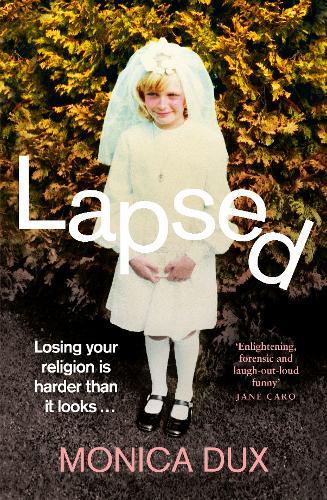
‘Lapsed’ by Monica Dux

2021, 352 p.

It seems rather strange to think back on it now, but there was a time when I wanted to be a nun. Inspired by The Sound of Music and with absolutely no experience of nuns at all, I wasn’t even Catholic, and indeed the only Catholics I knew were a family who lived down the street from us. It’s strange to think back now about how the world was so firmly divided into Catholic and Protestant. That division just seems to have dissolved, and Monica Dux’s memoir Lapsed goes some way to explaining why.

Dux was brought up in a Catholic household, with a Protestant father who had promised as a condition of marriage, to bring up his children as Catholics. She went to church each Sunday with her mother and brother; she played Jesus in an Easter play; she made her first communion; she attended Catholic schools. She thought that she had emerged intact from her Catholicism after long years of disengagement until her daughter, (rather like me all those years back) declared that she wanted to be Catholic. Dux herself didn’t want to go back to Catholicism, but did she have the right to deny her daughter the free selection of a faith? This forced her to revisit her childhood Catholicism, to observe as an adult the pressures and influences of Catholicism, and to belatedly question the effect that the sectarian divide had had on her extended family and thus, indirectly, a whole other life that she could have lived.

Some of the chapters are personal, revolving around her own suburban experience of 1960s Catholicism; others are more exploratory – unpacking, for example Jesus’ relationship with women in the bible and the role of Mary in Catholicism. Other chapters are angry, especially when revisiting the sexual abuse of children, something that causes Catholic families- including hers- to rethink some of the tragic trajectories of lives of siblings, cousins, and grandchildren, cruelled by such corrupt abuse of power. Her rejection of her Catholicism drifted from nonchalance and inertia to an active rejection, both personally and politically, fuelled by the Catholic churches’ own intervention into Capital P Politics, with the temperature turned up even higher by the Catholic Church’s own moral and legal failings. In many ways her uneasiness about her daughter’s sudden profession of faith caused her to peel back the layers of her own identity, highlighting that her Catholicism was (and to a certain extent, is) cultural rather than confessional. In rejecting her Catholicism, how could she disentangle it from memories, emotions, urges?

I enjoyed this book. As one might expect from a journalist who has a regular column in the Saturday Age, it is engagingly written with humour and insight. Despite its light touch, it has useful footnotes for specifically Catholic terminology and doctrine, and the endnotes reveal the research that lies behind the book, including journal articles interviews, newspaper articles and Vatican documents and Bible references. It is at its core a memoir of suburban Catholicism in an Australian 1960s society separated by the ravine of sectarianism. Even if it was not part of your own upbringing, there is much to recognize here.

I am drawn to books about searching for spiritual meaning but rather perversely, when an author proclaims that they have found it, I tend to reject them and their ‘solution’. I think that I am more attracted to the search than the destination, and I acknowledge that much of my spirituality (such as it is) revolves around capturing the cultural aspects of my former Anglicanism-but not my childhood flirtation with taking the veil!) , while standing on the firm ground of humanism, science, fact, beauty and optimism.

My rating: 8/10

Sourced from: purchased e-book

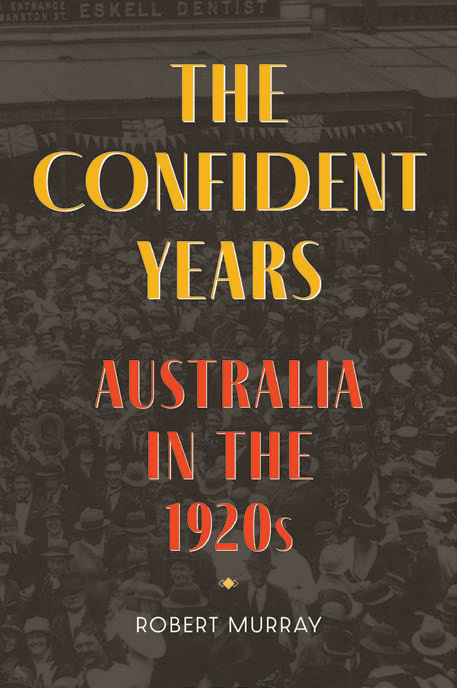
‘The Confident Years: Australia in the 1920s’ by Robert Murray

2020, 245 p.

One of the things that I do when I’m not reading, practising my Spanish or listening to podcasts about Rome, is work at my local Heidelberg Historical Society. Our newsletter, which is published every two months, has a feature called ‘A Hundred Years Ago’ which draws together items of local interest from the ‘Heidelberg News’ and, to a lesser extent, the major Melbourne newspapers through Trove. I’ve been writing this feature since 2015 so I’ve gone through the war, through the ‘Spanish’ flu, the commemoration of fallen soldiers and now I’m up to the 1920s. I’d like to know more. A local paper, by its nature, is full of quotidian events with a heavy emphasis on the civic and the worthy. Leaving aside the Bowling Club results and church socials, I’m finding myself interested in the emotional tenor of the times. With a title like ‘The Confident Years’, I was hoping that Robert Murray might unpack the mindset of the 1920s, but I found myself disappointed.

The book, reissued by Australian Scholarly Publishing in 2020 (no doubt with this centenary in mind), was originally published in 1978. This new edition is, as the author admits in his preface

varies little from the original, published in 1978, but has been slightly abridged or amended

p. vii

There are the occasional mentions of Gough Whitlam or Donald Trump as points of comparison, but I suspect that much of the text and certainly the bibliography is unchanged, with not a single book or article published after 1978.

It started well. In the opening chapter, Murray writes:

The 1920s, the decade that followed the war, have gone down in legend as gay and glittering. Relative to the years that preceded and followed them, this was certainly so. From the perspective of the 1970s, Australia’s 1920s were straitlaced, drab, and crushed in a narrowness of vision and stridency of statement. Yet for all the smothering smugness, it was also a time when the spaciousness and order of the nineteenth century merged almost felicitously into the freedom and affluence of the twentieth.

They were above all confident years, when reasonable people could believe- with from the late-century perspective, a quaint dogmatism of certainty- in nation and leaders, in socialism or free enterprise capitalism, religion or atheism. A world war had been won; during it the socialist revolution had won Russia, but had later been overthrown by counter-revolution elsewhere in Europe. This was just enough experience of what the young century had to offer to drive the imagination. The long years had yet to come when the world would live for more than two decades with the shadow or reality of depression and more world war, when not only capitalism and socialism but the very millenia-tried bastion of the Christian belief itself would eventually crumble almost discredited before new generations to whom disillusion seemed merely the way of things.

p.5

This is what I was looking for in this book, but I found that most of the book involved politics with a capital P and the machinations of political operatives on all sides. After an introductory chapter ‘Fit for Heroes’, there follow four chapters dealing with the Nationalist, Labor and Country parties (Ch. 2 The Political World of Billy Hughes; Ch.3 Post-War Labor; Ch. 4 The Big Fella and Chapter 6 Bruce-Page Australia). Chapter 5 inserts an analysis of the Big Boys of the press (Ch. 5 Packer, Murdoch, Fairfax and Co – how depressing that they are still household names a hundred years later) and Ch. 8 After the Bulletin looks at literature and theatre both on stage and screen. Chapter 9 Workers and Bosses looks at the strike activity particularly in the last years of the decade, and Chapter 10 Countdown to Catastrophe ushers in the Depression of the 1930s.

In these chapters, Murray is careful to pay attention to State politics as well as Federal politics, and he introduces male politicians of all stripes with potted biographies. There is a lot of politics squashed in here, as events and crises unfold and pass by.

My favourite chapter was Chapter 7 The Golden Years, which came closest to what I was looking for in the book. There are more women in this chapter although it, too, reads a little like an almanac even to the point of finishing with ‘A Miscellany of Australia’s Twenties’ containing observations that didn’t fit anywhere else. In his preface, Murray mentioned that he interviewed people who were alive during the 1920s, and this chapter- although I enjoyed it most of the whole book- had a bit of the ‘oral-histories’ about it.

This is the only book that I have found that focusses on the 1920s in Australia beyond those ‘So You Were Born in 1925’ type books in newsagents. In terms of capturing a mindset, I gained much more from Deirdre O’Connor’s Harlem Nights, and perhaps I am going to have to look at individual chapters in books about other themes that are less tied to a chronological period (e.g. Janet McCalman’s Journeyings; or Kirsten Otto’s Capital, both of which I have read previously) or fiction -especially newspaper fiction- of the time. I found myself wondering about my own time, a hundred years later, and whether a book about our 21st century ‘Twenties’ that focussed on Australian politics, technology and culture would capture what it is to live now. It would have to include those things of course, but they would not be sufficient. Perhaps I need to send Hugh Mackay back in a time machine to 1920 to measure the emotional climate for me.

Sourced from: State Library of Victoria as an e-book.

‘A Town Called Solace’ by Mary Lawson

2021, 288 p.

Had this book won the Booker Prize, all my fears about the dumbing down of the Booker would have been realized. As it is, it did not progress from the longlist, and that’s a good thing.

Not that there’s anything wrong with the book. Set in a small town Solace in 1970s Ontario, the narrative switches between three characters: Clara, Elizabeth and Liam. Eight year old Clara’s family is in crisis after Clara’s older sister Rose has left home and disappeared without trace. She stands vigil by the window, willing Rose to re-appear. Rose doesn’t, but instead she sees a car draw up at the house next door and a young man get out and let himself into the house. The owner of the house, Elizabeth Orchard, is in hospital and Clare has promised to feed the cat in her absence. Unknown to her, Elizabeth has died and left the house to Liam, the young man, who had been a neighbour of Elizabeth’s many years earlier. Many years earlier Elizabeth, unable to have children, had welcomed Liam into her house and come to love him as her own son. Liam had only re-established contact with Elizabeth in recent years, and was surprised that Elizabeth had left the home to him. His own marriage had just broken down, and so he moved up to Solace with the intention of selling the house and working out what to do next.

It’s a pleasant enough, holiday read: I read it in an afternoon, sitting on the back deck. All the ends are neatly tied up and it’s a slightly unsettling feel-good story, but it’s certainly not Booker material. A Women’s Weekly Good Read maybe. But surely not the Booker

My rating: 6/10

Sourced from: Yarra Plenty Regional Library

Read because: it was short-listed for the Booker Prize in 2021

‘A Gentleman in Moscow’ by Amor Towles

2018, 512 p.

Almost as satisfying as a ‘big house’ novel is a ‘big hotel’ novel, and we find one here in Amor Towles’ A Gentleman in Moscow. In the wake of the Bolshevik revolution, Count Alexander Ilyich Rostov was arrested on account of his noble background, complete with country estates, duels, troikas and sleighs. Normally such a man would be executed, but because of a revolutionary poem attributed to him, he was instead sentenced to house arrest at his residence at the Hotel Metropole, in the centre of Moscow.

He was rather unceremoniously bumped from his luxurious third-floor suite to a small room on the sixth floor in a scene reminiscent of Sara Crewe’s sudden change of circumstances in A Little Princess (a childhood favourite of mine). In what had become a series of scaling-downs, he chose his favourite pieces of furniture, personal luggage and books to shift upstairs with him, only to find himself suffocating in his own belongings until he discovered a hidden disused room which he could turn into a study. That was not all he discovered. Through his acquaintance with Nina, a young girl who often stayed at the Metropole, he became familiar with the hallways and basement rooms of the hotel, accessed through a small master key that Nina had somehow procured. Nina grew up, while Alexander stayed confined within the hotel, passing the days through a routine of frequenting, eating and drinking at the various restaurants and services provided through the hotel – the seamstress, the barber, the bar, the concierge’s desk. When Nina returned as an adult, with her small daughter Sofia in tow, she begged Alexander to look after the child while she followed her husband to Siberia, where he had been exiled. Of course, she did not return and Alexander, as a middle aged single man, became Sofia’s surrogate father as she joined him in his exile in the centre of Moscow.

The narrative unfolds chronologically, and the history of twentieth-century Russia is a background hum as Stalin accrues more power, famine ravages the country, World War ensues and then Russia and America settle into Cold War hostility. These events of course have an effect on the hotel, as informants are planted within the staff and individual fortunes rise and fall, but it is a muted effect. The hotel had been a luxury destination prior to the Revolution, and as new men find themselves moving into positions of power and influence, they are happy to avail themselves of the faded splendour of the hotel, just as the powerful, but now fallen, men had done before them.

Alexander remained remarkably tranquil in the face of these very reduced circumstances. He still had access to money, and the breadth of mind that a wealthy and cultured background had brought him, and so his life continued on much as it had before, except within the walls of the hotel. The staff of the hotel remained much the same as well. Alexander himself became one of the staff although the deference remained. Montaigne’s essays were a bulky nuisance in his small rooms, but he seems to imbibe a sense of equanimity from them that allows him to float above the changes occurring outside.

The book is told in the voice of an observant, dry omniscient third-person narrator. I found myself laughing out loud in places, and the book is suffused with a 19th-century sepia, redolent of wax and cigar smoke. I enjoyed it very much, and when the pace picked up considerably at the end, I felt satisfied that the author had created a self-contained, almost fairy-tale world of basically good people where good is rewarded in the end.

My rating: 8/10

Sourced from: purchased e-book.

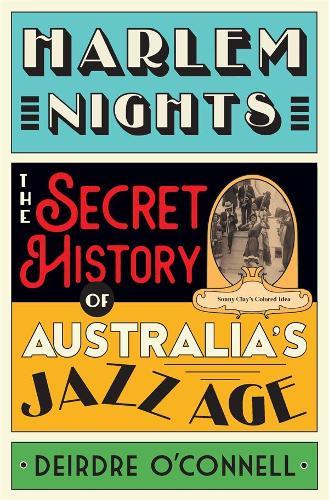
‘Harlem Nights: The Secret History of Australia’s Jazz Age’ by Deirdre O’Connell

2021, 314 p. plus notes

On the 19th January 1928, the SS Sierra drew into Circular Quay. On board were seventeen members of the Colored Idea, an all-black Jazz revue comprising dancers, comedians, vocalists and musicians. On the dock, there was a placard advertising them erected by the Tivoli Theatre and, on deck, technicians from Radio 2FC strung microphones to broadcast the Sonny Clay Orchestra as they played ‘Australian Stomp’. As the members of the Sonny Clay Orchestra made their way onto the street, they were photographed by the waiting press, the editor of a popular film magazine, and a group of young female jazz fans. But on 31 March 1928, the Colored Idea were back at Circular Quay on the SS Sierra. There were press photographers this time too, and two dozen or so ‘smartly dressed’ young women, some ‘coloured’ and some White. This time the Colored Idea were deported, overseen by a number of customs officers who were under instructions to intervene should ‘difficulty’ arise. It didn’t. Several of the jazzmen lined up on the ship’s deck rail, tossed streamers and called to the well-wishes on the dock. Then they were gone.

Harlem Nights is the story of the Sydney and Melbourne legs of the Colored Idea’s Australian tour, but it is much more than that. It is the story of the international rise of African-American jazz; White Australia and what Marilyn Lake and Henry Reynolds have called ‘The Global Colour Line’; anxieties over the rise of the ‘girl’; media and celebrity; right-wing politics, and police corruption.

SPOILER ALERT

The book is divided into 12 parts, each comprising 3-5 short chapters. This would ordinarily make a rather choppy history, but in this case a peppy first paragraph of each chapter breathes interest back into the narrative, making it a very approachable and accessible read. There are black-and-white images throughout the text, many of which are drawn from newspaper accounts, emphasizing that much of the action took place in the public realm, although the real power was obscured.

Part 1 ‘Tijuana Nights in Phoenix and Los Angeles’ takes place in America and focuses on Sonny Clay, the leader and business manager of the Colored Idea. His family was originally from Texas, but he grew up in Arizona. As racial tensions mounted there, he shuttled to and fro across the Mexican border, playing with his jazz band in Tijuana where the dancers acclaimed their hot jazz and raw rhythms (p.18). He joined ‘Jelly Roll’ Morton’s band, then arrived in Los Angeles in early 1922. He poached players from The Black and Tan orchestra to join his Eccentric Harmony Six. He played the ‘colored jazz bandleader’ in dozens of films as part of what Black observers at the time called ‘Negro vogue’, an affection for what ‘chic’ White people imagined was ‘Negro’. (p. 30) By 1925, in yet another iteration, his band was now Sonny Clay’s Rhythm Demons, with a regular 7.00 p.m slot at Radio KFl, playing at the Plantation Cafe.

Sonny Clay’s life embodied the liminal slippages of Jazz Age America. By the mid 1920s, he had more money and influence than respectable Black citizens felt he deserved; wore sharper suits and mixed with more powerful people than White unions could stomach and played much with more rhythm than melody, enticing a public to dance with more freedom than grace. This was not racial advancement in the steady, diligent, God-fearing sense of the word, but it was impressive, extravagant and spectacular.

p.40

Part II ‘In California with Harry Muller’ introduces us to Harry Muller, the West Coast theatre agent for JC Williamson company, scouring California’s vaudeville theatres for acts to bring across to Tivoli Theatre venues in Australia. The Australian moving picture industry in 1925 was a small but highly lucrative market, but live vaudeville acts and dance contests could supplement the short-comings of celluloid jazz. The ‘idea’ format involved a short, sharp burst of live entertainment, usually before the celluloid feature. There had been Black American performers in Australia before: the Georgia Minstrels had come to Sydney in 1877, the Fisk Jubilee Singers travelled throughout Australia in the 1880s, Jack Johnson had fought in the boxing ring. Comedians, jubilee singers and dance troupes toured Australia, but not dance band musicians. This was largely because of opposition from the Musicians’ Union of Australia, but a variety theatre act fell outside the jurisdiction of the musician’s union. In organizing the tour, Harry Muller was careful to fudge the difference between ‘coloured theatrical artists’ and ‘musicians’, but as he sailed into Sydney Cove with Sonny Clay’s Colored Idea, he did not explain these nuances, or the increasingly rigid White Australia policy to Sonny Clay or his band members.

Part III ‘Rattlin’ Fine Sydney’ introduces Gayne Dexter, who was there on the dock at Sydney waiting for them. The editor of the film industry magazine Everyones, he publicized the arrival of the Colored Idea on the “Jazz Ship”. Twice daily, he travelled to the Tivoli’s flagship theatre in Haymarket to hear Sonny Clay’s Plantation Orchestra as part of the ‘idea’ format. Through his magazine he promoted a modernity that was anaethema to ‘highbrow’ cultural bodies or those who only accepted ‘Negro’ jazz if it drew on ‘minstrel’ tropes. The musicians performed 2 shows daily, six days a week which was a comparative vacation compared to their schedules in American entertainment houses. They had apartments in Kings Cross, close to Woolloomooloo, where a cluster of Aboriginal families and ‘coloured Britishers’ lived. The tabloid newspapers reported ‘warmth’ and ‘affection’ between the dance band musicians and a few ‘coloured women’. In her chapter ‘American Boomerang’ O’Connell tries to identify these ‘coloured women’ but has not been able to do so. Besides, the attention of the Commonwealth Investigation Branch was not on the ‘coloured women’ but more concerned about the visiting jazzmen consorting with White women.

This plays out in Part IV ‘Views of Commonwealth Policy’. Major Longfield Lloyd was head of the NSW division of the Commonwealth Investigation Branch, military hero from Gallipoli, a friend of former prime minister William Morris (Billy) Hughes and prosecutor of the war against the ‘Communists’ on the waterfront. In February 1928 he penned a confidential report into the ‘Negro Orchestra’ after monitoring their Darlinghurst Road flat. It was written in the atmosphere of a crusade against the ‘Black Menace’, headed by Ezra Norton, the owner of Truth newspaper, a national network of scandal-mongering tabloids. When the Colored Idea opened on 20th February at Melbourne’s Tivoli Theatre, Major Lloyd encouraged his Victorian counterpart to continue investigation into the band. Lloyd’s report was handed on to General Thomas Blamey, another former military commander and now Victoria’s commissioner of police.

Part V ‘The Making of Modern Melbourne’ shifts its attention to Melbourne. The Green Mill Dance Hall, managed by Tom Carlyon, was on the banks of the Yarra River at the southern end of Princes Bridge. By day it was a roller-skating rink and velodrome but by night it featured dance marathons and the Film Star Quest, a beauty pageant and nationwide search for a ‘girl’ with motion picture possibilities. Carlyon engaged the Colored Idea for a week at the end of the Tivoli Run, arousing the hostility of the Musician Union’s federal secretary Cecil Trevelyan.

Trevalyan’s involvement is explored further in Part VI ‘Keeping Orchestras British’. A man of shady background, he was strongly patriotic, seeing the Australian nation and the British Empire as indivisible, and White Australia as a blueprint for maintaining a culture of ‘Britishness’. He was hostile to all American players, both White and Black, possibly as a response to what he perceived as the shoddy treatment of the Australian Commonwealth Band by the American Musician Union. He had the support of former PM and now disgrunted backbencher Billy Hughes, with whom he met on 15 March.

Part VII Petty Sessions takes us to Rowena Mansions in Nicholson Street East Melbourne. Ready to pounce was Constable Les Saker, part of the plainclothes squad handpicked by Police Commissioner General Thomas Blamey. He was a familiar face in Truth newspaper, and a reliable police source for its stories. The media needed its police sources, but they would dry up if the media turned its attention to police corruption which was rife in the ‘vice’ economy. For several nights, Constable Saker and a journalist from the Truth monitored movements in and out of the Rowena Mansions apartment. On a rainy Saturday night, they finally made their move on the upper floor apartment, arresting Edna Langdon ( a finalist in the Film Star Quest at the Green Mill), Nola Mackay, Ivy Day, Dorothy Davis and Dorothy McGowan. Another girl, Irene McCulloch escaped the raid on the downstairs flat by fleeing through the window. Both she and Ivy Davy (real name Dorothy Anderson) were likely to have been stool pigeons. The Rowena Mansions Five were bailed, and Sonny Clay (who was not present) was woken with the news that his bandsmen had openly associated with White female fans- thus dragging his name into the press pile-on.

Part VIII ‘Idle and Disorderly’ starts with the Eight Hour Day parade, with the Musicians’ Union Gift Band leading the procession. By the time the procession had crossed Princes Bridge, Tom Carlyon had cancelled the upcoming season of the Sonny Clay Orchestra at the Green Mill. On Tuesday 27 March, the Rowena Mansions girls appeared at Melbourne City Court, charged with vagrancy. They were defended by Nathaniel Sonenburg who was familiar with and suspicious of Constable Staker and Dunn’s police methods. Despite his distaste for the girls’ lifestyle, he proved that the evidence lacked substance, and that no cases of ‘indecency’ were committed. Nonetheless a wave of moral indignation arose in White Australia, which was obsessed by interracial sex involving White women and non-White men (a blind eye was turned to White men’s violence against Indigenous women).

Part IX ‘Unwritten Law’ sees Sonny Clay on the platform at Sydney Central Station defending his band against the aspersions levelled against them. It was a ‘frame up from start to finish’ he asserted; they had not broken any laws. Their only public support came from the two or three unidentified ‘coloured women’ from Sydney that they had met a few weeks earlier. He finished his impromptu press conference accusing the Musician’s Union of orchestrating the raid. As he moved up to the concourse of Central Station, he was greeted by several hundred White men. Cameras clicked, but only one protestor was photographed, a disheveled, toothless demonstrator. Otherwise they were faceless vigilantes. Who were these men? Who arranged for them to be there? Two senior figures had the resources to assemble a formidable force on call: Police Commissioner Thomas Blamey and Investigation Branch chief Major Longfield Lloyd. Irregular militia activity was becoming increasingly active against ‘coloured immigration’. But vigilantism was not necessary once the bureaucracy moved in. The following week, entertainment and sporting promoters received new procedures concerning the entry of ‘coloured theatrical performers or vaudeville artists’. Applications needed to be made in advance, with credentials testifying to the musician’s general good character: a character test that no ‘coloured musician’ would be able to pass.

How high up did this go? Part X ‘Purification Rites’ turns its attention to the Right Honourable William Morris Hughes. On 28 March, the day after the court case and on the same day that 200 faceless White men stood on the Central Station Concourse, he made an unscheduled appearance at the Nationalist Party’s annual conference. In words echoed in 2001 by John Howard, Hughes announced “This bit of earth belongs to us! It is for us to say who shall come in and who shall not come in!”. It was a stance that Hughes had been championing over in America during the preceding February on a speaking tour organized by the English Speaking Union (I heard O’Connell describing this segment in more detail at the recent AHA conference). This stance was not just at the level of Federal and international politics. Angela Booth, a moral purity crusader, had been on the magistrates bench at the trial of the Rowena Mansions Five. Some saw her as a wowser: others saw her as a modern woman versed in the latest scientific research into miscegenation and vice. The Argus deplored the actions of ‘white girls’ who ‘forget what is due to their racial origin’ (p. 269). The Bulletin called for more censorship; the YWCA launched a ‘Building up our Girls’ campaign, the National Council of Women renewed calls for more policewomen to patrol the streets, railway stations and dance halls. Meanwhile, the Rowena Mansions Five were subjected to further surveillance and oversight.

Part XI ‘On Their Way’ follows up on one of the five women, Edna Langdon, at a Broken Hill dance endurance competition, the 1930’s world wide craze featured in ‘They Shoot Horses Don’t They’. By this time the Sonny Clay orchestra was long gone.

Part XII ‘The Quarantine Blues ‘ traces through Sonny Clay’s career back in America, and the stifling of jazz music in Australia. The Australian government only welcomed Black acts that evoked the cotton fields and days of slavery (p. 301). White vigilantism increased, with the bombing of a West Melbourne boarding house where Italian migrants lived, bombing of the Greek Club and other attacks against Southern Europeans in Melbourne, Sydney and North Queensland. Music and dancing retreated into ‘old fogey’ dances. Meanwhile, overseas, Swing was recognized as the ‘musical fashion of the hour’ and Duke Ellington lionized over his 1933 tour of England. Not in Australia. Bookshops were closed; the Weinstraubs Syncopators, a dance and cabaret act from Weimar Germany were interned; Eugene Goosens was hounded from the country. Despite the Booker T club established in Sydney during WWII for Black GIs, the Musician’s Union prohibition on ‘coloured’ members and the government’s ‘character’ test remained. The Union did not revoke the ‘no coloured’ rule until 1954 and a wave of tours of Black performers followed. What had Australia missed out on in all that time?

As you can tell from this rather lengthy summary, this book ranges much further than just a group of musicians on a quay. It is a densely knitted weave of event and context, but written with a lightness of touch that belies the weight of its analysis and research. In her acknowledgements, she mentions John O’Brien’s expertise in screenwriting which “helped draw out the narrative”, and indeed it is her light tap on the accelerator at the start of each chapter that propels the narrative forward – so much so that I felt compelled to put a ‘spoiler’ warning on this post- something that I rarely do for a history text. At times she would start with an anecdote that seemed to be only oblique to the main story, but she would double back to stitch it into the main narrative. The text switches effortlessly between description and analysis, and the lengthy biography and detailed footnotes testify to the academic rigour underlying the narrative. It is excellent.

I had heard of the deportation of Sonny Clay’s orchestra previously: during my postgraduate sessions at La Trobe University, a fellow doctoral student – Kyla Cassells gave a paper on it. I’m aware of increasing interest in the New Guard and the White Army movements of the 1930s at the moment (probably reflecting current fears 100 years later). I’m no fan of Billy Hughes, and all I know of Thomas Blamey is his statue near Government House in Melbourne but I didn’t realize how ruthless and entrenched their conservatism was. It has certainly woken my interest in 1920s Australia, when so many political, spiritual, cultural, military and sexual movements contested against each other. This book tells us so much about those years. There is a strong throb of anger at the racism implicit in the White Australia Policy, but also a yearning regret for a modern, progressive Australia that was suffocated at birth with events like the deportation of Sonny Clay’s Colored Orchestra and the persecution of the ‘girls’ who dared to embrace the modernity offered by a new century.

My rating: 9.5/10

Sourced from: Yarra Plenty Regional Library.

Other reviews: Lisa at ANZLitLovers reveals some of her other ‘off-duty’ interests in her very good review of Harlem Nights.

‘From Where I Fell’ by Susan Johnson

2021, 338 p

Epistolary novels have gone in and out of fashion, but they have probably had a resurgence with the advent of email which facilitates a to-and-fro unheard of since the decline of two-deliveries-per-day mail services. I do find myself wondering, though, how many of these email correspondences will survive into the future as mailboxes get culled, email programs are superseded and internet providers change. As with photographs, we have so much digital ‘stuff’ but little of it is treasured and put aside for the future. Nonetheless, I find a rather guilty pleasure in reading epistolary novels – as if I am eavesdropping on a conversation or snooping through someone’s mail – although, of course, these novels are deliberate creations among fictional characters, intended to be read.

The correspondence between Pamela and Chris happens by accident. At 11.10 on the night of her eldest son’s birthday Pamela sends an email to her ex-husband Christophe in Paris, full of guilt and regrets. Unsure of her husband’s email address, she sends it to ‘Chrisxwoods’ at both Hotmail and Gmail. The next day she receives an email from Chrisanthi Woods, from Schenectady, New York, telling her that she has the wrong email address and wishing her luck and hoping that things work out. The relationship starts off rather shyly and tentatively, but right from the start there is an information imbalance, with Pamela over-sharing: “Oh dear- I suppose I do pour out my heart to strangers”. Chris’ responses, however, are rather crisp and abrupt. Chris is older than Pamela, sixty-four years of age, working at SUNY in student enrolments. If characters in one book could invade other books, I had in mind Elizabeth Strout’s Olive Kitteridge– a rather brusque, snippy woman largely oblivious to the effect that she has on other people.

Pamela, on the other hand, is 51 years old and works in a library. She has her three sons living with her, but the oldest, Raf (Raphael) is obviously angry and lashing out, while she tends to baby the youngest, Baps. She feels that she is lacking all authority with Raf and Claude (the middle son), who fight constantly. She complains about the children at length, until Chris snaps

For Christ’s sake, Pamela, why did you have children if you weren’t prepared to surrender? Everyone says people who don’t have children are selfish. I think it’s people having children for no good reason who are the selfish ones. I’m not sure we should keep emailing each other. My heart is banging so hard I feel like I’m having a heart attack. This isn’t good for me. Bye, Pamela

p.67

There is a three week cooling-off, but Pamela keeps going apologizing, complaining, over-sharing. Again, Chris baulks:

Don’t you get sick of talking about yourself all the time?

p.83

Chris later apologizes, recognizing that she had been “mean” and that Pamela caught her on a bad day. They call each other Plato and Socrates but I’m not sure that a great deal of learning is taking place. The correspondence starts again, still one-sided but Chris begins talking about her elderly mother’s plans to return to Greece, her attempts to help a Syrian family and her spurned offer of assistance to a friend. Chris seems to be an awkward and at times clumsy helper, with definite views on how things should be done but at times she cuts through Pamela’s wordiness with no-nonsense advice. It takes a long time until Chris divulges more of her own life.

Two middle-aged women, on different sides of the globe, with very different life experiences. Never catching sight of each other, never in each other’s space. There’s not a lot to work with here, but Johnson manages to develop characters who have an identity beyond the written word. It’s a curiously engaging book, despite little actually happening.The end, when it comes, was unexpected. Catching sight of the book the morning after I had finished it, I felt regretful that they had both moved beyond me.

My rating: 8.5/10

Sourced from: Yarra Plenty Regional Library.

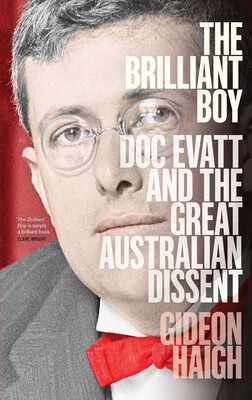
‘The Brilliant Boy: Doc Evatt and the Great Australian Dissent’ by Gideon Haigh

2021, 384 p.

Very clever title, this one. There are two ‘brilliant boys’ in this book. One is only seven years old, and one afternoon in 1937 he disappears into a badly-fenced trench from which he is dragged, lifeless, some time later. The youngest child of a family of Polish emigrants, Maxie Chester was his mother’s ‘brilliant boy’. The other is ‘Doc’ Evatt: prize-winning student, lawyer, judge, attorney-general, leader of the Opposition for the Labor Party, and President of the United Nations General Assembly. In this book, Gideon Haigh brings the two together in an analysis of the court case Chester v the Council of the Municipality of Waverley (1939) where Evatt issued a poignantly written dissenting judgement that revealed his humanity and erudition. This book is the story of this case, interwoven into a biography of Evatt himself.

So what was so significant about this case? It was a High Court case which had been escalated as part of an appeal against the original findings, not so much about the facts of the drowning, but over whether the council’s duty of care extended to Maxie Chester’s mother Golda as well. As Haigh points out,

Dissents, a minority opinion at odds with the majority view of an appellate court, are a judicial tradition with roots 400 years deep. They are partly an artefact of legal individualism- the freelance life of the Bar instills habits of working alone… the Supreme Court has reserved an honoured place for its ‘Great Dissenters’ and their great dissents…

Dissents fall, broadly, into two categories: the kind written simply as an opinion that turns out not to be shared by colleagues, and the kind self-consciously composed to stand on its own…Evatt’s in Chester fits unapologetically into the later category

p.272, 273

Evatt’s dissent was six times the length of the average judgment of the 1930s. He writes clearly – almost journalistically- setting out the about the trench, the children playing in the streets, young Maxie, his mother. When you read his dissent against the judgments of the other judges, they seem particularly brusque and abstract. Evatt, on the other hand, imagined himself into the situation, and called upon the Lost Child trope that has run so deep in Australian culture. He quoted from literature, not Shakespeare or Ruskin but from Australian literature, in the form of Joseph Furphy’s Such is Life, bringing Golda Chester’s suffering “into the range of normal human Australian responses” (p.281). His prose

with its long sentences and sometimes complex constructions, never scintillates, but it is muscular, rigorous, pungent. Through the patina of judicial restraint, a fine fury can be felt…If the concepts are occasionally abstruse, Evatt’s reasoning is seldom obscure. He finds ways at each point to relate them to everyday understandings…It is the use of literature, of course, that affords the judgment such accessibility and reach. It is possible, in fact, to read Evatt’s judgement in Chester not just as dissenting a major view in this case, but dissenting a majority view of judicial writing and legal thinking casting only backwards and sideways. Law insisting that harm required lesions and lacerations ignored the march of science. Law incapable of acknowledging something so fundamental as maternal love was at odds with the humanity it purported to serve.

292,293

I’m not sure if, taken over the whole length of Evatt’s life, the Chester case was the most important one on which he ruled. Nor am I sure that it is a particularly significant case in Australian law. But in a way, that is not important. Haigh is a writer, more than he is a judicial biographer or historian, and he hangs his broader professional and political biography on the Chester case as part of shaping the narrative, as a creative act in re-reading and re-presenting a man’s life.

Like others of a progressive leaning, I was appalled by Donald Trump’s bare-faced stacking of the U.S. Supreme Court with conservative judges. But I have to admit that Evatt’s appointment to the Australian High Court was a prime example of stacking as well. Evatt was a politician, a High Court judge, a politician and then a judge again as Chief Justice of the NSW Supreme Court, ping-ponging between politics and the judiciary to an extent that I’m not aware of occurring today. Indeed, had it occurred before Evatt either? I’m not sure.

Haigh highlights Evatt’s precocity and brilliance, and his involvement in the progressive cultural life in Australia at the time. As a progressive lawyer, he admired H.B.Higgins and was part of the literary network that had the Vance and Nettie Palmer (Higgins’ niece) at its heart. His artistic interests led him to the Heide network and to become the champion of modernist art, pointedly in opposition to his political foe Robert Menzies. He was a historian, although his philosophy of history appears particularly bombastic and rigid to me, loftily pronouncing that lawyers had a unique faculty for pronouncing on history, being ‘skilled in the actual science of legal investigations’ (p. 176.). He wrote on William Bligh in Rum Rebellion and also of the Royal Prerogative, the subject of his PhD thesis that led to his nickname ‘Doc’ and which was expounded in his 1936 book The King and His Dominion Governors. Some forty years later an erstwhile legal colleague, by then knighted as Sir John Kerr, was to pore over it in 1977 when weighing up options to dismiss the Whitlam government. Evatt’s intellect was broad ranging and intense, isolating him from many of his more quotidian Labor Party colleagues but also empowering him to circulate at the highest judicial and political levels when he visited the United States. As Haigh notes, he was egotistical, self-interested and ambitious, as well as imbued with a life-long sense of social justice, not just as a principle but as something to be enacted, with him playing a part himself in the formation of liberal and human policies.

There’s a lot of law in this book, and Haigh does wander at times into tangentially-related cases as part of painting a picture of how the law grappled with issues of negligence, trauma and technological change. As part of a High Court bench and as puisne judge, Evatt was just one member of different triads of judges hearing appeal cases. As in many judicial bureaucracies, there were jealousies and rivalries in a competitive milieu of sharp intellects and long-game ambitions.

There’s a lot of politics too: the chronological fortunes of the Labor Party at national and state level, the clash of political personas, the historical significance of cases in which he participated (as in the defence of Egon Kisch) the interpersonal snarling politics of judges amongst themselves and the opening up of international politics post WWII with the creation of the United Nations.

Haigh walks around his subject, viewing him from multiple perspectives: student, husband, father, legal practitioner, politician, international diplomat, historian and public intellectual. As a work of biography, it is masterful in cracking the humanity in the Chester case – both the poignancy of Maxie’s death and the humanity of Evatt’s response to it – and using that case as the fulcrum on which Haigh balances other perspectives of a public life. Haigh has not written this as a history, even though history is woven throughout it, and I found myself ruing the absence of an index – something that I think undersells Haigh’s work and the diligence of the reader.

I’ve read my share of judicial biography, and this book stands apart in the roundedness of its approach. It acknowledges Evatt’s flawed genius and locates the man and his work within the political and judicial currents running at the time. It’s very good.

My rating: 9/10

Sourced from: Yarra Plenty Regional Library

‘My Year of Living Vulnerably’ by Rick Morton

2021, 297 p.

I don’t really know what I expected from this book, a follow-up from Morton’s very successful One Hundred Years of Dirt, which I reviewed here. After all, not many of us have a very interesting ‘what-happened-next’ story that can be told while it is unfolding around us. He couldn’t just rewrite the last book, and, as he admits:

I’ve written about my family before, in my debut book One Hundred Years of Dirt, but spent so much energy focused on everyone else’s trauma that I never noticed my own.

p.6

In this book, he picks up on his trauma, formally diagnosed in early 2019, but manifested through a five year mental breakdown, in spite of multiple attempts and strategies to save his sanity. In those five years, he came to understand that his meltdowns were triggered when his close, straight, male friends established a relationship with a woman. Then his complex PTSD would emerge, a trauma that he traced to being left on a remote pastoral property as a child, while his father embarked on an affair with the governess. That little boy, watching, shut down and became an absence, and under stress the adult Rick Morton would shut down too.

It always happens the same way. The moment I find out my friend is seeing someone it is as if the world goes blurry. I can feel myself leave my own body. There is ringing in my ears and a sensation that has no equal in daily life but what I can only describe as 100,000 ants marching up from my feet along the length of my nervous system, nesting in my chest. It is the most agonizing type of fear where death itself feels imminent….Trauma is not a memory. It is a Broadway production of the first hurt, a leg-kicking, show-stopping conflagration of the mind and body that needs no remembering. It is the thing. Each and every time.

p.9,10

However, in the midst of his flailing during 2015, the year when he lost his grip, his closest (female) friend hugged him and apologized for never telling him that she loved him. He started telling other people that he loved them too and it was “as if the colour had begun to run back into my world from the top of the frame, pooling at the bottom around the moss-covered rocks on one of my infrequent bush walks. “(p.11)

It was not, of course, a cure but a “renaissance of tiny joy” (p.12) but it did give him permission to do the work required to get better. This book is a series of essays on this work, each chapter named with a single concept: Touch, The Self, Forgiveness, Animals, Beauty, Masculinity, Loneliness, Kindness, Dysfunction, Doubt, Next, Beginnings. As with One Hundred Years of Dirt, there are times when he writes ‘journalistically’ with the dispassion of the intellect, and in the next paragraph divulges an intimate event or observation. His choice of topics could be schmaltzy and twee, or patronizing, but there is enough self-deprecation to bring his lofty pronouncements back to earth and to stop the book sliding into a self-help manual.

I will admit that this book isn’t what I expected it to be. It’s far more gentle and human than that. Having said that, though, I don’t know that there’s much more to be mined from this genre, and I doubt if he would want to anyway. It’s not a final destination; it’s just steps along the way. Not ‘cured’ – how pretentious and premature that would be- but ‘better’.

My rating: 8/10

Sourced from: Yarra Plenty Regional Library