Category Archives: Biography

Uplifting Quotes for the Uninspired Historian #16

To live over other people’s lives is nothing unless we live over their perceptions, live over the growth , the change, the varying intensity of the same – since it was by these things they themselves lived.

Henry James, William Wetmore Story and his Friends 1903

Leon Edel used this quote as an epigraph to the first volume of his Life of Henry James.  To be honest, I can’t actually find it in the online versions of William Wetmore Story.  Still, interesting quote…..

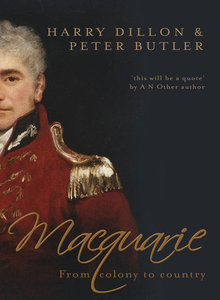
‘Macquarie: From colony to country’ by Harry Dillon and Peter Butler

macquarie

2010, 329 p.

Probably my first introduction to historic argument, as distinct from historic narrative and fact, came in HSC Australian History (yes, I am old enough that it was HSC and not VCE and young enough that it was no longer ‘matric’.)  There I was feeling all soft and fuzzy over Macquarie when along came that nasty Bigge character.  But was it as simple as this? For the first time I realized that historians- Manning Clarke, Ellis, Ritchie- could have a different take on the same event, and that you could talk about historians’ arguments and set them up against each other,  rather than just relate what happened.

And there I was nearly 40 years later, reading another book on Macquarie, nicely timed with my trip to Sydney in December last year.  It evoked a whiff of the goodies-and-baddies sense of history, and Macquarie is definitely in the goodies camp in this book.  It’s a very readable account of Macquarie’s time in New South Wales and his contribution to the shift from ‘New South Wales’ to the entity of ‘Australia’.

The authors argue that Macquarie was the victim of a mismatch between the intended use of New South Wales as both penal settlement and free colony.  His position at the head of a penal colony gave him autocratic powers but he used them to make opportunities for ex-convicts, rather than the elite- which was pretty much the expectation at the time.  He was, at heart, a military man, which expressed itself through his authoritarianism and brittle response to criticism.  The authors emphasize his Scots background as a motivating factor, and indeed call him the ‘laird’ throughout, arguing that his policies sprang from a paternalist mindset.  I’m not convinced that ‘laird’ is the right imagery, and it’s not something that Macquarie himself claimed.  The book is written from a very Australian-centred perspective, and I think that the depiction of the Colonial Office would have benefited from a fuller empire-wide analysis. As it is, the goodies/baddies dichotomy is a little too simple.

Although the biographical details of the authors links them with Charles Sturt University, they both have a background in journalism, and I think that this comes through in the book, which is eminently readable.  They have been granted all the publishing features on a historians’ wishlist- footnotes (not all that many) AND a bibliography (what luxury!), index, and source list for the illustrations.  Many other much more academic tomes than this one are often short-changed in this regard.

I was attracted to read this book after a brief browse at the ‘reduced’ table in my uni book shop. I noted that the book started with a chapter highlighting the heritage of Macquarie today, followed by a chapter that had him returning home ‘under a cloud’.  It then reverted to a more conventional biography, ending with a 2010 visit to his ancestral home.  I’m interested in the way that historians structure biography at the moment, hoping to break out of a strictly chronological form for my own thesis, and so I was interested to see how this worked as a reader.  I think it did, in that it had a pleasing sense of symmetry and that the bookend chapters allowed an argument to be mounted in what is, essentially, narrative history.

‘The Galts: A Canadian Odyssey’ by H. B. Timothy

1977, 175 p.

Well, now that I’ve read a book written by John Galt about Canada, an autobiography by John Galt, and now finally this biography of him, I’ve got to admit that the biography wins hands down.  It’s set me off wondering about the relationship between autobiography and biography, especially when considering a literary figure, as John Galt is.  I can only think of two other cases where I’ve read a writer’s autobiography followed by a biography penned by another person: Janet Frames Angel at my Table trilogy  paired with Michael King’s Wrestling with the Angel, and Patrick White’s Flaws in the Glass paired with David Marr’s Patrick White: A Life.  In terms of feeling that I understood the character, the biography trumped the autobiography each time, no matter how beautifully or incisively the self-penned work was written.

Am I surprised by this? I don’t know. The autobiography of a writer, by its very nature, will be framed by the author’s own self-image and imbued with a literary sensibility and becomes  source material itself for the biographer, as well as a work in its own right.  The biographer can challenge, contextualize and interrogate the self that is portrayed by the autobiographer, bringing the questions, perspectives and judgments of the outsider in a way that the autobiographer cannot. The autobiography is undertaken at a particular time of a life not yet fully lived- not on the deathbed as a rule!- and the biographer can know things to which the autobiographer is oblivious or blind.

This biography of the author John Galt is written by a Canadian academic who brings with him the nationalist agenda of claiming Galt as part of a significant Canadian family dynasty, even though John Galt (1779-1839) spent only a small proportion of his life in Canada itself, and  he set relatively few of his books there.  As a result, the author privileges Galt’s experience with Canada as a lobbyist and Canada Company promoter and administrator over his identity as a literary figure.  I’m interested in Galt’s Canadian connection, too, so even though Galt in his autobiography sees Canada as just one thread of his life story,  I’m glad that H. B. Timothy has teased it out in this way.

One of the things that I have been grappling with in dealing with my own research interest (Justice John Walpole Willis) is cracking through the brittle, rather volatile early-Victorian masculinity that is displayed by both men, cloaked in obsequious language and intellectual self-possession.  While living in Upper Canada Willis and Galt became friends, for whatever reason, and they obviously recognized some commonality between themselves.  The autobiography, because it emerges from such a  brittle, rather volatile man, exemplifies this sensibility but it does not interrogate it.  The biography is able to do so somewhat more easily.

Then there is the knowledge of subsequent events and broader context that a latter-day biographer can bring as well: the ‘unknown unknowns’ if we want to get all Donald Rumsfeldian about it.  In this case, Timothy suggests that there was an element of set-up at play: that members of the Established Church back in England acted in the interests of Anglican Church interests in Upper Canada in engineering Galt’s financial downfall (is ‘conspired’ too strong a word?).  He explores the possibility that Maitland and the Family Compact elite had Galt under surveillance even before he set foot in Canada, and that his links with people active in politics to the embarrassment of the administration rendered him suspect from the start.  If so, there’s an element of rather touching, unwitting naivete  about the autobiography because of his unawareness of these larger political forces at work.  This rather tragic edge enhances the autobiography, rather than working to its detriment.

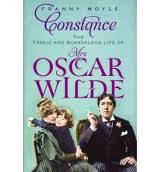
‘Constance: The Tragic and Scandalous Life of Mrs Oscar Wilde’ by Franny Moyle

2011, 328 p

Look carefully at the cover of this book, because in many ways the cover sums up the challenge of writing this book.  Constance (Mrs Wilde) has often been relegated to a bit part in the much more flamboyant story of Oscar Wilde.  This biography is about her, in her own right, but even in the marketing of it, the name ‘Oscar Wilde’ dominates.  Look, too, at the picture of the family.  It is actually two photographs combined.  The photograph of Constance with her older  son, Cyril, was taken in 1889.  While it is a charming photograph, I was chilled throughout the book by the favourism that both Constance and Oscar showered on Cyril, at the expense of his younger brother Vyvyan who was about three at the time this photograph was taken.  It was, indeed, as if they had only the one child. Then, to the right of this artificially-compiled family portrait, is Oscar. I suspect (although I admit to not being absolutely sure) that this photograph was taken in 1892 .  If so, by this time, Oscar and Constance’s marriage was already under strain, with Oscar already enmeshed with Robbie Ross and he had already met, and been smitten with Bosie.

However, Constance did not linger at home alone in the shadows, as this book shows.  When she married Oscar, they formed what we would now call a celebrity couple, noted for their radical aesthetic tastes and pre-Raphaelite sensibilities.  Constance was a striking beauty.  She too wrote stories, and she was well-known for her adherence to the principles of the bohemian Rational Dress Society.  She had a number of strong female friendships, particularly with older women, and she thought nothing of packing her children off to stay with others- particularly the less-favoured Vyvyan- and vacationing with friends for months at a time.  Like many other late 19th century men and particularly women, she was attracted to Theosophy and spiritualism.  Moyle draws heavily on the correspondence between Constance and her brother Otto, and to her close friend Lady Mount-Temple with whom she often stayed.  Oscar is, of course, mentioned in these letters, but they are written to her own friends and relatives, not Oscar’s.

We all well know about the court case and Wilde’s imprisonment.  It’s well-trodden territory and yet Moyle is still bewildered by Constance’s easy encouragement of Wilde’s friendships with men, and again by Oscar’s erratic behaviour after his release from jail, especially in demanding money from Constance who had already been more than generous.  Moyle’s sympathies are very much with Constance, who despite changing her own and her children’s surname to “Holland” continued to love Oscar after his conviction, visited him in jail, and was equivocal about divorcing him although she gained a judicial separation from him eventually.  She died in April 1898 following surgery, anecdotally on her spine although it may have been gynecological, at the age of 42 and just over a year after Oscar had been released from prison.

The book cleared up one thing for me.  In Stephen Fry’s film ‘Wilde’ (and was ever a man born to play a part as this?), Oscar is shown visiting Constance’s grave on which is engraved ‘Wife of Oscar Wilde’. I commented while watching at the time that it was a brave statement to make, given Wilde’s broken reputation at the time.  In reality, Constance’s grave originally made no such claim.  It read instead ‘Here rests in peace Constance Mary, daughter of Horace Lloyd Q.C.’.  The inscription ‘Wife of Oscar Wilde’ was added in 1963 by her brother’s descendants.  I have mixed feelings about it, and I wonder how she would have felt about the omission in the first place, and its reinstatement many years later.

My rating: 8.5 /10

Sourced from: Yarra Plenty Regional Library

Read because: It interested me.

National Biography (?) Awards

I notice that the longlist for the National Biography Awards has been announced.

  • Robyn Arianrhod Seduced by Logic, University of QLD Press
  • Tim Bonyhady Good Living Street: The Fortunes of My Viennese Family, Allen & Unwin
  • Alexander Brown Michael Kirby: Paradoxes & Principles, The Federation Press
  • Pamela Burton From Moree to Mabo: The Mary Gaudron Story, UWA Publishing
  • Sophie Cunningham Melbourne, NewSouth Publishing
  • Delia Falconer Sydney, NewSouth Publishing
  • John Howard Lazarus Rising, Harper Collins
  • Paul Kelly How to Make Gravy, Penguin
  • Mark McKenna An Eye for Eternity: The Life of Manning Clark, Melbourne University Publishing
  • Martin Thomas The Many Worlds of R.H. Mathews: In Search of an Australian Anthropologist, Allen & Unwin
  • David Walker Not Dark Yet, Giramondo Publishing
  • Patrick Wilcken, Claude Levi-Strauss, Bloomsbury

I’m interested by the inclusion of the Sydney and Melbourne books.  There has been a trend over recent years of writing ‘biographies’ of inanimate objects (think Mark Kurlanky’s Cod and Salt) and locations (think Ackroyd’s London: A Biography).

I see that the guidelines for the award specify that the work be “classified as either biography, autobiography or memoir; be written in book form and consist of a minimum length of 50,000 words”.  I haven’t read either the Melbourne or the Sydney book, but I do know that both have a heavy emphasis on memoir, as well as a more factual approach to the two cities.

Still- an interesting inclusion for a biography award.

Uplifting Quotes for the Uninspired Historian #12: Hazel Rowley

I was saddened to read that Hazel Rowley died in March this year. It’s timely that I should write this post aware that the French department of the University of Adelaide is hosting a day-long tribute to her this coming Saturday 19th November. One of the  conundrums of the internet is the status of a website of a person who has died. Should it be left as it was? Does updating it somehow detract from its integrity, or does it honour the person’s ongoing relevance? Hazel Rowley’s website has been taken down this route by her sister.

I enjoyed reading Rowley’s 2007 LaTrobe University/Australian Book Review lecture “The Ups The Downs: My Life as a Biographer”, which is available on the ABR archives page (you’ll need to scroll down almost to the bottom of the page).  Once again, I haven’t actually read any of the biographies she has written, but this comment about the art of writing biography struck a chord with me:

Biographers carry a big responsibility.  They have someone’s life in their hands.  What’s unjust is that, if you read a dull biography, you come away thinking that person’s life was dull.  In reality it’s almost never the life that’s the problem; it’s the narration.  No wonder people are wary of biographers.  It’s hard enough to die; we don’t want some dullard turning our lives into insipid gruel.

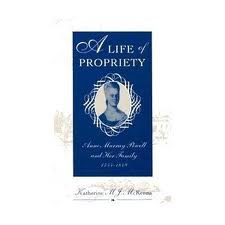
‘A Life of Propriety’ by Katherine M. J. McKenna

Katherine M.J. McKenna A Life of Propriety: Anne Murray Powell and her Family 1755-1849 , Montreal & Kingston, McGill-Queen’s University Press, 1994 , 260 p. & notes

Judges’ wives don’t tend to get much of a look-in in the judicial biographies written about their husbands. As you might expect, in such books the emphasis is on the judge and his interactions on the bench and amongst his judicial peers and government officials.  The wife and children- if they are acknowledged at all- tend to cluster off-stage in the folds of the curtains.

Not so in this book, which consciously focuses on Anna Murray Powell, the wife of  Chief Justice William Dummer Powell, of the Kings Bench Upper Canada. It was her husband’s position that gave Anna Powell her own prominence within York (Toronto) society, but I suspect that she would have been the subject of biography in any event.  The Powell family were prolific letter-writers, and more importantly, the letters were saved and now are scattered between archives in Ottawa, Toronto, Boston, New York and Washington.  Anne herself generated about 2,500 pages of letters alone, written over a span of 50 years, most particularly to her brother George Murray in New York.  These are rich letters for the social historian- full of family news and waspish commentary about York society- and they provide a solid basis for a study of Anna Powell and her family in her own right, not just as the wife of the Chief Justice.

Anna Murray Powell was born in Wells, England in 1755 to parents of a middle class background.  She emigrated at the age of 16 with her Aunt Elizabeth, who had herself emigrated to the New World at the age of thirteen and established a thriving millinery business in Boston.  On a trip back ‘home’, Aunt Elizabeth was horrified by the new ideals of middle-class female domesticity becoming popular in England, which did not sit well with her own ideas about female independence and business activity.  She did not have children of her own, and as seemed to be common at the time, ‘adopted’ her nieces and brought them back to Boston to manage her business.  What might have been a good solid business experience for a young man was greeted by Anne and her sister with reluctance and resentment.  She was mortified by working in ‘trade’ and she carried this sensitivity about her pre-marriage working life throughout her life, and indeed it may have contributed directly to the stiff-necked and inflexible ‘propriety’ that she demanded of her family, and all other York inhabitants in her social circle.

The book is divided into four parts. Part I ‘Learning and Living the Lessons of Propriety’ is largely biographical, tracing Anne’s childhood and adolescence, prolific childbearing years (nine births) and her establishment of her status within York society.  The narrative then bifurcates into a gender-based analysis of her family relations.  Part II ‘The Intersections of Male and Female Gender Roles’ examines Anne’s relationship with the men in the family: husband, brothers and sons.  Part III ‘The Transmission of Female Gender Roles’ examines education, marriage and childbirth within women’s lives in Upper Canada, and closes with a fascinating analysis of the lives of her three daughters.  Part IV ‘Conclusion’ deals with her life as widow and elderly matriarch- an aspect of women’s lives that is often dismissed in a few sentences- a life-stage which, as we (I) embark on an increasingly-lengthened old age will probably attract more historical scrutiny than it may have received in the past.

The book draws heavily on Barbara Welter’s 1966 article ‘The Cult of True Womanhood’ (American Quarterly, 18, 1966 p.151-74), a fairly dated article for such a recent book, and a choice that was questioned by several of the reviewers I have read.  McKenna cites Davidoff and Hall’s Family Fortunes, but it is the True Womanhood trope that she returns to most often.

Despite Anne’s strict insistence on ‘propriety’ and her incorporation of it into her own identity, you have to admit that her children were a bit of a disappointment.  The ‘good’ sons tended to die tragically, leaving the family with the duds.  Among her daughters, there was one ‘good’ daughter who trumped her mother in the fertility stakes, popping out ten children in an alarming succession. Another daughter remained the unmarried maiden aunt, a companion to her mother and built-in helpmate to her spawning sister.  The most fascinating chapter was that concerning the ‘unnatural’ daughter, Anne Murray Powell Junior.  It is  a very nineteenth-century take on the difficulties with parenting a wilful and troubled adolescent daughter.  The story of Anne Jnr.’s infatuation with John Beverley Robinson, the future attorney-general, has been told by other historians, but I suspect not with the sensitivity that McKenna brings to the situation.  It all ends tragically, and although the expectations and language of these unyielding 19th ‘pillars of society’ in their treatment of their daughter might not sit well with us today, the experience of parenting, loving, and losing transcends these differences.

Anne Murray Powell’s voice through her letters to her family is strong, censorious and inflexible.  Her letters are laced with a religious sentimentality which does not quite cover the snippiness, complaint and smugness that she expresses in almost the same breath.  Through the richness of the family archive, and through McKenna’s own insightful treatment, you feel as if you have been in the presence of a formidable woman.  I think I prefer her at a distance.

Sourced from : La Trobe University Library

Read because: it’s set in York at a time very close to my own research interest.


Uplifting Quotes for the Uninspired Historian #9

Not a historian this time but one of my favourite fiction writers, and not so much uplifting as interesting.  It’s the late Carol Shields from a short story I read last night called Collision. She’s talking about biography, not as a genre or literary construct, but as the live experience that we all accumulate around ourselves just through the act of being and living:

The only law of biography is that everything, every particle, must be saved.  The earth is alight with it, awash with it, scoured by it, made clumsy and burnished by its steady accretion… That’s the worst of it: there’s nothing selective about biography’s raw data, no sorting machine, no briny episodes underlined in yellow pencil or provided with bristling asterisks- it’s all here, the sweepings and the leavings, the most trivial personal events encoded with history.  Biography- it sniffs it out, snorts it up… (p. 315)

…Written biography, that’s another matter, quite another matter! Memoirs, journals, diaries. Works of the biog-imagination are as biodegradable as orange peels.  Out they go. Pssst- they blast themselves to vapor, cleaner and blonder than the steam from a spotless kettle.  Nothing sticks but the impulse to get it down. (p.316)

From ‘Collision’, Carol Shields The Collected Stories


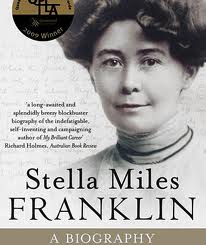
‘Stella Miles Franklin: A Biography’ by Jill Roe

569 p. plus notes, 2008

(4.5 /5)

Miles Franklin, to the extent that she is known at all today, is  probably most famous for the film of her book My Brilliant Career and for the Miles Franklin literary award that bears her name.  Jill Roe has been working on Miles Franklin for many years and this long biography- all 700 odd pages of it including notes-  will probably be the definitive biography for many years.

The first thing to notice is the title: Stella Miles Franklin.  The writer we know as Miles Franklin was called by her first name, Stella, by her family and friends.  Although in the body of the text Roe calls her “Miles”, the title clearly marks out that this is not a literary biography alone but an examination of her life in its many facets: as daughter and sister, as labour activist,  office worker and friend- as well as writer.

The second thing to notice is how little of the book – the first hundred odd pages only- deals with the writing and publication of ‘My Brilliant Career’, for which she is probably best known today.  Once I turned to Part II of the book, I wondered how on earth Roe was going to sustain this biography for the succeeding 450 pages.   She did it largely by following Miles’ career across the span of her life:  in America as a women’s labour organizer between 1906- 1915,   then following Miles to England where she worked in a stultifying job as admin support for a Housing reform authority, nursed in the Balkans during World War I, moved back and forth between Australia and UK before finally returning to Australia in 1933 to live out her final years before her death in 1954.   I think that Roe is firmly making the point here that the whole of a life matters: as a ‘woman of certain age’ herself Roe is not content to shove Franklin’s  later years into a perfunctory final chapter before dispatching her unceremoniously.

Franklin’s bequest of money for the literary prize that bears her name comes almost as a surprise at the end of the biography.  Miles lived alone and frugally in the family home and it surprised many that her 8922 pound estate had been squirreled away for a literary prize awarded to “the Novel for the year which is of the highest literary merit and which must present Australian Life in any of its phases“.   Australian commentators, writers and readers have often chafed under what now seems a rather jingoistic, dated and parochial restriction, but having read this biography I am now more aware of and sympathetic to what Franklin probably hoped to encourage: a publishing industry more independent of British and American publishing houses and  an appreciation of a literature that rings true to Australian experience and consciousness.  As Roe points out,  there are no national eligibility criteria so that, conceivably, the prize could be awarded to a non-Australian writer for a work that was published outside Australia.  This, too, reflects Franklins’ priorities- that Australia and Australian life that should be rendered realistically (she was no fan of modernism or Americanization) , and that Australian writers and Australian themes take their place amongst world literature as a whole.

The bequest was not Miles Franklin’s only gift to her country.  Her other gift was a huge archive of her correspondence which eventually numbered at least 10,000 items from 1000 or more correspondents , diaries and manuscripts, collected over a lifetime.  It is here that we see her rich intellectual life in the admittedly small Australian literary culture and  her involvement with politics both in Australia and overseas.  Her association with communist writers like Jean Devanny and Katharine Susannah Prichard brought her to the attention of ASIO during the Cold War, but she was also associated through friendship, but not politics, with the uncomfortably right-wing views of P.R. Stephensen and his Australia First movement.  Miles herself was neither communist nor fascist, being more aligned with  traditional post WWI British Liberalism.  Franklin herself expressed fears of Asian immigration and over-breeding in a political stance that makes me shift uneasily today.  As Roe explains, she was a first-wave feminist, steeped in ideas of moral purity, and as part of the ‘Australian girl’ trope of the first decades of the 19th century, claimed the suffrage and Australia’s relative progressiveness as part of her own identity as an Australian working in American women’s and radical organizations in the US. Through her correspondence and hospitality she fed, and fed on, camaraderie with fellow writers and their circle- Nettie Palmer, Dymphna Cusack and Florence James,  David Miller, Katharine Susannah Prichard etc- but she was wary and defensive amongst academics and academia.

Miles Franklin’s own identity, her “essential self” as she put it, centred around being a writer and indeed, writing was work that she carried out throughout her life.  I was unaware just how much there was, often dusted off and recycled, in the hopes of publication under yet another guise or as often unsuccessful entries for a string of literary prizes.   This approach to her work partially explains her insistence on nom-de-plumes, most notably Brent of Bin Bin, but also more risible pseudonyms (like ‘William Blake’, or ‘Mr and Mrs Ogniblat L’Artsau’)  which came to be viewed more as a form of eccentricity than, as she intended, literary commercial savvy.  Much of this work remains unpublished- often for good reason as Roe suggests- although much of it attracts me as an historian:  she went ‘undercover’ as a domestic servant in the early 1900s and wrote about her experiences, and her novels set during WWII sound interesting from a social history point of view.  But much of her work sounds (admittedly only from Roe’s summaries of the unpublished manuscripts) overly melodramatic, self-referential and repetitive and perhaps best left in the archive.

Roe approaches this work more as historian than literary biographer, focussing on the act of writing and what it meant to Miles and her milieu, rather than the texts themselves.  She has mined the huge Franklin archive exhaustively (an archive now supplemented even further by later purchases) and she represents it in its entirety, perhaps to the detriment of her biography overall.  To Roe’s credit, she provided enough background information about Miles’ friends and contacts for the book to veer away from mere name-dropping, but it is a narrow line.  It is a huge, detailed biography but I found myself enjoying most the parts where Roe stepped back with her historian’s hat on to explain, for example, the demographic phenomenon of the single female in the 19th and 20th centuries, and the nuances of first-wave feminism and its approach to men and marriage.   I can’t imagine that other scholars will be able to top the detail of this biography, but their interpretations may differ.

Further reading:

The State Library of New South Wales presented an exhibition on Miles Franklin Miles Franklin: A Brilliant Career? and the exhibition catalogue, including photographs, has been archived here.

See also ANZLitLover’s review of the book, and a review by Nicole Moore in The Australian

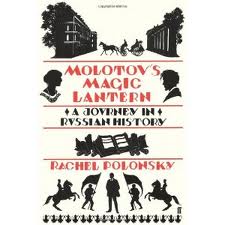
‘Molotov’s Magic Lantern: A Journey in Russian History’ by Rachel Polonsky

Rachel Polonsky Molotov’s Magic Lantern: A Journey in Russian History, London, Faber and Faber, 2010, 369 p.

One of my fellow students is writing a thesis about the status of family history and genealogy  within historiography more generally.  Is the  distinction always clearcut? I wonder.  After all, there are historians who write books that,  while not academic histories as such, combine elements of family history and broader history (Henry Reynolds’ Why Weren’t We Told? and Anne Summers The Lost Mother spring to mind).  In fact, just today I read a fascinating study by Cassandra Pybus of the negro ‘Commodore’ of Port Jackson (see citation below) where Pybus pursues, and  then interrogates, all those archival minutiae that are the family historian’s quest.  Richard Holmes’ Footsteps of a Romantic Biographer, which I enjoyed so much and have cited so often,  is a long reflection on methodology, arranged through the device of a journey.  Then  there are those popular historians/journalists who write books that combine history and travel (Simon Winchester Outposts, Bill Bryson even?).

So when I read a  glowing review of Rachel Polonsky’s  recent book Molotov’s Magic Lantern: A Journey in Russian History, I snapped it up.  Rachel Polonsky, Rachel Polonsky- where have I heard that name?  Then I remembered: she was involved in the recent academic brouhaha over Orlando Figes and Amazon reviews- see her perspective here.

Two personal libraries are the pillars of this book.  One of them was the library owned by Molotov, kept intact and largely untouched  (more through inertia than intent) in his apartment at the Romotov Lane building,  where Rachel Polonsky herself lived in while she was in Moscow many years later.

‘Have at it,’ the banker had said in his charming smoky drawl, dangling from one finger the keys to his apartment.  He had rung our doorbell early as he passed on his way down the stairs. ‘You’re the scholar, you’ll know what to make of it all.’

We had met the evening before at his welcome-to-Moscow party in one of the other Romotov apartments.  Over my champagne and his Jack Daniel’s, I told him, in my fumbling way, that I was some kind of fugitive academic, not really a journalist, working on a novel.. (p. 1)

…Our conversation picked up animation when he told me about Molotov’s library.  I already knew that the apartment he had moved into (immediately above our won) had been the Moscow home, in the last years of his long life, of Stalin’s most loyal surviving henchman. I did not know that some of Molotov’s possessions had remained in place- left there by the granddaughter who now let the apartment to international financiers- including hundreds of books, some inscribed to him or annotated in his hand, now apparently forgotten, in the lower shelves of closed bookcases in a back corridor. (p. 2)

And there it was- Molotov’s wood-paneled library- with a magic lantern in the corner that, when you cranked the handle, showed a succession of slide images; a carpet from the Shah of Iran on the floor, and books, books- some with the pages left uncut;  some inscribed to him; others underlined and annotated.

The second library was that of the Russian scholar, Edward Sands, who died a few weeks before the author took up her Cambridge fellowship.  He had died intestate, and not knowing what to do with the chaos of books and papers piled in his room among old shoes and half-empty medicine bottles, the bursar asked her to sort through them, working out which should go to the university library, and which should be given or thrown away. (p. 6)  Three years later, her husband called her from Moscow, encouraging her to join him.  She told herself and the fellowship that she would be back after a spell of 18 months working in the great libraries of Moscow and studying orientalism in Russian poetry.  Her eighteen months became ten years.  (p. 10)

These two libraries, then, are the foundations on which the book rests.  In her travels throughout the streets of Moscow,  down around the sea of Azov, up to the Finland border and across to Siberia and the Mongolian border, she reflects back on the  books and authors represented on the shelves of these two libraries.  There are many of them, but some are repeated again and again: Mandelstam, Akhmatova, Chekov, Dostoevsky, Pushkin, Shalamov, Marina Tsvetaeva.   Events and historical figures appear and re-appear as well: Molotov himself, Stalin, Lenin, Napoleon Bonaparte, Peter the Great, Tsar Alexander I, Catherine the Great- and with a burst of currency, Putin, Medvedev and the assassinated journalist Anna Politskovskaya.  Underpinning all this, like a ghastly merry-go-round tune is the repetition of repression, exile, and cruelty, repeated by the Cossacks, the Tsars, the Bolsheviks, Stalin- and she suggests, Putin too.  The reference of the rotating magic lantern in the title is apt- people and events flash before our eyes, disappear, only to reappear again later.

There are many, many names of people and places and Polonsky has supported her readers as much as she could with clear maps and a generous index. Ah- but there are so many names and I felt as if I needed to be taken up to the linchpin ones,  formally introduced to them and told “Remember this person- she’s going to be important”.   Unlike  more journalistic travel books (e.g. the Winchesters and Brysons), Polonsky did not give a rationale for the journeys she undertook, and so there was a sort of aimlessness to the book.  It could have been three chapters longer: it could have been three chapters less- the end came because she chose to end it there, but the journey itself did not demand it.

Her final chapter, however, does bring it all together.  By the end of the book, I realised that names and stories had become familiar, almost without my being aware of it.  I’m not particularly well-versed in Russian literature: I find myself becoming anxious over the profusion of characters and the similarity and length of the names, and this same concern that perhaps I’m not ‘getting it’ did steal over me at times with this book. But I closed it with a feeling that the deficit lay more in me than my guide, and I was sorry to leave my perceptive, erudite travelling companion.

References:

Cassandra Pybus ‘ The Old Commodore: A Transnational Life’   in Desley Deacon, Penny Russell and Angela Woollacott (eds) Transnational Ties: Australian Lives in the World, ANU e-press, 2008 available online at the publisher’s website [It has nothing at all to do with Russia, but it’s a fascinating read!]