Category Archives: Australian Women’s Writing

‘My Father’s Moon’ by Elizabeth Jolley

I have to admit to not being a fan of Elizabeth Jolley.  I know that she’s highly thought of:  a good reading friend whose reading judgement I trust  (and who is probably reading this post!) very much likes her. So why do I find her so off-putting?

I’ve really tried: I’ve read several of her books but find myself being repelled by the mustiness and acidity of her female characters.  They’re like a prickly heavy British overcoat: they’re like Hetty Wainthrop and Hyacinth Bucket; like a whiskery old Aunt.  Even in the books set in present time (given that she stopped writing about ten years ago), there’s a dissonance about these characters, as if they are out of time.   Her novels are often set in Australia, but there seems to be an innate Britishness about them.

I’ve seen her described as “disturbing” and perhaps this is what I’m alluding to, but I’m never really quite sure whether Jolley’s writing is deliberately subversive and edgy.  I think her dialogue is often wooden- or does that reflect the awkwardness of the characters she’s describing?  I think that her books seem to jerk around without a strong narrative thread- or is she being very clever and post-modern?  Is it bad writing?  Or good writing?  I really don’t know.

That said, I’ve enjoyed My Father’s Moon more than the other works I’ve read.  It is set in London during WW II, and for me this gives the book a unity and integrity that I can’t find in her other books.  The characters act, and feel, like 1940s characters in 1940s times.  The book is written in a number of first-person, self-contained chapters but there’s not a clear narrative arc in the way they are placed:  events happen and the reader works on making the causal and chronological links, because Jolley doesn’t.   Again- is this clever writing, or lazy?

I often sense steel in Jolley’s writing, but there’s a vulnerability in the writing in My Father’s Moon.   There’s an unresolved yearning to touch and be touched by other female friendships, and a sense of distance and apartness.  Perhaps these same qualities are there in her other books as well, because there’s a strong autobiographical element repeated in many of her works.  But I think I find it less repellent in a younger woman, coming of age in a time further back,  in a British world of London streets and air raids and prickly woollen overcoats.
‘Addition’ by Toni Jordan

Grace Lisa Vandenburg is an unemployed teacher on sick leave after a breakdown triggered by a young boy’s accident in the schoolyard.  But Grace’s problems lie deeper than this: she counts obsessively and incessantly, as a way of trying to control her world and all around her.  Into this ordered and tense life comes Seamus, who is attracted to her humour and quickness, and steers her towards therapy and medication as a way of overcoming her obsessiveness.  We lose our perky, wisecracking, passionate and controlled narrator as the medication submerges her into a slow, passive inertia. Will she lose the medication or lose her man? Or both?

This is all the stuff of good chick-lit, in this case bolstered by clever use of narrative to reveal the personality change that Grace undergoes as a result of her medication.  In this regard, it reminded me of Daniel Keye’s short story Flowers for Algernon, which was picked up as the film ‘Charly’.  I think that this use of narrative voice to denote change is one of the real strengths of the book, along with a main character who is not just sassy but also sees the world quite differently.  The book also introduced me to Nikola Tesla, a Croatian engineer who was likewise driven by the need to count, but for him it ended in madness.  The book explores the often narrow line between habit and obsession;  routine and ritual; self control and control of others; passivity and strength; eccentricity and madness.  In these regards, it steps out of the chicklit genre into something more complex.

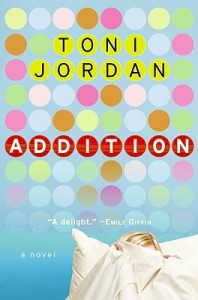
But Toni Jordan has not been served well by her publishers, methinks.  There are several versions of the front cover, and none really does justice to a book that is more than just chick-lit.

Here’s the American version.  Who the hell is Emily Giffen? Thank you Wikipedia-  Emily Giffen is obviously the Queen of Chicklit. Her insightful blurb  calls it “A delight”. I hope that no-one offered their first-born child in exchange for such a glowing endorsement.  I wonder if her books are so nuanced?  And in case you think it’s a primary school textbook- a not unreasonable assumption really-  the cover helpfully labels it as ‘A novel’.

jordanaddition2

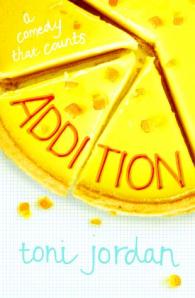
The English version has a little pun – “A comedy that counts”.  The lemon tart is nice and cheerful- but surely it should be a flourless orange cake sprinkled with poppy seeds- if you’ve read the book, you’ll know why.

jordanaddition3

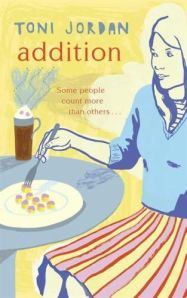
There’s a second UK cover that sticks with the pun on counting: this time “Some people count more than others”.

jordanaddition4uk

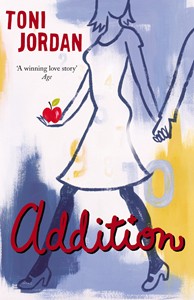
One of the covers available in Australia resembles this British one, but with a sassier girl who looks more like a model and less like a schoolgirl.  The blurb cites The Age’s recommendation:  “A winning love story”.

jordan5aust

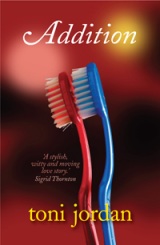
Then finally, there’s one that perhaps gets closer to the tone of the book.  Sigrid Thornton (much loved of Sea Change) endorses it as “A stylish, witty and moving love story”.   But as the Resident Husband commented “Since when has Sigrid Thornton been a book reviewer?”  Maybe I should keep an eye on my toothbrush, lest it also get up to shenanigans.

JordanAddition

There is a happy ending in this feel-good, romantic fiction book, and it’s good fun, engaging and heartwarming.  I gobbled it up, and shut the book with a smile.  I think we can all do with a bit of this, in small doses.  And, of course, only as part of a well-rounded reading diet.

‘Modern Interiors’ by Andrea Goldsmith

goldsmith

1991, 242p.

This is Andrea Goldsmith‘s second book, and one that I hadn’t heard of before.  I read it for my C.A.E. bookgroup – a night of wine, laughter, affection amongst the women my daughter has dubbed “The Ladies Who Say Oooooh” (because apparently we work ourselves up into a chorus of  ‘oooooh’ at some stage during the night. I’m not sure if this is a compliment or not).

The book’s main character, Phillipa Finemore, is a wealthy widow whose adult children expect her to share the family money with them and subside into a well-heeled widow’s existence as their mother and grandmother.  Instead she sells the big family home, shifts into a terrace house in Carlton, starts a charitable foundation, travels with her deceased husband’s lover and secretary, and befriends a Jewish bookstore owner and then a 25 year old university student.

The goodies and baddies are stereotyped and one-dimensional.  There’s the grasping daughter and embezzling son-in-law; the insipid and incompetent son, and the good gay son who gets on well with his mother.  There are overdrawn parodies of the self-aggrandizing business school and a grasping evangelical preacher and his young wholesome wife.  The slabs of Goldsmith’s own opinions about the perils of family and the commodification of university education, voiced through the characters, became laboured too.

In spite of all this, though, I enjoyed reading the book.  It was almost Anne Tyler-ish in places, and although very wordy, captured emotions and descriptions well.  I felt glee at the come-uppance of such unpleasant people, so I must have been engaged with this book in spite of myself.

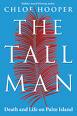
‘The Tall Man’ by Chloe Hooper

hooper

2008, 269 p

Chloe Hooper is obviously strongly drawn to this story.  It started as an essay “The Tall Man”  in The Monthly ; she returned to it in November 2006 with another essay “Who Let the Dogs Out?”. She revisited it more recently through a book review of Thea Astley’s ‘Multiple Effects of Rainshadow’ in  Sept 2008, and  again in a tangentially related story “Boxing for Palm Island” in the February 2009 edition of The Monthly.

Her book and related essays use the motif of the mythical figure of  The Tall Man to frame the story of the death in custody of Mulrunji, who died in police custody on Palm Island in 2004.  His death sparked inquests,  a riot, a court case and a re-opened inquest over a five year period. The story is not finished: nor do I think it ever will be.

Palm Island has had  a troubled history. It has been an Aboriginal mission station and viewed by its inhabitants as a penal settlement; it was used as a naval base during WW 2;  and a nearby island was set aside for sexually transmitted disease, then as a leper colony.   An early white administrator Robert Curry went berserk there in the 1930s, shooting his children after the death of his wife, a tragedy compounded by the arrest of the young aboriginal boy deputized by the white staff to kill Currey in order to protect the other inhabitants.  Fortunately, after six months remand, the young man was found not guilty.

As was Chris Hurley, the police officer accused of the death in custody of Mulrunji in 2004.  Drunk and abusive, Mulrunji was  arrested for causing a public nuisance.  An hour later he was dead in his police cell.  Death was found at autopsy to be caused by “an intra-abdominal haemorrhage caused by a ruptured liver and portal vein”.

This was the first trial of a police officer for a death in custody. Hooper spoke with Mulrunji’s family, sat with them at the trial and shared an umbrella with them in a tropical downpour.  She makes no secret of where her sympathies lie.   On the other hand, though, she is clear-sighted about the violence, drunkenness, poverty and hopelessness of life on Palm Island.  She could not get access to Chris Hurley, and in an attempt to understand him better, she travelled to where he had been posted earlier-  the ironically-named Doomadgee, and Burketown.

The inhabitants of Burketown, and the Queensland and Northern Territory police who closed ranks around Chris Hurley are dismissive of  ‘southerners’ with their caffe lattes and liberal ideas.  They’re right in one thing: people ‘down south’ don’t understand.  It churns up all the ambivalence that ‘southerners’ feel about John Howard’s intervention (continued by the ALP); our discomfort with the group of aborigines drinking under a shady tree on a naturestrip in a country town, or even here in St Kilda, Melbourne; our  conflicted feelings about David Gulpilil.  The world she describes here evokes Kurtz in Heart of Darkness, Maycombe County  in To Kill a Mockingbird.  Somehow it’s easier to slot it into a literary genre, rather than own it as part of your own country.

This is a gritty and challenging book.  It evokes Helen Garner’s work, where the author is right there in the story: questioning, weighing, judging.   As with Garner, as a reader you are always aware that the author is framing the narrative for you, and directing you to “look here”, “listen to this”.   Like Garner, Hooper declares her loyalties and feels angry and bemused.  I suspect that she will keep writing it, on and on, because the story itself goes on and on and on.

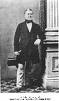
‘Redmond Barry: An Anglo-Irish Australian’ by Ann Galbally

barry3

1995, 228 p.

As a Melburnian, it’s difficult to get past the image of Redmond Barry as a strong, imperious philanthropist.  He is still very much a visible presence:  a large statue of him rears up in front of the State Library (one of his projects); his name adorns prominent buildings at the University of Melbourne (another of his projects), and of course his reputation has been forever intertwined with that of Ned Kelly, whom he sentenced to death.  This is the stuff of myth-making: the pompous Supreme Court judge cursed by the fearless bushranger “I will see you there when I go” (or words to that effect), only to die 12 days later of “congestion of the lungs and a carbuncle in the neck”.  [ Can you die of carbuncle? Dear Lord, if I should die, please let it NOT be of a carbuncle!]

Ann Galbally’s biography covers, of course, his whole life but my interest is mainly on his early years in Port Phillip and his relationship with Judge Willis.  Barry was born into the Anglo-Irish ascendancy.  The peace that followed the Napoleonic Wars cruelled his chances for a military career, so he entered the law instead only to find the Bar crowded with other young men who had made the same vocational choice.   When his father died in 1838, he emigrated to Sydney where there was less competition.

barry4

On the journey out, he embarked on a relationship with a Mrs Scott- and worse still, continued it when he reached Sydney.  News of the affair reached the ears of Governor Gipps, and he was awarded few government briefs as a result.  He continued to suffer from disapprobation even after leaving Sydney for the small town of Melbourne because, although he socialized and got on well with Superintendent La Trobe, the more prominent legal positions were in the gift of Gipps rather than La Trobe.   His unorthodox relationships with married women seem to be an ongoing theme: in 1846 he took up with a Mrs Louisa Barrow, with whom he had four children, in a  public, lifelong relationship that was never regularized by marriage.

Barry was only 26 when he arrived in Melbourne, and Galbally paints an engaging picture of Barry socializing with the other predominantly-Irish members of the Bar:  his good friends Sewell, Foster and Stawell and fellow Trinity-college and King’s Inn  graduates Brewster and Croke.  Although a member of the Melbourne Club and welcomed to all the vice-regal social occasions, he had little capital behind him and thus was not caught up in the land speculation of the early 1840s and  “perhaps for this reason his managed to maintain civilized relations with Willis for longer than most of the legal fraternity” (Galbally p. 49).

Not that Barry found Willis easy.  His diary records a succession of entries where he “argued with Willis“, “fought with Willis” or had a “blow-up with Willis who threatened to suspend me“.  He greeted the news of Willis’ suspension with relief  “Supreme Court Willis suspended + removed, Te Deum Laudamus” (24 June 1843).

In spite of this, Barry did not seem to have been exposed to the same personal insults or attacks that other barristers and officers of the court suffered.  Willis seemed to greet his appointment as the Commissioner for the Court of Requests in January 1843 with genuine approval, and at times their sparring in court (complete with historical allusions and Latin jests)  seemed to be equally relished by them both.   Although Barry had a reputation as a bit of a dandy who wore an old-fashioned Beau Brummel style suit, obviously Judge Willis did not take exception to this as much as he did the trimmed moustaches of Edward Sewell, Barry’s friend and erstwhile housemate.

barry1

Unlike Judge Willis, Barry was noted for his “dignified deportment and invincible politeness” (Garryowen p. 867). Galbally captures this quality well.   Against such a man, Willis’ own failings of temper and demeanour would have been even more marked.

References

Ann Galbally  Redmond Barry: An Anglo-Irish Australian

Barry, Sir Redmond, Australian Dictionary of Biography (online)

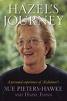
‘Hazel’s Journey’ by Sue Pieters-Hawke

hazel

2004, 306p.

At the moment, I am wary of books written by children about their parents’ struggle with Alzheimers.  Increasingly, I know, I will find myself identifying with them more and more because someone very close to me has Alzheimers.

I picked up this book in a bookshop while I was down at the beach, and put it down again.  But when someone who knows my family-member offered it to me, with some trepidation, I accepted her offer and settled down to read it.

Hazel Hawke is the ex-wife of Bob Hawke, the former prime minister.  In Australia, we don’t particularly think in terms of “first ladies” as such, but the Prime Minister’s wife often escorts her husband on official occasions and acts as patron to charities and causes close to her own heart.  Prime Minister Bob Hawke was a flamboyant, emotional larrikin. Although he always acted with propriety while Prime Minister, his past of alcohol and womanizing always seemed close to the surface.  You always sensed that he would be a challenging man to live with.  When the marriage broke up after he was no longer Prime Minister, Hazel kept her silence and her dignity.

When reading this book, I was reminded of the deep affection I have for Hazel Hawke.  She earned it through her own intelligence and interests, her strong advocacy of abortion rights, and although I’m sure she didn’t wish it this way, her resilience after her marriage breakdown was a model for the many others in similar situations.

In 2003, she and her daughters revealed on the ABC television program Australian Story that she was suffering with Alzheimers, or ‘The Big A’ as she called it.   I watched the show with a mixture of admiration for her courage and selflessness in so publicly aligning herself with such a silencing, stigmatized illness, and a feeling of dread that I was watching what will, inevitably, also be my fate as daughter.

To be honest, the tone of this book really annoyed me.  It was like listening to someone affecting a rather forced cheerfulness,  full of platitudes, and talking too much.  If it’s beautiful writing you’re after, then Sue Miller’s book The Story of My Father is far superior.  But both these books are not really about the writing and  they’re not only about the father or mother whose stories they are telling.  What they are both about is grief, loss and being a parent to one’s parent.

This book reminded me that, in spite of the loss of planning abilities, routines and conversation, it is the emotions that remain.  As someone who loves them, it is the emotions that matter and emotions that we need to respond to.

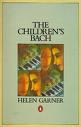
‘The Children’s Bach’ by Helen Garner

1984, 96p.

Don Anderson, in reviewing Helen Garner’s book The Children’s Bach wrote:

There are four perfect short novel in the English language.  They are, in chronological order, Ford Maddox Ford’s The Good Soldier,  Scott Fitzgerald’s The Great Gatsby,  Hemingway’s The Sun Also Rises and Helen Garner’s The Children’s Bach.

Boy- where do you go after that???!!

I think that brevity is an intrinsic feature of this book.  Like a small Bach piece, it is short and self contained, simple and yet complex.  It takes a slice of life in 1980s Melbourne, and in this regard, Garner’s keen observations almost provide an ethnographic (and now historical!) artefact.  Athena and Dexter are 1980s people who feel like people you’ve known and  their house and lifestyle is so well-depicted that you feel you could recognize it if you walked in the door.  As a northern suburbs gal myself, I can recognize many landmarks and events that she mentions almost in passing.  In fact, I reckon you could plot a pilgrimage walk of the book!

The relationship between Athena and Dexter lies at the heart of the novel.  They have two children- an autistic son, Billy, and a bright articulate son called Arthur.  The summary on the back of my edition, and the recent rendering of the novel into an opera both make more of Billy’s autism than I was aware of in the book, where Billy is a stolid presence, but not particularly the focal point of the family dynamics.  It’s not just the strain of Billy that drags at Athena, drawing her to abandon it all: it’s also her husband’s exuberance and obliviousness to her own personhood and the dream of being someone else in another more exciting world than hers.

I’ve read this book three times now, which is easy to do as it’s so short and it tumbles over you like a conversation overheard.  It’s a book to grow up with. As I’ve grown older, I see different things in it, as if I’m revisiting my own young-motherhood at much this same time.  I sense that in Garner’s most recent book, The Spare Room, she’s also revisiting the sort of characters in The Children’s Bach, grown older.

This is not the stuff of crashing drama: it’s lived-in life, with fallible and flawed human people, mess, and making do.  Taking liberties with the final sentence, life as depicted in The Children’s Bach is the steady rocking beat of love and family in the left hand, and the flying arpeggios of “what if’s” and “maybes” in the right.

‘Aphelion’ by Emily Ballou

2007, 493 p

There is such a thing as too much.  Chocolate, for example. Or wine. Or, as in the case of ‘Aphelion’ by Emily Ballou, too much scenery, too many storylines, too much thinking, too much talk, too many themes, too much imagery, too many pages, too much ‘luminous’ prose.

The book is set in the Snowy Mountains, in a small town that has been relocated as part of the hydro-electric scheme.  Four generations of women live in the family home- the 101 year old Hortense, her 80 year old daughter Esme, Esme’s niece Byrne (about 50) and her own daughter Lucetta (20 plus).  Into this seething mass of mother/daughter/aunt entanglement comes young Rhett from next door, returning to the family home after the death of his mother, bringing with him Hazel the American museum curator who barely speaks to her mother.   You can probably imagine the multiple themes here: motherhood, regret, what-ifs, relocation, dislocation, nostalgia etc. etc. etc.

This book felt like a Sunday evening serial on the ABC with lots of Australian scenery (just in case it can be flogged off to British television), iss-ews that we can all identify with, and multiple storylines.

But it wasn’t all bad.  In fact, even though the book was overdue and I was accruing a daily penalty, I wanted to keep it until I had finished it.  Perhaps, in spite of all these qualifications and criticisms, the fact that I wanted to reach the end is the most important response of all.

Helen Garner “The Spare Room”

2008, 195 p.

This is Garner’s first avowedly fiction book in over a decade, and was greeted with wide acclaim.  It is a beautifully presented book, right from its crisp front cover and its interesting face boards.  This care in presentation is amplified in the opening pages where Helen is preparing her spare room for the 3 week visit of a friend from Sydney who is seeking alternative therapy for advanced cancer.  Nicola’s death is not really the core of this story: instead the drama of the book is Helen’s rage and inadequacy in the face the demands of friendship, and her frustration at her friend’s relentless faith in a “cure” that Helen feels is quackery.  I suspect that Garner herself is ashamed at her own behaviour, and is seeking absolution from herself and her readers in this thinly disguised memoir.  I loved the embeddedness of this book within Melbourne suburbia, and her confidential and warm tone- like a good, satisfying talk with an old friend.