Category Archives: Australian Women’s Writing

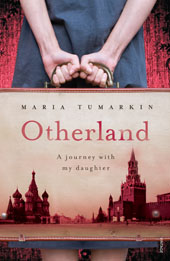
‘Otherland’ by Maria Tumarkin

2010, 301 p & notes

“What IS this book?” I wondered half-way through. Travelogue; a reflection on literature and historical methodology;  a history of nations and a history of family; a reflection on the mother/daughter relationship- how would all that be summed up in the one-word descriptor that you often find on the back cover of a book?

“Memoir” .  It seems a little incongruous to me that anyone born in 1974 could write a memoir yet, but if a memoir is a literary construct through which the writer represents a lived experience, then yes, this is a memoir- but I’d qualify it by adding “and much more”.

The author is a Melbourne-based historian, who emigrated from the Ukraine with her parents and sister in 1989, a month after the fall of the Berlin Wall,  at the age of fifteen.  She had returned to Russia  previously, but had not made it to the Ukraine.  On this trip she takes her twelve- year old daughter, Billie, largely because she feels that it is the last chance she will have to do so:

Right now is my last chance to go back with her and still be the centrifugal force of our journey, exercising the course-setting and veto powers.  It is, in other words, my last chance to have Billie follow me around, however begrudgingly, as her mother’s tail.  In a year, maybe a few months, the tail will drop off, or the tail will be wagging the dog, and such a trip, if even possible, will be a different proposition altogether. (p. 28)

It is the journey that ties this memoir together, but it is a layered journey. Mother and daughter are travelling, but Tumarkin is making her own journey back to the relationships that were ruptured when she and her family left so abruptly, and she is making a journey into her own parents’ and grandparents’ experiences as well.  But it is not her story alone: she interweaves the journey with the stories and observations of writers, historians, poets and political dissidents.  In this way, it is an intellectualized endeavour- indeed, I had not heard of many of the writers she cited- but it is also highly personalized.

It is much more than the story of a mother and daughter, and yet this is important too. We read excerpts from Billie’s diary- am I the only one who felt slightly grubbied and complicit in this?  The mother/daughter relationship generally is often fraught, and here I found myself judging the author rather harshly for her own intrusion into her daughter’s perceptions of her experience, where she so much wanted her daughter to see and feel certain things. Ah, but in terms of judgement and criticism Tumarkin was often there before me, aware of her own shortcomings.  There is a stringent honesty in her writing, as when she describes her daughter opening up the piano to play in the apartment of an elderly woman herself the cultured, brilliant daughter of a revered dissident:

In this apartment at the very heart of Moscow, metres away from the Mossovet and Statira Theatres and the Tchaikovsky Concert Hall,  Billie sits down at the old piano.  She plays what she usually plays- Tori Amos and Coldplay.  How alien they sound inside these walls.  Not in Adorno’s ‘no poetry after Auschwitz’ kind of way, no.  And not in a vulgar popular-culture way.  It is just that here these songs, which evoke places and times that make no sense in the world of this apartment, sound thin, flat and inconsequential in the extreme, like a mobile ringtone underneath a cathedral dome. Momentarily I feel ashamed. Ashamed for both of us. (p. 76)

There are several mothers and daughters here.  It is also a history of a Jewish family, who were part of a much bigger history, and here I found myself hampered by my lack of late twentieth-century history: who came first again? Gorbachev? Yeltsin?  I craved a factual chronology, to juxtapose against this very personalized history.

This is a very carefully constructed memoir.  It opens with a cliff-hanger that is not resolved until after half-way through the book.  The writing is reflective and scholarly in places, and confessional and all too human in other places.  Like all journey narratives, it moves forward and there is a homecoming, in more than one sense.  It is quite a journey.

My rating: 9/10

Sourced from: Yarra Plenty Regional Library

Read because: I read it as my third book in the Australian Women Writers Challenge
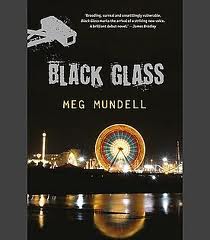
‘Black Glass’ by Meg Mundell

2011, 281p

This book is set in Melbourne, but it’s a dissonant Melbourne- recognizable, yet there’s something wrong.  Locations were familiar to me, and yet I think that inhabitants of any affluent city could recognize their own here: every city seems to have a Docklands with high-rise buildings, a ‘Westgate’ bridge or some variation on a similarly anodyne name, malls, a waterfront, a Casino, tourist Ferris wheels [although, unlike Melbourne, most cities seem to have one that actually works.]

In this future Melbourne, the tourist, civic, retail and commercial centres have been made safer by close electronic surveillance and the requirement for official entry documentation. The inner suburbs have been declared an  ‘interzone’, providing residential housing for those permitted to work in the city centre.  Those without the required documents, or the ‘undocs’ are prohibited from working legally and are thus forced into a marginal existence, scrounging for food, working illegally and squatting in disused buildings and under viaducts, bridges and in tunnels.  The proper place for ‘undocs’ is outside the city, in the Regions, where services are non-existent and civic governance seems to have collapsed.

Tally and Grace are teenaged sisters living in the regions, dragged from town to town throughout the Regions by their drug-dealing father.  They had long been planning an escape to the city, even though they would be ‘undocs’, but when their father is killed in a drug-kitchen explosion, they are separated and unsure how to find each other again.  The book traces their two paths as they search, each struggling to find a toe-hold in this dystopian society.

The structure of the book is interesting.  It is divided into 12 chapters, each announced with a rather excessive unnecessary title page, such as you might see when a book has Part I, Part II etc.  Within the chapters, each scene is headed by an annotation of place and people present, as if part of a dossier. Multiple scenes make up each chapter, and this device  quickly contextualized the episode that followed, but also endowed a filmic quality on the narrative.  The scenes were quite distinct from each other, and the writing was so fresh and careful in each one that you almost felt as if they were written, and should be read, each time as a polished episode in its own right.  I don’t normally like such disjointed writing as it sometimes seems a bit of a cop-out from the hard work of maintaining the narrative and moving it forward.  But in this case, each one was so beautifully written and worked well in inching the story forward that it felt like a considered and well-chosen narrative structure.

Tally and Grace and their search for each other lie at the heart of this novel, but there are other themes woven in as well: exploitation, surveillance, dissent and authoritarianism.  Unlike some science fiction (or is it ‘speculative fiction’ these days?) she does not spend a great deal of time on the logistics and details of this chilling world but instead uses it as a backdrop to the story of these two lost sisters.

My rating: 8.5/10

Sourced from: Yarra Plenty Regional Library

Read because: it is the second book that I am reading for the Australian Women’s Writers Challenge 2012

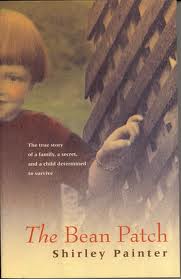
‘The Bean Patch’ by Shirley Painter

2002, 310 p

Spoiler alert. 

The author of this book was 83 years old when this book was published.  It was the product of a writing course undertaken at Holmesglen TAFE in her later years, and its narrative voice is just a little stilted.  But she is conscious that she is crafting a narrative, as well as relating it and so she makes the decision to withhold and complicate information so that the reader experiences the same partial and confused state that she did for so many years:

Because memories are often disjointed, I had two choices in dealing with them.

The first was to tidy them all up into a neat chronological order, with a beginning, a middle and an end.  But a lifetime of reading wonderful books has made me a highly critical reader, and I feared that choice might make for a very flat narrative.

The other choice was to present the reader with the same gaps, the same clues, and the same dilemmas as I had, so that the effect would be the same: What’s going on? Who in this dangerous and contradictory world can be trusted? Who are the goodies in white hats and who are the baddies in black hats?

Tough, reader! I have chosen for you the hard option   (p. vii)

This stylistic choice works well, and it is the promise that it will all come clear that draws the reader through the narrative.  There seems to be such a disconnect between what seems like an ordinary-enough life with husband, children, career, house, brothers and sisters, juxtaposed with a nightmare existence of extreme brutality.  This disconnect becomes even stronger in part 2 where, tangled in amongst the narrator’s story of breakdowns and therapy, details of the abuse are released in jerks and flashes- as indeed, such searing and painful memories must be.

But the reader is left with the final question of credibility, and here I find myself in uncomfortable territory.  I had let suggestions of the paranormal go through in Part I, but with the litany of abuse and crime in Parts II and the Epilogue  of the book, drawn out through extensive therapy, and encompassing recovered memories at and before birth, I found myself stepping back and asking “Do I really believe all this?” Although I feel almost disloyal to the narrator in distancing myself from these recovered memories,  I just cannot credit the bloodshed and crime without external corroboration.

I’m obviously not alone in my hesitation as this Sydney Morning Herald review shows.  The Bean Patch was awarded the Dobbie award in 2003 for a first book by an Australian woman writer.  The book is marketed and publicized as ‘memoir’.  Deborah Adelaide, one of the judges for the award is quoted in the review as saying that the truth or otherwise of parts of the memoir is immaterial:

Because we know it is based on her life, and the thrust of the story is true, to me the details don’t really matter

Ah, but it’s more than just details- it’s the whole premise of the book.  All memoirs are constructed narratives, and the reader takes on the author’s part in this construction as part of the memoir genre, aware that these choices are an inherent part of what is being offered.  There is always the question of fidelity and soundness of the architecture by which the author has chosen to structure the narrative, but if the whole intent of the endeavour is suspect???  I’m not sure.

Update 27 August 2014

The Age this morning published a beautifully crafted obituary for Shirley Painter (3-11-1918 – 29-07-2104) written with the assistance of family members.  It notes that:

Shirley was dux of both her primary school and MacRobertson Girls’ High School and earned an honours arts degree from Melbourne University.  She married and raised three children.

She taught Latin and English with diligence and care at St Catherine’s Secondary School for Many years. .. She was supported financially to go on to university by a bursary created by her teachers who recognized her extraordinary ability.  As a teacher she gave her tireless support and encouragement to young women seeking to find that spark in knowledge and thought that might enliven them.  She felt angry, in recent years, that free education had become a thing of the past….

Shirley was a lover of art, film and literature and a member of book clubs, film groups, bridge clubs, ACSA (Adult Survivors of Childhood Sexual Abuse) and Probus…

Shirley is survived by her three daughter, four grandchildren and the legacy of hope and love she embodied.


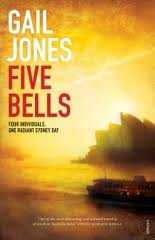
‘Five Bells’ by Gail Jones

2011, 216 pages

I don’t always read the epigraphs that grace the front pages of a book.  To be honest, I’m not really sure what purpose they serve- are they an encapsulation of the book in someone else’s words? are they a nod to writers who have come before? or are they a window into the texts that served as inspiration for the writer?  Probably all of the above, and I suspect that in this case, the latter is close to the mark.

The quotation from which the book takes its title is Kenneth Slessor’s poem Five Bells,  one of his best known poems, written after the death of a friend.  Gail Bell has chosen from the poem these lines.  The author has chosen:

Where have you gone? The tide is over you,

The turn of midnight water’s over you

As Time is over you, and mystery,

and Memory, the flood that does not flow.

‘Five Bells’ is a nautical term that measures the elapse of a four-hour watch on board ship, and the focus of time elapsing is pertinent here because we are very aware of it in the structure of this book.  The book is set on one summer Saturday, around Circular Quay (there’s that water theme again- and it emerges again throughout the book) as four people converge there from somewhere else, and the narrative swings from one character to another, in a sequence, not unlike the chiming of bells.  Round and round it goes, from Ellie to James to Catherine to Pei Xing then back to Ellie again as the day breaks clear and blue and creeps on to one of those night-time storms  that Sydney summers are noted for.  In this regard, it reminded me very much of Virginia Woolf’s The Waves, which took six friends, each writing from their own stream of consciousness.  However, here the characters in this book are observed minutely,  yet from a distance, rather than speaking in their own voices. Nonetheless,  it is very much an interior description, ranging over their memories, fears and disappointments across decades and continents.  In another nod to Woolf, there are echoes too of Mrs Dalloway in its single-day focus.

Her characters are each suffering loss of differing degrees: loss of relationships, loss of brother, loss of freedom, and exposure to tragedy.  Their stories are revealed gradually, as the spotlight of the narrative swings onto them before moving on to the next character.  There are resonances between the stories with multiple allusions Pasternak’s Doctor Zhivago,  eight year old girls etc. which at times felt a little forced, but I suppose evokes the same sense of connectedness and chance that we feel with the concept of ‘six degrees of separation’ and other such life coincidences.

Despite the rhythm and symmetry of the structure, the characters are not equally well-developed.  Catherine, the Irish tourist, never really became real to me, and although Pei Xing’s story was touching, I found it difficult to actually understand and thus accept her motivation for acting the way she did.  I think that Ellie and James, meeting again after twenty years, were the most clearly defined characters.

I must admit that I only made the connection with the maritime use of five bells when I googled it for this posting.  While I was reading it, I assumed that it referred to the characters and the circular way of telling their stories, like the rounds of a church bell.  There are four of them- who was the fifth? For much of the book I wondered if it was Sydney itself,  which with its harbour, the ferries,the Opera House,  Luna Park and Circular Quay is almost a character in its own right.  But then, in a marked change of pace near the end of the book, two other manifestations of what could be fifth character come into view.  This comes as rather a jolt.  I had been lulled into the almost soporific rhythm of the narrative and all of a sudden it changed direction.  I’m not really sure, though whether this sudden plot development was wise, or necessary to the book.  It changed the trajectory of the book and made some plot scenarios possible, but I think weakened the overall effect.

It is only a short book at 216 pages, and that is probably exactly the right length.  It is very carefully written with almost every phrase and image carefully burnished.  Perhaps a little too polished for my liking- I found myself almost  smothered by such intense, artistic writing- and so, while unsure about the necessity of the change of pace near the end, I greeted it as an escape into open air from a rather oppressive, perfumed interior.

I have set this post aside for a couple of days, unsure of how to sum up my response to the book.  Ambivalent, I’d have to say.  I admire the cleverness of the endeavour and the complexity of her allusions to other works of literature and acknowledge that there are some beautiful images and phrases.  But I need to balance that with my misgivings about the plot development at the end of the book, and my feeling of overload from a surfeit of fine writing.  Not sure.

My rating: Mmmm. 8/10??

Read because: My Australian Literature Online group had it as the September read

Copy sourced from: Yarra Plenty Regional Library and then, when I was unable to renew because it had a hold placed on it, La Trobe University Library.

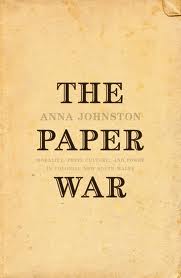
‘The Paper War’ by Anna Johnston

Anna Johnston The Paper War: Morality, Print Culture, and Power in Colonial New South Wales,  Crawley Western Australia,  The University of Western Australia Press, 2011.226 p. Plus notes

Now that my thoughts are actually turning to writing my big baggy monster of a thesis (stifle those snorts of laughter, please) I’m finding myself conscious of the way other writers are treading the tenuous line between ‘straight’ biography and something that’s not quite biography.  The Paper War by Anna Johnston is one such book.  Her focus is on Lancelot Threlkeld, the NSW missionary, and the texts he generated  by and about  his colonial experience. But it’s not a biography of Threlkeld as such, and the author is at pains to reinforce this distinction.  Her work is not history, or biography, but a literary/cultural study which

examines the archive as a set of writing and reading practices, seeking to make different meanings than a historian might.  The Paper War retells stories found in archives as well as revealing modes of construction, in order to create new narratives. It foregrounds the complexity (perhaps the impossibility) of efforts to establish coherent, credible narratives from partial sources  (p.4).

This means that, as well as looking at the content of a particular source, she also asks about the source itself : how did this document/series of documents come to be created?  What are the institutional structures, and individuals within those structures, that created them? Can we rely on these texts as stable and authoritative guides to the past? (p.4)   She is insistent on maintaining this emphasis on text as a mediated material when her reader’s attention might drift into the biographical corridors of  chronology and lifestory instead.

Her book focuses on the writings by and about Lancelot Threlkeld, the missionary in charge of the Lake Macquarie Aboriginal Mission in New South Wales in the 1820s, a man rather unkindly described as one of the “perpetual blisters” that the London Missionary Society (LMS)  seemed “destined to carry”.  He certainly seemed a rather pugnacious and belligerent character as a missionary and his writings to attack his adversaries and defend his own position generated what could well be described as a “paper war’.  As is often the case, his own irascibility was  in response to, and elicited, similar traits in his main clerical adversaries: the equally combative  Rev. Samuel Marsden and the protestant cleric John Dunmore Lang.  What a combination!  I’m particularly interested in this combustible 19th century character type, because our own Judge Willis himself exhibited many of the same traits.

Surrounding the Threlkeld/Marsden/Lang sparring ring were representatives of the broader 19th century  humanitarian network.  Daniel Tyerman and George Bennet were missionary agents charged with overseeing Threlkeld’s establishment of the mission at Lake Macquarie under the auspices of the London Missionary Society and thus his immediate supervisors.  James Backhouse and George Washington Walker were peripatetic Quaker investigators whose opinions were valued by metropolitan humanitarian networks for their independence and clarity.  The Paper War is very much embedded in the historiography of the ‘networked’ image of the British Empire (Zoe Laidlaw, Alan Lester, Kirsten McKenzie etc) and these agents and investigators exemplify the way that ideas were circulated throughout the empire by missionaries, intellectuals and London-based groups like the Ethnological Society of London.

The book itself has five main chapters, an introduction and a conclusion.  The first chapter, ‘Colonial  Morality’ gives a brief biographical account of Threlkeld’s career along with the careers of his major protagonists and the circumstances that led to the intersection of their careers with his.  The second chapter ‘Colonial Linguistics’, looks at Threlkeld’s pioneering work in researching the language of the tribes surrounding Lake Macquarie, and she traces the evolution in his thinking about how language can be studied and depicted.  His earliest work in 1825 was an attempt to develop an orthography (spelling) for an Aboriginal language, mainly in the form of question and answer phrases, strongly based on Europeans assumptions about categories and sentence structure by imposing  an artificial  one-to-one match between English and Aboriginal words.  In 1834 he changed his methodology to investigate the grammar of the language, followed by another work in 1851 written for the Great Exhibition in London called A Key to the Structure of the Aboriginal Language.   As was common at the time, colonial collectors were expected to scoop up the raw materials of plants, animals, languages and ethnography, which were channelled to the ‘experts’ in London for ‘proper’ classification and analysis.  She traces the use of his work by such ‘experts’, especially the way that it was posthumously re-published and co-opted as part of late 19th century racial theories.

Chapter 3, ‘Colonial Press’ shifts its focus to the newspaper record generated by and about Threlkeld, especially in relation to the execution of Tommy, an aboriginal prisoner for whom Threlkeld acted as interpreter.  This execution itself became subsumed within a broader sectarian argument, and in February 1828 Threlkeld wrote a series of letters to the editor- a common feature of colonial newspapers- against the Catholic Church.

Chapter 4 ‘Colonial Respectability’ takes up Threlkeld’s Statement Chiefly Relating to the Formation and Abandonment of a Mission to the Aborigines of NSW; Addressed to the Serious Consideration of the Directors of the London Missionary Society, written to justify his actions as missionary at Lake Macquarie.  Despite its title, it was not aimed at the directors of the LMS alone: he had at least 270 copies printed and distributed it to every director and missionary in the LMS network.  It is a 72 page document, largely composed of letters written and received in relation to the Lake Macquarie mission. Threlkeld’s adversary J. D.  Lang waded into this documentary swamp with his own series of newspaper articles criticizing the mission and Threlkeld’s character as a missionary, culminating in a civil court case Threlkeld v Lang in 1836.

Chapter 5 ‘Colonial Legality’ remains in the courts, but here investigates Threlkeld’s work as an interpreter in the courts, and his position and increasingly critical stance over questions of the amenability of Aboriginal people to British law, the use of Aboriginal evidence and questions of sovereignty.

The  conclusion of the book picks up themes from the introduction by returning to the question of historians’ uncritical use of the colonial archive.  Both Henry Reynolds and Keith Windschuttle as combatants in the ‘History Wars’ share, she claims, a “remarkably simple” view of the archive as unmediated primary source material that can be drawn out to construct a narrative. She picks up on Kevin Rudd’s championing of Thomas Keneally for the background in literary fiction that he brings to his retelling of Australian history (an issue also pertinent with Kate Grenville’s recent works). And here we are returned to the question of the heart and the affective world so prominent in the humanitarian world view, including that of Lancelot Threlkeld.

As I mentioned earlier, I was particularly interested in the structure of this book for my own work, given that it takes an documentary archive deeply imbued with questions of personality and temperament.  I ‘m interested by the decision to place Chapter 2 where it is- perhaps because Threlkeld’s linguistic work has been somewhat overlooked?- because it seems more related to Chapter 5.  I’m impressed by the way that her strong, minimalist chapter structure forces the reader’s attention on the form rather than the content of the archive. The book is on one level about Threlkeld , without being a biography as such, but on another level it works on a much larger canvas.

You can download a generous extract of the book here.

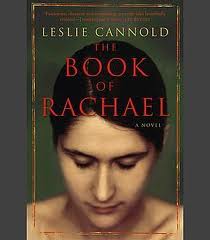
‘The Book of Rachael’ by Leslie Cannold

2011,  324 p.

Leslie Cannold is an esteemed  Australian public intellectual best known for her contribution to debates over feminism and reproductive technology.  I haven’t read her previous non-fiction publications What, No Baby? and The Abortion Myth but I generally read her newspaper columns and articles.  This is her first fictional work.

The impetus for this book, the author tells us, sprang from watching the BBC documentary Son of God.  This documentary examined Jesus the man (as distinct from Jesus the religious figure) and mentioned that he had four brothers who were named.  His sisters- if indeed he even had any- were un-named and not part of the historical record at all.  When Cannold went to research the existence of these possible sisters,  she found that there was nothing – not even enough for an article.  “That’s OK” she thought “I’ll just write a novel instead.”  And here it is: dedicated to the women of her family and to “every woman still struggling for a place in history.”

This  goes some way to explain my response to the book.  Cannold wanted, from the start, to mount an argument about women’s visibility in history, and the injustice of their life experience in 1st century Galilee.  It is a conscious, political statement that places women back into the biblical story.   The eponymous Rachael is the intelligent, headstrong younger daughter of Yosef the carpenter and his wife Miriame, and the sister of the charismatic preacher, Joshua.  This slight shifting in the names unsettles our easy identification with the gospel story, and there is certainly no supernatural or religious element here at all.  Her father Yosef is a good, loving man; Miriame is a carping, bitter woman and certainly no saintly figure;  her brother Joshua changes from a quietly empathetic ally into a somewhat fey, distant figure, driven by his own obsessions and agendas.   Rachael, conscious from the start of her difference and chafing against the many restrictions placed on women, becomes an acolyte of ‘the crone’ Bindy, who initiates her into the women’s arts of healing.  She falls in love and marries Judah of Iscariot, rebel leader of a guerilla band that is resisting the Roman authorities. She struggles with the pressures to have a baby and yet continue her work as a healer.

The anachronisms started early- on the second page in fact, with the ‘Galilean resistance fighters’ (shades of Monty Python’s Judean People’s Front??) and Rachael’s mindset is a thoroughly twenty-first century one.  The book is obviously well  researched, especially the details of women’s medicine and herbalism, but the research is conveyed with a heavy hand.

The book reminded me of Anita Diamant’s The Red Tent, but it has none of the rich female intimacy that marked that book.  The Book of Rachael  is a book of the head that mounts an aetheistic alternative narrative to the gospel.  Perhaps it could be described as an extended, fictionalized ‘what-if’ argument. As  a reader I found myself watching how the argument was constructed, weighing it and judging how well it countered the gospel account.

I  switched to intellectualizing the book because it was the only way that I could break through the writing, that veers between chicklit and stilted, pompous prose.  At times there are hints of a biblical cadence- think Song of Solomon perhaps- but they are fleeting and not sustained throughout the book.  Is it just me, perhaps?  Very few of the reviews I have read address the issue of the narrative voice at all.  I’ll leave it to you- here’s an example. Here is our first century, Jewish narrator.  A deeply troubled Judah has gone off by himself, just prior to Passover,  ostensibly to buy a sacrificial lamb for the feast that night, but we sense (and know) for another purpose:

By late afternoon I was close to gnawing off my own arm from idleness when Judah burst through the door, whistling through his teeth.  I ran to his side, desperate for company and news. ‘Where were you?’

He removed his scarf and pegged it on the hook before turning to me. His brow was smooth and eyes clear.  He was Judah again: vigorous, confident, in charge. ‘Nowhere,’ he boomed cheerfully, then changed his mind: ‘Buying a lamb for sacrifice. I have tied it in the lane.’ He looked around then gathered me for a passionate kiss, one hand gripping a breast.  When we separated he gazed in the direction of the hearth. ‘Is there anything to eat?’  (p. 272,3)

The reviews I have read of this book are generally glowing.  Lisa at ANZLit Lovers wrote one of the most enthusiastic reviews I’ve ever seen her give;  Kylie Ladd on Mamamia liked it too, as did Theo Chapman in the SMH and Patricia Maundel on Radio National’s Bookshow.

I’m afraid that I have to disagree.

My rating: 5/10

Reason read: Australian literature bookgroup

Book obtained from: Eltham Bookshop (purchased)

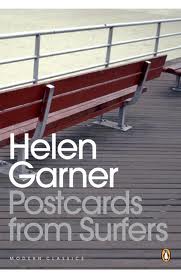
‘Postcards from Surfers’ by Helen Garner

1985,  106 p.

I don’t really know how to review a book of short stories.  I find myself making several assumptions.  I assume that it is a selection from a corpus of work developed over a period of time:  it is common to find that several stories in a collection have appeared in other compilations previously.  I assume that someone–  author? editor?- had a vision for a book of short stories as a self-contained piece of work.  I assume that one story was accepted as ‘right’ but another put aside for now, and  that the ordering of the stories was a conscious and carefully thought out decision.  There’s an arbitrariness about the whole process  that makes it hard to think about a book of short stories as a single object: would it be any less satisfactory if one of the stories had been omitted? would it be a different entity with one of the stories that was rejected  included instead?  For me, even the act of reading a collection of stories differs from my normal reading habit.  I prefer to read them just one at a time, but often they’re so short that I find myself thinking “Well, what now?” Sometimes I cram in another one straight away (which I don’t like doing), or else turn afterwards to another full-length book that I might have on the go at the same time.  When I come to write about them here, I’m not sure how to proceed- do I treat them individually (which might become rather tedious and might place a heavier burden on a few pages of writing than it can support)? Do I just hold onto the one or two that stay with me even without opening the covers again? Or do I embrace it instead as a collection without peering too closely at the component parts?

I’ll go with the memorable stories, without looking at the book again.  The first one, which gives the collection its title fitted in neatly with another book I’d read recently- Life in Seven Mistakes.  It is uncanny how often one book seems to ‘speak’ to another.  This short story is located in Surfers Paradise too, but the narrator is more mature and thus easier to spend time with, and Garner adeptly uses the device of postcards written over a period of time to quickly shape the contours of a larger plot that stretched over a longer expanse of time.  Good, sharp, clever writing.

Her story ‘Little Helen’s Sunday Afternoon’ captures a child’s perspective well, and evoked for me those visits to my mother’s friend’s houses, where there were other barely-known children and mutual wariness and showing-off.  In ‘All Those Bloody Young Catholics’ she nails the drawl, condescension and prejudices of the slightly-tipsy narrator of some thirty years ago when sexism and sectarianism were threaded unselfconsciously and largely unchallenged through overheard conversationsIn ‘Did He Pay?’ she describes vividly the washed-up, unattached old rock-star, indulged by friends and committed to no-one.

I’ve always seen Helen Garner as a perceptive observer, who has gone to places that I never dared, several years ahead of me.  There’s an innate authenticity in what she describes, and I can see why so much of her more recent work straddles the conjunction of non-fiction/reportage/fictionAs a Melburnian, I love the very local context of her narratives, although she ventures overseas, particularly to France, in these stories as well.  It’s like looking through someone else’s eyes at the things, people and situations that surround you, and thinking “Yep, she’s got it!”

It’s interesting that this book has had so many lives.  My copy is an early 1986, and there is a 1992 one as well; it was republished in 2008 as one of Penguin’s Modern Classics with the cover above, and most recently it has appeared as one of the orange-and-white retro (and cheap!) Popular Penguin reprints.

Rating: 8/10??

Reason read:  Australian Literature Group (Yahoo Groups)


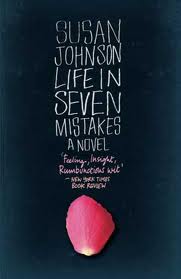
‘Life in Seven Mistakes: A Novel’ by Susan Johnson

2008,  344 p.

(4.5 out of 5)

One of the two epigraphs that grace the opening pages of this book quotes Shakespeare’s As you Like It

All the world’s a stage,

And all the men and women merely players;

They have their exits and their entrances’

And one man in his time plays many parts,

His act being seven ages.

I’m not sure that it was a particularly apposite quote, and it complicated rather than illuminated the title of this book, which for the life of me I can’t quite make fit with the story itself.    Doesn’t matter really: I enjoyed it anyway.

There are two intertwined narratives in the book.  The first, written in the present tense, is told from the perspective of Elizabeth, a middle-aged ceramicist on the verge of her first international exhibition. She has travelled up to Surfers Paradise with her third husband Neil and her children to spend Christmas, and to celebrate her parents’ 50th wedding anniversary four days later. Her  brother and his wife and  children have done the same.     Ah- families- you’ve gotta love them, don’t you- with all that jealousy and love and rawness and spite mixed in together.  There they are, in their parents’ large air-conditioned penthouse at the top of a Gold Coast hi-rise: Bob the patriarch a boorish, loud bully; Nancy his tense, controlling,  hyper-critical wife; Robbo the younger brother who just rolls with the punches and his rather intrusive and opinionated wife, and a brood of disengaged, self-absorbed grandchildren.  Then there’s  Elizabeth, our entree into this family,  who despite her own status as mother, artist and adult woman feels as if she turns into a little girl again around her parents.  Her brother Robbo is spot on about her:

You’re pathetic.  Still bleating about what Mummy and Daddy did to you when you’re almost old enough to retire.  Next year you’ll qualify for one of those over-fifty retirement places.  Are you still going to be blaming your parents when you’re seventy? Life’s too short, Liz (p. 108)

Then there’s the missing youngest brother, Nick who is in jail after a long history of drug use with all the betrayal, defiance and hurt that this brings.  He’s barely spoken of, only briefly encountered in the book,  and yet a presence nonetheless.

How did this family get to be like this?  The other narrative strand takes the young Bobby and Nancy as they meet in the 1950s, begin courting, marry, have children, become increasingly affluent as Bob (who drops the ‘Bobby’) moves up the corporate ladder  into private schools, prestige cars, Surfers Paradise penthouses etc.  But all of this comes at a price- expectations of gratitude and performance- and Bob becomes angrier at the world and the sense of entitlement that he himself has fostered for himself and his family; Nancy tries to make herself and her children smaller targets;  and the three children in their own ways negotiate this spreading emotional mine-field.

Both narrative threads were strong and well-made, and I didn’t find myself regretting when I turned the page to find that the narrative was about to switch again.  The dialogue was particularly good, and the author obviously has a sharp, observant eye.   The ending had an emotional authenticity, at least for this middle-aged reader at the time I am in my own life, although other readers may judge it a cop-out.  The book had the groundedness and edge of Christos Tsiolkas’ The Slap, and felt a little like Jonathan Franzen’s The Corrections down under.  This is perhaps a little flippant: all three of these books have a truth at their core about loyalties, judgment and the emotional mess of just living.  All three are more than the “human comedies” that their blurb writers have pigeon-holed them as.

Oh, but that title- it’s turning me into a numerologist.  There’s seven main characters- is that it?  Or is it, on p. 106 when Elizabeth lists all the things that people tell her not to be take too seriously: love, art, university, jobs, children, her parents, life itself–  there’s seven of them too.  I wish I hadn’t been so hung up on looking for a reference to the title while reading, and I wish I could let it go now too, but Elizabeth-like, I can’t.  Perhaps that’s the mark of a good book- that it turns YOU into its protagonist??!! ( now that’s  a dangerous thought….)

Some other blog reviews:

Kimbofo at Reading Matters

Lisa at ANZLitLovers

Reeling and Writhing

And other reviews:

The Sydney Morning Herald review by Louise Swinn

The transcript of Jo Case’s review on RN’s Book Show

Felicity Plunkett’s review in The Age

The Australian review by Jennifer Levasseur

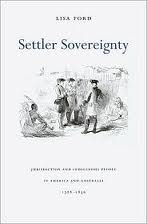
‘Settler Sovereignty’ by Lisa Ford

Lisa Ford ‘Settler Sovereignty: Jurisdiction and Indigenous People in America and Australia 1788-1836’

2010 , 210 p & notes (86p)

I’m starting to think that a good gauge for my response to a book is the resounding slap of the book as I close it, and the whispered “Well done!” or “You beauty!”  that accompanies it.  That’s how I finished Tom Griffiths’ Hunters and Collectors, and it was my response as I finished Lisa Ford’s Settler Sovereignty as well.  I’m not alone: obviously the judges of the 2010 NSW Premier’s History Award felt the same way.

I was lent this book an embarrassingly long time ago, and I have been eyeballing it rather guiltily for some time.  Any of you who follow this blog chronologically may have noticed a  preponderance of reviews of books related to Aborigines in Port Phillip over recent months.  I have been writing a paper that looks at Judge Willis and the Aboriginal cases that came before his court, and I kept deferring reading Ford’s book until I’d finished because the 1836 cut-off in the book’s title was too early for the case I was examining.  How wrong I was: I would have gained so much from this book had I read it earlier.  Ah well.

In this book Ford takes Georgia (in America) and New South Wales as two exemplars of the development of what she calls “perfect settler sovereignty”. By this she means that,  in claiming the territory of the indigenous people who were there before them, white settler governments claimed sovereignty and legal jurisdiction over them as well.  There’s shades here of  Fran in the ABC series The Librarians voicing the same assertion-  “Our Country: Our Rules.”  This had not always been the case.  Both colonies, up until the 1830s, had tolerated plurality through a combination of dependence on native expertise,  uncertainty, impotence, silence  and ‘leaving them to their own business’. But in both colonies this was to change, at much the same time and based on much the same rationales.

We might raise a quizzical eyebrow at this combination of Georgia and New South Wales.  Traditionally Canada, Australia and New Zealand have been linked together as imperial triplets on the basis of their shared relationship with the Colonial Office, especially after the American Revolution sent America off onto a different trajectory.   Certainly during Willis’ time,  Australian judges were viewed as rather suspect if they referred to American law, and they took every occasion to declare their fidelity to British justice.  However, recent work has begun considering American legal conditions alongside those of Canada/Australia/New Zealand e.g. John Weaver’s The Great Land Rush, Peter Karsten’s Between Law and Custom: ‘High’ and ‘Low’ Legal Cultures in the Lands of the British Diaspora and James Belich’s Replenishing the Earth.

In both Georgia and New South Wales, settlers did not seek to govern through indigenous hierarchies (as they did in India), and in both places indigenous people occupied arable or pasture land.  Farming did not proceed through the forcible co-option of indigenous labour, although it did run on imported free, indentured or slave labour.  But there were differences too: Georgia was surrounded by other powers (Spain, France, the Creek and Cherokee Indians), and Georgia used slavery.  There was a multiplicity of treaties in Georgia, and none in New South Wales beyond Batman’s quickly disowned ‘treaty’.  And yet, both Georgia and NSW passed similar declarations in 1830 and 1836 that abandoned the legal pluralism that both had exhibited previously, ruling that indigenous violence fell within the jurisdiction of settler courts.  They used the same legal arguments at the same time, and it is this historical congruence that Lisa Ford sets out to explore.  Her approach is strongly based in legal history and court cases, and this is the lens through which she views the world.

By linking two apparently dissimilar colonies like this, she runs the risk of leaving scholars of one or the other societies bemused.  It’s a testament to her writing that, even though the New South Wales cases were far more familiar to me, I feel that I understood the Georgian cases as well and the parallels she was drawing.  But was there something particularly special about Georgia and New South Wales, or could she have chosen any other American state  and drawn the same connections? I’m not in a position to say. Or, indeed was New South Wales the best Australian example? Henry Reynolds in his review of this book in the Australian Book Review in April 2010 thought that Georgia and Tasmania would have been a better pair for comparison because both societies took up expulsion as a way of solving the ‘problem’ of their indigenous populations.  But I think that Ford is looking not so much at the outcomes of legal actions, as the philosophy behind the legal interventions.

For the most part, her chapters are organised thematically- e.g. pluralism as policy (Ch.2); indigenous jurisdiction and spatial order (Ch. 3); legality and lawlessness (Ch. 4) etc.  She starts each with a general introduction,  examines Georgia, then New South Wales, then draws parallels and distinctions between the two.  This pattern is broken at Chapter 6 where the narrative splits into two separate streams, with what she has identified as a seminal case in each colony.  Chapter 6 focuses on a case in Georgia  while  Chapter 7 looks at the case of Lego’me in New South Wales, tried and found guilty for a particularly petty robbery (of a pipe, no less!)  as part of a more general clampdown on Aboriginal ‘lawbreaking’.  In chapter 8 she then returns to the pattern of  intertwined chapters to discuss the way that 1830 in Georgia and 1835 in New South Wales marked a turning point in settler sovereignty. In both colonies, the claim of settler ‘ownership’ of territory was now offered without question as the rationale for the extension of settler law over indigenous people .   In relation to New South Wales, she goes on to explore the way that this rationale fed into R v Murrell, which has long been viewed as the touchstone case on which all subsequent legal policy in Australia has been based.

She points out that this shift was not restricted to Georgia and New South Wales alone.  Instead it was part of the post-Napoleonic era trend of formalizing or eroding legal pluralism world-wide, including in Europe itself.   She recognizes that by ending with the great cases of the 1830s, she is creating “historical closure where there was none historically” (p.204)- and this is exactly the point at which my own work with Judge Willis fits in.

This is a beautifully written book.  It has a very disciplined chapter structure- an introduction, an argument (clearly bifurcated into the parallel Georgian and New South Wales scenarios) and succinct and thought provoking conclusions.  Fairly conventionally academic, perhaps, but certainly clear. She obviously enjoys language, images and words- she rolls words around, rejoicing in alliteration, repetition and nuance.  We see it where  she describes the imperial network of bureaucrats as they “moved about the Atlantic, Pacific and Indian Oceans with Vattel and Blackstone under their arms” (p.4), and the settlers as “savvy masters of the discourses and politics of settler jurisdiction…eager for its bounties and wary of its gaze” (p. 84).

I’ll leave the last part to her.  She is describing how the flexible pre-1820s plurality that had governed settler/indigenous relations began to chafe against hardening notions of sovereignty:

Again and again, troubled executives and their law officers tried to perfect settler sovereignty by bringing indigenous-settler conflict within the bounds of settler law.  Again and again, they tried at the very least to preserve order in their towns and on the roads that connected them.  Again and again, they were thwarted by indigenous people, by frontier settlers or by local magistrates…The period described here, then, is one of plurality in transition, when a new vision of perfect sovereignty emerged from long-practiced and institutionally entrenched pluralism. (p. 120)

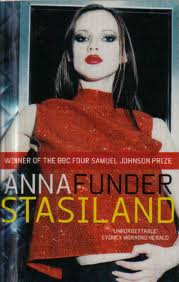
‘Stasiland’ by Anna Funder

2002, 288 p.

(4/5)

Every year for the last five or so years I have put Stasiland onto my list of selections for my face-to-face bookgroup (AKA ‘The Ladies who say Ooooh’). Every year for the past five years, the year elapsed and Stasiland wasn’t chosen.  Ah! But this year IT WAS!!!

I was a little tentative about subjecting The Ladies to yet another of my gloomy selections after subjecting them to The Land of Green Plums about Ceausescu’s Romania last year- what would they think of the Stasi in East Germany this year?  I need not have feared: the narrative was more straight-forward here, and having a young Australian journalist as the first person narrator introduced a familiar voice and viewpoint onto something that, fortunately, is not within the experience of most of us.

Funder, working as a journalist in Europe after reunification, was first attracted to investigating East Germany when a request for a program on the “puzzle women” was brushed aside by the television producers she worked with. There was, it seemed, an embarrassment about the East Germans, as if it would all just disappear if no-one spoke about it.  These “puzzle women”, she later discovered, were employed to reassemble the papers shredded by the Stasi as the wall was falling, a task that would take over 300 years at the current speed.  Methodical to the end, the papers had been shredded in order and shoved into a bag together, and so it was possible to piece them together and reveal the banality and the all-pervasive intrusion of the Stasi into the lives of East Germans.

In East Germany, it has been estimated, there was one informer for every six people.  Some of the surveillance was the stuff of farce, like the  ‘smell samples’ that purported to capture every individual’s smell for later reference.  Other surveillance was more insidious: the reports that were given to potential employers who later changed their mind about the offer of a job; the insistence that there was no unemployment when, as a result of such reports,  one could not get a job; the  warning that a rock group singing subversive lyrics would no longer exist, only to disappear completely from all public view and hearing.  Escapes that were thwarted, imprisonment, blackmail, and the withholding of contact for years with a sick baby on the other side of the wall- by such means the Stasi dabbled in one’s very soul.   There was physical torture as well, but she broaches this only at the very end of the book.  By this time the claustrophobia, vindictiveness and degradation of such minute surveillance seemed on a par with physical torture.

But of course, such intrusion and cruelty leaves no physical trace.  She comments on the memorialization- or more correctly, the distortion of memory regarding East Germany.  She notes the way that East Germans distanced themselves from the Nazis immediately after the war, as if Nazi ideology had flowed from the West and engulfed them, then withdrawn completely afterwards, leaving them innocent of it completely.  She comments on tourist industry that has arisen around the physical fact of the wall- the remnant sections, the tours- that co-exists with a nostalgia amongst some East Germans for the simplicity and security of a life without the bombardment of consumer ‘choice’ and capitalist pressure.  When she places an advertisement seeking ex-Stasi operatives for interview, she encounters men  holding onto the shreds of a Communist dream,  in denial of reunification, and hopeful of the re-emergence of the Stasi.  She finds men who have mounted their own museums to East German life; she speaks to others who have their own justifications for their actions which ring hollow and rather pathetic in a changed world.

The stories of the Stasi operatives and their victims are important, because the Stasi’s reach was not so much in physical things but in the more intangible  sense of safety, identity and autonomy.  There is no museum to hold such things.

I was particularly interested in this book because of the role of the narrator in it.  It is not an academic book as such, and I was surprised to find notes related to specific pages at the end as there had been no footnotes to alert me to their existence.   The narrator is front and centre in this book: we see through her eyes and filter through her consciousness.  At times you need to read against her prejudices- for example, with one man who, as perfect East German man, was moulded this way through his own father’s well-founded fears and insecurities as a dissident, and was to a large extent, a victim as well as perpetrator.  I’m aware of a trend in academic history,  to make oneself part of the story as well, and to use one’s own doubts, questions, misconceptions and false trails as part of the intellectual journey.  I can see its allure as narrative device, but I’m wary.

Funder is not, though, offering this as academic history.  She is upfront about her outsider status, and she documents rather than explains.  It is powerful, chilling reading nonetheless.  Timely, too, as we hear of the Egyptians gaining access this week to their files, many of which had been hastily shredded.  Just as the East Germans before them, they are becoming aware of the size and pervasiveness of the secret police and the complicity of family and neighbours in their midst.