Category Archives: Australian Women Writers Challenge 2019

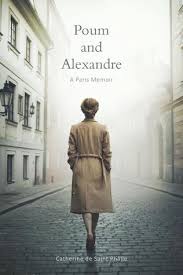
‘Poum and Alexandre: A Paris Memoir’ by Catherine de Saint Phalle

Poum_Alexandre

2016, 256 p.

There is no shortage of memoirs about parents written by their children.  Too often, there is an underlying whine of grievance in such memoirs – admittedly, quite often justified- because the parents are too cruel, too self-absorbed or too mad, and the author/child is seeking to blame or understand (and often both at once).  Alternatively, there are memoirs of parents bathed in nostalgia, sorrow and yearning: yearning for a return to a simpler time and regret for lost opportunities and all the things the author did not say at the time.

Poum and Alexandre falls into neither of these camps. It’s significant that the title makes no reference to the author at all – there’s no ‘my’ in the title- and the subtitle ‘A Paris Memoir’ emphasizes place. The book is written from the child’s point of view, but the author’s own life, and most particularly her adult life, is largely absent, except in the final section. The book is written in three parts: ‘Poum’ dealing with her mother Marie-Antoinette, nicknamed ‘Poum’ because of a childish game in bouncing down stair ‘poum, poum, poum’; ‘Alexandre’ dealing with her father; and then a final short coda involving both parents.

Both Poum and Alexandre are eccentric. Poum is a disinterested mother, just as happy to stay in bed with her books, as to spend time with her daughter. Alexandre imbues his daughter’s mind with Greek myths, praise for the Magna Carta, and tales of Napoleon. Both parents are drawn to tales of blood and savagery, and they share these with their daughter, irrespective of her age.

Their daughter, Catherine, spends much of her early life away from her parents. Born in England, ostensibly  because of the freedoms bestowed by the Magna Carta, she is largely raised by her nanny Sylvia, and Sylvia’s own family. When she finally settles in France, she can barely speak French, and the book is largely devoid of friends or any other contacts other than her family.

Told from Catherine’s point of view, there are many gaps and non-sequiturs. Alexandre is already married and has an older, first family and what seems to be an ever-increasing number of offspring that Catherine gradually learns about, but does not meet. Alexandre and Poum are cousins, and have fallen out with their families over their relationship. Poum tries doggedly to maintain relations with her own family, but there is tension and resentment, and Catherine feels it. This ‘situation’ swirls around Catherine and her parents, marking them out as different and disreputable. Perhaps it’s this exclusion that turns them towards each other in a fey, irresponsible and downright strange way.

Yet there is no judgement here. Catherine describes them with love and acceptance, even though as a reader you find yourself raising a sceptical eyebrow or huffing with disapproval at the sheer irresponsibility that both parents display at different times.   The book is beautifully written, and it certainly subverts the chronological memoir genre. It shuttles backwards and forwards, and tells events from multiple perspectives. It withholds as much as it gives.  And yet at the end of the book, you realize just how much Catherine has given you as a reader, and you are left with a puzzling and yet rich view of her parents – much how the author finds herself. This is a challenging memoir, but I suspect that I will remember it long after the ‘misery memoirs’ have merged one into another.

Read because: CAE bookgroup selection (mine). And several people on the Australian Women Writer’s Challenge website had read it

My rating: 8
AWW2019

I have added this review to the Australian Women Writers Challenge database
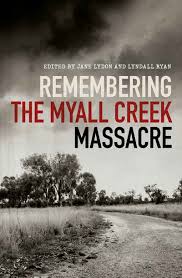
‘Remembering the Myall Creek Massacre’ ed. by Jane Lydon and Lyndall Ryan

myallcreek

167 p. & notes, 2018

The name should have been a give-away. “Myall” was an old term for “aboriginal” and it was to be expected that any outback station called “Myall Creek” would have – or used to have- a noticeable indigenous presence. Late in the afternoon of Sunday 10 June 1838, eleven armed stockmen, most of whom were expired or convict labourers, rode into Henry Danger’s Myall Creek station near Invernell in north-east New South Wales. Henry Dangar himself was absent; as were the overseer and senior stockmen. The stockmen dismounted and entered a hut where they brought out about thirty Wirrayaraay old people, women and children who had sought refuge there on hearing the stockmen ride in. They led them out, tied with a leather strap, and took them away. Shots rang out; then the stockmen rode away. They returned the next day to burn twenty-eight bodies.

It was an appalling crime, and we know about it because the perpetrators actually faced court, and seven white men were hanged. The massacre itself was not exceptional: massacres had occurred prior to Myall Creek, and they continued afterwards. But the case was marked with controversy,  both from observers appalled by it, and squatters and settlers outraged by its legal consequences. It was the last time in the nineteenth century  that  white perpetrators of frontier massacres were convicted and hanged.

In 2000 a permanent memorial was erected at Myall Creek. Eight years later the Myall Creek Massacre and Memorial Site were added to the National Heritage List. This book, comprising a number of essays by both indigenous and non-indigenous authors, was published for the 180th anniversary. The academic historians represented here – Lyndall Ryan, Jane Lydon, Anna Johnston and John Maynard –  are all well-respected within the academy. The earlier chapters focus on the massacre event itself.  The final three chapters focus on Myall Creek within the songlines and trading networks of indigenous groups the length of the east coast of Australia and tease out issues of memorialization and reconciliation. The book evokes the harshness of distance and the impunity it confers in Warwick Thornton’s film Sweet Country, even though that was set in a different place some eighty years later.

If you’re not familiar with the Myall Creek massacre, you will be by the time you finish this book, which gives a clear account of the event and the men involved. I did know about it – my own Judge Willis was bobbing around in the background as one of the members of the NSW Supreme Court, but I have been guilty of the “failure of imagination” that Paul Keating spoke of in his Redfern Speech.  This book shows that it was all there: unarmed, defenseless, frightened old women and children; white onlookers too intimidated to intervene; wide distances adding a sense of menace, and averted eyes that cloaked these stockmen with the arrogance of impunity.

In Chapter 1 Lyndall Ryan focuses on Henry Dangar, the absentee owner of the Myall Creek station, who chose not to support his employees who reported the crime. In Chapter 2, Patsy Withycombe points out that the ringleader, John Fleming, was the only one of the eleven stockmen who was not a serving or former convict, and he escaped punishment altogether, protected by local squatters. In Chapter 3, Jane Lydon places the international and humanitarian response within the anti-slavery context of the 1830s, focussing particularly on the widely circulated engraving of the prologue to the massacre titled ‘Australian Aborigines Slaughtered by Convicts’ by ‘Phiz’, better known for his illustrations of Dickens’ Pickwick Papers. Chapter 4 looks at the more local response where Anna Johnston examines Eliza Hamilton Dunlop’s poem ‘The Aboriginal Mother’ published in December 1838 and later put to music by Isaac Nathan in 1842. In Chapter 5 Lyndall Ryan asks of the massacre “Was it typical of the time?”. Building on her work on the Massacre Map, she points out that it was. All the perpetrators had been involved in other massacres. It was not unusual for incidents to take place in daylight, or be led by a settler. It was not unusual to tie the victims together and lead them to the site where they would be slaughtered, or burn their bodies afterwards. Such atrocities have their own sickening rhythm and recurrences.  Chapter 5, which has multiple authors, links the Myall Creek massacre with another massacre at the Wonomo waterhole, and argues that trade networks and songlines made it possible for different aboriginal groups along the eastern coast of Australia to be forewarned of the struggle which would soon extend to their area too. Chapter 6 ‘Myall Creek Memories’ is a reflection by John Maynard on being asked to give the commemorative address- the first by a non-indigenous historian – in 2015. Chapter 8 co-written by Jessica Neath and Brook Andrew is a compilation of interviews with advisors, architects, academics and scholars of cultural memory, over the question of how Myall Creek should be memorialized (if, indeed it should be) and its relation with other memory-sites related the Holocaust and Genocide. The book is framed by a prologue by Sue Blacklock and John Brown who worked on a reconciliation and covenant relationship between the Uniting Church and ATSI people in 1992. It closes with Mark Tedeschi’s QC’s address delivered in 2017, both as Chief Crown Prosecutor for NSW and the author of his own more legally-oriented account of the massacre and its legal aftermath.

This is an excellent book. The chapters are engagingly written, and if the chapter by Jessica Neath was perhaps a bit tedious in its format, it raised some interesting questions. It makes me wonder: will I live long enough for Australians and their governments to have the maturity and humility to look at the white settler past, and actually do something about an honest recognition and reconciliation that must come one day?

AWW2019

I have included this book in the Australian Women Writers Challenge 2019 database.

‘Saltwater’ by Cathy McLennan

saltwater

2016, 314 p

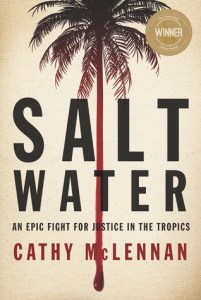
If you go by the cover of this book, with its subtitle “An Epic Fight for Justice in the Tropics”, you’re going to be disappointed. There is a trial in this book, but you won’t have heard of it. It’s just one of what I suspect is an ongoing succession of trials of young aboriginal men, whose lives seemed almost doomed to incarceration by their background of alcoholism, illiteracy and aimlessness. It’s not an ‘epic’ fight for justice, and there’s certainly no victory here.

The book is a memoir written by Magistrate Cathy McLennan, who looks back some twenty years to her first graduate job with the Townsville Aboriginal and Torres Strait Islander Legal Service, when she was aged just 22. She is not of indigenous heritage herself, and although brought up on nearby Magnetic Island, she felt largely overwhelmed working with this indigenous organization. Other non-indigenous barristers came and went, and despite her youth, she was very much thrown in at the deep end. The clerical and administrative staff were indigenous, and she relied on the guidance of aboriginal women working in a liaison capacity.  The male indigenous administrator of the organization was less supportive.

One of her earliest cases involved four young men charged with the murder of a white grog-runner. She was initially convinced of their innocence, and feels blocked by the local police.  The police, however, are not one-dimensional.  Called out to meet with a group of aboriginal people drinking in the park, she was horrified that a very young baby was lying on glass-strewn dirt. Brought right up against the dilemma of child protection vs. fear of another stolen generation, she realized that, in this situation, the police wee just as conflicted as she is.

Running alongside her involvement in this case was her ongoing contact with Olivia, to whom the book is dedicated, an 11 year old the size of a 5 year old, who was continually being locked up for robbery, and was sexually abused repeatedly. Olivia was failed at every turn: by her alcoholic mother, by child services who could do no more than come up with ‘a plan’, and by the ‘justice’ system that was content to shunt her off to Palm Island, where Olivia was even more abused than she was in Townsville.  McLennan bridles against failure at all levels that condemns indigenous children to incarceration. She could see the problem: she had no answers.  Now, twenty years later and as a magistrate, I find myself wondering if she has found a way for the system, that she is now part of, to do better.

The book is written in the present tense, and the prose is fairly pedestrian. She certainly raises many questions, and even if the book is not as “compelling” as its blurb suggests, it does add texture and complexity to a tragic and seemingly intractable situation.

My rating: 7/10

Sourced from: Yarra Plenty Regional Library.

I have added this to the Australian Women Writers Challenge database.

AWW2019

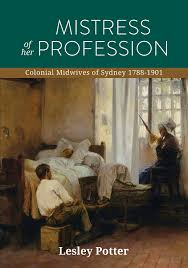
‘Mistress of her Profession: Colonial Midwives of Sydney 1788-1901’ by Lesley Potter

Mistress_Profession

2017, 133 p plus notes.

I suspect that, of all the different types of historians, family historians are probably the most attuned to the world of the midwife. In their family trees they trace those successions of births just two years apart, often over two decades; those births of the baby followed by the death of the mother in the days and weeks afterwards. Most probably, other women were present at these events, but they are largely invisible. It was this invisibility that attracted me to this book.

The author of Mistress of her Profession emphasizes the difficulty of finding these midwives within the sources, but she has managed to locate and name some of them. Having done so, Lesley Potter then aims to

discover not only midwives’ attitudes to midwifery and to understand the kind of midwifery they employed, but also to discover the attitudes of others (patients, doctors, coroners and others in authority) towards them…. the purpose is to bring the colonial midwife to life, to encapsulate her humanness, fraught with all her faults, ideals, values and anxieties: to explain and interpret her past to the present generation. (p. 6)

Her book starts with a case study, one of the eight which separate the chapters. Sarah Ann Hopkins, who boarded the Steadfast from London in 1848 as an emigrant to NSW was a trained midwife, possessing a diploma from Westminster Lying-in Hospital. As a trained midwife, she accepted the temporary position of matron on the Steadfast, working under the supervision of a Dr Read. Seven confinements took place on the ship, and not all had happy outcomes. Twenty-four year old Lydia Lever went into premature labour, triggered by dystenteric diarrhoea (it doesn’t do to think about just how awful that must have been). Her premature baby died, and she died about six weeks later. That same day a second baby was born, this time to 26 year old Jane Calder. The baby died at five days, and the next day Jane Calder’s one year old child died. Twenty year old Matilda Humpreys developed ‘epilepsy’, which was often the diagnosis of eclampsia at the time. Nor did this baby survive.   Four of the babies and mothers did survive, and one of these was Sarah Ann Hopkins herself. Just in this one case study, we have writ large the uncertainty of childbirth in the early nineteenth century.

Potter divides the midwives of colonial Sydney into several groups. First there were the convict midwives, many of whom only became midwives after transportation, using midwifery as a way of gaining respectability and a economic foothold in the colony. The second group were free immigrant midwives, often widows, who had been practising as untrained midwives in their own communities prior to immigration. Third, as the century drew on, overseas-trained midwives emigrated for a range of reasons. Finally, there were colonial-trained midwives who appeared at the end of the 19th century, some of whom were registered with the Australasian Trained Nurses Association.

The books starts with Aboriginal birthing. Probably as a result of the curiosity of early officials and naturalists, there are quite detailed descriptions of indigenous births. Although (and because?) the details in these descriptions sprang from the mindset of ‘otherness’ held by their male writers, they provided more information about actual practices in terms of pain relief and rituals than the European sources about European births did.

Where Potter was able to find such information was in the coroners’ inquests, but even in these there is not the detail that she as historian, and I as reader, wanted to know in terms of pain relief and the actual birth. What is interesting is that most 19th century cases involving midwives charged with misdemeanours associated with childbirth did not advance to higher courts (p. 41). Most often the verdict was ‘visitation by God’ or ‘natural causes’, reflecting the ignorance of an all-male jury.

Of more concern was the charge of ‘for want of medical aid’ , which spoke to the authority relationship between male medical doctors and female midwives- a familiar story even today. Midwives and nurses operated in a legal system that did not recognize them or consider them part of the health system. The law had no precedent  whereby a midwife at fault could be prosecuted, and as a result several midwives whose care was deficient, escaped sentencing. Likewise, the number of midwife-abortionists is unknown, and here too the courts were reluctant to convict.  But as the century progressed, their activities increasingly fell under the purview of the law.

The book traces through the beginnings of maternity care in Sydney, from the Female Factory in Parramatta, through the unsuccessful efforts of Dr Tierney to establish a private lying-in hospital, the development of the Benevolent Asylum, which did not have trained midwives until after 1879 and the gradual increase in private lying-in and maternity homes, especially in the 1890s. Midwifery was a commercial enterprise for women acting independently, and after midwifery training was instituted in the late nineteenth century, employment opportunities within an institutional setting increased. In terms of training, Australia followed the British trends, and midwifery became a certificated qualification, earned through on-the-job training in hospitals. However, as in Britain, midwifery training was kept separate from the training of medical men (although as Potter notes, there were men-midwives). Legislation and registration had to wait until the twentieth century.

I enjoyed the case studies which separated the chapters of these books, which generally illustrate the chapter to which they are attached.  They vary in the amount of detail that Potter was able to uncover, and unfortunately some of them are rather bare-bones, factual accounts. But even this highlights the difficulty of the task Potter set for herself.

I found the law chapters in this book the most illuminating, but even they do not really answer my questions about what it was like to give birth in colonial times. Did they sit? stand? lie? What was the attitude towards making noise? And even the most basic question- what did they do with all that boiling water that people were sent off to fetch in the movies? (or was that just a way of keeping them busy?) I recognize the paucity of the sources, but I do wonder if Potter had access to the records once training moved into more institutional settings which might have shed more light on this. Were there textbooks? Did new, more standardized techniques  replace traditional, ‘old wives tales’?

Potter has brought many of these women out of invisibility by naming them, but I’m not sure that she actually achieved her aim of bringing them to life or explaining and interpreting them to the present generation. I think that perhaps, given the limitation of the sources, her aim may have been too ambitious, and for me, still unmet.

Sourced from: Yarra Plenty Regional Library.

AWW-2018-badge-rose-199x300

I have included this book as part of the Australian Women Writers Challenge.