Category Archives: Australian Women Writers Challenge 2017

‘A Wife’s Heart: The Untold Story of Bertha and Henry Lawson’ by Kerrie Davies

wifes_heart

2017, 225p

David Marr, the celebrated biographer, has proclaimed for himself the rule that “biographers should stay out of sight”. I suspect that he would be ‘tut-tutting’ the whole way through this book, because the biographer/author Kerrie Davies is very much on-stage, using her own early 21st century experience as a lens through which to examine and reflect on the marriage and separation of Bertha and Henry Lawson.  The book both starts and finishes with Davies’ own reflections on single parenthood and she shuttles back and forth between her own memoir and a biographical examination of Bertha and Henry Lawson.

Henry Lawson, as most (I hope!) Australian readers would know, is one of Australia’s best known writers, with his short story ‘The Drover’s Wife’  forming one of the staples of school anthologies in the last century.  He wrote in the 1890s and early 1900s at a time when ‘Australianness’ was being explored in writing through the pages of The Bulletin and through the works of the Australian impressionists – Roberts, McCubbin, Streeton et al. He is a much-biographied subject, as Davies found, with biographers falling into two camps: those who blamed his wife Bertha for pursuing child support payments and hounding him to imprisonment, and those who saw Bertha as the long-suffering, separated wife bringing up her children alone.

Davies falls very much into the second category. She, too, has brought her daughter up alone when her marriage to her musician husband fell apart through his incessant travelling, and this sense of identification with Bertha permeates the book. I’m not sure that it makes good biography, but I don’t know if a ‘pure’ biography was ever her intention. Certainly she draws on primary documents, including court files, letters, memoirs, secondary sources and Henry’s own writings, reproducing important paragraphs in the text itself, and footnoting the sources at the rear of the book.  In this way she has certainly given Bertha an identity and agency. She has carefully researched the legislation governing divorce at the turn of the twentieth century, and beautifully integrates Henry, in particular, into the bohemian and literary milieu of the day.  However, as a journalist, she makes no claim to be a historian, and in describing the Darlinghurst gaol in which Henry was imprisoned, she turns us over directly to the hands of the archivist at the gaol, Deborah Beck, in a manner reminiscent of meeting-the-historian in ‘Who Do You Think You Are’. In fact, that same sense of anachronistic identification that permeates ‘Who Do You Think You Are’ is evident in this book as well, and it means that as reader, you’re taken along for the story in the present just as much for the history.

Although a very different sort of endeavour, this book evoked for me Jennifer Gall’s Looking for Rose Paterson. There’s a symmetry in that both researchers are drawing an otherwise unseen woman (a mother, a wife) out from the background of these two writers – A. B. Paterson and Henry Lawson- who are together synonymous with colonial nationalistic turn-of-the-century writing.  But Bertha Lawson was not unseen: she wrote her own memoir, her correspondence is found amongst Henry’s works, people knew her and she looms large in his lifestory as the force that he resisted and railed against, and which eventually- in the eyes of his champions- brought him undone.  The subtitle of the book is “The Untold Story of Bertha and Henry Lawson”, and Davies has succeeded in telling this untold story.  “No one is more pleased to see you yourself again than I am” Bertha wrote to Henry (p 185) during one of his recurrent phases of sobriety before lapsing into alcoholism again. In seeing Bertha, and the cycles of alcoholism and cruelty, unsuccessful reconciliations, legal maneuverings, emotional bargaining, justifications and accusation, we see  Henry ‘himself’ also.

The author’s paper to the 2015 Australasian Association of Writing Programs conference discussing her writing decisions can be found here.  (What a fantastic site! they have all the papers from decades of conferences).

Sourced from: Yarra Plenty Regional Library

My rating: 9/10

aww2017-badge

I have posted this review to the Australian Women Writers Challenge website.

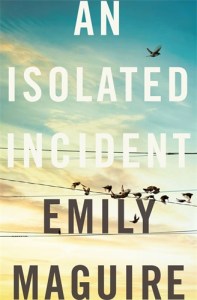
‘An Isolated Incident’ by Emily Maguire

maguire

2016, 243 p

The reviewing cycle for a much-talked-about book seems to move so quickly that, after a few months, everything seems to have been already said and people are moving onto the next new much-talked-about book. So I come- at last-  to ‘An Isolated Incident’, which was shortlisted for the Stella Prize, longlisted for the Miles Franklin and commended for the Victorian Premier’s Literary Award for Fiction.

It all makes me feel rather outgunned when I say that my response is rather lukewarm.

You probably already know that it’s about a murder of a young woman, Bella Michaels, an aged-care worker in the small country town of Strathdee.  Despite being described by the publishers as a ‘psychological thriller’, this book doesn’t really fill that description at all. Instead, it is the description of grief and the surrounding media manipulation of a murder report.  We, as readers, know as much or as little about the murder as the police do.

It is narrated from the alternating viewpoints of the murdered girl’s sister Chris, a barmaid at the local pub in Strathdee, and May, the journalist dispatched from the city to report on the crime.  The book is arranged chronologically, starting with daily entries on the 6th April, then becoming less frequent as media interest in the case wanes. Chris’s sections are written in the first person, using a conversational tone and capturing the cadences of a fairly rough, indifferently educated country woman. May’s narrative is written in the third person, interspersed with the trashy interviews and articles that she has written over this time.

For much of it,  I felt as if I were reading an article at the supermarket checkout or watching Sixty Minutes. I know that this was probably intentional on the part of the author, drawing readers into the voyeurism of crime-watching and armchair speculation.  This is just one of the things that the book does well. It also captures well the lazy, casual misogyny of everyday life, magnified further in a small town, and the juxtaposition of an active, consensual  female sexuality alongside non-consensual sexual creepiness.  Sexuality was used to manipulate by both men and women in this book.  She also puts her finger on – although does not explore further – the connections between offences that are portrayed as only “isolated incidents”

This had nothing to do with what happened to Bella and what happened to Bella had nothing to do with Tegan Miller [another woman murdered in Strathdee] and none of it had to do with the rich Sydney housewife left out to rot in the street which had nothing to do with the Nigerian girls stolen as sex slaves or the Indian woman eviscerated on a bus or the man grabbing women off the streets of Brunswick.

None of it connected, she knew, and yet, and yet, it felt like it. It felt to May, that there was a thread connecting it all, and if she could find it she could follow it back, see where it began. Rip it out and examine its source. p.343

“Rip it out and examine its source”: a noble aim, but not one achieved in this book.  Sometimes I feel as if I’ve read a book that has been consciously written for a book-group discussion or to air “an issue”.  I couldn’t quite shake this feeling when reading this book.  Don’t get me wrong- I am a member of a bookgroup myself, and know that I would happily participate in the discussions that this book is likely to generate for the next couple of years.  However, I don’t like feeling that I’ve been targeted as a market.

There’s the enjoyment that a reader has during reading, as distinct from the discussion and contemplation afterwards. I found that the book dragged and it was really only in the last 1/3 that I found myself becoming more engaged.  Until then, I was underwhelmed by the vacuity of both women, and irked by the supernatural angle that was introduced halfway through. Just as the case ambled along, with little progress, so too did this book.   Perhaps this is one of those books where its strength lies after reading it, rather than while reading it.

Sourced from: Yarra Plenty Regional Library

My rating: 7/10

aww2017-badge

I’ve added this to the Australian Women Writers Challenge 2017.

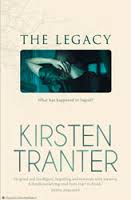
‘The Legacy’ by Kirsten Tranter

tranter

2010, 438 p.

Like all good titles,  the title ‘The Legacy’ is a double-barrelled one.  It could refer to the unexpected financial bequest that sets the chain of events in this novel into action, or it could refer to the aftermath of the news of a death.  Both interpretations work.

The novel opens with a prologue voiced by Ingrid, as her step-daughter  Fleur watches Ingrid emerging from a beating in what we assume is domestic violence.  Somehow – illogically – this violence seems incongruous with the New York affluence within which Ingrid is living.  This is the last we hear of Ingrid in her own voice.  From then on, the narrative is taken over by Julia, her friend from Australia, whose relationship with Ingrid oscillates between awe, jealousy, love and anger.

Told in retrospect, Julia’s life was financially straitened and emotionally unsatisfying. She worked at a video store while she was at university, and became friendly with Ralph, who called in at the video store and watched films behind the counter with her. Ralph was wealthy, and Julia was drawn into his wake, invited to lunches at his parents’ quietly opulent Kirribilli House, overlooking the Sydney Harbour. She was not the only young woman attracted to the Kirribilli enclave; so too was Ingrid, brought over from Perth by Ralph’s aunt Maeve when Ingrid’s parents diee.  Ingrid enchanted Ralph and his family, and when Ralph’s father died Ingrid was left a huge legacy- something encouraged by Ralph who was infatuated with Ingrid, despite his bisexual leanings. Ingrid used her legacy to travel to New York, and it was there that she met an older man, Gil Grey and his precocious young daughter Fleur, lauded as a prodigy for her artwork from early childhood.  She married him, despite the misgivings of her friends Ralph and Julia who were unnerved by his controlling nature.  The friends drifted apart.  But when news came of Julia’s death in the Twin Towers (and how telling that I just need to say ‘Twin Towers’ and you know exactly what I mean), the increasingly-ill Ralph dispatched Julia over to New York to find out what happened to her and to fill in the details.

This is a long book – 438 pages- but I didn’t find that it dragged.  The first 2/3 of the book reminded me of an Antipodean Brideshead Revisited or Great Gatsby, with the outsider narrator watching wealthy people living out their greed and insecurity. There is an artificiality and staginess to the lives of these wealthy and ruthless people, and the glamour of the New York art scene does not disguise the curdled ugliness of  these so-called ‘ beautiful people’.    The last 1/3 of the book took on the pace and tone of a mystery, although its ending was too open-ended to be really satisfactory on that score.  The descriptions of both Kirribilli and New York were well-drawn, and the dialogue flowed  so naturally that it was barely noticeable.  There were too many paranormal deadends – a neighbour who read tea-leaves and too many dream sequences- but she captured well the uneasy line between enterprise and exploitation, sexual adventureness and abuse.  The book was an amalgam of a coming-of-age love triangle, shot through with a mystery.  It worked for me.

My rating: 7.5/10

Read because: CAE bookgroup (the Ladies Who Say Oooh)

aww2017-badge I’ve posted this review to the 2017 Australian Women Writers Challenge.

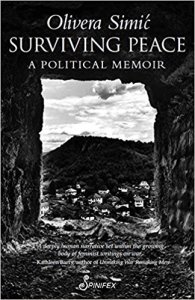
‘Surviving Peace: A Political Memoir’ by Olivera Simic

simic

2014, 188 p

It’s not often that I open up a book and find myself thinking “Hey! I was there!” I did in this book, though, where Olivera Simic starts by describing an encounter at a law and history conference in Melbourne. [Those of you who have been with me since 2010 might vaguely remember that I was involved in the organization of the ANZLHS Law and History Conference that year. For me, any recollection of the conference is completely overwhelmed by the accompanying memory of leaving quickly after the last session to sit with my mother at her nursing home. She died the next day.]

Olivera Simic’s recollection of that conference, though, involves a quick interaction she had with the chair of the panel who asked how he should introduce her.  ‘Where are you from?’ he asked. ‘Yugoslavia’ she replied. ‘But that country doesn’t exist!’ he countered, finding the interchange sufficiently bewildering to share it with the audience.  Several people came up to afterwards, saying that it was very unusual to hear someone still introducing herself as Yugoslav.

But I do. I am a Yugoslav without Yugoslavia. I identify with the country I was born in; I am homesick for the place that exists only in my distant memory: the beautiful old towns, rivers and mountains, and the part of the Adriatic coast that was Yugoslavia. I speak a language that was declared dead when the war broke out in 1992. I was fortunate not to lose a close family member, but like many Yugoslav people, I lost so much.  The beginning of the war meant the end of my physical belonging to the country I was born and grew up in, the country I loved, the country I left and soon abandoned.  I tried to move on, to forget destruction and war, to run away from it all… The further I was from home, the closer home was to me, to my heart, to my mind.  The connection to my homeland was not severable to distance but, as many migrants will know, on the country, was made stronger by it. The smell, the sound, the sky and the sun of my home haunt me. They are always with me. (p.10)

We hear and read of people surviving war, but less often surviving peace. Simic was born in 1973 and spent her childhood in Banja Luka, the second-largest city in Bosnia and Herzegovina (BiH). Her parents are Orthodox Serbs and were members of the Community Party before the 1990s in what she regarded as “a heterogenous multicultural, multilingual and multireligious community.” (p11) When war broke out in 1992, her parents sent her as a nineteen-year-old to neighbouring Serbia, her mother’s home country, where she was granted refugee status and enrolled in law school. She lived in Serbia, with occasional dangerous trips home to see her parents, from 1992 through to the 1999 NATO bombing during which, for 78 days,  she along with her fellow residents, lived in a permanent state of fear and anxiety. She was –  and still is – angry at the world for allowing this to happen, and after September 11, the emotional and existential burden of this experience devastated her in the form of PTSD.  At the end of the war, she was no longer ‘Yugoslavian’  but, on the basis of her surname, was designated to be Serbian – “a specific, but somehow alien ethnic identity”  that it had never occurred to her to apply to herself previously (p.21). Her mother-tongue, Serbo-Croation ceased to exist, replaced by other languages (Serbian, Croatian and Bosnian).

Our labels of ethnicity have overridden our very being and make it impossible for us to be recognized first as people, and only then as an ‘ethnicity’. (p.25)

In 2001 she started work with Human Rights Watch in Washington DC. She completed an M.A. in Gender and Peacebuilding in Costa Rica. Since 2006 she has lived in Australia, and after gaining her PhD., worked as an academic writing on genocide and war crimes, most particularly (but not only) those committed by Serbs, and on trauma more generally. It’s an academic path that her parents and neighbours back in BiH try to dissuade her from, seeing her as a traitor to their concept of the Serbs as both victims and heroes.  She is aware that she is part of the ‘industry’ of postwar recovery and reconciliation, organizing seminars and workshops, receiving grants to carry out research on armed conflicts.

One of the paradoxes of experiencing violence first hand is that it can give unconditional power and authority to one’s voice, and people who have not had these experiences might feel as if they cannot say anything worthwhile (P 102)

She is aware, when faced with representatives of Srebrenica (where thousands of Muslim men and boys were slaughtered by members of the Serbian forces) that she, like other academics, could be seen “as ‘conference tourists’, building our careers on the misery of survivors.” (p. 104) It doesn’t sit well with her.

I have summarized her story as a continuous, chronological narrative, which is not the way she has structured this book. There is a timeline of Yugoslavia’s disintegration as an appendix, but it acts more as an organizing device after reading her memoir, rather than during it.  Instead, her chapters are titled as paradoxes and opposites:  Journeying through War and Peace; Traitor or Truth Seeker? Moving from War to Peace; The Past Is Present; Victims and Survivors; Between Remembering and Forgetting.  There is no narrative tension of wondering if she will survive or not: no tales of want or deprivation.

Instead, this is a memoir of the intellect. She refers often to other writers and theorists and her bibliography is rich with academic references.  I was puzzled by her subtitle ‘a political memoir’ because this is so much a memoir of the head AND heart, until I remembered that old feminist touchstone ‘the personal is political’.  The blurbs on the back cover clearly place it within a feminist tradition, and in her preface she explains:

In feminist research women are considered to be experts regarding their own lives who communicate and reveal the narratives about the events that took place in their lives, their feelings about those events, and their interpretation of them (Foss and Foss, 1994 . 39) … Although mine is an individual story, I believe that on many levels it is also universal . My experiences of war and survival are similar to those of other war survivors…This is…why I have been motivated to embark on this emotional journey which sometimes links intimate experiences with existing scholarship. (p. 2, 3)

It is, then, her story but analyzed from an academic perspective, and interwoven with literature, history, genocide studies, trauma studies, human rights and peace studies.  It’s not the sort of memoir that will make you cry, but it will make you think.  I watch television and those streams of Syrians, carrying children and one or two plastic bags (what do you pack?); I hear predictions that partition might be the only solution for Syria and I think of Simic’s resistance against having an ethnic identity forced upon her by war.  I think of Simic’s need to weave her own experience into a larger philosophical and intellectual web – to make it mean something more.  It reminds us that the victims of war need to become survivors of peace, as well.

Source: Yarra Plenty Regional Library

My rating: 8.5/10

aww2017-badge I have posted this review at the Australian Women Writers Challenge website.

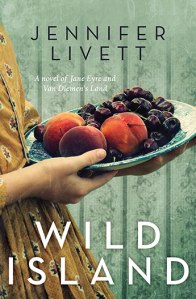
‘Wild Island’ by Jennifer Livett

livett

431 p., 2016

From the opening lines of this book, you hear echoes of a book you have read before:

Reader, she did not marry him, or rather, when at last she did, it was not so straightforward as she implies in her memoirs. Jane Eyre is a truthful person and her story is fascinating, but some things she could not bring herself to say. Certain episodes in her past, she admits, ‘form too distressing a recollection ever to be willingly dwelt upon’ .. My name is Harriet Adair, and forty years ago on that ship I was Jane Eyre’s companion (xii)

Thus begin Harriet Adair’s own memoirs, written forty years later.  Readers of Jane Eyre have met her before, as Grace Poole, caring for the mad Bertha Mason at Thornfield.  But in this telling, Bertha did not die in the fire thus freeing Edward Rochester to marry our Jane.  The woman we knew as Grace Poole was really Harriet Adair, and Bertha was instead  Anna – not Antoinette as in Wide Sargasso Sea, a model for this book in extrapolating and subverting Jane Eyre into a new story. There was a way in which Edward would be free to marry Jane, but it involved sailing to Van Diemen’s Land to seek out Captain Booth, now a commandant at Port Arthur Penal Settlement, who was the only man who could confirm an earlier marriage that would invalidate Edward’s marriage to Anna (Bertha). Part way along the journey it is decided that Edward and Jane will return to England, and so off they sail back into the northern hemisphere to become shadowy, background characters who tether this book to its original inspiration but play no further role.

There have been other books that have sprung from a much loved story – Wide Sargasso Sea is one; Pemberley is another- but in this book Jennifer Livett has added another level of difficulty.  The opening pages have two lists of characters: the first a list of historical characters drawn from the real-life inhabitants of Van Diemen’s Land in the late 1830s and early 1840s; and the second a list of fictional characters, some of whom have been taken from Jane Eyre, others created to mingle with the real-life Hobartians.  The research for this book is exhaustive- and exhausting.  In her acknowledgments at the rear of the book, the author mentions that this book has been forty years in gestation, and I believe it.

From my own research into Port Phillip at the time that this book was set, I know these historical characters and, for me, there was a little leap of recognition as if I’d seen Tulip Wright (who later turned up in Melbourne) in his brilliant-hued waistcoat, disappearing around a corner.  You probably know them too. We’ve met Sir John and Lady Jane Franklin in several books previously (see here and here),  and Mathinna from Richard Flanagan’s Wanting makes an appearance. John Gould the bird-artist and his wife Eliza are here too, and there’s even Mad Judge Montagu and Charles Swanston, the bank director whose finances propped up the Port Phillip expedition, now immortalized in one of Melbourne’s main streets.

Livett has a beautiful turn of phrase: take for example her description of black swans, heads-down feeding, looking “like black mops floating on the surface” (p. 245).  Her ear for dialogue and her historical felicity are first rate. The details are absolutely accurate but -oh- there are so many of them and I often found myself wondering if a reader less steeped in Tasmanian/Port Phillip politics would find them overwhelming.

One of my favourite quotes about Port Phillip society is the Port Phillip Gazette’s observation that “Melbourne boils over like a bush cauldron with the scum of fierce disputes”. It’s a characterization of colonial life which holds true for many of nineteenth century port towns across the British Empire including Hobart. In this book we are taken to the factional conflict  between Sir John Franklin and his colonial secretary John Montagu, an adherent of the Arthurite faction who had prospered under the long governorship of Franklin’s predecessor Lieutenant Governor George Arthur. We are taken to the politics of the transportation policy and its change over time, with the cessation of the assignment system.  At times the narrative becomes a vehicle for explaining the politics, and at this point, it threatened to collapse under the weight of so much didacticism and so many peripheral characters.

And yet, even for a reader familiar with this period of Tasmanian history, reading this book brings this history alive, especially the world of middle-class women who have been swept up into the circuits of empire through the postings of their husbands to official positions throughout the Empire.  Livett captures well the jostling for position, the grabbing at opportunities that opened up in a settler-colonial economy, the importance of patronage and   the censoriousness among women restricted to a round of visiting and levees and balls. She is completely at home with the ‘networks of empire’ conceptualization of colonialism that underpins much recent historiography:

…there are always more connections than we know about, across the widest spaces. So many links between the colony and England, most of them fluid. Water, ink, blood, each carrying its own cargo. Frail ships criss-crossing the seas, their holds packed with innocent-looking objects as dangerous as guns: china tea sets; bolts of flannel; packets of seeds and bank drafts. All bearing the message that there are certain ways in which life must be lived, and ways in which it most assuredly must not.” p 44

At the same time, the author is pulling the strings of the Jane Eyre connection, with the question of whether Rowland Rochester  (Edward Rochester’s brother) had ever lived in Tasmania providing the narrative pull of the story. St John Wallace, Jane Eyre’s rather wet (in my opinion) cousin is here with his wife Louisa, and Anna (the former mad Bertha) moves in and out of the story.

It’s a long book, but Livett has maintained Harriet’s narrative voice throughout the alternating chapters which switch between Harriet’s first person point of view and a third-person omniscient narrative.  It is this high-wire act of playing out a twist on the Jane Eyre story, while maintaining such historical integrity that most impresses me about this book. But then I find myself wondering: is there such a thing as too much historical integrity? I suspect that there is; and I think that the book threatened to be engulfed by it, even for someone familiar with and appreciative of its fidelity.

And so, my praise for Wild Island is not completely unalloyed.  Livett has aimed high, but much though I admire the accuracy and richness of her historical rendering of Van Diemen’s Land, I wonder if it ensnared her in details and explanations that stopped this book from really soaring.

Source: Yarra Plenty Regional Library

My rating: 8/10

I’ve posted this review at the Australian Women Writers Challenge website. aww2017-badge

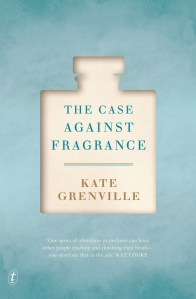
‘The Case Against Fragrance’ by Kate Grenville

grenville_fragrance

2017, 173 p & notes.

The genesis for this book was Kate Grenville’s own increasing sensitivity to the fragrances of perfumes, room fresheners, cleaning products and cosmetics.  She found herself overwhelmed by the perfume of a fellow audience-member at the opera; she reeled back from women’s scent at book signings and book festivals, and covered her face with her scarf as she sprinted through scented hotel lobbies.  (I must confess that part of me whispered “first world problem” at this stage.)

It was when she went looking for an accessible, user-friendly book about fragrance that she found there was none. This, then, is the book she wanted for herself: “straight-up, reliable information- a book for the general reader that gathered together what people knew about fragrance” (p. 13). She turned to published studies in scholarly journals where she could, and used science reviews funded in the interest of public health by the United States, EU and other governments.

This book aims to balance things out, not by trying to persuade, but by presenting some of what’s known about fragrance.  Armed with a bit of information, readers can make up their own minds.  Using fragrance is a choice, and my hope is that this book might give people the chance to make that choice an informed one. (p. 15)

Yes- but there is a tone of the wagging figure that pervades this book.  Her studies- and they are exhaustive in this footnoted but confidently and engagingly written book – make much of the chemical complexity of the products she is examining with the full, multi-syllabic names written out in full, as if to emphasize their foreignness. I found myself reflecting, though, that the whole world examined at molecular level like this is a convoluted jumble of unpronounceable and convoluted terms.  I turned to my fragrance-free moisturizer and its tongue-twisting list of ingredients, and it sounds just as chemically-daunting as the fragranced cosmetics and perfumes she describes.

I am not a scientist, and neither is she. I don’t know how to talk back to her description of these studies and the conclusions she takes away from them.  For that reason, I was interested in Ian Musgrave’s (Senior Lecturer in Pharmacology at University of Adelaide) commentary on the book in the Conversation. While generally positive about the book and especially its accessibility, he provided qualifications about some of the claims in the book, especially in relation to hormone disruption.

Yes, it is true that fragrance is produced and pushed by industry, and supported by its own lobbyists and funded research bodies. It is true that we layer one fragranced product over another, probably skewing any tests of side-effects conducted on a single product alone by compounding it with countless other similarly-fragranced products.  Yes, I agree that, just as we look back in bewilderment at how meekly we accepted having cigarette smoke blown all over us, one day wearing a strong perfume will be seen as similarly inconsiderate.

aww2017-badge

I have posted this review to the Australian Women Writers Challenge website.

‘Bush Studies’ by Barbara Baynton

baynton

1999, 140 P

A funny thing happened on the way to reading this book. I’ve been aware of it for some time, and always thought that I’d read it sometime but I never actually did anything about doing so. Then, last December, it turned up as our read for CAE bookgroup, even though no-one had selected it. When the secretary for the group rang to complain, she was told that another book that we had selected would be sent if it returned on time.  We’d have two books to read over Christmas, but that was no problem. When the second box of books arrived she opened it, only to find another book we hadn’t selected (Reading in Bed reviewed here). And so, here I was finally reading Bush Studies, even though I didn’t really mean to.

The version that I read started with an introduction by Elizabeth Webby. I often don’t read the introduction until I’ve finished a book, figuring that I need to read the book first before I want to engage with someone else’s opinion about it.  However, in this case I did read the intro, and I’m glad that I did so, as Webby’s introduction was followed by a memoir of Barbara Baynton written by her grandson in 1965.  In Webby’s introduction she follows Sally Krimmer and Alan Lawson in virtually debunking the whole of the family story that Baynton had put about and that her grandson had swallowed.The effect of this debunking was to put me on my guard as a reader, and alert me to the fact that this was one slippery woman.

Bush Studies is a compilation of short stories, and as I have said many times, I struggle to review a volume of short stories, aware as I am that what I am reading has been consciously curated from a selection of material that was written as stand-alone stories.  The first story, A Dreamer, was about a daughter returning home to her mother in a storm.  It was all very dramatic and Wuthering-Heights-y, and rather predictable.

The second story, Squeaker’s Mate is probably her best known story and one of the strongest in the collection.  The woman, unnamed until the end of the story, has been the mainstay of a timber-cutting partnership, hardworking and stoic and quite frankly taken advantage of by her feckless partner, Squeaker. When she is injured, it doesn’t take him long to find a substitute. There’s no freedom in this bush: it’s grey and harsh, just like Squeaker’s Mate’s prospects.

In Scrammy ‘And  an old shepherd is left to mind the selection. He talks to the dog to quell his fear that Scrammy ‘Hand- a bushman thief- would rob him. I found myself reading this book as a historian, mindful of John Hirst’s work on ex-convicts and their place amongst small selector society.  She’s writing from experience here, and it’s historically pitch-perfect.

The story I admired most was Billy Skywonkie, where a Chinese girl travels out to a selector. Racism is an unsettling undercurrent that runs through the story, and there’s no heroic bushman here. The story thrums with menace.

I have no idea how to read Bush Church at all. Is it a comic piece?

The final story The Chosen Vessel reminded me, as it does most readers, of Lawson’s The Drover’s Wife in the isolation and stoic vulnerability that being left behind in the bush engenders.  It’s not a snake she’s frightened by, but a man – not unlike the old convict in Scrammy Hand, but she has more to fear that mere robbery. I’m not sure about the Virgin Mary twist at the end though, and the story was chilling enough without it.

No wonder Barbara Baynton has been placed in the constellation of late nineteenth-century ‘bush’ writers but it’s a different bush that she’s writing about in her stories. There’s no ‘legend’ here. There’s isolation, racism and menace in this bush, and it brutalizes men who brutalize women in turn.

Sue at Whispering Gums has written several separate posts on Bush Studies, where she writes far more thoughtfully than I have done, as I’m writing some two months after I read the book. Both Squeaker’s Mate and Billy Skywonkie have stayed with me, which speaks to their strength I think, because short stories tend to wash over me a bit. and I must say that I’m glad that I’ve finally read Bush Studies (even though I didn’t mean to!)

Source: CAE bookgroup

aww2017-badge

I’ve posted this review to the Australian Women Writers Challenge.


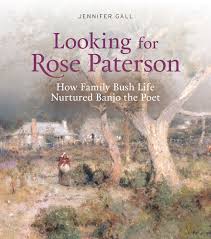
‘Looking for Rose Paterson: How Family Bush Life Nurtured Banjo the Poet’ by Jennifer Gall

rosepaterson

2017, 192 P & notes

I can remember how disappointed I felt when I first read Graeme Davison’s article ‘Sydney and the Bush:an urban context for the Australian Legend’, published in Historical Studies in October 1978 [1]. It was written some 20 years after Russel Ward’s The Australian Legend and it argued that the bush legend sprang not from the trenches of the goldfields or Gallipoli, but from the streets of central Sydney. How un-bush-like!  I couldn’t remember the details, but I did remember a map of Sydney, with dots depicting all the places where the ‘bush’ writers (Lawson, Price Wurung) lived, often in boarding houses and close to the radical centres of urban Sydney life.  Where were the ‘lowing cattle’ and  stringy eucalypts there?, I wondered.

I’ve only just gone back to look at the article to refresh my memory, and my eye snagged on Davison’s qualification that “’Banjo’ Paterson was the one important figure with even fair ‘bush’ credentials” (p. 192)  That’s good, then, because I’ve just finished reading Jennifer Galls’ book Looking for Rose Paterson: How Family Bush Life Nurtured Banjo the Poet. The crux of her argument is that Banjo (Andrew Barton) Paterson’s  short stories and poems like Clancy of the Overflow  and The Man from Snowy River drew on his childhood upbringing in small country towns in New South Wales (close to Orange and then Yass) and the influence of strong women of the bush- women much like his mother, Rose.

The author, Jennifer Gall is a curator at the National Film and Sound Archive in Canberra, and this is at least the second book of hers that has been published by the National Library of Australia.  I’ve been thinking about why a library, in particular, might publish a book about an individual.  In some cases, the subject has achieved fame, and the documentation held by the library or museum might be published to add an extra dimension to their already-public character (I’m thinking, most pertinently, of Germaine Greer’s archive which is about to become available from the University of Melbourne archives).  Alternatively, the library or museum may hold a collection that is notable for its completeness, or the illumination it throws on otherwise-undocumented, lived experience, but the creator him/herself is unknown (and I’m thinking here of the Goldfields Diary held by the State Library of Victoria). In such cases, the publication of a hard-copy, illustrated book would be a way of bringing the wealth of that particular archive to public attention.

Looking for Rose Paterson is a combination of both these spurs to publication.  As the title and cover design lettering suggests, this book is indirectly a commentary on the famous Australian writer Banjo Paterson, but the larger emphasis is on his mother Rose Paterson, rather than her son.  The book is based on the collection of thirty nine of Rose Paterson’s letters written to her younger sister Nora Murray-Prior between 1873 and 1888 and available online at  http://catalogue.nla.gov.au/Record/650061  The letters had once been part of the Murray-Prior estate and were crammed into an old sea-chest that had been cleared out of a family home.  In this regard they are like the family letters of any family that has had the education to generate and value the letters in the first place, and the wealth and stability to keep family documents through a limited number of shifts of location and strong family ties. The letters were purchased by academic Colin Roderick,  author of several books on Henry Lawson and Banjo Paterson, who recognized the significance of the placenames and personalities (Banjo himself and  Nora’s step-daughter the author Rosa Praed) and hence the letters also have value because of their links with famous people. Roderick  published the letters in 2000 and offered the letters to the National Library.

So who was Rose Paterson, other than Banjo Paterson’s mother?  In her own right, she lived and died without recognition beyond her family. She was born in 1844 in Australia, four years after her parents had arrived separately in the colony on the same ship. She was part of the lineage of a pioneering pastoral family. Her mother had educated her at home, along with her siblings in a standard classical education- English and French, and an introduction to the rudiments of Latin, Greek, German and Italian.  She married at the age of 18 in one of those sisters-marrying-brothers constellations found in many family trees. Her husband, Andrew Bogle Paterson  was often absent on pastoral work on the three stations co-owned by the brothers in NSW and Queensland.  When the elder brother John died suddenly at the age of 40, his remaining brother Andrew lost the stations but was kept on at their Illalong station as an overseer.  It was in this environment that Banjo Paterson grew up, with his three siblings and cousin, and it was here  at Illalong that Rose wrote to her younger sister Nora, who lived with her much-older husband Thomas Lodge Murray-Prior along with her twelve step-children and eight own children. One marvels that Nora had time to correspond, but judging from Rose’s side of the correspondence (Nora’s is lost), she clearly did, facilitated most probably by money and material comforts that her sister Rose lacked.  After the death of Rose’s husband in 1889, the connection with Illalong was severed and Rose shifted to her mother’s house at Rockend, in Gladesville, Sydney where she died in 1893 at the age of 49.

These are just the sort of letters that a historian craves. There is continuity and detail, and they provide an entrée to the world of women who have intermarried into a small subset of pastoralist families and who are known to each other.  Although Rose’s life at Illalong was hard, she maintained her connections with her much more genteel and refined pre-marriage life. The line between a wealthy squatter and an impoverished one was a permeable one because of clan connections, particularly in the Scots pastoral fraternity.  If you’re looking for details of interactions with the indigenous people who had either been ‘turned away’ or still lived and worked on the stations, you’re not going to find them here. Instead, through the intimacy of sisters who see each other on occasion at their mother’s house in Sydney and who take an interest in their nieces and nephews, we gain a family-based, woman’s-eyed view of childbearing, motherhood, parenting and social life. In this, I was reminded of the repository of letters by Anna Murray Powell in Upper Canada, and Katherine McKenna’s wonderful use of them in writing A Life of Propriety.    However, in Gall’s book the narrative is driven by themes rather than chronology, and what rich themes they are!

In Chapter 1 ‘This poor old prison of a habitation’, the circumstances by which Rose ended up at Illalong are detailed, but the chapter then moves to a discussion of sewing, mending, trousseaus and marriage.  Chapter 2 ‘All utilities and no luxuries’ highlights the drudgery of farming, the isolation and cheerlessness of living on a remote station, and the financial strain of drought and the poor remuneration for overseers.  Ch. 3 ‘Smuggle a bottle of chloroform’ was absolutely fascinating in exploring the experience of pregnancy – a topic that is delicately avoided in most colonial correspondence, particularly when the correspondence itself is infrequent, addressed to and read by the men of the family, and covering months of news, rather than the day-to-day.  The two sisters write about the pregnancies, births and losses of mutual acquaintances, and Rose’s letter to Nora after her nine-month-old baby died gives the lie to the assumption that parents were inured to the loss of children at a time of high infant mortality.  They write of the search for doctors, or failing that,  ‘gamps’ – midwives- and plans for confinement where there will be assistance. Gall points out that Australian women were more likely to call on a doctor during their confinement than women in Britain and Europe, who turned to midwives instead, suggesting that this might reflect the disproportionate rate of men to women in early decades of Australian settlement.

There is an abrupt change of pace and direction in Chapter 4, where Gall returns to the ‘Banjo’ thread of her narrative.  I found this rather jarring, as the spotlight is turned to the son, rather than the mother.  Having noted the dearth of commentary about Aboriginal people in Rose and Nora’s letters, it was startling to turn the page to see a full-length portrait photograph of Banjo, known to the family as ‘Barty’, aged possibly 2 or 3,  sitting on a chair with his Aboriginal nurse Fanny, who was barely more than a child herself.  Rose accuses ‘that horrid Black Fanny’ of allowing him to climb trees and injure his arm, but there is no other comment in the text (and presumably in the letters) of the presence of Aboriginal people on the station or in the domestic setting of the home.  This chapter is more chronological, briefly tracing through Banjo Paterson’s career,  the writing of Waltzing Matilda and his work as war correspondent.  Was this chapter necessary? I think maybe not, or perhaps it could have been better incorporated into the introduction, because it broke the narrative thread of the other chapters.

Chapter 5 ‘Judicious neglect and occasional scrubbing’ returns to the domestic world of childcare, child rearing and education. As an educated woman herself,  Rose placed high importance on education for both her sons and her daughters, and she sought to secure the best tuition she could with the limited money available to her.  For her sons, this involved boarding in Sydney to attend Sydney Grammar School, but for her daughters this involved tuition through a governess, and later through boarding with school teachers in nearby Yass, and the passing on of skills from one sister to another.   Chapter 6 ‘No better dower than a good education’ continues this theme, describing the career paths and life choices available to Rose’s and Nora’s daughters.  Rose’s awareness of the literary success of Nora’s stepdaughter Rosa Praed, and her responses to the books that she is reading hint that Rose could, perhaps, have been a writer herself – like Louisa Lawson perhaps? Chapter 7 ‘We shall have a fine houseful’ describes Roses’s social life and larger cultural world, which encompassed what could be termed ‘bourgeois’ families in the local area, wider contacts within the intermarried squattocracy families, and at her mother’s house in Sydney.  The chapter discusses etiquette, the importance of the piano, visiting protocols, weddings and country balls- and here again I was reminded of the Powell family in Upper Canada and the transference and ubiquity of middle-class domestic practices  across the colonies of the Empire.

The book finishes with a short summary of Rose Paterson’s legacy and returns to the theme announced in the title of ‘How family bush life nurtured Banjo the poet’ – something that I wondered if Gall was going to return to at any stage.  The book closes with an expression of regret that no photo had been found of Rose, but as we read in the obviously-later-written introduction, there is a photograph of her- and what a beautiful photograph it is.

The book is interspersed with reproductions of Rose’s letters on yellowed paper, with the ink faded to brown, and occasionally cross-written (the historian’s curse!). There are lengthy quotes from the letters in the text, marked with the icon of a pen-nib to denote when the original has been reproduced on the adjoining page, and as a reader you never felt that the author was holding the sources back from you.  The book is lavishly illustrated with images, only few of which relate directly to the Paterson family.  At times I wondered if the images were being used  too tangentially.  Barely two pages of text passed without an illustration, and the ‘coffee-table’ presentation tended to  detract from the scholarship of the work, in the quest for atmosphere and context.

I very much enjoyed this book.  As a historian of a ‘famous’ man myself, this archive of correspondence is just the sort that I craved and sought in vain,  in trying to flesh out the domestic world that lies behind us all- famous and unknown alike.   Gall has served us well, in presenting the archive, contextualising it within the milieu of nineteenth century Australian pastoralism,  and drawing out the themes of women’s lives in that class and environment.  I felt sorry to leave Rose- or rather, sorry that she left us- a sure sign that a  letter can reach  across time and generations.

[1] Graeme Davison ‘Sydney and the Bush: an urban context for the Australian Legend’ Historical Studies, vol 18, no 71, October 1978.

Source: Review copy NLA, courtesy Scott Eathorne, Quikmark Media

My rating: 8.5/10
aww2017-badgeI am posting this review to the Australian Women Writers Challenge.

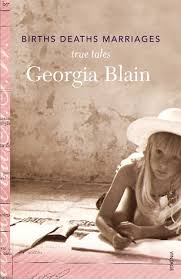
‘Births Deaths Marriages: True Tales’ by Georgia Blain

blain

2008, 224 p.

When an writer dies, I often make a point of reading one of their books. It’s an act of tribute, I suppose, even though the reality is that all books live on beyond their authors eventually.  Although the book has to stand on its own merits, the recent death of the author probably does affect the way I read it. With an older author I read the book as the affirmation of a career, and with a younger writer it’s with a sense of lost opportunities and books not written.

This is particularly the case when the book is a beautifully crafted memoir, as Georgia Blain’s Births Deaths Marriages most surely is. As the daughter of the writer Anne Deveson, Georgia Blain died recently with a brain tumour at the age of 51, one day before her mother also died after many years living with dementia. In this series of autobiographical essays, we have met the whole family- mother, father, husband and daughter, and the overwhelming feeling that I am left with is: “I think I would have liked you”.

The book starts and finishes with a chapter titled “A Room of One’s Own”. In the opening chapter, Blain returns to her childhood home, now up for auction, and remembers her mother typewriting in the 1970s as her children waited resentfully in the doorway, for the tip-tap of the typewriter to finish. In the essay that closes the book “A Room of One’s Own II”, she is now the writer, jostling with her husband Andrew for space in the shed at the back of their ugly house to use as a workroom.   The essays between these two bookends are arranged roughly chronologically, as she writes about her years in an ‘opportunity’ class for gifted students, travelling with her mother and brothers to Adelaide after her parents separate, losing her virginity, establishing a relationship with film-maker Andrew after other unsuccessful relationships, marriage counselling, having a child, buying a dog.  Her description of her ambivalence about motherhood is one of the most honest and raw accounts that I have read. Her descriptions of place are almost cinematographic: you can feel the hot prickle of the Adelaide summer; smell the salty tang of Sydney beaches and the dust of Terowrie, a disintegrating outback town, seems to coat your skin.  As with Helen Garner’s work in sketching both people and place, I liked the sharpness of her vision, as if she is looking through a window that is cleaner than the one I’m behind.

The book itself is not new: it was published nine years ago in 2008. Even though as the title suggests, the book is about relationships, it is also very much about the act of writing itself.  In an interview with Sophie Cunningham in Meanjin in 2008, she explains that the book started as a Ph D and that several chapters had been published in a range of literary journals, each with different editors. At the time of writing it, she had already published four novels and she reflects on her decision to write from her own life:

There is a private space and a public space, and within each there are many layers. I wanted to hold the private up to the light, to look at it and put it out there on the table for public viewing, but I need to think carefully about how I wanted to do this. (p. 128)… I believed and still do, that if I wrote about my own life and lives of those I love, I had to tell the truth. But foolishly, I believed the truth lay only in the immediate. (p 130)

It’s an odd mixture of the very ordinary  set alongside the particular circumstance of being the child of two journalists who had their own public personas, and as the sister of a brother whose schizophrenia was explored publicly in her mother’s own book Tell Me I’m Here. Most particularly, the essays are a conversation on paper with her parents as professionals.  She listens, with embarrassment, to an old tape of an interview her father conducted with Germaine Greer and realizes how ineffectual he was as journalist.  She describes her ambivalence over her mother’s writing about her brother, Jonathan, thereby making his story public property, in much the way that she has herself done in this book.

Indeed, much of the book is a dialogue with her mother as writer. After years of writing non-fiction, Anne Deveson tried to write a novel but was frustrated because it kept turning into autobiography or reportage. Blain, already a published novelist, decided to switch in the other direction:

We had switched places, my mother and I. And we looked at each other. Both mothers. Both writers. Both trying on each others shoes, taking a few steps back, eyes on our feet, before we glanced across, once again, curious as to how this had happened. (p 158)

Even though the chapters are self-contained, there is a real unity to the book, best captured by the circularity of the opening and closing chapters. She writes about the narrative problem of ‘finding’ the ending in a memoir, when life that still offered more. She found that she had reached the end of the book, almost without realizing it:

There was no need to search for it. It is right here where it had all looped back on itself, complete in this moment. Here is the place to stop, to pause before the next swoop of the arc continues following the path of all that has gone before, the same shape but a different line. (p. 163)

And a different line it certainly was to be, nine years later, even though she did not know that at the time.  Last year Georgia Blain began contributing a column to the Saturday Paper, talking about the brain tumour and the world of illness that she had been plunged into. The columns stopped late in the year.  Her friend, Charlotte Wood, wrote a beautiful tribute in the last edition for 2016. Yet in many ways and unconsciously at the time, Blain herself leaves us with her own words of comfort:

Because this is the place where I am, like my mother, writing about us. And I have so much more than I ever hoped for; I have love, work that I want to do, and a couple of rooms to move between each day.

My rating: 9/10

Source: Yarra Plenty Regional Library as an e-book.

aww2017-badge

I have linked this review to the Australian Women Writers Challenge 2017


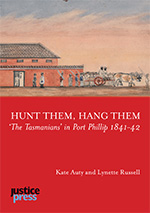
‘Hunt Them, Hang Them’ by Kate Auty and Lynette Russell

hunt-them-hang-them-cover

2016, 78 p.

This slim book of  78 pages stands in its own right as the account of a historical incident – that of the execution of Tunnerminnerwait and Maulboyheener in Melbourne on 20 January 1842- but it is also (and perhaps more importantly) a contribution to the present-day debate over marking and commemorating the frontier wars in Port Phillip.

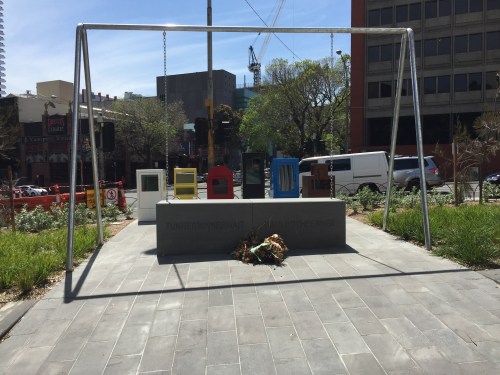
First- some background. In 2016 the City of Melbourne launched a public memorial to Tunnerminnerwait and Maulboyheener on the corner of Franklin and Victoria Streets in Melbourne, close to where the two men were executed on 20 January 1842.  This was the culmination of a long campaign by activist Joe Toscano, who had been marking the anniversary of the execution of these two ‘freedom fighters’ over many years.  In laying the ground work for this memorial, the City of Melbourne commissioned a booklet by Claire Land available at http://www.melbourne.vic.gov.au/SiteCollectionDocuments/tunnerminnerwait-and-maulboyheenner.pdf  .

standing_by_tunnerminnerwait_and_maulboyheenner_front

[Image attribution: By Canley (Own work) [CC BY-SA 4.0 (http://creativecommons.org/licenses/by-sa/4.0)%5D, via Wikimedia Commons]

In response to this proposal for a memorial, historian Marie Fels, former Aboriginal Affairs Victoria heritage operations manager David Clark and Mornington Peninsula local historian Rene White published an article in Quadrant magazine titled ‘Mistaken Identity, Not Aboriginal Heroes’ available at https://quadrant.org.au/magazine/2014/10/mistaken-identity-aboriginal-resistance/   .  In speaking out against the proposal to commemorate Tunnerminnerwait and Maulboyheener, they wrote:

Our problem with it is that it is history-lite, based mainly on secondary sources, with little primary research. It reads as an argument that Tunnerminnerwait and Maulboyheenner were resistance fighters deserving of memorialisation. Our research, based only on primary sources, demonstrates conclusively that they were not resistance fighters: on their own personal testimony, they shot and killed two whalers by mistake.

I have reviewed Marie Fels’ work previously (here and here) and I have seen her described as one among a number of  ‘benignist’ historians who, while not denying settler violence and injustice towards indigenous people, also point to co-operative strategies between settlers and indigenous people in early frontier history.  The journal in which their article appears, Quadrant,  is a right-wing publication which strongly supported Keith Windschuttle when he accused historians of ‘fabricating’ aboriginal history.  An interview with Fels, Clark and White reported in a Frankston local newspaper notes that when they had difficulty in having their criticisms of the Melbourne City Council memorial publicized (most particularly in the Age)  they turned to Quadrant which, perhaps not surprisingly, took up their article with alacrity.

This, then, is the context in which Hunt Them, Hang Them has been published.  The authors, Kate Auty and Lynette Russell, note Fels’ public opposition to the City of Melbourne commemoration, on the basis that Tunnerminnerwait and Maulboyheener were convicted on the basis of ‘their own personal testimony‘.  In making their own argument they claim:

The events outlined here are just one part of an unfolding tragedy- race relations and the judicial process in Australia.  The ultimate question is whether these men received a fair trial and whether they should be memorialised.  We answer ‘no’ and ‘yes’. (p.7)

In making this argument, they delve deeply into the details of the arrest and trial of the Tasmanian prisoners. In particular, they raise questions about the manner of the arrest of ‘The Tasmanians’, an event I described in my ‘This Week in Port Phillip’ entry for 25-30 November 1841.  They ask why the Assistant Aboriginal Protector William Thomas, who was present at the arrest, was not called at the trial, and raise questions about the ‘admissions’ of guilt.  They question whether Judge Willis was biassed, most particularly  in his decision to force the trial in the absence of an important witness and against the application of the prosecutor, and they ask whether there was a conflict on interest on behalf of their legal counsel, Redmond Barry.

Their argument is framed very much within a consciousness of the intertwining of Port Phillip and Van Diemen’s Land history, an awareness strongly reinforced by Lynette Russell’s earlier work on sealers and whalers along both sides of the Bass Strait (see my review of Roving Mariners). They note that Tunnerminnerwait and Maulboyheener were part of a ‘family’ (loosely defined) of indigenous Tasmanians brought over by Aboriginal Protector George Augustus Robinson, who had made his reputation as a ‘conciliator’ in Tasmania.

The opening chapter begins with a description of the historical actors most pertinent to the trial: George Augustus Robinson, who they (along with many others) portray  as a vain social climber; the vainglorious and unpredictable Judge John Walpole Willis (a view I also share) and mineowner William Watson, the shadowy ‘charlatan and liar , the only witness called during the trial.

Chapter Two ‘Context, conflict, cases, confessions’ describes the frontier resistance with the ‘settlement’ of Port Phillip, fraudulently presented by John Batman (another Tasmanian) as a consensual, treaty-driven process.  In particular, they look to Major Lettsom’s ‘dispersal’ of  ‘Goulburn black’ men, women and children, a little over a mile from Melbourne in late 1840. This action, involving 58 armed troopers, culminated in the death of two indigenous men and the wounding of another, and the detention of 300 people in the Melbourne stockade. A dozen indigenous men were charged and nine were sentenced to ten years transportation. This occurred prior to Judge Willis’ arrival in Melbourne, and he  overturned all the verdicts on a technical miscarriage of justice. However, Willis’ findings in other cases highlight the unpredictability of Willis’ stance in indigenous cases.  The authors correctly identify Willis’ direction that his neighbour Bolden be acquitted as an important factor, occurring almost simultaneously with the Tasmanians’ trial.

Chapter Three ‘Hunting stories’ triangulates the accounts of three of the men involved in the pursuit of the Tasmanians in different capacities: the journals of  William Thomas and George Augustus Robinson as Aboriginal Protectors (albeit with professional differences in approach), and  military ensign Mayor Rawson who wrote an undated account ‘ Journal of an expedition after some Van Diemen’s Land Blacks who were committing depredations at Western Port on the Southern Coast of New Holland October and November 1841.’ As well as highlighting the bumbling farce that the pursuit became,  they remind us  that this occurred during the visit of Governor Gipps- an important event for Port Phillip pride and identity.

Chapter Four  ‘The Dispersal- a thrice-told  tale’ again takes the approach of triangulating three accounts: those of Frederick Powlett, the Commissioner of Lands and J.P. responsible for the Border Police contingent, Ensign Rawson as one of the military troops involved in the pursuit, and the Assistant Protector William Thomas.  The discrepancies between their accounts are most pertinent in the varying accounts they gave of ‘Truganini and the grave’ in Chapter Five where, along with the evidence of Corporal Johnson of the Border Police, there are different opinions over whether or not Truganini took her captors to the grave of the murdered men and ‘admitted’ the murders and the varying involvement of the indigenous men and women who were now being charged.

Chapter Six traces through the committal before a bench of magistrates, which was attended by Judge Willis, a permissable but unconventional practice that he undertook, claiming oversight of all justice in the Port Phillip District as its only resident Supreme Court Judge.  Moving on to the Supreme Court trial in Chapters Six and Seven, Auty and Silver stress the significance of the absence of three important witnesses who were present for the committal but not the Supreme Court trial.  In particular, they ask why and by whom Assistant Protector Thomas was prevented from attending – a point now revealed by the recent and very valuable (but prohibitively expensive)  publication of Thomas’ journals by Marguerite Stephens. They highlight the inappropriate interaction between George Augustus Robinson and Judge Willis, and Willis’ indulgence of sloppy testimony from Commission of Lands Powlett, (especially in the light of the lambasting he had recently given Aboriginal Protector Charles Sievewright in the Bolden case).  The authors suggest that Willis may have been smarting under the criticism of George Arden from the Port Phillip Gazette, but as I have shown through several This Week in Port Phillip postings, Willis well and truly had Arden’s measure.  I don’t dispute that Willis was very aware that this was a ‘hot-button’ case, but he didn’t need Arden to tell him that.  They finish their book with a brief description of the hanging.

Have they convinced me about the shortcomings of the trial?  Yes- most particularly in regard to Assistant Protector Thomas’ absence, who would have provided a completely different angle. In other cases where Willis had an interest in seeing a particular outcome- in the case he heard against Bolden, for example- he would have picked and picked until it all unravelled. But Auty and Russell, along with Claire Land in the Melbourne City Council publication, sidestep the issue that Fels has emphasized: that two whalers were murdered.  The Tasmanians admitted this, and said that it was a case of mistaken identity because they intended retribution against William Watson instead.I think that the jury understood this, whatever the shortcomings of the trial. I have always been struck by Willis’ rejection of the jury’s recommendation to mercy when he called for the death penalty, to which Gipps agreed.

Auty and Russell’s argument for memorialization is based on the insufficiencies and failures of the trial:

This case is tainted.  It unfolded at a time when ‘near enough was good enough’ for Aboriginal people in legal settings.  We no longer should accept that reasoning. If there is a memorial to Redmond Barry, a street and a river named for Powlett, an inlet named for Anderson, a creek named for Watson and a town named for Rawson, then Tunnerminnerwait and Maulboyheener should have their own travails recognized. (p.73)

While they have convinced me about the shortcomings of the trial, I’m not convinced that they should be memorialized for this alone. I should imagine that this justification would rankle with Fels, Clarke and White too, who suggest that Winberri, who was shot in Major Lettsom’s raid is a far more fitting “Melbourne hero” to merit a memorial. For myself, I have never been comfortable with the ‘freedom fighter’ frame that has been placed on this episode- a point well made in the Fels article.

standing_by_tunnerminnerwait_and_maulboyheener_2

Whatever my reservations about the design of this memorial (and yes, I do have reservations), I absolutely love the image of the Wurundjeri elder, Barak, that has been shaped out of the white building behind.

[Image attribution: By Leighblackall (Own work) [CC BY-SA 3.0 (http://creativecommons.org/licenses/by-sa/3.0)%5D, via Wikimedia Commons]

aww2017-badge

I am posting this review to the Australian Women Writers Challenge page.  In a way, it’s a 3-for-1 review, because all three texts that I have mentioned in this review are written by women, which is in itself interesting. I strongly suggest that you dip into all three. Hunt Them, Hang Them is available for $28.95 through Justice Press, while Fels’ Quadrant article is available here,  and Claire Land’s City of Melbourne booklet is here.  Auty and Russell’s book and Fels’ article both draw heavily on primary sources, and there is much commonality between them until the political implications are drawn out. Even if you just read the two online sources, you’ll see historians at work, raising good questions about the rationale and impetus for memorializing in the present-day.