Category Archives: Australian Women Writers Challenge 2014

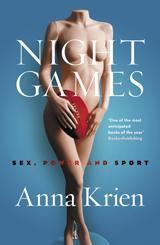
‘Night Games’ by Anna Krein

krein2

This book sits comfortably on the shelf that holds Helen Garner’s Joe Cinque’s Consolation, Chloe Hooper’s The Tall Man and indeed, Krein’s earlier book Into the Woods.  Like them, it starts with a court case as its springboard.  Here, it is the trial of Justin, a VFL player who hasn’t quite made it to the AFL standard, who is accused of rape after one of those numerous footy gang-bangs we read about.  They bubble up into the news, meet with momentary tut-tutting and ‘boys will be boys’ then submerge again until the next dreary occurrence.

Like Garner and Hooper before her, Krein sits in the courtroom, observing the procedures, watching the protagonists and their families, feeling her own sympathies being twisted and swayed by what is playing out before her.  “Playing” is the operative word here, because as observer, she is privy to what the jury is not: the blokey negotiation of what can and can’t be said in the court, and the effect of the enforced silences on the narrative that can be made to explain the events on the night of the crime.

For Justin may have been hanging around with the Collingwood Football Club big boys, but he wasn’t one of them.  At first the courtroom bulges with Eminent Legal People because there is a chance that Collingwood stars will be caught up in it, but once the involvement of The Club is negotiated, they depart.  Justin’s whole family will pay financially and dearly for the legal representation they are left with.

Justin’s family feel that Krein is on “their” side, but she is not completely.  Sarah, the rape victim, does not engage with her at all (as is her absolute right), but it does mean that the narrative of the book is somewhat slanted.

But Justin and Sarah and what happened that night are only one part of the book as it spins off into a broader exploration of sex, rape, power, celebrity and permission.  This is very much a join-the-dots exercise, as she narrates a series of sexual scandals that have arisen over recent years involving both AFL and NRL, all too many of which involve my own football team, St Kilda.  She teases out these threads even further by examining the treatment of women journalists in sporting culture (for example, Caroline Wilson on The Footy Show) and the ubiquitous Wives-and-Girlfriends who have their own reflected celebrity status.

In many places, she can find no definitive answers, only more questions. She often refers to “shades of grey”  (denoting uncertainty rather than That Book) both in her own response and in the issues that arise.  I must say that I found this rather frustrating.  Both Garner and Hooper, in their fore-mentioned books, also admit to “shades of grey” but somehow manage to come to some sort of definitive statement.  I don’t know that Krein ever does: she can say that there are connections and injustices here, but I’m not sure that she ties them together into an argument that you can take issue with.  You sense that she is dodging what she expects to be brickbats from feminists and football supporters, by raising questions and admitting uncertainty as a pre-emptive defence.

In recent weeks, the questions raised by this book have resurfaced with the publication of an article by The Secret Footballer, where he very much voices the arguments of the sporting fraternity: they (the women) are scrags and ask for it; what about permission etc. etc. etc.  [Interestingly, the article itself seems to have disappeared, but a commentary on the article survives here]. He says that what is driving change is not all the behavioural programs imposed by the clubs, or wider societal change, but fear of exposure through social media.  He never was involved in gang-bangs himself, he says, because he never did like to share his toys.  It’s rather chilling to hear all this voiced so definitely.  It reinforces everything that Anna Krein has written about in this book.

There’s a very good review of the book by Deb Waterhouse-Watson here.

I have posted this review on the Australian Women Writers Challenge website.
awwbadge_2014


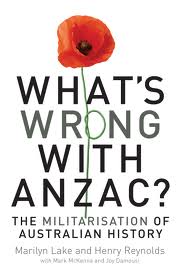
‘What’s Wrong with Anzac?’ Marilyn Lake and Henry Reynolds.

whatswrongwithanzac

2010, 167 p.
I doubt that this book will be reissued in the next two years. I’m sure that the publishers have had an asterisk against 2014 and 2015 as bumper years for military history, with the centenary of WW I in 2014 and the Gallipoli centenary in 2015. This book, originally published in 2010, is not likely to sit comfortably on the shelves with big books with big blokey authors that would have been scheduled specially to take advantage of all this interest. But many of the sentiments expressed by the historians who have contributed to it will continue to bubble along underneath all the ceremony, emotion and hyperbole.  You can find it manifested in the Honest History website.

In 2009 historian Marilyn Lake was invited by the History Teachers Association of Victoria and the University of Melbourne to give a lecture on ‘The Myth of Anzac’ in a series on mythologies. A condensed version of the address was published in The Age soon afterwards.

In it, she argued that in the 21st century Australia should reclaim the values of equality and justice which in an earlier era was thought to define a distinctive ‘Australian’ ethos. She suggested that it was inappropriate for “a modern democratic nation to adopt an Imperial, masculinist, militarist event as the focus of our national self-definition in the twenty-first century.” (p.3)

A furore erupted online- a “mixture of hostility and support, personal abuse and thoughtful reflection”. In her introduction to this book, she briefly mentions the abuse but outlines in more detail some of the more reflective responses posted onto the Comments section of the Age website.

This book is a compilation, then, of chapters written by a number of authors (both male and female) in response to the questions raised by Lake’s article and the commentary that surrounded it. Continue reading

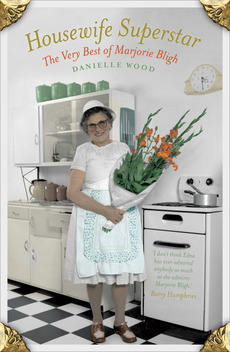
‘Housewife Superstar’ by Danielle Wood

housewifesuperstar

2011, 209 p.

I happened to hear Shannon Lush on the radio the other day- she of the handy household hint and stain removal. How Olde Worlde, I thought: household advice on the ‘wireless’! It brought to mind my mother, who listened religiously to Martha Gardner on the radio. My mother was of the class and generation of women for whom ‘housewife’ was a conscious career choice, a source of pride, learning and improvement. There were new products to try and master, old skills to polish and pass on, recipes to experiment with, and new trends and fashions to encompass. The household hint genre of newspaper columns, books and radio and television programs fed right into this view of housework.
I have never heard of Marjorie Bligh, who seems to have been a Tasmanian phenomenon. I guess that each Australian capital city had their own version. Tasmania’s Marjorie Bligh is said to have been the origin of Barry Humphrey’s Edna Everage, before she became a Dame (humph!) and while she was still Norm’s wife, Valmai’s friend and Kenny’s mother. One of the author’s quests in this book was to probe this claim.


Marjorie had three authorial name changes from Marjorie Blackwell to Marjorie Cooper to Marjorie Bligh as she moved through three marriages. It is a sign of her own individual presence and what we would now call her ‘brand’ that her followers recognized her and followed her through these different guises. Her first marriage was an unhappy one ending in divorce, something more devastating and noteworthy then than now, and she was widowed twice. The author, Danielle Wood, treats these marriages with respect but with a clear eye as well. She allows Marjorie to tell her own story, to withhold and to embellish, but it is quite easy for the reader to fill in the silences and to imagine the other perspectives that others in her story might tell.
Marjorie Pearsall was born in 1917 in Ross, in the Tasmanian midlands. The convict architectural heritage of the town would not have been a tourist drawcard at that time. Her father died when Marjorie was three. Marjorie, as she told it in her own autobiographical writings, was always an industrious homebody, making money for the straitened family through running errands for the teachers, cleaning the school room, knitting and sewing. She was a perfectionist and had ‘stickability’ (p. 31). After leaving school she worked as a ‘help’ until she met her first husband Cliff, whom she married in 1938. In a world seemingly untouched by war, they shifted to Campbelltown.

It was there that she set her sights on the Agricultural Show. In 1958 she surpassed her record of the preceding two years, winning prizes in seventy-eight categories. Her passion was the creation of her dream home, Climar (the combination of Cliff and Marjorie’s names), an Art-Deco inspired brick house, now on the Heritage register (for all the good that will do, as Banyule has taught me) and rather oddly dated for its completion date of 1955. My ex-husband’s family lived in a very similar house that was built in the late 30s-early 1940s- perhaps architectural trends took longer to reach Tasmania?  You can see a photo of Climar here (there are many other photographs related to Marjorie Bligh on this site as well.)

There seems to have been a falling out with the Agricultural Show committee in 1958 over the awarding of the W. T. Findlay cup for most points awarded, and she withdrew from exhibitions in 1960, 1961 and 1962 and in this hiatus in her show career she turned to writing. Marjorie Blackwell at Home was her first book, published in 1965. It was to be republished in three editions . In 1973 under the name At Home with Marjorie Cooper, and then again in 1998 as At Home with Marjorie Bligh. The first edition was 310 pages in length, comprising 44 sections covering food, flowers, gardens, children’s parties, pets and stains. “All these things” Marjorie wrote assertively in the foreword “are dear to the heart and the majority of all women.”

“Assertively” is the operative word here. Danielle Wood’s book is sprinkled with the dictates and aphorisms of Marjorie Blackwell/Cooper/Bligh, gleaned from this and her other publications. There’s a rather threatening confidence in the way that Marjorie frames her advice implying that of course you would WANT to prevent the cock from crowing (by placing a lath above his head so that his comb brushes against it) or WANT TO walk to country dances wearing a rubbish bag with two holes cut in it, drawn up to your waist with the pull-tie to protect the hem of your gown from the mud.

They’re small slices of life from another world. Some examples:  try putting sticky tape on your toddler’s hands and watching ‘him’ being delightful as he tries to pull it off; use a slice of beetroot to rub on your cheeks if you run out of rouge; make a nice apron for yourself by sewing together nine men’s ties. Her worldview is that of “wilful waste brings woeful want” (a family aphorism that I grew up with as well) borne not only from straitened circumstances but also almost as a form of resistance to the deluge of manufactured consumerist goods that now engulf us. However, I still struggle to imagine WHY you would want to crochet a cover for a 5 litre icecream container (so handy for transporting small cakes and scones) out of used bread wraps.

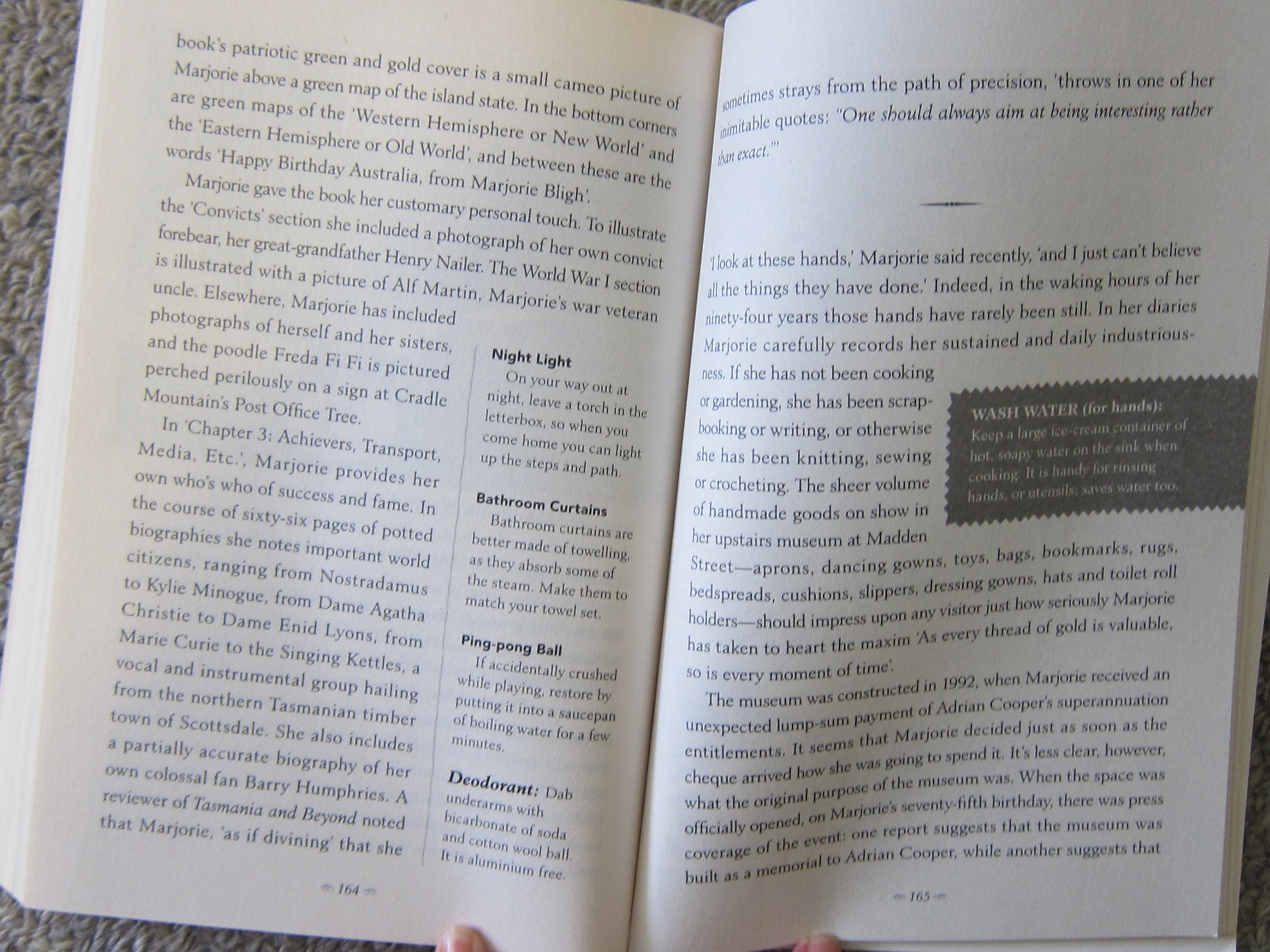
Wood (or her publishers) have decided that these excerpts from Marjorie’s writings drawn from her books and autobiographies should be inserted throughout the book. Hence, as well as small break-out boxes on the side of the text, the narrative is interrupted for pages at a time with a lengthy extract. I’m not sure if I liked it or not. I found myself distracted by reading the excerpt, but on the other hand it captured well this nagging, insistent soundtrack of what I perceived as Marjorie’s imperious, bossy narrative voice.

IMG_0935
By the end of Marjorie’s long career, I think that she had become an unwitting parody of herself. Danielle Wood obviously has great affection for her, but is somewhat wary of her as well. In the foreword, she describes her as “formidable”.

 As I write, she is ninety four years old, and almost certainly muttering into her coffee cup about the dire consequences that will befall me if I fail to finish this book before she dies.

She did. The book was published in 2011 and Marjorie died in September 2013.
In her conclusion, Wood reflects on her own ambivalent feelings about Marjorie (p.206)

Though I have spent hundreds of hours with her books and diaries, and talked with her, I still struggle to get a fix on Marjorie. At times on the page, I have found her difficult to warm to. But while she is often self-serving in her explanations of past events, she is also honest enough to supply the facts that allow readers to construct alternative understandings. In person, I have always enjoyed her frankness, humour and generosity. But I have always known, too, that she would have me on toast in a flash if I vexed her or let her down. It has been difficult to reconcile the written Marjorie with the living one, and simultaneously to understand the multiple versions of Marjorie that have manifested during her ninety four years.

The book is lightly written and yet insightful. It’s quite a difficult task to render gently and with respect someone who has, with the passing of time, almost become a spoof. Wood lets Marjorie speak for herself, and lets the reader fill in the silences and omissions. Ironically, with the return to ‘natural’ products and deep-green environmentalism, Marjorie could become an unlikely poster-girl for sustainability, and some may wish that there was an index to this book to locate an unlikely household hint. It is a book which chuckles to itself, but quietly.

awwbadge_2014I’m posting this review to the Australian Women Writers Challenge 2014.


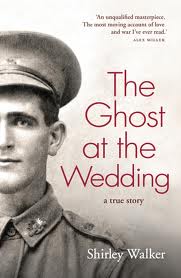
‘The Ghost at the Wedding’ by Shirley Walker

walker_ghost

2009, 247 p

It has often struck me that I am part of a blessed generation that has lived in a time of peace and ,with only a few blips of recession, continued economic growth.  My father was too young to have fought in World War II, my brothers too young for Vietnam, and unless world war breaks out within the next ten years, my son is unlikely to have to fight (and indeed, I find it hard to imagine the scenario that would prompt him to volunteer to do so).  An earlier, blighted generation, however,  experienced World War I,  the Depression and World War II again in what must have seemed an almost never-ending succession of difficulties and disasters. Jessie Walker, who is the subject of this book, stood at the pier to wave off her brothers and their friends in World War I and then sent off her own sons and younger brothers to the Second World War.  It is a war story, but told from the point of view of the women left behind.

The author, Shirley Walker, describes this book as “a memoir of my mother-in-law, Jessie and… an imaginative reconstruction of her family’s truth“. She has used letters, diaries, service records and family documents but she writes “the inner life of each character, especially that of Jessie” from the imagination.  She draws on the existing paintings that Jessie created in later life as a way of reconstructing Jessie’s inner life, but imagines and describes other paintings never made.  The mother-in-law and daughter-in-law relationship is often tentative- it is, after all, the love of the same man in the different guises of son and husband that links them-  and you sense Shirley Walker’s sensitivity to the wider family in writing this book. She has changed some names to protect some family members.

The book opens in 1983 with Jessie in a nursing home, and from here the  chronology of the book skips back and forth.  The author (the daughter in law) identifies herself as “I” and Jessie’s story is told in the third person.  There is limited dialogue. Although Jessie is the focus of the book, it also describes at third-hand or through letters, the war experiences of sons, fathers, nephews and uncles. It is a book very much grounded in Jessie’s life with her husband and sons on the peninsular island that emerges from the waters of the Clarence River, but it traverses much further.

It is a beautifully written, lyrical book.  The men of the Walker family were alive to the sights and sounds around them, and it comes through in Shirley Walker’s retelling. The book comes with high praise from the novelist Alex Millar whose blurb reads:

An unqualified masterpiece.  The most moving account of love and war I’ve ever read.

I must confess, though, that even though I was saddened by the book and the thought of so much death across several generations, I was not moved to tears.  Perhaps it was the author’s restraint in telling another’s story, or perhaps it was the ethical distance that her relationship with the subject imposed on the author, already a published academic.

Like Lisa at ANZ Litlovers, I would have appreciated a family tree, as different generations were named after their forebears.  I’m still a little perplexed by the title, which does not seem to refer to any particular wedding, but perhaps that is intentional.  The story here of one individual woman is a generational story, and as such, one that I hope women yet unborn never have to experience.

We are sure to read many biographies and histories of World War I this year, and next year, the centenary of Gallipoli which has assumed such importance in popular Australian historiography.  There is, among some historians, an uneasiness about the overwhelming prominence given to ANZAC -hence the Honest History website which notes:

There is much more to Australian history than the Anzac tradition; there is much more to our war history than nostalgia and tales of heroism. Honest History is being set up to get those two messages across. Our approach is ‘not only Anzac, but also [many other strands of Australian history]’. We see history as complex with many interwoven, competing evidence-based strands. This sort of history should be the mainstream; hyperinflation of a particular strand is an anachronism.  Editorial and moderation policy, Honest History website

The bookshops already seem to be stuffed full of Big Books of War, generally written by men, many of whom have a journalistic background. I’m thinking Les Carlyon, Peter Fitzsimons etc. and of course, the author of the biggest Big Book of War of them all, Charles Bean.   Where women have written about war, the focus tends to be less on battles and more on the men themselves; less on valour and bravery and more on loss and suffering. (I must confess to not having read Patsy Adam-Smith’s The Anzacs, and so I don’t know whether this holds true for her book or not). The Ghost at the Wedding fits into this more person-centred approach that encompasses both the warfront and the homefront, those who stayed behind and those who returned.

My rating: 8.5/10

Sourced from: Yarra Plenty Regional Library

Read because: I want to post it to the Australian Women Writers Challenge 2014.

awwbadge_2014