Category Archives: Australian literature

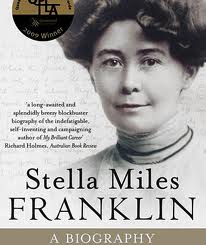
‘Stella Miles Franklin: A Biography’ by Jill Roe

569 p. plus notes, 2008

(4.5 /5)

Miles Franklin, to the extent that she is known at all today, is  probably most famous for the film of her book My Brilliant Career and for the Miles Franklin literary award that bears her name.  Jill Roe has been working on Miles Franklin for many years and this long biography- all 700 odd pages of it including notes-  will probably be the definitive biography for many years.

The first thing to notice is the title: Stella Miles Franklin.  The writer we know as Miles Franklin was called by her first name, Stella, by her family and friends.  Although in the body of the text Roe calls her “Miles”, the title clearly marks out that this is not a literary biography alone but an examination of her life in its many facets: as daughter and sister, as labour activist,  office worker and friend- as well as writer.

The second thing to notice is how little of the book – the first hundred odd pages only- deals with the writing and publication of ‘My Brilliant Career’, for which she is probably best known today.  Once I turned to Part II of the book, I wondered how on earth Roe was going to sustain this biography for the succeeding 450 pages.   She did it largely by following Miles’ career across the span of her life:  in America as a women’s labour organizer between 1906- 1915,   then following Miles to England where she worked in a stultifying job as admin support for a Housing reform authority, nursed in the Balkans during World War I, moved back and forth between Australia and UK before finally returning to Australia in 1933 to live out her final years before her death in 1954.   I think that Roe is firmly making the point here that the whole of a life matters: as a ‘woman of certain age’ herself Roe is not content to shove Franklin’s  later years into a perfunctory final chapter before dispatching her unceremoniously.

Franklin’s bequest of money for the literary prize that bears her name comes almost as a surprise at the end of the biography.  Miles lived alone and frugally in the family home and it surprised many that her 8922 pound estate had been squirreled away for a literary prize awarded to “the Novel for the year which is of the highest literary merit and which must present Australian Life in any of its phases“.   Australian commentators, writers and readers have often chafed under what now seems a rather jingoistic, dated and parochial restriction, but having read this biography I am now more aware of and sympathetic to what Franklin probably hoped to encourage: a publishing industry more independent of British and American publishing houses and  an appreciation of a literature that rings true to Australian experience and consciousness.  As Roe points out,  there are no national eligibility criteria so that, conceivably, the prize could be awarded to a non-Australian writer for a work that was published outside Australia.  This, too, reflects Franklins’ priorities- that Australia and Australian life that should be rendered realistically (she was no fan of modernism or Americanization) , and that Australian writers and Australian themes take their place amongst world literature as a whole.

The bequest was not Miles Franklin’s only gift to her country.  Her other gift was a huge archive of her correspondence which eventually numbered at least 10,000 items from 1000 or more correspondents , diaries and manuscripts, collected over a lifetime.  It is here that we see her rich intellectual life in the admittedly small Australian literary culture and  her involvement with politics both in Australia and overseas.  Her association with communist writers like Jean Devanny and Katharine Susannah Prichard brought her to the attention of ASIO during the Cold War, but she was also associated through friendship, but not politics, with the uncomfortably right-wing views of P.R. Stephensen and his Australia First movement.  Miles herself was neither communist nor fascist, being more aligned with  traditional post WWI British Liberalism.  Franklin herself expressed fears of Asian immigration and over-breeding in a political stance that makes me shift uneasily today.  As Roe explains, she was a first-wave feminist, steeped in ideas of moral purity, and as part of the ‘Australian girl’ trope of the first decades of the 19th century, claimed the suffrage and Australia’s relative progressiveness as part of her own identity as an Australian working in American women’s and radical organizations in the US. Through her correspondence and hospitality she fed, and fed on, camaraderie with fellow writers and their circle- Nettie Palmer, Dymphna Cusack and Florence James,  David Miller, Katharine Susannah Prichard etc- but she was wary and defensive amongst academics and academia.

Miles Franklin’s own identity, her “essential self” as she put it, centred around being a writer and indeed, writing was work that she carried out throughout her life.  I was unaware just how much there was, often dusted off and recycled, in the hopes of publication under yet another guise or as often unsuccessful entries for a string of literary prizes.   This approach to her work partially explains her insistence on nom-de-plumes, most notably Brent of Bin Bin, but also more risible pseudonyms (like ‘William Blake’, or ‘Mr and Mrs Ogniblat L’Artsau’)  which came to be viewed more as a form of eccentricity than, as she intended, literary commercial savvy.  Much of this work remains unpublished- often for good reason as Roe suggests- although much of it attracts me as an historian:  she went ‘undercover’ as a domestic servant in the early 1900s and wrote about her experiences, and her novels set during WWII sound interesting from a social history point of view.  But much of her work sounds (admittedly only from Roe’s summaries of the unpublished manuscripts) overly melodramatic, self-referential and repetitive and perhaps best left in the archive.

Roe approaches this work more as historian than literary biographer, focussing on the act of writing and what it meant to Miles and her milieu, rather than the texts themselves.  She has mined the huge Franklin archive exhaustively (an archive now supplemented even further by later purchases) and she represents it in its entirety, perhaps to the detriment of her biography overall.  To Roe’s credit, she provided enough background information about Miles’ friends and contacts for the book to veer away from mere name-dropping, but it is a narrow line.  It is a huge, detailed biography but I found myself enjoying most the parts where Roe stepped back with her historian’s hat on to explain, for example, the demographic phenomenon of the single female in the 19th and 20th centuries, and the nuances of first-wave feminism and its approach to men and marriage.   I can’t imagine that other scholars will be able to top the detail of this biography, but their interpretations may differ.

Further reading:

The State Library of New South Wales presented an exhibition on Miles Franklin Miles Franklin: A Brilliant Career? and the exhibition catalogue, including photographs, has been archived here.

See also ANZLitLover’s review of the book, and a review by Nicole Moore in The Australian
‘The Pioneers’ by Kathleen Susannah Prichard

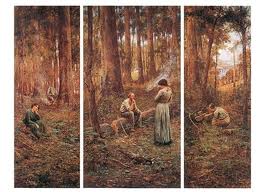
I hadn’t realised during reading this book that I was actually reading a painting.  Here it is- McCubbin’s triptych “The Pioneers”- how could I have possibly missed the allusion?

The book opens with Mary Cameron, standing in the bush beside their wagon, desultorily feeding a smouldering campfire with sticks of eucalyptus that she breaks in her hands or across her knees.  She goes to a fallen trunk, sits down and gazes into the shadows.  The book closes with her grandson pushing the bush away from a “lichen-grown wooden cross”, dropping on one knee to read the inscription.  Ah- I thought- “The Pioneers”- of course!

The Pioneers won the Hodder and Stoughton All Empire Literature Prize for Australia in 1915.   It is not hard to imagine why: for a British publisher the book is steeped in eucalypts, pioneer spirit and optimism exemplified by the young colonial  soldiers of the Australian Imperial Force in WWI.   Although its author became (in)famous for her heavy Communist Party involvement in later decades,  there’s a nationalistic pride here that I, at least, find difficult to reconcile with the internationalism of her later politics.  Perhaps it was prompted by the circumstances in which it was written- by a young Australian journalist based in England, drawing on the notebooks she had penned recording the old-timers’ stories during her own time in Gippsland several years earlier.

It’s all there- the silence and forbidding beauty of the bush, the old convicts, the cattle-duffers and the bushfires- but there’s also a defiant pride in the generation that followed the pioneers, who threw off the shame of convictism that haunted their parents and grabbed the opportunities open to them.  There’s a White Australian debt to be acknowledged to the pioneers on the frontier, and a  romance and optimism about the “currency” lads and lasses growing up tall, proud and resourceful – who wouldn’t want to embrace that?

I often find it hard to talk about “old”  Australian books and authors.  There’s often a mawkishness and blatant nationalism that I’m not comfortable with as a reader.  I find myself wondering if the incorporation of such books  into the “Australian Classics” canon subjects them to a critical scrutiny that their targeted audience of the time might not have shared.  For example, a review of The Pioneers at the time noted that “the setting of romance is said to be very attractive to readers who are only incidentally interested in history”  and then as now, books were written and published with a contemporary audience in mind- an audience with different expectations and tastes to what we might have today.  For myself,  I find myself being dragged back to my 21st century reader mindset because the sentimentality and melodrama of these late19th/early 20th century books overwhelms me (two exceptions: Ruth Park’s Harp in the South and Henry Handel Richardson’s The Fortunes of Richard Mahony).  I then find myself reading such texts as a historian, because I’m rather discomfited by them as a fiction-reader. I’m aware that this is probably not fair on the book, or the author, or my own experience as reader.

I’m particularly conscious of this because I’ve just finished reading Sarah Water’s The Night Watch (glowing review to come!) which I found much more satisfying than, say, Dymphna Cusack and Florence James’  Come In Spinner.  Surely the 1950s book written from experience would have an inherent fidelity, but in terms of my emotional response, I found the more recent text,  aimed no doubt at a different audience segment, and stripped of the popular melodrama and skittishness, more satisfying.  Perhaps it’s the different mindset that a reader brings to reading historical fiction as a genre, as distinct from popular contemporary fiction from an era that is now historical itself?

You might want to read Whispering Gums’ review of the book too.

‘The Harp in the South Trilogy’ by Ruth Park

1985, 1948, 1949. 684 p.

Can I just declare at the outset that I loved reading this?  I found myself looking forward to bed and being able to put aside all the ‘proper’ reading that I’m supposed to be doing and just plunging myself into the domestic lives of Mumma and Hughie, Roie and Dolour.

I had read the second book of the trilogy several decades ago (oh dear, fancy being old enough to be able to make a such a declaration!) but I came back to the book because it was a selection in my online Australian Literature bookgroup.  The scheduled read was ‘Missus’, which is chronologically first in the trilogy, but was actually written almost forty years after the second and third books.  Stylistically, ‘Missus’ is a very different book, covering a much wider time span and more in the style of ‘sweeping family saga’ with its multiple generations and incorporation of historical themes.

‘The Harp in the South’ and ‘Poor Man’s Orange’ are far more domestic and limited in scope.  They are limited in geography too, for the focus very much revolves around Coronation Street, Surry Hills and the neighbours, shopkeepers, and local personalities of a small constellation of city streets.  Had I not known that it was written in the 1940s, I would have said that it was a television tie-in, as the chapters are quite episodic in nature; perhaps its construction was influenced by radio serials as a writing genre.  For me  (partial as I am to the domestic drama), the books worked at an emotional level: these are flawed, thwarted but fundamentally good people doing the best they can.  At times there was a discordant, omniscient authorial commentary which made me uncomfortable with its patronizing tone, and I didn’t like to think of the author ‘looking down’ on these people as examples of a socio-economic ‘type’.  I much preferred it when the author allowed her love for the characters to come through.

I was impressed that in the second book, which was written first, situations were set up that allowed Park to return to them in the prequel all those decades later.  Was it planned that way?- if so, what foresight!  As it was, I am pleased that she chose to finish where she did and return to the prequel.  ‘Poor Man’s Orange’ closes with an awareness that the slum neighbourhood of Surry Hills is about to be transformed, and somehow a continuation of the book into the government housing projects of the western suburbs doesn’t have much appeal.

This is good, solid story-telling, with none of the rather precious self-consciousness of 21st century writing.  It rings true in its dialogue and in the development of character, and as a reader I was able to just relax into the hands of a confident author, sure of her craft.

‘Norfolk Island: An Outline of its History 1774-1977’ by Merval Hoare

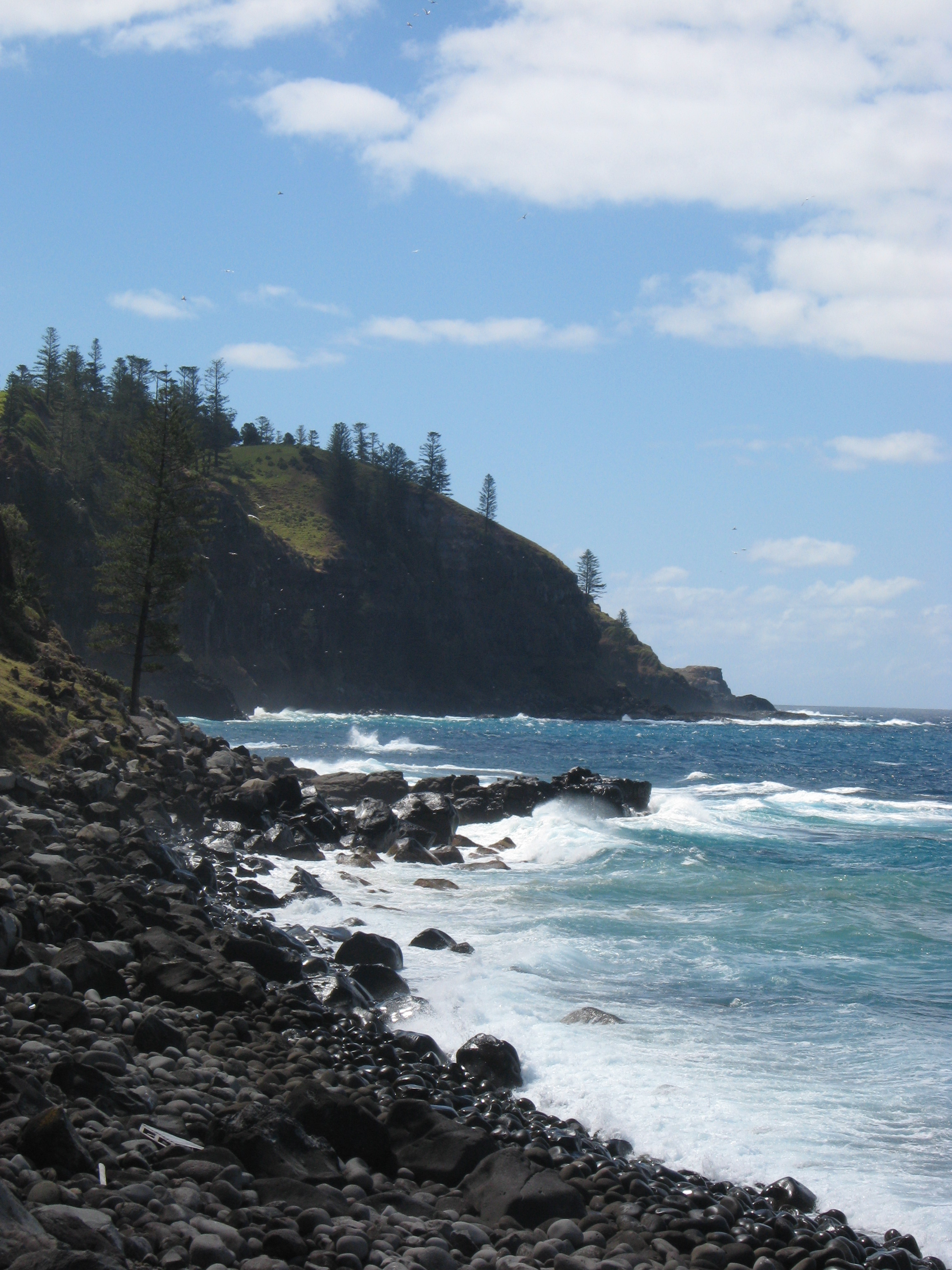
Why am I reading a history of Norfolk Island? Because I’m here on a week’s holiday! But even if I were not, it’s a fascinating history.

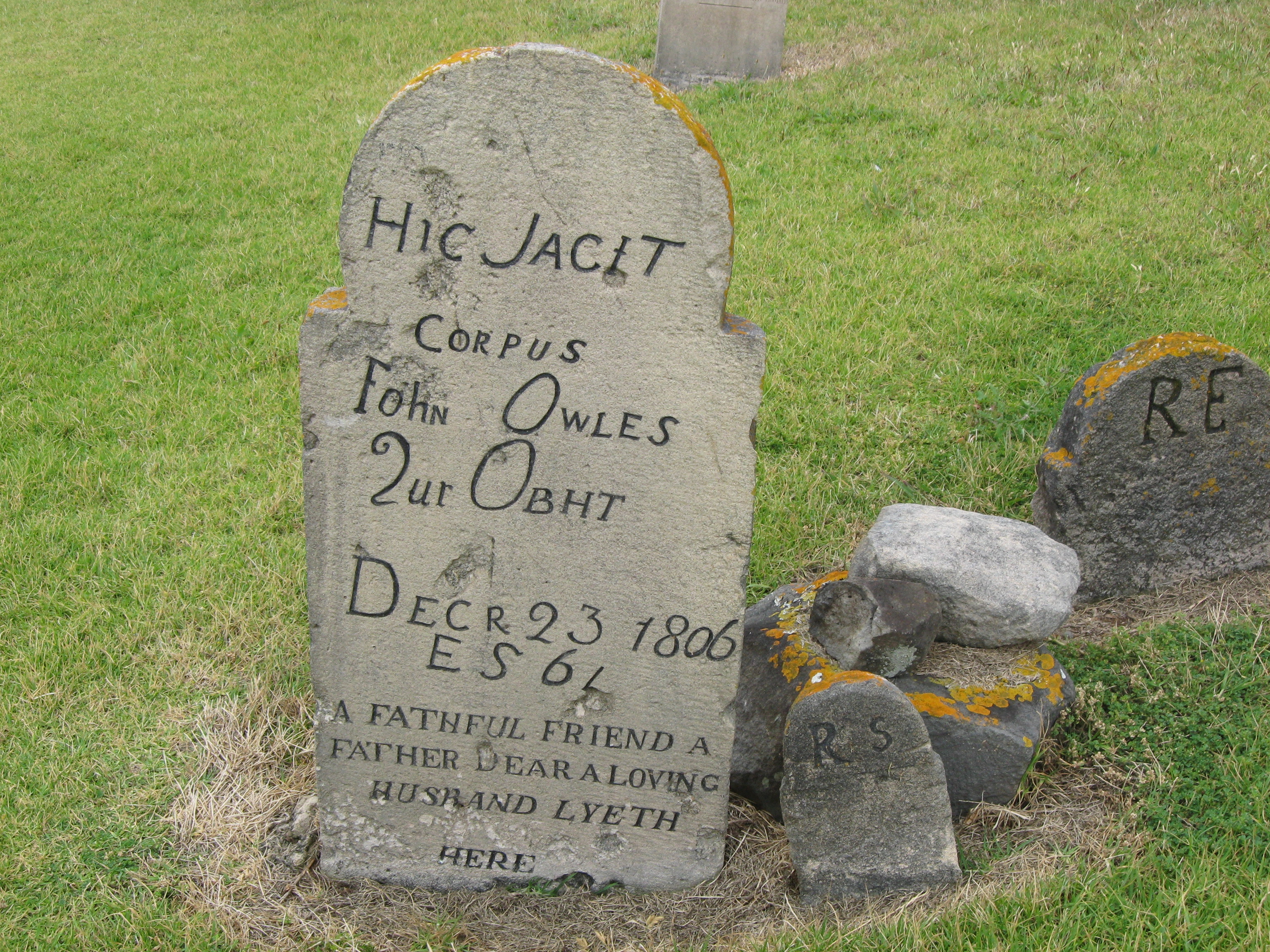
Kingston, Norfolk Island

Merval Hoare, the author of this book is herself a Norfolk Island inhabitant.  I am not sure whether she herself is a Pitcairn descendant, but I note that in her acknowledgements, none of the major Pitcairn families are mentioned.  Nonetheless, having now been here, it is not hard to discern the sensitivities and allegiances that arise in portraying Norfolk Island’s history.

There are surely not many places on earth where a local history can be divided up so neatly into self-contained epochs, with virtually no strands between each era.  Norfolk Island was uninhabited until the Polynesian  diaspora around 1100 until approximately 1400.  Interestingly, Hoare’s book does not address this phase at all, beginning its narrative with Captain Cook’s discover y in 1774.  For some reason, the Polynesians left and the island again fell silent.

What is known locally as the “first settlement” commenced in 1788, just 6 weeks after the British arrival at Port Jackson, when Norfolk Island was established as a parallel settlement to forestall French occupation, provide pine spars and flax sails for shipping, and furnish an alternative food source for the struggling Port Jackson settlement.  Once Sydney (as it was by then known) had overcome its early food shortages and the Napoleonic Wars were drawing to a close (although, I note, only just!) it was no longer expedient to keep Norfolk Island as a parallel colony, and it was closed in 1814 and its settlers and convicts sent, in some cases very reluctantly,  to Van Diemen’s land.  The buildings were torched and the island left silent again, except for the barking of the dogs and the snuffling of the pigs left on the island.

The island remained uninhabited until , under the influence of new practices in prison administration, the “second settlement” began as a fully-fledged penitentiary.  It was run as a place of secondary punishment: there were no women, brutality was widespread, and the island as a whole ran as a prison.  Except for a brief respite under Alexander Maconochie, there was a succession of prison commandants of varying degrees of cruelty and despotism.  With the uneasiness over transportation from  the 1840s on, and the anxiety and repugnance over the inevitable and widespread homosexuality, the decision was made to close the second settlement in 1856.  A few men were left as caretakers, but again the island fell silent, awaiting its next tranche of inhabitants.


They arrived soon after.  They were the descendants of the Bounty mutineers who had outgrown the small Pitcairn Island that had been their home since 1790.  In the first decade, the mutineers and their Tahitian companions had fallen out with each other and after a succession of murders, there was only one original Bounty mutineer left- John Adams.  He descended into alcoholism, but one night had a vision and converted to Christianity.  He became a devout student of the Bible and the Book of Common Prayer, and his example extended throughout the Pitcairn Islanders who were transformed into a pious, God-fearing community.  They brought their faith with them when they shifted as a group to Norfolk Island, although some returned to Pitcairn.  The community on Norfolk Island today has at its core the descendants of this “third settlement”.

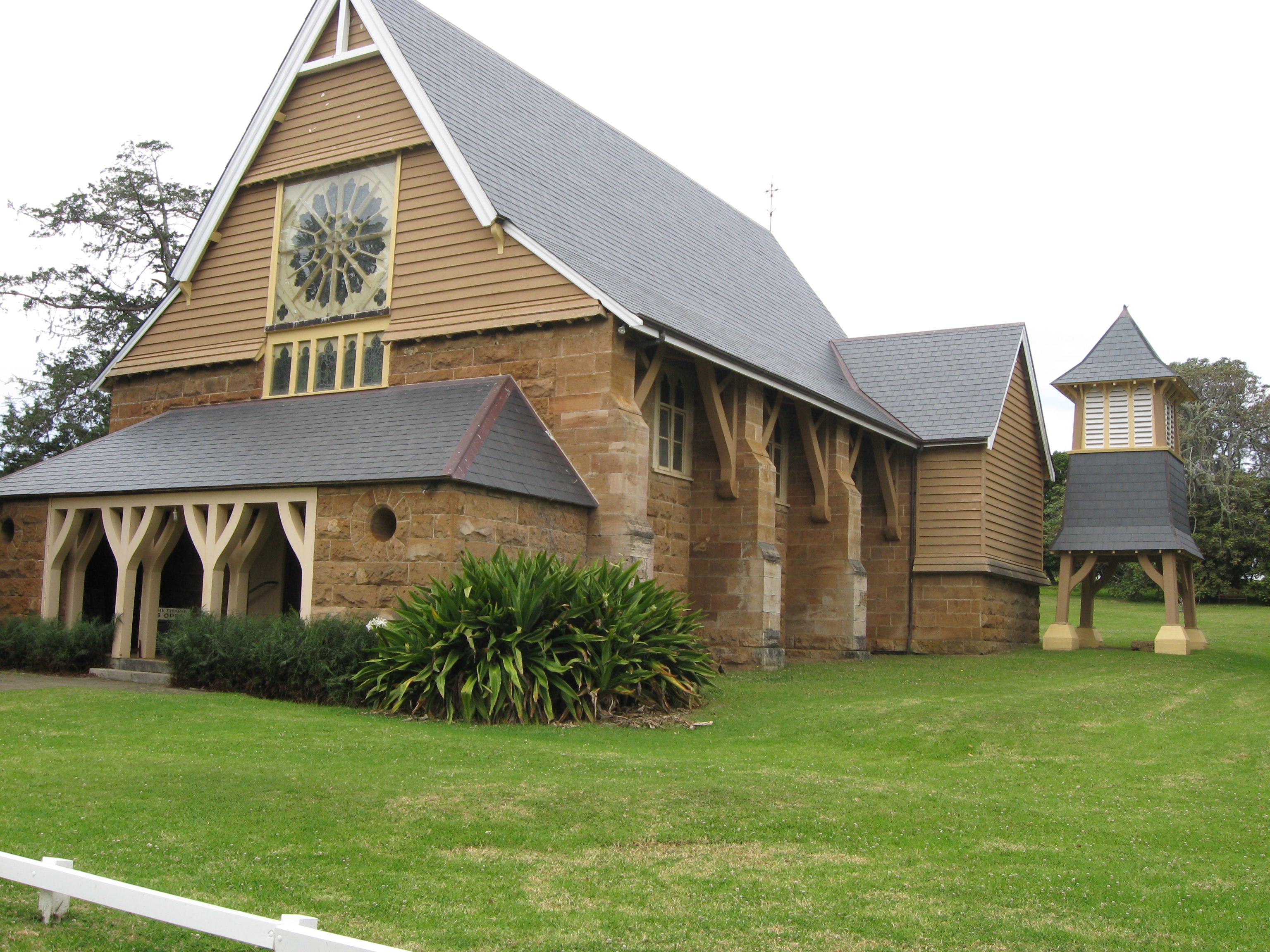
St Barnabas Church, Norfolk Island

Over half of this book is devoted to the third settlement, which is after all, the longest phase of white settlement on the island.   At times I found myself wishing that the author would draw breath and move away from the narrative a little.  For example- how did Norfolk Island intersect with the passing Pacific traffic? What was the nature of the contact between Sydney and Norfolk Island in the first and second settlements?  There are obviously sensitivities that she is tip-toeing around: the eviction of the Pitcairn/Norfolk Islanders from the abandoned Crown buildings at Kingston; the reports about homosexuality that expedited the closure of the second settlement.

At one stage the author herself slips modestly onto centre stage- good heavens! I would have made much more of this!  For many years there had been debate over the content of a missing document which the Norfolk Islanders claimed had transferred ownership of the island to them.  The document had disappeared very quickly considering its putative significance, but the author herself re-discovered it amongst the papers of Bishop George Selwyn, deposited at the Auckland Institute and Museum.  What an intake of breath and internal whoop of joy that must have occasioned!!  Her relative downplaying of her find is either modesty or circumspection- I don’t know which.

I read the second edition of this book, which has an additional chapter added onto what had clearly been the conclusion.  There has since been a third edition which has no doubt added an extra chapter again.  That’s the problem with this approach- it tends to result in more farewells than Melba, or perhaps the third book of the Lord of the Rings.  Nonetheless, I feel that I’ve been given a good narrative skeleton of the history of the Island, which in its displays, tourist attractions and yes, in its very community  vibe, delivers  its own perspective on the island’s history.

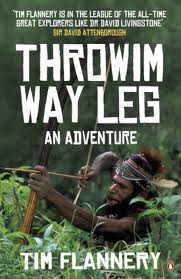
‘Throwim Way Leg’ by Tim Flannery

1998, 326 p.

I’m not sure about Tim Flannery’s writing, or Tim Flannery himself for that matter.   I was astounded when he was proclaimed Australian of the Year under the Howard government.  Although I don’t know how much influence a government has over the Australian Day board, it seemed to me during the Howard years that the government’s conservative influence was pervasive across all institutions. Tim Flannery with his 2006  book The Weather Makers certainly seemed at odds with the Howard government stance on climate change at the time .  But there seem to be many contradictions – or more charitably, nuances- in Flannery’s views on a whole range of topics: whaling, nuclear energy,  restoration of ecosystems.  Is he a brilliant, wide-ranging thinker?  Or does he not think widely and carefully enough?

It’s hard to classify Throwim Way Leg.  It’s organized geographically around different locations in New Guinea and Irian Jaya where Flannery had worked over an extended period of time, going back to the 1980s.   At times it reads like an extended set of case notes, at other times it is more autobiographical and even political in places.

There is a rather juvenile and somewhat disconcerting fascination with penises-  although the sight of the penis gourd does tend to attract one’s attention somewhat.  There is a whiff of self-absorption in his cataloguing of his illnesses and discomforts, and I don’t know whether I’d find him a particularly amiable travelling companion.  In fact, he comes over rather as he does in “Two Men in a Tinnie” with John Doyle- full of information and lessons to be conveyed, but a bit wooden.

His work is steeped in blood.  He no sooner arrived in a location than he had dispatched his hunters off into the jungle to bring back bodies for him which he skinned, boiled down for their bones, and bundled up to send to an Australian museum back home.  I felt uncomfortable at the undercurrent of colonialist appropriation- all in the name of science, of course- and the sheer profligacy of killing even rare animals for specimens.  It did not seem too far removed from the Hunters and Collectors of the nineteenth century so well captured in Tom Griffiths’ book.

At the same time, there is a naiveté about his work as well.  He admits, to his credit, the assistance he received from the Ok Tedi mine but one wonders whether the company has bought his silence about their environmental and commercial practices.  Not so for the Freeport mine, however, which he speaks out strongly against.  In this regard, I can forgive him many of his other shortcomings.  I look at a map of West Papua (he calls it Irian Jaya) and I shake my head at how Indonesia could make any claim to it on either geographic   or ethnic grounds, and even the historical argument based on earlier Dutch colonialism seems rather dubious to me.  I think that Australia, along with the Western world generally , is spineless in its acquiescence  to strident Indonesian rhetoric over their claims to West Papua.  At least Flannery calls it as he sees it.

I read this book with the Ladies Who Say Oooh, several of whom really enjoyed it for its depiction of adventure and discovery occurring within the last thirty years in a world that we think of as fully mapped and known.  I, on the other hand, was frustrated by the plodding prose and the “well done those men”- type of masculine back-slapping often found in military histories.  I note that Flannery’s first degree was in English literature before embarking on a more science-based academic journey.  There’s not much of the poet here.

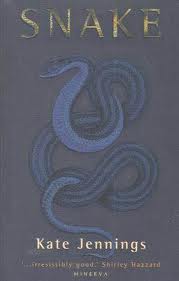
‘Snake’ by Kate Jennings

Kate Jennings Snake,  Melbourne, Minerva, 1996, 145 p.

Snake is a short book: only 145 pages and easily readable in one sitting.  It is a sharp, gritty book and you know from the opening pages that this is not going to be an easy reading experience.

The layout of the book is interesting.  It is in four unevenly sized parts, each divided with an engraved version of the snake of the front cover.  Part 1, only nine pages in length, is written in the second person and addressed to Rex, the father of the family. Immediately you are plunged into Australian Gothic:

Everybody likes you.  A good man.  Decent. But disappointed. Who wouldn’t be? That wife.  Those Children.

Your wife.  You love and cherish her.  You like to watch her unobserved, through a window, across a road or a paddock, as if you were a stranger and knew nothing about her.  You admire her springy hair, slow smile, muscled legs, confident bearing.  If this woman were your wife, your chest would swell with pride.

She is your wife, she despises you.  The coldness, the forbearing looks, the sarcastic asides, they are constant.  She emasculates you with the sure blade of her contempt.  The whirring of the whetstone wheel, the strident whine of steel being held to it, that is the background noise to the nightmare of your days  (p. 3)

Part 2 moves into third person, and is only a little longer- 11 pages and it takes us to their wedding, and already the ashes are in our mouth as we move through the unvoiced thoughts of the unlovely people who make up their extended family.

The longest section of the book is in Part 3, where there are short vignettes of the pettiness and the cruelties of everyday life in this blighted family:  Irene’s love letter to ‘the other man’ intentionally left where her husband Rex would find it; her moodiness and favouritism, the dog tragically left to die in a car. You know- as you’ve known from the opening pages, that this isn’t going to end well.

The final Part IV returns to the second-person voice, but this time it is addressed to Irene.  It is short- the shortest part of the book- and bitter.

All of the chapters in this book are short – in some cases the title is almost as long as the chapter itself!  The relationship of the title to the chapter is often oblique, as is the image of the snake that slides through the book both graphically and structurally.

Sue at Whispering Gums wrote a fantastic post about ‘taker-outers’ in books, and this book is just about as spare as you could get.  It is as dry and dessicated as the family it is describing, and all the more powerful for that.

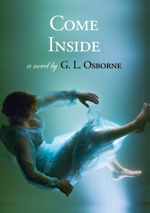
‘Come Inside’ by G. L. Osborne

2009, 170 p

I hadn’t heard of this book until I read Lisa’s review at ANZLitLovers, but I see that it has attracted quite a bit of attention with shortlistings at both the Commonwealth Writer’s Prize First Book of Fiction and the Age Book of the Year.  It’s only short- just the right length really, because she teases her reader and as we know, it’s a narrow line between teasing and tears.

It’s an unusual and risky book.  A young girl is rescued by a young man after being swept ashore as the only survivor after a shipwreck in 1887.  She is  unable to remember her earlier life, and her story becomes part of the local folklore, heavily mined by the press at the time,  a series of oral histories in the 1940s and then centenary publications a hundred years later.   There’s shades of the Loch Ard here, but not quite; the small seaside town of Colego seems as if must exist somewhere in Western Australia, but it doesn’t seem to, either.  The slippage between fact and fiction starts on the flyleaves, where the author thanks “Ken and Claire Stewart” for the extracts from an unpublished manuscript by Caroline Stewart held at Colego Public Library.  It is this manuscript that forms one strand of  the narrative: the other strand is the drugged delirium of a woman on what appears to be a ship.  Woven around these two main strands is an assortment of tangentially-related ‘evidence’- press clippings and letters from 1887,  extracts of books, interviews with Colego inhabitants in 1946, a collection of letters by Isobel Smith, a book by the same Isobel Smith, then an edited anniversary edition of the same work.

There’s much here about memory and history, as layer upon layer is built up over the story.  Caroline Stewart, the author of the manuscript, works in the small Colego museum where she works cataloguing the objects,  and although her instructions are to label the materials empirically, the edifice of objectivity is just as tottery for the ‘fact-based’ local museum as it is for the other retellings. The curator of the museum is fiercely protective of the artefacts and the version of local history that the museum promulgates but there’s a flatness and deadness about the history it embalms, especially compared with the other stories we are given based on people rather than things.

A risky book? Sure is.  She has assembled it all carefully, but it is the reader who puts it together.  I’m not sure if I understood it, and that’s an uncomfortable reading experience.  At 170 pages it is short and as the number of pages diminished,  I found myself wondering how she was going to draw it to a close, and even why it ended at that particular point.  It is beautifully written, and she deftly catches the tone and cadence of many different genres in the material that she lays out for us.   And yes, I know the adage about judging books and covers, but that is a truly lovely photograph on the front.

I mentioned a couple of posts ago a book called Pistols! Treason! Murder! which, labelled “History” on the back cover, uses a similar methodology.  I’ve borrowed it and I’m interested to see the technique used in non-fiction. I wonder if I’ll experience the same sense of floating anxiety (yes- that front cover is well chosen)  about whether I’m putting it together “properly”.

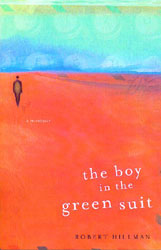
‘The Boy in the Green Suit’ by Robert Hillman

2003, 232 p.

My bookgroup ladies (aka “the ladies who say oooh”) were not unanimous in their opinions of this book.  I liked it though.

For me, a memoir is not the same as an autobiography.  There is not the same imperative to cover all the major bases; it does not have to start at the beginning and end at the end.  A memoir, for me, is more a construction, given its own shape by the author, and truth or completeness are not the major criteria by which it is to be judged.

This memoir was not complete, and some of the bookgroup ladies felt that it was not true either.  It focussed on one year in the author’s life when as a naive and rather pathetic sixteen-year old he left behind his apprenticeship in the butcher’s shop in Eildon and job in the shoe department of Myer Melbourne to embark a Greek ship for Ceylon.  He wore a green suit already too short in the leg that made him look, by his own admission, like a grasshopper, and he carried a suitcase of books and his typewriter.  With no money and no passport, he travelled through Athens, Istanbul, Tehran and Kuwait, ending up in a Pakistani jail.

There are aspects that stretch credulity.  His misadventures are told at a distance, complete with reported conversations which, of course, must be a construction after the event.  The CAE booknotes we used when discussing it quoted Hillman insisting that he remembered conversations word-for-word.  The ladies-who-say-ooh lifted a sceptical eyebrow. This didn’t particularly trouble me.   I found myself more stunned by the naivete  and youth of the lad, and that he survived relatively unscathed. For me, the charmed status he enjoyed in the jail compared with his fellow-prisoners added to the credibility of the book- if the author was inclined to exaggerate or embroider, this Bangkok-Hilton scenario was the place to do it.  But he didn’t.

His narrative is interspersed with events from his emotional life that both explain, and follow through on his travel experience.  His mother walked out on the family when he was very young;  he was uncomfortable with his step-mother and she with him; his father contemplated having his adopted out until dissuaded by Hillman’s older sister; his mother reappeared in his life; he himself had a succession of failed relationships.  These snippets are short, barely two pages and marked with a different font. They raise more questions than they answer.  His relationship with his father is wistful and inadequate, and he seems set to repeat the same pattern.

I thought that this memoir was beautifully constructed, with self-deprecating humour and an ongoing flinch of pain.  It won the National Biography Award in 2005, and I think it was well-deserved.

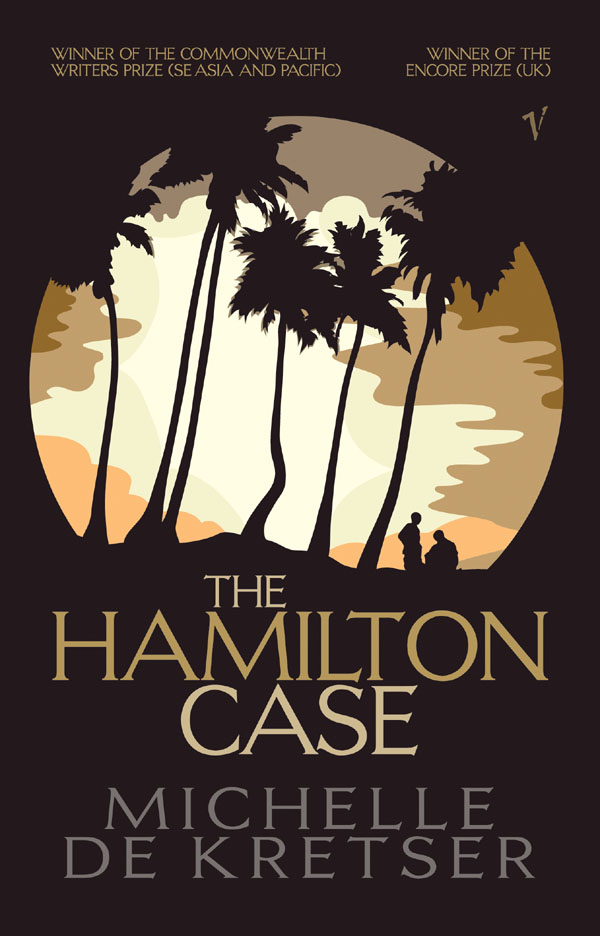
‘The Hamilton Case’ by Michelle de Krester

2003, 367 p.

Three puzzling books in a row.  My dear daughter, bless her, says that I’m just getting stupider.  That may be the case (I blame Judge Willis), but in my own defence in my last three fiction reads I think that I’ve read

  1. a wilfully abstruse  book (House of Splendid Isolation)
  2. a genre high-wire act (Truth)
  3. and now a carefully constructed, unsettling book that I feel satisfied to puzzle over.

This was my face-to-face book group read for the month.  It was my selection (“Who chose THIS book?”) and I was rather disappointed to find when I was flipping through my reading journal that I’d actually read it before, in 2004.  I now realize that what I meant to nominate was her next book The Lost Dog which she wrote in 2007.  It didn’t matter though- I really could not remember much about The Hamilton Case at all.  I was interested to see that the comments I made six years ago are pretty much the same comments I’m going to make now.

This is a clever, clever book.  It commences with an autobiographical fragment, written by the elderly Ceylonese lawyer Sam Obeysekere, reminiscing about The Hamilton Case which he prosecuted many years previously.  The case was emblematic of Sri Lanka’s colonial past: it occurred on a tea-plantation where the white manager was murdered and two labouring coolies were accused of the murder.  Our narrator is a pompous, deluded, rather pathetic character, reminiscent of the narrator of  Ishiguru’s The Remains of the Day.  This section ends abruptly and the narrative broadens to an omniscient third-person perspective.  This is perhaps a little unfair as we have been repelled by Sam’s character in the first section, just as other characters in the book had been repulsed by him for other reasons.  What follows is a narrative of Sam’s family- his mother, sister and son- and what a steaming, foetid family this is.  De Kretser  evokes vividly the rampant Sri Lankan jungle- it reminded me a little of One Hundred Years of Solitude– and the book is drenched with colonial decay.   Much though I was enjoying this section, I did find myself wondering about the title, given that the Hamilton Case itself had taken up only a small part of the book.  But I was in confident hands, and sure enough the last section of the book, written as a letter from an author who had fictionalized (or had he??) the Hamilton Case, disrupted completely Sam’s telling of the case in the book’s opening.

Confusing?  It might read that way in my summary of it, but it didn’t feel confusing while reading.  Certainly, as a reader, you felt distrustful of all the characters and alert to the nuances and tricks of memory but at no stage did I feel that the author was losing control of her own narrative.  On the contrary, it was very assured, clever writing, very careful and well worth a second (or in my case- third!) reading.

‘The Bee Hut’ by Dorothy Porter

2009, 139 p.

I wasn’t going to write this post. I was going to write about my own experience of poetry as a reader, the frustrations of reading a collection of poetry in an online environment etc. etc. But I’ve just been crying as I turn the page on the last poem in The Bee Hut, the collection of Dorothy Porter’s poetry that was completed just before she died in December 2008.  I feel so very sad at the thought that this is, literally, the last poem. I’ve been thinking, too, of my friend Dot Mac (everyone knew her that way)- another Dot, my Dot-  who also died of breast cancer a few years ago, at much the same age.  I still can’t quite believe that my life goes on, day after day, and yet she is not here.

While I was reading this book, I found myself wondering about the interweaving of the poet’s life and her poetry. It seemed to me that the whole book was pervaded by a clearness of vision- a close, intense, way of looking- that had been sharpened by her cancer and confrontation with death. In the final poems there is a closing around and a drawing inwards that I think even someone unaware of Dorothy Porter’s own biography would detect.

The book itself is divided into sections, almost like the acts of a play. In this way, it has its own narrative thread, as a collection.  There are travel poems- dust-laden poems about Egypt, cold green poems about London; there are theatrical poems written as lyrics for stage performance.  There’s a section of poems about illness, reflecting the first bout of cancer years earlier, then there are the final, quiet poems at the end. There’s a sense of movement through the poems as a whole, rather than just one self-contained poem after another.

I read this book as part of an online book group that I’m in that focuses on Australian literature-http://groups.yahoo.com/group/AustralianLiterature if you’re interested in joining us. We read and discuss (rather desultorily I must admit) one book a month. This was the first poetry book we have read, and I found it hard to actually comment on it during the process of reading, beyond saying “I liked this bit….” and quoting particular phrases and stanzas.  But there’s an artificiality about reading a book over a month like this, and I don’t think it serves poetry well.   I think that poetry has to be purchased, rather than borrowed; I think that you need to have it at hand for dipping into, rather than reading straight from cover to cover.  I think it needs to be read out loud, rather than read through. It stands on its own two feet: anything that I could add is superfluous.

I really didn’t think that I’d be in tears at the end of it.  The opening poem has been well chosen: the first words you encounter are:

The most powerful presence/is absence.

And what a powerful presence this is.