Category Archives: Australian literature

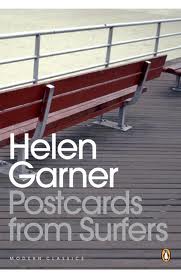
‘Postcards from Surfers’ by Helen Garner

1985,  106 p.

I don’t really know how to review a book of short stories.  I find myself making several assumptions.  I assume that it is a selection from a corpus of work developed over a period of time:  it is common to find that several stories in a collection have appeared in other compilations previously.  I assume that someone–  author? editor?- had a vision for a book of short stories as a self-contained piece of work.  I assume that one story was accepted as ‘right’ but another put aside for now, and  that the ordering of the stories was a conscious and carefully thought out decision.  There’s an arbitrariness about the whole process  that makes it hard to think about a book of short stories as a single object: would it be any less satisfactory if one of the stories had been omitted? would it be a different entity with one of the stories that was rejected  included instead?  For me, even the act of reading a collection of stories differs from my normal reading habit.  I prefer to read them just one at a time, but often they’re so short that I find myself thinking “Well, what now?” Sometimes I cram in another one straight away (which I don’t like doing), or else turn afterwards to another full-length book that I might have on the go at the same time.  When I come to write about them here, I’m not sure how to proceed- do I treat them individually (which might become rather tedious and might place a heavier burden on a few pages of writing than it can support)? Do I just hold onto the one or two that stay with me even without opening the covers again? Or do I embrace it instead as a collection without peering too closely at the component parts?

I’ll go with the memorable stories, without looking at the book again.  The first one, which gives the collection its title fitted in neatly with another book I’d read recently- Life in Seven Mistakes.  It is uncanny how often one book seems to ‘speak’ to another.  This short story is located in Surfers Paradise too, but the narrator is more mature and thus easier to spend time with, and Garner adeptly uses the device of postcards written over a period of time to quickly shape the contours of a larger plot that stretched over a longer expanse of time.  Good, sharp, clever writing.

Her story ‘Little Helen’s Sunday Afternoon’ captures a child’s perspective well, and evoked for me those visits to my mother’s friend’s houses, where there were other barely-known children and mutual wariness and showing-off.  In ‘All Those Bloody Young Catholics’ she nails the drawl, condescension and prejudices of the slightly-tipsy narrator of some thirty years ago when sexism and sectarianism were threaded unselfconsciously and largely unchallenged through overheard conversationsIn ‘Did He Pay?’ she describes vividly the washed-up, unattached old rock-star, indulged by friends and committed to no-one.

I’ve always seen Helen Garner as a perceptive observer, who has gone to places that I never dared, several years ahead of me.  There’s an innate authenticity in what she describes, and I can see why so much of her more recent work straddles the conjunction of non-fiction/reportage/fictionAs a Melburnian, I love the very local context of her narratives, although she ventures overseas, particularly to France, in these stories as well.  It’s like looking through someone else’s eyes at the things, people and situations that surround you, and thinking “Yep, she’s got it!”

It’s interesting that this book has had so many lives.  My copy is an early 1986, and there is a 1992 one as well; it was republished in 2008 as one of Penguin’s Modern Classics with the cover above, and most recently it has appeared as one of the orange-and-white retro (and cheap!) Popular Penguin reprints.

Rating: 8/10??

Reason read:  Australian Literature Group (Yahoo Groups)
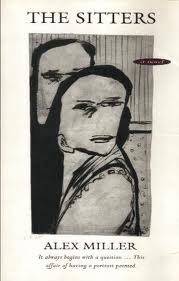

‘The Sitters’ by Alex Miller

1995, 131 p.

The Sitters is only a small book- 131 pages- and as with other Alex Miller books, its simplicity is deceptive.  Its narrator is an elderly, somewhat self-deprecating and yet emotionally frozen painter who has not been able to return to his painting after achieving success with an earlier portrait The Tan Family.  I felt as if I had met this character before in other of Miller’s works the voice is similar to that in Lovesong and Miller has written about painting before in Prochownic’s Dream.

The narrator paints only portraits of other people, never his own family,  but

… a portrait’s always a portrait of the artist.  Except that nothing’s ever as simple as aphorisms.  Whenever we’re tempted to try them on, we discover that their general truths never quite fit our particular realities.  All the untidy bits are left hanging out, the important bits, the inexplicable stuff that nothing resolves, and we discover again that those explanations don’t help because they don’t belong to our present reality but belong to something in the language, to that other dimension.  The cover- up.  (p.71)

Language and silence are brought up against each other again and again in this small work.  Early on, the narrator comments

There are things that are impossible to express with words.  Language employed to express emotion is a perversion.  The records of commerce is the only honest use of written language.  The rest is a cover-up.  It’s not words that shape our intuitions.  It’s not in what we say but in what we leave unsaid that we reveal the shape of our deepest motives. In the places between the words.  In the tacit and the implicit. In the silence beyond words.  That’s where we hid our truth.  Behind the endless buzzing of language.  The sovereignty of silence is its ambiguity.  Silence is a power greater than speech. (p.16)

Spoiler alert:

Presence is brought up against absence as well.  The painter meets, fleetingly an expatriate academic, Jessica Keal,  who has returned to Canberra on a fellowship, and he is instantly attracted to her.  After a commission to paint a series of sketches of women, including her, he asks if he can paint her portrait- not just one, but many studies of her, over an extended period of time.  Yet when he does paint his first portrait of her, he finds that he leaves her out of the painting: the room, the bed, the furnishings are there, but she is absent.  He does not need his subject to be present, and when she is, he doesn’t necessarily paint her.  He had earlier in his career painted a close, recently deceased friend as a corpse, just died, and years later he will paint Jessica again, rubbing her chest in heart-pain. Some years earlier he had painted the back view of his agent.  His agent perceived this painting as a joke, which on one level it was, but it also revealed something about our narrator as painter.In a portrait-sitting, he is painting from life, but the life is not necessarily present in that moment.

He has never painted his family: indeed, he lives in a vacuum with his memories of his family intentionally suppressed, and his relationship with his son detached and observational.  He lets us know early in the book that he has distorted and embellished his memories of his father as some type of artistic mentor and influence.  He has extended his memory of a single pre-WWII day painting outdoors with his father into a golden-tinged lifetime of paternal artistic inspiration, and this benign memory has been overshadowed by the words and actions of the bitter, damaged man who returned from World War II.  His sister, from whom he had become estranged through inattention rather than intention, had written to him that she’d come to see one of his art shows but left without speaking to him, not wishing to intrude.  She had since died, and it was in painting The Tan Family, the painting that brought him the greatest praise, that he painted his grief for her, even though he didn’t recognize that.

The book is titled The Sitters (plural) and although ostensibly it is a slight story about an elderly painter and a younger female sitter, the ghosts of his childhood are sitting, too.  There are multiple sitters, not just one, and he is painting them present from their absence.

The book makes much of silence, but there’s much in it about language.  The sentences are short and pared-back, and although his narrator professes to eschew words, there is a joy in them as well.  The description of his sister as “ungainly, angular, gangly, ugly” betrays a joy in the sound and shape of words.  It is a reflection on the act of representation and capturing the essence, whether it be through words or through art.

This is a carefully crafted little book with nothing superfluous.  There are no chapters and the reader has to work a bit in following its leaps back and forward.   It sustains a sexual tension well, but is tinged with regret and vulnerability as well.  It was shortlisted for the Miles Franklin in 1996 (a year with a majority of female authors, by the way); pipped by Christopher Koch’s 450 page Highways to a War.  You’d be hard-pressed to find two more dissimilar books.

8.5/10

Read because:  David recommended it.

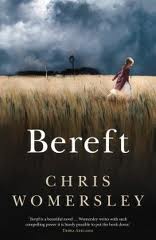
‘Bereft’ by Chris Womersley

2010,  264 p.

There are eras in Australian history which, in my imagination are flooded with light- the gold rushes is one; the time around Federation is another- when Australia seemed open to opportunities, hungry for change and with the future opening up before it.  Then there are other low, muted,  hold-your-breath times, and I think that immediately after World I would have been such a time.  So much death and absence, felt so keenly at the intimate and everyday level and yet played out so far away: men returning broken, damaged and strangers to themselves, and the incomplete, unresolved grief about those men who failed to return.  Then, overlaying all this is another winnowing as the Spanish flu sweeps the country, as if Death has been brought home from across the sea.

Bereft is set in this time.   Quinn Walker returns from the front to his childhood town, Flint, in western New South Wales.  There is no homecoming celebration: instead he skulks in the bush, too frightened to appear in public.  Ten years earlier he had fled when his sister was found raped and stabbed, and he was accused of the crime that his father and uncle swore to avenge.  Watching his house from a distance, he realizes that his mother is very ill, probably with influenza, and that his father, frightened of catching it too, spends little time at the home, sitting on the verandah outside his dying wife’s window.  And so he is emboldened to approach the house when his father is not there, and his mother, not sure whether he is a hallucination or not, speaks with him.  She has lost everyone- her husband to bitterness and the quest for revenge, her daughter to the slaying, her eldest son to Queensland.  Quinn had just disappeared, confirming the rumours of his guilt and then was reported dead from the front- but now her younger son returns.  There is the word ‘orphan’  for a child who has lost its parents, she says, but no word for a parent who has lost her children. Or, thinks Quinn, for a brother who has lost his sister.  They are all just bereft.

He is being watched while he hides out in the bush.  Sadie Fox, a dishevelled, fey little orphan knows many dark things, and Quinn does not know quite what to make of her- changeling? spirit? urchin? hallucination?  In the face of so much bloodshed and pain, the line between life and death seems tenuous.  It is a time when clairvoyants feed on unresolved grief, and when many people are open to spiritualism.  Quinn’s own experience of the mud and the gas of the Front leaches into his present, and his own long absence from his home town means that his own identity is a vacuum.

Although Womersley has worked very hard in embedding the narrative within a particular time, I can see why this book has been described as ‘rural gothic’,  along with other Australian novels that span right up to the 1970s and 80s- think Craig Silvey’s Jasper Jones,  Elizabeth Jolley’s The Well and Sonya Hartnett’s Surrender.   I do wonder, though, if the easy interchangeability of this book with others set some 70 years later suggests that (a) country life and country people do not change at all, and/or  (b) that he hasn’t quite captured early twentieth century relationships and interactions very clearly.  Did people speak, move and interact in a qualitatively different way in 1919 compared with 1969?  I’m not sure.

I can see continuities, too, with his first book The Low Road, in that they are both stories of escape and hiding.  In both of them there is a sense of pursuit.

Bereft is one of the three books that have made the cut as the short-list for the Miles Franklin prize. All up, Bereft is  a book that weaves many strands- historical fiction, a type of crime fiction, the supernatural, and small-town claustrophobia- and it does it well.  So far for me, though, That Deadman Dance is the front-runner- although my record in picking the Miles Franklin winner is, so far, abysmal! I was right but disgruntled in 2009 and wrong and outraged in 2010.

7.5/10  (I think I prefer scoring out of 10)

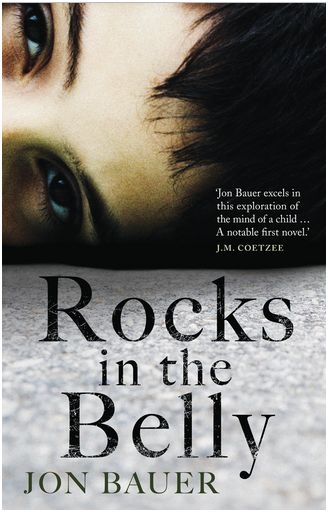
‘Rocks in the Belly’ by Jon Bauer

2010,  296 p

I’m not going to give this book a star rating (something I’ve only started doing recently anyway).  I really don’t know what I’d give it.  I very nearly didn’t finish reading it, and that is unusual for me: I usually hang on to the bitter end once I’ve started a book.  But I found this book very disturbing and unrelievedly painful and I did not enjoy the experience of reading it at all.  Is that powerful writing? Probably.  Did I want it to go on for even one page longer? Definitely not.

The story is written in two strands.  One is in the voice of eight-year old boy, an only child, whose family fosters other children as well.  They have been recently joined by Robert, an older boy.  The second voice is that of the same boy, now twenty-eight, returned from Canada because his mother is dying of brain cancer.  Significantly, we don’t ever learn what the narrator’s name is, and although the voice of the child and the man are distinctive, the pain, injury and jealousy throbs through both narrative strands equally.  A damaged and damaging child: a damaged and damaging man.

In the acknowledgments at the back of the book Bauer mentions that the book had an earlier incarnation as a short story.   Maybe a book so lacerating  should remain in a small format- a 190 page novella perhaps.  I did not want to keep reading, and I just wanted the pain, all round,  to stop. I tired of the scatological references to wee, the poo and doodles by the young boy and I shuffled uncomfortably at the violence and warped thinking of the man.  I didn’t want to be with any of these people.

I see that it has been long-listed for the Miles Franklin.  I’m not sure.  In fact, I was quite positive that it was set in England- to me it had all the hallmarks of the archetypal ‘gritty BBC mini-series’- and I was surprised flipping through the book later to find that there is no real indication of where it is set.  Its oppressiveness, the hedged garden, the upstairs bedrooms, all signalled England to me.  I don’t think that the Miles Franklin is the right award for this book.

I am sure, as Lisa at ANZLitlovers point out, that this book would spark a lively discussion in book groups.  However, thinking of my bookgroup ladies, I suspect that if I, not usually so disturbed by a book, found it difficult to continue then they even more would baulk at such unmitigated pain.

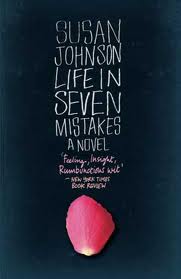
‘Life in Seven Mistakes: A Novel’ by Susan Johnson

2008,  344 p.

(4.5 out of 5)

One of the two epigraphs that grace the opening pages of this book quotes Shakespeare’s As you Like It

All the world’s a stage,

And all the men and women merely players;

They have their exits and their entrances’

And one man in his time plays many parts,

His act being seven ages.

I’m not sure that it was a particularly apposite quote, and it complicated rather than illuminated the title of this book, which for the life of me I can’t quite make fit with the story itself.    Doesn’t matter really: I enjoyed it anyway.

There are two intertwined narratives in the book.  The first, written in the present tense, is told from the perspective of Elizabeth, a middle-aged ceramicist on the verge of her first international exhibition. She has travelled up to Surfers Paradise with her third husband Neil and her children to spend Christmas, and to celebrate her parents’ 50th wedding anniversary four days later. Her  brother and his wife and  children have done the same.     Ah- families- you’ve gotta love them, don’t you- with all that jealousy and love and rawness and spite mixed in together.  There they are, in their parents’ large air-conditioned penthouse at the top of a Gold Coast hi-rise: Bob the patriarch a boorish, loud bully; Nancy his tense, controlling,  hyper-critical wife; Robbo the younger brother who just rolls with the punches and his rather intrusive and opinionated wife, and a brood of disengaged, self-absorbed grandchildren.  Then there’s  Elizabeth, our entree into this family,  who despite her own status as mother, artist and adult woman feels as if she turns into a little girl again around her parents.  Her brother Robbo is spot on about her:

You’re pathetic.  Still bleating about what Mummy and Daddy did to you when you’re almost old enough to retire.  Next year you’ll qualify for one of those over-fifty retirement places.  Are you still going to be blaming your parents when you’re seventy? Life’s too short, Liz (p. 108)

Then there’s the missing youngest brother, Nick who is in jail after a long history of drug use with all the betrayal, defiance and hurt that this brings.  He’s barely spoken of, only briefly encountered in the book,  and yet a presence nonetheless.

How did this family get to be like this?  The other narrative strand takes the young Bobby and Nancy as they meet in the 1950s, begin courting, marry, have children, become increasingly affluent as Bob (who drops the ‘Bobby’) moves up the corporate ladder  into private schools, prestige cars, Surfers Paradise penthouses etc.  But all of this comes at a price- expectations of gratitude and performance- and Bob becomes angrier at the world and the sense of entitlement that he himself has fostered for himself and his family; Nancy tries to make herself and her children smaller targets;  and the three children in their own ways negotiate this spreading emotional mine-field.

Both narrative threads were strong and well-made, and I didn’t find myself regretting when I turned the page to find that the narrative was about to switch again.  The dialogue was particularly good, and the author obviously has a sharp, observant eye.   The ending had an emotional authenticity, at least for this middle-aged reader at the time I am in my own life, although other readers may judge it a cop-out.  The book had the groundedness and edge of Christos Tsiolkas’ The Slap, and felt a little like Jonathan Franzen’s The Corrections down under.  This is perhaps a little flippant: all three of these books have a truth at their core about loyalties, judgment and the emotional mess of just living.  All three are more than the “human comedies” that their blurb writers have pigeon-holed them as.

Oh, but that title- it’s turning me into a numerologist.  There’s seven main characters- is that it?  Or is it, on p. 106 when Elizabeth lists all the things that people tell her not to be take too seriously: love, art, university, jobs, children, her parents, life itself–  there’s seven of them too.  I wish I hadn’t been so hung up on looking for a reference to the title while reading, and I wish I could let it go now too, but Elizabeth-like, I can’t.  Perhaps that’s the mark of a good book- that it turns YOU into its protagonist??!! ( now that’s  a dangerous thought….)

Some other blog reviews:

Kimbofo at Reading Matters

Lisa at ANZLitLovers

Reeling and Writhing

And other reviews:

The Sydney Morning Herald review by Louise Swinn

The transcript of Jo Case’s review on RN’s Book Show

Felicity Plunkett’s review in The Age

The Australian review by Jennifer Levasseur

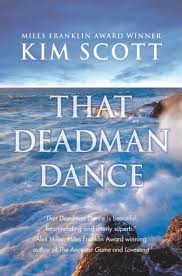
‘That Deadman Dance’ by Kim Scott

2010, 406 p

(5/5)

Is it too soon to say three little words: “Miles Franklin Prize”?  I don’t think so: I see that this book has been nominated as the Pacific region contender for the  Commonwealth Writers Prize for 2011, and it’s surely destined for the Miles Franklin shortlist at least.  And this is just as it should be.

I found myself reminded of many other works, both historical and fictional, while reading this book: Inga Clendinnen’s Dancing with Strangers which echoes more than the title alone, Kate Grenville’s The Secret River, and most recently Lisa Ford’s Settler Sovereignty. But this book, taking as it does an Aboriginal – specifically Noongah- sensibility and voice could be written by an Aboriginal person alone, and this, too, is just as it should be.

That Deadman Dance is roughly chronological, although we learn early in the book that Bobby Wabalanginy , the main character, will end up a dishevelled busker-type, entertaining  tourists with a patter that combines history, pathos and showmanship.  The book opens in 1833-5 with Bobby already ensconced in among the whalers and early settlers on the Western Australian coast.  It then backtracks to 1826-30 with first contact, a spearing, accommodation and wariness, and the actions of  Dr Cross – a good man who trod carefully in this strange and old land, remembered kindly by the Noongah people who knew him, and claimed and acclaimed as a venerable ‘old pioneer’ by subsequent white settlers who did not.  Then forward again to 1836-8 in Part III, followed by 1841-44 in Part IV.  There’s an increasing sense of foreboding as the book unfolds.  The abundant whales stop coming, the ‘depredations’ intensify, and the Governor and his son Hugh impose an imperial imperative onto the narrative.

Kim Scott makes you work hard as a non-Indigenous reader.  There’s Noongah language here, untranslated, and the narrative voice is a lyrical but overwhelmingly oral one.  I found myself slowing down while reading, apprehensive of what was to come in the steadily decreasing pages, but also just to subvocalize as I read and to let the language wash over me.

I cannot help it: I am a historian, and even in my fiction reading I cannot turn this part of my brain off.  But here I found no false notes, no clashing consciousness. Indeed, I felt as if I were reading Lisa Ford’s Settler Sovereignty being acted out in front of me:

Laws were being enforced now, thankfully.  Natives must be clothed and without spears if they were to enter town.  It was only decent, and if we are to civilise them, as Papa said is the only way, then clothing is an important precursor…to what use do they put this ownership as against what we have achieved in so short a time? Papa could sometimes explain things so well. It may have been expedient at one time, but was no longer necessary (p367)

Scott does not set out to write history, but there is an authenticity to his work, and I sense that he has not hard to work as hard at finding it as, for example, Kate Grenville admits to have done in her Searching for the Secret River.  It is a book that uses fictional names but is solidly grounded in Noongah country and landscape. But the story it tells is bigger than this and it has its echoes in Bennelong and  Charles Never.  There’s an element of magic realism as well, and a sense of ‘if only’ as well as tragedy.  Well, well worth reading.

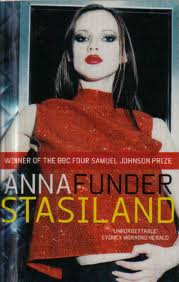
‘Stasiland’ by Anna Funder

2002, 288 p.

(4/5)

Every year for the last five or so years I have put Stasiland onto my list of selections for my face-to-face bookgroup (AKA ‘The Ladies who say Ooooh’). Every year for the past five years, the year elapsed and Stasiland wasn’t chosen.  Ah! But this year IT WAS!!!

I was a little tentative about subjecting The Ladies to yet another of my gloomy selections after subjecting them to The Land of Green Plums about Ceausescu’s Romania last year- what would they think of the Stasi in East Germany this year?  I need not have feared: the narrative was more straight-forward here, and having a young Australian journalist as the first person narrator introduced a familiar voice and viewpoint onto something that, fortunately, is not within the experience of most of us.

Funder, working as a journalist in Europe after reunification, was first attracted to investigating East Germany when a request for a program on the “puzzle women” was brushed aside by the television producers she worked with. There was, it seemed, an embarrassment about the East Germans, as if it would all just disappear if no-one spoke about it.  These “puzzle women”, she later discovered, were employed to reassemble the papers shredded by the Stasi as the wall was falling, a task that would take over 300 years at the current speed.  Methodical to the end, the papers had been shredded in order and shoved into a bag together, and so it was possible to piece them together and reveal the banality and the all-pervasive intrusion of the Stasi into the lives of East Germans.

In East Germany, it has been estimated, there was one informer for every six people.  Some of the surveillance was the stuff of farce, like the  ‘smell samples’ that purported to capture every individual’s smell for later reference.  Other surveillance was more insidious: the reports that were given to potential employers who later changed their mind about the offer of a job; the insistence that there was no unemployment when, as a result of such reports,  one could not get a job; the  warning that a rock group singing subversive lyrics would no longer exist, only to disappear completely from all public view and hearing.  Escapes that were thwarted, imprisonment, blackmail, and the withholding of contact for years with a sick baby on the other side of the wall- by such means the Stasi dabbled in one’s very soul.   There was physical torture as well, but she broaches this only at the very end of the book.  By this time the claustrophobia, vindictiveness and degradation of such minute surveillance seemed on a par with physical torture.

But of course, such intrusion and cruelty leaves no physical trace.  She comments on the memorialization- or more correctly, the distortion of memory regarding East Germany.  She notes the way that East Germans distanced themselves from the Nazis immediately after the war, as if Nazi ideology had flowed from the West and engulfed them, then withdrawn completely afterwards, leaving them innocent of it completely.  She comments on tourist industry that has arisen around the physical fact of the wall- the remnant sections, the tours- that co-exists with a nostalgia amongst some East Germans for the simplicity and security of a life without the bombardment of consumer ‘choice’ and capitalist pressure.  When she places an advertisement seeking ex-Stasi operatives for interview, she encounters men  holding onto the shreds of a Communist dream,  in denial of reunification, and hopeful of the re-emergence of the Stasi.  She finds men who have mounted their own museums to East German life; she speaks to others who have their own justifications for their actions which ring hollow and rather pathetic in a changed world.

The stories of the Stasi operatives and their victims are important, because the Stasi’s reach was not so much in physical things but in the more intangible  sense of safety, identity and autonomy.  There is no museum to hold such things.

I was particularly interested in this book because of the role of the narrator in it.  It is not an academic book as such, and I was surprised to find notes related to specific pages at the end as there had been no footnotes to alert me to their existence.   The narrator is front and centre in this book: we see through her eyes and filter through her consciousness.  At times you need to read against her prejudices- for example, with one man who, as perfect East German man, was moulded this way through his own father’s well-founded fears and insecurities as a dissident, and was to a large extent, a victim as well as perpetrator.  I’m aware of a trend in academic history,  to make oneself part of the story as well, and to use one’s own doubts, questions, misconceptions and false trails as part of the intellectual journey.  I can see its allure as narrative device, but I’m wary.

Funder is not, though, offering this as academic history.  She is upfront about her outsider status, and she documents rather than explains.  It is powerful, chilling reading nonetheless.  Timely, too, as we hear of the Egyptians gaining access this week to their files, many of which had been hastily shredded.  Just as the East Germans before them, they are becoming aware of the size and pervasiveness of the secret police and the complicity of family and neighbours in their midst.

’88 lines about 44 women’ by Steven Lang

2009, 257 p

(4.5 /5)

This is a damned good book.  I hadn’t heard of it at all until Lisa at ANZLitLovers reviewed it. I liked the title and, self-willed exile from the land of new wave music that I am, I didn’t realize that it was the name of a song by The Nails that has moved into its second generation with a recent digital remastering.  The author does mention this in passing, which is just as well because I’d been wondering where the other 41 women in the book were. In fact I’ve just realized that,  like the remastering of the song that gives the book its title,  in this book we are seeing an old event re-lived and re-enlivened many years later.

There may not be forty-four women, but there are three women in this book, with the shadowy presence of many more.  We meet the most significant one in the opening pages of the book- and what a jolting opening it is, drawing you right in- and she dies right there within the first chapter.  For the next twenty years her husband Lawrence (Larry)keeps returning to her death, shamed and shrunken by it. He had been the keyboard player in a successful rock band: she had been a TV soapie star. He’d had a peripatetic life: boarding school education, Scotland holidays   with his boarding-school friend Roly who later cajoled him into joining him in Australia where their musical career began, and touring with the band on the fringes of international stardom. Twenty years later he is back in the  Scotland highlands, leasing a cold and isolated farmhouse to work on his music again more seriously, facing medical problems and still paralysed emotionally by Gizelle’s death.  There had been a New-Age lover in Byron Bay who filled his head with psychobabble, and now in Scotland he meets Sam, a self-reliant, fiesty single mother.  She learns, independently, of Gizelle’s death and bridles against his secrecy over it.

The book itself is divided into three parts marking the three days since Sam confronts him after learning about his first wife’s death.  Within these parts, Lang traverses back and forwards across the  twenty years since Gizelle’s death, Larry’s childhood, his emergent relationship with Sam, his relationship with his elderly parents and his rock star lifestyle.  I’ve been complaining lately about books with short, hyperactive ‘chapters’ that lurch the reader from one narrative viewpoint and location to another.  There’s none of that here-  Larry as the narrative voice is leisurely, discursive, emotionally complex and ultimately unreliable.  After a gripping beginning, the story unspools almost effortlessly with beautiful descriptions of landscape and a vulnerable, damaged masculine consciousness.

This book had me in from the very beginning.  It was shortlisted for the 2010 Christina Stead  Prize for fiction and the Queensland Premier’s Award.  Lang has given us an assured, pitch-perfect work that would have been a worthy winner.

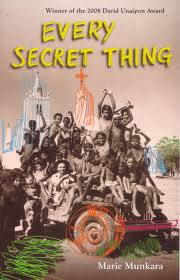
‘Every Secret Thing’ by Marie Munkara

2009, 179 p

(3.5 /5)

Before I talk about this book, a word first about humour, and aboriginal humour in particular.  Inga Clendinnen closes her analysis of the very earliest days at Port Jackson in her book Dancing with Strangers with an observation about humour as a means of connection between black and white Australians.  (Among historians, there’s often an anxiety about nomenclature for aborigines/Indigenous/specific tribal name/Aboriginal Australians- and to a lesser degree for whites/British/settlers as well.  Clendinnen settled on the term ‘Australians’ for the former, and ‘British’ for the latter, recognizing the limitations of both terms.)  But humour, she suggests, has been a bridge:

There remains a final mystery. Despite our long alienation, despite our merely adjacent histories, and through processes I do not yet understand, we are now more like each other than we are like any other people.  We even share something of the same style of humour, which is a subtle but far-reaching affinity.  Here, in this place, I think we are all Australians now. (p.288)

And so I come to Every Secret Thing by Maria Munkara, which was awarded the 2008 David Unaipon Award. It’s only a small book at 179 pages, and while it’s not, and does not claim to be,  high literature, it’s an important book nonetheless.  It is a series of tales set around an Aboriginal mission in far northern Australia with the Mission mob, the Catholic clergy, trying to convert the Bush mob who lived just outside the Mission.  The Bush mob move back and forth between the arbitrary strictures and efforts of the  clergy and their own more grounded life outside.  They are clear-eyed about the hypocrisy and smallness of these white priests and nuns, but they are also painfully aware of the degree of control that the mission has over their lives.

The stories are self-contained, but there is a broader chronological arc that runs through them, particularly in the second half of the book.  Hippies with marijuana arrive amongst the Bush mob, a mission is established for the ‘half-caste’ children who are taken from their families and sent into domestic service,  and just occasionally a child returns to the mission but cannot find her place back amongst her family again.  And finally a couple of the Bush mob men confront Father Voleur of the mission, “asking that the mission mob leave because no-one wanted them there any more” and were told to bugger off:

So began the slow downwards spiral of despair…Then the grog came and the winding path of good intentions became a straight bitumen four-laned highway that led even deeper into a world of self-destruction and hopelessness that no-one knew how to fix.  And then more and more people began to leave unexpectedly without goodbyes or explanations and a sorrow so deep that no-one could see an end to the despair descended upon them and they’d be found hanging  from trees or electrocuted by the power lines and the cemetery had to be made bigger to accommodate the unexpected influx of new residents.  But there was one thing they were certain of.  They didn’t have to die to go to hell because the mission had happily brought that with them when they’d arrived unasked on the fateful shores of the place that was their heaven all those years before. (p. 179)

This stab of pain runs throughout the book, right alongside slapstick and send-up, derision and wry irony.  Yes, there were places where I laughed out loud in this book (a 2.5 on my 4-point  laughter scale) and  Munkara’s  real skill  is to write so that, after reading a comic scenario, your smile freezes as the underlying pain and cruelty of what she is describing seeps into you.  It is a quick, deft, cutting wit.  There’s anger here too: an almost shaking rage at the inhumantity of separating the ‘half-caste’ children from their families into the ‘Garden of Eden’ mission on a nearby island.

But time has a way of covering all wounds with scar tissue, and the little abductees eventually settled down into their new life away from their homes and their families….But if the nuns at the Garden of Eden knew about the scars they certainly didn’t show it as they worked relentlessly to shape the unruly half-caste rabble into obedient and God-fearing servants of the muruntani [whites].  No rod was spared or abductee spoilt in the process as the little coloured kids were repeatedly chastised and flayed until prayers and hymns and excerpts from the Bible were slowly absorbed by rote into every fibre of their being.  And when they were eventually knocked into shape they were passed on to caring white families as domestics and the like because, let’s face it, the mission mob knew these useless individuals would never amount to anything else.  In order to control them many of the good Christian families duly followed in the incarcerators’ lead by perpetuating the violence, sometimes throwing in a few more tortures for good measure like rape and mental abuse, because this was the only thing this half-caste lot understood.  A few even had to be sent back to the mission because they just didn’t seem to respond to the kindly ministrations of their new families and kept trying to run away or told wild stories to people about their treatment.

It was sad really. (p81)

Sad, sad indeed. There’s anger at the hypocrisy by which the Mission mob decided that  a white woman, Odile, who had a ‘half-caste’ child called Treasure should be allowed to keep her own child:

And didn’t the anger of the bush mob bubble away in their guts as they grumbled at the injustice of it all.  The more erudite had reasoned that if they had to hand over their coloured kids then why shouldn’t Odile.  No matter that the mother wasn’t black, the kid was still coloured, wasn’t he, and everybody knew what happened to them. (p. 137)

But Father Macredie found a way to rationalize himself around this:

…there’d be no way he’d be taking young Treasure away from his rightful parents and the bush mob would just have to accept and understand that.  Despite Treasure’s coloured skin, he would always be white on the inside not like their kids who would always be black on the inside- and that’s where the difference therein lay. (p. 138)

This sounds bleak, and it is bleak.  But just as importantly, there is humour here too, and the author’s photo on the front page shows that.  The pettiness of the Mission mob is skewered, but with almost a sense of pity. There is a generosity of spirit among the Bush mob that is often completely lacking amongst the nuns and priests who have such power over them. It’s the ridicule of pomposity and the refusal to take things too seriously that reflects the humour that Inga Clendinnen noted.   We see it in the recent musical Bran Nue Day, and it’s there in the term ‘Moomba’ (meaning ‘up your bum’) offered up as an aboriginal translation for ‘let’s get together and have fun’ for the founders of  Melbourne’s festival some fifty years ago: a scenario repeated in this book where an earnest ethnographer is tricked into recording a string of expletives and obscenities as ‘authentic’ language.  But make no mistake amongst the derision and send-up, the mission mob do hold the power here, but it’s a hollow and ultimately unstable victory.  And I’m glad that it is.

Some other links:

Blog review from Musing of a Literary Dilettante

Interview with the author by Bob Gosford on Crikey

Biographical information about the author

‘The Women in Black’ by Madeleine St John

1993,  228 p.

(4/5)

The further I get from the right side of fifty years of age, the more I am drawn to writers who don’t get published until they themselves are over fifty. What in my younger days I may have perceived as to be rather pathetic (the idea of someone scribbling away secretly for years, the mounting rejection slips, or life just slipping away with ambitions unfulfilled) I now see as an affirmation of the strength of maturity, a victory for persistence and dedication, the triumph of character and a validation of life experience!  Methinks I do protest too much.

Madeleine St John’s first book The Women in Black was written in 1993 when she was fifty-two years old.  She’d been working odd jobs in bookshops in London for years and, convinced that she could do as well as the authors of the books she was selling, she wrote this book and three succeeding books, one of which was shortlisted for the Booker Prize.  From the preface ‘Madeleine and Me’ written by Bruce Beresford and the obituary at the end by Christopher Potter, she seems to be a rather reclusive expatriate who lived her life in London, seeking various kinds of spirituality and with rather brittle friendships and little contact with her family back in Sydney.  She was an undergraduate at Sydney University in the early 1960s, alongside Clive James, Germaine Greer, Robert Hughes, John Bell and Bruce Beresford: were university students more brilliant then in the rarified air of fees and Commonwealth Scholarships, or arriving early on the cultural scene,  have they just promoted themselves better?

The Women in Black relates a sliver in the life of the main character, Lesley who has adopted the name Lisa instead, who is I suspect rather biographical. Lisa has taken a job in the Ladies Cocktail Dress department of F.G. Goode in Sydney- a thinly disguised David Jones.  I say ‘a sliver’ because Lisa is  in that hiatus between completing her Leaving Certificate results and finding out whether she has been accepted for University.  She is the young casual, working alongside older permanent women as one of the “women in black”, changing from their street clothes into the black uniform of F. G. Goode before starting work. She just works the one Christmas/New Year period, then she moves on.

The narrative shifts in successive small chapters (often only 2 pages in length) between the lives of the women who work in the department store.  I’m starting to make “being able to build a sustained narrative over 20 pages” as one of my criteria for good writing: I am tiring of these short, jumpy snatches that seem to be common in recent writing.  It seems ridiculous that a novel  of only 228 pages should have 55 chapters.

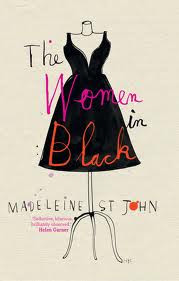
The front cover of the book suggests chick-lit, and it IS an easy read.  But I think that St John has captured the early 1960s  well here: the wariness and yet curiosity about ‘New Australians’ who seem cultured and exotic with their strange food, coffee and wine;  the stifling embarrassment about sexuality even among married couples, and the world of promise opening up with universities that is stretching the expectations of women for their lives. It is an intellectual coming-of-age book too, in a way, as Lisa finds herself feeling embarrassed about her home-made clothes and dipping her toes into adult social life.  Her father is gruff but grudging: her mother is out of her depth both socially and educationally but she is encouraging her daughter to move into this world that she knows nothing of.

It is certainly a well-blurbed book  with Clive James, Bruce Beresford and Barry Humphries (Helen Garner???)  as contemporaries, and with younger women writers Toni Jordan, Joan London, Kaz Cooke and Deborah Robertson as well.   They refer to the warmth, wit, wistfulness and sharp observation of the book, and they’re right.  It’s a small nugget of a book, affectionate, nostalgic and optimistic.  And yes, I did laugh during this book- at force 2 level (breaking into a smile with a little chuckle). It’s only short- you could almost knock it over at a reading- but it was a satisfying, happy read.

Sue at Whispering Gums and Lisa at ANZLitLovers have both reviewed this book.  It’s not a coincidence that Sue and I have read this together: it was the January selection for the online Australian Literature group we’re both in.