Category Archives: Australian literature

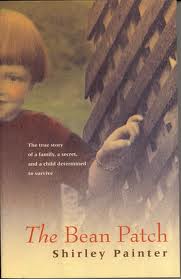
‘The Bean Patch’ by Shirley Painter

2002, 310 p

Spoiler alert. 

The author of this book was 83 years old when this book was published.  It was the product of a writing course undertaken at Holmesglen TAFE in her later years, and its narrative voice is just a little stilted.  But she is conscious that she is crafting a narrative, as well as relating it and so she makes the decision to withhold and complicate information so that the reader experiences the same partial and confused state that she did for so many years:

Because memories are often disjointed, I had two choices in dealing with them.

The first was to tidy them all up into a neat chronological order, with a beginning, a middle and an end.  But a lifetime of reading wonderful books has made me a highly critical reader, and I feared that choice might make for a very flat narrative.

The other choice was to present the reader with the same gaps, the same clues, and the same dilemmas as I had, so that the effect would be the same: What’s going on? Who in this dangerous and contradictory world can be trusted? Who are the goodies in white hats and who are the baddies in black hats?

Tough, reader! I have chosen for you the hard option   (p. vii)

This stylistic choice works well, and it is the promise that it will all come clear that draws the reader through the narrative.  There seems to be such a disconnect between what seems like an ordinary-enough life with husband, children, career, house, brothers and sisters, juxtaposed with a nightmare existence of extreme brutality.  This disconnect becomes even stronger in part 2 where, tangled in amongst the narrator’s story of breakdowns and therapy, details of the abuse are released in jerks and flashes- as indeed, such searing and painful memories must be.

But the reader is left with the final question of credibility, and here I find myself in uncomfortable territory.  I had let suggestions of the paranormal go through in Part I, but with the litany of abuse and crime in Parts II and the Epilogue  of the book, drawn out through extensive therapy, and encompassing recovered memories at and before birth, I found myself stepping back and asking “Do I really believe all this?” Although I feel almost disloyal to the narrator in distancing myself from these recovered memories,  I just cannot credit the bloodshed and crime without external corroboration.

I’m obviously not alone in my hesitation as this Sydney Morning Herald review shows.  The Bean Patch was awarded the Dobbie award in 2003 for a first book by an Australian woman writer.  The book is marketed and publicized as ‘memoir’.  Deborah Adelaide, one of the judges for the award is quoted in the review as saying that the truth or otherwise of parts of the memoir is immaterial:

Because we know it is based on her life, and the thrust of the story is true, to me the details don’t really matter

Ah, but it’s more than just details- it’s the whole premise of the book.  All memoirs are constructed narratives, and the reader takes on the author’s part in this construction as part of the memoir genre, aware that these choices are an inherent part of what is being offered.  There is always the question of fidelity and soundness of the architecture by which the author has chosen to structure the narrative, but if the whole intent of the endeavour is suspect???  I’m not sure.

Update 27 August 2014

The Age this morning published a beautifully crafted obituary for Shirley Painter (3-11-1918 – 29-07-2104) written with the assistance of family members.  It notes that:

Shirley was dux of both her primary school and MacRobertson Girls’ High School and earned an honours arts degree from Melbourne University.  She married and raised three children.

She taught Latin and English with diligence and care at St Catherine’s Secondary School for Many years. .. She was supported financially to go on to university by a bursary created by her teachers who recognized her extraordinary ability.  As a teacher she gave her tireless support and encouragement to young women seeking to find that spark in knowledge and thought that might enliven them.  She felt angry, in recent years, that free education had become a thing of the past….

Shirley was a lover of art, film and literature and a member of book clubs, film groups, bridge clubs, ACSA (Adult Survivors of Childhood Sexual Abuse) and Probus…

Shirley is survived by her three daughter, four grandchildren and the legacy of hope and love she embodied.
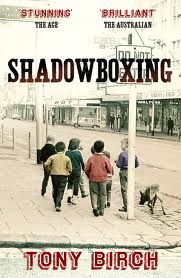
 

‘Shadowboxing’ by Tony Birch

2006, 178 p.

Shadowboxing is a collection of ten linked, largely autobiographical short stories set in Fitzroy during the 1960s.  As such, it ticks all my boxes: Melbourne-based, baby-boomer, cumulative stories.  They stand alone quite well, while building up into a longer-term, more nuanced work, and indeed apparently several had been published previously and were reworked for this collection.

The stories are written in the first person by the fictional Michael Byrne, looking back as a young father on his own childhood.  He was brought up in one of the sidestreets in Fitzroy where the houses were demolished as part of a slum-clearance program in the 1960s.  As such, it is a vanished landscape, and many of the attitudes of the people living there have vanished too.  Children had their own world, largely divorced from that of adults; people looked the other way from domestic violence in their own families and the families of their neighbours; there was an expectation that boys needed a good slap around the ears from their peers and older men to be a ‘real man’; mothers were alternately put onto a pedestal and abused.

The relationship that lies at the heart of these stories is that of Michael and his abusive, wounded, father.  Indeed, many of these stories are observations on masculinity and fatherhood and Birch resists the temptation to give easy, feel-good answers.  Redemption and forgiveness are here, but they are both fragile and deeply ambivalent.

The Melbourne depicted here, while in many ways more closely aligned with working-class slum suburbs across the world, is clearly recognizable to Melburnians.  I’m surprised that ‘The Return’ hasn’t been picked up in an anthology of  Australian Christmas stories because, while it describes a December Melbourne well known to Melbourne baby-boomers, it also captures the tenderness that can exist between an older brother and his little sister.

These are terrific stories, honing in on small details and events and yet able to take big strides across a family’s history-  indeed, across the history of a suburb and a generation- as well.

Update: You might be interested in the Radio National Hindsight program about the slum clearances in Fitzroy that Andrew mentions in his comment below.

My rating: 8.5/10

Read because: it was the December read for the Yahoo Groups Australian Literature group

Sourced from: La Trobe University Library

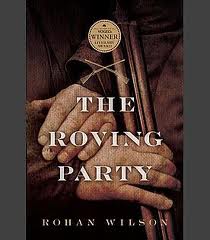
‘The Roving Party’ by Rohan Wilson

282 p. 2011

As a historian, there’s often a jolt when you encounter in fiction a character that you know from your own research.  This is the case with John Batman, one of the main characters of Rohan Wilson’s The Roving Party. Alongside the mirth that his name evokes he has become an emblematic figure, in the same vein as Captain Cook and Ned Kelly. His is a name attached to a picture-book depiction, freighted with a cargo of abstractions: discovery, dispossession, duplicity.  Bain Attwood’s recent book Possession:Batman’s Treaty and the Matter of History looks at the man and the mythology around him in more detail, and Melburnians continue to travel along Batman Ave, and pass Batman Park etc. etc.  For myself, I encountered John Batman in Judge Willis’ Melbourne- or more correctly, I encountered the legal proceedings involving his wife and children in Willis’ courtroom after Batman died with syphilis, insolvent and leaving seven children who were taken into the care of their guardian, Rev Thomson, the Church of England minister.

But the Batman of Wilson’s book is a younger man, employed in Tasmania as the leader of a roving party, funded by the government to capture and remove Aboriginal people from the settled districts as a means of conciliation between the settlers and the dispossessed tribes.  Batman himself offered his services  to Governor Arthur, citing his own familiarity with the countryside and his contact with Aboriginal people who would help him in his task.  These are the men and the situation we encounter in this book: Batman, four convicts, two black trackers from Sydney, a bumbling farmhand and Black Bill, a Panninher man brought up from childhood as a white man, battling the sodden and chilled Tasmanian bush in June 1829, charged with finding and bringing in the remnants of the Plindermairhemener people.

Black Bill is the central character in the book. He has thrown in his lot with John Batman, but, Manalargena the head warrior and Taralta the law-man of the Plindermairhemener have called him, asking him to join them.  They tell him-

…You listen my story.  Three wallaby near the river you see.  Not two and one but three.  Them brother lost, you understand.  They see plenty wallaby.  But no see brother.  Three wallaby near river eat the grass and drink the water but they forget.  Who is brother.  Who is hunter.  They forget this thing.  Now three wallaby.  No one sing.  Them all lost.  All same you see. (p.8)

Who is brother, who is hunter?  Other books sprang to my mind while reading this.  One is Cormac McCarthy’s All the Pretty Horses with the relentless drive of pursuit/escape, and the need to keep going day after day through a hostile and unforgiving environment.  The other is, rather curiously Moby Dick which, although as different in setting as it is almost possible to be, is driven by the same sense of obsession and fear. For having rejected  overtures to join the Plindermairhemener, Black Bill takes the pursuit and capture of Manalargena as his own personal quest and object, irrespective of the  official intent of the expedition.

All three books- McCarthy, Melville and now Wilson- are steeped in blood. In fact, I found it hard to pick up the book again each time, with each chapter opening with another dank Tasmanian winter morning, the cold, the bone-weariness and the hunger.  The violence is always present like mist, even though this is ostensibly a ‘reconciliation’ party.

Much is strange to us as 21st century white readers.  As with Kim Scott’s That Deadman Dance, we encounter Aboriginal language that is presented without translation, and at the end of the book we are brought face-to-face with the essential aboriginality of Bill’s wife “Katherine”, despite her English name.  In fact, there is an unknowingness between us as readers and all these characters.  Wilson does not attempt at all to get into their heads, to explain, to exonerate, to complicate as Kate Grenville tried to do in The Secret River.

Of course, this is Tasmanian Aboriginal history.  After Keith Windschuttle’s intervention, it is probably the most heavily politicized,  contested and trepidacious history there is.  Batman’s leadership of his roving party is part of the official record and Wilson has woven his story out of this ambiguous and shadowy byline in Batman’s larger life-story.  He makes no claims to truth beyond this and does not ask us to identify or judge.  The book’s relentlessness, violence and moral coldness has a nightmarish quality, and the writing is sure and powerful.  No wonder it has received such acclaim.

My rating: 9/10

Read because: my interest in early 19th century Australian history

Sourced from: La Trobe University library.

Vale Diana Gribble

Many of us will have heard or read that Di  Gribble, of the now-defunct McPhee-Gribble publishing house died several weeks ago.  I read and reviewed Hilary McPhee’s book Other People’s Words a few months back here and when I heard the news, I wondered what had happened after McPhee’s book had been published.  How did Di Gribble react? I wondered.  How did they feel about each other’s career in the wake of McPhee-Gribble’s demise?

Hilary McPhee answered many of my questions in a tribute that she wrote for The Drum recently.  I urge you to read it here.


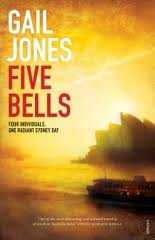
‘Five Bells’ by Gail Jones

2011, 216 pages

I don’t always read the epigraphs that grace the front pages of a book.  To be honest, I’m not really sure what purpose they serve- are they an encapsulation of the book in someone else’s words? are they a nod to writers who have come before? or are they a window into the texts that served as inspiration for the writer?  Probably all of the above, and I suspect that in this case, the latter is close to the mark.

The quotation from which the book takes its title is Kenneth Slessor’s poem Five Bells,  one of his best known poems, written after the death of a friend.  Gail Bell has chosen from the poem these lines.  The author has chosen:

Where have you gone? The tide is over you,

The turn of midnight water’s over you

As Time is over you, and mystery,

and Memory, the flood that does not flow.

‘Five Bells’ is a nautical term that measures the elapse of a four-hour watch on board ship, and the focus of time elapsing is pertinent here because we are very aware of it in the structure of this book.  The book is set on one summer Saturday, around Circular Quay (there’s that water theme again- and it emerges again throughout the book) as four people converge there from somewhere else, and the narrative swings from one character to another, in a sequence, not unlike the chiming of bells.  Round and round it goes, from Ellie to James to Catherine to Pei Xing then back to Ellie again as the day breaks clear and blue and creeps on to one of those night-time storms  that Sydney summers are noted for.  In this regard, it reminded me very much of Virginia Woolf’s The Waves, which took six friends, each writing from their own stream of consciousness.  However, here the characters in this book are observed minutely,  yet from a distance, rather than speaking in their own voices. Nonetheless,  it is very much an interior description, ranging over their memories, fears and disappointments across decades and continents.  In another nod to Woolf, there are echoes too of Mrs Dalloway in its single-day focus.

Her characters are each suffering loss of differing degrees: loss of relationships, loss of brother, loss of freedom, and exposure to tragedy.  Their stories are revealed gradually, as the spotlight of the narrative swings onto them before moving on to the next character.  There are resonances between the stories with multiple allusions Pasternak’s Doctor Zhivago,  eight year old girls etc. which at times felt a little forced, but I suppose evokes the same sense of connectedness and chance that we feel with the concept of ‘six degrees of separation’ and other such life coincidences.

Despite the rhythm and symmetry of the structure, the characters are not equally well-developed.  Catherine, the Irish tourist, never really became real to me, and although Pei Xing’s story was touching, I found it difficult to actually understand and thus accept her motivation for acting the way she did.  I think that Ellie and James, meeting again after twenty years, were the most clearly defined characters.

I must admit that I only made the connection with the maritime use of five bells when I googled it for this posting.  While I was reading it, I assumed that it referred to the characters and the circular way of telling their stories, like the rounds of a church bell.  There are four of them- who was the fifth? For much of the book I wondered if it was Sydney itself,  which with its harbour, the ferries,the Opera House,  Luna Park and Circular Quay is almost a character in its own right.  But then, in a marked change of pace near the end of the book, two other manifestations of what could be fifth character come into view.  This comes as rather a jolt.  I had been lulled into the almost soporific rhythm of the narrative and all of a sudden it changed direction.  I’m not really sure, though whether this sudden plot development was wise, or necessary to the book.  It changed the trajectory of the book and made some plot scenarios possible, but I think weakened the overall effect.

It is only a short book at 216 pages, and that is probably exactly the right length.  It is very carefully written with almost every phrase and image carefully burnished.  Perhaps a little too polished for my liking- I found myself almost  smothered by such intense, artistic writing- and so, while unsure about the necessity of the change of pace near the end, I greeted it as an escape into open air from a rather oppressive, perfumed interior.

I have set this post aside for a couple of days, unsure of how to sum up my response to the book.  Ambivalent, I’d have to say.  I admire the cleverness of the endeavour and the complexity of her allusions to other works of literature and acknowledge that there are some beautiful images and phrases.  But I need to balance that with my misgivings about the plot development at the end of the book, and my feeling of overload from a surfeit of fine writing.  Not sure.

My rating: Mmmm. 8/10??

Read because: My Australian Literature Online group had it as the September read

Copy sourced from: Yarra Plenty Regional Library and then, when I was unable to renew because it had a hold placed on it, La Trobe University Library.

‘The Eye of the Storm’ by Patrick White

1973, 609 p.

After finishing reading the dissatisfying The Book of Rachael,  I felt like reading something astringent and masterful.  The pre-publicity for Fred Schepisi film was gearing up, so I thought I’d have a quick read of the book before seeing the film. What was I thinking? There’s no such thing as a ‘quick read’ of a Patrick White: he’s magisterial, allusive, dense and uncompromising.  But, after overcoming my aversion to him after being subjected to Voss  as assigned HSC reading (what were they thinking?), I now consider him to be challenging, but well worthwhile.

Nonetheless, it is just as well that I saw a blurb summarizing the plot of the upcoming film because even on p.195 I hadn’t quite realized what the book was about.  You could say that it took some little time to get going. I don’t know whether the nutshell synopsis of the film helped to focus my attention, or whether the book itself tightened at that point, but from about p. 200 on, I found it  compelling in a grubby, voyeuristic way.

When I was a child, one of my favourite stories was Hans Christian Anderson’s The Snow Queen.  I think that, like Kay in the fairytale, Patrick White has a splinter of glass in his eye too, and it lacerates everything it sees.  His characters are often flawed, ugly and marred by their physicality; there is the whine of weakness or the throb of madness about them, and their mannerisms are coarse and grotesque.  And yet White also stretches out for beauty and transcendence as well, in the midst of an ugly and petty world.  The same clearness of eye that strips his characters naked also washes clean our view of the natural world.  Here’s the tropical rainforest, that will soon be lashed by the cyclone in the title:

Now [the island] hushed the strangers it was initiating. At some stage of the journey the trees were so densely massed, the columns so moss-upholstered or lichen-encrusted, the vines suspended from them so intricately rigged, the light barely slithered down, and then a dark watery green, though in rare gaps where the sassafras had been thinned out, and once where a giant blackbutt had crashed, the intruders might have been reminded of actual light if this had not flittered, again like moss, but dry, crumbled, white to golden. (p. 375 Virago edition)

The emotional stillness of the book- the eye of the storm- is the dessicated,manipulative matriarch, Elizabeth Hunter.  She surrounds herself with nun-like nurses who cater to her petulant, fretful demands as everyone waits for her to die.  Circling her, sweeping in from their European lives are her two children, the celebrated actor Sir Basil who has probably seen the best days of his career, and her brittle daughter, Dorothy, the Princess de Lascabanes, whose marriage into minor European nobility had failed. Despite their platitudes, they despise their mother for her beauty, her promiscuity, her self-centredness and her casual, but deliberate, cruelty.  Her children are both failures in their different ways, and in need of money.  They decide to curtail the expenses of their mother’s home-based nursing care by placing her into a home in order to access the income from the sale of her home and effects.

And that’s all there really is to the plot itself, although it’s a story that has been told many times before as the frequent allusions in King Lear attest.  In many ways, the whole scenario is a staged performance, and the characters themselves are conscious of the theatricality of the situation- indeed, the narrative breaks into scripted dialogue in places.  At times I really wasn’t sure what was happening, or whether what I thought had happened actually did.  There are whole paragraphs of images tumbling one on top of the other as a rush of disjointed memories floods Elizabeth’s mind,  and events on which the whole book turns seem to occur in that half-world between sleeping and waking. White’s narrative style continually unsettles your confidence in yourself as a reader.

I’ll be interested to see the film, because given the fairly slight plot line, I wonder how the nuances and complexities of the interior world of the characters will be portrayed.  White himself barges into carnival and parody at times with his crudely named nurses Sister Manhood and Sister Badgery, and the exaggerated grossness of his characters’ behaviour is probably better left imagined than depicted on the screen.  Still, if anyone can carry this off, it would have to be the cast assembled for this film version- so watch this space.

Snap! Lisa at ANZLit Lovers has just read the book before seeing the film too (and I strongly suspect she’ll see it before I do)- her review is carefully-referenced and well worth reading.

My rating: 9/10

Reason read: to read it before seeing the film

Book sourced from: my own bookshelves! Purchased second-hand from the now defunct Printed Treasures bookshop in Macleod.

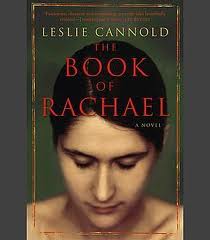
‘The Book of Rachael’ by Leslie Cannold

2011,  324 p.

Leslie Cannold is an esteemed  Australian public intellectual best known for her contribution to debates over feminism and reproductive technology.  I haven’t read her previous non-fiction publications What, No Baby? and The Abortion Myth but I generally read her newspaper columns and articles.  This is her first fictional work.

The impetus for this book, the author tells us, sprang from watching the BBC documentary Son of God.  This documentary examined Jesus the man (as distinct from Jesus the religious figure) and mentioned that he had four brothers who were named.  His sisters- if indeed he even had any- were un-named and not part of the historical record at all.  When Cannold went to research the existence of these possible sisters,  she found that there was nothing – not even enough for an article.  “That’s OK” she thought “I’ll just write a novel instead.”  And here it is: dedicated to the women of her family and to “every woman still struggling for a place in history.”

This  goes some way to explain my response to the book.  Cannold wanted, from the start, to mount an argument about women’s visibility in history, and the injustice of their life experience in 1st century Galilee.  It is a conscious, political statement that places women back into the biblical story.   The eponymous Rachael is the intelligent, headstrong younger daughter of Yosef the carpenter and his wife Miriame, and the sister of the charismatic preacher, Joshua.  This slight shifting in the names unsettles our easy identification with the gospel story, and there is certainly no supernatural or religious element here at all.  Her father Yosef is a good, loving man; Miriame is a carping, bitter woman and certainly no saintly figure;  her brother Joshua changes from a quietly empathetic ally into a somewhat fey, distant figure, driven by his own obsessions and agendas.   Rachael, conscious from the start of her difference and chafing against the many restrictions placed on women, becomes an acolyte of ‘the crone’ Bindy, who initiates her into the women’s arts of healing.  She falls in love and marries Judah of Iscariot, rebel leader of a guerilla band that is resisting the Roman authorities. She struggles with the pressures to have a baby and yet continue her work as a healer.

The anachronisms started early- on the second page in fact, with the ‘Galilean resistance fighters’ (shades of Monty Python’s Judean People’s Front??) and Rachael’s mindset is a thoroughly twenty-first century one.  The book is obviously well  researched, especially the details of women’s medicine and herbalism, but the research is conveyed with a heavy hand.

The book reminded me of Anita Diamant’s The Red Tent, but it has none of the rich female intimacy that marked that book.  The Book of Rachael  is a book of the head that mounts an aetheistic alternative narrative to the gospel.  Perhaps it could be described as an extended, fictionalized ‘what-if’ argument. As  a reader I found myself watching how the argument was constructed, weighing it and judging how well it countered the gospel account.

I  switched to intellectualizing the book because it was the only way that I could break through the writing, that veers between chicklit and stilted, pompous prose.  At times there are hints of a biblical cadence- think Song of Solomon perhaps- but they are fleeting and not sustained throughout the book.  Is it just me, perhaps?  Very few of the reviews I have read address the issue of the narrative voice at all.  I’ll leave it to you- here’s an example. Here is our first century, Jewish narrator.  A deeply troubled Judah has gone off by himself, just prior to Passover,  ostensibly to buy a sacrificial lamb for the feast that night, but we sense (and know) for another purpose:

By late afternoon I was close to gnawing off my own arm from idleness when Judah burst through the door, whistling through his teeth.  I ran to his side, desperate for company and news. ‘Where were you?’

He removed his scarf and pegged it on the hook before turning to me. His brow was smooth and eyes clear.  He was Judah again: vigorous, confident, in charge. ‘Nowhere,’ he boomed cheerfully, then changed his mind: ‘Buying a lamb for sacrifice. I have tied it in the lane.’ He looked around then gathered me for a passionate kiss, one hand gripping a breast.  When we separated he gazed in the direction of the hearth. ‘Is there anything to eat?’  (p. 272,3)

The reviews I have read of this book are generally glowing.  Lisa at ANZLit Lovers wrote one of the most enthusiastic reviews I’ve ever seen her give;  Kylie Ladd on Mamamia liked it too, as did Theo Chapman in the SMH and Patricia Maundel on Radio National’s Bookshow.

I’m afraid that I have to disagree.

My rating: 5/10

Reason read: Australian literature bookgroup

Book obtained from: Eltham Bookshop (purchased)

‘New Voices’ at Eltham

On Saturday I went up to the “New Voices” Writers’ Festival up at St Margaret’s Church in Eltham.  Apparently it’s been running for a number of years but to be honest, I hadn’t heard of it before- or perhaps I just didn’t notice.

I was attracted by the first two sessions in particular that focused on the memoir as a genre: Rodney Hall- twice Miles Franklin winner- speaking about his memoir Popeye never told you, followed by cultural historian David Walker conversing with the biographer and historian Jim Davidson about Walker’s own memoir/reflection Not Dark Yet: A Personal History.

Although distrustful of autobiography as a genre, Hall was spurred to write Popeye never told you mainly for his siblings.  The book covers his childhood in wartime Britain from the ages of 5 to 9, and he intentionally adopted the voice of a child with short sentences, and a child’s eye perspective of size, relationships and causality.  Hence, he chose episodes  for their impact on him rather than their historic or narrative significance, and drawing on the rather linear and black-and white reasoning of a child, he limited his conjunctions to words like “and” “but” “so” etc. It’s a brave, and perhaps rather contrived narrative stroke, and one that could fail disastrously.  However, this review suggests that Hall succeeded well.

The second speaker of the day, David Walker, also moved out of his accustomed genre in writing Not Dark Yet: a Personal History.

After a long career in academe, Walker’s eyesight deteriorated suddenly in 2004 as a result of macular degeneration.  With the term “A personal history” as the rider to his title, this book is not just a memoir (or perhaps an ‘auto-ethnography’ as Walker himself has described it) but also a reflection on family history, history more generally,  memory and storytelling.    When he was  (rather chummily) discussing the book with fellow-historian Jim Davidson, it brought to my mind Inga Clendinnen’s Tiger’s Eye, one of the most personally influential books I have ever read.  In fact, it’s not going too far to say that you would not be reading this blog, at least in the guise it is,  had I not read Tiger’s Eye. Historians, I think, approach memoir and autobiography with a particular wariness and cannot completely divorce their professional academic skills from the shaping of their own life-story, so I’m interested to read this book. Certainly Tom Griffiths’ review (another historian I deeply admire) suggests that it will be well worthwhile.

I’m not really a writers’ festival sort of person, which may surprise you, given that I love reading so much.  I do, however, enjoy hearing non-fiction writers talking about grappling with a body of evidence in some form (lived experience, research, primary sources) and shaping it into an argument and narrative.  There’s an independence of the material beyond the author, and a  responsibility on the author’s part for some degree of fidelity.

However,   I’m less drawn to hearing fiction writers speak about their craft.   For me, it’s a bit like reading an artist’s or art critic’s statements about a work in a gallery: a self-consciousness and layering of meaning that seems sometimes contrived and retrospective.  Listening to fiction authors talking about their work- a creation of their own making-  is a discussion that really requires you to have read the book in question, in a way that is not necessarily true for a non-fiction book, and so after a rather good lunch, I left early in the afternoon.

As well as drawing on sponsorship from publishers  and the local council, the day was conducted under the auspices of the Eltham Bookshop. I was saddened to read in the local paper that after 14 years this bookshop, like so many others, is really struggling.  Its proprietor, Meera Govil, is a generous contributor to the cultural and literary life of Eltham and surrounding districts, and the leafy north would be the poorer for her shop’s demise.  I shift a little uncomfortably in my chair as I write this: I rarely purchase books but instead borrow them from libraries or buy them second hand.  I’ve bought from Amazon and Book Depository, and I am drawn by 10% loyalty schemes for the few books that I do buy.  Although I’m still chafing at the e-reader experience, I know that I’ll succumb increasingly if the digital versions are priced attractively enough.  At one stage I promised myself that I would buy one book a month, but that resolution has gone out the window.  I look in despair at the deluge of new books that keep on tumbling into the market, and I am saddened to hear of such small print runs and the out-of-print status of so many precious works. Perhaps print-on-demand might be one form of salvation, but it’s  such a bland and stripped down product in its present form.  It’s all beyond me.

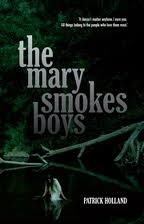
‘The Mary Smokes Boys’ by Patrick Holland

2010, 239 p.

Rather odd name- The Mary Smokes Boys– until I realized that ‘Mary Smokes’ is the name of a country town in Queensland in which the book is set.  The author of this book, Patrick Holland, hails from Roma, inland of Brisbane in Queensland, and in writing this book, he combines his childhood hometown with that of Esk,  the fictional home of the comediennes The Kransky Sisters. In my head when reading this book, I thought of the cold nights of  Toowoomba and those small country towns with their single main street, dogleg railway line and strung-out fibro cottages that you pass on the Melbourne-Queensland run, where you think “But what on earth do people DO here?”

This book falls well within the Australian rural gothic genre- think Chris Womersley’s Bereft, Sonya Hartnett’s Surrender, Gregory Day’s The Patron Saint of Eels, Elizabeth Jolley’s The Well, Craig Silvey’s Jasper Jones  and Rosalie Ham’s The Dressmaker.  It has often been pointed out that the late 19th century literature that so much fed into our image of ourselves as Australians – the Henry Lawsons and Banjo Patersons- was often grounded in a rural setting, despite the fact that Australians then were heavily urbanized.  It’s still true- overwhelmingly Australians live in urban areas, and yet much of our literature is based on small-town life that somehow we feel as if we know, even if it’s just from the window of a car, driving through.

The sense of place and the slow, almost aimless pace of life in a small country town are captured well in this book.  It is in three parts, and it tells the story of Grey and his sister Irene who grow up in Mary Smokes with a shiftless and pathetic father after their mother dies in childbirth.  They are poor, limited, and largely defeated right from the start.  Their mother is a gaping absence in all their lives, and Grey and Irene’s brother/sister relationship develops over time from resentment, solicitude, dependence to eventually something that verges on the edge of  an unhealthy physicality.  The Mary Smokes Boys are the group of marginal, bored, similarly unmotivated boys who grow up in Mary Smokes, who drink too much and dabble in dodgy petty crime and work in dead-end and casual agricultural labouring jobs.  As might be expected in a Queensland town, there’s an aboriginal presence  with wary and unarticulate relationships between white and ‘half-caste’ boys who are connected by the intimacy of time and shared childhood experience.

The tone of the book is laconic- so much so that when big plot shifts occur, they are told in that same, slow, understated narrative voice.  Although events were foreshadowed for some time, as a reader I found myself having to re-read to make sure that something so big had actually happened. It was a pity, too, that big events were often marred by rather clichéd writing, right at the climax, with tears ‘burst[ing] from his eyes’, knives being driven into hearts, and clunky dialogue.

The real strength of the writing comes in the descriptions of landscape, weather and the slow pace of country life. For instance, there’s a description of an all-night shift in a country petrol station that unspools slowly, dreamlike, as travelers emerge out of the darkness of the highway and are swallowed up by it again.  As you read it, you know that at times you’ve been one of the customers passing through the fibro petrol station with its dried-out food and dog-eared magazines that Holland has described so well.

I read this book on my e-reader. It was reasonably priced for an e-book ($9.95), which is about the price that I think an ebook should be, instead of $20.00 which is the price they are asking for some other e-books.  However, I’m still not sure that I don’t read differently, and with less satisfaction, on the e-reader.  I wonder if somehow my sense of the pacing of a book is influenced by one page looking very much like the one that preceded it. I sense a lack of progress through the book, and I think that it’s because you can’t see the pages that you’ve read becoming thicker on the left hand side as you progress through the book.  It’s possible that my judgments about books read in this mode are negatively skewed as a result.

My rating: 7.5/10

Reason read: Australian Literature online bookgroup (even though I finished it long after everyone else)

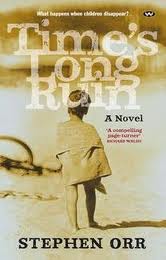
‘Time’s long ruin: a novel’ by Stephen Orr

2010, 422 p

It seems to me that most recently-published Australian fiction books  hover around the 300 page mark, and it’s relatively rare to have a book that extends over the 400 page range.  So, at 422 pages, Time’s Long Ruin  is a lengthy book,  reflecting the title that is drawn from one of the three lengthy epigraphs on the opening pages.  As a book, it felt long too.  Part I, which was 179 pages in length, functioned to set the scene and introduce the main characters.  Part II at 243 pages traced the slow-motion disappearance of the children at the centre of the narrative, then the long unspooling of a fruitless  investigation and the unresolved grief of family and friends- a grief, anxiety and perplexity that still lurks behind parenting and child crimes today.

The plot is loosely based on the Beaumont children who disappeared in 1967 but the author relocated the timing to the early 1960s instead.  Given that the author himself was born in 1967, the rendering of 1960s Adelaide is drawn from research rather than memory, which is quite an achievement in itself.  Much of the book has the elegiac feel of a wistful memoir, with details and sensations piled on heavily- a little too heavily, I think, because it felt at times like a lengthy oral history.  There is an element of slippage in the narrator: at first it is an adult Henry, still living in his family home many years later looking back on his childhood, but then the ‘memoir’ voice morphs into the child’s eye view of  Henry, the nine-year old next door neighbour of the Riley children who disappeared.  This child’s-eye view of suburbia and the tapestry of local shopkeepers, teachers, doctors and neighbours is both perceptive and oblivious at the same time.

Perhaps the fact that the author himself is younger than the events he is describing accounts for a major infelicity that troubled me in the book.  The minute, step-by-step description of the children’s trip to the beach by train suggests that neighbours and incidental witnesses noticed the children heading off to the beach, as if there were something unusual or incongruous about it.  I’m not sure that there was.  A group of three children, especially, would have the run of the neighbourhood, and a train-line was just an extension of that neighbourhood.  I’m sure that the parents of the real-life missing  children blamed themselves and each other afterward, and I think that the blood every parent of a child of the 60s- of which I am one- ran cold at the Beaumont case (and still does). But  at Beaumont-time and even after,  children continued to roam the streets in little groups, returning home only when the street lights came on,  going from one friend’s house to another, catching buses and trains with little parental oversight- I know, because we did.  There was nothing so unusual in the latitude given to the fictional Riley children.

The author is quite clear, even by the subtitle of the book that it is fiction, and by warping the time-frame in the way he has, he gives himself licence to evoke other Adelaide-based mysteries and insecurities as well-  the Somerton Man case of 1949 (which I’d never heard of- I thought that Taman Shud were a band !) and hints of the Snowtown murders of the 1990s by placing one of the main characters there at the time of the children’s disappearanceIn this regard, I felt as if my Adelaide-buttons were being pressed to trigger my knee-jerk reactions to Adelaide mythology-  disappearances, dead bodies, and Don Bradman.  It seems a little too easy to do.

In the lengthy second half, the author of course is faced with the dilemma that having based his plot so closely on the Beaumont children, of course there could be no resolution.  Much of the narrative in Part II involves disclaimers “I couldn’t know, but I imagine that it went like this….”. Combined with the long scene-setting in Part I, this contributes to a nebulousness about the whole endeavour, which is offset to some extent by the meticulous detailing of place and milieu.

The book was long-listed for the 2011 Miles Franklin Prize but did not make the cut into the very short short-list.  I think that this is appropriate on both levels- it does deserve recognition as a careful depiction of Australian life, but I’m not sure that it is the highest expression of this.

Some other reviews of this book include Deborah Orr’s review in Transnational Literature, a review by Liz Ellison at Culture and the Media, David Whish-Wilson and Lisa at ANZLitLovers.


Rating: 7/10

Read because: it was long-listed for the 2011 Miles Franklin.