Category Archives: Australian literature

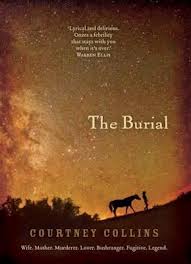
‘The Burial’ by Courtney Collins

theburial

2012,  288

One of the fundamental and potentially riskiest decisions that an author makes is the narrative voice that s/he adopts to tell the story.  It doesn’t come much riskier than this:

Morning of my birth, my mother buried me in a hole that was two feet deep. Strong though she was,  she was weak from my birth, and as she dug the wind filled the hole with leaves and the rain collapsed it with mud so that all was left was a wet and spindly bed… I opened my mouth wide to make a sound, but instead of air there was only fluid and as I gasped I felt my lungs fold in.  In that first light of morning my body contorted and I saw my own fingers reaching up to her, desperate things.  She held them and I felt them still and I felt them collapse.  And then she said Shhh, shhh, my darling. And then she slit my throat.

I should not have seen the sky turn pink or the day seep in.  I should not have seen my mother’s pale arms sweep out and heap wet earth upon me or the white birds fan out over he head.

But I did.  (p. 9)

A newborn baby as narrator rather does your head in if you think about it too much.  In Courtney Collins’ hands, though, the baby-narrator can see all things, know all things, and be as one with the sky, the earth, the universe.  It also frees the author for some beautiful, lyrical writing that would perhaps be too baroque and overwrought otherwise.

The Burial is based on the true-life story of Elizabeth Jessie Hickman, a bushranger who ranged around the Wollemi area in the 1920s.  A ‘wanted’ poster (which I assume is authentic??) for here can be seen here  and a brief account of her life by her granddaughter can be found here.  Both in fact and in this novel, Hickman was a circus performer, cattle rustler and rider.

This post about the real life Jessie Hickman here mentions her marriage to the brutal Fitz, thus opening up the space for Collins’ story as Jessie escapes Fitz into the bush.  She is pursued by many men, chasing her for many different reasons: her Aboriginal lover Jack Brown, the opium-addicted Sergeant Barlow, and the violent gun-happy posse of local farmers bent on revenge and punishment for the theft of their cattle.  The feeling of them closing in on her drives the narrative, and it comes almost as a shock when the baby-voice narrator interposes itself again.

Collins has many balls in the air here: the dead but all-seeing baby, the circus back-story, a somewhat superfluous story of a cattle-rustling gang that she joins with in the folds of the mountains, an encounter with a Chinese prostitute and a love story.  While they were perhaps necessary to the knitting together of the plot, just the escape and the flight would have been enough for me.

This book has been likened to Cormac McCarthy’s work (indeed, the  frontcover is rather McCarthy-esque) and was eagerly anticipated after acclaim in its manuscript form.  I can see the parallels with McCarthy, but what I liked in this book was the theme of thwarted maternity- both Jessie’s own and that of the few women she meets- and that’s something you don’t get in McCarthy, whose books explore masculinity so well.

A rather petty quibble: I was irked by the author’s name on the top of each left-hand page.  Whose decision was that, I wonder? Possibly not the author’s. It made me feel as if I were reading someone’s homework.

This book was shortlisted for the Stella and the NSW Premier’s Award under the UTS Glenda Adams category for new writers.  It has been optioned for a film, and I can certainly see how easily it would translate to the screen as it is already composed of a series of ‘shots’- a technique that I’m not particularly fond of and which betrays, I think, an author’s difficulty in wrangling the disparate elements of a  story  into a flowing narrative.

And what about that baby as narrator?  Well, I think that the gamble paid off. It liberates her to write lyrically and, given that I often only take a broad-sweep memory of a book with me, I think that it makes the book stand out.  I’m not sure that she sustained it throughout- or even if I would have wanted her to have done so- but it was a brave move and one that this new author handled well.

My rating: 8.5 /10

Sourced from: Yarra Plenty Regional Library

Read because: it was short-listed for the Stella and I want to use it as one of my Australian Women Writers Challenge reviews.
awwbadge_2013

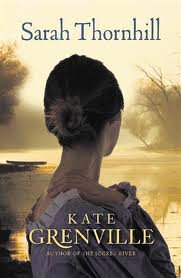
‘Sarah Thornhill’ by Kate Grenville

sarahthornhill

2012, 304 p.

An author writing a book that is part of a series has to write for two audiences.  The second and later books of a series need to stand alone for readers who are coming to it without having read the other books, and yet those who have read the other books will look for, and hopefully find, larger themes that carry across the work as a whole.

Sarah Thornhill is the final book in what is known as Grenville’s ‘Colonial’ Trilogy.  It picks up the story of William Thornhill that Kate Grenville explored in the first of the trilogy, The Secret River, published in 2005.  William Thornhill, a lighterman on the Thames had been transported to NSW in 1806 for theft, and after his sentence had  been commuted ‘took up’ land  on the Hawkesbury River, with all the consequences for the original inhabitants that such an innocuous term as ‘took up’ elides.

The second book of the trilogy, The Lieutenant  steps even further back in time to the years immediately following the First Fleet, which arrived in 1788. It is based on William Dawes, the astronomer, and his friendship with a young Aboriginal girl, Patyegarang.

This final book in the trilogy returns to the Thornhill family and is told by Sarah Thornhill, William’s youngest daughter who was born in 1816 in the colony as a ‘currency lass’.  She knows no other home

They called us the Colony of New South Wales.  I never liked that.  We wasn’t new anything.  We was ourselves. (p. 3)

This sense of this new, native-born generation of British Australians being ‘themselves’ is captured beautifully in this book.  John Molony has written about this generation in his book The Native Born (Google preview here) and  it is examined in Portia Robertson’s work The Hatch and Brood of Time.

One of the real triumphs of this book is the narrative voice that Grenville has crafted in her character Sarah.  She is illiterate but quick, and her voice is ungrammatical and conversational.  It is not an act of ventriloquism like Carey’s True History of the Kelly Gang, but instead she echoes the cadences and slips of the spoken conversation of an unlettered woman, talking to someone she knows well.

At heart, it is a love story.  Sarah grows up alongside and loves Jack Langland, the son of a white man and an aboriginal mother who is marginally accepted by the white settlers in the surrounding district.  But when Sarah, as a white woman, declares her love for Jack, she runs into the intolerance and cast-iron proprieties of white society and the relationship ends abruptly.  Heartbroken, she marries  the settler John Daunt as a second-best, and gradually comes to love him.  If the book does nothing else, it tells this story well.

But Grenville has another purpose in this trilogy as well.  She has clearly identified ‘reconciliation’ as one of her driving passions in her life as well as in her writing, and I think that it’s the theme that holds the three books in this trilogy together.  The first book grapples with the question of how a good man does terrible things; the second wonders whether there wasn’t another way; this third asks, what can we do if it can’t be mended.  Sarah (and Grenville’s?) answer is to tell the story; say what you know.

How will I ever find a way to tell everything that brought me here?…Of those things left undone that ought to have done, and those things done that we ought not to have done?

Rippling away into all those lives, down along the fathers and daughters and granddaughters. Generation after generation, the things joining us and the things cutting between us.  All made by something done so long ago….If there was anything I could do to mend things, I’d do them…. I’m never going to be able to tell what it was all about… I can only tell what I know. Cruelties and crimes, miseries on every side.  But of all the crimes done, the worst would be to let the story slip away.  For what it’s worth, mine had best take its place, in with all theothers (p 313, 304)

If you follow the public conversation about the nexus between Australian literature and Australian history at all, you will know of the controversy over The Secret River  between Grenville as author and the historians Inga Clendinnen and Mark McKenna.   Grenville’s take on the controversy can be found here on her own website.  She notes in the introduction that she had previously removed this response from the site, but was constantly asked for copies of it.  So, at the risk of giving oxygen to it again, she replaced it on the site.

I do not at all have a problem with authors having a larger message, a deeper purpose, or a moral, political and intellectual impetus for driving for their work. I do have a problem, though, when it warps the logic of the narrative, and I think that this happens here.  Quite simply, I found the ending of the book implausible in terms of the range of behaviours open socially to the characters in the mores of the time and  I was not convinced by the drive that impelled their action.

Nor do I completely believe Grenville’s insistence that the beat-up belongs in oblivion.  In a cheeky little ‘last word’ right at the start, she has an epigraph.

It does not follow that because a mountain appears to take on different shapes from different angles of vision, it has objectively no shape at all or an infinity of shapes.

And where does this come from?  None other than E. H. Carr’s What is History? p. 21.

Some other responses I’ve enjoyed.

Marilyn at Me, you, and books.  http://mdbrady.wordpress.com/2012/07/31/sarah-thornhill-by-kate-grenville/

Lisa at ANZLitLovers  http://anzlitlovers.com/2012/03/25/sarah-thornhill-by-kate-grenville/

Alison Ravencroft’s Meanjin article http://meanjin.com.au/articles/post/the-strangeness-of-the-dance-kate-grenville-rohan-wilson-inga-clendinnen-and-kim-scott/

My rating: 7.5 /10

Read because: it was my book group’s selection for March 2013.

Sourced from: CAE book groups

awwbadge_2013

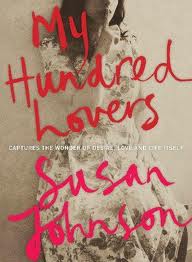
‘My Hundred Lovers’ by Susan Johnson

myhundredlovers

2012, 262 p.

I must admit that the whole Fifty Shades  phenomenon and its innumerable offshoots leaves me cold.   So it was with some trepidation that I borrowed My Hundred Lovers, hoping that a writer that I’ve enjoyed in the past would not betray me with a fleeting and warped assertion of empowerment through a string of  hot-breathed, moist, look-away sex scenes. I need not have feared. This is a beautifully written book, expanding love and sexuality to encompass the whole of life and being human.

It is written as one hundred chapters, each very short consisting rarely of more than four pages, and sometimes as little as a paragraph.  The hundred lovers here (such a daunting number!) are the spark between sensuousness and embodiment (in the sense of being in the body) and the whole range of a woman’s experiences.  There is  much for the fifty-year old reader to reflect and identify with here: the ambiguity of father/daughter physicality; the childhood sex play that I find myself looking back on and wondering about;  explorations of changing adolescent bodies; self-exploration;  sex for all the wrong reasons; sheer experimentation.  But sensuousness and being in the body is more than genitals and crevices: it’s also luxuriating in water, sand, heat; buttery croissants; it’s buildings and houses and landscapes; it’s friendship and companionship.

Unlike the sweaty, fervent erotic fiction that its title evokes, this book champions an older, wiser, more lived-in view of love.  It’s a view of love that  a fifty-year old reader does not feel disqualified from- if anything, it affirms and confirms what it sometimes takes fifty years to learn:

Love arrived smaller and more humble than advertised.  Love turned out to be plain, quotidian… She preferred herself now, less succulent and more loving, humbled, loved. (p.261)

This book is more than a list, it’s a life-story with relationships, losses, pain and confession, all measured out against the beat of passing time.  In fact, counting and taking measure is prominent here.  As she tells us in the opening sentence, romance between the average couple dies two years, six months and twenty-five days into marriage.   Most of us will live for a thousand months.  There are one hundred experiences in this book, numbered off in a countdown, and given that the book could have finished anywhere really, I found myself counting too…98, 99, 100.  Biography (including fictional biography as in this case) relies on the countdown of years and the elapse of time for its shape; unlike memoir which is an intellectual construction where time can be squeezed, stretched and compressed like clay.  This book combines the two- it is basically chronological in its structure, but events and reflection are intertwined and the whole  “100” framework is a literary and arbitrary construction.

The writing is crystal-sharp: quite an achievement in a genre that even has its own award for failure and mis-steps in the Bad Sex Awards– a dubious ‘honour’ that must surely shrivel up the juices of any writer.  Although it is completely self-contained in its own right, the author’s highly-acclaimed earlier work The Broken Book, a fictionalized biography of Charmian Clift, sits alongside it as a close companion.   They are both beautifully written, intelligent books.

My rating: 10/10

Sourced from: Yarra Plenty Regional Library

Read because:  I’d heard of it and very much enjoyed the author’s earlier works.  And I’ll backtrack a little and  count it for the Australian Women’s Writing Challenge 2013

awwbadge_2013

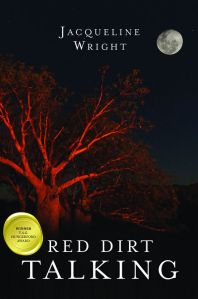
‘Red Dirt Talking’ by Jacqueline Wright

wright_reddirttalking

346 p. 2012

I’m nearly always disconcerted by film footage of aboriginal settlements- the dust, the rubbish, the band of kids clustering around.  Yet I sense, despite the many deficiencies that can be picked out so easily, that there’s another way of living there with priorities and resiliences that I can’t see.  Alexis Wright gave us a glimpse of it in Carpentaria, as did Maria Munkara in Every Secret Thing.

Red Dirt Talking is a whitefella perspective on this landscape.  The small town of Ransom is in outback Western Australia; eight kilometres  out  is the ex-mission station  Eight Mile Creek, smaller still; and 370 kilometres further out again  the Aboriginal communities of Yindi and Breakaway.  Here are all the set pieces of what we understand of outback life today-  the smelter and its fly-in, fly-out workers that distorts the economy of small towns; the art centre co-op that teeters uneasily on the line between exploitation and entrepreneurship; the whitefella managers; the Toyota trucks; the Flying Doctor Service.

The book opens with the first-person narrative voice of Maggot the Garbo whose job takes him round the camps and pubs, the haunts of hard-bitten men and women, hoarders and crazies.   An eight year old Aboriginal girl, Kuj, has disappeared.  He doesn’t know what’s happened to her- no one does- but they all have their theories and suspicions.  The second narrative, told in the third-person voice,  is set some months earlier, focussing on Annie, a 40 year old anthropology postgraduate who arrives at Ransom, tape-recorder in hand and thesis in sight, hoping to collect some quick oral history interviews about a massacre some decades earlier.  Of course, such earnest whitefella briskness is completely the wrong approach.  Annie finds herself drawn into a diffident but increasingly complex relationship with the laconic Mick Hooper, one of the white project officers, and is gradually forced to let go of all the objectives, timelines and academic protocols that the university is trying to impose on her research.  Kuj is one of the constellation of children who swarm around the community, and as time elapses, the narrative takes us up to her disappearance but this time through the web of relationships- marriages, deaths, breakdowns, fosterings- that blur the boundaries between long-term black and white inhabitants of Yindi. Finally, there are the transcripts and contextualizing introductions to her interviews, printed in a different font on coloured paper: white-fella academia that stands apart both visually and as knowledge, from the rest of the book.  The book is called Red Dirt Talking, but it’s even more about silences and listening.

I must admit to becoming rather jaded at all the historian-as-protagonist stories that I seem to have read this year.  There’s a whole string of them- Candice Bruce’s The Longing; Paddy O’Reilly’s The Factory; Anne Summers’ The Lost Mother and Eliot Perlman’s The Street Sweeper.  What’s going on? Is it the influence of all these creative writing courses in universities, so that ‘writing what you know’ starts and ends with an academic?  Is the academic hunt an upmarket version of the ‘journey’ narrative that we all seem to be on these days?  With the increase in tertiary education levels, are we all academics and historians these days? Or am I hyper-aware of this  because my own thesis-clock is ticking away in the background?  I suppose that it’s a common framing device, but it’s wearing a bit thin for me at the moment- and so, I put A. S. Byatt’s The Biographer’s Tale back onto the shelf until I can read it with fresher eyes.

Red Dirt Talking was written as part of a creative arts doctorate, it won the T. A. G Hungerford award for an unpublished debut West Australian manuscript, and the author Jacqueline Wright has worked as a teacher and linguist in outback Aboriginal communities.  I think that you can detect all three influences in the text.  As a debut book, it is probably fifty pages too long and it has far too many characters to remember.  She has acutely depicted the politics and protocols of academia, and I suspect that she has observed other Annies, ( if, indeed, she was not an Annie herself when first arriving in the outback).  I found it hard to keep track of who was black and who was white (in fact, I don’t think that Wright did identify in terms of black/white anyway)- which is probably a good thing; her descriptions of landscape are evocative, and she captures dialogue particularly well.

But most importantly, she cuts through the visual imagery of outback life- the mess, the flies, the rubbish strewn yards, and the people gathered under trees- and picks up on the humour, the complexities of relationships and histories, and the uneasy coexistence of wariness and generosity in a community where she is an outsider.  I found myself perfectly happy to pick up the book to keep reading, and I was drawn along by wanting to know what happened to Kuj.

My rating: 8/10 maybe 8.5

Sourced from: Yarra Plenty Regional Library

Read becauseLisa at ANZ LitLovers reviewed it, and I read a good review of it somewhere (although I can’t remember where!)

‘The Factory’ by Paddy O’Reilly

2005, 258 p

Ah, synchronicity!  Within days of reading Lisa’s review of this book at ANZLitLovers, why there it was sitting on my library shelf.  It’s out of print, she tells us, and very good she says, so off to the borrowing machine I go!

You’re drawn in from the opening paragraph:

They took away all my research papers when I was arrested on the mountain in Japan.  As the four policemen crowded into my cubicle, neatly piling up my reams of handwritten notes and packing my computer into its travelling case, I sat on the bed and started to tremble….

…Later, during my interrogation, an interpreter with a twittery voice read out some badly translated excerpts of my notes.  Did I write that? I wondered.  Did he say that?  I may never have those notes returned, so now I can only write from memory.  Some events are hazy, others I remember so clearly that my eyes ache from the pain of those days living in the sharp light reflected off the sea around the peninsula.

Hilda Moore is an Australian PhD student, researching the establishment and collapse of  Koba, a Japanese community dedicated to rescuing traditional folk-arts and performing them for new audiences during the 1970s, based at The Factory on a Japanese island.  It combined radicalism with tradition, artistic high-mindedness with more human jealousy, manipulation and power-trips. There were certainly cultish aspects to the group, which revolved around the master Yasuda sensei, and it collapsed after the death of one of its members, only to be revived again twenty years later.  This is Hilda’s opportunity- she agrees to act as record-keeper for this second manifestation of the group, while interviewing the original members for her research, some of whom have rejoined; others who eschew any contact with it.

The book has a complicated structure: the stories she pieces together of the original Koba, the interviews from her informants who each give their own conflicting perspectives on Koba and its collapse, and her own experience as she and another Western girl, Eloise, join the second-generation Koba as it re-establishes itself at its original home at the Factory. Suspended throughout  are the present-tense episodes from the quiet, sterile, lonely and controlled jail.  We do not know why she is there, and it seems to exist completely outside time and place.

It was mainly this jail narrative that kept me going through the book, and at the risk of spoiling I will just say that I was rather disappointed by the ending.  The ending is beautifully written and open-ended, but I didn’t think that it was strong enough for what had come before.

Unless I didn’t ‘get’ the ending. That’s a distinct possibility.

My rating: 7/10

Sourced from: Yarra Plenty Regional Library

Read because: Lisa spoke so highly of it.

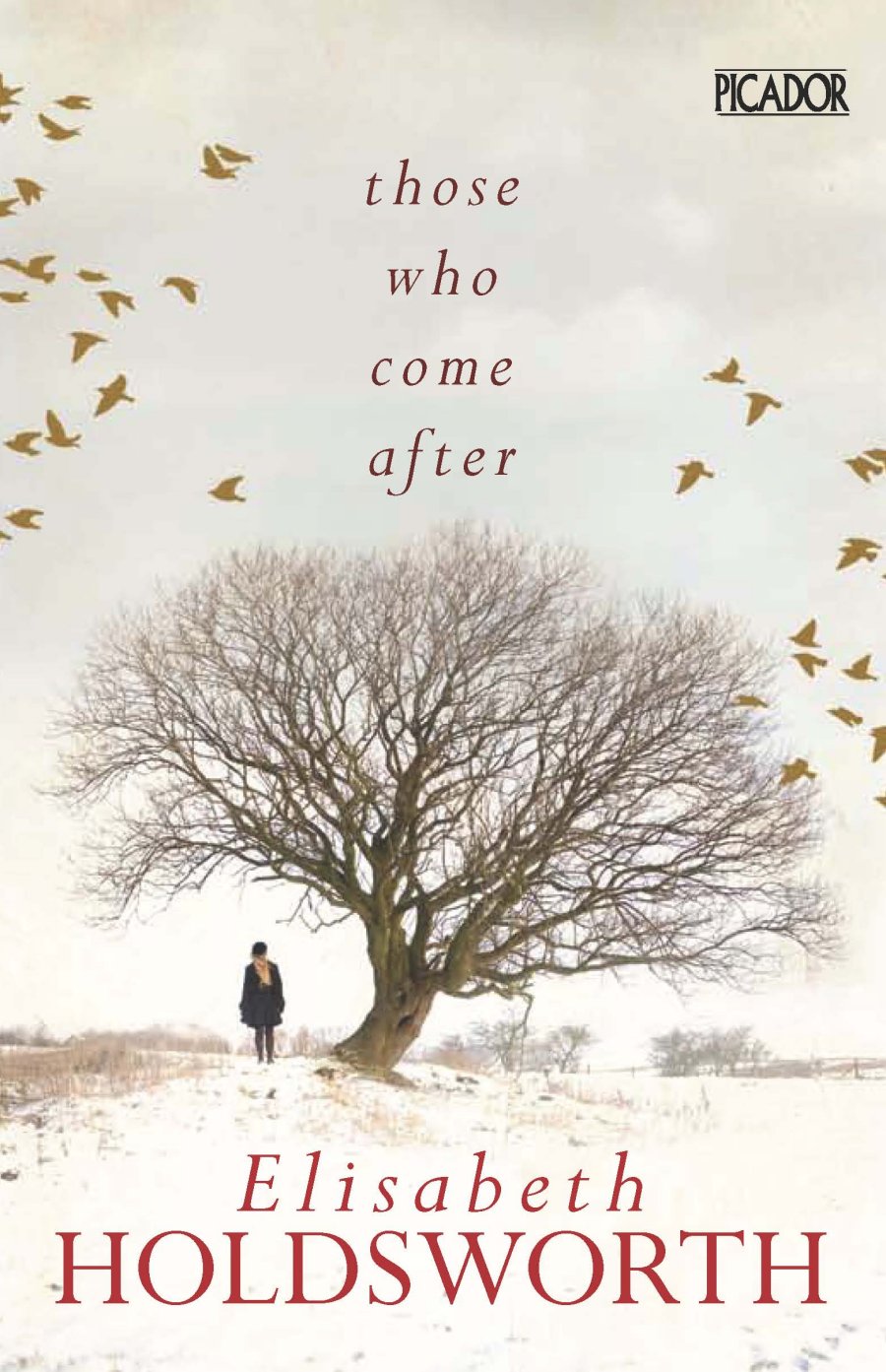
‘Those who come after’ by Elisabeth Holdsworth

2011, 342 p.

I snapped this book straight off the shelf as soon as I saw it because I remembered the author’s Calibre-Prize winning essay that was published in The Australian Book Review about five years ago.  I recall where I read the essay: in a cafe in North Melbourne that I walked to from the Public Records Office to stretch my legs after a morning steeped  in the archives .  It was a powerful read that combined history, memoir and reflection as a middle-aged, Dutch-born, now Australian narrator returned to her childhood home in Walcheren, a flat island sheltered from the sea by a network of dykes off the coast of Netherlands.  Her father had been the scion of an old, aristocratic family; her  mother a Jewish beauty.  She tells of the war and its aftermath that swept away the history of her family with such  a flatness of tone that the reader is left  to fill in the betrayal and violence that such actions engendered for herself.  I found myself sitting there, quite stunned by the strength of such a quiet retelling. You can read the essay here:  it’s called An die Nachgeborenen: for those who come after, published in the Australian Book Review in February 2007.  I had remembered the essay, and its effect on me for all those years.

But on reading the book, it seemed as if I was reading the essay again, except in a longer form.  Here was the child, the old aristocratic family, the Jewish mother, the dykes, the flooding again, but now intertwined with a longer travel narrative and a migrant story as well.  It was fuller, but somehow seemed emptier.

It was only when I read an essay that Elisabeth Holdsworth wrote about the writing of the book in ABR in October 2008 that I realized that what I was missing in the book was the writer herself.  I hadn’t noticed the switch between first person voice in her original Calibre-prize essay and the third person voice of her novel, and having now read her reflection on her decision to write her memoir as fiction, I’m even less sure of the distinction between them.

I think, actually, that I preferred the first essay.  There, the flatness of tone conveyed a dignified restraint, whereas in the book it seemed like an absence and a distance.  It’s unusual to read three versions of the same story like this – essay, novel, reflection – and it raises many questions about the choice of genre, the line between memoir and fiction, and the author at work.

My rating: for the book 7/10; for the essays 9/10

Read because: I enjoyed the essay so much

Sourced from: Yarra Plenty Regional Library

awwc2012

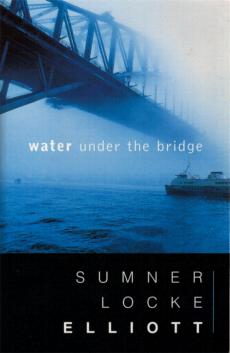
‘Water Under the Bridge’ by Sumner Locke Elliott

1977, 367 p.

After I finished reading this book, I got to thinking about the marvel of reading: that somehow those printed words on the page become an internal experience of seeing, hearing, even smelling that somehow the reader generates for herself in her own head, and yet can be shared with others who have read the same book.  It was only when I arrived at bookgroup last night, fresh from finishing reading it the night before, that I realized that my fellow book-groupers felt very much the same way.  Perhaps there’s something special about this book.

Water Under the Bridge is a very consciously plotted book.  It begins and ends with fireworks and a party- at the opening to celebrate the opening of the Sydney Harbour Bridge in 1932 and at the end to celebrate the Sydney Opera House some forty years later.  In the opening party scene, he introduces all the main characters: the wealthy, socialite Mazzini family, Neil Atkins the restless and dissatisfied actor, the rather pathetic middle-class Flagg sisters, Maggie McGhee the journalist and Archie Ewers, an insufferable little bully.  At first this deluge of characters seems overwhelming, but they soon distinguish themselves one from another as he traces through their trajectories in the four parts of the novel. The author was well-known as a screen writer and playwright, and you sense how well this book would translate onto the screen (where, indeed, it did end up as a miniseries).  His characters do veer a little too close to caricatures but he  gives them enough depth to rescue them from this fate.  Somehow, in a book with many characters, it’s hard to label any of them as “minor”.   He has a keen ear for language, and is highly attuned to class distinctions in our so-called classless Australian society.

Looking at the book 35 years after it was written, it is a good social history- perspicaciously so.  His descriptions of the opening up of experience for women and gay men during World War II Australia fit in very much with the current historiography, and his marshalling of small details from his own memories and experience is impressive.  It evoked many other books for me-  George Johnston’s My Brother Jack, and F. Scott Fitzgerald’s The Great Gatsby– and it didn’t suffer by comparison with these literary heavy-weights.

I’ve only read one other Locke Elliott- Careful He Might Hear You, and I don’t know why I waited so long to read another one.  One day I’d like to read his biography too- Sumner Locke Elliot Writing Life.  The introduction to the thesis on which the biography is based is available here and this review of the biography gives a hint of the man: gay, expatriate, brought up by his aunts- all themes that he mined heavily in his fiction.  I waited twenty years between reading my first and second Sumner Locke Elliott.  I won’t wait that long to read my third.

My rating:  9/10

Sourced from:  CAE bookgroups

Read because: it was the October book for my bookgroup.

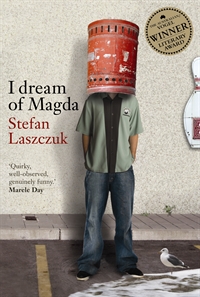
‘I Dream of Magda’ by Stefan Laszczuk

2008, 270 p

When I read the blurbs on some books, I sometimes find myself wondering whether I read the same book as the reviewer did.  “Quirky, well-observed, genuinely funny” wrote Marele Day about this book.  The first two I concur with, but I found very little humour in the book.  It seemed achingly sad to me.

George and Matthew Harrison are two twenty-something brothers sharing a house.  Both are wounded, damaged young men.  The narrator, George is not exactly the sharpest knife in the drawer, and he works amiably enough in a dead-end job at a bowling alley washing dishes and doing other odd and demeaning jobs around the place.  His boss takes advantage of his acquiescence, placing the reader in the uncomfortable place of watching injustice at a distance, unable to intervene.  I sorrowed (because I was reading as a mother of young adult children no doubt) at the obsessiveness and desperation with which he  grapples with his break-up with a girlfriend who, frankly, seems much brighter than he is, and at the rather brittle bravado with which he props up his self-esteem. His older brother Matthew is recovering after a car accident that killed his girlfriend.  He’s not eating, he’s sleeping too much.  He’s not doing well.  The boys’ father had committed suicide; their mother has her own strangeness.  So, in all, not a lot to laugh about here.

The triumph of this book, I think, is George’s voice.  There’s a danger in having such a flawed, unconscious narrator in such a look-away situation, balancing the reader’s discomfort and even embarrassment for the teller, with enough sympathy to keep reading, almost with a sense of concern for him.  The book is written in the first person present tense, which I always find a rather oppressive and intrusive style, but I think that it works well here.

There are no chapter divisions, but the book is written in three parts. It starts with a short prologue. The narrative is broken up by dream sequences, without punctuation, unevenly spaced and told in disconnected snatches, as dreams often are.  There’s some beautiful, plaintive writing here that balances the rather plodding, impoverished real-life of daylight.

I feel a bit embarrassed to confess this, but I misread the dream sequences until almost the closing pages of the book, attributing them to the wrong brother.  When I looked back, I found that it is clearly identified who is dreaming in the opening pages, but I missed it- or perhaps the characters were not well enough established at that point? It was a rather strange experience being jolted to realize that the dream sequences were not what I thought they were, so late in the book, and considering what change that made to the way I had read and interpreted them.  I had felt rather foolish, but then I looked at the title again, and realized that the “I” in the title is a bit misleading too- so perhaps the fault is not all mine- or was the ambiguity intentional?

So, for me, I was led into an unexpected detour into a consideration of my own reception of the book as a reader.  Adding to this reflexivity- from the writer’s perspective this time, rather than the reader, is the fact that it was written as part of a PhD in creative writing, and won the Vogel Award for an Unpublished Manuscript.  [As an aside,  I must admit to being a little perplexed about the conjunction of an academic award for writing intended as a commercial product- not just for this book, but generally.]

The thesis containing the original book- not the ultimately published one- and his reflections on the writing process are available through the University of Adelaide website at http://digital.library.adelaide.edu.au/dspace/handle/2440/52229

[ A further aside: The availability of theses online is an interesting development- especially when considered against the commercialization of research which is being pushed so heavily.  I recall being advised strongly against putting a copy of my thesis (hah! that it should ever be written!) online because it would jeopardize the chances of having it published (hah! that it should ever be published!). I see that at my university, it is now compulsory to make a digital copy available, accessible in full through Trove.  While I’m well aware that a thesis and a book are two different creatures; while I’m also conscious that taxpayers’ dollars go into supporting postgraduate research; while I welcome with wide open arms the thought of being able to access recent research from universities right across the globe…. all these things- I’m aware that it’s not at the forefront of your mind when you’re actually writing the thesis.  It’s probably even more of an issue when the product of the thesis itself – a book, a piece of music- is written with an eye to its commercial value from the start?]

The abstract of his thesis reads:

People who write books are invariably asked how they do it, by people who read them, in a similar way, for example, to how pilots might be asked ‘How do you fly a plane?’ by passengers who couldn’t imagine steering several tonnes of metal through the sky at 30,000 feet. Although there is a consistent, if complicated, logic to the flying of planes, I’m not sure there is a definitive one with regards to writing books. Creative processes, in whatever genre, are by their own nature constantly evolving and redefining their own boundaries. I decided to remain acutely aware of the creative processes involved with writing the novel for my PhD, ‘I Dream of Magda’. I also made note of external inspirations and practical considerations I encountered along the way. This resulting exegesis is an attempt to explore the genesis and creative evolution of my novel. Specifically, it will address the various challenges and benefits involved in writing the novel to a predetermined form, which, in this case, was the musical form ‘sonata’, adapted for literary expression. In the end, it may not be any more helpful in addressing a general question on how to write a book, but it should go a long way to explaining how the initial idea for this book, in particular, took off and eventually flew at 70,000 words.

Very interesting reading- especially in light of my own response to the book.  The completed, published book stands perfectly well and confidently on its own two feet, but I found it fascinating to read the author’s reflections on the book that it could have been, and the changes that he made to it along the way.

My rating: 8/10

Sourced from: Yarra Plenty Regional Library

Read because: I had heard about it- and was puzzled by the title.  Is it THAT Magda?

‘Past the Shallows’ by Favel Parrett

2011 251 p

This is the debut novel for Favel Parrett, who has published several short stories  and looks from her photograph to be impossibly young.  According to her bio, she is a surfer herself, and this comes through in her writing about the sea which is almost a character in its own right.  Hence, I kept sensing resonances with Tim Winton in Breath, and in his exploration of the troubled and troubling people of the  marginal coastal towns in The Turning.  I felt echoes of Sonia Hartnett as well, in that the story is told from the perspective of children powerless against the cruelties of their elders, and as with many Hartnett books, you know almost from the opening pages that this is not going to end well.

Joe, Miles and Harry are three brothers, living on the south coast of Tasmania.  Joe, the eldest, has escaped the family but the two younger brothers still live with their embittered and widowed father, an abalone fisherman.  It is an intensely masculine world, and their father is a harsh taskmaster.  He forces the middle son, Miles, to work on the boat with a small crew of hardbitten and hardliving men, and he treats his youngest son Harry with a neglect that has an edge of hatred.

Perhaps the failing is in me as a reader, but I found it hard to picture the setting of this novel.  My overwhelming impression was one of coldness, both physical and emotional, and a bleak rural poverty, but I didn’t really have a sense of landscape at all- although perhaps the evocativeness of the seascape made up for that.

The voice of the novel is unusual, and I’m not sure if it is completely successful.  The writing is expressed in very short sentences, which makes it feel like a Young Adult book.  It is told from the boys’ perspective, switching its focus between Miles and Harry, but is not a first person narrative.  I wondered if the simple voice was matched with the perspective of the younger boy, but there did not seem to be a clear distinction between the narrative voice when dealing with the older brother.  I’m not sure.

But the real bite of this book is in the relationships and its exploration of brotherhood and masculinity.  It has a sharp edge, right from the start, and a feeling of impending sadness that builds up over time.  It’s certainly an impressive debut.

My rating: 8/10

Sourced from: Yarra Plenty Regional Library

Read because: It was shortlisted for the Miles Franklin.  It took such a long time for my reservation to become available that the Miles Franklin is done and dusted!  And I’ll add it to my Australian Women Writers Challenge tally as well


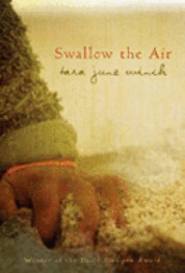
‘Swallow the Air’ by Tara June Winch

2006, 198 p.


This is only a small book that fits right into your hand.  It is a series of short vignettes,  surrounded by quite a bit of white space, with several pages separating each chapter from the next.  The Sydney Morning Herald review of the book likened it to “short stories strung together like beads on an outlandish necklace”, and I found myself thinking of it in much the same way- as a series of small, glittering stones, carefully polished.  I soon stopped reading through the book quickly, but instead took my time, turning over her language and concentrating on the close-up, rather than striding through the broader arc of the story.

There is an overarching narrative in this book: it is essentially a quest story as a young girl leaves home after the death of her mother, who was raising her family alone and battling her own demons.

When Billy and me lost our mother, we lost ourselves.  We stopped swimming in the ocean, scared that we’d forget to breathe.  Forget to come up for mouthfuls of air.  We lost trust because we didn’t want to touch something that was going to fall away.  Like bubbles, too delicate, too fragile, too brief.

Her brother, Billy, had descended into his own half-light of drug addiction, and her aunt, who had taken over care of the siblings had her own battle with alcohol. So sixteen-year old May Gibson set off north, looking for her father, looking for her mother’s people, looking for some sense of belongingness.  Her journey takes her to the Block in Redfern, to the red sand rodeos in outback Queensland, and to the ironically-named ex-mission town of Eubelong.  She finds acceptance in the midst of poverty, addiction and anger; she comes to distrust her own memories of her father, and her dreams of the embrace of a grounded, intact aboriginal family are dealt with brusquely.  As an author, Winch does not resile from the violence and hopelessness of these different settings, but she does also overlay this with the humour and easygoingness that exists alongside it, just as Maria Munkara and Alexis Wright have done in their own books. There are good people here as well as lost ones: truck drivers who don’t take advantage of a young, rather vulnerable young girl; Joyce of the Block who accepts her at the same time as pushing her out to keep searching; Aunty who is still there, even though May has travelled far away.  She has a good ear for dialogue.

However, in reading this book, I was more struck by the language than the overall narrative.  It is very carefully written- perhaps too carefully written?- with lyrical imagery that forces you to slow down. It’s more like reading poetry than a novel.  At times the imagery clags up the meaning and becomes nonsense (can, for example, sand be said to ‘stew’?)  but overall, it challenges you to take the book on the writer’s terms, rather than your own.

My rating: 7/10

Sourced from: Yarra Plenty Regional Library

Read because: Lisa at ANZLit Lovers has held an Indigenous Reading Challenge to mark NAIDOC week (which, ahem, I am a little late to join).  Also, I’m reading this as part of the Australian Women Writers Challenge.