Category Archives: Australian history

‘Larrikins’ wins Ernest Scott Prize

Image

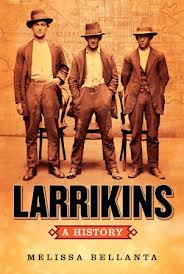
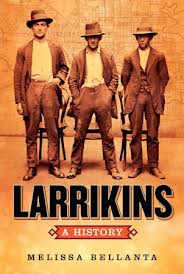
Congratulations to Melissa Bellanta, whose book Larrikins:A History ( you can see my review of the book here) won the Ernest Scott Prize, announced at the Wollongong Conference last week.  The prize is awarded to the book judged to be the most distinguished contribution to the History of Australia or New Zealand or to the history of colonization published in the previous year. The shortlist for this year’s prize was:

  • Webs of Empire: Locating New Zealand’s Colonial Past (Tony Ballantyne, Bridget Williams Books)
  • Larrikins: A History (Melissa Bellanta, UQP)
  • University Unlimited: The Monash Story (Graeme Davison & Kate Murphy, A&U)
  • The Lone Protestor: A M Fernando in Australia and Europe (Fiona Paisley, Aboriginal Studies Press)
  • Tasmanian Aborigines: A History Since 1803 (Lyndall Ryan, A&U).

The citation for Larrikins  from the judges for the prize, Professor Mark Finnane (Griffith University) and Professor Philippa Mein-Smith (University of Canterbury) reads:


A landmark first book by a young scholar, Larrikins stands out for its liveliness, centrality to issues in Australian culture and politics, and breadth of approach, including attention to patterns of speech and youth behaviour,  style and dress. Melissa Bellanta unpacks the origins of Aussie larrikinism as a cultural phenomenon (and performance) that originated on city streets.  Noting that Ned Kelly perceived the larrikin as a city version of himself in 1879, she asks why the larrikin became such a mythic type in Australian identity formation. Contextualised by a social history that locates the shaping of a colonial urban youth culture in the wake of the gold rushes, Larrikins teases out how Australians turned a term of abuse imported as dialect from the United Kingdom into a national mythology once merged with the image of the digger during the First World War. This youth culture – attracted by the pull of the ‘push’ rather than the bush – was ‘flash’, exhibitionist and violent. Part of the book’s appeal is the way in which Bellanta engages with the language and conduct of her youthful larrikin subjects, young ‘brazen’ women as well as men. The quality of research, engagement with the spoken word, connections with the theatre and visual culture place this engaging work in a singular category. Its inter-disciplinary achievement is considerable, respecting the best scholarly conventions of archival history while deploying analytic and interpretative tools from literary and cultural studies that illuminate this phenomenon of Australian history.  Based on rigorous primary research, this work addresses a core aspect of Australianness and Australian sensibility in a refreshing, thoroughly readable but equally scholarly way.
 

‘Eugenia’ by Mark Tedeschi Q. C.

eugenia_tedeschi

2012, 236 p & notes

I must admit that I don’t very often come away from the ANZLHS Law and History Conference rushing  to my library website to look up a book.  I did, however,  with this book last December only to find that it already had multiple reservations.  I put a hold on it in December and finally received it in May.  Perhaps they should buy another copy….

You’ve probably seen or hear of Mark Tedeschi  QC, even if you don’t know you have.  He’s the NSW Senior Crown Prosecutor, and he has been involved in a slew of important and famous criminal trials: Ivan Milat’s Backpacker Murder; the trial of the men who murdered the heart surgeon Victor Chang;  the trial following the assassination of politician John Newman; the Gordon Wood case over the death of Caroline Byrne at The Gap; and Counsel assisting the Coroner in the 2007 trial into the killing of the Balibo Five.  It was in his role as Senior Crown Prosecutor that he addressed a gathering of former and present Crown Prosecutors gathered at NSW Parliament House in 2005 to celebrate the 175th anniversary of the appointment of the first Crown Prosecutor,  Frederick Garling, in 1830.At that presentation he listed a number of extraordinary, complex and bizarre trials, and first on his list was that of Eugenia Falleni. In the introduction to this book he writes:

In the intervening years, I have come to consider that the trial of Eugenia Falleni in 1920 should be viewed as the single most important criminal trial of those 175 years.  Its prominence is not because of any  lasting effect that the trial had on the law or the administration of criminal justice, but rather because of the multitude of legal and social issues that Eugenia’s life and trial throw up for us to consider, so that we can use them as a yardstick to ask ourselves what we have learned and how far we have progressed since then.” P. 228

So who was Eugenia Falleni?  I’m wary of spoilers, so I’ll cite from the publicity on the back cover.

Eugenia Falleni was a woman, who in the 1920s was charged with the murder of her wife.  She had lived in Australia for twenty two years as a man and during that time married twice.  Three years after the mysterious disappearance of Annie, her first wife, Eugenia was arrested and charged with her murder.  This is the story of one of the most extraordinary criminal trials in legal history anywhere in the world.  The book traces Eugenia’s history: from her early years in New Zealand, to her brutal treatment aboard a merchant ship and then her life in Sydney, living as Harry Crawford- exploring how Harry managed to convince two wives that he was a man, culminating with Annie’s death, the police investigation, Harry’s second marriage to Lizzie, and then arrest for Annie’s murder three years after she had disappeared.

The book is written in three parts.  The first, ‘The Search for Love’ takes us up to the trial.  Many chapters start with a paragraph identifying the year and listing a number of events that occurred that year.  It reminded me a bit of the technique in the film Same Time Next Year where each new encounter was separated from the last by a film clip of significant events.  So, in this book Chapter 5 is set in 1913, marked by Roland Garros’s flight from France to Tunisia, Emily Pankhurst’s jail sentence and the commencement of work on Canberra.  It’s rather repetitive and overt, but on the other hand I could actually name the years in which events took place instead of just having a vague idea after a single date is given at the start of the book , then not mentioned again.

The book is written using fictional techniques, but it is not fiction.  There are conversations in the book, and frequent internal dialogues where the author suggests the thoughts of various characters.  Despite the spoiler on the back cover, there is little foreshadowing of events that will unfurl during the story.

In his introduction, Tedeschi  signals how he is going to deal with his sources.  He writes:

The historical facts of Eugenia Fallini’s story that I have related in this book, including quotations from newspaper reports and evidence from her trial, are based upon contemporary public records, press reports, court transcripts and other written accounts, as well as subsequent recollections of people who had direct contact with the main personalities.  I could have provided footnotes or endnotes for the historical facts, but I believe that including numbered notes in a text creates a visual and psychological hurdle for the reader to overcome.  For this reason, I have instead included a bibliography at the end of the book and I have only inserted numbered endnotes in the text  where they are essential for an explanation.  Where I have referred to personal thoughts and emotions, these are generally inferred by me from the background factual circumstances in which they occurred.  Most conversations are taken from police statements or evidence given in the committal proceedings and the trial.  In those two instances (in chapters 1 and 8) where, in the absence of established facts, I have engaged in conjecture about significant events, I have clearly indicated that this is the case and stated the basis for my supposition. P. xiv.

I didn’t find this particularly satisfactory.  The bibliography at the end of the book is divided into legal documents, newspaper articles, obituaries and family histories, and secondary sources.  The legal documents, which are probably the most important, include the transcript of the trial, the judge’s trial notes, the register of post mortem examinations , NSW female penitentiary records and a police statement.  Yet in the text itself, there is no indication which document a particular fact draws upon and thus no way of the reader weighing the authority and interests that the statement reflected.  The footnotes are more like explanatory notes e.g. conversion of imperial measures into decimal, biographical details of minor characters, or references to tangential legal cases.  Occasionally, though, there are footnotes directly related to the narrative.

He makes many assumptions about his characters’ state of mind without indicating the basis for his reconstruction .  For example:

 Over the long weekend, Harry languished in his kitchen over a bottle of whisky, agonising about what would become of Annie’s fourteen-year old son, and indeed himself, without Annie.  When the boy returned from his long-weekend holiday at Collaroy with the Bone family, how was he to break the terrible news to him that his mother had gone off without telling him or even leaving a note, leaving him with his stepfather? He felt great sorrow for this boy who had lost his father when he was very young and who now faced being informed that his mother was gone.  P 66

There is no indication of the evidence he used for deducing Harry’s feelings about his stepson, or whether this ‘terrible news’ of Annie’s desertion  was clearly thought through rather than an excuse conjured up on the spot. We do not know whether this reflects Eugenia (Harry’s) own confession, the step-son’s testimony, or Tedeschi’s assumptions- and surely that matters.

In his introduction, he particularly signposted Chapter 8 as a section where he was creating his own explanation.  I cannot fault the care with which he does so in the opening paragraphs of that chapter:

There were only two people who knew exactly what happened next in the clearing at the Lane Cover River Park: Harry Crawford and his wife, Annie.  Neither of them was in a position afterwards to give an account, for reasons that will become apparent.  What follows is therefore a possible version of events, re-created by the author, that is entirely consistent with all the known facts that later emerged, but interpreted with the benefit of today’s superior knowledge in the forensic sciences and unimpeded by the considerable prejudice that existed at the time for someone in Harry Crawford’s predicament  (p.55)

What follows is a narrative that is highly sympathetic to Harry Crawford (Eugenia).  It is very much the sort of legal narrative that a defence counsel could create, but it is oddly placed in Part I, which is a straight chronological account.  The author gives no indication of the evidence from which he has drawn up the scenario, and once created, it skews the rest of the narrative.    What would I have done, were I writing this book?  I think I might have created this narrative, and then immediately created a counter-narrative.  Perhaps I would have put it in Part II where Tedeschi writes as a lawyer, or perhaps at the end of the book.  I would certainly, at least identified the sources for my explanation here, if not elsewhere.  This chapter has no notes at all.

It is in Part II of the book  (“Legal  Proceedings”) that Tedeschi really hits his straps.  Using his legal knowledge, he examines the investigation and trial from beginning to end, noting discrepancies and anomalies and distinguishing changes in the law from the early 20th century to today. He notes flaws in the Crown’s case and is particularly scathing of Harry’s defence lawyer.  You’re very much aware of the lawyer at work here.  He creates a long list of fifteen alternative questions that the defence layer could have but did not ask, and embroiders the narrative with the rhetorical flourishes that a lawyer in full flight might use: for example,  a succession of paragraphs that each end with the sentence “it has not always been so” or in another section listing things that the defence lawyer could have done “but would he do so?”  Whatever my misgivings about the first part of the book, only a barrister could write this second section.

Part III, “Incarceration and Release” examines Eugenia’s life after she has been released from prison. Here he quotes more directly from medical reports, oral histories and newspaper articles, and I felt as if I was on surer evidentiary ground.  It is only a short section and rather sad.  He concludes with a retrospective that reviews the trial from a 21st century perspective.  It’s an interesting chapter.  Finally, there is an appendix that follows up on the main characters and what happened to them later, and the places and institutions in which events occurred.  I’m not really sure that it was necessary as an appendix because the story stood well on its own two feet.

The book addresses the issue of sex and gender directly.  It’s a fairly human response, I suppose, for us to wonder “But surely his wives would have known that she wasn’t a man?!” and Tedeschi goes into quite a bit of detail about the object coyly referred to in the court cases as “the article”.
eugenia_246x550

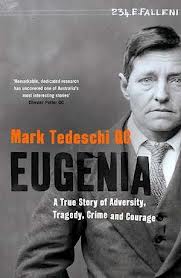
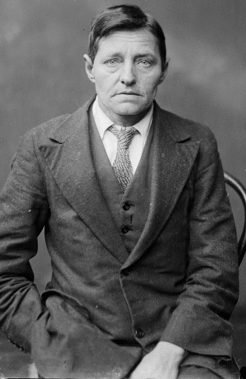
I found myself returning again and again to the police photograph of Harry on the front cover.  It was taken immediately after his arrest.  Not only had he been charged with the murder of his first wife, but his second wife now knew about his false identity.  He was afraid that he would be placed in a male prison with his identity as man/woman common knowledge.  There’s cockiness and yet sorrow in his face, and he had every reason to be fearful.

It’s a compelling story and, quite apart from the narrative itself, this book has raised so many methodological questions for me that I want to read more. How would a journalist deal with the story, or an historian?  Tedeschi acknowledges his debt to Suzanne Falkiner’s book, and I know that the historian Ruth Ford has written about her as well.  I haven’t finished with this story yet.

Ballarat Bound #3: The Gold Museum

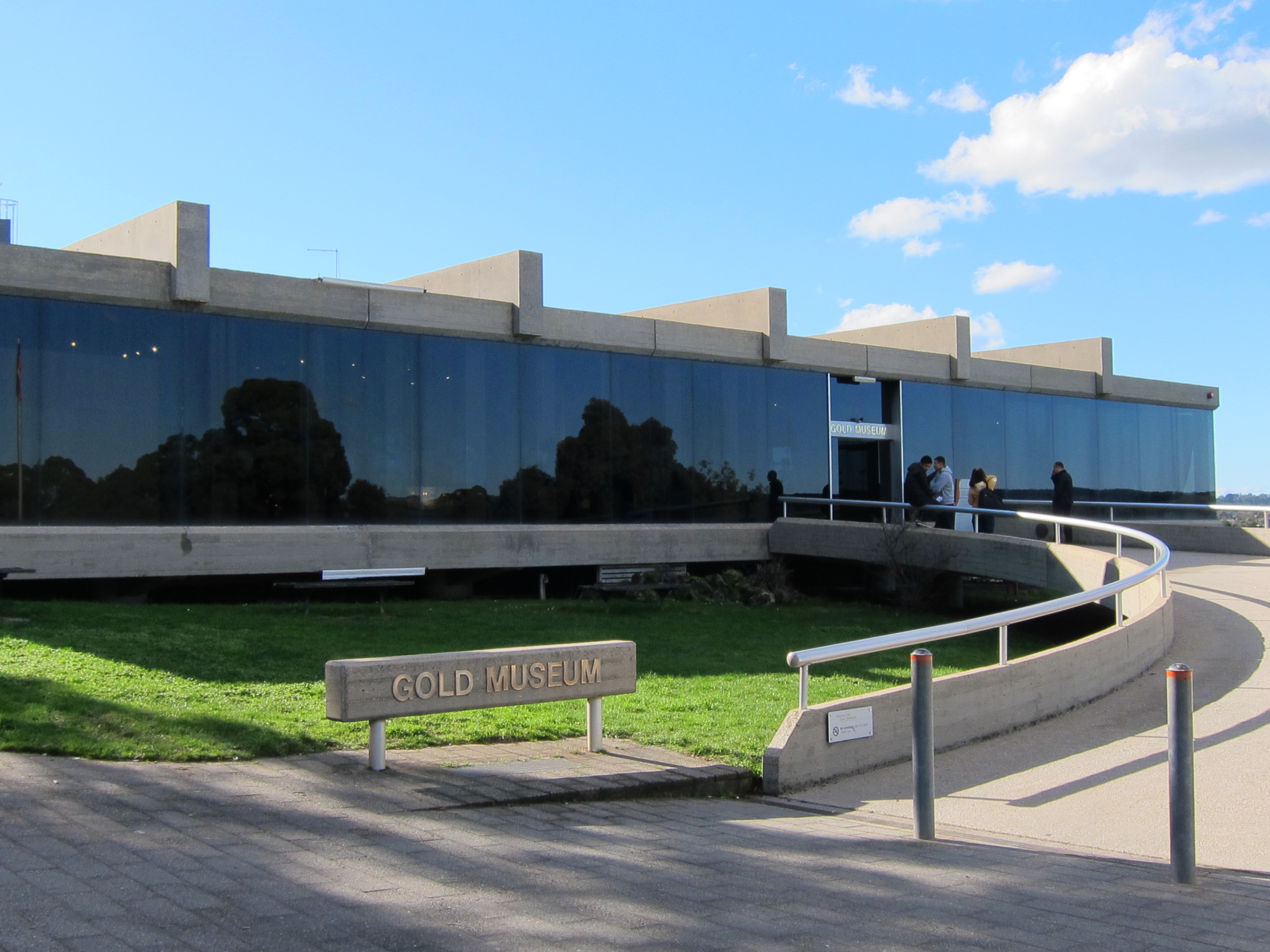
The final stop on our weekend in Ballarat was the Gold Museum that is adjacent to Sovereign Hill.  It’s been there for some time- in fact, it even has a statue of Sir Henry Bolte out the front, welcoming his contribution to the creation of the Sovereign Hill/Gold Museum precinct.  I suppose that there’s a long tradition of commemorating patrons with a statue.

IMG_0260

The Gold Museum had always seemed a rather strange place to me.  I remember it having many displays of gold coins and nuggets which have never particularly interested me.  I’m not sure whether they’re authentic or reproductions: I suspect the latter because there seemed to be little overt security presence.  As a display, it seemed even more disjointed this time around and rather tired.

However, this was only part of the display, and the rest was excellent.  There was a rather dimly lit exhibition about gold and its impact on Victoria generally, and Ballarat in particular, and it was very well done.  We spent probably 45 minutes looking at a panorama of Ballarat taken by William Bardwell from the top of the town hall spire in 1872. (See here for just one of the 15 images)  I assume that the photographs had been taken in the early morning because there are not many people about and the clarity, especially for a photograph of its age, is amazing.  We spent ages picking out buildings we knew, contemplating the variety of industry and civic life depicted, transportation etc– very well done indeed.

A temporary display highlights letters of the goldfields, and in particular the Petford Letters Collection.  This is a series of 36 letters written by James Petford who arrived in Adelaide in 1848 then travelled between goldfields in Victoria.  It’s sobering to see how tenuous the communication links could become between family members with letters waiting literally years before being collected, and vain attempts to keep some sort of chronology intact with marriages occurring and breaking down, children being born and dying and people moving on.

We had been lured up to the museum by the Anne Frank travelling exhibition which had closed in Melbourne before I got to see it.  No doubt, those who have seen the Anne Frank house itself would sniff at this travelling exhibition but given that I’m not in Amsterdam….  There was a good video, then a pictorial display based on a timeline.  All very apposite, given that last week was Refugee Week.  I’d like to think that I would have had the courage to help had I been in the situation, but I fear that I wouldn’t.  Life was so cheap.  I hadn’t realized how close to liberation Anne Frank’s death was, and I continue to be impressed, especially when I hear readings of her diary entries, by how well she wrote.

And so,  completely museum-ed out we headed for home.  Where next, I wonder, within 100 km of Melbourne?

Ballarat Bound #2: The Museum of Democracy at Eureka

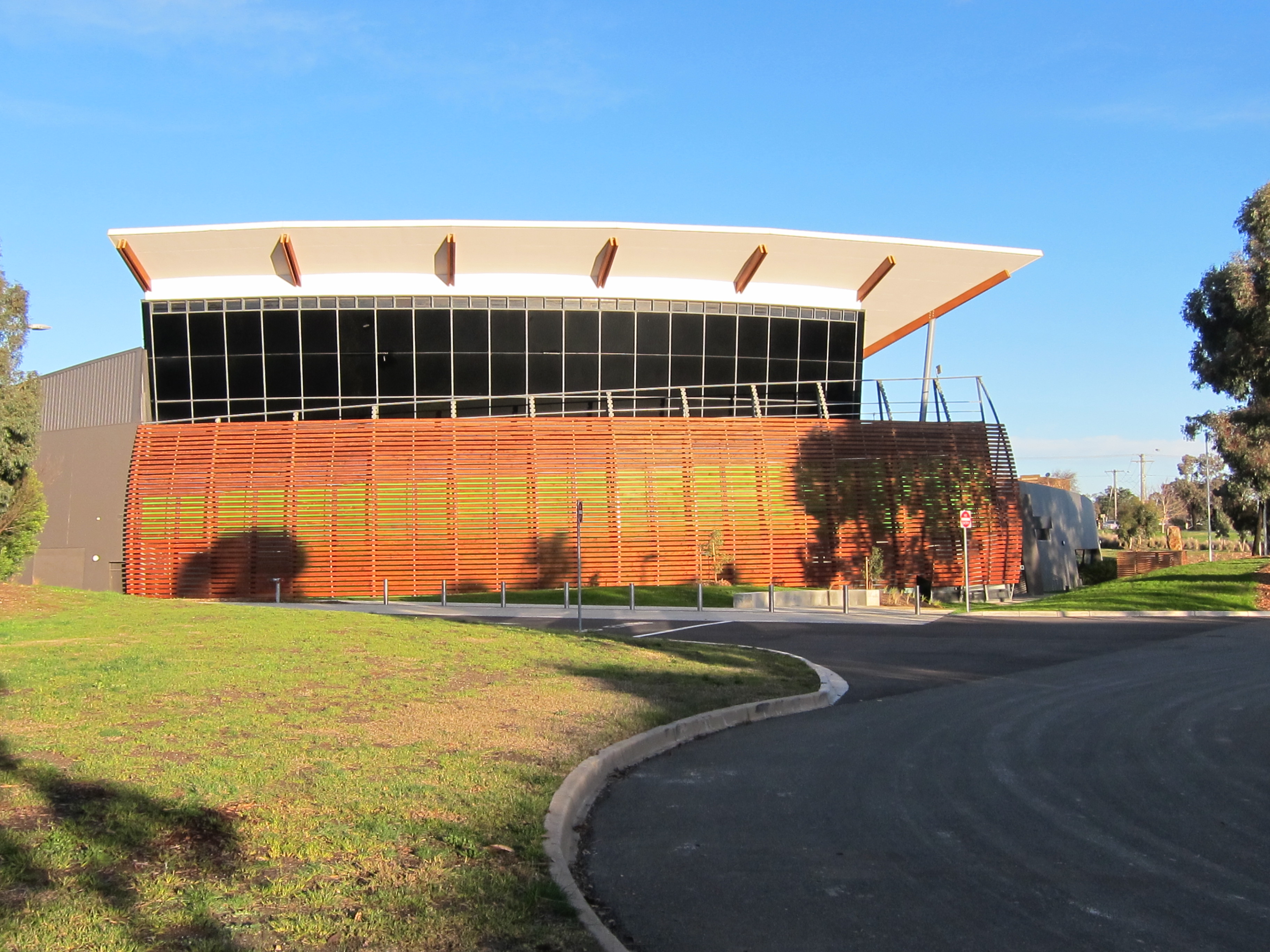
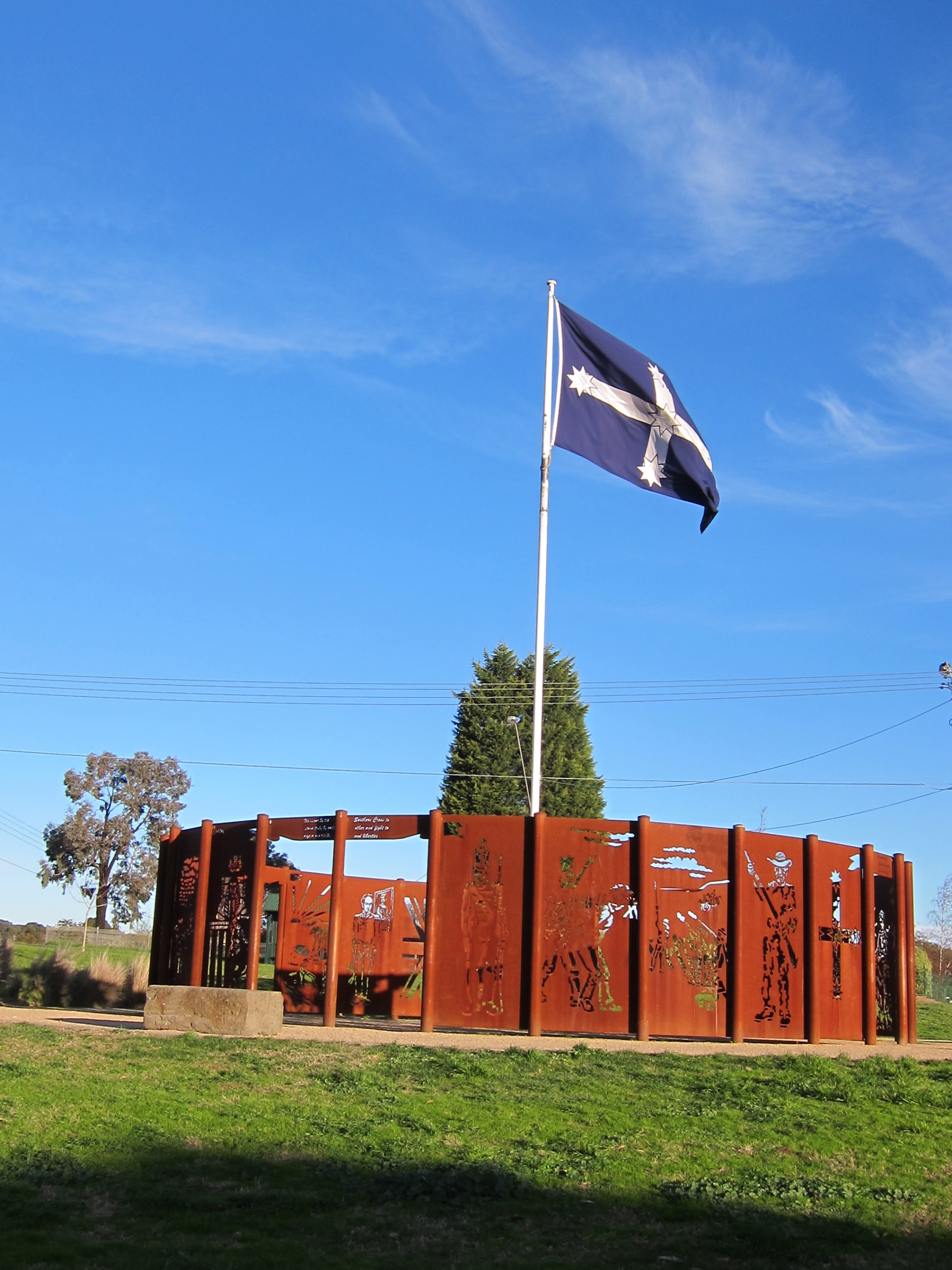
Victoria’s newest museum, M.A.D.E , The Museum of Democracy at Eureka opened in May this year.  The building looks a bit like a grown-up version of Julia’s schoolrooms throughout the country, with the timbering on the back expanse referencing the stockade that was erected roughly on the site in 1854.

IMG_0246

IMG_0247

As all of the kerfuffle over the National Museum in Canberra during the Howard years demonstrated, museums are rarely neutral institutions and this is particularly true of this museum.  You can see a number of worthy priorities at stake here: a desire to ‘teach the young ones their civics’; a desire to take advantage of one of the colourful episodes in Victorian history as something that kids might get excited about; a bit of local pride and tourism opportunities for Ballarat as a region.

The Eureka Rebellion of 1854 was a revolt of gold-miners against the expense of the mining licence they were required to hold in order to pan for gold and its administration by the Gold Commissioner and his troopers.  Civil disobedience had been rumbling along for a while, and culminated in the creation of the Ballarat Reform League and a shoot-out at a hastily erected ‘stockade’ (probably a generous term) on 3rd December 1854.

One of the claims for the Eureka Rebellion- and one that is pursued through the displays in this museum- is that the Eureka Rebellion marked the birth of Australian democracy.  This is a rather tenuous and parochial claim, and one that you’d rarely find enunciated in other museums celebrating democracy in other states.  It’s a view that largely overlooks the contribution of Chartism in UK and other international political undercurrents,  and struggles to explain why South Australia had manhood suffrage before Victoria did.  Direct links between the Eureka rebels and the Federal Parliament and its policies some 50 years later are also fairly slight.  However, not to put too much weight on this particular thrust of the display, the museum does also explore the concepts of democracy, power and participation more widely.

The exhibition space is laid out with the Eureka Story in the centre, with alcoves around the room other sections discussing differing aspects of power through words, influence, numbers and symbols.  The Eureka Story display had a good chronological narrative and was, rather surprisingly, very heavily primary document-based.  The displays were operated using all the display syntax of the i-phone: swiping, pinching to reduce and magnify etc- something that people would not have known how to do three years ago (and possibly will be surpassed in future years).  That said, it’s not a particularly option-laden display: your choice involves choosing which particular topic to explore on a given screen and then just clicking ‘next’ on the transcription of the primary document attached to it.  It was frustrating and troubling that already, after less than a month, some of the touch displays required several pressings.    Only two or three people can gather around each display tablet at a time, and only one person can ‘drive’ it. I don’t know if I would have felt comfortable poring over the primary documents in the way I did, had there been a queue of people behind me.  There’s always the tendency to keep pressing buttons (or in this case, icons) quickly just as a way of seeing what comes next, and I think that under the pressure of crowds waiting for you to move on and let them control it instead of you, you’d feel a strong pressure not to linger.

The displays on the outer walls were rather less touch-screen based.  There was an interesting video with a woman talking about feeling powerless in a Muslim country, followed by a video of a refugee;  there was an  activity where your face was scanned for digital recognition and you were either granted or denied the right to vote based on age or gender (not colour, interestingly enough given the salience of colour as a criterion for the right to vote, historically).  It was rather funny: I was trying to look as happy and beautiful as possible (!) and was assessed as a 45-55 year old MAN in a ‘neutral’ mood.  There was a display about songs, which had a rather primitive stop/start mechanism based on standing on footsteps on the floor.  The one song was played,  no matter which set of footsteps you stood on- perhaps there would have been too many competing sounds in a small area otherwise.  I don’t think that it was well enough explained why those songs, in particular, were chosen.  There was a good video-based display about the power of persuasion, with an interactive quiz at the end, and an excellent auditory presentation of famous political speeches highlighting the rhetorical devices used by the speaker.

Then, of course, there’s the Eureka Flag itself, on permanent loan from the Art Gallery of Ballarat, where it has been on display for a number of years.  It’s in a darkened room behind glass, and it’s quite a reverential experience.  A video outside the display explains the conservation techniques that have been used on the flag, and the complexity of its shift from the gallery to this new museum.

Like all  new public buildings of its ilk constructed today, the gift shop, cafe and auditorium dominate most of the usable space.

All in all, it’s a very multi-media laden display and I wasn’t at all surprised to see that the director of the museum is a digital-content expert rather than a historian.  In fact, any mention of curators or historical consultants seems to be missing entirely. Perhaps that’s why, too, the transcriber of a particular government document seemed to be completely unaware of the bureaucratic convention of writing the gist of the government reply on a diagonal angle across the back of a document.  This led to a rather garbled and nonsensical transcription, and one that should not have appeared in a display of the quality and expense of this museum.  Still, given the huge conceptual difficulties of displaying and even enthusing visitors (and especially young people) about democracy,  this museum is a very twenty-first century approach.

I’ll be interested to see how this museum fares under a conservative government, if that’s what we’re heading for.  I’d be willing to bet that Christopher Pyne, who has already reprised the cry against ‘black arm band history’ will be hightailing it to Ballarat very quickly, calling for an enquiry into this exhibition that celebrates protest so overtly.  It’s definitely worth a visit.

‘Babes in the Bush: The Making of an Australian Image’ by Kim Torney

torney

2005,  241p.

I feel as if the McCubbin image that graces the front cover of this book has been hanging in the corridor of every school I have ever attended.  Just looking at it evokes for me the smell of squashed sandwiches and pencil cases.  Likewise, the mere mention of the “Lost in the Bush” story in the primary school reader brings back memories of brave little Jane Duff, struggling with her brother to carry their baby brother through the ravines of the endless bush, tenderly covering him with her cotton dress at night.  Of course, that’s the whole power of an image:  just a glimpse or uttered word evokes a cascade of remembrances and associations. And as the title of this book suggests, the lost child in the bush is a particularly durable and potent Australian image. Continue reading

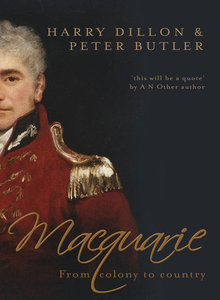
‘Macquarie: From colony to country’ by Harry Dillon and Peter Butler

macquarie

2010, 329 p.

Probably my first introduction to historic argument, as distinct from historic narrative and fact, came in HSC Australian History (yes, I am old enough that it was HSC and not VCE and young enough that it was no longer ‘matric’.)  There I was feeling all soft and fuzzy over Macquarie when along came that nasty Bigge character.  But was it as simple as this? For the first time I realized that historians- Manning Clarke, Ellis, Ritchie- could have a different take on the same event, and that you could talk about historians’ arguments and set them up against each other,  rather than just relate what happened.

And there I was nearly 40 years later, reading another book on Macquarie, nicely timed with my trip to Sydney in December last year.  It evoked a whiff of the goodies-and-baddies sense of history, and Macquarie is definitely in the goodies camp in this book.  It’s a very readable account of Macquarie’s time in New South Wales and his contribution to the shift from ‘New South Wales’ to the entity of ‘Australia’.

The authors argue that Macquarie was the victim of a mismatch between the intended use of New South Wales as both penal settlement and free colony.  His position at the head of a penal colony gave him autocratic powers but he used them to make opportunities for ex-convicts, rather than the elite- which was pretty much the expectation at the time.  He was, at heart, a military man, which expressed itself through his authoritarianism and brittle response to criticism.  The authors emphasize his Scots background as a motivating factor, and indeed call him the ‘laird’ throughout, arguing that his policies sprang from a paternalist mindset.  I’m not convinced that ‘laird’ is the right imagery, and it’s not something that Macquarie himself claimed.  The book is written from a very Australian-centred perspective, and I think that the depiction of the Colonial Office would have benefited from a fuller empire-wide analysis. As it is, the goodies/baddies dichotomy is a little too simple.

Although the biographical details of the authors links them with Charles Sturt University, they both have a background in journalism, and I think that this comes through in the book, which is eminently readable.  They have been granted all the publishing features on a historians’ wishlist- footnotes (not all that many) AND a bibliography (what luxury!), index, and source list for the illustrations.  Many other much more academic tomes than this one are often short-changed in this regard.

I was attracted to read this book after a brief browse at the ‘reduced’ table in my uni book shop. I noted that the book started with a chapter highlighting the heritage of Macquarie today, followed by a chapter that had him returning home ‘under a cloud’.  It then reverted to a more conventional biography, ending with a 2010 visit to his ancestral home.  I’m interested in the way that historians structure biography at the moment, hoping to break out of a strictly chronological form for my own thesis, and so I was interested to see how this worked as a reader.  I think it did, in that it had a pleasing sense of symmetry and that the bookend chapters allowed an argument to be mounted in what is, essentially, narrative history.

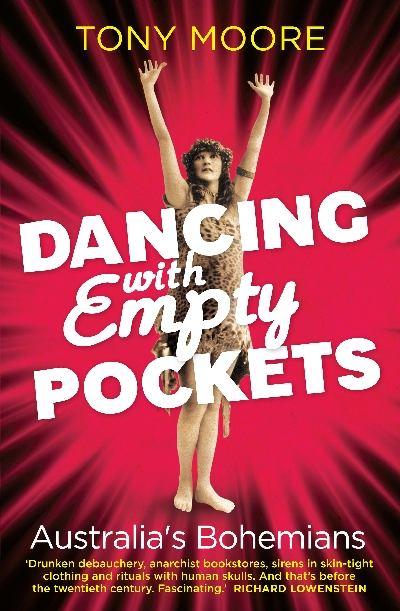
‘Dancing with Empty Pockets: Australia’s Bohemians’ by Tony Moore

2012, 351 p

Thanks to the vagaries of the hold system at my library, I read this book shortly after reading Melissa Bellanta’s book Larrikins: A HistoryAs with Bellanta’s book, this one too was adorned with the label on the spine describing it as ‘Travel and Culture’, and both books explored in different but complementary ways the appropriation of the term ‘larrikin’.  Bellanta’s book is much more accessible and person-based than this one, which is based on the author’s doctoral research, more heavily freighted with theory and hence requires more concentration.  But it’s worth it.

Moore looks at bohemianism as a mindset and abstract phenomenon, and locates its starting point with Henri Murger’s 1851 book Scenes de la View de Boheme ,  based on the author’s own lost youth amongst the  unconventional and impoverished aspiring writes, painters, poets and philosophers of the Latin Quarter of Paris.

Moore commences his study of Australian Bohemianism with Marcus Clarke, who is better known today for his book For the Term of his Natural Life than for his voluminous press writings or lifestyle.  Clarke adopted the stance of the urban flaneur, strolling observing and reporting about town, playing the dandy, joining mock clubs and,  descending into ‘lower bohemia’ for brief excursions. Clarke preferred the city to the bush, but this was reversed by the ‘bush bards and artist heroes’- the Heidelberg School of Artists, Lawson, Dennis, Lindsay et al- who identified with and drew upon the culture of both town and country workers. Here is the crossover with Bellanta’s work where Lawson and Dennis romanticized and sentimentalized the urban, delinquent larrikin culture, and identified themselves as having a softer, cosier ‘larrikin streak’.  Moore explores the overlap between bohemianism and radical politics at the turn of the twentieth century, a theme picked up again in his analysis of the Cold War anarchists of the Sydney Push, and its mainstreaming with the victory of the Whitlam government.  Yet interweaving, and sometimes challenging, this more ‘intellectual’ political seriousness was the carnivalesque, performance aspect of Bohemia, present from the start but most notable during the 1920s Jazz age and again in the expression and resistance to the modernist avant-gardes like the Angry Penguins.

The book is arranged chronologically, and switches its focus mainly between Sydney and Melbourne, and particular suburbs and places within these cities- Darlinghurst,  King’s Cross, Fitzroy, Eltham, my own Heidelberg.  Structurally, the chapters take in 20 or 30 year thematic bites, with single chapters devoted to the 1920s and the 1950s. However, the period of the 1960s to 1980s is treated to three chapters, where he discusses the commodification of bohemianism, the politics leading up to Whitlam, and the capture and contribution of bohemians in the exploration and dissemination of the “Australian identity”.  The book closes with a chapter dealing with 1980-2012 which argues the continuation of the bohemian tradition through the counter-culture, punk and pomo.

His focus is mainly on artists and writers (journalists rather more than novelists) and I found myself wondering about earlier musicians and theatrical performers, although these do get a look in with Dulcie Deamer in the 1920s and even more so from 1970s on.  There is a huge cast of characters here- the index really doesn’t do it justice- but at times this felt a little like a roll-call.

He argues that the connections, transmissions and patterns of living implicit in Bohemianism are often invisible to the historical actors themselves, but apparent to the historian who takes a long term perspective (p. 344).  Indeed, bohemianism often manifests as a conscious push against what immediately came before it, and conversely, bohemians tend to see themselves in retrospect  as the last ‘authentic’ bohemians.

It was common for Australian bohemian artists and writers, once established and grown older, to recycle the bohemianism of their youth as nostalgia in memoirs, journalism, exhibitions, television documentaries and even semi-autobiographical films.  Across the generations they close down the possibility of tradition by denying the credentials and credibility of young artists who came after them. (p. 345)

Although I am in no sense WHATEVER a bohemian, perhaps I too am doing this because I found the last chapter of this book the least satisfying and often found myself thinking “But they’re not real Bohemians!” In this regard,  Moore was right, I think, to separate out his analysis of the 1960s-80s to explore the commodification of bohemianism because I think that it marked a qualitative change from the ongoing ambivalence that had always existed between rebellion and the need to earn money to eat.  Hence, I found myself puzzling over some of the current mass-media ‘personalities’ he included within the bohemian tradition- the Masters Apprentices, The Chaser, Midnight Oil- and distrusting somewhat his inclusion of his own contribution to bohemia.  Was the last chapter perhaps more a manifesto, a claim for a stake in the bohemian paddock, rather than a historical analysis?  Perhaps it’s just that I feel uncomfortable having my own present historicized?

Just an aside- a fascinating interview with Dulcie Deamer (complete with cupid’s bow lips) from the 1960s here.  In fact the whole collection of You Tube videos Stations of the X is engrossing.

‘Larrikins: A History’ by Melissa Bellanta

2012, 191 p & notes

For some reason my local library has taken to sticking little labels on the spines of its books denoting ‘biography’ ‘crime’ ‘Australian’ etc. Even though this book is titled Larrikins: A History, the library-gods have decreed that this book is ‘Travel and Culture’.  At first this seemed to me to be rather inappropriate, but on reflection, it is a journey into the subculture of the Australian larrikin between 1870 and 1930, framed very much in a current commentary.  This presentism may do the book a disservice ten or so years down the track however, when I hope that Corey Worthington (who?) has shrivelled back into  irrelevance and that Steve Irwin is just an embarrassing jingoistic memory. Bellanta starts and finishes her book with these men, along with the Beaconsfield miners and Bob Hawke, who are affectionately viewed as ‘a bit of a larrikin’, a good bloke, who cuts through the bullsh*t, and doesn’t stand on ceremony.  She reminds us of Kevin’s Rudd’s cringe-inducing attempt to be a larrikin with his ‘fair shake of the sauce-bottle’ (although I note that the ANU Word Watch gives this mangled expression a shred of credibility) and even ropes the Bundy Bear into the larrikin camp.

But, she argues, although there might be a feel-good factor about larrikins today, when the term first emerged around 1870, it was a term of abuse for shiftless, marginal, disaffected teenaged boys and girls – and certainly no Prime Minister would be falling over himself to be labelled a ‘larrikin’ then.  The origin of the term ‘larrikin’ is not clear-cut, but  the whole larrikin milieu was heavily influenced by English slang and the stage depictions of cockney characters who circulated as part of the empire-wide theatrical circuit of the mid-to-late nineteenth century.  In fact, many aspects of the larrikin phenomenon in its original form were moulded by what we would now call the media: the ‘Today/Tonight’-like feature articles on larrikin gangs in the press and in more ‘respectable’ publications like Blackwood’s Magazine,  the geographical nomenclature given to larrikin gangs like the ‘Gipps Street Push’ or the ‘Haymarket bummers’  in the crime reports, and the music-hall burlesque tradition.  But make no mistake, these larrikins were hooligans and thugs: they were involved in rape, bashings, theft, anti-Chinese riots as well.  They were mixed-sex groups, with girls or ‘donahs’ fronting the courts as well.  Their faces stare out from the mug shots that stud the book: young, defiant, with the odd hint of a shared street identity in their haircuts and clothes.

However, at the turn of the century and in the shadow of WWI both the larrikin phenomenon and its depiction changed.  Several factors were at play. European battlefields winnowed the ranks of these young men; there was a change in the retail sector that removed the  itinerant trade from the streets, and the rise of football, especially in inner-city Melbourne, both channelled and was an outlet for larrikin behaviour.  The burnishing of the Anzac legend incorporated a soft-focus version of larrikinism, and the swell of nationalist literature in the 1890s and early 20th century brought a tamed, more affectionate depiction of loveable larrikins like the Sentimental Bloke and Stiffy and Mo.  Larrikinism and organized crime were two completely different phenomena, and there gradually came to be increased tolerance for larrikinism in a world that had seen worse things.

The book is prefaced by three reproduction maps of the ‘larrikin belts’ of Melbourne, Sydney and Brisbane.  It is a paradox of this early larrikinism that it was strongly geographically based, often honing in on a particular street, a particular building, and yet the phenomenon itself spanned urban environments across colonies, and even spanned metropole and periphery.  In many ways the crime reports and mug shots are interchangeable: you’d be hardpressed to distinguish a Melbourne larrikin from a Brisbane one.

The frequent references to current events (Cronulla, hoodies) kept the tone of the book light, without detracting from the nuance of her analysis.  I must confess to being a bit disconcerted by her paragraph structure  that has a foreshadowing final sentence leading into the next paragraph- probably a grammar lesson well learnt- but I found myself re-reading thinking “hold on, do I know about this person?” until realizing that all would be revealed in the next paragraph.  It’s a stylistic choice, I suppose, but one that tricked me again and again.

Although the meaning of ‘larrikin’ might have changed from its nineteenth century usage, the fond, chuckling, good-guy version is likely to be with us for some time, especially at times of high public sentimentality.  As for that other, darker, more dangerous meaning which has never really completely disappeared-  the ugly, thuggish one-  no doubt new labels will be found for that too.

awwbadge_2013

The GG, the Judge and the Prince

Were you, like me, transfixed by the extract in Saturday’s Age from Jenny Hocking’s upcoming second volume of the Whitlam biography? Were you reading, spoon hovering betwixt your Vita Brits and mouth, eyebrows rising higher and higher?  Or is it just me? – a sign that I’ve hanging around reading about colonial judges, self-government and the colonial judiciary for too long?

In writing this second volume, Jenny Hocking has used interviews and, according to the publisher’s website, “previously unearthed archival material” including the papers of Sir John Kerr, the Governor-General who was central to the dismissal of Prime Minister Gough Whitlam in 1975. According to the video interview with Jenny Hocking on the Age website, Sir John Kerr’s personal papers had been deposited in the National Archives some time ago, but had not been opened previously.  This might explain why  no-one had seen it before:  the now-deceased Kerr’s intrusion of himself into the archive as he set down the role – unknown until now-  played by Sir Anthony Mason, a sitting judge of the High Court of Australia and a pro-chancellor of the Australian National University.

Kerr wrote:

In the light of the enormous and vicious criticism of myself I should have dearly liked to have had the public evidence during my lifetime of what Mason had said and done during October-November 1975 [but] he would be happier…if history never came to know of his role.

I shall keep the whole matter alive in my mind till the end, and if this document is found among my archives, it will mean that my final decision is that truth must prevail, and, as he played a most significant part in my thinking at that critical time, and as he will be in the shades of history when this is read, his role should be known.

Apart from the Pauline Hanson ‘death video’ overtones of this document, the intervention of Sir John’s voice into the archive reminds us that an archive is always a constructed entity- not necessarily by the subject of the archive, but by someone scooping up, harvesting, organizing or in this case, shaping the material that appears there.   Is this the vanity of a puffed-up man, piqued that others escaped the opprobrium he attracted, and determined that his version should surface eventually? A final manipulation or final confession? A determination to share the credit or spread the blame?  Or is this a man with an eye to history, anxious that ‘the truth’ as he saw it was documented?

Whatever his approach to history, he did at least have one, unlike Sir Anthony who refused Kerr’s entreaties to make his role public.

Mason’s view, as he still maintained when pressed on these matters nearly 40 years later was, “I owe history nothing”.

What an extraordinary statement!  I still have it rattling round in my head, as I try out different permutations and explanations of it.  What on earth did he mean? Does he “owe history nothing” because he feels he was vindicated? Does he see it as a purely personal, private matter? Does he feel that he has already done enough for history?  Does he somehow see the judicial sphere completely divorced from the political arena, or does history have its own great sweep, unaffected by the actions of individual men? (in this case I use ‘men’ very deliberately). I note that even though he might owe history nothing, he now feels that he owes it to himself ( if he felt inclined to use such a quaintly 19th century Colonial Office phrase) to set the record straight in an article in the next day’s paper where he acknowledges his involvement but emphasizes that he advised Kerr ignored his advice that Whitlam should be forewarned of Kerr’s plans.

The final revelation that made me finally put down my spoon and read even more closely was the appearance of Prince Charles into the imbroglio. Sir John Kerr had met Prince Charles the year before, and engaged with him on a discussion of the possibility of Prince Charles himself being appointed Governor-General of Australia. In September 1975, some two months before the dismissal, the paths of the Governor General and the Prince crossed again in Port Moresby at a ceremony to mark the transition to an independent Papua New Guinea.

Kerr took this previous interaction to suggest a personal connection to the Prince of Wales and now, as the two met against in Port Moresby, the governor-general took the extreme step of raising with the prince the possible dismissal of the Whitlam government and his grave fears that he would himself be dismissed by Whitlam should he do so.

Apparently oblivious to constitutional expectations, Charles replied, according to Kerr’s notes of their exchange “But surely Sir John, the Queen should not have to accept advice that you should be recalled at the very time, should this happen when you were considering having to dismiss the government.”

Prince Charles at this time was 27 years old, no longer the gangly schoolboy of his Timbertop days.  For a man raised from birth to become King, and who could have been discreetly tapped on the shoulder the very next moment to be told exactly that, his ignorance of the constitutional parameters of his role is astounding.  If nothing else, silence would have been an appropriate response.  It was as if 150 years of responsible government and the principle that the governor takes his advice from the popularly elected prime minister just dropped away in a private conversation.

I found it impossible to read these extracts without my historian’s hat on.  I can only imagine the heart-stopping moment for Jenny Hocking when this document reached out- “Historian- look here!”- from the archived collection of a man obviously intent on moulding his own place in history.  I found so many parallels with my own work, too, in the conjunction of big, historical events and the vanities and networks of individual men; the careful legal language that rather inadequately veils ego and ambition; the importance of the dinner party and the whispered conversation within the ostensibly transparent political structures.  Definitely the best breakfast read I’ve had in a long, long time.

A pleasant Sunday drive to….The Portable Iron Houses

Do people do Sunday drives anymore? We did- across the Yarra and down to South Melbourne to look at the Portable Iron Houses in Coventry Street South Melbourne.

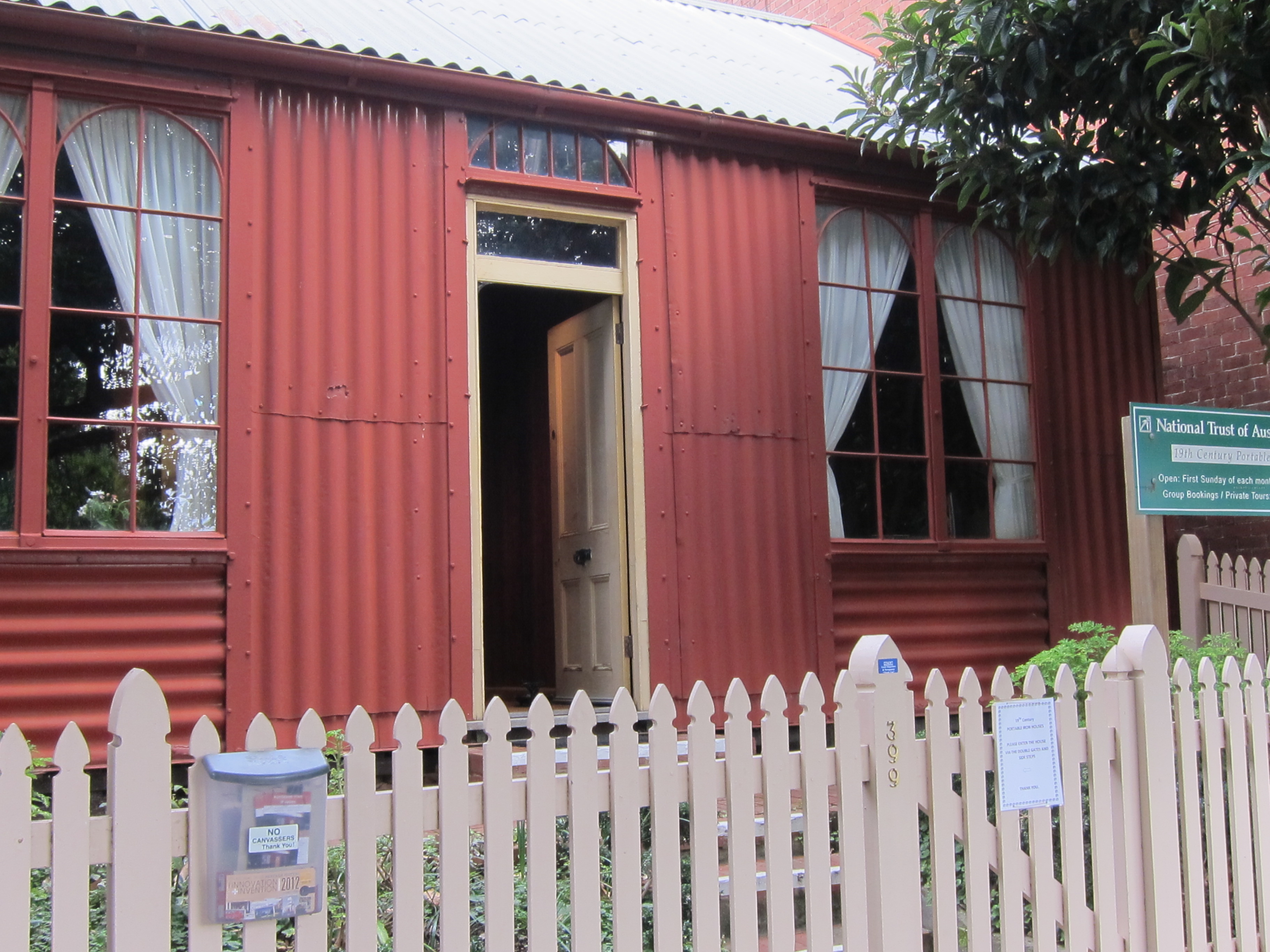
Patterson House, Coventry St South Melbourne

There are three galvanized iron houses on the South Melbourne site.  The one facing Coventry Street, shown above, is still in its original position where, in 1855 it was one of nearly one hundred portable buildings in the vicinity that included cottages, two-storey houses, shops, stores and a coach house.  It was valued at 60 pounds when it was erected in 1853/4.   Portable iron houses were packed in wooden cases (which could be used to line the internal walls) and easily transported by ship or cart.  They were quickly erected and could be unbolted and dismantled to be taken elsewhere for re-erection as a practical and enterprising solution to the dire housing shortage in gold-rush Melbourne.  The house above contained four rooms on the ground floor, with two attic bedrooms that are reached by a precipitous stairway.  I found it hard to envisage negotiating these stairs- barely more than a ladder really- with a babe in arms.  The temperature of the attic rooms in summer must have been fearsome too.

The second house on the side, Bellhouse House, was originally built at 42 Moor Street Fitzroy.

Bellhouse House, South Melbourne

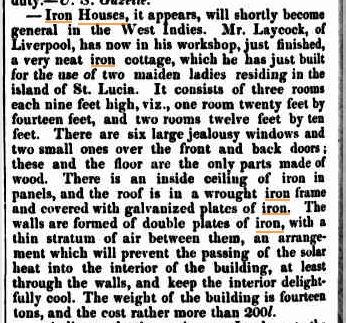
It is believed to be the only remaining example of the work of Edward T Bellhouse of Manchester England.  In 1851 he displayed his portable houses at the Great Exhibition, where they exemplified the practical use of new technology, especially for an imperial context.  There had been iron houses available previously- say for example, this house designed for St Lucia in the West Indies, but the cost and the weight were prohibitive

The Courier (Tasmania) May 8, 1845

(by the way, it should be ‘jalousie’ window, which apparently is just a louvre window).

There had been timber pre-fabricated houses as well (La Trobe’s cottage is a good example) but with these iron houses we are talking mass-produced, cheap, urban housing that could be manufactured in Britain and shipped to colonies throughout the world.  The iron on the Bellhouse House runs horizontally, and it would have originally contained three rooms.  I must admit that I found it rather charmless.

The house that I was most intrigued by was Abercrombie House, which faces Patterson Place at the back, where there were originally fourteen houses of a smaller size erected by the entrepreneur who erected the Coventry Street House.

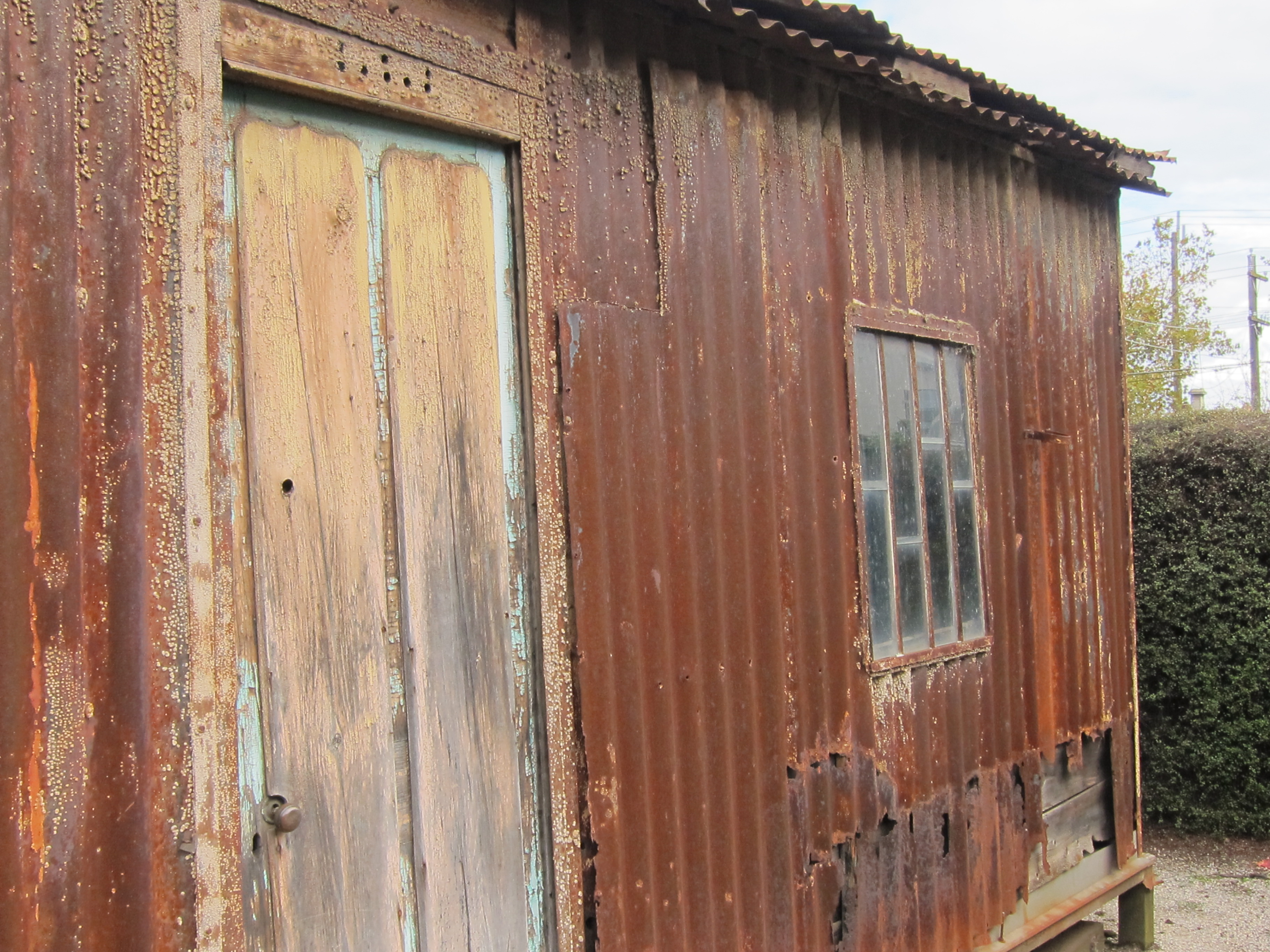
Abercrombie House, Patterson Place South Melbourne

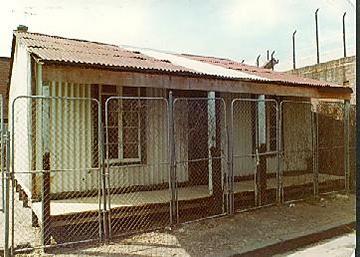
This particular house was moved from its original location at 59 Arden Street, North Melboune in about 1980.  You can see a picture of the house still in North Melbourne here  and it being shifted by semi-trailer after being cut in half here. They must have had their hearts in their mouths while they were moving it, because it is certainly in a very precarious condition.  It was last occupied in 1976, and standing there looking at the single light bulging hessian-covered ceiling and the layers of wall paper, it’s hard to credit that such primitive living conditions still existed in the middle of Melbourne forty-odd years ago.  But conversely, on a wet and cold winter’s day, it’s also important to recognize what a vast improvement this house would have been on the canvas tents that were the alternative.

Abercrombie House from Patterson Place

The Portable Iron Houses are presented by the National Trust, and they are open on the first Sunday of the month 1-4 p.m.