Category Archives: Australian history

The Foundational Orgy

convict

Some time ago, I rather flippantly (and crassly?) suggested that the 6th February- the night of drunken revellry on the Sydney Cove beaches- might be a more appropriate celebration of Australia Day than 26th January. You know the story- Robert Hughes has the couples rutting between the rocks; Tim Flannery started his The Birth of Sydney with it; Tom Keneally fictionalized it; and the tele-doco The Floating Brothel based on Sian Rees’ book of the same name re-enacts it.  Now I find that perhaps this “foundational orgy” never occurred.

Grace Karskens in her beautifully written and presented book The Colony: a history of early Sydney pins the origin of the “foundational orgy” on Manning Clark’s Short History of Australia, but Manning Clark himself backtracked on the story when he re-read the original sources.  Too late- the story (and let’s face it- it IS a striking one) was off and running.

There is no real evidence that the orgy ever occured. Surgeon Arthur Bowes Smith wrote that “the men convicts got to them soon after they landed” and that it was “beyond my abilties to give a just description of the scene of debauchery and riot that ensued during the night.”  Perhaps because that’s because he wasn’t there- he was on the Lady Penrhyn moored out in the harbour.  The sailors on his own ship were issued with rum rations, but the convicts were not.

Ralph Clark described the women’s tents of  “Seens of Whordom” but he called all convict women “whores”.  He describes the punishments meted out to male convicts and sailors alike who tried to have sex with the women, but not on or around 6th February.  He mentions the thunderstorm, but nothing else.  Neither does anyone else- in fact, Watkin Tench mentioned that “nothing of a very atrocious manner appeared” during February.

So, Karskens asks, does it matter?  Are we going to let the facts get in the way of a good story?  It does matter, she claims, because told as a story of  “loose  whores and randy drunken men”  it validates, and even celebrates certain types of male behaviour.  Even more than this,  Hughes et al claim this “scene” as the foundation of Australia’s sexual history- a sensationalist view that obscures the real legend- the fruitfulness and growth of relationships between men and women in those early years.

I am duly chastened.

References:

Grace Karskens The colony: a history of Early Sydney pp.313-315

Mr Robinson reports

I’ve been reading the Port Phillip journals of George Augustus Robinson.  Note that these are the Port Phillip ones, not those that he wrote in Van Diemen’s Land which were edited by N.J.B.  Plomley.  Actually,  Plomley’s work has had a bit of renaissance lately, with the republishing of his Friendly Mission and the release of Reading Robinson,  a set of essays by various authors which extends Robinson’s work into a broader imperial context.   I have this book of essays on hold, and shall report anon.

Robinson himself seems to be undergoing a reconsideration.  Until recently, his main biography has been Black Robinson by Vivienne Rae-Ellis, a vehement portrayal that depicts him as an incompetent and dishonourable liar and cheat.   Rae-Ellis’ book had a troubled publication history and  received much critical comment on its publication (Pybus, 2003).   Keith Windschuttle in his Fabrication of Aboriginal History interprets this as an attack on Rae-Ellis for her negative depiction of Robinson, who has been treated more benignly by Henry Reynolds, Lyndall Ryan and other historians that he himself attacked for their depiction of Aboriginal history.  Perhaps it’s a matter of “the enemy of my enemy is my friend” because Windschuttle certainly did not extend the same level of scrutiny to Rae-Ellis as he did to Reynolds and Ryan.

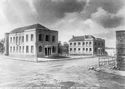
Robinson’s Tasmanian journals have received most of the attention, but the ones I’ve been reading are his Port Phillip journals, written after he had spent several years on the blighted Flinders Island with his dwindling band of natives.   He took with him to Port Phillip  several Aborigines from Flinders Island, including Truganini and Wooredy.   He arrived in Melbourne in February 1839, prior to La Trobe.  His instructions were vague.  Glenelg at the Colonial Office in London sent a copy of the report of the 1837  parliamentary  Select Committee  to Gipps, with recommendations to protect, educate, provide religious education for and ‘civilize’ the aborigines.   Glenelg told Gipps to fill in the details, but Gipps was loathe to do so.  He argued that Robinson had been appointed Chief Protector on the strength of his “acquired experience superior to that which is possessed by any other individual in the Colony”, and he was left largely to define the role himself.  It seems that La Trobe was keen for Robinson to move around the District: he sent him on his trips to the Western District and was reluctant to appoint Robinson as a town magistrate lest it “seem to form the idea that his Duties lie in Melbourne instead of in the Bush” (Gipps to La Trobe 11 Feb 1843).  But his role did, indeed, involve both administration in Melbourne- in fact, he was appointed an office in Willis’  “old” Supreme Court building once the “new” courthouse was opened- and field work both supervising the Assistant Protectors and recording the language, names and habits of Aborigines throughout the District both as a form of ethnographic study and census.

This dual focus of  acting both as administrator and protector is reflected in his journals.  Inga Clendinnen tells us in her memoir Tiger’s Eye that she  drew on Robinson’s diary of his Western District  journey between 20 March and 15 August 1841 as her first step back into the academic waters after a long period of illness.  Her essay ‘Reading Mr Robinson’ focusses on Robinson’s  journey, but the George Augustus Robinson we see in the saddle, riding from tribe to tribe and outstation to outstation is not the same fussy, petty man that we see around the streets of Melbourne.  His role was not just to observe and count: he was also a minor bureaucrat puffed up with self-importance but ultimately impotent and compromised when the pointy end of the law intersected with the humanitarian aspects of his task.

Clendinnen admits “I have become very fond of Mr Robinson”.  I’m not quite as fulsome.  The ‘town’ Mr Robinson is rather wearing; in management-speak he is unable  ‘upwardly manage’ his relationship with his superiors (if indeed, he even perceives them as such), and he undermines and backstabs the assistant protectors under his supervision- although admittedly some of them were a rum lot too.  His attitude towards the Aborigines he brought over with him from Flinders Island is puzzling: he distances himself emotionally from the execution of  “Bob” and “Jack” for murder in January 1842, fulminating about process but oblivious to the tragedy; he goes into organiser-mode for the return of the women to Flinders Island without expressing any regret. The death of Peter Brune, who did not return to Flinders Island but remained with him as his native right-hand man, is brusque and matter-of-fact.

He doesn’t really seem to “get” Aboriginal communication, despite his compiling of long lists of words.  The whole idea of bringing the Van Diemen’s land natives over to smooth his path with the mainlain Aborigines highlights his lack of awareness of the distinctiveness of the Tasmanian tribes.   His interaction is often completely utilitarian on his own terms: he is dismissive of the context of communication wanting only the content:

When the natives appear I brake through all Aboriginal ceremony [sic] (which to observe would be a waste of time) and go forth and meet them  (10 May 1841)

There are several occasions of riding into a location incognito, and pumping people for information about “Robinson”- a curious way of gaining feedback, if that’s what he was doing.

Although, having said all this, there are times when the humanitarian breaks through, and I think that this side of him is what Clendinnen is responding to.  He is genuinely filled with admiration when he sees the construction of eel-traps, and acknowledges the ingenuity, strength and dedication of the men who created them, quite irrespective of race.  He is sceptical of the numbers of deaths reported by the settlers; he decries the preference for emancipated convicts as workers who, unlike new emigrants were not frightened of the natives.  He hears, and understands, the aboriginal claims on the land:

I should remark that, when Tung.bor.roong spoke of Borembeep and other localities of his own nativity he always added ‘that’s my country belonging to me!! That’s my country belonging to me!!” This language language is [plain] but not the less forcible on that account.  Some people have observed, in reference to the natives occupying their country, what could they do with it?  The answer is plain- they could live upon it and enjoy the pleasures of the chase as do the rich of our own nation (17 July 1841)

He is dismissive of the stories of cannibalism relayed to him by the settlers- “Fudge!”. And when he comes across a settler who freely admits murdering five natives,  he is chilled and repulsed by the man.  He is determined not to partake of the lonely man’s desperate hospitality:

Francis pressed me to sleep in his hut and it was evident the bed had been prepared, clean sheets and pillow case.  He entreated and said he would play me a tune on the fiddle and I was to make myself at home, &c.  I however had made up my mind to sleep in the van and got away.  I could not sleep in the place; I was disgusted and my heart sickened when I thought of the awful sacrifice of life done by this individual.  He acknowledged to five, the natives say seven.  (30 July 1841)

On leaving the man as quickly as he can, he passes a skull planted nearby- shades of Kurtz.  Robinson knows the message it is sending- and no doubt the local tribes do too

I cannot conceive why this skull was permitted to remain exposed in such a situation; it is doubtless best known to Francis. (30 July 1841)

With my almost endless ability to be diverted from actually writing my thesis (as distinct from wool-gathering about it), I’m looking forward to reading the new Robinson essays.  I’ve also borrowed a book of Sievwright, the assistant protector who was the cause of much scandal and criticism from all sides.  More on him anon too.

References:

Ian D. Clark  The Journals of George Augustus Robinson, Chief Protector, Port Phillip Aboriginal Protectorate, Volume Two: 1 October 1840-31 August 1841 Melbourne, Heritage Matters, 1998.

Ian D. Clark (Ed) The Journals of George Augustus Robinson, Chief Protector, Port Phillip Aboriginal Protectorate, Volume Three: 1 September 1841- 31 December 1843Melbourne, Heritage Matters, 1998

Inga Clendinnen Tigers Eye 2001 (includes the essay ‘Reading Mr Robinson’)

Anna Johnston and Mitchell Rolls (eds). Reading Robinson 2008

N.J.B. Plomley Friendly Mission 1966

Cassandra Pybus ‘Robinson and Robertson’   in R. Manne (ed) Whitewash: On Keith Windschuttle’s Fabrication of Aboriginal History, Black Inc, 2203

Vivienne Rae-Ellis Black Robinson: Protector of Aborigines 1988

A.G. L. Shaw  A History of the Port Phillip District: Victoria before Separation 1996

A.G.L. Shaw Gipps-La Trobe Correspondence

Keith Windshuttle  The Fabrication of Aboriginal History, 2002


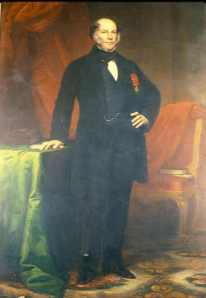
‘Colonial Improver: Edward Deas Thomson’ by S. G. Foster

PortDeas Thomas2

Once you’ve got some little way into your research, it’s quite amusing to look back at the things that puzzled or amazed you right at the beginning.  For me, it was coming across so many letters addressed to ‘E. Deas Thomson’.  Who WAS this man, I wondered, who seemed to write with such authority on so many topics- and why had I never heard of him?

Edward Deas Thomson was originally appointed clerk to the Legislative and Executive Councils under Governor Darling in 1829, then went on to serve as  Colonial Secretary for Governors  Bourke, Gipps, Fitzroy and Denison between 1837-1856.   The term ‘Colonial Secretary’ is a little confusing, as it was used both  for the Secretary of State for War and the Colonies in London (e.g. Marquess of Normanby,  Lord John Russell, Lord Stanley during Judge Willis’ time in NSW) as well as for the chief adviser and second administrator to the Governor here in the colonies.  In my focus on the empire-wide peregrinations of colonial civil servants and judges as they crisscrossed between Upper and Lower Canada, Newfoundland, Cape Colony, the West Indies, New Zealand, Australia, Sierra Leone etc., I have tended to forget that their mobility was supported by an ongoing administrative structure that remained more or less stable, despite the comings and goings of Governors.   This was the case with E. Deas Thomson who served under four governors, of varying political stances and administrative habits.

E. Deas Thomson was born in Edinburgh in 1800 to a family with naval and merchant connections.  His father was  the sometime accountant-general of the Navy, and family drew heavily on the patronage of Sir Charles Middleton (Baron Barham) , First Lord of the Admiralty, and his family after Sir Charles’ death.    His mother was from South Carolina, where Thomson’s father had worked as a plantation agent for his uncle.  After marriage, the couple moved back to Scotland but Deas Thomson’s mother seems to have not settled well and returned alone to South Carolina after suffering a period of paranoia, leaving the 5 year old Edward with his father.  Edward was educated at Harrow, then spent two years in France,  returning to London for a period before travelling to America, then Canada after attending  to business arising from his mother’s death in 1826-7.  The French and American connections, though not necessarily out of the ordinary, do suggest a broader experience than many other civil servants may have been exposed to.

Through his contacts with Sir Charles Middleton’s family, he appealed to Huskisson, then Secretary of State for War and the Colonies for a position in the colonial civil service.  At first he was offered the position of registrar of the Orphan Chambers in Demarara, then a second offer of Clerk of the Council of New South Wales, which he accepted, despite the lower salary, on account of the healthier climate.  This consciousness of the tropical climate, and its deleterious effects, is an ongoing theme in the English imagination of Empire.

He came to his position as Clerk of the Councils via a circuitous route.  The previous incumbent, Henry Grattan Douglass had been removed from the position, and Darling tried to replace him with his own brother-in-law Henry Durmaresq. However the appointment was vetoed by the Colonial Office after complaints of nepotism and Darling was warned against the appointment to public office of  ‘any relative or near connection’.  The position was then open for Thomson’s appointment.

Thomson was not particularly impressed with the drought-striken New South Wales during his first year in 1829, but his perceptions improved as the drought lifted and his friendship with Governor Darling developed.     He maintained a good relationship with Darling’s replacement, Richard Bourke ,and dined frequently with him, despite differences in political stance.  He married Bourke’s daughter Anna, which then placed him in a similar position to his predecessor Dumaresque when Bourke recommended Thomson (his son-in-law) as a replacement Colonial Secretary in place of Alexander Macleay– an erstwhile friend whose nephew ended up marrying Thomson’s own daughter in 1857- ah, the tangled intermarriages amongst colonial ‘gentry’ family!

Despite Bourke’s qualms about nepotism, the appointment went ahead, and as it was, Thomson remained Colonial Secretary for twenty years, long outlasting his father-in-law’s stay in New South Wales.   As such, he acted as confidant, advisor and spokesmen for the succession of governors.  His role changed after the 1842 Constitution introduced a partially-elected Legislative Council, and again with 1856 responsible government when, relucant to engage with electoral politics, he became a life appointee of the Legislative Council where he came to be aligned with the conservative element.

My own awareness of E. Deas Thomson, however, arises from his position as medium between Governor Gipps (the governor in charge during Judge Willis’ time in Port Phillip) and official and individuals in the community at large.   The protocols of communication were an important means of control:  individuals and government officials were instructed to direct all communication with the governor through his Colonial Secretary, and all communication with the Secretary of State in the Colonial Office in London also had to be channelled through Governor Gipps in Sydney (and hence, his Colonial Secretary E. Deas Thomson).   Certainly individuals could, and did, circumvent this process by writing directly to the undersecretary at the Colonial Office , but by Judge Willis’ time this practice, overtly encouraged by Undersecretary Robert Hay in the mid 1820s, had been regularized by the new undersecretary  Sir James Stephen.   Likewise,  there was an off-record back channel of communication within the colonies as well:  Gipps wrote personally to Superintendant La Trobe, and Thomson himself maintained long-standing communications with Denison in Van Diemen’s Land who was later to become Governor of New South Wales.   Indeed,  Thomson became increasingly critical of Governor Gipps’ carelessness in communications with local politicians,  and his inability to recognize when to speak and when to remain silent.  At the same time, leading members of the community recognized that it was better to sound out Thomson before approaching the Governor directly. (Foster, p. 62).

E. Deas Thomson himself has been cast as ‘conservative’ in his politics, particularly when he became a political actor in his own right after representative and then responsible government was granted to the colonies.  Certainly he came to be  seen to represent the interests of the squatters,  and expressed wariness and distaste for universal suffrage and wanted the constitutional backstop of a conservative upper chamber on a restricted franchise.  However, other aspects of his politics are less clear-cut.  He was a lifelong Free Trader, right from his time back in Scotland where he attended lectures by J. R. McCulloch.   He supported the idea of ‘improvement’- a theme picked up on in Foster’s title to his book- through schooling, universities, postal communications, railways, and his involvement in a range of benevolent societies and educational instutions including the Australian Museum and Sydney University.

The lives of E. Deas Thomson’s surviving children illustrate major themes in Thomson’s own life.  His eldest son suffered an ‘unstated ailment’ and could not hold down a job and drew on large sums of his father’s money- shades, perhaps, of Thomson’s mother’s ‘instability’; or maybe just colonial waywardness??? A second son became heavily involved in the Church of England and the temperance movement- the ultimate ‘improvement’ activity.  His three daughters’ marriages are a microcosm of empire: one married a nephew of Thomson’s own predecessor as Colonial Secretary, Alexander Macleay; another married a member of the Indian civil service, and the other married a naval officer.

Thomson’s own early career demonstrates once again the importance of patronage in embarking on a colonial role.   Patronage seemed to make the world go round, but it’s easy to overlook its infantalizaing aspects.  Thomson’s own father, dismissed from his position as accountant-general in the Navy by the incoming Whig Government, turned his attention to a rich widow.  To his son he wrote:

The party I have had in view and still have, if it can be accomplished is a Mrs C a person about 50, being neither (of course) young nor handsome but with more good temper than falls to the lot of most people in life- She is the widow of an army surgeon who has been dead about 7 years- Her father left her about 15,000 pounds which has not been decreased but rather added to… Lord and Lady [B]arham approve the Match  & have visited & paid the necessary attention (quoted Foster p. 36)

Shades of Lady Catherine de Bourgh in Pride and Prejudice??  I suspect, but am not certain, that by now the Barham influence rested with 1st Earl of Gainsborough– or perhaps Lord and Lady Barham are a different branch of the family?  Ah, it’s hard to shake my 21st century perception that there’s something rather demeaning in all this deference and condescension.

Foster paints a picture in this biography of a public servant who was not just a cipher for the Governor but who had influence in his own right.  He was in the mould of 19th century gentlemen improvers: he was concerned to ‘maintain balance’ between the forces in society, and he embraced technology, communications and education as a way of improving society.  His efficiency as public servant and administrator in many ways blunted the calls for responsible government: had the position of Colonial Secretary been filled by someone less capable, there would possibly have been more political agitation for constitutional change, much earlier.

References:

S. G. Foster Colonial Improver: Edward Deas Thomson, Carlton Vic. Melbourne University Press, 1978


‘Quest for Authority in Eastern Australia 1835-51’ by Michael Roe

In his long epilogue to War and Peace, Tolstoy mused about the role of ideas in history.  He didn’t think much of  it: according to him,  it was “altogether impossible to agree that intellectual activity has controlled the actions of mankind”.  Michael Roe’s Authority in Eastern Australia 1835-51 , however, is just such a history of ideas.

In particular, Roe poses the question: as the penal nature of the Australian colonies subsided, what new form of power was to take its place?  Was it to be the charisma of an individual or a small group of men?  Virtuosity on the part of government? Or the dominance of a set of ideas? He plumps for the final one: the set of ideas he dubs ‘moral enlightenment’ which, he argues, provided an alternative vision of society to the one  presaged by the dominance of conservative forces in the early 1800s.  The  Church of England and the transplanted (albeit rather second-rate) landed gentry had been dealt with generously in the carve-up of land and authority in the penal years, and they could have shaped Australia into an antipodean replica of a paternalistic, authoritarian, static society.  But they did not succeed, and this book explores that failure.

Roe argues that the conservative forces of the Episcopal Church and the landed gentry were challenged by four main factors.  First was the squatting movement which eschewed the landed gentry’s emphasis on property ownership and paternalist responsibility for a more pragmatic use of the land without emotional attachment and without actually paying for it. The squatters vociferously resisted any form of authority which attempted to constrain them, and once attaining political power in the 1850s, became a staunchly conservative force in protecting their gains.   Second was the phenomenon of radical politics, part of the mental freight of free immigrants especially in the 1840s.  They brought with them a strong antipathy to taxation without representation, and by the late 1840s a distinct working-class political movement had emerged, eclipsing the earlier linking of  native-born ‘Australianism’ and the emancipist cause.  The third and fourth factors are different manifestations of religious expression: the Roman Catholic Church and Protestantism.   The Catholic Church, although not necessarily ‘liberal’ in its politics drew on a strong Irish tradition of resisting Anglican supremacy, and identified more with “have not” policies that championing the small man.  Protestantism, on the other hand, was more fractured than Catholicism, but shared its insistence on equal standing before the law.  It also injected an element of self-will and challenge to hierarchical authority.

These factors did not cause, but did support the intellectual and emotional attractiveness of the philosophy he calls (after the poet Charles Harpur) “moral enlightenment”.  This grew out of eighteenth-century thought, combining  Romantic, Protestant and liberal attitudes.  It drew on the utilitarian tenets of individualism,  rationality and progress, suffused with the Romantic ideals of a simple and optimist view of humanity and perfectability.

In Australian society it was manifested through the emphasis on generalized learning (Mechanics Institutes, debating societies etc),  a popular but not deep interest in science and technology, belief in progress, temperance,  voluntaryism and self-help.  To be sure, it was a transplanted derivative philosophy, common across the European and especially English-speaking world.  But it lent itself easily to the concept of a new start in a new country, where the absence of tradition was a boon rather than a handicap.

I was nudged into reading this book which I’d had on my to-be-read list for some time, by a friend’s negative response to it.  Where were the people? she asked- and certainly, there is a dizzying array of small-time largely forgotten colonial political activists, named but then passed over without a coherent narrative being drawn out of their individual contributions.  This name-dropping tendency seemed less obvious in the final part of the book, perhaps because his research on transcendentalism and temperance was deeper and more original, and there was less need to tip his hat to the men and times of  colonial politics that he assumed would be familiar to his readers.

I was looking for an exposition of Conservative colonial politics and the challenge to it in 1840s NSW society- and in that, I am satisfied.  I was hoping for a template into which  I could fit Judge Willis’ own political stance and in that I was frustrated.  That, however, reflects the man.  I also found myself wanting to go one step further back- “But where did moral enlightenment come from?”. It was, as Roe, admits a transplanted species, and I find myself wondering if this contest of ideas was played out across many colonial societies of the 19th century, or whether it was a particularly Australian challenge.

References:

Michael Roe Quest for Authority in Eastern Australia 1835-1851, Melbourne, Melbourne University Press, 1965.

‘Lawless Harvests’ by Alex Castles

hobart-jail

2003, 209 p.

As a primary school child in the 1960s, there were certain stationery items that your parents had to buy for you each year.  They always had to buy two HB pencils and a red-lead pencil that would kill you if you sucked the end of it (surely not?).  There was the 12-pack of Cumberland pencils that always looked insipid and cheap against the 24-pack Derwent pencils that the luckier kids had, with that brilliant aqua and lush bright green that even now gives me pleasure.   There was the pack of Greyhound Dry Pastels that went unopened all year until they crumbled to dust in your desk.  And then there was the plastic stencil map of Australia, with the states marked out with a thin line except for Victoria, where the boundary with NSW seemed to inexplicably dribble out into a series of dots on the right hand side.

It must have been a source of much chagrin for school children on the Apple Isle (Tasmania) to realize that their own state was left off the map.  No doubt having the little island dangling below Victoria added a level of complexity and expense to the manufacturing task that was not worth the effort.  And so, if you remembered Tasmania at all, you had to hand-draw it, down below Victoria somewhere.

Yet when looking at Port Phillip in the 1840s, one is struck by the dominance of Van Diemens Land on the new settlement.  George Town at the mouth of the Tamar River was much closer to Port Phillip than Sydney, 600 miles away.  Trade was frequent between Hobart, George Town and Port Phillip, and it was largely the scarcity of  available land after a heavy bout of land-grant activity in the late 1820s/early 1830s that drew men’s eyes northwards across Bass Strait.  Just as men and stock meandered down from the settled districts of New South Wales, so too did ship after ship from Van Diemens Land disgorge sheep that moved into farms throughout the Port Phillip district.

New South Wales dominates our awareness of early colonial Australia, but Van Diemens Land runs alongside it as a parallel but separate colonial entity.  Although the NSW Governor was officially Governor-in-Chief,  from 1825 onwards he played no active role in the administration of Van Diemens Land. The Van Diemens Land Lieutenant-Governor styled himself “His Excellency” (suggesting that there was no immediate superior) rather than the “His Honor” title that he had used up until this date, and the Tasmanian Supreme Court, officially proclaimed on 31 March 1824 was a separate entity in its own right rather than an arm of the Supreme Court of New South Wales as Judge Willis’ Port Phillip court was.

Alex Castle’s book, published posthumously in 2003 tells the story of the Van Diemens Land legal system.   The book had its genesis in a plan by the Law Society of Tasmania in 1985 to commission a history of the legal profession in Tasmania.  Professor Alex Castles from Adelaide University offered to write it, with a view to publication during the Law Society’s centenary year in 1988.  But only 3 chapters were written at that stage, and focus shifted to the 28th Australian Legal Convention to be held in September 1993.  By May of that year, twelve chapters had been completed and the final chapter was in draft form.  However it was never editted sufficiently for publication and the manuscript remained unpublished in a filing cabinet.  In 2003, after the death of Professor Alex Castles, the Law Society remembered the part-completed manuscript, and engaged its librarian to retrieve the text, and Dr Stefan Petrow to edit it, write an introduction and epilogue and compile a bibliography, as the text itself does not have footnotes.

In his introduction, Stefan Petrow discusses this book in relation to Castles’ other work, particularly his pioneering textbook 1971  ‘Introduction to Legal History’.  In this textbook, Castles concentrated on the English influences on the Australian legal System but Petrow detects  a movement in Castles’ work in later years that acknowledged local variation, particularly in frontier legal environments.  I wonder if Castles had written the introduction himself,  how he would have addressed himself to this question.

This book traces through the earliest legal steps in Van Diemens Land, which are hard to recover because the papers were burnt on the evening of  Lieutenant Governor Collins’ death- possibly to obscure legal decisions made during his time of office.   Collins’ successor Davey was completely out of his depth, and it was William Sorell, the next Lieutenant- Governor who reordered local affairs.  But the main focus of the book is on Lieutenant George Arthur and his devolution of power to himself, with the acquiescence of his fellow-Tory Supreme Court judge Pedder.   Castles credits Sir John Franklin (yes,  the villain of Richard Flanagan’s Wanting) with introducing the legal changes resisted for so many years by Arthur.  He traces through the amoval of the puisne judge Algernon Montagu and the attempted amoval of Pedder by Franklin’s successor Denison over the taxation-like nature of the Dog Act-  the same process of amoval (but for different reasons) which finished off Judge Willis’ career.

One thing that I very much appreciated in this book was the way that each chapter started anew with a little vignette or anecdote that piqued the reader’s interest anew.  He finished each chapter a similar way too, often returning to the episode with which he opened the chapter.  In between things got a little turgid, with a very ‘top-down’ perspective running throughout, but the openings and closings of each chapter remedied this.  I’m not sure that Castles himself would have finished the book with the what-happened-next epilogue that Petrow wrote-  the book suffers from the lack of a strong, argumentative final chapter.  However, it would have been beyond the ethical and editorial demands on Petrow to have written anything beyond what he has done.

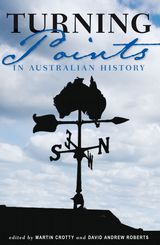
‘Turning Points in Australian History’ ed. Martin Crotty and David Andrew Roberts

turningpoints

2009, 254 p plus notes.

I would have loved to have been a fly on the wall for some of the concept discussions for this book, published by the University of New South Wales press.   It takes a similar format to a preceding volume by the same editors which looked at Great Mistakes of Australian history. I find myself wondering whether the editors themselves pitched the idea, or whether it sprang from a marketing initiative of UNSW Press.  For there is certainly an ambivalence about the whole endeavour as even the back cover  blurb indicates:

This exciting and stimulating book examines turning points and crucial moments in Australian history.  Rather than arguing that there have been forks on a pre-determined road, the book challenges us to think about other paths or better paths that might have led to different outcomes.  It shows that a decisive event often only becomes so only in retrospect and that what seemed like a major turning point at the time often had no real impact at all.

I’m not sure that the book is as conditional and ‘if only’ or ‘what if’ as the blurb suggests.  Instead, its chapters are structured as fairly straight narratives on a particular event with, except for two chapters (Chs. 1 and 13) , a specific month and year identified as the ‘turning point’.

1. 14000 BP. On Being Alone: The isolation of the Tasmanians by Iain Davidson and David Andrew Roberts

2. 26th January 1788: The Arrival of the First Fleet and the ‘Foundation of Australia’ by David Andrew Roberts

3. 19 June 1822: Creating ‘an Object of Real Terror’: The tabling of the first Bigge Report by Raymond Evans

4. 15 July 1851: Hargreaves Discovers Gold at Ophir: Australia’s ‘golden age’ by Keir Reeves

5. 16 August 1890: The Maritime Strike Begins: On upotia and ‘class war’ by Melissa Bellanta

6. 1 January 1901: Australia Federates, Australia Celebrates by Erin Ihde

7. 25 April 1915: Australian Troops Land at Gallipoli: Trial, trauma and the ‘birth of the nation’ by Martin Crotty

8. 10 June 1931: The Premiers’ Plan and the Great Depression: High politics and everyday life in an economic crisis by Erik Eklund

9. 27th December 1941: Prime Minister Curtin’s New Year Message: Australia ‘looks to America’ by David Day

10. 16 September 1956: ‘It’s here, at last!’ The introduction of television in Australia by Michelle Arrow

11. January 1961: The Release of the Pill: Contraceptive technology and the ‘sexual revolution’ by Frank Bongiorno

12. 27 May 1967: The 1967 Referendum: An uncertain consensus by Russell McGregor

13. 1970: When it Changed: The beginnings of women’s liberation in Australia by Susan Magarey

14. 26 January 1981 The Opening of the Australian Institute of Sport: The Government takes control of the national pastime by Brett Hutchins

15. I July 1983 Saving the Franklin River: The environment takes centre stage by Melissa Harper

16. 14 May 1986 Paul Keating’s ‘Banana Statement’ and the End of the ‘Golden Age’ by Ray Broomhill.

17. 26 August -11 September 2001: From Tampa to 9/11: Seventeen days that changed Australia by Robert Manne.

There’s some very familiar names amongst the historians here- they have been chosen well.  But in several of the chapters you sense a real ambivalence with the whole project.  The concept being written about often spills out of a chronological strait-jacket, and the selection of an arbitrary date obviously leaves several of the authors feeling quite uncomfortable.  More than one author questions whether it’s really a turning point at all, or whether the concept of a turning point is even valid or useful.   The editors themselves raise this question in the introduction, and in this radio segment about the book.

The chapters are fairly uniform in length, and while not formulaic, tend to follow a pattern of ‘what happened’ then some analysis of the aptness of the designation ‘turning point’ for the event in question.  With the exception perhaps, of Susan Magarey’s chapter, you don’t really get a sense of the distinctive writing style or methodology of the authors’ other work.  The frequent use of inverted commas (‘golden age’ ,’class war’, ‘sexual revolution’)  in many of the chapter titles reflects the rebuttal of popularly-received myths, images and understandings of the events described.

The particular selection of ‘turning points’ (or not) tells us just as much about 2009 as it does about the events under consideration.  I wonder if a similar book, written 50 years hence will feature the same events- I suspect not.  Many of the chapters discuss parallels between current events and the ‘turning point’, which of course adds to its appeal today and its quaintness tomorrow.

I find myself wondering who the intended audience is for this book- well, me for a start, I suppose.  The tenor of the book seems to have been written simultaneously to feed on, and yet resist, the ‘just stick to what happened’ continuous narrative genre that has become associated with John Howard’s attempt to rewrite the history curriculum for schools.  I enjoyed it in small grabs, a chapter here and a chapter there, much as I might read essays in a magazine.  I learnt things I didn’t know; I found myself curling a skeptical lip over the inclusion of some events at times (for example, on the Australian Institute of Sport chapter which, while making an interesting link with the Cold War, didn’t make a very convincing case for its inclusion as a ‘turning point’. ) It’s a bit like eavesdropping on an interesting conversation with informed, thinking people who have considered a phenomenon more deeply than you have, and are able to place an issue into a broader historical context.   The research is sound; the arguments are well-put but it is a book of its time, so read it now, while it’s still fresh!

‘David Collins’ by John Currey

sillsbendjan2009-036

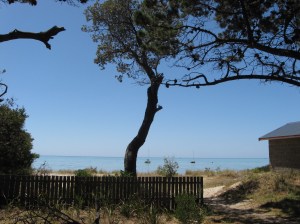
If my postings here have been a bit erratic lately, it’s because I’ve been going back and forth between home and my little caravan on the Mornington Peninsula.  It’s daggy and unsophisticated but as the sun sets over the bay, it’s a beautiful spot- here’s my view from outside the van, just up the track a bit.

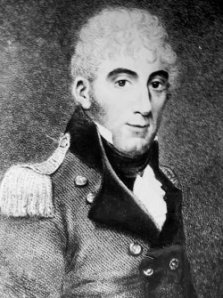
Being in such close proximity to the 1803 settlement at Sorrento has prompted me to read John Currey’s biography of David Collins– the leader of the aborted settlement of a consignment of convicts direct to Port Phillip.  By sending the fleet straight to Port Phillip from England, the Colonial Office intended to both quickly create a British presence and to alleviate the moral corruption of the constant inflow of convict blood into Sydney.  The settlement only stayed in Port Phillip for eight months until it shifted to Risdon Cove (Hobart) in two separate journeys separated by months.

The author, John Currey, describes himself in his preface as “an independent scholar without access to the services and resources normally associated with an academic environment”.  He has written and edited  a number of works of early Australian settlement.  The epigraph that commences his preface is an admonition from Andre Maurois’ Aspects of Biography (1929):

Every biographer should write on the first page of his manuscript: ‘Thou shalt not judge”.

He draws heavily on Collins’ letters to family and patrons, family papers and official correspondence, supplemented by newspaper comments and other peoples’ observations and comments on their relations with Collins.  Currey is scrupulous in his search and documentation, and almost succeeds in following Maurois’ advice.  But even he, at the end of the book raises questions that verge on the edge of judgement:

“Essentially conventional in so many ways, Collins was at the same time a complex and enigmatic man.  His written legacy, despite some tantalising revelations, offers few answers to the questions his life provokes.  How could a man so attentive to minute detail in his public duties be so negligent of his own financial affairs?  By what circuitous route did the man who aspired to ascend the pulpit come to find himself reviled as a lecherer and an adulterer?  Why did a mind so receptive and alive with curiosity become so dulled and inactive?  How could a man so blessed with so many natural charms fail to find enduring love and companionship? Did Collins himself, for all his introspection have any insight into his actions?  The exhumation of  [Collins coffin in ]1925 removed some of the mysteries surrounding Collins’s death.  It offered no explanation of the profound mysteries of his life.” (p. 308)

I find it frustrating when an author raises the very questions you want answered, but draws back from actually risking an answer to them.  Currey’s conception of his role as historian constrains him from venturing his own response, informed by his research, to these questions.  He should not be so cautious.  He has read the documentation: he has spent years with this man; he is qualified to venture a judgement.

In fact, I’d add a couple of other questions.  Why was he so unsuccessful in negotiating the patronage networks that all colonial civil servants had to manage?  How exceptional or commonplace was his relationship with the various convict women he had relationships with over his time in New South Wales?  What was the public response to these relationships?

collins

Inga Clendinnen in her Dancing with Strangers is less squeamish about speculating and judging David Collins as one of her informants.   After reading his published journal about his time with the First Fleet she characterizes its author as ” the Master of Plod” (ouch!).  She describes him as a man “susceptible” to liaisons with convict women.  She notes that Collins is

…a perfect representative of the moral and material economy of European culture.  It was these assumptions he brought to his analysis of the convict condition, and which he initially brought to the encounter with the very different culture and economy of the nomad people of Australia…. But as the slow years pass we watch David Collins ripen into an absorbed observer of native conduct, and a man capable of recognizing, indeed of honouring, a quite different way of being.” (p. 55, 56)

In reading this book, I found myself thinking of James Boyce’s Van Diemen’s Land which, like Clendinnen’s book, carves out a small what-if lacuna of time where the dispossession which certainly, inevitably and inexorably occurred was not yet deepened with violence and bloodshed. I found myself wondering if Collins’ insecurity and unsteadiness in his own authority did not hold the seeds of the 1803 failure in Port Phillip, thus averting an alternative history of Port Phillip as another convict outpost of New South Wales.  Boyce’s book about Van Diemen’s Land describes a benign environment: Collins saw it as hostile.  Boyce sees plenty and food sufficiency: Collins sees starvation and abandonment.

Although Currey doesn’t say so, the  David Collins I drew from his biography was a flawed man, who failed to achieve the hopes he had for himself.  He was impotent in using patronage to his ends; his career sputtered then died out; in an environment where many others prospered financially he ended up almost penniless;  he displayed poor judgement in relation to importing cattle from Bengal at huge expense; he failed to settle an area which just over thirty years later sprang into activity; despite his cheerful exhortations and assessments to some of his correspondents, his world view was essentially pessimistic.