Category Archives: Australian history

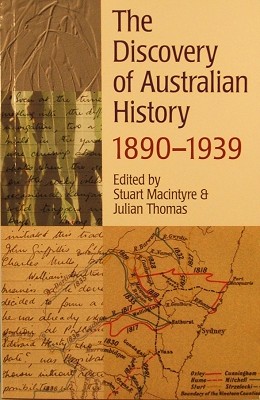
‘The Discovery of Australian History 1890-1939’ ed. Stuart Macintyre and Julian Thomas

1995, 191 p.

I borrowed this book from the library primarily for its chapter on S.H. Roberts,  the author of “The Squatting Age in Australia 1835-1847”.   Despite my intention to read only that chapter, comments on my post about that book and discussion here and here regarding what we would now call “political correctness” and historians led me to read the whole book.  I certainly do not profess any great knowledge here at all: I have read only this one book and a couple of other bits and pieces.

My gut-feeling was that the question of political correctness was anachronistic( i.e.  relating a phenomenon to the wrong time), and having read this book, I found nothing to disconfirm that view.  The book, edited by Stuart Macintyre and Julian Thomas (both of whom contributed a chapter) is a series of biographical sketches of key figures of the first and second generations of academic historians.  The focus is not so much on biography, but on the “profession and discipline” of history, both personally and as a field of intellectual endeavour.  Because of its time-span, the “sandstone” universities only are represented: George Arnold Wood and Stephen Roberts at Sydney; A.V.C. Melbourne at Queensland; G. C. Henderson and Keith Hancock at the University of Adelaide;  Edward Shann at the University of Western Australia;  Ernest Scott, Jessie Webb, Kathleen Fitzpatrick and Max Crawford at the University of Melbourne..

It is sobering to remember that until the 1890s, there were only three universities- Sydney, Melbourne and Adelaide.  At the University of Sydney prior to Wood’s appointment, history was included under the umbrella of natural history, or part of the classics. The University of Adelaide offered a chair of modern history and English language and literature. History had long been taught at the University of Melbourne, closely associated with political economy, law and the classics but the early holders of the chair were not recognizable as academic, research-based historians.  For many decades, there would only be the one professor at the single university in each state, with one or possibly two assistants and he – always ‘he’- would lecture across all history subjects presented. (A post on the women in this book will have to wait for another day).

The selection of any one professor was often not in the hands of the university at all- the University of Melbourne for example, delegated an English selection committee, based in England, to make the appointment.   Universities resisted what they perceived as government interference: at Melbourne, the chair had included history and political economy, but the second field was dropped in expectation of State government funding for a separate chair of economics or political science.  This funding did not eventuate because the university would not agree to the government’s stipulation that the new post be filled by one ‘whose views and training accord with Australian traditions and conceptions of economic matters’. (p. 72).  In their selection practices, and the talent pool to which they looked, Australian universities were integrated into an Imperial network.  Without exception, these academics gained their post-graduate qualifications  in England- predominantly at Oxford, with one or two in London.

And  to the extent that these Australian historians were involved in politics at all, it was generally at a British Commonwealth level through various Commonwealth bodies and sub-committees. They also contributed to ABC broadcasts as public intellectuals.  Two economic historians, however, played policy roles within government. Shann was very much involved in a sub-committee of the Australian Loan Council during the 1930s and later on a committee investigating unemployment under the Lyons Government- an involvement that he was later criticized for.  A.V.C. Melbourne was heavily involved in imperial trade policy.  As far as “political correctness” is concerned, George Arnold Wood seemed to have been affected most by it: after criticizing the British government for taking military action against the Boers, he was given only one lectureship up to 1916 and he felt that the university was unjust to him. Nonetheless, his appointment spanned 1891-1928.  The blurb on the back of the book writes that:

The path was not an easy one. The times and the institutions were conservative, resistant to change and new direction.

Institutional conservatism is clearly apparent but political conservatism less so. Certainly many of these historians had deep-seated political beliefs (Shann, for example was a Fabian; several of them embraced Liberalism) and publicly participated in the elite and  intellectual milieu of their societies. The chapters in this book do not pay much attention to the content of the histories produced by these historians, but there seems to be no suggestion that they tempered the narrative of the histories they wrote for the political government of the day.

The history discipline itself, across the world, underwent a huge change during these years as it shifted away from an antiquarian and chronicling emphasis to adopt von Ranke’s emphasis on primary sources.  Here there was fertile ground.  It was these historians who were involved, with others, in the compilation of the grunt-work of Australian historiography- the Australian Dictionary of Biography (Keith Hancock) and supporting,  the compilation of Historical Records of Australia (Wood and Henderson, among others; Scott was involved in writing a rather critical report on the project). It’s hard now to imagine that these sources were ever not available, but Henderson wrangled for five years with the Secretary of State for the Colonies, with the support of successive South Australian governors, over access to government dispatches, enclosures and reports relating to South Australia. The Secretary of State refused to give general access to records beyond 1837, although was willing to consider special cases for records up to 1860 and perhaps beyond (p. 39). When you look at the index, there is reference throughout the book to the  Australian and New Zealand Association for the Advancement of Science, the major professional body to which these academic historians belonged.

In the introduction Macintyre and Thomas note that the essays in their book

resist the temptation to chart a clear line of historiographical progress, whether in the form of an evolution from literature to science, or in the emergence of Australia as the subject of narrative or analysis, or the growing prestige and sophistication of the university. (p. 7)

I felt as if there was a qualitative difference between the chapter on Max Crawford, and the other chapters- as if there was a fundamental shift that occurred at the end of the timeline of this book.  The Cold War was no doubt largely responsible for this, as well as the ushering in of a more mass-oriented tertiary education system. I’ve just been looking, through Google Books, at the introduction and conclusion to Fay Anderson’s book  “An historian’s life: Max Crawford and the politics of academic freedom” . In her conclusion, she observes that selection committees considered the political affiliations of candidates for academic posts from the 1930s (p. 372) and suggests that the study of self-censorship among historians would be a fruitful area for research.

Certainly, I felt in reading these essays that they described a different world, a different intellectual milieu.  The huge expansion of university education in the post-war years brought a whole new environment with more students, a broader pool of historians vying for academic posts, a more defined set of local academic peers, and less integration with the imperial academic network.   All of this is much more familiar to us now, more conducive to intellectual jousts over the content of one’s history and I suspect, more responsive to party-political pressures than this earlier, elitist and empire-driven era.
Letters of a Nation Archive

Want to spend hours and hours and hours fiddling round on a website? [ahem, as if I don’t already]. Well, you might want to check out Australia Post’s “Letters of a Nation” website.  The project was part of Australia Post’s 200th anniversary.  They invited contributors to send in letters held in their personal collections which were scanned, indexed and transcribed and are all there on the website.

In fact I even had a little weep over the letters sent by the POW returning to Australia to his four year old son.

Fantastic!

https://200years.auspost.com.au/#/bicentenary/loan

The morning after the night before: Anniversary Day 1841

So how was your Australia Day?  From the coverage of Melbourne (Port Phillip)’s Australia Day celebrations, it seems to have been a street parade with different multicultural groups represented, citizenship ceremonies, flags at the Australian Open tennis tournament and Lily Allen in a flag dress at the Big Day Out.

From The Australian, 28TH JANUARY 1841

And as for Sydney in 1841?  There was a long report about the yacht regattas on the Harbour, mention of a cricket match and the dinner that followed it where

Turtle, venison and the other good things of this life were in abundance, conjointly with sparkling champagne &c.; and a more loyal set never yet met at the festive board.  The Queen’s health was drunk with enthusiasm, and Australia, the land of their adoption, was honored with reiterated cheers.  These jovial souls kept up the joyous scene to a late hour, and returned to their homes delighted with their evening’s meeting.  May they meet on many such occasions, is our hearty wish.

then the Harmonic Club who presented a prize to the winner of the sixth race.

There’s then a report about the town itself:

…It was expected that the festivities in celebration of the natal day of the colony would have been concluded with a general illumination throughout the town; but, the the great disappointment of the good folk of Sydney, the streets were all in darkness with the exception of the houses of Mr Diod [?] of Pitt Street who displayed in beautifully variegated lamps, a star, with the age of the colony (53) underneath, supported by the letters A. A. on either side; and of Mr Ward of Bridge-street, who exhibited the Scottish Thistle and the letters V. R. which had a beautiful and dazzling effect, and drew a large concourse of admiring spectators.  Both these decorations were executed by Messrs Wood, of King-street, who have long been known to the Australian public as the most celebrated “illuminati” of the age.  Mr Aldis, the tobacconist had a few lamps in his window; and Mr Carrick, the publican of Bridge-street sported a few tallow candles in the same manner, both of these, however, only sufficed to make the “darkness visible”.

I must confess myself mystified by these “illuminations”- perhaps one of my readers might illuminate me!  From the Sydney Gazette of May 27 1841 it seems that gas was not supplied to Sydney until 1841, although as editorials at the time pointed out, this was a mere 25 years after gas lights were introduced for general use in London.

Many reports of celebrations mention “illuminations” but I’m not sure how they worked.  I see advertisements for “illumination lamps” and “transparencies” and on 21 April 1829 T. Wood the Lamp Contractor advertised that “Persons desirous of illuminating on His Majesty’s Birth Night are requested to make an early application to T. Wood, Lamp Contractor, George-Street who will provide Lamps and Devices at moderate charge” .  Inclement weather tended to extinguish the illuminations. The Colonial Times (Hobart)  of 26 Aug 1834 reports on an illumination at Government House that cost three hundred pounds but could not go ahead for two nights because the wind was too strong, and when the lamps were finally lit, the view was obscured by large ugly pine trees.   There is a long description of the Queens Birthday illuminations on 25 May 1839 (i.e. two years before the Anniversary Day illuminations mentioned above and two years before the introduction of gas):

In the evening the customary birth night ball was given at Government House, and, notwithstanding the unpromising state of the atmosphere, it was very numerously attended. The entrance to Government House was brilliantly illuminated, the gate being surmounted with the word ” Victoria,” in very large letters, and the verandah with a large crown and wreath. In various parts of the town the inhabitants displayed their loyalty in the shape of illumination. The following principally attracted our reporter’s attention : -Australian Club House. – The words ” Vivat Regina.” in large letters, surmounted by a large crown, and star with festoons &c. Mr. James Wood, opposite the cattle market, wine merchant, Crown and V. ; Anchor and Hope (Doran) public house, corner of King and Pitt streets, neat variegated star ; Shakespeare Tavern (Rogers) Pitt-street, letters Q. V. with Shakspeare’s head illuminated. Cornwallis Frigate, (Meredith) Pitt street, the letters V. R. surmounted with large crown and star, a truelover’s knot &c. King’s Arms (Stone) Pitt-street,.Star and Garter with letters V.R.,rows of variegated lamps &c. Garriek’s Head (Murray) Pitt-street, letters V. R. surmounted by Crown. Australian Chop House Pitt street, letters V.R.  and Crown, festoons &c &c ; Mr. Dole, Tobacconist, George-street, opposite Police Office, letters V.R.; Mr. Martin, Castlereagh-street, (publican) near Cattle Market, star; Forbes Hotel (Mrs Barnes) King and York-stree, letters V. R. with handsome crown, festoons of variegated lamps, suspended round the windows. William the Fourth (Morris) Pitt street-, illuminated transparency of Queen Victoria. Mr. Denne, Pitt-street, Brunswick Star. M. Gill confectioner V.R.. and Crown Pitt-street. Crooked Billet (Puzey) George and Hunter-streets, V. R. and Crown. Mr. Samuels V. R. and Crown, George-street.

The devices most attractive to the spectators were a very neatly executed transparency of the noted “Jim Crow” exhibited above the door of the Flower Pot, public house, York-street, and a handsome transparency in Pitt-street, in front of the residence of Mr. Gould, painter and glazier, representing Queen Victoria, with a rampant lion, having  the motto Invicta on the one hand, and  the Royal Arms on the other, each occupying a window.-Two fire balloons were sent up in the course of the evening.

Here we see expressions of loyalty amongst the working people of Sydney, in their pubs and businesses- and quite a collection it is- with many V.R.s and crowns, Shakespeare’s head, lovers knots and a “Jim Crow”.

Anyway, enough of the mysterious illuminations- back to Anniversary Day in 1841 from The Australian.

A number of Australians dined together on Tuesday at the St. John’s Tavern, to celebrate the Anniversary of their Native Land.  There were about fifty present; the dinner was sumptuous in the extreme, and after the cloth was removed, several loyal and patriotic toasts were proposed, which were responded to by the warmest enthusiasm.  During the evening some very eloquent speeches were made, which reflected much to the credit upon the heard and head of the speakers, breathing as they did, a true loyal feeling for their Sovereign, and a love for their Father Land.  The harmony of the evening was enlivened by some very pleasing music.  They kept up the festivities of the day until a late hour, and departed with a feeling of mutual reverence to the Parent Country, and love for Australia and her institutions.

I find it interesting that there is a distinction drawn between the “good folk” of Sydney and the “Australians” who no doubt are the native-born.   Australia is their “Father Land”, but Britain is the “Parent Country”.   The term “the anniversary of their Native Land” (meaning of course only fifty-three years!)  grates harshly on our 21st century ears.

References:

The wonderful National Library of Australia Newspapers page of course!

Australia Day editorials

One of the set pieces in the editor’s armoury must be the Australia Day editorial which needs to be dusted off each January and polished around the edges a bit to distinguish it from the editorial the year before, and the year before that.

I was interested to compare the editorials of The Australian newspaper in 1841 and today.  The Australian as we know it today was founded in 1964 and is part of the Murdoch empire.  It’s not a paper that I read regularly, except for the Australian Literary Review which is issued on the first Wednesday of every month, and even there the paper’s centre-right stance seeps through. It shares the name but not the lineage of the Australian newspaper founded by William Charles Wentworth as New South Wales’ first privately-owned newspaper in 1824.  Wentworth’s Australian newspaper in 1841 acted as a mouth-piece for Wentworth’s own politics at the time where he was agitating for representative government and independence from the twin and paradoxical evils of Colonial Office oversight and neglect.  It published its last edition in 1848.

The Australian 2010

So, The Australian’s editorial of 25th January 2010 on the eve of Australia Day-  what did it have to say? Well, there’s plenty to celebrate apparently:

Australia Day marks the real start of the year in this country: once tomorrow’s holiday is out of the way, the nation gets down to the serious business of work and school after the summer break. This year, the celebratory mood is likely to linger longer thanks to the upswing in the economy and a growing confidence in the future after a year of living anxiously in the shadow of a global downturn.  The year begins with real hope that economic stability and strength will nurture the social coherence and health that must be the core goal of any modern society.

The paper notes the financial emphasis of Rudd’s speeches over the last week leading up to Australia Day (productivity, deficits, infrastructure blah, blah, blah) but then warns us:

There’s more to life of course, and the Australia Day celebrations draw attention to the less tangible questions of community, social tolerance, and national identity…But our national holiday becomes an empty affair if we ignore the real challenges facing many of us.

The editorial then goes on to speak about “Twenty-two years ago, at the Bicentennial celebrations on Australia Day” when “the nation was trapped in a painful historical debate that denied the real issues facing indigenous people, particularly those in remote areas.  The often fruitless arguments over whether the country had been invaded or settled 200 years earlier served to polarise rather than educate white and black Australians over their shared history.”

I find it interesting that the touchstone date in this editorial (and in commentary generally)  is now 1988 rather than 1788.  In the last twenty-two years, the editorial says, we have ” come a long way in recognising the rights of indigenous Australians to decent housing, education and jobs” and “there is room for optimism…”.  Twenty-two years ago the population was 16.6 million; now it is 22 million and projected to be 35 million mid-century and The Australian is “excited by the potential for vibrant social and economic growth” although cautioning of the need for clear plans.  “The integration of more ethically diverse Australians must be carefully guarded” and “racism has no role in Australia which, since the abolition of the White Australia Policy in the mid-1970s, has built an enviable reputation as a tolerant and welcoming nation”.

Australia Day- marked by citizenship ceremonies around the nation- is a perfect time to affirm belief in a mature and single society that also accomodates difference.

The paper notes the affection for Prince William at his recent (fleeting) visit and the respect for his grandmother, but asserts that “those feelings would seem to have little or nothing to do with Australians’ support for a republic”.

The Australian 1841

Why 1841? Because Judge Willis was still in Sydney in January 1841, although it was well-known that he had been appointed to Melbourne and his house, horses and phaeton were being advertised in the newspaper.  In a few days, he would make his farewell speech from the bench- in itself a matter for controversy as might be expected.  But given that Anniversary Day celebrations were most conspicuously celebrated in Sydney compared to the other colonies, it seems fitting to look at Judge Willis’ last Anniversary Day in Sydney.

The editorial of 26th January 1841 (published on the actual day) starts off with a blaze of optimism:

On this 26th of January 1841, the Colony of New South Wales commences the fifty-third year of its existence.  What striking and gratifying recollections does the reoccurrence of this, our natal day, recall to our mind? Where, in the whole range of ancient and modern history, can an instance be found of a similarly rapid advance towards wealth, importance, and respectability, under circumstances so singularly discouraging, under the pressure of obstacles of such peculiar magnitude?

The Australian was very much Wentworth’s creation, and the next very lengthy sentence goes on to criticize the Colonial Office, and the influence of the South Australian lobbyists, with their Wakefieldian agricultural-based ideas, who were pushing an alternative to the squatter-based, pastoral future that Wentworth was agitating for:

Labouring under all the odium which has naturally attached itself to a penal colony, systematically disdained and neglected by the Colonial Office, the only quarter to which we have been enabled, and indeed are still able to look for assistance and sympathy, with out financial resources misapplied, our most earnest prayers for free institutions disregarded, autocratically governed at the caprice now of this, now of that minister, with enemies avowed, and enemies concealed, handed over with indifference within the last twelve months to the tender mercies of Colonel Torrens and the Land Board…

This gargantuan sentence continues with a look to the past, going back fifty, even twenty years to the penal origins of New South Wales.  As with the editorial of 2010, there’s an element of bringing observations within the scope of living memory.  The bleak environmental picture painted here sits at odds with the more benign environment portrayed in Grace Karsken’s recent book The Colony, and the reference to Aborigines is very much of its time:

we yet can exhibit, where half a century, nay twenty years since, gangs of lawless convicts laboured upon a limited and uncleared desert, where the hallowed names of religion and justice were unknown, where the wandering savage, lowest in the scale of humanity, and the wretched English criminal, scarce gained a scanty subsistence from an ungrateful soil, where unblest sons poured their angry luster upon the thirsty sand

Now the observant eye of Englishmen beholds:

far-stretching districts, hundreds of miles in extent, covered with flocks and herds, teeming with convertible wealth, the fertile banks of numerous rivers producing abundant supplies of agricultural produce…

and a maritime industry that is “sending home annually in the place of hundreds, no less than eight millions of pounds of wool…verging upon the annual value of a million of money…” and “importing British manufactured produce to the amount of twice this sum.”  It seems a little incongruous to us now to think with pride on the amount we import (as distinct from export), but in 1841 it was a matter of pride that New South Wales was now a sophisticated and modern consumer society, proud of its place within the broader imperial marketplace.

But the life of an upstanding member of society has its responsibilities as well and so,

We trust that our readers will permit us to remind them without offence that the joy and the festivity with which they so pleasingly celebrate this birthday of their country, should be tempered with reflections of a higher and a somewhat more thoughtful nature.  These they are bound to entertain for their own sake, for the sake of those who come after them, for the sake of vindicating for themselves that high and leading position in this hemisphere, which it is in the order of things that they must, and that at no distant day attain. We would urge upon all, whatever may be their condition in life, to give their individual efforts for upholding and still further exalting the standard of integrity and of morals in our social community.

In particular, the Australian deplored “with reluctance and with grief” that “an avowed selfishness, the bane of all young communities, is to a very large and engrossing extent, prevalent throughout this country”. The editorial called upon

everyone who occupies a position which gives him influence over his fellow-colonists, to promote these views fearlessly and cordially, if he has any true or forward-looking desire for the welfare of his native or adopted country.

Note that this was leading by example, and a call to the leaders of society rather than to “the people” as a whole.  The political winds were stirring, but nobody was agitating for democracy as we know it today- and would even less so in coming years with the rise of Chartism and the 1848 revolutions to follow.

…if you do your duty at this now early hour of the political day, when the seed can be sown and the tree of virtue planted, you will indeed be “remembered for good”, for upon a nation such as by your wise efforts may be constituted, one in honour, one in high and unswerving principle, one in their passionate love of liberty, one in their disdain of everything that is mean, and sordid, and cowardly, it is not too much to say, that the feet of tyranny, foreign or domestic, shall NEVER trample.

The Australian was confident that representative democracy- limited though it was- would be just around the corner but we know that the drip-feed of a form of self-government would take over a decade.

The eyes of Britain are more and more intently fixed upon you.  The importance of this Colony is being rapidly appreciated at home.  Representative institutions of on the eve of concession to us.  May we so wisely and temperately use them, as to convince our worst enemies that we are worthy of the boon granted.

And now for the important thing- what’s on? Sydney always put on a bigger bash for Anniversary Day than the other colonies did, so here’s what’s happening:

And now, with reference to the sports of this day- His Excellency will be present at Macquarie Point with a numerous party.  We perceive that many excellent boats, several of them newly built for the occasion, will contend for the prizes.  All the available steamers will ply about the harbour during the day with bands of music, to enliven the scene.  The shipping will hoist their colours and be decorated with all their flags.  In the evening Mr Wyatt will present, at the Theatre, the owner of the successful vessel with a silver cup of the value of thirty pounds; and a numerous party of Australians will dine together at the St John’s Tavern, to celebrate the auspicious occasion.  In fact, nothing will be wanting but the sun to shine brightly to complete the happiness of our towns men.  We hope that no accidents may occur to damp the festivities of the day.

I’ll let you know how the day went off, tomorrow.

Enjoying an Australia Day holiday

The Age tells us that a record half a million Australians “chucked a sickie” today in order to have a four-day long weekend.  I know several people who took today as a leave day but that’s not necessarily a “sickie” in my book.   Of course there’s lots of  tut-tutting by employers, designating such enterprising workers as “un-Australian bums”  with “no concept of mateship or the Australian way”.

They should spare a thought for the Tradesmen of Sydney, who were asking the editor of the Sydney Herald to grant a holiday on Anniversary Day (now Australia Day) when it fell on a Tuesday in 1841- let alone angling for a long weekend!

HOLIDAY ON THE 26th.

To the Editor of the Sydney Herald.

Sir,- As next Tuesday is the Fifty-third Anniversary of the Colony, and will be kept a holiday by some, you would confer a great favour on many, if you would give the Tradesmen of   Sydney, particularly the Chemists and Druggists a gentle hint in your widely circulated Paper to close their shops on that day, and to allow their so much confined assistants and apprentices a   little recreation. I am Sir, for many,

Your’s very respectfully

A CONSTANT READER.

Saturday morning, Jan. 23 1841

From NLA Australian Newspapers

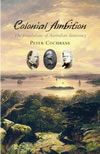
‘Colonial Ambition’ by Peter Cochrane

2006, 511 p & notes.

As you might expect, I am fascinated by the 1830s and 1840s in Australia- that time when the penal colonies were emerging into something different-( but what? ) and new colonies driven by a mixture of philosophy, moral entrepreneurship,  political theory and capitalism were being brought into being- (and would it work? ).  But try as I might, I find it hard to get energized by the crown land acts and constitutional legislation.  Perhaps it’s those years in school going on about squatters, selectors, dummying and peacocking;  and all those men in top-hats and Legislative Councils and Legislative Assemblies.  The lived politics of the time only really came to life for me with Margaret Kiddle‘s Men of Yesterday (of which more anon, I think) which brought people back into the situation- and this is what Peter Cochrane has done in this book too.

In one of the blurbs on the back, John Hirst wrote that

This is not the usual political history; it’s more wide-ranging, more vivid, more alive with people, places and talk.

At first I thought this a rather prosaic endorsement, but having finished the book, Hirst is spot-on.  There are people here- strongly drawn, complex, real people who change over time, whose public life is interwoven with their private concerns and anxieties.  And what a cast:  the strange-looking, brilliant, waspish Robert Lowe; the wealthy, bombastic, driven Wentworth, stung by  social exclusion on the grounds of convict origin ;  the versatile, enthusiastic, financially-straitened toyshop owner Henry Parkes.   And there are places: the action is located onto the Sydney city map  in theatres, parade grounds, street corners and houses.  The sense of place is perhaps not quite as strong as in Grace Karsken’s The Colony, but it’s reminiscent, say, of Jeff and Jill Sparrow’s work on Radical Melbourne.  It’s a politics that spills out of Governors’ offices and Legislative Council chambers onto the streets and newsprint, placards and petitions. And talk- yes, there’s lots of talk as well in the bubbling cauldron of the newspaper editorial and the forceful oratory of the public address.

What comes over strongly in this book is the dilemma of liberal politics at this time.   “Democracy” at this time- and especially during the politically turbulent mid-1840s-  was a concept that dared not speak its name. Both liberals and conservatives drew on the trope of Britishness, and ancient British traditions and loyalties.  For the liberals in particular,  responsible government was a poisoned chalice if it was a means by which the existing elites could cement their political position indefinitely.  For conservatives, long-standing demands like a nominated upper house and lifetime nominations became just as toxic when it was a liberal government in ascendancy, cementing its own position indefinitely.  To draw on cliches: you leave the book aware that, somehow or other, a fork in the road had been negotiated and that there was an alternative road that had not been travelled.

The book weaves local and imperial politics together well.  The regular churning of Secretaries of State at the Colonial Office was matched by the instability of the early ministries in the years immediately following responsible government in Australia.  Cochrane alerts us to the wider political debates and issues that the Colonial Office was dealing with at the same time: the Durham Report in Canada and the gradual implementation of its recommendations; the political trickiness for the British Government of the Crimean War; the empire-wide horror at the Indian Mutiny.  In the speeches quoted from radicals, liberals and conservatives alike, we see orators cherry-picking from historical analogy, particularly drawing on the American War of Independence and Canadian history for examples.

The book captures change well.  An idea that might be greeted with horror in one decade is not so unthinkable in the next.  The empire changes: local politics change: people change.   Cochrane illustrates that all sides of politics needed to learn how to “do” politics: governors needed to learn how to withdraw; liberal politicians like Cowper needed to learn how to make space for negotiation;  conservative politics like Henry Parker needed to learn how to bring his own colleagues along with him.   Liberals, conservatives and governors alike had to learn how to handle the politics occurring “out of doors” in meetings and street protests; how to project decisiveness and yet temper it with a degree of responsiveness.

I learned a great deal from Cochrane’s intermeshing of personality, place and politics- and it’s something that I’d like to emulate in my own work.  The book was written for the Sesquicentenary of Responsible Government in New South Wales (hence the focus on Sydney) and could have suffered from a eye-glazing sense of  “worthiness” and hat-doffing to a small readership.  Instead, it won the inaugural Prime Minister’s Prize for History in 2007, along with Les Carlyon’s The Great War.    At over 500 pages, Colonial Ambition is a long book but it moved quickly.  It is a very human book, and this focus on personality, flaws, ambitions and emotions was well-sustained and only on rare occasions struck me as being perhaps a little too fervent in places.  The ending, while emotionally satisfying and well-crafted in terms of the structure of the book, was rather too  rounded-off for my taste, and is perhaps my main qualm about the book. Nonetheless, as throughout the book,  his final paragraphs returned us to a person, to encapsulate the long constitutional journey we had been on.

But I don’t want to end on such a snarky note.   Cochrane has opened my eyes to a different sort of writing, and he has breathed life into a topic that could be otherwise dry and unappealing.  It’s a damned good read.

‘The Commandant’ by Jessica Anderson

This book has been recently re-released as part of Sydney University Press’ Australian Classics Library.   The original was published in 1975 and there are still copies of the original imprint around: mine has a particularly lurid cover that would deter any casual browser.

The penal colonies at Sydney and Van Diemen’s Land have long attracted novelists- Thomas Keneally has been writing about them for decades and Kate Grenville has been lured by them more recently.  But there were other penal outposts in the Australian colonies as well: Norfolk Island, Moreton Bay in Queensland, Western Australia after 1850 and even Port Phillip, while not a penal colony as such, had convict gangs engaged on public works and the Pentonvillians in the second half of the 1840s.

“The Commandant” is set in Moreton Bay under the command of Patrick Logan.   The setting of the book is fairly accurate:  Logan did exist; his wife was called Lettie; he did come to a sticky and inconclusive end.  But the main character of the book, Frances O’Beirne, is Jessica Anderson’s invention entirely and here Anderson can let her imagination take flight.  This is a penal colony described from the domestic perspective, with the convicts not as “the men out there” but as shadowy but ever-present domestic servants.  Here we can see the blurring of the lines that John Hirst writes so well about in Convict Society and its Enemies with assigned convicts occupying that here-but-not-here space of the English domestic servant whose intimate presence gave them such an ambiguous status.

This is a very ‘interior’ novel in that much of it takes place inside, and much of the text is turned over to dialogue.  It is almost Austenesque in this regard, and I found it a little noisy and claustrophobic.  For me, the novel really opened up once it got outside into the Australian landscape- until this point it could have been set anywhere.

Frances O’Beirne is a recent arrival in the colonies and after a short time in Sydney, she travels up to join her sister Lettie who is married to Capt Logan. While in Sydney she comes into contact with the daughters of Edward Smith Hall, the editor of the Monitor and the (real life) opponent of Governor Darling.  She absorbs the ‘radical’ views circulating in Sydney, and is wary of her brother-in-law Logan, who is about to fight a libel case against the Sydney newspapers over reports of his excessive cruelty.  She is uneasy about the convict presence, and appalled by her brother-in-law’s discipline.

In an interview about the writing of The Commandant in “Making Stories” by Kate Grenville and Sue Woolfe (generous extracts available here), Anderson talks in an interview about the character of Frances

INT: Did you consciously seek a character to, as you say, ‘identify with’ or did the character come to you?

JA: Well I came to myself.  But I had to have someone who could see and comment on the action. But not just one person, and not just one point of view.  So I had Frances, Louisa and Letty.  Particularly Frances, although the other points of view are both well within my own range.  My daughter said it was quite easy to see who I was. But she saw me as Louisa.

INT: Is Frances really, in fact, a twentieth century character?

JA: There were people like Frances, radicals and reformers , in Sydney. There was nobody like her at Moreton Bay.  But I couldn’t have done it without her.  I needed an opponent for Logan.

Despite Anderson’s protestations, I’m not really sure that Frances isn’t a 20th century character. I don’t think that Anderson caught the religious aspects of a humanitarian anti-transporation stance, complete with its racism, class bias and cast iron certainties. Instead Frances’ opposition to the penal system is a bit too secular and Amnesty International.

Anderson’s real stroke of brilliance is in explaining Logan’s death- which, again, is historic fact. But her explanation which runs against the popular story about how he died is, unfortunately,  plausible and we can see with 20th century eyes what the implications of such an explanation could/did set in train.

I enjoyed this book and I’m glad that it has a second outing.  I think that it stacks up well against Keneally’s convict works like The Playmaker and Bring Larks and Heroes and Grenville’s The Secret River and The Lieutenant (which I haven’t read yet).  It isn’t as imaginatively extravagant as Flanagan’s brilliant Gould’s Book of Fish, but her twist on the narrative and history is inventive and deserves to be better known.

‘The Colony’ by Grace Karskens

karskens

2009, 549p plus notes

This is an absolutely beautiful book.

Physically, it is a thing of beauty.  It is hard cover, brimming with photographs and drawings (some glossy museum pictures juxtaposed with current photographs that the author has taken herself), with thick, luxuriant white pages.   And beautiful it should be, I suppose, supported as it is by the City of Sydney, the Australia Council, the Australian Academy of Humanities and the State Library of NSW.  In fact at first I thought it was a coffee table book to accompany a series (there was an SBS series of that name) but it’s not.  It’s a history (with the humility to designate itself a history rather than the history) fair and square, without apologies.

Karskens nails her colours to the mast: she is writing as an historian, and participating in a historical conversation with other historians:

This book has its roots deep in a great mountain of existing research, thinking and histories.  Historians work collectively, within a wider community of scholars.  So history writing is less an individualist pursuit than a collective quest, and an ongoing process.  This is one reason references are so important: they rightly acknowledge the work of past scholars, as well as guiding future readers and scholars into the literature.  In the notes and bibliography of this book you will find, besides original manuscripts and archival records, maps and pictures, an extraordinary and diverse body of scholarship about early Sydney, works mainly by historians, but also archaeologists, economists, anthropologists, art and architectual historians, ecologists, geologists, museuologists, geographers, biographers and local and community historians.  (p. xii)

She is true to her word.  There’s a heavy debt to Inga Clendinnen here, not only in content but in writing style, and likewise to Alan Atkinson– two historians I deeply admire whose writing turns an event around and looks at it from different angles, giving us the gift of coming to the familiar with new eyes.   There’s also a connection with James Boyce whose recent book Van Diemen’s Land is almost a pigeon-pair with this book in its re-visioning of the penal colony as a new environment with new opportunities.  Unlike Robert Hughes’ The Fatal Shore, this book joins other histories- John Hirst’s work springs to mind-  written with  a determination to look beyond Hughes’ gulag and horror: it looks to the agency, optimismism and opportunism of ordinary people in a new environment instead of just the dregs of the old world.

The history itself is a thing of beauty too.  It breaks free of many straitjackets: more than perhaps any other history of Australia that I have read it interweaves Aboriginal history, archaeology, women and environmental history throughout the book.  Not content with the almost obligatory “before” chapter dealing and then dispensing with “the aborigines”, she asserts that Sydney remained an Eora town- that Eora people continued to live within Sydney on their own terms, with their own geography and in resistance to christianizing impulses, into the 1830s and 40s. Indeed, they have never left.

The environmental theme carries throughout the book as well.  She starts in deep time and emphasizes the connection between landscape and food supply not just along the coastal regions, but inland along the rivers and ravines.  Unlike other histories which are drawn to the inland and the importance of crossing mountains and going towards the centre, she turns back towards the sea, just as the early Sydney people did.  She reminds us that Sydney had three beginnings: the abandoned Botany Bay settlement;  Port Jackson (truly a ‘port’ city where early convicts settled into the Rocks with their own raucous, uninhibited subculture), and then the third, more ordered attempt to start again in Parramatta by imposing conformity onto the layout.  She reminds us that once settlers spilled onto the Cumberland Plain, confronted by different tribes, the same battles had to be fought anew with new opponents.   The Europeans of early Sydney were not the industrialized huddled-masses; they were pre-modern people bringing with them the patterns of village tradition and the pre-industrial paradox of deference combined with the English moral economy.  At the same time, though, they were a consumer society, tied into the broader imperial economy by virtue of the port which serviced and was served by British trade routes and markets.

In Karsken’s book Macquarie is not the benign “Father of Australia”.  Instead she depicts both Lachlan and Elizabeth Macquarie as landscape artists, imposing their improving architectural vision onto Sydney, obliterating the emergent, spontaenous eruption of the workers’  lifestyle and culture by appropriating public space for the ‘respectable’ in mimicry of  a modern European urban landscape.

Nor, despite her obvious respect,  does she let Clendinnen’s romantic vision of dancing strangers blind us to the violence that was the first response and default position.  She is not so enamoured of Watkin Tench that she sees his expedition under Phillip’s orders as a face-saving farce, as Clendinnen argues.

In her review of the book  Cassandra Pybus chided Karskens for following the well-worn and well-mined biographies of  governors, scribbling military officers, Macquarie, Ruse and a few high-profile convicts.  I’m not sure that this is fair: the book is studded with small stories that move into the spotlight then fall back to the wings- not grand narratives to be sure, but small solo items that illuminate and make larger arguments human before moving on.  There is the grand design of official planning and policy, but she emphasizes that there was a complementary,unofficial, spontaneous counter-reality that emerged from the myriad small stories and small lives of ordinary people.

Some quibbles?  Karskens had succeeded so admirably in integrating an aboriginal worldview and interaction throughout the book, but two lengthy chapters at the close of the book focus on black/white relations in the Cumberland region.  Given that she was already handling this so naturally and unselfconsciously these two chapters deflected the book into another direction.  They are both long chapters.  Up to this point, there had been such elegance in the writing, at both structural and sentence level, but the conclusion of the book is  weighted unevenly and the work as a whole loses its symmetry.

The book is richly illustrated, so much so that I was surprised to find colour plates half-way through.  I had assumed that it was black and white only, and there was no reference in the text (e.g. Plate 3) to prompt the reader to search for them.  I felt almost cheated to find them later.  Likewise, maps would have reinforced her argument about the importance of waterways and coast and the pattern of the spread of settlement.

Ah, but these are just quibbles.  This is an insightful, intelligent, deeply human history with immaculate scholarship.   In his review published in The Monthly, Alan Atkinson wrote that the book  “propels Karskens straight to the first rank of Australian historians”- high praise indeed.  It’s certainly had me engrossed for about the last three weeks (hence the paucity of other book reviews recently), and you know- I think I’ll read it again one day.

‘Fatal Necessity: British Intervention in New Zealand 1830-1847’ by Peter Adams

waitangi

When considering early Australian and New Zealand history, you have to keep your bifocals on. Isolated ‘down here’,  ten thousand miles from ‘home’, with at the least a six month round trip for any official communication,  it’s possible to view events and people through a local lens with a type of nonchalance about pronouncements and edicts that arrived from the other side of the world.   But taking a broader view, the network of relationships and communications between the colonies themselves and the Colonial Office formed another type of reality- not as immediate perhaps, but imbued with the finality of ultimate veto.  But both local and distant views have the illusion of solidity: neither is as straightforward as it appears.

The “Fatal Necessity” described in Peter Adams’ book refers to the mission creep that accompanied the creation and signing of the Treaty of Waitangi in New Zealand in February 1840.   The Colonial Office developed the treaty from a theoretical duty springing from the legal bond between subject and state, in order to control and protect British subjects who had chosen to go to New Zealand.  A second imperative was the increased humanitarian concern for the aboriginal people already there.   A third imperative, more urgent from the Antipodean perspective than that of the Colonial Office, was to prevent Maoris selling their land to strangers- particularly the French who were perceived to have designs on New Zealand.  The Colonial Office originally planned to gain sovereignty over only parts of New Zealand, but when the New Zealand Company despatched large numbers of settlers under systematic colonization, the Colonial Office realized that the whole colony had to be annexed.

This book shifts between the motivations and actions of individual men at the local, antipodean level- Gipps, Busby and Hobson- and the political manoeuvering of pressure groups and politicians to influence Colonial Office policy in London.  In particular Adams concentrates on the Church Missionary Society and its president Dandeson Coates, and the New Zealand Association- later the New Zealand Land Company- a group of investors influenced by Wakefieldian ideas of systematic colonization.   Diametrically opposed in their objectives, these two pressure groups circled around the main political and bureaucratic figures in colonial affairs, conducting meetings, petitioning and lobbying all as part of the game of politics and patronage.

Ten thousand miles away, Gipps, Hobson, Busby and Wentworth may have thought that they were key players and that their actions and submissions were influential, but this was a delusion. More important was the political make-up of British parliament and the always-present imperative to retain power.  Hence we see the clash of the Lords – Lord Howick, Lord Durham, Lord Melbourne, Lord Glenelg – doing deals, appeasing, jockeying and saving face as part of another dance of politics far removed from the lawn of the Resident’s House overlooking a quiet bay on the other side of the world.

treaty house

‘Sex and Suffering’ by Janet McCalman

mccalman

1998, 368p

I’d already worked out what I was going to say in reviewing this book.

I am not keen on institutional histories.  I dislike their celebratory nature and the way that their authors obviously feel compelled to doff their hats and gush over the institutional big-wigs and stalwarts.  You can often sense the shadowy presence of the steering committee in the back-ground and that a publicist and risk-management expert are hovering in the wings.

However, I was drawn to read this history of the Royal Women’s Hospital after hearing a Radio National Hindsight program on it, available for download hereJanet McCalman, from the University of Melbourne ( I see that she, at least still works there, given the University’s decimation of its Arts faculty) wrote Struggletown: Public and Private Life in Richmond 1900-1965 – a history of the working-class suburb of Richmond,  and Journeyings: The Biography of a Middle Class Generation 1920-1990, which followed the No 69 tram through the middle-class suburbs of Melbourne.  She’s obviously drawn to writing larger social histories by focussing her lens on a small patch of inquiry.

And so Sex and Suffering: Women’s Health and a Women’s Hospital carries on an approach that she obviously feels comfortable with.  As the title might suggest, this is not just a history of an institution: instead it deals with sex and the experience of being woman, health and institutions.

The experience of childbirth is intimately woven into the hidden parts of private lives and soon overlaid by the other experiences and achievements of a growing person.   It is common to us all, and for a short period of time is overwhelming in its effect on the mother at her exposed, most basic core and on the people closest to her.   So it was fascinating to consider the act childbirth- that most intimate and personal of events- as part of a social phenomenon that can be handled at the structural level in so many ways.

The book itself follows a chronological approach, with seven sections covering roughly 20-30 year periods.  The emphasis varies in the sections, from the clinical (particularly in the sections discussing sepsis and antisepsis) to the social and structural (where the judgments of upper-middleclass doctors and the Board of Management were trained onto the predomiantly working-class and migrant clientele).   Throughout most of the book, she draws on the case notes of individual women- helpfully supplemented with a glossary of medical terms in the margin- to make real her discussion of anaesthesia and surgery and its effect on horrendous labour situations, the horror of clostridium welchii which could kill a woman in hours, and the changes in attitudes towards labouring women and their partners.  Ye Gods- some women had enormous babies- particularly in the post-Gold Rush period when women who had suffered malformations of the pelvis through malnutrition themselves as children, especially in Ireland,  gave birth to large babies when their own diets had become carbohydrate-heavy in a new country.  There’s something stark in reading the case notes reproduced at the end of the book that chart the death over a number of days of a woman, knowing that there are mothers and fathers, husbands and other children who have been left bereft.

I know that when I was in labour with my children, I was very conscious that I was part of a chain of labouring women in my family and thought -even then!- about how absolutely dreadful it would be to die in childbirth. Hormonally, physically and from an evolutionary sense, every sinew of your being is focussed on giving birth to that child then and there, even if it is your twelfth or illegitimate.  I felt as if I was surrounded by generations of women who had given birth before, and that I was stripped down to my essential female-ness.  In reading this book I was made conscious of the effects of bad births- those fistulas you now only know of in Third World countries,  the lifelong invalidism that followed some births, and the amount of pain that lingered on year after year.  It made the knowledge of my maternal grandmother’s seven births and several miscarriages, and my paternal grandfather’s first wife’s death in childbirth, more meaningful.

There are wonderful photographs and diagrams in this book.  The photographs of Melbourne in the early chapters from both the La Trobe Picture collection and the Royal Women’s Hospital Archives are clear and showed perspectives of my city that I hadn’t seen before.  The internal photographs of the hospital, again from the hospital archives,  while deliberately posed, speak volumes about hospital discipline and nurses’ roles.

A second thread that runs through the book is a commentary on class and gender in Melbourne. The more feminist, women-centred  Queen Victoria hospital stands as a counter-point to the more traditional, male-dominated Royal Women’s Hospital, and the class perspectives of the charity-oriented upper-middle class female board members run through the attitudes towards sexually-transmitted disease, abortion and adoption that the hospital had to deal with.

Well, this is what I was going to say until I got to the last part of the book.  The last section, unfortunately, descended into that boosterism and oily fulsomeness of the standard institutional history.  Probably for privacy reasons, the case histories dropped out of the narrative.  Although they were replaced by oral history reminiscenes of experiences in the Women’s, they lacked the immediacy and contingency of those earlier case notes.   Judgments about individuals who are alive and likely to read this book need to be tempered, and as a still-operating (though re-located) hospital , there is the equivalent, I guess, of the doctor’s  “do no harm” in writing about the institutional culture.  The management-speak of the final pages reflects the funding and political milieu in which institutions now exist, but I also suspect that it has been carefully vetted by the current hospital administration as well.

So, if you read this book- and I exhort you so to do- you might want to stop after Section VI in 1970.  To that point, it’s fascinating.