Category Archives: Australian history

25 June? E.S. Hall wishes you Merry Christmas

From Edward Smith Hall’s Sydney Monitor26 December 1836

Yesterday was Christmas Day…Instead of the old English fire-side, with skaiting [sic] outside and shooting partridges among the turnips, or tracking hares amid the snow, we have a torrid heat, rendered still more oppressive by the steam of extra dishes rising in our faces at meal-times, and causing the sickly appetite with which we sit down to our Christmas fare, entirely to depart.  At church, instead of feeling the comfort of the fire in the tremendous stove, eight feet high in the middle of the church, and of being habited in a great-coat and lamb’s-wool stockings, we could scarcely sit for the heat, although clothed in slight cottons.  In the evening, we are gasping for breath, while the musquitoes and sand-flies worry us at all points- face and wrists, the fine dust from the garden [sticking] to our warm faces and suffusing the room at the same time; so that at length we throw ourselves on the mattrass and try to forget the “merry” Christmas of New South Wales, by getting beneath the musquito-curtains. Such is Christmas-day in this Colony.

…Are we to be for ever troubled with the heat on the anniversary of an event which transpired in winter?- are we to be such slaves to precedent, as to violate a divine festival in its most essential physical points, but continuing to substitute for the winter’s cold of Judae [sic], the torrid heat of an Australian summer?

Well, no- because he had a better idea!  Christmas in winter- in fact, on the 25th June.  After all, the climates of Judaea and NSW were exactly the same, with the same mild winters (?? I’m not sure about this argument!)  Changing Christmas to June would

abrogate the present anomalous and unscriptural custom of celebrating the birth of our Saviour, which took place in the depth of winter, in the middle of summer.  Then we shall be Englishmen, in this respect, once again; and merry, gladening [sic], heartsome, hospitable, recreable [sic], delightful CHRISTMAS, will return to console us for our long exile from the land of our fathers.

But they needed to do it before people became accustomed to a hot Christmas day

If this law be deferred until the Australian-born be all grown up, and their children after them, a hot Christmas, will be to them, the natural Christmas, and they will not comprehend a frosty and cold Christmas, and will object to, as far as their feelings and sympathies may influence them; though their judgment [sic] must see the propriety of the change now proposed by us.

Obviously, E. S. Hall didn’t prevail and he was right- future generations did come to see a hot Christmas as natural.  But happy 25th June anyway.

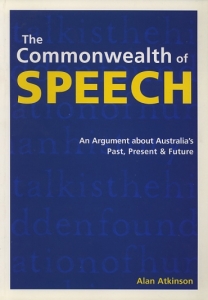
‘The Commonwealth of Speech’ by Alan Atkinson

2002, 136 p & notes.

The full title of this book is The Commonwealth of Speech: An Argument about Australia’s Past, Present and Future . The extended title gives a better indication of the book’s flavour because it is a wide-ranging publication that meanders between history, politics, rhetoric and methodology.  Many of the chapters were originally presented as speeches or lectures in their own right, thereby complicating for us the relationship between speech and writing from the start.

Talking and writing were fundamental in the founding of Australia, Atkinson argues, and indeed the first chapter of Atkinson’s intended-trilogy The Europeans in Australia is titled “Talk”.  When the Aborigines came across from Timor or Sulewesi, they must have used language to plan their trip, and by the time the English made their own journey in 1788  the logistics and implementation of the First Fleet was a product of detailed bureaucratic talk and writing.  Unlike any other people in the world, the convicts and soldiers of the New South Wales penal settlement were recorded in writing from the very inception of the colony,  in convict indents and admiralty documentation.  Frontier life demanded writing, in the form of overseers’ orders, information from agents’ letters and the provincial newspapers that quickly emerged. When the early forms of democracy arrived,  their introduction was largely unproblematic because of this underlying basis of literacy.

Early white  settlers recognized that Aboriginal people were highly attuned to speech.  They noticed, even if they didn’t fully understand,  that when aboriginal people spoke among themselves, there were nuances of affability, tact, respect and authority. This is something that white Australians are still learning today.   Despite the ubiquity of text, talk is still important in both black and white communities.  Atkinson spends quite a bit of time on Australia’s bi-centenary in 1988, examining the speeches given by Bob Hawke, Prince Charles and Galarrwuy Yunupingu for the occasion, and notes the power-plays jostling amongst the three speeches and the paradoxical symmetry between the speeches given by Charles and Yunupingu.

In another chapter, Atkinson discusses what he calls “vernacular history”.

Vernacular History rests on a body of assumptions about the ethnic or national past which exists, mostly unquestioned, as part of common conversation and common judgement….They regularly seep into popular, everyday writing.  And the more familiar they become on the printed page, the more they belong to everyday talk. (p. 27) …..Vernacular History always throws up moral themes.  It establishes, or it tries to establish, a uniform moral message.  It offers moral contrast, sometimes even melodrama, with the evocation of heroes and villains, of golden ages and dark days. (p. 31)

I’m still not sure whether he approves of vernacular history or not:  he describes it as a

peculiarly powerful combination of formulas, old and new, a vivid mix of subtle tones and heavy patterning. (p.33)

He proposes three examples of Vernacular Historians: Manning Clarke, Robert Hughes and Henry Reynolds.  All three, he says, presented themselves as unique figures, somehow independent of the community of scholars.  Their histories burst off the page and broke out of the academy to become integrated into the talk of ‘ordinary’ Australians (albeit often at a fairly simplistic level).  He spends quite a bit of time on Henry Reynolds in particular, whose history, Atkinson argues, is a history told from the perspective of “we” whites that relies on the tension borne of the moral relationship between current-day blacks and whites.

I enjoyed reading this book, and I can see that I’ll be using it later in my thesis.  I’ve been aware, in my work on Judge Willis, of the importance of talk-  the talk of power in the courts, the middle-class respectable talk of men’s debating societies, and the gossip of the streets.  I enjoyed spectating while Atkinson joustedwith other historians (an acquired taste, I admit) and his discussion of the use of history by politicians.

A memorial for a memorial?

You might have seen on the back page of  today’s Age  a little article about the re-enactment of a photograph.  You can see the article here (scroll down about half way).  Apparently 50 years ago, as part of the 125th anniversary of Batman’s proclamation,  Robert Waddell stood with his mother Beryl at the corner of Flinders and Willliams Streets to have their photograph taken beside the Batman memorial plaque that was embedded in the footpath, outside what is now the Immigration Museum.  And here they are, fifty years later, standing on the same spot beside a piece of empty footpath.

As Bain Attwood tells us in his book Possession, this memorial has had a contested history right from the start.  In 1923, after the Old Melbourne Cemetery had been removed from what is now a Victoria Market carpark, it was felt by some city worthies that Batman deserved a new memorial close to where he was said to have disembarked and declared “This will be the place for a village”.  As a result R. A. Crouch proposed that a memorial be erected on the corner of Williams and Flinders Streets that read

This is the place for a village- John Batman 1835.

However, the Secretary of the Historical Society of Victoria, A. W. Grieg was wary of the wording because his own research had questioned whether Batman himself had visited Melbourne on this occasion.   A compromise, from which Grieg later distanced himself, was reached, and the amended wording read

John Batman landed near this spot June 1835. “This will be the place for a village”.

You can see a photograph of the artisans working on the plaque here and a report and photograph of the hatted gentlemen watching the slab being placed in the footpath at the official ceremony in March 1925  here and here.

The plaque became a popular rallying spot, not only for commemorations of Batman’s putative landing (the last of which probably occured in 1973) , but also for Aboriginal protest.  The Aborigines Advancement League began its protest rally against the loss of Lake Tyers from the memorial in 1963, and in 1970 The Day of the Mourning also commenced its march from the same spot.

Right from the start there had been disquiet about the accuracy of the claims on the plaque: whether Batman had even been there at that time;  whether the portentous words were ever uttered; whether “this” was the spot even under consideration.  Along with a heightened discomfort about the treaty and Aboriginal possession, there was the increased prominence given to John Fawkner as the alternative “founder of Melbourne”.  In 1995 a corrective marker was placed beside the plaque that read:

There is some doubt as to whether Batman was actually with the party that rowed up the Yarra in June 1835 or that they landed near this site.  The map that was drawn up by surveyor John Hedger Wedge on Batman’s return to Launceston indicates the land south of the Yarra River and down to its mouth as being reserved for a “Township and Other Public Purpose”.

This rather wordy correction was stolen in 1998 and not replaced.  But by 1998 the memorial stone itself went as well, gazumped somewhat by Enterprize Park directly opposite.  Ah well, we can always remember the memorial.  Perhaps a plaque for a plaque?

References:

Bain Attwood Possession: Batman’s Treaty and the Matter of History , Melbourne, Miegunyah Press, 2009.

Shane Carmody ‘John Batman’s Place in the VillageLa Trobe Journal No 80, Spring 2007

‘Aborigines and Colonists’ by R.H.W. Reece

Aborigines and Colonists: Aborigines and Colonial Society in New South Wales in the 1830s and 1840s

I was speaking to a fellow postgrad of close proximity (wave!)  the other day and he commented on the deluge of research amongst our postgraduate colleagues in Aboriginal history now, compared with the 1970s, when he first dipped his toes into the historical waters.   It brought home to me the distinctiveness of  Reece’s Aborigines and Colonists, published in 1974, where it joined a handful of books written after Stanner’s Boyer 1968 lectures that spoke of  “the great Australian silence”.  There was John Mulvaney’s work, and C.D. Rowley’s trilogy, and Henry Reynolds had published a book of sources and some journal articles- but not yet the books that he was later to become famous for.

In fact, it’s difficult to read Reece now without peering through the dust raised by Reynolds, Windschuttle etc. in the history wars of late last century.  There was such a heightened moral fervour in that debate that Reece’s work seems very cool and dispassionate in comparison.

The aim of his book, he says in the introduction, is to examine the “Aboriginal problem” as seen by philanthropists, squatters and colonial administrators, and so it locates itself very clearly on “one side of the frontier” as Reynolds might have characterized it.  The early chapters of the book explore the mindset of  “improvers” and “officials”.  Among the “improvers” he identifies those who wanted aborigines separated from white society as distinct from those who opposed segregation; those who thought that the introduction of Christianity was the main priority; those who saw “kindness” as a sign of weakness, and those who were repulsed by the sight, the smell and the sensational anecdotes that surrounded the Aborigines.  He traces through the changing emphases of official policy and the influence of evangelicals on Colonial Office policy, particularly in the mid 1830s, and the changes during Gipps’ tenure up until about 1844.  He sees the brief period between 1838 and 1844 as the time of genuine, but ill-informed attempts to bring Aboriginal and white relations under the framework of the law and to improve the spiritual and material welfare of Aboriginal people.

He focusses closely on the Myall Creek Massacre of 1838 which he contextualizes as one of a series of massacres in the Liverpool Plains district at the time.  It is here that I most clearly noticed the sober tone of his writing. He does not underplay the death and cruelty of Myall Creek but nor does he sensationalize it, and the writing is more powerful for it.  He also injects  field research (quite literally) when he writes of  Len Payne and Cecil Wall traipsing around what had been the Myall Creek stockyard, digging up hinges and fence posts.  Cecil Wall had been the last of a succession of Walls who had worked on Myall Creek.  You can read more about this here, in a rather idiosyncratic site.

Reece also spends quite a bit of time on the Port Phillip district, which was being newly settled at the time of the Myall Creek massacre.  It was in Port Phillip that the evangelical vision of Aboriginal Protectors was trialled, and found wanting.  He is particularly critical of La Trobe over his unfavourable reports of the Protectorate which made no recommendations to Gipps and provided little insight into the problems they faced.  I’d take issue with this: I see La Trobe as a benign but ultimately impotent figure in relation to the Protectorate.  Within the tenor of the deferential relationship he had with Gipps, I don’t think he could be anything else.

Nearly forty years after publication, this book still stands strong but it was a product of its time.  It would be wrong to chide it for the perspectives it does not explore- aboriginal resistance, aboriginal agency- because these historiographic themes did not emerge until decades later, and no doubt will be themselves overtaken.  As a trailblazer in its field, this book might well have been drowned out by the flood of later research, but its dispassionate tone serves it well.


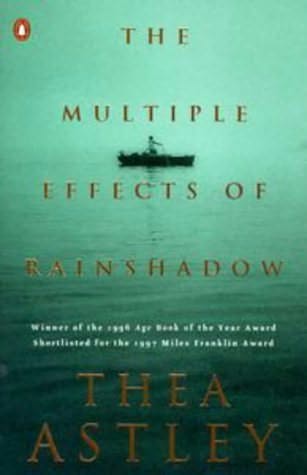
‘The Multiple Effects of Rainshadow’ by Thea Astley

1996, 296p

Thea Astley’s book was written fifteen years ago about an event that happened in the 1930s but this historical fiction has turned out to be tragically prescient.

It begins with the cyclone that annihilated the Aboriginal settlement Mission Beach and led to the establishment of a new mission on Palm Island and it ends with the 1957 strike of the Palm Island men against the menial tasks they were expected to do- an industrial action that was severely repressed.  And though Thea Astley didn’t know it, we could add another post script to her story with the Palm Island death of Mulrunji Doomadgee that Chloe Hooper has described so sensitively in her book The Tall Man.

The central action in the book is the massacre inflicted by the superintendent of the island, Robert Curry (known in the book as “Uncle Boss Brodie”) who, crazed by the death of his wife and suffering from neuralgia, torched his own house killing his children,  shot and wounded the Doctor and his wife (mistress in the book), set fire to the other houses and blew up the buildings on the reserve.  He was eventually shot by one of the Palm Islanders on the orders of one of the white officials.

At first I thought that the book was going to unfold as a series of Rashamon-like chapters, each telling of the killing from different perspectives.  The book started with an Aboriginal English telling of Palm Island’s history – a technique that non-Aboriginal writers might flinch from now.  Then the narrative voice shifts to Mrs Curthoys the hotel-keeper;  then Morrow the inept Works Manager;  and finally Brodie himself.  But then it jumps ahead some fifteen or so years and picks up on other characters who had been there on the island that night: the teacher, the Catholic priest, and even beyond them to the children of those witnesses who had not even been born at the time of the massacre.

Brodie dies; the Aboriginal boy who shot him is jailed but then released.  At one level it is over, but the witnesses and their children are drawn back to it like a web.  The jobs they take, the marriages they make, the choices their children make are all set wobbling onto a different trajectory by what happened on Palm Island in the 1930s.  On Palm Island, too, Brodie is replaced by other administrators who, like their predecessor, become crazed with their own authority and the tension builds again.

I had mis-read Astley’s metaphor of the rainshadow.  I had in my mind those billowing afternoon clouds of tropical Queensland that build like towers in the sky until the rain pours down, the skies clear overnight and then the whole cycle starts again the next day.  I thought that she was referring to the oppressive humidity, or the fury of rain.  It seemed apposite:  Palm Island’s recent history seems to have been a succession of crises that build, burst, abate then begin to build again.

But a rainshadow is a desert, not a jungle.  It’s the phenomenon by which rain falls on one side of a mountain range but it remains dry on the other side.  Now that I know this,  the rainshadow metaphor works well too.  There is a cataclysm; it occurs, then there is parched emptiness. There is a dessication about the people in this book: they move out from Palm Island onto the mainland where they live unhappy, meaningless lives.

The book ends in despair and hopelessness.  There’s no redemption here for anyone. Even less for the Palm Island that Chloe Hooper brought us some eighty years later.

Postscript

If you read the comments below, you’ll see that Whispering Gums and I both wonder if our reviews (her review is here) emphasize strongly enough that the book is fiction.  As I look at my posting, I think that’s a valid point.  The bookends that frame the book- the rampage and the strike- are both factual events, but she has fictionalized the characters.  Even Brodie/Curry (a factual character) has been filled out from the imagination, as he did not survive to give any account of his motivation.  So- look for Astley on the fiction shelves, not the non-fiction! and tease out a little more that eternal conundrum about history and fiction…

The newspaper reports of the day provide a sobering illustration of the imaginative space that Astley had to roam in- they are stark, skimpy reports that read as if they were coming from outer space or a distant, distant frontier .  From the National Library newspaper site, here’s an article about Palm Island that will make you cringe written prior to the event;  and here’s one about the rampage itself.  There’s others too- just search “Palm Island”, narrowing the dates to around 1930.

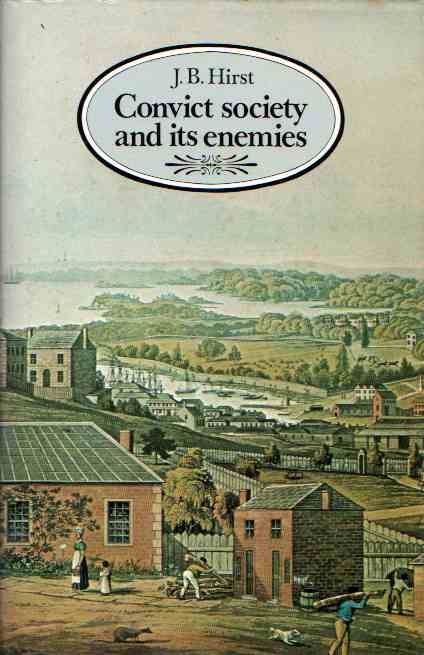
‘Convict Society and its Enemies’ by J.B Hirst

1983 , 217 p

This book has been recently re-released, along  with its companion volume The Strange Birth of Colonial Democracy as a new book called  Freedom on the Fatal Shore.  In the foreword to the new version, Hirst writes of his affront at the wealth of  publicity that Robert Hughes’ book The Fatal Shore attracted, compared with the muted attention that his own book had received.

The phrase ‘the fatal shore’, originally in a convict ballad, has been made famous at the title of Robert Hughes’ magnificent book on the convict system. The advance publicity for The Fatal Shore had no need to tell lies about it, but it made the claim that this was the first book seriously to examine the convict system in Australia.  I was ropeable.  Why was my book Convict Society and its Enemies, then four years old, being overlooked?   When this claim was repeated in a quality newspaper, I determined to write a letter-to-the-editor to correct this error and push my own claims.  My wife told me I should not think of doing such a thing until I had seen the Hughes book.  I am very pleased to have followed her advice  (p.vii)

Because in the introduction, Hughes acknowledges Hirst’s book upfront:

Colonial Australia… was a more ‘normal’ place than one might imagine from the folkloric picture of society governed by the lash and the triangle, composed of white slaves tyrannized by ruthless masters.  The book that best conveys this and has rightly become a landmark in recent studies of the system is J. B. Hirst’s Convict Society and its Enemies. (Hughes ‘The Fatal Shore’ ,1988, p.xiv)

Yet although Hughes agreed with many of Hirst’s arguments about the normality of the system, the overwhelming “takeaway” from Hughes’ book was that the Convict System was a cruel, dehumanizing, oppressive system.   Although Hughes admitted that the secondary punishment system he describes was not the norm, it is his depictions of  the lash and the triangle that a reader remembers.

Hirst argues instead that, right from the beginning- even at the planning stages of the First Fleet- there was an intention for something other than a harsh, punitive penal society.  Women and children were included on the First Fleet, complicating from the start the creation of a strict penal system;  convicts were encouraged to marry; there was an unfulfilled intention to pick up more women from the islands on the way (and what a what-if scenario that gives rise to!) .  The overall concern of the British authorities was that they not return to England; hence they were given grants of land and known as ‘settlers’ once their sentences had expired.  Because it was intended that they become part of a British capitalist economy, they had more legal rights than they could have had in England- the right to sue, the right to give witness in court- and there was no bar on their economic activities once freedom was attained.  The early food shortages amplified the imperative that an agricultural sector be developed as quickly as possible. When convicts were turned over to private landholders they were called ‘assigned servants’;  they refused to work all day and insisted on “own time” after their tasks were completed;  they often lived in huts separate from the owner’s house compared to the suffocating oversight of servant life in England; even flogging was controlled by law.

So who were the “enemies” in Hirst’s title?  The  “exclusives”  spring immediately to mind:  emigrants with capital who came to the colony and resented the wealth and social acceptance of the ex-convicts who surrounded them.

But Hirst complicates this simplistic explanation.

First there were the Benthamites back in England, whose own commercial proposals for the Panoptican-style penitentiary were thwarted by the settler-model penal scheme that underpinned the First Fleet.  They had a vested interest in promoting their own model, and had increasing influence from the 1820s on in making the system more uniform.

Then there were the liberals and humanitarians themselves (not necessarily the same thing), particularly in England, who decried the dehumanizing effect of convictism and its parallels with slavery.   Ironically, in their efforts to overturn transportation, they themselves had to demonize the system by highlighting its inequality, cruelty and degradation.  It was also a rather tenuous line to tread, because in many ways British labourers during the Industrial Revolution had more difficult lives than transported convicts in the colonies.

Third, by the turn of the century there was an increasing group of native-born white Australian who, unlike both exclusive emigrants and convicts, were born in the colony.  They were shaping up as a fine generation: good food and the beneficiaries of an emphasis on education that far outstripped that in Britain. They grouped together both emigrants and ex-convicts as British, not Australian like themselves.

It was the mooted re-introduction of transportation that galvanized these groups into action.   The supporters of transportation- the wealthy squatters with large pastoral properties- wanted to portray the benefits and normalcy of the convict system.  The opponents of transportation- many of whom were free emigrants who wanted to protect their high wages and respectability-  needed to  develop a narrative of convict society that highlighted its aberrant features and suppressed its successes.   They needed to distance themselves from the convict past.  In agitating against the revival of transportation, the blurred edges and compromises of the system had to be downplayed and convict society had to be framed as a de-humanizing system, steeped in cruelty and violence.   The irony is, Hirst argues, that even today our understanding of convict society is based on the assumptions of its enemies.

This is a punchy book.  Its footnotes are utilitarian: there is no alternative narrative being played out in the notes at the back of the book.  Its argument is made upfront, and pursued relentlessly throughout the body of the work.  From a structural sense, there are two fairly short opening chapters, then a long third chapter that examines convict society in terms of the economy, the law, rebellion, status and the politics of dependence.  The book closes with a short but succinct conclusion.

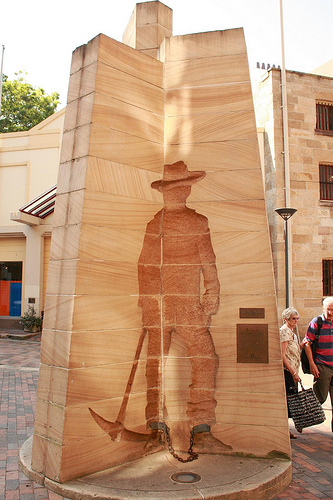
It’s also fairly pugnacious book, determined to convince, and it does not take a backward step at all.  This becomes rather strained in the section on flogging, which is written carefully but insistently.  It is unashamedly  a book of the head rather than the heart.   At times this can be rather exhausting, but in its sheer doggedness it raises some interesting questions.  For example, Hirst notes the convict sculpture at The Rocks in Sydney.

Hirst’s caption to the photograph is interesting:

A persistent symbol: ‘The Convict’ is put in chains though, as the plaque on this modern sculpture explains, only incorrigibles suffered this fate. (p. 214)

His decision to persevere with the illustration and to caption it in this way  makes me pause.  He has done the right thing in acknowledging the plaque on the sculpture, and thereby undercutting its usefulness to him as an argument. The plaque has done the right thing in pointing out its artistic licence in depicting the unusual. However,  I’m not sure whether the plaque was there from the start, whether it was itself part of the artist Bud Dumas’ creation, or whether it was added later perhaps even in response to Hirst’s criticism.

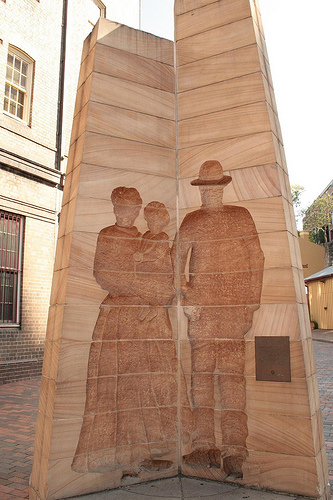
For as Hirst pointed out in his book, visually convicts and free labourers were indistinguishable from each other.  He cites an episode from Alexander Harris’ book The Emigrant Family where a magistrate rides up to make enquiries amongst a group of farm workers who have come onto the farm to collect their rations.  When rebellion breaks out and the magistrate is brought in to intervene, he calls for those who are prisoners to stand on one side and the free men on the other.  The magistrate could not tell, just by looking or by the men’s activities, who was bond and who was free.   Convicts were not chained; they dressed like free men, and collected the same rations.  Fencing and clearing stumps was work exclusively undertaken by free men although labouring with a hoe was performed almost exclusively by convicts because that was all that smallholders could afford to employ.  In all other categories of work- shepherding, shearing, ploughing, clerical work, school teaching- convicts and free men worked alongside each other. (p. 104)

It is the chains that mark out the “Convict” from the man in the “Immigrant Family” sculpture above.  In this sculpture, the immigrant man stands with his family, but he was just as likely to wield a mattock in a sunhat when he was at work.   But when we take the chains away from the convict, what are we left with visually? Just men.  And that’s the conundrum.

‘Convicts of the Port Phillip District’ by Keith M Clarke

One of Port Phillip’s claims was that, unlike Van Diemen’s Land and New South Wales,  it was not a penal colony.  It was opened up during the 1830s when emigration schemes were hitting their strides and there was much to be gained by distancing Port Phillip  from the degradation and corruption that was perceived to flow from contact with convicts.

But it was not as clear cut as this.  Right from the start, there were convicts in Port Phillip.  The earlier abandoned attempts at settlement at Sorrento and Western Port involved convicts, and had they been more successful, there would have been a permanent convict presence in the area.  As it turned out, Melbourne was established by, or at the behest of,  private pastoral and agricultural interests.  When these pastoralists, their sons and their agents moved in, especially from the Middle District around Sydney, they were able to bring their assigned servants with them.  John Hirst, in his book Convict Society and its Enemies notes the slippage in terminology that avoided the use of the term “convict” and instead used “assigned servant”.  He suggests that all sides were comfortable with this linguistic subterfuge:  emancipists and expirees were keen to expunge the moral connotations of ‘convict’, and for those who availed themselves of labour from the assignment system, the use of the term “servant” framed the contract as the more acceptable master-and-servant relationship that underpinned all labour exchange at the time.

Once they were here as assigned servants, there was no formal supervision at the local level.  In theory, assigned servants could only be transferred between owners with the permission of Governor Gipps, but this does not seem to have been strictly enforced. An advertisement for land of the Plenty River in May 1841 included “five government men” in the purchase, and according to Judge Willis,  at the height of the economic depression in 1842 there were two hundred assigned servants wandering at large because their masters could no longer afford to keep them.

Then there were convicts sent down from Sydney.  Some of these were highly qualified “specials”, who were sent to fulfill particular roles.  For example Phillip Harvey, who had been transported after pleading guilty to a charge of forging and altering two Bills of Exchange, was sent down from Sydney after being instructed by Mr Dunlop the Astronomer on the keeping of meteorological journals.  Another convict worked as a writing clerk at the Police Office and Judge Willis strenuously protested him being left in charge of prisoners on remand because he was  “not fit to have charge of free persons, who coming out to this colony were entitled to all the privileges of British subjects.”   The distinction between government and domestic employment was not clearcut: a letter to the Port Phillip Herald complained that Dr Shaw of Geelong had been using men assigned to the customs service to fetch wood and move furniture.

Then there were the public works gangs sent down to work on roads and other constructions.  They were a highly visible presence, although they do not seem to have worked in irons.  Just as one could imagine today, the “shockjocks” of the press at the time became highly exercised at the sight of convict gangs fiddling around on their spades in fine weather, and when unemployment rose in 1842, it was felt that government work should be provided to emigrants rather than convict work-gangs.

Added to this were convicts who had gained tickets-of-leave (for example, the Port Phillip Herald of 12 April 1842 has an advertisement of a ticket-of-leave belonging to Martin Brennan that had been found), and those whose sentences had expired.  A large number of people coming across from Van Diemens Land fell into this category.

So, we should perhaps raise a sceptical eyebrow at all the “free” rhetoric coming from the Port Phillip boosters.

A book that deals with the convict presence in Port Phillip in more detail is Keith M Clarke’s Convicts of the Port Phillip District.  Self-published in 1999, it is a large, illustrated paperback book of 370 pages, much of which is made up of appendices giving names, shipping details, and sentencing data and comments for the different waves of convict settlement (Sorrento, Western Port, Port Phillip and later the exiles sent between 1844-1849).

It is from this book (p.100)  that we learn that, of the population of 12, 994 in Port Phillip during the 1841 Census, there were 2,762 who had been transported to the colonies- i.e. 21% of the Port Phillip population at the time.   Although the numbers are rubbery, there were 338 holding tickets-of-leave, 185 on Government Service, 637 on private assignment and 1455 “other free” men and 147 “other free” women.  “Other free” was a catch-all category that included emancipists, those free by servitude, and those holding conditional pardons.

We can also see from his compilation of Supreme Court data that many of these assigned servants were under the control of prominent Port Phillip personalities that we have met before: William Verner (Judge Willis’ good friend), Porter, Carrington, Thomas Wills, Dr Thomson, Ebden, Lonsdale,  Peter Snodgrass.  It is significant that Judge Willis himself did not have assigned servants, and in this he was true to his word in 1839:

For my own part, I have ever  considered the provisions of His Majesty’s order in Council, in 1831, for reconstructing the Supreme Courts of Judicature in certain crown colonies, when negro slavery unhappily existed, to be most wise in prohibiting the Judges from being owners of, or in any wise interested in slaves, or their labour. Believing the same principle to be as applicable to the bondsmen of Australia, as to the negroes of Guiana, Trinidad, and St Lucia, I have abstained, and ever will abstain, so long as I remain on this bench, from being the assignee of convict service. I will never permit the possibility of insinuation that my private interest can in anywise interfere with the honest discharge of my judicial duties.  I will always endeavour to keep myself beyond all reach of vulgar suspicion.

A large part of this book involves a retelling of the different settlements in Port Phillip, albeit with particular attention to convicts.  It is a largely narrative approach, and while the bibliography cites the body of academic work on this era, it does not engage with the literature in an academic sense.   It starts with a description of the parish system in England and the changes to Poor Law legislation during the Industrial Revolution.  The second chapter describes changes to the penal code in England during these years and the global nature of transportation to penal settlements worldwide.  The third chapter involves the establishment of the Botany Bay scheme and explorations of the Port Phillip Area.  Chapter 4 involves Sorrento (Sullivans Bay); Chapter 5 Westernport, and in Chapter 6 the coming of sealers, the Hentys, Batman and Fawkner.  Chapter 7 describes the appointment of William Lonsdale and the convict workforce under his supervision.  Chapter 8 covers the La Trobe years, including the pressure to accept exiles under the revamped transportation-that-dare-not-speak-its-name system.

The heart of the book is the 200 pages of appendices with names and details.  These are set out in spreadsheet format and give you the little jolt of recognition that these are real individuals, who each have their own life story.  In this regard, the book would be a useful addition to a family history resource centre, where family historians would no doubt fill in the gaps between the statistics.

References

Keith M Clarke Convicts of the Port Phillip District, Waramanga, KM & G Clarke, 1999.

J. B. Hirst Convict Society and its enemies


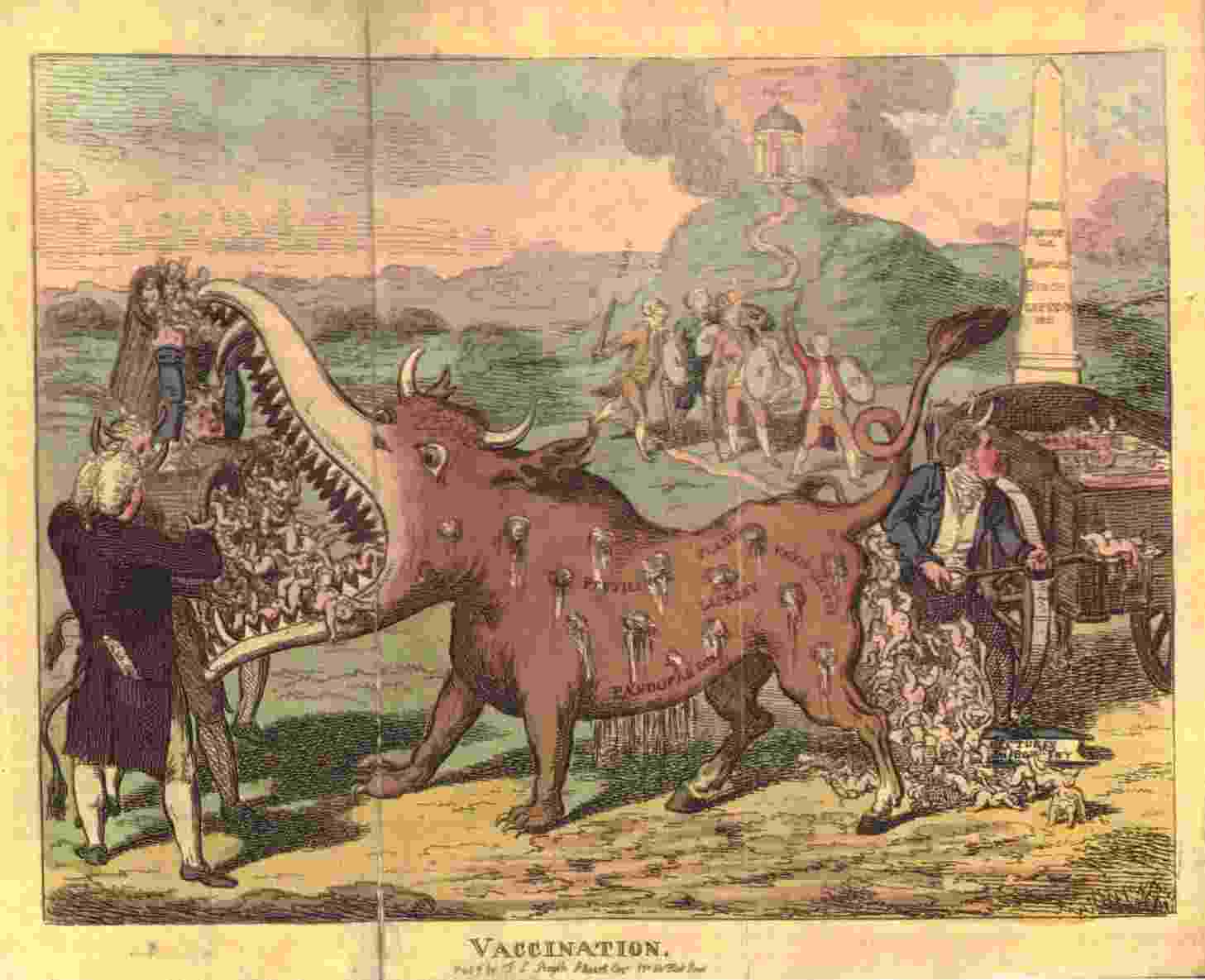
Vaccination time

I really should be doing other things, but I noticed this in the Sydney Free Press of October 1841.  (This is one of the periodicals reproduced as part of the Australian Cooperative Digitisation Project, available at the NLA site.  It’s separate from the Australian Newspapers digitisation project also at the National Library site. These are small runs of Australian serials published between 1840-5. What an embarrassment of riches we have here with these digitized papers!)

Smallpox had been carried on an American ship of war from Tahiti, where smallpox was prevalent.  The ship had touched at New Zealand and in response the Government reprinted this notice from two years earlier.

Colonial Secretary’s Office

Sydney 29th July 1839

In order to avert the calamities which must necessarily follow if the Small pox be introduced into the Colony, and to keep up a constant supply of Vaccine Lymph, His Excellency the Governor directs it to be notified that children will receive vaccine gratis, if taken to any of the public hospitals, or Colonial Surgeons throughout the colony, every Tuesday at eleven o’clock in the forenoon.  But as the operation itself, without any proof of its having taken effect, would be insufficient security to the public mind, His Excellency has been pleased to direct, that a charge of one shilling shall be deposited for every child vaccinated, which sum will be returned on the presentation of the child on the next vaccination day.

His Excellency very strongly recommends parents and guardians to avail themselves as early as possible, of the means thus afforded to them of taking this necessary and proper precaution with respect to all children not already vaccinated

By His Excellency’s Command

E. DEAS THOMSON

Interesting to see in this public notice the appeal to the hip-pocket nerve. Bring ’em back next immunization day and we’ll pay you! There’s an idea for Rudd’s health plan and perhaps the Republicans in America might feel more comfortable about this rebate scheme instead of Obama’s health insurance plan.  If Nana survives her hip transplant, we’ll pay you!

I really don’t have time to comment further- I should be doing other things instead of thinking about scabs and lymphs.
There’s a fascinating article by Michael J Bennett called “Smallpox and Cowpox under the Southern Cross: The Smallpox Epidemic of  1789 and the Advent of Vaccination in Colonial Australia” from the Bulletin of the History of Medicine, 83, 1, Spring 2009.

And just to make sure we’re not too relaxed and comfortable as we survey our little dimpled smallpox vaccination scars on our upper arms, I’ll leave you with this.

Masters and servants: a Labour Day reflection

It’s Labour Day here in Victoria, celebrating the awarding of the eight hour day to the stonemasons employed at Melbourne University in 1856.  The idea of eight hours work, eight hours recreation and eight hours rest seems rather quaint in our deregulated, open-all-hours economy.

During Judge Willis’ time in Melbourne, labour relations (a terminology not even dreamed of at the time) were governed by Master and Servant legislation.  Such legislation was an empire-wide concept whereby relationships between employers and employees were governed by contracts that were enforceable by magistrates and where breaches by employees were punished.  The New South Wales legislation promulgated in 1828  was even harsher than the corresponding English statute because it provided up to six months imprisonment for absenteeism and desertion, double the penalty in the English legislation.  Labour shortages were an ongoing problem in the colonies, although during the 1840s depression workers were exhorted not to keep insisting on their wages because it would only push their employers into insolvency (huh- I’ve heard THAT before!).  The legislation applied to the overwhelming majority of workers including, at first, independent contractors as well as hired servants and apprentices.  Domestic servants, and especially female domestic servants were expressly included because of perceptions of scarcity and troublesome character, and to prevent them absconding.  The Act was modified in 1840 but still remained heavily weighted towards the employer, although cases for non-payment of wages were reported in the newspapers as well.  This legislation was generally heard by the Police Magistrate in the Police Court.

So, in the Port Phillip Herald on the 24th January 1843 we have an item headed “Female Impudence”

At the police office, on Thursday, Jane Kelly preferred a charge against Mr J. Cade of the River Plenty, under the Masters’ and Servants’ Act, inasmuch as she had been in the service of the said Mr John Cade as a maid of all work, he refused to pay the balance of wages due to her, 24s.  The defendant on being asked by the Police Magistrate if he denied “the soft impeachment” ungallantly said, the fair Jane had got drunk last Sunday evening, disturbed the whole family with her vagaries, while in that unenviable state of oblivion and would not go to her own bed, but wanted to come to his, and to effect her purpose broke open the window of his bed-room. Here an angry discussion ensued between the parties as to who had the best right to the bed in question, the complainant contending the bed was hers, and the defendant with equal pertinacity urging his claims to it.  The bench consisting of the police magistrate, Mr Airey, and Capt. Smith endeavoured to solve the point by ascertaining its position in the house, but nothing definite from the conflicting statement of the parties could be arrived at. The complainant at last said the least the defendent said on that subject the better as he had bit her finger and endeavoured to take liberties with her, which charge was indignantly denied by the defendant, who expressed his honest indignation at her impudence in endeavouring to force an entrance into his bed-room. The court and bench were frequently convulsed with laughter at their mutual recriminations, and the police magistrate suddenly discovered her as an old acquaintance who had formerly endeavoured to force an entrance into the bed-room of Mr Boyd, who was so alarmed on the occasion as be compelled to have recourse to the protection of the police: she had since been in gaol several times for misconduct, and under all the circumstances the bench dismissed the case, to the no small mortification of Miss Jane, whose countenance, which had been before sprightly and gay, now assumed a dark and down-cast hue.

Or, another report in the Port Phillip Herald of 28th June 1842 where  a servant girl took her employer to the Police Court for non-payment of wages.

On Saturday, at the Police Office, in a case for the recovery of wages, by a servant girl from her master, Mr Murray a late arrival, the defendant stated in his defence that in the place where he came from, in Scotland, three pounds per annum was the rate of wages which he was willing to allow her, but as she had made an application for the return of a certificate she had received from her clergyman, and which he held, he refused to give it up, he having himself paid 2s 6d for it before leaving home.  Major St John [the police magistrate] after having patiently heard both sides of the case, immediately directed the payment of the wages due, and that the certificate of character should immediately be given up, and that he would himself pay the half-crown, which he presented to Mr Murray.  The latter, however, said he could not give it up as he had it not, whereupon the Major ordered him to sit down and write her out a receipt for the document, which Mr Murray did without specifying whether it stated that her character was good, but was forthwith directed to add the fact to the receipt, as the poor girl, like many others, had nothing but her character on which to depend.

It wasn’t just women who fronted the courts.  An item headed “Cakes” of 4th January 1842:

A person whose name like his trade was A. Baker, summoned his master on Saturday last to the Police Office for wages due: the latter in his defence stated that the man engaged with him as journeyman Baker, but proved a traitor to his name and profession, being neither baker nor tradesman, having lately spoiled a family Christmas cake, by flattening the nose of the white sugared Queen seated thereupon. On being reproved therefore he offered to perform the like service for his master “if he was game” for which the latter stopped payment until advised to stump up by the Bench.

It seemed fitting to spend Labour Day at the movies seeing George Clooney in “Up in the Air”

I assume that the last segment of talking heads was just to reassure us, in case we didn’t already know, that life is really about family and loved ones in your backpack.  And I just shake my head in amazement that somehow Americans assure themselves that they can stand on their own two feet and don’t need “big government” and that having a health insurance system tied so closely to employment status is a good idea. Sheesh.

References:

Michael Quinlan ‘Australia 1788-1902: A Workingman’s Paradise?’ in Douglas Hay and Peter Craven Masters, Servants and Magistrates in Britain and the Empire, University of North Carolina Press, 2004

Review of ‘Masters, Servants and Magistrates in Smith Book Review

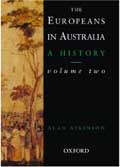
‘The Europeans in Australia A History Vol 2: Democracy’ by Alan Atkinson

2004 , 339 p. & notes.

I’d been looking forward to reading this book for some time.  I bought Volume 1: The Beginning some time ago at an incredibly cheap price, courtesy no doubt of some intricate global book industry policy structure, and was instantly engrossed by such a different way of telling.  So- what to do?  Relish the series and honour its author’s vision by reading it in its intended order starting with Volume 1?  Or jump ahead into Volume 2, which after all, is the period that I am more interested in, and go back to Volume 1 later? In the end the exigencies of library renewal periods and the imperative to actually write this section of my thesis (as distinct from doodling around reading it)  won out, and so Volume 2 it was.

I was reassured in reading the Foreword that perhaps I would not be too hampered by not having read Volume 1.  He reprises some of the main themes, and speaks of how he is going to pick them up and introduce new themes in this second volume. The series, he says, is meant as “a history of common imagination in Australia” (p.xii)- not identity, but imagination- not just through the views of powerful individual men, but the imagination of large numbers of people considered together.  The change over the decades 1820s-1870 was in part generational, and also a product of the revolutions in communications, literacy and ‘systems thinking’.   He identifies the broad argument of the book and how the chapters contribute to its larger themes.

Which is a good thing, because I have to admit that during the reading of the book, I kept berating myself for not “getting it”.  Despite the title, which suggests a political text, this is a book about imagination, experience and ideas- all intangible entities that are best seen through their expression in individuals’ actions.  I enjoyed his vignettes and careful interweaving of the experiences of men and women, convicts and intellectuals, but I kept feeling as if the bigger themes were running through my fingers like sand.  In a review of the book, Ged Martin observes that

The reviewer too must soar to catch the author’s winged heels: this is a pointillist history…Atkinson’s meaning flows subliminally and is not easily pinned down. As he enigmatically puts it: ‘ vivid things are to be glimpsed merely on their passing our window.’ (p. 286)

I’m relieved to read this: I was beginning to think that perhaps I was being particularly thick. Within the parameters of his large, important themes, the detail is written almost as a stream of consciousness that meanders between ideas.  An example- Chapter 13 Railway Dreaming, which was perhaps my favourite chapter.  I’m not alone in focussing on this chapter- other reviewers (see below) seem to have been attracted to this chapter too.  Why, I wonder? Is it because, like me, they shook themselves and sat up straight and ordered themselves to “Start concentrating!”?  Or was it because, over half way through, suddenly you become aware of how Atkinson is working through his argument?  Is it the writing, or the reader?  He starts this chapter speaking of the democratic settlement- a three sided concept with politics on one side, commerce and enterprise on the other, and the way government worked as the third section.  He talks about systems, which are exemplified by gynaecology as a form of objective tenderness, and studies of inner-urban slum life and disease where disease was  often caused by water supply. Australia was now a richer place; chemistry and consumerism led to the development of glass bottles; glass and iron was used in London’s Crystal Palace and also in railways- Dickens wrote of ‘railway dreaming’ and the Moonians.  Railway dreaming in Australia included ideas of federal co-operation; there was thrill and terror in train-travelling; and Australia’s first serious train accident occured in 1858.  Mrs de Courcey, a travelling piano-teacher was injured in it.  She needed to work because her husband was ‘deranged’, and she said that she herself became ‘deranged, almost, for a time’ from the injuries she sustained.  Lunatic asylums were developed; a leading physician was Frederick Norton Manning, who was an apostle among the lunatics of Queensland. Queensland itself was a kind of hallucination; and then follows a potted history of the development of Queensland.

I found myself just letting go,  swept along by this assured and insistent whirlpool of ideas, but often found myself gasping for air, wondering where on earth I was going. It was with almost a sense of relief that at I turned to the Afterword and discovered that, really, I had understood the direction after all.  Turning back to the Foreword at the start of the book again, I  found that, yes,  he had done all that he had promised and more and that yes, there was an argument there had I had followed, almost without realizing it.

This series is written after Atkinson has spent thirty years reading, study and talking.  The period of time covered in this book (from about 1820s to about 1870s) is very much Atkinson’s ‘patch’, given his work on Push from the Bush which accompanied the 1838 volume of the Australians series. It has been likened to Manning Clark’s opus in its vision, and as with Clark  it is a creative,  idiosyncratic and personalised sweep that tells much, but certainly doesn’t give you “what happened and when”.  It is not a book for novices.

The book itself is divided into three sections, each prefaced by a description of insects in Australia to highlight a theme:  a locust swarm “Still they Kept Coming”;  the noise of cicadas “Their Method of Utterance”; and the disturbance of tightly packed insects in a decayed log of wood “The Masses Unpacked.”  The final image of the book is of a log that contained two ant nests: the first forming a thick crust, which when broken open revealed a complex labyrinth of ant-architecture.

The two ant-nests, old and new, might be taken to stand for the two generations that are described in this volume- the generation that coloured life around the 1830s and that of the goldrush years and after.  The notion of an intricate way of life given over and replaced by something new certainly matches what I say here.  At length, the habits of earlier days seemed to be, in the minds of the young, as dried up and useless as Moore’s “great city”. The Europeans in Australia made for themselves another mental habitation, like the ants.  Like the ants, moreover, they were gatherers from the world beyond, living by traffic and communication.  In rehousing themselves they drew their main materials, all that coloured glass, all those entrancing ideas, from Britain and the United States. (p. 339)

The poetry of his narrative, the bravery of his history-writing, the aurality of his perspective (because this is a ‘noisy’ history) are all breath-taking in their novelty and audacity.  I did enjoy the book once I reached the end of it, a bit like reaching the end of a water slide.  It was a long climb up; I wondered on the way down whether I was going to go over the edge; and probably- probably- I’d like to climb up and do it again.

Some other reviews:

Ged Martin review-  I can’t get the link to work but it’s a PDF document that should download at  http://www.nla.gov.au/openpublish/index.php/ras/article/download/288/346

Marion Snell’s review at Politicalreviewnet at

http://www.politicalreviewnet.com/polrev/reviews/AJPH/R_0004_9522_323_1007582.asp

Paul Pickering http://www.api-network.com/main/index.php?apply=reviews&webpage=api_reviews&flexedit=&flex_password=&menu_label=&menuID=&menubox=&Review=4493