Category Archives: Australian history

‘Bunyip Aristocracy’ by Ged Martin

Ged Martin Bunyip Aristocracy: the New South Wales constitution debate of 1853 and hereditary institutions in the British Colonies, Sydney, Croom Helm, 1986, 198 pages & notes.

To understand the past in its full roundness, the historian must acknowledge that the ideas and plans which did not come to fruition are sometimes as significant as those which did.  Any other approach is tantamount to accepting that what has happened had to happen, it which case there is really no point in writing history at all. (p. 197)

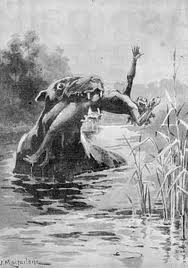
“Bunyip aristocracy”- what a delicious phrase! It was coined by Daniel Deniehy to describe the squatters and pastoralists who, if they got their way in the constitutional debates of the early 1850s,  would style themselves as earls and lord it over the rest of the people. He was speaking  at a protest meeting held at the Victoria Theatre (in Sydney) on 15 August 1853, on the eve of the Select Committee of NSW’s debate about a hereditary aristocracy.

People may have laughed at the idea of a jumped-up bunyip aristocracy  but, as Ged Martin points out

From the standpoint of modern Australia the scheme is exotically bizarre. To men who saw themselves as a resident outpost of a British world, it was eminently appropriate… In many ways, New South Wales and 1853 were the logical place and year for the idea to surface.  As a colony of large pastoralists it had a superficial similarity to landed society in Britain. Its convict past had accustomed its landowning and conservative classes to equate the defence of political control with social exclusivism.” (p. 195, 196)

The idea of a hereditary colonial aristocracy that could sit in an upper house was not new, however, and nor was it confined to New South Wales alone.  In the early chapters of this book, Martin examines the idea of hereditary institutions across the empire.  Hereditary honours for Canadian colonists were mooted in the British parliament during the debate over the 1791 Canadian constitution, but the suggestion was not acted upon.  The governor of British Guiana, Sir James Carmichael Smyth, urged the establishment of a colonial order of knighthood in 1831 and again in 1837.  It was an idea that bubbled up from time to time, only to subside again when derided or frowned upon at either the London or colonial end.

In its favour was the argument that as British subjects, colonists should be able to be considered for imperial honours.  It was felt that by instituting a framework of honours, not-quite-aristocratic-but-close-enough families would be encouraged to migrate to the colonies, where they would improve the temper of society.  An upper house composed of hereditary peerages, with perhaps the odd lifetime peer thrown in to give people something to aspire to, would act as a brake on democratic excess. After all, the colonial lords would have the long-term interests of their families and their dignity at heart, and so could be trusted to do the right thing.

But should they be ‘proper’ titles, that had good standing back home? What if England was flooded with newly minted lords, flaunting their new titles when there was such demand for titles in Britain itself?  Was it possible to invent an instant aristocracy, or was it the outcome of centuries of slow growth?

These problems were never really resolved, and by the time the British government considered the new constitution for New South Wales, the proposal for a hereditary upper house had been withdrawn at the colonial end.  Not that it was envisaged that it would be an instant House of Lords in New South Wales: instead, it was envisaged that an order of baronets, uniting wealth and merit, would be established by nomination, which over time would become an electoral college for the upper house.

As Martin points out, it turned out that Australian politics ended up with a number of legislators styled ‘Sir’ and a number of families that developed a tradition of political service anyway : Sir Robert Menzies, Sir Richard Casey and political dynasties like the Anthonys, the Downers, the Jenkins, the Cains and the Newmans.   It was sobering to remember the occasional re-emergence of quaint ideas of Australia as a cadet monarchy with suggestions that Prince Charles might become governor-general, or a rather weird suggestion that Princess Alexandra might become Queen of Australia.  Sir Robert Menzies was her first son’s godfather, and his middle name was Bruce (after Sir Stanley Bruce, I assume, and not because the name ‘Bruce’ summons up a broad-shouldered farmer with big hands?)
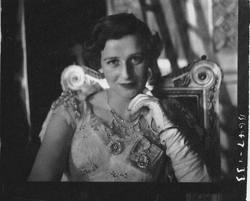
Queen Sandy of Australia?

Apparently this idea was treated with derision, with critics suggesting that Sir Robert Menzies or Sir Richard Casey could be appointed governor-general of Great Britain instead.

In many ways this book is a good counterpart to Peter Cochrane’s Colonial Ambition, although it lacks the rollicking characterizations of Cochrane’s book. The typesetting is of its time and awful: dense, single-spaced, typed pages with footnotes jammed up against the lines of text.   It’s not a what-if history, but it does finish by noting the things that could have brought a hereditary honours system or a cadet monarchy into existence, had they fallen differently.  And had a more systematic association with the royal princes developed,

Historians would still have gently derided the whole thing, because historians are usually good-humoured progressives.  But historians are also very good at being wise after the event.  If the persistent rhetoric of transferring British institutions to the colonies had actually led to an attempt to imitate the distinctively hereditary features of Britain’s constitution, no historian today would express much surprise. (p. 198)
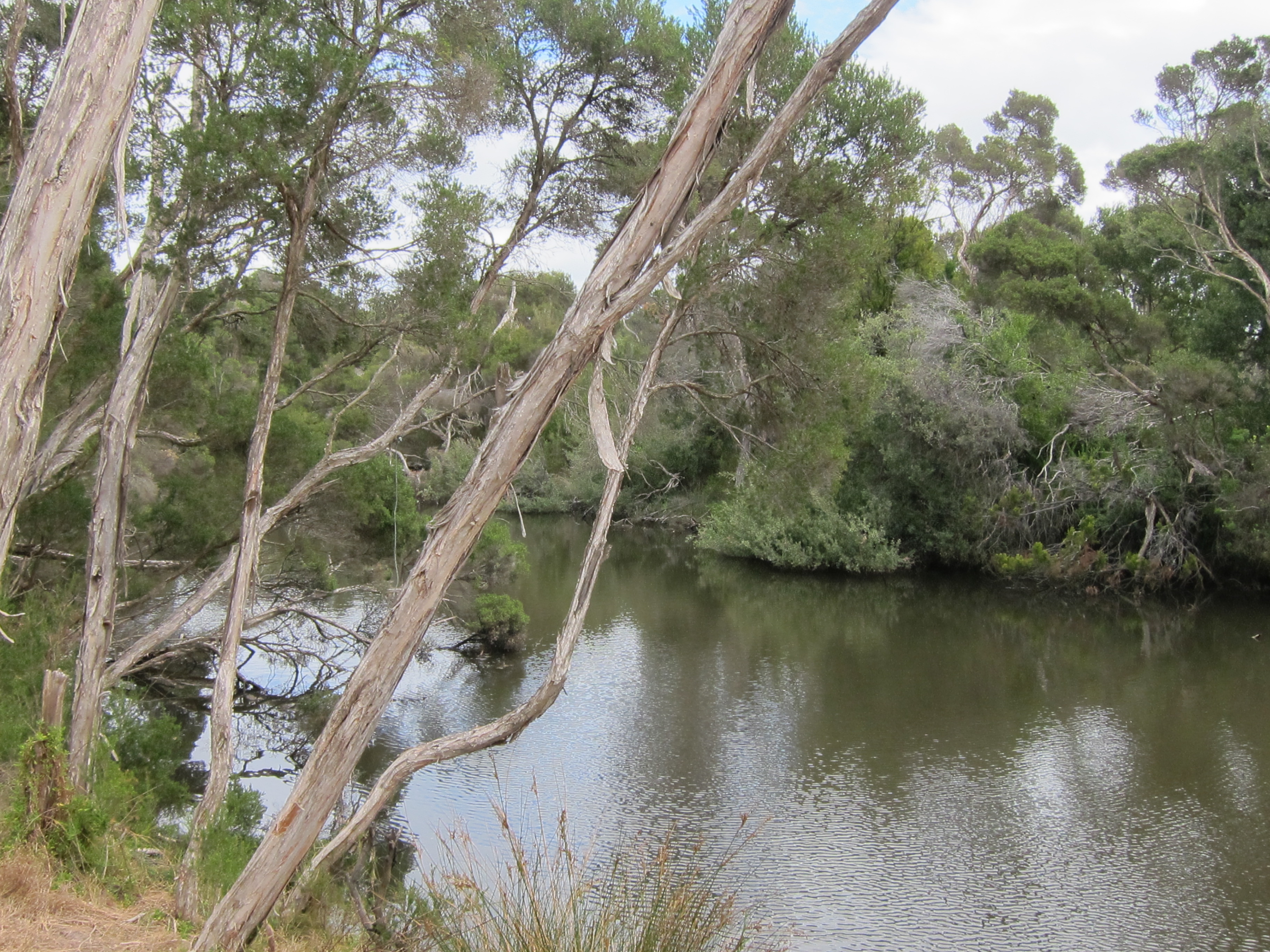
‘I Succeeded Once: The Aboriginal Protectorate on the Mornington Peninsula 1839-40’ by Marie Hansen Fels

There is a somewhat elegaic, wistful tone to this book, hinted at by its title. It is a quote from the journal of Assistant Protector William Thomas as he was about to re-locate his Protectorate for the second time in three years under official instructions.  He had been forced to shift from the Mornington Peninsula in 1840 to Nerre Nerre Warren, then forced again to shift to Merri Creek in 1843.  There were many reasons that he had failed, he said, but there was one time when he could have been said to have succeeded- and that was at Arthurs Seat between 1839 and 1840.

In the Afterword to the book, the author admits that there is “no conclusion, no grand summing-up” in her work.  She evokes the late Greg Dening, who taught that “the historical effort was to understand and to explain: not to judge, not to label, not to take sides.” (p. 397).  In many ways, it would have been helpful to have her afterword as a preface, because I found myself somewhat puzzled about what this book actually is. It is part of ANU’s Aboriginal History Monograph series, which presents “studies on particular themes or regions, or a series of articles on single subjects of contemporary interest.”  In this case, it focuses minutely on a relatively small area of land, over mainly a one-year period, although it does spill out of this chronological limit at times.

The book won the ‘Best Community Research, Register, Records’ category of the Victorian Community History Awards in 2011. The typographic layout of the book is more suited to a records-based document than a narrative history: it has the appearance of a work-book or training manual, and the headings and boxed biographies of individual aboriginal people feel as if they are the product of a word-processor rather than a commercial print layout.   It is thoroughly commendable that the book is available free as a download through ANU e-press here.  I suspect that I might have felt short-changed had I paid $29.95 for a print-on-demand copy (although, admittedly that is not a high price).   The rather thin covers of my book are already curling.

But the value of this book lies in its contents, not the layout.   As a Melburnian, and one who holidays on the Mornington peninsula side of the bay (rather than the “other”, western side), it was as if my January canvas of caravans and holiday houses had been stripped back to another, earlier frontier time.  Names were familiar, but distorted (like Moody Yallock for what I assume is now Mordialloc, and Kullurk for Coolart).  Although I was of course aware of McCrae Homestead, it had never occurred to me that there were other pastoralists down on the peninsula as well. I hadn’t thought of my caravan site down at Capel Sound as part of a squatter’s run, but I think that I sensed, just a little, an older history of the peninsula when I was down at Balcombe Creek a month or two back.

Her book is, as she admits, a contrarian view to the prevailing orthodoxies of confrontation, massacres and victimhood.  Instead, hers is a story of an “amiable, intimate, non-violent coexistence”, but this is not explained by the facile “our lot were a peaceful lot” with “mild and inoffensive” men. Instead, she argues:

That there was no conflict at all on the Mornington Peninsula is to be explained in the same terms as conflict is explained in other regions of Victoria, that is, in terms of individual leaders, of social and political agendas of groups, of the tone of relationships between both Indigenous and European. (p.177)

And this is what her book is- an exploration of the tone of relationships between Assistant Protector William Thomas and the squatter farmers of the Mornington Peninsula, and the men and women of the Bunurong people who ranged over it as their traditional lands.  Just as she did in her earlier book Good Men and True: The Aboriginal Police of the Port Phillip District, Fels delineates, names and gives a life trajectory and agency to aboriginal people who otherwise remain as the shadowy ‘other’. In text boxes headed with the variations of their names- both aboriginal and conferred-  (e.g. Nunupton/Nunuptune/Nalnuptune/Naluptune/Nunnapaton/Nunupthen/Namapton/Billy Langhorne/Mr Langhorne p. 266), you sense the white informants grappling with unfamiliar sounds, trying to render them into writing and to somehow capture individuals within a bureaucratic report and a census system.  She traces the appearance of individuals at different locations throughout the district as recorded in musters, reports and official letters, their family connections, and their all-too-often premature deaths.

She brings Assistant Protector William Thomas to life for us as well.  The Protectorate scheme was devised in Britain in response to humanitarian concern over the decimation (a term that under-estimates) of indigenous people across the empire.  The Protectors were greeted by many settlers with disdain and derision, and by humanitarians with frustration and annoyance at their various shortcomings.  Rather than being mobile, single men able to follow tribes ranging across country, they were family men operating on a model of establishing a mission in a central location.  I’ve mentioned Robinson before here and here, and Sievewright here.   Assistant Protect William Thomas was a family man as well, and shared with his fellow protectors the curse of execrable handwriting, although the depth and range of his private and public writings has been invaluable for historians (especially now that someone else has grappled with the handwriting!)

And so we see Thomas trying (not always successfully) to enforce Sunday observance; we see his powerlessness to stop a raiding party; the pettiness of Protector Robinson and the futility of railing against bureaucracy, and his sense of bewilderment and sinking disappointment as he returns to the Peninsula after the enforced and much-resented shift to Narre Narre Warren, only to find the peninsula deserted.

Although the focus of the book is on 1839-40, this one year did not happen in isolation.  Actions which took place in this focal year had antecedents, and when the Bunurong men took off on a raiding party towards Gippsland, it was yet another episode in a long-running distrust between the two nations that long predated white settlement.  She works hard to uncover the context and rationale for this feud, exploring a number of hypotheses that take her beyond tribal and cultural factors into a consideration of geological and archaeological evidence of sedimentation, inundation and earthquakes in millenia past.

Moreover, there had been contact between the Bunurong people and white sealers and timber gatherers along the coast and the Bass Strait islands in the decades before Fawkner/Batman claimed possession of the district.  Fels devotes a considerable amount of time tracing the kidnapping of particular individuals, both men and women, who ended up in the Bass Strait Islands, South Australia and even Western Australia,  far from Bunurong country.  This is important: as we speak, there are competing custodial claims from the Boonwurrung Foundation and the Bunurong Land Council based on the status and identity of Louisa Briggs, one of several women abducted.  The contentiousness of such issues is highlighted by the heavily censored and blacked-out reports generated by archaeologists and ethnographers as part of this twenty-first century dispute.

There is a sense, too, of the clock ticking over several of the sites that she describes here.   A footnote questions the expertise of the author of the archaeological report for the Martha Cove development, and a planning permit has been granted on a mission site, extended to 2013, for a Holiday Resort incorporating a winery, function centre, restaurant, hotel, camping park and golf driving range. Another mission site has been identified on private property, but she does not disclose the location.

This is not a ‘straight’ narrative history.  She rebuts a number of local history myths, and she challenges other written histories, for example Bruce Pascoe’s The Convincing Ground.   There is not a smooth narrative flow and it is certainly no coffee table book (and I’m sure was never intended to be).  It is history with its sleeves rolled up.

Vale A.G.L. Shaw

I see in today’s newspaper that A.G.L. Shaw has died, aged 96.  His full name was Alan George Lewers Shaw, but I only ever heard him referred to as ‘Agl’ (pronounced ‘aggle’).  He was Professor of History at Monash University between 1964 and 1981, and took a leadership role in the Friends of the La Trobe Library, the Royal Historical Society and the C.J. L Trobe Society.

I first encountered him as the author of one of the textbooks we used in HSC Australian History in 1972- I can’t remember if it was The Story of Australia or The Economic Development of Australia– and with the callowness of youth, I always assumed that anyone who was old enough to write a textbook would surely be dead and buried by then.

However, I encountered him again once I commenced my work on Judge Willis some 27 years later only to find that he was not only not dead and buried, but still working hard.  I often find myself reaching for Shaw’s A History of the Port Phillip District: Victoria Before Separation, a book published in 1996 and remarkably, the first general history of the Port Phillip District written since Henry Giles Turner’s History of the Colony of Victoria in 1904.  Although there were books on particular subjects, and although such books usually had an introductory chapter on the period before 1851, he could find no general survey history.  So he decided to write one.  His introduction gives a hint of the flavour of the history that was to follow:

It is old-fashioned narrative history, and though I fully realise its statements can not be proved philosophically ‘true’ and that my judgements are my own, and therefore influenced by subjective bias and prejudice, in writing it I have been searching for the truth and trying to produce a narrative of unique events.  These are clearly not subject to general laws, which is not to say they are ‘uncaused’, but rather that they are the result of human agency, largely dependent on human motivation.

In one sense this seems a success story and therefore can be denigrated as ‘Whig’ history, but this depends on the meaning ascribed to success.  Everyone achieves something, whether it be good or bad, great or small, and I have tried to write about the bad as well as the good.  Such a mixture is, to my mind, inevitable given the mixture of qualities belonging to the members of any community- weak and strong, heroes and villains, intelligent and stupid, far-seeing and short-sighted, strong-minded and weak-willed, pushing and subservient, arrogant and humble.  From the interplay of these comes the community development, beneficial or harmful, and it is the story of that development in the Port Phillip District before the discovery of gold that I have tried to tell- though my prejudices will inevitably have influenced my telling of it.  (p. xv)

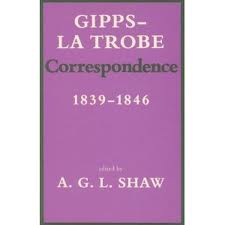
It is the interplay of personalities that is most clearly on show in my favourite of his works, and one that migrates frequently between my bookshelf and my desk: the Gipps-LaTrobe Correspondence,  written in 1989.

This is an edited collection of the ‘back-channel’ personal correspondence between Governor Gipps in Sydney, and Charles La Trobe, the first superintendent appointed to the nascent settlement of Port Phillip.  La Trobe was, perhaps, an unusual candidate for appointment.  Unlike many of the colonial appointees, he did not have a military or judicial background- indeed, he had spent quite a bit of time ‘rambling’ in Switzerland, then camping with Washington Irving in North America.  He had, however, worked on three reports on the emancipation of West Indian slaves in the mid-late 1830s, and it was this work that brought him to the attention of the evangelically-inclined Secretary of State, Lord Glenelg at a time when the Colonial Office was particularly attuned to the recommendations of the Select Committee on Aborigines (British Settlements). La Trobe brought with him his Moravian background, but he had had no experience at all in administration, and he was appointed as subordinate to Governor Gipps, an older and much more experienced officer of military background in Sydney.  La Trobe stayed briefly with Gipps en route to Melbourne, and the warmth of the relationship they established there is reflected in these personal letters.  It is a largely one-sided collection of correspondence, with relatively few letters remaining from La Trobe to Gipps, but as with such archives, it is possible to detect the tenor of the missing correspondence.  A.G.L. Shaw’s contribution to this collection is his extensive and minutely-detailed footnotes to the letters, providing not only context, but also small details of who, where, when. He is so sensitive to the reader’s needs that almost as soon as the question about something you have read forms in your mind,  the footnote number pops up to show you that Agl has thought about it before you.  And so, from a rather over-awed distance, thank you Agl Shaw.

‘Alexander Macleay: from Scotland to Sydney’ by Derelie Cherry

2012, 415 p & notes  (Review copy)

What a beautiful book! was my initial response on opening this book.  Like Alice in Wonderland’s sister, I am accustomed to my colonial biographies arriving without pictures or conversations, and if by chance there are pictures, it is usually a set of black-and-white pictures inserted in two or three places in the text.  But this book is a well-bound hardback, complete with ribbon place-keeper, with a coloured and gold-embossed dusk-jacket that envelopes an even more beautiful cover underneath.  It shows Conrad Marten’s painting of the landscape surrounding Elizabeth Bay House, built by Alexander Macleay, and possibly the best known association that many of us have with Macleay today.  The fly-leaves of the book are patterned with thistles, reflecting Macleay’s Scottish origins, and the book is replete with vividly coloured photographs.  The book has many of those features that publishers seem to begrudge these days: footnotes AND a bibliography, index and timeline.

I’m not accustomed to such luxury in my history books, although two other recent beautiful publications in Australian History spring to mind: Grace Karsken’s The Colony and Bain Attwood’s Possession.  But both these books, written by noted and established historians, dealt with the founding of the two largest cities in Australia, and while being strongly academic texts, could be expected to- and did- attract a broad readership and both garnered significant history awards.  Who, I wonder, is the audience for this beautiful book?

Alexander Macleay (1767-1848) was born in Scotland and did not arrive in Australia until 1826 at the age of 59 to take up the position of Colonial Secretary, alongside the new governor Ralph Darling.  By this time, he had a large family (17 children!- although only 10 survived to adulthood) and he was accompanied to Sydney by his wife and six daughters and an extensive private collection of insects and objects from all over the world. As Secretary of the Linnean Society in London, he had contacts with scientific boards and their gentleman collectors across Europe, and his interest in botany and natural history continued in NSW where he not only served as patron of the fledgling societies established amongst the colonial gentry here (including the Museum and the Botanic Gardens), but also maintained his networks with the natural history community back home.  His daughters married into the colonial elite of Sydney society, and his home Elizabeth Bay House was noted for its extensive and exotic gardens, through which he introduced many plants into Australia, including the wisteria.  His close association with Governor Darling meant that he had to share the increasing acrimony directed at Darling, and his career ended ambiguously and unhappily under Governor Bourke, with whom he never established the same rapport. However, with the granting of a limited degree of self-government in 1842, Macleay offered himself for election to the Legislative Council where he was voted Speaker, a position in which it was acknowledged, even by his political opponents, that he served well.  But despite (and perhaps because of) the rapid accumulation of land,  he fell victim to the widespread depression of the 1840s, and was forced to move from his Elizabeth Bay House, estranged from his eldest son William who had taken over his finances.  His scientific collection was eventually transferred to the Macleay Museum at the University of Sydney, where it still rests.

So which of these aspects of Alexander Macleay- civil servant,father, naturalist and collector, owner of one of Sydney’s grandest colonial homes, patron and politician- might attract readers to this book?  A well-rounded biography would incorporate all of them, of course, but an insightful, scholarly biography would do more than  enumerate achievements: it would also mount an argument about the individual that is woven into a broader approach to a society, a movement, a time.

The approach that a book is adopting is usually foreshadowed and shaped in the introduction, which in this book takes the form of a literature review, emphasizing that this is the first comprehensive biography of Alexander Macleay and questioning in particular the depictions of Macleay in the works of Stephen Roberts and Manning Clark.  The author takes up where an earlier researcher into the Macleay family, Annabel Swainston,  left off, citing frequently from Swainston’s papers which are now placed in the Macleay Museum.  Reading as an historian then, I found myself wishing that she would move back from her subject, and integrate her observations into a broader scholarly context.  Macleay is a prime example of the collector-networker described in the work of Zoe Laidlaw and Lambert and Lester, and yet this whole approach to empire is largely invisible.   Macleay’s prominence as a conservative is noted, but not taken any further.  A large portion of the book is devoted to Macleay’s gardening and horticultural significance and yet the work of Katie Holmes and others about the meaning of the colonial garden is nowhere to be found.  The blurb from Professor Stephen Garton from the University of Sydney describes her work as a “path breaking piece of forensic research”, and “forensic” is exactly the right word to describe this very close-up, detailed analysis.  However, I found myself craving a bit of distance, and a broader sweep that pointed out the ways in which Macleay was acting as a man of his time and place, and where, if anywhere, he was distinctive.  Having said that, though, her description of the Colonial Secretary’s office was illuminating, bringing to life the men behind the different scripts that you note in reading the primary sources, and her analysis of the financial entanglement that so damaged his reputation was insightful.

What, then, of Macleay’s activities as collector and horticulturalist?  In these sections, the fine-grained approach serves her well, resonant of the painstaking minutiae of the collecting and classifying mindset.  At times, however, the detail and connections seem rather laboured and indulgent: a glorious photograph of a dahlia from her garden that Alexander “would have been among the first to grow” and sweetly-scented stocks that the Macleays “certainly would have included” in their garden, perhaps moves the book towards the ‘significant garden’  market.   Given the prominence of Elizabeth Bay House as one of the foremost homes overseen by the Historic Houses Trust in NSW, I found it strange that the house itself played a minor part in the book if it is directed towards the gift-book buying public who may have visited the house, or those who may appreciate the importance of Elizabeth Bay House amongst our colonial architectural heritage.

And so, I find myself somewhat confused over how to appraise this book. It is a close-grained biography that could have benefited from more distance and a broader sweep.  It is also a particularly beautiful publication, that reflects no doubt the author’s experience in publishing over many years, and her own love of gardening and her family connection with Paradise Gardens and Nursery in Kulnura, west of Gosford.  The combination of the two is rather puzzling- appreciated, but puzzling nonethess.

This book was provided as a review copy by Paradise Publishers, Kulnura.  Available at www.alexandermacleay.com

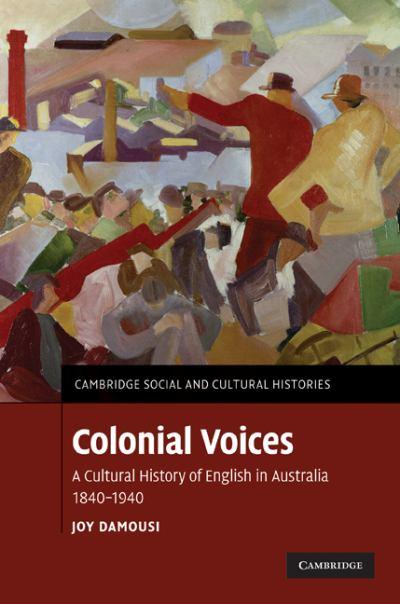
‘Colonial Voices’ by Joy Damousi

Joy Damousi, Colonial Voices: A Cultural History of English in Australia 1840-1940, Cambridge University Press, 2010, 295 p.& bibliography

Historians have always privileged the written over the spoken, and the visual over the aural.  It’s no wonder: few of us consciously document the sounds around us, and it is only occasionally that we become aware of their passing. Think, for example, of the flash of recognition that you probably experienced the first time you heard that current mobile phone ring tone that replicates the echoing, mechanical bell of an old fashioned, black, dial-up telephone.  I think of the little ‘tune’ that modems used to play when you were connecting to the Internet: it was a sound unheard twenty years ago, and probably will no longer be heard twenty years hence.  Then there are familiar childhood sounds that time and development have erased: the ‘chuck-chuck’ of a rainbow sprinkler on the front lawn, the sound of the milkman’s horse.

Joy Damousi’s book Colonial Voices focusses on the Australian voice in particular.  As I trawl though my 1840s Port Phillip documents,  I’ve found myself wondering about the actual, physical voices that would have accompanied the words that I am reading.  How, for example, did speakers get themselves heard at these rowdy meetings in support of, or against, Judge Willis?  In a new community supplemented  constantly with waves of new immigrants especially from Britain, and the stream of colonists from New South Wales and Tasmania (some of whom were native born), did people lose their accents within a generation as seems to occur today- or is that only with NESB people?  Did the Australian-born child of a Scots family sound different to the Australian-born child of an English family?

Colonial voices were not superimposed into a silence: Aboriginal voices were raised, and then largely suppressed.  The first chapter of this broadly chronological book investigates the role of missionaries and educators in teaching English to Aboriginal children in an attempt at first to make them  English, become English, and also as a way of drawing a dichotomy between savagery and civilization.  The second chapter examines the emergence of public speech in Australia during the 1840s in the male-dominated political and public arena- and here of course, I read closely, aware that the controversy over Judge Willis was carried out in this milieu.

Chapters 3, 4, 5 and 6 examined the phenomenon of elocution, which was promulgated through books, classes, speech nights, eisteddfods and  paid performances.  At this point of the book, I felt as if I was stuck in a bit of whirlpool.  Many of the examples quoted seemed rather repetitious, and although she distinguished between expectations exhorted from overseas and those that emerged from within Australia itself, their content seemed pretty much the same.  While at pains to emphasize the celebrated status of various practitioners, their names mean nothing today and although this section of the book covered about 60 years, there did not seem to be much difference from one decade to another.

The narrative picked up, however, from Chapter 7 onwards. Vita Goldstein and Alfred Deakin were used as two examplars of public political speech, at a time when political speech was a way of agitating for political change, and when the relationship changed between speaker and audience from one of recipient to participant.  During WWI, in Chapter 8, there was a move towards a less formalized form of public speech, and elocution was now seen more as a distancing mechanism.  Mourning and commemoration ceremonies, soldiers’ slang, and school-based patriotism encouraged a distinctive Australian eloquence.  She picks up on the debate about the “Australian sound” in Chapter 9 that was carried out in literacy circles and etiquette manuals.

This debate was heightened by the introduction of radio, discussed in Chapter 10, both as a form of connection to the wider British Empire, but also as a way of creating and promulgating an Australian Sound.  The introduction of sound to film and the dominance of American film in particular, is discussed in Chapter 11, leading us up to the 1940 cut-off for the book.

This book took me into byways and places that I did not expect. I liked the emphasis on gender that ran throughout the book, especially in the chapters on political speech.  However, I was puzzled by the relatively slight treatment given to the bush nationalism evoked by Lawson and Banjo Patterson which, even today, are the backbone of a particular form of oral performance.  I think of the School Readers,  produced between 1927-30 and still in use even within my own educational history during the 1960s,  and how poetry in those books formed the basis of  oral performance in schools.  I was also disconcerted by the prevalence of small proof-reading errors, especially in a book published by Cambridge University Press.  I counted six which seemed to cross some sort of threshold for me, making me hyper-critical of editorial foibles.  It was all rather paradoxical (or was it some form of reflexivity?) , given that much of the book was devoted to concepts of ‘correctness’.

However, a marker of whether a book is working on you, might be the way that you notice things with new eyes, or in this case, ears.  I was sitting reading the book, conscious that a workman was talking loudly on his mobile phone in the driveway of the street across the road.  Likewise, I could hear a construction worker on a block in the next street on his phone.  I could not catch every word, but had I concentrated I could have followed the one-sided conversation.  I set Mr Judge, who is fond of such puzzles, to work out how many people would be able to hear a speaker in a crowd without amplification.  He estimated that to speak to a crowd of 20,000 people, you would have to be able to project your voice to a distance of 60 metres.  Take it from me, the chippies and builders of Melbourne can do this with bells on.

Wonnangatta

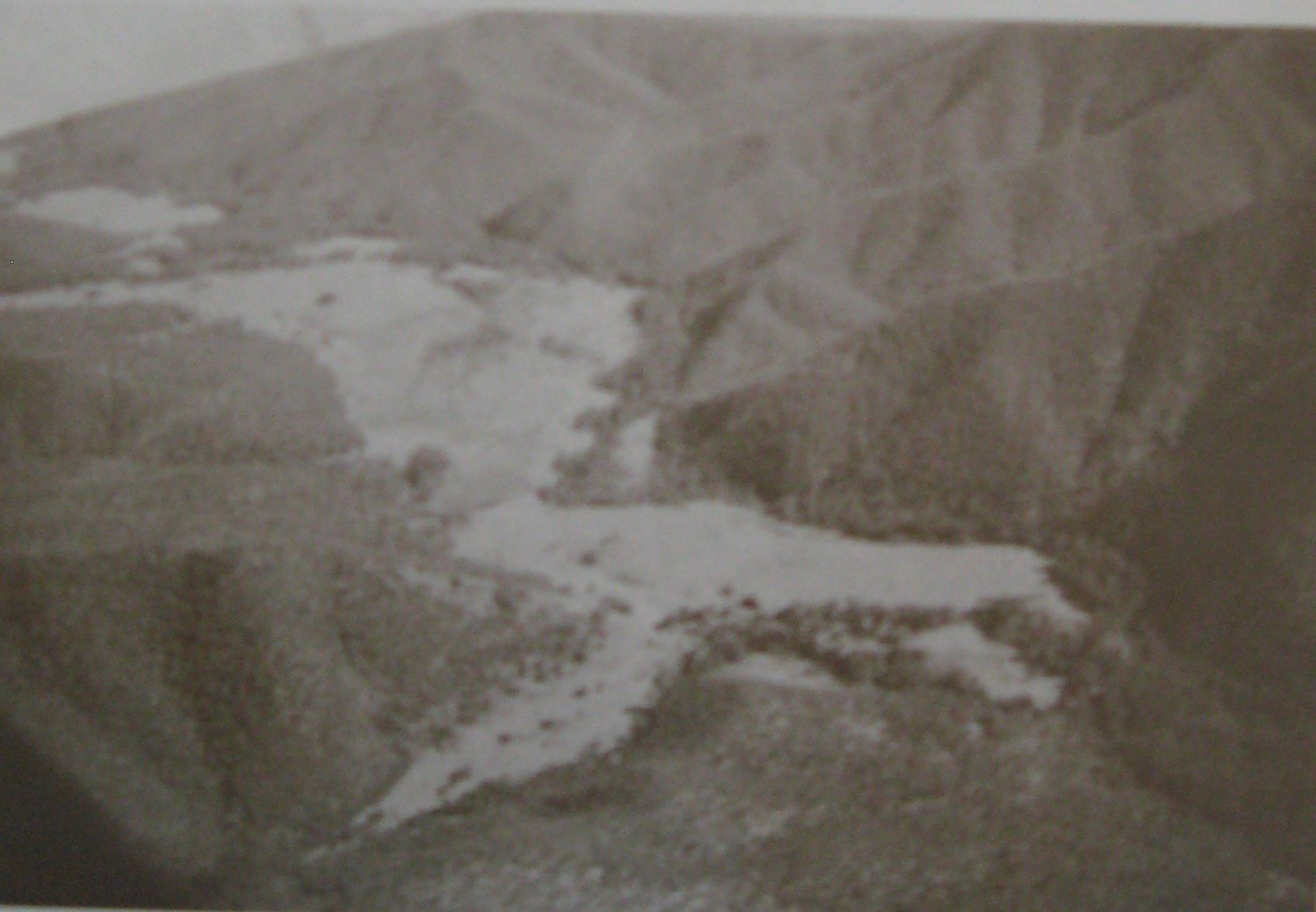
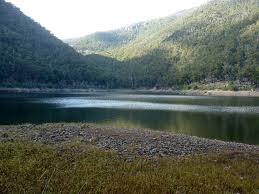
Inspired by the ‘Pioneers of Bushwalking’ exhibition,  I turned to an article in the most recent Victorian Historical Journal about the Melbourne Walking Club’s trek to Wonnangatta in Easter 1936.  The article, written by one of the walkers is written in the rather flippant, “what-an-adventure!” tone that we use for holiday emails or blogs today. What really intrigued me in the article was a photograph accompanying the article, now part of the RHSV archives, showing Wonnangatta homestead as a mere speck on a wide, grassed plain that opened up amongst the folds of the surrounding mountain peaks.  The photograph below is not the one in the article but it gives an idea of the remoteness of Wonnangatta and the splendour of the landscape.  What particularly struck me was that there are no roads at all.

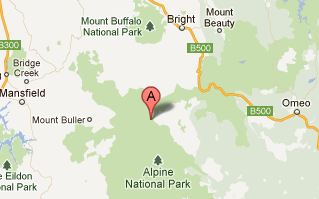
Wonnangatta was, until late in the 20th century, Victoria’s most remote high country cattle station.  It is located in the high country east of Mansfield and as late as 1947 it could be claimed that there were no records of a wheeled vehicle ever visiting it (although the claim was qualified by noting that a dray was built in-situ at Wonnangatta and two bicycles were carried in). It is two-and-a-half day’s horse ride from Mansfield, and a day-and-a-half from Dargo.

It is ironic that in many ways Wonnangatta was more accessible in the 1860s than it was a hundred years later (after which four-wheel drives became more common).  During the 1860s Gippsland gold rush a number of small towns sprouted around the Crooked River, Snake Creek and Jungle Creek diggings, connected by a pack-horse trail. Twenty to thirty horses would be saddled with two padded flaps on either side, joined at the top with iron loops like an inverted U to which hooks were attached and loads secured.

Wonnangatta at the time lay on this trail, and was visited by William Bryce and his pack-train who brought supplies to Oliver Smith who had settled there with his sons, his second ‘wife’ and her son Harry from a previous marriage.  Bryce decided to bring his wife and six children there as well, and the men from the two families worked together to build Wonnangatta Homestead.

What an isolated life for these two families!  Ellen Smith died in childbirth in 1873, giving birth to twins who both died within a week.  Oliver Smith quit the station with his sons, signing it over to Bryce and did not return, although his youngest son Harry did come back later.   Two years later, Mrs Bryce also gave birth to twins, attended only by her thirteen year old daughter. A year later the ninth and  final child, Cornelius, was born.

Wonnangatta Homestead itself consisted of two parts.  The first section, constructed jointly by Bryce and Oliver and Harry Smith consisted of five rooms, and this was extended by a second section of nine rooms, joined to the first by a covered verandah.  Bryce employed a cabinet maker to assist with the construction, and he built furniture from locally grown blackwood that was so heavy and well-constructed that it was left behind when the homestead was sold in 1914 to pastoralists who let it fall into disrepair when they used it as a storage shed.  In the main bedroom was a triple-doored wardrobe almost ceiling height with a large drawer at the base; there were carved mantlepieces, and elaborate sideboards, tables, chairs and ottomans.  The house was wall-papered in a green-and-gold design throughout (even the kitchen!), although in later years this was covered by layers of newspapers.  The homestead survived the 1939 bushfires, only to be burnt down some time between a visit in 1955 and the next visit two years later in 1957.

Although remarkable for its remoteness, Wonnangatta may have remained largely unknown except for two murders which occurred there in December 1917/January 1918.  The body of the caretaker, Jim Barclay was discovered by one of Wonnangatta’s first white occupants, Harry Smith, who lived in (relatively) nearby Eaglevale, by now an elderly man, who used to call in one every three weeks or so with the mail.  At first the cook John Bamford was suspected of the murder, but his body was also found some months later.  The mystery was never solved, despite wide coverage of the inquests and investigation in the newspapers.

The mystery of the murder is the main focus of a small publication on Wonnangatta called The Saga of Henry Smith by Geoffrey H. Mewton, with contributions by B. Alex Trahair and Ellen Walsh.  This is a small, typewritten publication of 24 pages, written in Melbourne in October 1984.  It comes with a rather forthright claim to accuracy:

This is a historically accurate account of some of the events which took place in the Wonnangatta Valley in northern Gippsland and the surrounding mountainous country from the early 1860s until the year 1945 when Harry Smith died.  This area is probably the most isolated and remote part of Victoria and until recently was unknown to most people, except of course to the few inhabitants themselves and the very occasional and more adventurous walker. … Before commencing writing I had read many books on the general subject of the mountains and the people who lived in them and with the exception of Wallace Mortimer, I was so surprised to find many authors giving inaccurate accounts of these people, particularly regarding the mysterious murders which occurred there, that I felt in necessary to make an accurate record.

The following is therefore the outcome of talks with people who lived in this country…Nothing is mentioned that is not from first hand information from talks with the people involved.  Nothing is the result of gossip or hearsay. (Foreword)

A similar claim to accuracy is found in the aforementioned Mortimer book History of Wonnangatta Station by Wallace Malcolm Mortimer, published in 1980:

This book is not intended as a novel, but simply as a document of facts.  There is very little information in this book that is hearsay; all statements have been checked and verified by documents, or are quoted from first hand knowledge.  In the course of research hundreds of miles have been travelled, and no stone has been left unturned in an attempt to gain the truth. (Author’s Note).

Neither book names the perpetrator/s of the murders, although they both hint that the authors, like their informants from the Wonnangatta area, know but they ain’t telling.

It is no doubt a reflection of their time and purpose, but both books blithely assume (despite the very name of the homestead and the nearby river) that this vast, grassed area was some kind of untouched pastoral Eden, lying waiting to be discovered.  Of course, such a fertile, watered expanse would have been well known to the local aboriginal people who had incorporated it into their  dreamings, along with all the mountains and waterways of the surrounding areas.  This is mentioned, almost in passing on p. 63 of Mortimer’s book where Bryce and another farmer, Riggall were the first white people to see Lake Tali Kargn in the heart of the forest near Mt Wellington, closer to Dargo.

As Mortimer notes:

Evidently during one of Bryce’s visits to Glenfallock he was out riding with Riggall and an aboriginal who worked on the station.  As they approached a certain tract of the country the aborigine, who was very old, became agitated and told them not to go any further because of the evil spirits.  This only spurred their curiosity and they rode on and found no evil spirits but the mountain lake.  Tali Karng is aboriginal for “Little Lake”, and the aborigines believed that it was inhabited by evil spirits because they could see water running into the lake but no evidence of water running out. (p.63)

Where the Mewton book clearly focusses on Harry Smith, who had a rather ‘Clancy of the Overflow’ reputation, I was less clear about the intent of the Mortimer book.  However, this all came clear in the final chapters where he mounts a lengthy argument for the building of a road between Buffalo and Wonnangatta as a way of opening up tourism, driving and forestry traffic between Gippsland and the high country.

I’m rather glad to think that his pleas fell on deaf ears, although it does seem from a Google search that 4 wheel drivers, deer stalkers and bushwalkers make their pilgrimages there.  It was also the site of a mountain cattlemen’s protest ride in recent years as part of their lobbying to have National Parks re-opened for cattle grazing. How curious that politics should reach all the way to this remote spot.

References:

Brennan, Nial ‘Historical Aspects of the Wonnangatta Valley’ Victorian Historical Magazine, vol 22, 1947, pp. 67-84  (available online at SLV)

Davey, Trevor W. ‘The Trail to Wonnangatta’ Victorian Historical Journal Vol 82, No. 2 November 2011 p.217-235

Hogan, Peter ‘The Trail to Wonnangatta, Easter 1936: Introduction’ Victorian Historical Journal Vol 82, No. 2 November 2011 p.212-216

Mewton, Geoffrey H. The Saga of Harry Smith, Melbourne, typescript, 1984

Mortimer, Wallace Malcolm History of Wonnangatta Station, Melbourne, Spectrum Publications, 1980

Trove

Argus 28 February 1918

Argus 1 March 1918

Argus 2 March 1918

that’s enough- search for yourself!!!

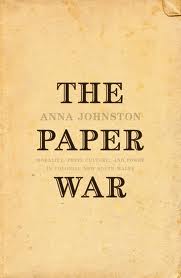
‘The Paper War’ by Anna Johnston

Anna Johnston The Paper War: Morality, Print Culture, and Power in Colonial New South Wales,  Crawley Western Australia,  The University of Western Australia Press, 2011.226 p. Plus notes

Now that my thoughts are actually turning to writing my big baggy monster of a thesis (stifle those snorts of laughter, please) I’m finding myself conscious of the way other writers are treading the tenuous line between ‘straight’ biography and something that’s not quite biography.  The Paper War by Anna Johnston is one such book.  Her focus is on Lancelot Threlkeld, the NSW missionary, and the texts he generated  by and about  his colonial experience. But it’s not a biography of Threlkeld as such, and the author is at pains to reinforce this distinction.  Her work is not history, or biography, but a literary/cultural study which

examines the archive as a set of writing and reading practices, seeking to make different meanings than a historian might.  The Paper War retells stories found in archives as well as revealing modes of construction, in order to create new narratives. It foregrounds the complexity (perhaps the impossibility) of efforts to establish coherent, credible narratives from partial sources  (p.4).

This means that, as well as looking at the content of a particular source, she also asks about the source itself : how did this document/series of documents come to be created?  What are the institutional structures, and individuals within those structures, that created them? Can we rely on these texts as stable and authoritative guides to the past? (p.4)   She is insistent on maintaining this emphasis on text as a mediated material when her reader’s attention might drift into the biographical corridors of  chronology and lifestory instead.

Her book focuses on the writings by and about Lancelot Threlkeld, the missionary in charge of the Lake Macquarie Aboriginal Mission in New South Wales in the 1820s, a man rather unkindly described as one of the “perpetual blisters” that the London Missionary Society (LMS)  seemed “destined to carry”.  He certainly seemed a rather pugnacious and belligerent character as a missionary and his writings to attack his adversaries and defend his own position generated what could well be described as a “paper war’.  As is often the case, his own irascibility was  in response to, and elicited, similar traits in his main clerical adversaries: the equally combative  Rev. Samuel Marsden and the protestant cleric John Dunmore Lang.  What a combination!  I’m particularly interested in this combustible 19th century character type, because our own Judge Willis himself exhibited many of the same traits.

Surrounding the Threlkeld/Marsden/Lang sparring ring were representatives of the broader 19th century  humanitarian network.  Daniel Tyerman and George Bennet were missionary agents charged with overseeing Threlkeld’s establishment of the mission at Lake Macquarie under the auspices of the London Missionary Society and thus his immediate supervisors.  James Backhouse and George Washington Walker were peripatetic Quaker investigators whose opinions were valued by metropolitan humanitarian networks for their independence and clarity.  The Paper War is very much embedded in the historiography of the ‘networked’ image of the British Empire (Zoe Laidlaw, Alan Lester, Kirsten McKenzie etc) and these agents and investigators exemplify the way that ideas were circulated throughout the empire by missionaries, intellectuals and London-based groups like the Ethnological Society of London.

The book itself has five main chapters, an introduction and a conclusion.  The first chapter, ‘Colonial  Morality’ gives a brief biographical account of Threlkeld’s career along with the careers of his major protagonists and the circumstances that led to the intersection of their careers with his.  The second chapter ‘Colonial Linguistics’, looks at Threlkeld’s pioneering work in researching the language of the tribes surrounding Lake Macquarie, and she traces the evolution in his thinking about how language can be studied and depicted.  His earliest work in 1825 was an attempt to develop an orthography (spelling) for an Aboriginal language, mainly in the form of question and answer phrases, strongly based on Europeans assumptions about categories and sentence structure by imposing  an artificial  one-to-one match between English and Aboriginal words.  In 1834 he changed his methodology to investigate the grammar of the language, followed by another work in 1851 written for the Great Exhibition in London called A Key to the Structure of the Aboriginal Language.   As was common at the time, colonial collectors were expected to scoop up the raw materials of plants, animals, languages and ethnography, which were channelled to the ‘experts’ in London for ‘proper’ classification and analysis.  She traces the use of his work by such ‘experts’, especially the way that it was posthumously re-published and co-opted as part of late 19th century racial theories.

Chapter 3, ‘Colonial Press’ shifts its focus to the newspaper record generated by and about Threlkeld, especially in relation to the execution of Tommy, an aboriginal prisoner for whom Threlkeld acted as interpreter.  This execution itself became subsumed within a broader sectarian argument, and in February 1828 Threlkeld wrote a series of letters to the editor- a common feature of colonial newspapers- against the Catholic Church.

Chapter 4 ‘Colonial Respectability’ takes up Threlkeld’s Statement Chiefly Relating to the Formation and Abandonment of a Mission to the Aborigines of NSW; Addressed to the Serious Consideration of the Directors of the London Missionary Society, written to justify his actions as missionary at Lake Macquarie.  Despite its title, it was not aimed at the directors of the LMS alone: he had at least 270 copies printed and distributed it to every director and missionary in the LMS network.  It is a 72 page document, largely composed of letters written and received in relation to the Lake Macquarie mission. Threlkeld’s adversary J. D.  Lang waded into this documentary swamp with his own series of newspaper articles criticizing the mission and Threlkeld’s character as a missionary, culminating in a civil court case Threlkeld v Lang in 1836.

Chapter 5 ‘Colonial Legality’ remains in the courts, but here investigates Threlkeld’s work as an interpreter in the courts, and his position and increasingly critical stance over questions of the amenability of Aboriginal people to British law, the use of Aboriginal evidence and questions of sovereignty.

The  conclusion of the book picks up themes from the introduction by returning to the question of historians’ uncritical use of the colonial archive.  Both Henry Reynolds and Keith Windschuttle as combatants in the ‘History Wars’ share, she claims, a “remarkably simple” view of the archive as unmediated primary source material that can be drawn out to construct a narrative. She picks up on Kevin Rudd’s championing of Thomas Keneally for the background in literary fiction that he brings to his retelling of Australian history (an issue also pertinent with Kate Grenville’s recent works). And here we are returned to the question of the heart and the affective world so prominent in the humanitarian world view, including that of Lancelot Threlkeld.

As I mentioned earlier, I was particularly interested in the structure of this book for my own work, given that it takes an documentary archive deeply imbued with questions of personality and temperament.  I ‘m interested by the decision to place Chapter 2 where it is- perhaps because Threlkeld’s linguistic work has been somewhat overlooked?- because it seems more related to Chapter 5.  I’m impressed by the way that her strong, minimalist chapter structure forces the reader’s attention on the form rather than the content of the archive. The book is on one level about Threlkeld , without being a biography as such, but on another level it works on a much larger canvas.

You can download a generous extract of the book here.

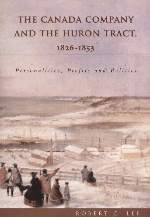
‘The Canada Company and the Huron Tract 1826-1853’ by Robert C. Lee

Robert C. Lee The Canada Company and the Huron Tract 1826-1853: Personalities, Profits and Politics, Toronto, Dundurn, 2004, 304 p.

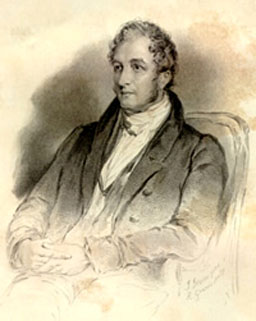
Thomas Carlyle is supposed to have said “Show me the man you honour, and I will know what kind of  man you are.” In this spirit, I read this book not out of any over-riding interest in the Canada Company per se, but because its first director, John Galt, was a close friend of Judge Willis’ in Canada.  It would seem that both men considered the other an honorable man.  They socialized in York together and they supported each other, so I was interested to see what sort of man John Galt was.

Lee’s description of John Galt is as follows:

A man of many talents, he was a well-travelled, big-picture visionary who was at once restless, energetic, scholarly, absent-minded, combative, disorganized, opiniated and well-connected in high places… (p.45)

John Galt  was born in Scotland in 1779, the son of a ship’s captain and an eccentric mother.  Even though he was extremely tall, he suffered from ill-health throughout his life and was educated at home.  His literary bent was established in childhood, and he become well known for his book A Statistical Account of Upper Canada (1807) which he cobbled together without setting foot in the place, largely from the observations of his cousin who worked as a captain on the Great Lakes.  He commenced studying law, but after a breakdown in his health, he travelled to Greece and Malta,  hung out with Byron, and organized the shipping of the Elgin Marbles.

He  published a number of literary works including novels, plays and fictionalized autobiographies.  He supplemented his literary career with work as a parliamentary lobbyist, first for the backers of canal building in Scotland, then for Loyalists along the Niagara frontier seeking redress for their losses in the 1812 War .  He became lobbyist and later operations manager for the Canada Company, which had a plan to purchase lands in Upper Canada that had been set aside for government and church purposes,  survey and package them up for sale to British emigrants.  When the Anglican Church in Upper Canada resisted losing their land, the Canada Company was offered instead a huge, unsurveyed expanse of First Nation land called the Huron Tract. In the final settlement in 1826, the company purchased 1.3 million acres of crown reserves throughout Upper Canada, the Huron Tract, and a million other scattered acres for the uniform price of 3s.6d per acre.

It is sobering to remember that, despite its blustering proclamations of policy, the Colonial Office was often making things up as it went along, especially in the early 19th century.  In the early 1820s the empire stretched across the globe and was still growing, but Britain itself was squeezed by the post-Napoleonic  War slump.  There simply wasn’t the money to pour into infrastructure for the immigration that Britain was encouraging as a solution to domestic unemployment.  There were demands for compensation and rewards for soldiers who had fought in the Napoleonic Wars, loyalist settlers who had fought in the War of 1812 in America, or schemes for resource development and convict labour in New South Wales and Van Diemens Land.  And that’s where private enterprise came in.

In what seemed like a win-win situation, charters were given to private companies of London-based stockholders to purchase huge tracts of land at a fixed price, with the expectation that the company would take over responsibility for infrastructure and settlement schemes.  There may well be others, but I’m aware of the Canada Company, the Australian Agricultural Company formed in 1824 and the Van Diemens Land Company in May the same year.  The two Australian companies were formed with a view to establishing a pastoral industry to provide wool for Britain’s industrial sector  using convict labour, while the Canada Company was established to encourage agricultural settlement by British settlers to counter the American influence from the south.

It was a huge outsourcing of colonialism, and within twenty years the Colonial Office was backtracking, realizing that perhaps they could have asked more for the land given so liberally.  My only real awareness of these companies was that there was a sense of disquiet over the sheer size of the holdings appropriated and privatized in this way, and the linking of the Van Diemen’s Land company with the Cape Grim massacre.   I  was surprised to learn that these three companies were so long-lived.  The Canada Company was dissolved in 1954 with its final licence cancelled in 1961; the  Australian Agricultural Company (now known as AACo  )is  the largest cattle producer  in Australia holding 7 million hectares of land across Queensland and the Northern Territory, and the Van Diemen’s Land Company still exists.

And as for John Galt and John Walpole Willis?  Well, they were kindred spirits in personality, and their fortunes rose and fluctuated in Upper Canada along a similar trajectory.  They both clashed with members of the elite in York, and fell out with the Governor.  When Willis was removed, he put his family affairs into Galt’s hands, but Galt was removed by the board of the company back in London some six months later.

The emphasis in this book was on the Canada Company, and Galt played a role only in the opening chapters.  If I want to find out more about him, I’m going to have to look elsewhere, and I’m tempted to dip into some of his writing instead (especially his autobiography).  But quite apart from John Galt himself, the book provided an insight into the tension between a board of directors back in London, and “localitis” -i.e. the tendency of their operations managers sent out to Canada to become too embroiled in local politics, too generous in public works, and too squeamish to enforce the company’s interests at all costs.  It’s a sobering thought in these days of multinationals and state-based foreign enterprises.

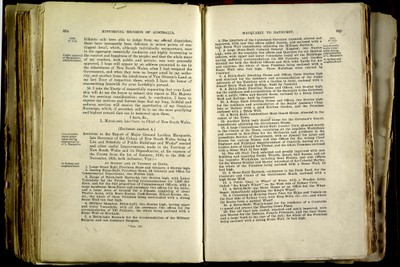
Historical Records of Australia


Looking for online? Go to the bottom of this posting.

The Historical Records of Australia comprise three series of volumes. Within the series,  each separate volume is about 900 pages in length, containing transcriptions of the official documentation between the Colonial Office and the local governments in the different states.    Series I provides the Governor’s despatches to and from England, Series III contains documents related to the settlement of the states  (especially Tasmania)  while Series IV which has barely begun, features documents relating to the legal system.    Volume 8 of Series III only appeared in 2003, and Volume 9 in 2006.  Series II  never appeared at all.

The early volumes were collected and published by the Library Committee of the Commonwealth Parliament between 1914 and 1925.  James Frederick William Watson was the editor.  According to his ADB (Australian Dictionary of Biography) entry, he was a medical doctor and historian.  He was appointed a trustee, then acting principal librarian at the Public Library of New South Wales.  In this position, he inherited the responsibility for transcribing the official New South Wales documents and the papers held in London, a task commenced by F. M. Bladen and James Bonwick separately some  years earlier.  The Commonwealth agreed to finance the project in 1907 and the project was expanded and retitled as The Historical Records of Australia.

This national vision, in the years following Federation is important.  Until then, transcriptions of records had been undertaken on a state-by-state basis, largely by James Bonwick who had been contracted to make copies by the Queensland,  South Australian, Victorian and Tasmanian and later NSW governments separately, and by Barton and Bladen for the  NSW papers.  Indeed Bonwick’s entry in the ADB suggests that Watson used Bonwick’s work without acknowledgment in HRA .  The compilation of the Australian historical records was a task hemmed in by constraints. When Bonwick made his transcriptions in London, he was not allowed to include the minutes written on the papers by the Colonial Office bureaucrats (a fascinating counter-narrative that runs alongside the official stance).  Bonwick had included newspaper articles and engraved illustrations in his collection, but had left out other information in deference to the sensibilities of families who were  still sensitive about convict origins. There were no official archives at all at this stage- South Australia was the first state to establish its own state-based archive in 1919- and papers were distributed across several government departments (Chief Secretary’s office, the Supreme Court, Lands Office etc) as well as in private hands.

The vision for the project was broader than the eventual product.  Watson envisaged seven separate series, of which only three ever appeared (I, III, IV)

I Despatches of Governors To and From England

II Papers belonging to the general administration

III Settlements in the different states

IV Legal papers

V Explorations

VI Scientific

VIII Ecclesiastical, naval and military papers.

In 1917 the Library committee agreed that they would limit the scope of HRA to 1856, the beginnings of responsible government, with the states taking over their own publication programs for material after 1856.

Each volume of HRA commences with a commentary of the years and issues covered.  Watson’s ‘untutored prose’ was criticized and George Arnold Wood, the professor of History at the University of Sydney was appointed literary consultant.  Unfortunately he was unable to persuade Watson to provide evidence of the documents’ locations, although today it is sufficient to just cite ‘HRA vol xxiii’ etc.

Between 1914 and 1925, with a 2 year suspension during WWI,  Watson  collated, edited and supervised the publication of 33 v0lumes of documents covering the period 1786 to 1848.  Of course, he did not do this completely alone, and there are a string of assistants (many of whom were women) who remain largely invisible in the finished product.  By 1925 Watson’s relationship with the library committee had broken down resulting in legal proceedings and the collapse of the project. The project was recommenced in 1997 and the volumes produced since then in the ‘resumed series’ appear sporadically, published by Melbourne University Press and the University of Tasmania.

Most large libraries have the series, usually in the reference section but the older ones in particular are getting pretty tatty and worn and there’s a danger that they’ll be whisked off into some ‘rare books’ section where they’re no earthly use to anyone.

And so, I was absolutely delighted to find them online at a NSW government site (even though they were huge PDFs and took a long time to download). But then – oh, no! they disappeared.  Thank heavens that La Trobe University has since digitized them, and they’re available through their Research Repository. But you need to be a bit of a sleuth.  First go to their Research Repository at http://www.latrobe.edu.au/library/research-and-grant-support/research-online

Then type in “Historical Records of Australia” in inverted commas and -voila! They have been helpfully broken into smaller, dated PDF files as well as a larger file, so that if you know the date, you don’t need to download the whole thing.  There is an index at the end of each volume

References:

Ann M. Mitchell (1982): Doctor Frederick Watson and historical records of Australia , Historical Studies, 20:79, 171-197  (She also wrote Watson’s ADB entry).

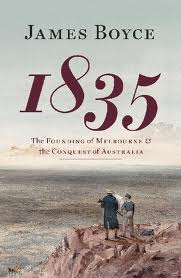
‘1835’ by James Boyce

James Boyce, 1835: The Founding of Melbourne and the Conquest of Australia, Black Inc, Melbourne, 2011.  212 p & notes

At last! I thought when I finally got my hands on this book.  In fact, three ‘at lasts!’  I’m almost sure (nothing is really sure these middle-aged days!) that I read about this book at the beginning of 2010 when publishers were spruiking the books that were about to appear during the year.  I waited throughout 2010 but no sign of it.  And now- here it is.  And ‘at last!’ I thought because in the closing chapters of excellent previous book, Van Diemen’s Land, James Boyce clearly signalled that, just like Tasmanian settlers themselves, his own  thoughts about Van Diemen’s Land crossed the strait as well.  And ‘at last!’ again  I thought because in reading about the early history of the Port Phillip District – for example in A.G.L. Shaw’s A History of the Port Phillip District – you find yourself wondering if Port Phillip will ever get itself off the ground.  Navigators just kept sailing past it, missing the bay completely; Collins picked up sticks and decamped for Hobart after a short time, and the aborted and rather half-hearted  attempts to establish a settlement on Westernport Bay sputtered away fitfully.  Like a car with a flat battery, the Port Phillip settlement just didn’t seem to be able to turn over and take off for decades.

Boyce describes the arrival of squatters coming across from Launceston in 1835 as “a brazen act” that “would shape the history of Australia as much as would the arrival of the First Fleet in 1788” (p xi). It’s a big claim:

…the policy turmoil which followed the establishment of a squatters’ camp in 1835 had an significance far beyond the baptism of a great city.  In this place, at this time, ‘Australia’ was born. (p. xiii)

As might be expected from the title, Boyce starts his book in the year 1835, which he approaches from a range of perspectives: by locating us in the deep time of the Yarra River, and then  amongst the smaller black/white encounters along Bass Strait in the decades prior to 1835 through the unregulated and largely undocumented whaling, sealing and wattle-bark industries.  After this largely geographical perspective he then moves on to explore the political mindset of the three groups of players during 1835: – the financiers, pastoralists and adventurers in nearby Van Diemen’s Land who formed themselves into the Port Phillip Association ; the governors in Sydney under official British instructions to limit settlement to the area adjacent to Sydney ; and the Colonial Office and lobbyists representing opposing evangelical and pastoral interests in London.

It’s important to remember that there was no inevitability about the Port Phillip district being considered as part of New South Wales.  In terms of distance, it was far closer to Van Diemen’s Land than it was to Sydney- it still surprises me when driving down near Lakes Entrance that you’re just as likely to find local Tasmanian stations as Victorian ones on the car radio.  Governor Arthur, whom Boyce suggests was influential in the whole Port Phillip Association endeavour, certainly was in no hurry to let Sydney know what was going on across the strait.

Indeed, as Boyce suggests,  this policy double-speak pervaded the whole endeavour.  Batman’s so-called ‘treaty’, was as Bain Attwood also suggests in his recent book Possession, a legal fiction, but Boyce claims that it was not meaningless, either to the Port Phillip Association, or to the Kulin leaders who putatively ‘signed’ it. Adopting the slow-motion, close reading that Inga Clendinnen used to such good effect in Dancing with Strangers,  Boyce traces the pedigree of the treaty in colonial thinking generally and in the actions of both black and white protagonists in that first year.  There was an intricate dance of go-slow and evasion between all the political actors involved, in Port Phillip, Hobart, Sydney and London, that exploited all the silences and ambiguities of correspondence at a distance.   Had the Colonial Office, or its representatives in Sydney really wanted to suppress the Port Phillip settlement in line with the espoused policy of closer settlement,  they could have used policy to do so. It could have punished squatters for illegal possession by banning them from future land purchases; it could have with-held convict labour from them and it could have equipped Aboriginal Protectors with the authority to award or strip leases depending on the treatment of the Aboriginal tribes already there.  There was, he claims, a choice involved, and the governments here in NSW and the British Govt through the Colonial Office,  chose to do none of these things.

Boyce takes up a second theme that he foreshadowed in his chapter in Van Diemen’s Land entitled ‘Victoria’s Van Diemonian Foundation’.   There was, he claims, a deliberate policy both in the Colonial Office and in Sydney to dilute the influence of the small, bush-savvy Tasmanian ex-convicts who flooded across the strait as shepherds and labourers.  By blaming ex-convict shepherds  as the main threat to Aboriginal tribes, Sydney and the Colonial Office and the behind-the-scene evangelists, championed the more ‘respectable’ large, NSW-based pastoralists as the means of civilizing and incorporating Aboriginal people into the settlement endeavour.  The pastoralists, already a powerful lobby group, were only too pleased to reap the benefits of this portrayal.    Boyce’s argument is not couched in the Marxist terms and language of Martin Sullivan’s earlier Men and Women of Port Phillip, but there is a strong class dynamic at play nonetheless.  In this regard, Boyce’s argument needs to spill out of the 1835 chronological straitjacket he has confined himself within.  For example, although Boyce does not mention it, in succeeding years the decision to hold the first land auctions in Sydney rather than in Melbourne itself played to the interests of Sydney pastoralists and speculators, and the early constitutional arrangements for elections to the Legislative Assembly favoured Sydney-based candidates for Port Phillip seats.  This process of expunging the VDL-based nature of Port Phillip society was set in play in 1835 and intensified in the years following.  But because his book focuses on the first year of settlement in Melbourne,  his account gives more prominence to VDL than the longer-term perspective suggests.

Boyce closes his book by asserting that the land rush and dispossession that so quickly followed the settlement of Port Phillip was not inevitable, even though it was portrayed that way by Governors and the Colonial Office at the time and is still portrayed that waytoday.  His final chapter engages in an exploration of ‘what-if’.  I’m always wary of ‘what-if’ (even though I enjoy it!)- I see it as a guilty pleasure but ultimately a sterile pursuit because the reality is that it didn’t happen.

I’m likewise  a bit uncomfortable about his closing observations that extend his observations about government decision-making, or the lack thereof, during the settlement of Port Phillip  into a discussion of climate change policy today.  His argument has been strong and  persuasive throughout the rest of the book but I don’t know if it can stretch this far into the realm of present-day politics.  Although ‘doing nothing’ or failure to act (are they the same thing?) might be the end result, I’m not sure that it always springs from the same impetus. It might be a deliberate delaying tactic; it may be quite self-conscious; it may be because some actions are literally unthinkable and certainly unvoiceable because other imperatives are more important, or it may reflect a failure of imagination.  I’m not convinced that failure to act on climate change and failure to act to suppress illegal possession are the same thing.  It’s a debate worth having, I suppose, and perhaps that was his purpose in introducing the question at all.

This book is well-written, clear, engaging and forceful in its claims and well worth reading.   As a Melburnian, it nudges you into a different place to look at your city’s history, and that’s a bracing and exciting thing to do.