Category Archives: Australian history

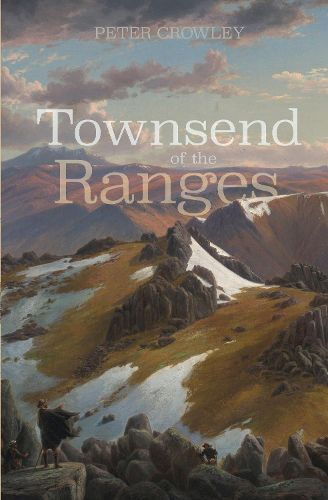
‘Townsend of the Ranges’ by Peter Crowley

2024, 312 p. & notes

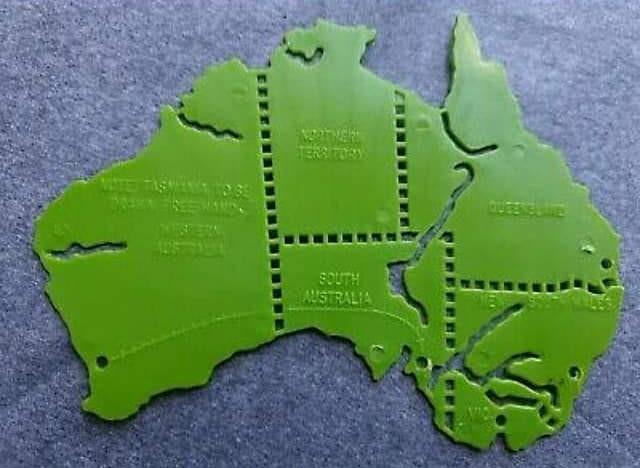
As I remember, it was in about Grade 5 that we “did” Australian history – the first taste of ‘aborigines, explorers, gold and Eureka’- and we used a plastic template to draw Australia. Poor old Tasmania didn’t even get a look-in, but I was also disconcerted by the borders of Victoria, which started with off the solid line of the Murray River before trailing off into dotted lines, like the other state boundaries. Not that the dotted lines were any use: they were impossible to fit a pencil point into, anyway, but they did give a visual sense of state borders. (And emphasized the importance of water compared to boundaries, even though that water might disappear completely from time to time).

Source: Reddit

Australians are not unaware of surveyors in their history. Travelling around South Eastern Australia, one often encounters the ‘Major Mitchell Trail’, or markers of the trail of Hume and Hovell, more often described as ‘explorers’ but at early stages of Australia’s colonization, the distinction was perhaps less clear cut. Many Australians are aware of Goyder’s Line that separates arable from drought land in South Australia, and the final proclamation of the Black-Allan line in 2006, more than 130 years after it was surveyed, brought the names of surveyors Alexander Black and Alexander Allan to (somewhat) public notice. But I must confess that I had never heard of Thomas Scott Townsend, the subject of this biography, although his name was given to the second-highest mountain in Australia and Townsend Corner marks where that solid line dissolved onto dots on my plastic school template. The author of this book, Peter Crowley, felt that Townsend had been short-changed:

As far as I am aware, this is the first biography dedicated to Townsend, a man who was the pre-eminent field surveyor of the south-east during the squatter age…I felt for Townsend and his family and wanted to restore his memory to the place it deserved. His triumphs and his travails were of compelling human interest, a tale of suffering and sacrifice endured in service to the public, and they were always going to be the backbone of this narrative. (p.18)

Narratively, Crowley gets you in from the outset. He starts with a suicide in 1869, more than twenty years after most of the action in this story, when the reclusive and belligerent Townsend kills himself by cutting his own throat. What could have led to this “pre-eminent field surveyor” taking his own life?

Thomas Scott Townsend was born in England in 1812. He, along with his parents and 10 siblings, lived at Woodend House in Buckingham Shire. His older brother Joseph was apprenticed to a land surveyor and then began his own surveying business, and it was later noted by Major Thomas Mitchell, the explorer and Surveyor General of New South Wales that Thomas Townsend had been “bred in a surveyor’s office in England”. Thomas had arrived in NSW at the age of 17, and after being unable to find employment, was the recipient of a recommendation to the Surveyor-General from the MP for Oxfordshire, generated no doubt as part of the lobbying and patronage network which underpinned colonial mobility around the empire. He was initially appointed as a draftsman in a temporary capacity in 1831, but remained an employee of the survey department for over 20 years. Those same patronage networks, deployed to the advantage of other new arrivals, were to stall his progress up the career ladder when other aspirants were appointed over him on the basis of similar recommendations from ‘home’. He had to wait under 1845 to be promoted to the position of ‘surveyor’ and the highest position he reached was Acting Deputy Surveyor General of New South Wales.

In these twenty years he was appointed to various projects: laying out towns in Albury, Geelong, Eden; acting as Surveyor-in-Charge of the Port Phillip District; surveying coasts in Gippsland and the South Coast; ascertaining the source of the Murray River; and traversing the Main Range of the Snowy Mountains, making an ascent of the then-unnamed Mt Kosciuszko. Even though the Surveyor-General, Major (Sir) Thomas Mitchell, was able to inveigle long periods of leave for himself to return ‘home’, it seemed that each time the opportunity for a voyage or desired excursion arose, the government found Townsend indispensable and directed him to another suddenly-urgent project. Located far from Sydney and beyond the reach of official orders, he devised his own surveying activities as well, using the time when snow and floodwaters made surveying impossible to go back over areas that had been surveyed in haste earlier. He was ridden hard by the government, but he was a self-driven man as well : perhaps there is a streak of madness in all explorers and surveyors? He was not the first man to enter these areas – he found that squatters had preceded him nearly everywhere he went, following generations-old indigenous paths to find open pastures – but the methodical, documented act of surveying was a form of exploration in its own right.

Surveying involved long periods living in tents in the bush, unless the territory was so impenetrable that supplies had to be left with the oxen and horses so that the surveying party could move unencumbered, sleeping in the open at night – surely a daunting prospect in south-east Gippsland and in the Great Dividing Range. Surveyors used the ‘chain and compass’ method, using a Gunter’s chain to measure distance and taking bearings and angles with a compass. Sometimes they had access to a circumferentor, a compass mounted on a tripod with a sighting arm, or later a theodolite to measure angles. They recorded information in field books, from which they later plotted their data onto maps. At this stage they did not use contour lines, but instead depicted ridges, spurs and valleys by parallel lines known as hachures. Thus, those early maps look quite different to the contour maps we are accustomed to today, and certainly they have their own beauty.

Townsend was instructed to record the indigenous names for the geographical features he surveyed, even though those other names were later overlaid by British names awarded as an act of homage to patrons at ‘home’. Crowley emphasizes throughout the presence of indigenous clans and nations across the whole area that Townsend surveyed. Indigenous guides could easily be procured from squatting stations, and Charley Tarra (or Tara) was a member of several surveying parties. Crowley notes the massacres associated with various squatters, although he does not interrogate the role of the surveyor in a political and legal sense. Certainly guns and violence led to appropriation of the land on-the-spot by the squatters, but it was the legal act of survey and resultant gazetting that imposed British title and sovereignty over Aboriginal land.

Townsend’s work was directly impacted by colonial politics. When he first arrived, the NSW government had already lost control of the squatters outside the Nineteen Counties, and pastoralists were moving into the Port Phillip district from across Bass Strait. When he arrived in Port Phillip as Surveyor-in-Charge, there was already a large backlog of work awaiting him, which only increased further with the influx of population during the gold rush. With the cessation of transportation, the source of cheap surveying teams dried up, and it became difficult to find men prepared to face the isolation and sheer hard work of the task. Squatting regulations introduced a degree of urgency into surveying work, with the imperative to mark out town reservations close to water supplies, to avoid them being swallowed up into large estates. Separation in 1851 brought politics into surveying, with suggestions of a border on the Murrumbidgee which would have placed the Riverina and the later Canberra district within Victoria. Townsend had his own opinion about where the boundary should be, suggesting that instead of rivers being used (which can, after all, expand and shrink depending on climate), mountain ridges and port access should guide the decision.

Crowley depicts well the arduousness of surveying work. It seems that Townsend suffered more from the heat of surveying the Murrumbidgee than he did the snowdrifts and dankness of the south-east. Men could get lost just when stopping aside to relieve themselves; sometimes ticket-of-leave and convict team members were unruly or absconded; and the sad death of Major Mitchell’s son 18 year old son Murray, who accompanied Townsend on his survey of the lower Snowy River, highlighted the isolation and dearth of medical assistance out on the field.

The isolation, the incessant work and the rootlessness of surveying work over such a long period of work did not augur well for a desk-bound job in Sydney once Townsend finally achieved the promotion he craved. In fact, he was quite clear with the governor that he felt that he still needed to be in the field to ensure the accuracy of the surveys conducted by men under his supervision. He married, but seemed unsettled and increasingly paranoid about his wife’s fidelity and sure that he was being ‘watched’. Many people were concerned about him, and felt that a trip back ‘home’, which had been postponed for so many years might alleviate his mental distress. This was not to be… and here we are back at the start of the story, with Townsend’s suicide. I had felt at the start of the book that Crowley had laboured the ‘ignored hero’ point a bit, but by the end, I no longer felt that way. Townsend has been overlooked. Strezlecki has garnered most of the praise for his exploration of the Great Dividing Range, and Alexanders Black and Allen received acknowledgement for tracing the Murray River that Townsend had surveyed twenty years earlier.

Crowley tells the story well, interweaving the biographical with the historical. He draws on official correspondence between Townsend and his colleagues and superiors, Colonial Office files with and about Townsend (which reflect the usual aggrieved tone of correspondents and pompous tone of Colonial Office officials), Townsend’s maps and drawings, and in quite a coup, family correspondence that fills in the last years of Townsend’s life. At times, particularly at the start of the book, I felt that he was distracted by the weeds a bit, giving more context and background information than was necessary. The book does not have an index, which would have been appreciated, but the old fashioned chapter summaries at the start of each chapter helped you to locate information. There was a single list of footnotes that spanned across all chapters. The book did seem to take an inordinately long time to get started, with a note about measurements, geographical notes about what constituted the Great Dividing Range, or the Murray River, a cast of characters, a timeline, acknowledgments and an introduction- all before we get to chapter one. Much of this could have gone at the end of the book.

The one thing that I cannot understand, however, is the dearth of clear, modern maps in this book. With the National Library of Australia as publisher, use of historic maps and documents is to be expected but they were virtually illegible once reduced in size and rendered into grayscale. For much of the book I had no idea where Townsend was or where he was going and no sense of distance or remoteness. This was a book that cried out for a visual representation of land: something to which Townsend devoted his whole life.

But these are quibbles about decisions that may well have been beyond the author’s control. Crowley captures well the incessant demands of the work, the beauty and intimidation of the lands he was surveying, and Townsend’s inexorable spiral into mania. It is both a very human story, and yet one placed within the vastness of unsurveyed territory. Townsend may have had to have wait more than 150 years for his biographer, but with Crowley’s book he receives the recognition earned and withheld for so many years.

Sourced from: review copy from Scott Eathorne, Quickmark Media

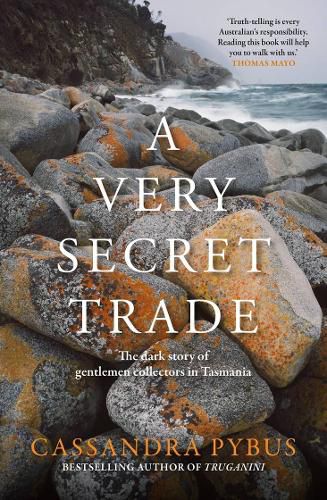
‘A Very Secret Trade’ by Cassandra Pybus

2024, 336 p.

If too many Australians thought that The Voice was too hard, then Truth Telling is going to be even harder. Cassandra Pybus’ book A Very Secret Trade: The Dark Story of Gentlemen Collectors in Tasmania confronts the clandestine trade in Tasmanian indigenous remains head-on: something we’ve all long known about but somehow tucked away back of mind. In a way, we’ve been softened up for the truths in this book by Marc Fennell’s podcast and TV series ‘Things the British Stole’. But in this book, the blame is not easily sheeted off to ‘the British’. Certainly, the governors and many of the civil servants in Van Diemen’s Land in the 1840s and ’50s were sojourners, returning back ‘home’ to England once they had attained their long-sought pensions. But collecting institutions like museums and universities were founded here as permanent institutions, and they need to own their histories of acquisition, obfuscation and refusal.

It was Zoe Laidlaw’s early book Colonial Connections 1815-45: patronage, the information revolution and colonial government (2005) that first opened my eyes to the connection between patronage, colonial careers and collecting. It underpinned the webs of influence that stretched from wealthy gentlemen collectors back in Britain, who could pull their parliamentary and civil service strings, across the ocean to civil servants in the colonies on a couple of hundred pounds a year. Once here, those local civil servants could pull on their own (rather more threadbare) strings to source animal and human remains which could be forwarded back ‘home’ to keep the connection strong. The gentlemen patrons back ‘home’ competed amongst themselves over the size of their personal collections and the prestige of the institutions with which they associated themselves, so there was always a market for curiosities, and especially those curiosities which were perceived to be on the road to extinction.

I hadn’t realized, though, that once the local functionary was in the colonies, he (and it was almost always ‘he’) deliberately petitioned and importuned for postings that made it possible to source such objects for his patrons. Pybus introduces us to doctors and surgeons (many of them), constables, merchants, Superintendents and magistrates, surveyors and artists, clergymen and librarians who were part of this network. Most disturbingly, some of them – especially those charged with the ‘care’ of this ‘dying’ race- deliberately maneuvered their positions so that they were untrammeled in finding, digging up and shipping human remains. And so many remains, often innocuously labeled as ‘specimens’ flowed across the ocean into private and institutional collections.

As a historian, Pybus has to work with silences and euphemisms. Clearly all these people realized the sensitivities of the indigenous people over the treatment of their people after their death, and so no-one actually wrote definitively about what they were doing. Many of the disinterments took place in isolated places or under the veil of darkness, and permission was neither given nor sought. Thus, the documentary record from the Tasmanian end is largely silent but at the receiving end, accession files, private correspondence and wills reveal the flood of ‘objects’ that made their way across to British and European patrons and institutions. They were being shipped overseas at scale, under the anodyne label of ‘specimens’.

Both through her own personal connection, and in keeping with her earlier book Truganini (my review here), Pybus focusses particularly on the islands north and east of Tasmania and the nearby mainland coastal areas, and the remaining people of the different nations on Van Diemen’s Land who were shipped between Wybalenna (Flinders Island) and Oyster Cove. They are so few that they can be named, and she does so in her Appendix 2. I’ve read quite a bit about George Augustus Robinson, the ‘Protector’ but I was unaware of his upwards change of fortunes once he returned ‘home’, where a lucrative marriage gave him all the property and status that he ever yearned for. He barely needed the dozen or so skulls that he carried in his luggage home, sourced from the First People who died under his ‘care’ at Wybalenna.

Lady Jane Franklin, too, is cast in a different light by her cultivation of collectors in her circle of friends, particularly young and handsome ones. Her expeditions across rugged terrain take on a new meaning when you realize the collecting intentions of the gentlemen accompanying her. The sheer number of surgeons and doctors in Pybus’ Appendix 1 of ‘The Worshipful Society of Body-Snatchers’ is chilling.

Pybus closes her book with Truganini, the so-called “last Tasmanian Aborigine” who, in floods of tears, had begged a minister whom she trusted that when she died, her body be burnt and the ashes thrown into the deepest part of the D’Entrecasteaux Channel. It took a hundred years for her wishes to be complied with. Copies and casts of her articulated skeleton were on display until 1969, and may even still be on display somewhere in the world as part of the inter-museum trade in objects. The push-back to the idea of repatriation and burial from the Tasmanian Museum and Art Gallery is instructive, as they garnered support from various professors of Anthropology and Anatomy, all of whom agreed that it would be a crime against humanity to comply with her wishes, even though Truganini’s remains had barely been properly studied at all in the 100 years of institutional custodianship.

This is a very personal book for Pybus too. It is beautifully written, and her use of ‘I’ is measured but always warranted. She grew up overlooking the D’Entrecasteux Channel, and although oblivious to it as a child, gradually came to understand her forebears’ connection with Oyster Cove. She had always thought of them as altruistic, but as she came to realize the web of patronage and obligation that touched her family too, she began to question this. I’m reminded of David Marr’s stance on ancestral guilt (see here) but I think that Pybus – who shares their name in a way that David Marr does not with the ancestors he writes about- cannot distance herself so easily. Her love of Tasmania, and especially the eastern coast bursts through her beautiful descriptions, and her own sense of country gives her an added feeling of indebtedness and complicity in the dispossession of the First People who were there before her. She had resisted for many years the ‘thorny’ word “genocide” but admits that “after years of research into the hidden corners of the history of my beautiful island home, I find the fact of it inescapable.” (p. 256) The rapid commodification of the remains of indigenous people, the ransacking of burial grounds, and the trade to collectors and museums world-wide with the added marketing-edge of “last of” and “extinct” certainly makes the word hard to avoid.

My rating: 9/10

Sourced from: Yarra Plenty Regional Library

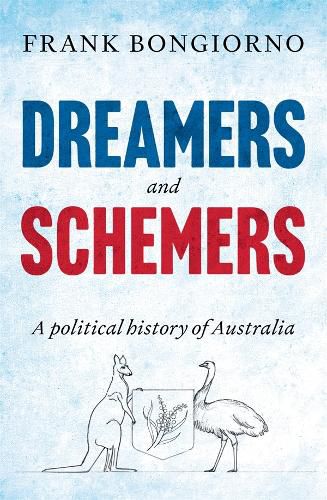
‘Dreamers and Schemers: A political history of Australia’ by Frank Bongiorno

2022, 396 p. plus notes

My overwhelming feeling on finishing this book is sheer admiration for the breadth of endeavour to write a political history of Australia right from pre-colonial through to COVID times. Few historians would take on such a task: even fewer could carry it off without flagging. But Frank Bongiorno does, with his customary clarity and a mischievous twinkle in the eye when he encounters absurdity and pretension.

I like Frank Bongiorno, and he is a historian who takes his role as a public commentator seriously. He is current president of the Australian Historical Association, and on the Federal Executive of the Australian Society for the Study of Labour History. He is a contributor to newspapers and journals (both academic and general) and he’s likely to pop up on politics programs on the ABC television and radio. I found myself wondering whether his own political leanings would influence his analysis once he reached the years which he would remember (he was born in 1969) but I couldn’t really detect any change in his stance. The title, while catchy, is a little misleading: it evokes a ‘Hundred Ratbags’ sort of book based on crackpots and shysters. The book takes a much more general approach than this, with more emphasis on the big sweeps and arcs of history rather than the foibles of transitory individuals. The ‘Dreamers and Schemers’ are not just found on the floors of parliamentary chambers – they are out in the pubs, meeting halls, churches and unions as well, but the main focus is on formal political structures.

We often talk today of ‘political junkies’, who delve into the minutiae of political events that many others flip past when they encounter them in the newspapers, and who see everything through a political lens. By writing a political history, Bongiorno focuses his attention on the science of politics as it played out chronologically over Australia’s white history, which means that there is necessarily an emphasis on the dead white men who dominated big-P politics, while many other forces are omitted. Women, for instance, are barely seen in the first third of the book because, politically, they were insignificant. Bongiorno starts the book with First Nations politics: something that is barely acknowledged in Australian history, and when it is, it is more anthropological than political. Indigenous politics are woven throughout the rest of the text, but reflecting the events of the time, they disappear for whole decades only to reappear 40 or 50 years later. Economic fluctuations and wars appear in the narrative, but only to the extent that they affected the politics of the day. Likewise, international events feature in the early chapters, when Australia’s nascent politics were a reflection of political currents that affected the empire generally, and they reappear in the closing chapters when a world-wide pandemic disease and cynicism over politics generally bring politics to uncharted territory.

One of the real strengths of this book is that it considers both federal and state politics alongside each other, taking care to address each of the states, and not just the most populous ones. Personalities tended to loom larger at state level, with a predominance of ‘schemers’ over ‘dreamers’. The distinctiveness of the different states is highlighted: the conservatism (by design) of the Legislative Council in Victoria; the radicalism of Queensland at the turn of the 20th century which contrasted so much with the Bjelke-Petersen era some 70 years later; the way that South Australia often seemed to be travelling its own path. This emphasis on the states means that the full range of politics is explored -not just the big moves of a Federal government, but the compromises and obligations of State governments as well.

I was interested to see how Bongiorno structured the chronology of the book. He proceeds chronologically, but decisive events like Federation, war, the Depression or the Dismissal are subsumed under broader categories, rather than meriting a chapter in their own right. The chapters are:

  • Autocracy, Community and Democracy: from Earliest Times to 1855 (i.e. the granting of a degree of not identical self-government to the separate colonies as part of a broader sweep towards reform across the settler empire)
  • Making Democracy Work: 1857-90 (which takes us far from the 1850s view of self-government to a concept of government as an entity which can transform society, alongside increasing demands – particularly through the unions- for direct representation of class
  • A New Australia 1891-1914 (emphasizing the importance of the ‘Deakinite Settlement’, and the rise of the Labor Party and fusion of conservative forces)
  • Loyalty and Interest: 1914-1939 (a big time span, collapsing WWI into the post war era until the start of another war. Labor dominance during the early years of the war, the rise of sectarianism, rise of the Country Party, first Menzies government)
  • War and Peace: 1939-49 (war and post-war considered together. Co-operation between Menzies and Curtin in welfare provision. The Labor Party would not have dreamt that they would be in Opposition for so long)
  • The Good Times 1949-1966 (Menzies’ second prime ministership; influence of Santamaria and Victorian Labor split)
  • Revolt, Reason and Reaction: 1966-1982 (series of Liberal prime ministers after Menzies, Victoria a brake on an ALP victory earlier than 1972, Kerr/Whitlam/Fraser conceptualized as a contest of manhood; Fraser more like a Country Party politician. A changed world- free trade, unions but reaction through Bjelke-Peterson in Qld, Charles Court in WA; rise of Australian Democrats)
  • Australia Remade? 1983-99 (Winding back of the protective state, much of it by the ALP; influence of globalisation and free market economics; Howard and Hanson)
  • ‘The Glimmer of Twilight’: 2000-19 (2001 the end of progressivism- emergence of the darker side of globalization. 2005 Howard wins Senate majority and introduction of WorkChoices, Australian Wheat Board, David Hicks, the Intervention; Kevin Rudd and the Summit, Kyoto, the Apology. Gillard’s first minority government since WWII but passing of 561 pieces of legislation; lower primary vote and rise of independents and Greens; Abbott, Turnbull, Morrison – studied ordinaryiness)
  • Conclusion – In the Age of COVID

I’m not going to go through the details: you’ll need to read the book for them. It’s a fact-heavy book, driven by chronological events. But there are themes that arise out of this mosaic of personalities and events.

The first is the continuity of the view of an interventionist government. He devotes much attention to the Deakinite Settlement of the 1890s, which held over many decades (perhaps there are even traces of it today) and brought Australia to the forefront of progressive legislation in the early decades of the 20th century. The economic interventions of the post-WWII governments in the 1940s – and here Bongiorno echoes Stuart Macintyre, to whom the book is dedicated- continued under Menzies and were only ruptured in the 1980s. Even during the COVID pandemic, with which the book closes, there remained

a broad acceptance, no doubt stronger among some than others, that government should play the predominant role in defining where the boundaries between individual rights and the common good lie….Outside extreme libertarianism, a minority taste in Australia, there tends to be only mild political disagreement. Otherwise, most people get on with their lives, expecting the state to set reasonable parameters for individual behaviour while allowing people a wide scope to pursue their private interests as individuals and families.

p.392

Related to the early adoption of progressive electoral legislation, voting schemes continued to evolve over the early 20th century. The method of voting (preferential, above-the-line, secret) etc. continued to be experimented with as the system was finessed. Democracy was not delivered cut and dried: instead, it evolved over time.

Some issues remained constant (or intransigent) over decades. The question of land and vested interests dominated colonial politics. Free trade versus protectionism was a major dividing line between states and parties, and still underpins politics today. Sectarianism and racism (against First Nations, Chinese, immigrants) bubbled under the surface throughout Australia’s political history.

That said, another theme was the sense of roundabouts and swings. One or the other of the major parties would make a clean sweep at both federal and state level, only for the jigsaw to be quickly broken apart as the opposing parties would have electoral success and the cycle would begin again. Where there was a long period of one-party dominance, it was largely through the weakness of the opposition. The significance of sectarianism, and especially the influence of Bob Santamaria and the ‘groupers’ in Victoria is highlighted as a brake on Labor success at both federal and Victorian level over an extended time.

Despite the title ‘Dreamers and Schemers’, the relationship between individuals and the big movements of political history is a nuanced tension between practicality, complacency and continuity on the one hand, and vision and courage on the other. In this, we see Bongiorno the progressivist historian coming out. He notes:

Australian political history has had its dreamers and visionaries alongside the pragmatists and schemers…Big change of the kind that occurred in Australia in the 1850s, 1890s, 1940s and 1980s would have been impossible without the idealists and thinkers: that is, without political leaders, activists, intellectuals and movements who refused to be merely ‘practical’. Change depended on people willing to resist complacent utilitarian appeals to majority interests and consensus opinions, on refusing to accept injunctions merely to tinker rather than transform. In the end, it depended on a vision, however modest, of the good life.

p. 392

This book is written for the general reader, but the relentlessness of change and a succession of actors means that it does require concentrated reading. It provides a wide sweep of history, enabling ‘political junkies’ to step aside from their own cauldron of day-to-day politics to reflect on continuity and courage, both of which have existed across Australia’s political history. Although I have read ‘generalist’ Australian histories that take a broad-lens approach from settlement onwards, I haven’t read another book quite like this one that is so disciplined in its focus on politics as the framework of analysis. It’s an important book, and well worth reading.

My rating: 9

Sourced from: review copy Black Inc books

‘William Cooper: An Aboriginal Life Story’ by Bain Attwood

2021, 204 p. plus notes

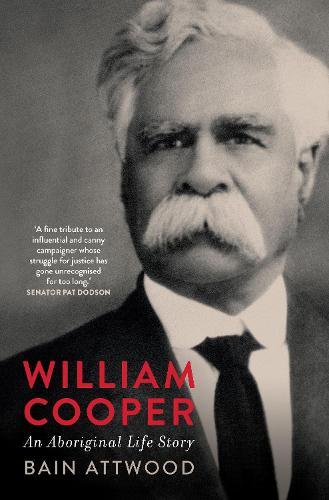
Unfortunately, I think that Australians may be more aware of African American political activists than they are of Indigenous Australian ones. William Cooper is now commemorated by an electoral district and a statue in Shepparton, but neither of these capture Cooper’s contribution to Australian history – in fact, in some ways they do a disservice to it. William Cooper’s attempt to have designated Aboriginal representation in Parliament never eventuated to this day, and the Shepparton statue commemorates an event which was only tangentially connected with his lifetime of Indigenous activism. The resolute, handsome face that stares out from the cover of Bain Attwood’s book William Cooper: An Aboriginal Life Story should be instantly recognizable to us, but it is not.

William Cooper was a Yorta Yorta man, born on the junction of the Murray and Goulburn Rivers in northern Victoria. His date of birth -sometime around 1860- is inexact, but as Attwood points out, the actual date was largely immaterial compared with the significance given to the place of someone’s birth, their family and kinship group and totem. Nor was his paternity particularly relevant. Attwood claims that that the Yorta Yorta, like other groups, tried to establish a reciprocal kin relationship with the white invaders of their country, by encouraging sexual relationships between their women members and whitefellas (p.5). Thus, several of Cooper’s siblings adopted the surname of Atkinson, for John Olbury Atkinson who worked on the nearby Moira run as overseer, while other siblings (including Cooper) adopted Cooper as their surname, perhaps for Edward Cooper – or maybe not. This meant that Cooper was “half-caste”, a distinction which he himself vehemently rejected, but which came to have ramifications as Aboriginal Mission policy changed over time. He was taken as a child to Melbourne in 1867 by the leaseholder of the Moira station, politician John O’Shanassy, and appeared to have lived with him in his Camberwell mansion Tara Estate- or maybe he worked for O’Shanassy in his New Imperial Hotel in Elizabeth – it’s not really clear. In any event, he returned to the Moira estate on his own Country as a teenager, and learned horse-breaking and pastoral skills that he drew on for the rest of his working life.

It was around 1874 when ‘Billy’ Cooper first approached the Maloga mission, established by Daniel and Janet Matthews on land selected by the Matthews brothers on the Barmah sandhills on a bend of the river Murray. This land had been traditional ceremonial grounds, and was formerly part of the Moira station – a source of later conflict. He moved there largely for the safety of his mother and younger siblings, but he himself moved away to work on surrounding pastoral stations. In 1881 the Matthews were joined by Thomas Shadrach James, from Mauritius, who worked as a teacher there and later married Cooper’s sister Ada. Cooper returned to Maloga more or less permanently from 1882, and two years later, he converted to Christianity, part of a wave of conversions amongst Indigenous men at Maloga at this time. The influence of the Matthews and Thomas James on Cooper’s political mindset was fundamental. Through their preaching, and drawing largely on the Old Testament and hymns, they gave him a framework that held that all people were God’s children and thus potentially equal, and that salvation was promised in the future for the oppressed. (p. 38) Shortly after his conversion, Cooper married Annie Murrie, but she died suddenly of respiratory illness after having two children. He remarried 21year old Agnes Hamilton in 1893 and over the next seventeen years she was to have seven children, six of whom survived infancy. However, the Maloga mission fell victim to the priorities and policies of the Aborigines Protection Association NSW which comprised white clergymen, philanthropists and leading parliamentarians under the patronage of the governor himself. Maloga was stripped bare, and incorporated into Cumeroogunga Mission, which is better known today. After initial problems, Cumeroogunga boasted 60 buildings by 1908, with three streets, gravel footpaths, a church, a meeting house, a school, a dispensary, storerooms and many outbuilding. With over 300 people, it was the largest Aboriginal reserve in NSW. But Cooper left the Mission in 1909 after conflict and controversy over the refusal to grant land blocks arose yet again, and following Agnes’ death from tuberculosis. Further deaths followed, including his eldest daughter in August 1913, his eldest son Daniel at Ypres during WWI, and several years later, Jessie the eldest daughter from his marriage with Agnes died of peritonitis after giving birth. In 1928 he married for a third time, to Sarah McRae (daughter of the artist Tommy McCrae). Cooper was to live to a ripe old age, but the reality of the foreshortened Aboriginal life expectancy, meant that he was surrounded by family deaths. In 1933 he and Sarah decided to move to Melbourne and embarked on a new phase of his activism as a seventy-year old.

Here Cooper set in train the actions for which he is best known today. He established the Australian Aborigines’ League around 1934, an organization which is often confused with the Aborigines Advancement League (of Victoria) which was formed in 1957. He was supported in this by several white supporters. The first was English-born fervent Christian and self-described “Christian communist” (p. 119), Helen Baillie, who had connections with many other Christian humanitarian networks involved in missionary work among Aboriginal people. The second was Arthur Burdeu, another fervent Christian, but wary of left-wing influences subverting Aboriginal organizations. Like Cooper, he was a strong Labor man; they had both lost family members in the Great War, and they lived relatively close to each other. He was appointed president of the Australian Aborigines’ League, even though by its constitution, full membership was only open to Aboriginal people. This raises the inevitable question of whether the League remained the voice of Cooper and other Aboriginal members, and whether the letters in Cooper’s name (generally composed by Burdeu) represented his views. By looking at the way that Cooper and Burdeu worked together, Attwood concludes that the letters in Cooper’s name by and large did represent his views, although formal statements were generally Burdeu’s work (p. 132). Cooper was joined by fellow Indigenous campaigners Shadrach James (his nephew) Anna and Caleb Morgan, Margaret Tucker, George Patten and and Doug Nicholls.

So what were Cooper’s views? Throughout all his activism – right from his time at Maloga- he drew on his Christian belief that as the first people of the land, created by God, and as British subjects, they had a rightful claim on the land, and on the government. However, ‘equal rights’ or ‘citizenship rights’ as distinct from Indigenous rights, were conditional in the sense that they rested on the capacity of their people to exercise them – not so much an entitlement as something that had to be earned (p.134). He framed this in different ways at different times.

At a time when Aboriginal people’s difference was deemed to be the cause of their plight and constituted the grounds upon which they were denied the rights and privileges enjoyed by British subjects, they emphasised their common nature with their fellow Australians and demanded the same rights as Australian citizens had. But in pressing these claims they often made reference to their difference, though the differences they had in mind were primarily rooted in their people’s history rather than culture (or civilisation) and race (or biology). Most often, Cooper and the members of his organisation invoked the fact that they were the descendants of this county’s first peoples and that the British Crown had given them an undertaking to protect them.

p.203, 204

This was exemplified in the petition that he drew up in 1933, prior to the establishment of the Australian Aborigines’ League but promoted and submitted under its auspices. It is not surprising that Cooper should turn to a petition as an instrument of persuasion. Indigenous people in Australia and across the empire, tended to look to the King/Queen as the source of power, rather than the local government, and had turned to petitions as their means of communicating with them. This petition, addressed to King George V argued that the commission issued to “those who came to people Australia” included a strict injunction that the original inhabitants and their heirs and successors should be adequately cared for. Given that the terms of the commission had not been adhered to, in that their lands were expropriated by the King’s Government and legal status was denied by the King’s Government in the Commonwealth, they prayed that the King would intervene to prevent the extinction of the Aboriginal race, give better conditions for all, and grant them power to propose a member of parliament “in the person of our own blood or white man known to have studied our needs and to be in sympathy with our race, to represent us in the Federal Parliament”. (p. 103) Actually, this was a watering-down of Cooper’s lifelong call for parliamentary representation, prompted probably by his white advisors, because he believed that white men could not “think black” and therefore they needed an Aboriginal representative in Parliament. The petition was signed by over 1800 Aboriginal people – no small feat when access to missions and permission to circulate the petition had to be sought over and over again. It was held back for some two years until after a meeting of all the administrators of Aboriginal affairs in Australia in mid 1937. It was only when this meeting failed to deliver any outcomes that the petition was finally submitted to the Australian government. However, it fell largely on deaf ears. Although Prime Minister Joseph Lyons expressed his sympathy, the petition was dismissed by the secretary of the Department of the Interior, J. A. Carrodus and was never submitted to the King. I found myself angered by such a supercilious dismissal, and the words of the Uluru Statement “the torment of our powerlessness” spring to mind.

Asking did not work: perhaps protest would. After witnessing a ceremony in Melbourne on 24 January 1937 to celebrate John Batman’s founding of Melbourne, Cooper realized that the imminent 150th anniversary celebrations in Sydney on 26th January 1938 would be of the same triumphalist tenor. Drawing on his Biblical schema of epochs and days – of Judgement and Restitution, Mourning and Hope, and eventual Deliverance, Cooper proposed “a day of mourning” to be held simultaneously with the sesquicentennial celebrations. The original idea was his, but the proceedings themselves, held at the Australian Hall, were dominated by Bill Ferguson and Jack Patten of the Aborigines Progressive Association. Cooper, Nicholls and Tucker attended, driven to Sydney by Helen Baillie in her little car, but did not play a prominent part.

Although Cooper lived in Melbourne, he and many of the League’s members retained their emotional connection to Cumeroogunga. He continued to appeal to NSW government to provide Aboriginal people with land and capital so that they could develop the land for their communities and become self-sufficient- something he had urged since his Maloga days. He urged that the services provided on reserves should be put into the hands of Aboriginal people themselves, and that regulations should ensure that no resident could be expelled from a reserve without an open enquiry. In June 1937, contrary to the wishes of the Aboriginal people, Arthur McQuiggan had been appointed as manager of Cumeroogunga, despite repeated complaints about his violence as superintendent of Kinchela Aboriginal Boys Home. Some people made preparations to leave, but were prevented from doing so by the police on the basis of “quarantine” regulations. Cooper submitted another petition signed at Cumeroogunga to the government, but this had no effect. On 26 January 1939 Jack Patten, born and bred at Cumeroogunga, returned there and addressed a gathering of the people in the church two days later, urging them to “walk off”, before they were prevented from leaving again. Cooper and Burdeu were rather ambivalent about this direct action. The League had long had a preference for representations, appeals, petitions and public meetings, and Cooper and Burdeu were apprehensive that Patten’s methods would alienate the League’s white supporters. In the end, it was socialists, communists and Labor supporters in Melbourne who backed what they saw as a “strike” at Cumeroogunga, providing moral and material support for the people who had walked off. But after nine months of hardship, the protest achieved nothing, and there was a tailing-off in the League’s activity, exacerbated by Cooper’s decline in health.

By now WWII was in train. Cooper had lost his son in World War I, and he was disillusioned by the failure of the Government to grant citizenship to the thousands of Aboriginal men who had enlisted in the AIF after World War I. He pointed out that Aboriginal men had ‘no status [and] no rights’ and ‘no country and nothing to fight for but the privilege of defending the land which was taken from him by the white race without compensation’. (p. 197) This was not necessarily a popular stance.

It is ironic that the only monument to William Cooper (presently) is the one in Shepparton, funded by Jewish philanthropists through Gandel Philanthropy. The monument depicts him holding a petition defending the human rights of Jewish people in response to Kristallnaucht, “The Night of Broken Glass” which he presented to the German Consulate in December 1938. The petition served an Indigenous purpose as well: it stated “Like the Jews, our people have suffered much cruelty, exploitation and misunderstanding as a minority at the hands of another race”. This fleeting act, which has captured and been embraced the (white) public imagination, tends to overlook the fact that several left-wing groups, churchmen, pacifists and civil libertarians had already raised their voices against the Nazi persecution of the Jews. Consistent with Attwood’s claim that this is a minor part of Cooper’s contribution, he spends only four pages on this petition, although he expands in further detail in the footnotes. I think that it says much about white Australia and its unease with Aboriginal activism, that Cooper should be commemorated for this one act of solidarity with an overseas injustice, rather than his activism against injustice here in Australia over many decades.

Attwood started his book by pointing out that, especially in relation to Cooper’s childhood, documentary sources are thin. Cooper was an eloquent speaker, but he found writing a struggle, and often turned to his white supporters to undertake this task. Moreover, members of Cooper’s family have their own stories about him, which differ in places from the stories Attwood is telling. He points out that a biographical approach can misrepresent the life of an Indigenous man or woman by casting them as exceptional.

Make no mistake: I believe Cooper was a remarkable man. But the political work for which he is best remembered was the product of a broad network of family, kin and community, and the outcome of a historical experience that he and his fellows had in common and shared with each other.

p. xiv

The book has many black-and-white photographs throughout the text, courtesy of Cooper’s family, and they emphasize both Cooper’s striking bearing but also his embeddedness amongst other activists. Attwood is writing within the academic discipline of history, and this tone pervades the book, with an essay-like introduction and conclusion, a cautious use of “I” and rather stilted cross-references in parentheses to different parts of the book. I sense a reserve in Attwood’s writing.

I’m sure that Attwood did not intend it this way, but I found the book ultimately depressing. William Cooper worked all his life for Aboriginal rights, but had little to show for it. His optimism that if only people knew; if only the King knew, then things would change- was sadly misplaced. He had a faith in white Australia that was not reciprocated. There are, of course, many resonances today. I hear shades of William Cooper in Noel Pearson, who shares his suspicion of “the left” and his deep faith in Christianity particularly in the linguistic and schematic framing of injustice in biblical terms. Cooper’s faith in white Australia echoes in the Uluru Statement from the Heart, and the call for a Voice has resonances of his call for parliamentary representation. Hopefully this time – at last- white Australia will recognize the generosity of what is being offered and finally fulfill William Cooper’s expectations.

Rating: 8.5/10

Sourced from: Yarra Plenty Regional Library.

‘The Confident Years: Australia in the 1920s’ by Robert Murray

2020, 245 p.

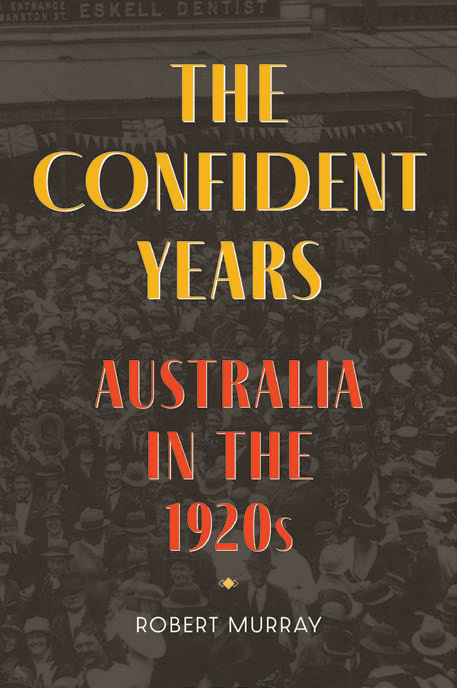
One of the things that I do when I’m not reading, practising my Spanish or listening to podcasts about Rome, is work at my local Heidelberg Historical Society. Our newsletter, which is published every two months, has a feature called ‘A Hundred Years Ago’ which draws together items of local interest from the ‘Heidelberg News’ and, to a lesser extent, the major Melbourne newspapers through Trove. I’ve been writing this feature since 2015 so I’ve gone through the war, through the ‘Spanish’ flu, the commemoration of fallen soldiers and now I’m up to the 1920s. I’d like to know more. A local paper, by its nature, is full of quotidian events with a heavy emphasis on the civic and the worthy. Leaving aside the Bowling Club results and church socials, I’m finding myself interested in the emotional tenor of the times. With a title like ‘The Confident Years’, I was hoping that Robert Murray might unpack the mindset of the 1920s, but I found myself disappointed.

The book, reissued by Australian Scholarly Publishing in 2020 (no doubt with this centenary in mind), was originally published in 1978. This new edition is, as the author admits in his preface

varies little from the original, published in 1978, but has been slightly abridged or amended

p. vii

There are the occasional mentions of Gough Whitlam or Donald Trump as points of comparison, but I suspect that much of the text and certainly the bibliography is unchanged, with not a single book or article published after 1978.

It started well. In the opening chapter, Murray writes:

The 1920s, the decade that followed the war, have gone down in legend as gay and glittering. Relative to the years that preceded and followed them, this was certainly so. From the perspective of the 1970s, Australia’s 1920s were straitlaced, drab, and crushed in a narrowness of vision and stridency of statement. Yet for all the smothering smugness, it was also a time when the spaciousness and order of the nineteenth century merged almost felicitously into the freedom and affluence of the twentieth.

They were above all confident years, when reasonable people could believe- with from the late-century perspective, a quaint dogmatism of certainty- in nation and leaders, in socialism or free enterprise capitalism, religion or atheism. A world war had been won; during it the socialist revolution had won Russia, but had later been overthrown by counter-revolution elsewhere in Europe. This was just enough experience of what the young century had to offer to drive the imagination. The long years had yet to come when the world would live for more than two decades with the shadow or reality of depression and more world war, when not only capitalism and socialism but the very millenia-tried bastion of the Christian belief itself would eventually crumble almost discredited before new generations to whom disillusion seemed merely the way of things.

p.5

This is what I was looking for in this book, but I found that most of the book involved politics with a capital P and the machinations of political operatives on all sides. After an introductory chapter ‘Fit for Heroes’, there follow four chapters dealing with the Nationalist, Labor and Country parties (Ch. 2 The Political World of Billy Hughes; Ch.3 Post-War Labor; Ch. 4 The Big Fella and Chapter 6 Bruce-Page Australia). Chapter 5 inserts an analysis of the Big Boys of the press (Ch. 5 Packer, Murdoch, Fairfax and Co – how depressing that they are still household names a hundred years later) and Ch. 8 After the Bulletin looks at literature and theatre both on stage and screen. Chapter 9 Workers and Bosses looks at the strike activity particularly in the last years of the decade, and Chapter 10 Countdown to Catastrophe ushers in the Depression of the 1930s.

In these chapters, Murray is careful to pay attention to State politics as well as Federal politics, and he introduces male politicians of all stripes with potted biographies. There is a lot of politics squashed in here, as events and crises unfold and pass by.

My favourite chapter was Chapter 7 The Golden Years, which came closest to what I was looking for in the book. There are more women in this chapter although it, too, reads a little like an almanac even to the point of finishing with ‘A Miscellany of Australia’s Twenties’ containing observations that didn’t fit anywhere else. In his preface, Murray mentioned that he interviewed people who were alive during the 1920s, and this chapter- although I enjoyed it most of the whole book- had a bit of the ‘oral-histories’ about it.

This is the only book that I have found that focusses on the 1920s in Australia beyond those ‘So You Were Born in 1925’ type books in newsagents. In terms of capturing a mindset, I gained much more from Deirdre O’Connor’s Harlem Nights, and perhaps I am going to have to look at individual chapters in books about other themes that are less tied to a chronological period (e.g. Janet McCalman’s Journeyings; or Kirsten Otto’s Capital, both of which I have read previously) or fiction -especially newspaper fiction- of the time. I found myself wondering about my own time, a hundred years later, and whether a book about our 21st century ‘Twenties’ that focussed on Australian politics, technology and culture would capture what it is to live now. It would have to include those things of course, but they would not be sufficient. Perhaps I need to send Hugh Mackay back in a time machine to 1920 to measure the emotional climate for me.

Sourced from: State Library of Victoria as an e-book.

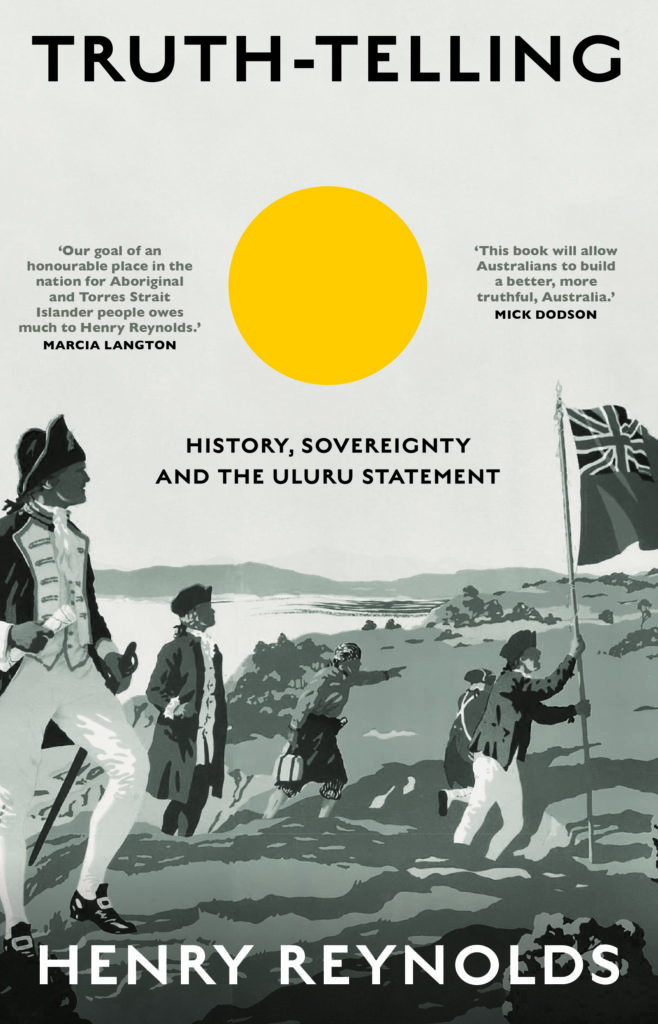
‘Truth-Telling: History, Sovereignty and the Uluru Statement’ by Henry Reynolds

2021, 247 p & notes

It’s fitting that this book should start with the Uluru Statement from the Heart, written out in full. I wonder if in decades to come, this statement will be as well known to Australians as the Gettysburg Address or John of Gaunt’s ‘This Sceptred Isle’ speech. I’d like to think that it will be.

In his foreword, Reynolds notes that there was not universal Indigenous support for the statement, but that it was undoubtedly the most widely canvassed document addressed to the wider community by First Nations representatives, drawn from over 1000 participants, meeting at 12 locations around the country.

It was also a masterpiece of forensic advocacy – succinct, with scarcely a wasted word, utilitarian where necessary, elegant, even poetic in places. It is a document that will endure. But its lasting political impact is yet to be determined.

p. 2

He points out that most of the political discussion so far has been about the Voice to Parliament, which reflects the strategic choice of the Referendum Council to go for Voice- Treaty – Truth. The response by the Australian government was quick and dismissive. (I wonder how Malcolm Turnbull feels about that now?) In this book, however, Reynolds concentrates on the starting premise of the Statement: the issue of sovereignty.

Our Aboriginal and Torres Strait Islander tribes were the first sovereign Nations of the Australian continent and its adjacent islands, and possessed it under our own laws and customs… This sovereignty is a spiritual notion: the ancestral tie between the land, or ‘mother nature’, and the Aboriginal and Torres Strait Islander peoples who were born therefrom, remain unattached thereto, and must one day return thither to be united with our ancestors. This link is the basis of the ownership of the soil, or better, of sovereignty. It has never been ceded or extinguished, and co-exists with the sovereignty of the Crown.

How could it be otherwise? That peoples possessed a land for sixty millennia and this sacred link disappears from world history in merely the last two hundred years? With substantive constitutional change and structural reform, we believe this ancient sovereignty can shine through as a fuller expression of Australia’s nationhood.

The Uluru Statement from the Heart, reprinted p. viii and ix

Now, I admit that sovereignty is not exactly the most gripping topic. It is mired in the 17th and 18th century international jurisprudence that was triggered by Spanish, Portuguese and British colonization in the Americas, Africa and Asia. Even the names are offputting: Grotius, von Pufendorf, Heineccius, de Vattel. This international law formed the basis of American court cases in the 1820s and ’30s when settlers were moving across the American continent. It’s a pretty specialized area, and doesn’t lend itself easily to the much-vaunted and Americanized ‘water cooler conversation’. But in essence, Reynolds argues here that Britain stuffed up colonization in Australia from the very start, acting in ways that were inconsistent with received international law at the time. Despite some hand-wringing from the Colonial Office as a result of humanitarian pressure-politics, the error was perpetuated and entrenched when the Australian colonies achieved self-government. It is was inconsistent then, and it is inconsistent now with the United Nations Declaration on the Rights of Indigenous People, adopted by the General Assembly in September 2007 and ratified by Australia in 2009. If blame has to be apportioned, it can be directed at the British government up until 1856 but from then on, it lies at Australia’s feet.

In the introduction Reynolds explains his own ignorance of the fraught relations between White Australians and the Aboriginal and Torres Strait Islander people until he went to teach at James Cook University in Townsville, where his students were living this history. From there, the book is divided into 2 parts.

Part 1 ‘The First Sovereign Nations’ explores different aspects of sovereignty. Chapter 1 ‘Taking Possession’ looks at Captain Cook’s ceremony on Possession Island off the NW coast of Cape York in August 1770 where he took possession of the country in His Majesty’s name, together with all the bays, harbours, rivers and islands situated on the coast. Right here we have a glitch: according to his secret instructions of 30 July 1768 he was instructed to ‘with the consent of the natives take possession of convenient situations’ or if he found it uninhabited, ‘take possession by setting up proper marks and inscriptions, as first discoverers and possessors’. He did not find it uninhabited, nor did he seek or gain consent. When the First Fleet landed in 1788, Arthur Phillip’s commissions on 12 October 1786 and 2 April 1787 made no mention of consent. Immediately on arrival, Phillip wrote back that there were far more Aboriginal people than Sir Joseph Banks and James Matra, who had advised the Colonial Office, had suggested. Nor was inland Australia uninhabited.

Chapter 2 ‘This Ancient Sovereignty’ explores the dawning realization that Aboriginal people lived in tribal groups, in specific districts with known boundaries, and that there were no ‘unpeopled’ lands. Each First Nation contested the encroachment on their traditional lands, and fought for their own country and nowhere else. By the time Ralph Darling was appointed as governor to NSW in 1825, his instructions were to treat Aboriginal nations no longer as British subjects but ‘as if they proceeded from subjects of any accredited State’.(p. 41) This stance was reversed in 1837 when they were again ‘considered as Subjects of the Queen’ (p. 72).

Chapter 3 ‘Whose Land?’ looks at the concept of terra nullius and the acceptance within Australia that, even if this was a mistaken characterization, it was an understandable and even appropriate decision on the part of the British government as a consequence of the failure of Aboriginal society to reach a designated level of ‘civilization’. However, this flew in the face of late 18th and early 19th century international law and the recognition of Native American property rights elsewhere in the Empire, especially in the American Supreme Court led by Chief Justice John Marshall between 1801 and 1835 and in New Zealand courts in 1847. By the mid 1830s, humanitarian reformers, previously involved in the slave trade, turned their attention to the fate of Indigenous peoples in British colonies, especially through James Stephen, the permanent under-secretary. Aboriginal protectors, governors (particularly George Arthur in Tasmania, to whom Reynolds gives credit) and eventually the Secretary of State argued that pastoral leases should not allow the driving off of the ‘Natives’ who “have every right to the protection of the law from such aggressions”. (p. 68) Once the colonies gained self-government, this stance was largely ignored.

Chapter 4 ‘Effective control?’ highlights the concern that the Australian government had over the ’empty’ north. The question of ‘effective control’ was important in international law and applied by the British government elsewhere in the world. Britain refused a Portuguese claim to territory in central Africa between Angola and Mozambique because there was no sign of Portuguese jurisdiction or authority and no real occupation. The same issue arose in Nicuargua, when claims of being a successor state to the Spanish Empire were rejected. If the standards of international law as they were understood at the time of Australian federation were applied, neither the states nor the federal government exercised effective control over large areas of Australia.

Ch. 5 ‘Australia and the Law of Nations’ returns to international law. There is, Reynolds claims “clearly more support in international law for the Uluru Statement than many Australians likely imagine.” (p. 90) He turns to the Australian cases of R. v Murrell in 1836 (and I’m surprised that Reynolds did not reference ‘my’ Justice John Walpole Willis here at all) and Cooper v Stuart (1889), both of which cast long legal shadows. He then jumps ahead to the Mabo case of 1992.

Ch. 6 ‘Treaty yeh, Treaty now’ looks at George Augustus Robinson’s ‘peace treaty in all but name’ that brought the Black Wars in Tasmania to an end. Reynolds is dismissive of John Batman’s attempt at a treaty in Port Phillip, pointing out that treaties can only be negotiated by the Crown. The British government, however, abandoned the policy of treaty-making in Australia, even though it ratified treaties in North America, thus condemning hundreds to violent deaths (p. 122). This did not mean that there were not informal ‘treaties’.

There seems to have been some common characteristics of successful negotiations, including understandings about access to water, and about hunting parties avoiding sheep and cattle. In exchange, animals were regularly slaughtered and given to the local band in return for a promise not to spear them out on the range…But an even more significant factor was the provision of young men, who quickly acquired the new skills that, when added to traditional bushcraft, made them valuable additions to any station’s workforce. Young women were provided to be trained in domestic work and to provide sexual comfort. It was often done with reluctance but with an understanding that if not mutually arranged the women would be taken by force. But a frequent underlying consideration was that with a negotiated settlement the station in question became a relatively secure haven away from ambient violence. The ‘white boss’ became a defender of ‘his’ blacks, even able at times to protect them from violent neighbours and marauding police patrols.

p.116

But if we are to move beyond the informal, ad-hoc and contingent, as the Uluru Statement urges us to do, a treaty is needed. To a certain extent, some state governments are picking up the baton after Bob Hawke promised to negotiate a treaty at Barunga in the NT thirty years ago. But, despite state-level treaties, there will still need to be a treaty between the national government and First Nations.

Only then will the vexed problem of how to deal with what in the Statement from the Heart was called ‘this ancient sovereignty’ be resolved

p.125

Part II of the book is titled ‘Searching for Truth-Telling’ takes the reader into the politics within which the Uluru Statement from the Heart has been launched.

Chapter 7 ‘The Truth about 26 January’ deals with the almost-annual controversy that emerges every January, and points out that the date has been problematic for some time. It was clearly on display in 1938 (150th anniversary) when the Sydney re-enactments were accompanied by a Day of Mourning in Victoria and New South Wales. Claims that 1788 brought the rule of law are inconsistent with the subversion of existing international law represented by Phillip’s instructions and later actions.

Chapter 8 ‘Settlement, Conquest or something else?’ points out that although the term ‘settlement’ suggests coming to rest, or establishing tranquility, it is a term far removed from the “gritty, turbulent and often bloody business of colonisation.” (p. 143) Although within a generation, observers in NSW and Tasmania recognized that the distinct First Nations had their own forms of law and government, a conceptual dissonance developed between the way the law was understood on the frontiers, and the way it was dissseminated in books, newspapers, speeches and sermons. This chapter describes this conceptual dissonance, which has bubbled along quietly for the past 150 years.

Chapter 9 ‘The Cost of Conquest’ highlights the widespread knowledge of the violence of the frontier, contrasted against the ‘great forgetting’ described by WEH Stanner in the 1960s and 1970s. Here he returns to his own ignorance of the violence, and his attempts to enumerate the deaths on the frontier. His first attempt was in a Meanjin article in December 1972 (perhaps 10,000-12,000 as a guess), followed by The Other Side of the Frontier in 1981 where he hazarded 20,000 deaths for the country as a whole, a number which remained unchallenged until the ‘history wars’ between 1996-2002. Of course, in 2002 Keith Windschuttle’s The Fabrication of Aboriginal History whipped up a storm of controversy.

In Chapter 10 ‘Queensland was Different’ he points out that there were two distinct phases in the conquest of Australia. The first unfolded over the first 70 years, the second played out in the second half of the 19th century as colonists pushed into the top third of the continent north of the Tropic of Capricorn. Although Queensland had been settled in the first phase, the conquest of the second phase took place as an Australian project, not a British one. The squatters of this second phase took with them the attitudes shaped by violent conquest in NSW. They rejected the idea that Aboriginal people were British subjects, and that killing an Aboriginal person left one open to a charge of murder (p.179). The most egregious departure from the rule of law was the deployment of the Native Police force from NSW, with the purpose “to kill Aboriginal people in sufficient numbers to terrorize them into submission” (p. 184). Raymond Evans and Robert Orsted-Jensen have sampled the remnant records that ended up in other government documents and came up with a figure of 40,000 Aboriginal men women and children killed by the Native Police, and another 20,000 violent deaths at private hands. It is true that this is Aboriginal people killing other Aboriginal people, and Reynolds points out that the truth-telling called for in the Uluru Statement will need to deal with this as well (p. 198)

Governors and settlers had long characterized this conflict as ‘warfare’ and in Chapter 11 ‘Remembering the Dead’, Reynolds contrasts this silence about frontier violence, and unwillingness to recognize Aboriginal warriors as patriots (in the truest sense of the word) with Australia’s remembering and commemorating of Australian citizens who have died in overseas wars. This is exemplified by the expense lavished on the Australian War Memorial, and its steadfast refusal to include frontier wars under its aegis. He suggests that a formal ceremony of placing a tomb for the unknown warrior in the heart of the War Memorial next the the grave of the unknown soldier would have been an event of “immense national importance, a symbol of respect, inclusion and reconciliation”. (p.207) He acknowledges that there is little chance now that this will ever happen.

Chapter 12 ‘The Consequences of Truth-Telling’ looks at the removal and replacement of statues in South America, the southern states of the United States, the University of Cape Town in South Africa, Georgetown University and in Britain. He looks at the daubing of statues in Sydney’s Hyde Park in 2017, and a new statue of Lachlan Macquarie erected in 2013 which received similar attention. This chapter includes a potted summary of the rest of the book from p. 215 – 219 which seems rather oddly placed so late in the narrative. He points out that Australians have been ready to call the early governors – Phillip, Macquarie, Brisbane, Arthur and Stirling – to account, but less likely to pay attention to Sir John Forrest (WA), Sir John Downer (SA) and Sir Samuel Griffith (Qld), who as premiers and attorney-generals in the late 19th century and early 20th century oversaw the violent suppression of Indigenous resistance. They have suburbs and universities named after them; in some cases their families are still prominent in political and legal circles.

He continues this train of thought in Chapter 13 ‘Inescapable Iconoclasm’ where he particularly looks at Sir Samuel Griffith. Reynolds has read the foreword that appears in every volume of the well-regarded Griffith Review, praising Sir Samuel Griffith as ‘one of Australia’s early great achievers” and claiming that their publication emulates Griffith’s ‘sceptical eye and a pragmatically reforming heart and a commitment to public discussion”. (p. 226) What about Griffith University? The Australian Electoral Commission removed the names of Batman and McMillan as Victorian electorates on the basis of their involvement in frontier warfare – what then about the Brisbane seat of Griffith?

[Griffith] oversaw far more bloodshed than the two frontiersmen. But is it a case of it being much easier to take symbolic action against the foot soldiers than against the high command and knights of the realm?

p.231

I think he’s right: it’s easy to attack ‘early’ perpetrators, especially when they are clothed in British imperialism, but less easy for more recent, ‘home-grown’ public figures, whose names are attached to institutions and intellectual endeavours that we value.

His final chapter ‘Conclusion: The Resurgent North’ returns to the Uluru Statement. It will always be associated, he suggests, with “its peremptory rejection by Prime Minister Malcolm Turnbull”, a rejection that was unexpected and “profoundly disrespectful”. (p. 237) The claim in the Statement that sovereignty had “never been ceded or extinguished, and co-exists with the sovereignty of the Crown” was more than a rhetorical flourish, and “it sits there unanswered in the inboxes of the nation’s leaders in both our parliaments and our courts.” (p.245)

This is a timely book, given the insistence of the Referendum Council in pushing the Uluru Statement forward, despite the wish by many politicians to sweep it away. In many ways, the book encapsulates many of the ideas that Reynolds has been putting forward over many years in his other publications, including The Other Side of the Frontier, Why Weren’t We Told? and This Whispering in our Hearts (which I see has been recently republished). Like his other books, it is quietly and doggedly argued. Reynolds is a historian, not a legal scholar, but by necessity this book has had to deal with a great deal of legal argument in order to underscore the illegality, in international law terms, of what we have long taken for granted. It is quietly but passionately argued, from a deep conviction. It raises important questions that, if we are to tell the truth, we will need to face eventually. The questions can be forced upon us by international bodies and treaties, or we can stand up ourselves with First Nations people who, through the Uluru Statement, have invited Australians “to walk with us in a movement of the Australian people for a better future”. I know which I’d prefer.

Sourced from: Yarra Plenty Regional Library

My rating: 8/10 (It feels a bit odd even giving it a rating).

‘Caroline’s Dilemma’ by Bettina Bradbury

2019, 352 p.

‘Ruling from the grave’ seems a particularly insidious form of personal power, as Caroline Kearney found out as a 31 year old widow with six children. She had immigrated to Australia with her family from England as a 17 year old, and married Edward Kearney, a Catholic Irishman who had left his family back in Ireland when he settled in Australia. After farming in South Australia and then the Wimmera in Victoria, Caroline expected that her sons would inherit the family property. It was only when her husband died in October 1865 that she learned that the inheritance, for both herself and her children, depended on her shifting to Ireland and raising the children there as a widow, under the guidance and oversight of her very Catholic -inlaws. She was English: she had never been to Ireland, and all her children had been born in Australia. A dilemma indeed.

It says much for this book that I’m not going to tell you any more. The decisions made and tactics deployed by both Caroline and the Kearney family lie at the heart of this narrative, and I don’t want to spoil your enjoyment by telling you what happened.

Bettina Bradbury is a New Zealand-born historian, who spends much of her time in Australia. She has spent much of her academic life in Canada, writing women’s and family history and her most recent book Wife to Widow: Lives, Laws and Politics in Nineteenth-Century Montreal won multiple awards. It was in widening her lens to look at marriage, property and inheritance in the British Empire more generally that she encountered Caroline Kearney. She found the reports of Caroline’s contest against the will in the Victorian Law Reports, and scrawled “Wow, draconian patriarch” and “controlling father too” across her copy. Fascinated by the case, and the ways in which it embodied the themes she wanted to explore, she put aside the broader book she planned, and concentrated on Caroline instead.

Although she acknowledges the assistance she received from two great-great-grandchildren of Caroline and Edward, this is not your usual family-history search narrative, freighted with family identity and identification. That is not to say that Bradbury was not emotionally invested: her loyalties clearly lie with Caroline and other women whose financial rights were circumscribed by property and inheritance law until Married Women’s Property Acts were legislated across the British Empire. But she brings to this case study her historian’s eye, conscious of context and the norm, and alert to the anomalous and unusual. Her extensive bibliography (how lucky she is to have footnotes AND index AND separate bibliography!) reveals the breadth of her sources: newspapers, genealogical information, legal documentation, secondary sources and an unpublished family history, written by one of Caroline’s sons explaining his family upbringing. These sources enable her to focus in closely on Caroline’s case, but then step back to take a wider perspective. In this way, we roam across emigration history, pastoral history, 19th century legal principles, sectarianism, social history, women’s rights, paternalism and history of the family more generally.

Bradbury is present throughout the narrative, interjecting “I” observations at various places. She is open in admitting where the sources fail her, and where she has had to turn to imagination and empathy instead. While her sympathies clearly lie with Caroline, she is not unaware of her foibles. From the perspective of more than a century later, mis-steps and wrong turns become clearer, but not more explicable. In some of the twists and turns of the story, Bradbury is incredulous – wondering whether the person named in a document really is ‘her’ person because their actions seem so discordant. I guess that it’s the difference between a life lived, with all its contradictions and compromises, and a life documented in the flat and abbreviated historical record.

Bradbury has hit the sweet spot between an engaging narrative history and insightful analysis with this book. Because the two are interwoven so seamlessly throughout the text, I was a little disappointed in the ending, which was a ‘what happened next’ follow-through with the members of the family. While I did want to know what became of the children, this section was necessarily more cursory in its treatment, and became rather too much of a genealogical run-through. There was a short, more analytic summary in the closing pages, but I would have preferred that it was longer, with a wider scope.

This book was shortlisted for the 2020 Ernest Scott History Prize, which is awarded to “the book judged to be the most distinguished contribution to the history of Australia or New Zealand or to the history of colonisation published in the previous year.” Its span and its strong tethering in the carefully-documented sources give it historical “chops” but it’s a very human, sensitive story as well, told with discernment and compassion.

My rating: 9/10

Sourced from: review copy from New South books. Also available from the Royal Historical Society of Victoria bookshop

I have included this book in the Australian Women Writers Challenge.

‘Amnesia Road’ by Luke Stegemann

2021, 267p.

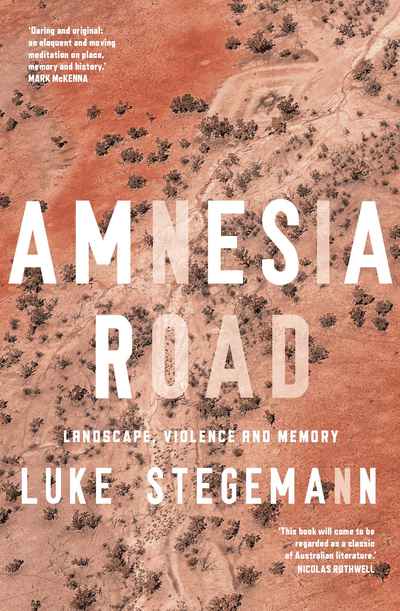
South-western Queensland and the rural backlands of Andalusia in Spain are two landscapes and histories that rarely mentioned in the same breath. However, they are not dissimilar to look at: indeed, the image on the front cover could be of Australia’s red centre or the arid desert regions of Andalusia. I suspect by the red tones that suffuse the photograph that it is of Australia, but blood is red too, and it has soaked into the landscape of both settings. In Queensland there were the barely acknowledge massacres of indigenous Australians as settlers moved westward; in Andalusia, there were the bloody atrocities on both sides during the Spanish Civil War.

There are few other people whose knowledge spans both locations, apart from fleeting visits by most travellers. This is where Hispanist and cultural historian Luke Stegemann comes in. He travels the backroads of Queensland as a boxing referee, while he refers to Spain as his ‘second patria‘. Deeply familiar with both, he brings them together in what is described as a “literary examination” of landscape, violence and memory in the two places.

He doesn’t actually describe what a “literary examination” or a “literary meditation” is, but I assume that it is a drawing together of the visions of other writers about an event or place. Certainly, he does reference other authors, but this is no mere desktop activity. He physically visits many of the places that he writes about, mainly as an outside observer. He marries the literary and experiential into a discursive, poetic, beautifully shaped exploration of questions about the memories that a landscape can hold, and the tenacity with which those memories take hold, despite the tacit or overt agreement to deny them.

This book employs two scenarios- the mid-nineteenth century pastoral frontier of south-west Queensland, and a series of early twentieth-century civilian massacres in southern Spain – as pathways towards examining the ways history is turned over and inspected, sometimes with fascination, sometimes with disgust, and its angles then polished for specific cultural and political purposes. Both scenarios are at the centre of contemporary debates around the need to tell, and approved methods of telling, troubled – perhaps better to say infamous – aspects of national history.

p.6

The opening chapters wrestle with the ideas of memory and forgetting, memorializing through graveyards and forgetting through unnamed massacre sites. He shuttles between Australia and Spain, using the writing from one culture to illuminate the other. In places this seems like a linguistic game, with chapters titled ‘The verb that has no name’ or ‘The Language of Eden’. The passing of generations and their knowledge is described grammatically:

The past tense soon closes down the present perfect nature of that claim: people have seen becomes, forever, people saw. Descendants remain, but the last of the witnesses are gone. The final death is often unremarked for who knows who is the last of the witnesses?…Each day, each year, each decade, periods of history move further away and we are left with an imperfect detritus. Windows are closed, doors shut, voices silenced, graves sealed.

p.34

The book is mainly based on the Australian experience, with the Iberian example used as a point of both comparison and contrast. The heart of the book lies in the two long chapters ‘Threnody’ (which I confess I had to look up – it means “a wailing ode, song, hymn or poem of mourning composed or performed as a memorial to a dead person”) and ‘Iberian Hinterland’.

The ‘Threnody’ chapter, at 50 pages, has the structure of a guided tour across the landscape of south-west Queensland. At each stop, he gives us a description of the landscape and a short history of the ‘interactions’ that took place there. He intersperses this with the local and amateur histories of these places, which generally celebrate the ‘progress’ of settlement and the ‘success’ of ‘dispersal’.

We have a duty to look unsparingly at the acts committed. We can now both see and understand the absurd vanity of the acquisitive graziers, to say nothing of the wretched illegality of their land grabs; nevertheless our contemporary morality is of limited use in grappling with this history. Unavoidably, the expansion of the Europeans across south-west Queensland involved tremendous cruelty and episodes of outright violence that mark our national history, though this fact must be tempered with the knowledge of acts of tenderness and attempts at understanding on both sides, and what were often immediate and close relationships between Indigenous people and settlers.

p. 85

Nonetheless, as he points out, in order to considered these acts of goodwill, “it is first necessary to climb over the bodies. The toll cannot be avoided.” P. 118 On the Massacre Map produced by the University of Newcastle, the area of South West Queensland is not studded with dots (as the coastal areas are) but when you do click on the massacres, they are of huge numbers of people. I have read of frontier violence before, but it was generalIy deployed against small groups of warriors, or family groups of women and children. I hadn’t imagined 300 people being massacred, as at Bulloo River. Imagine it. The vision is horrifying.

In the succeeding ‘Iberian Hinterland’ chapter, at 63 pages in length, he takes a similar approach, although here he overlays the bloody Civil War history with the tourist itinerary, which exists largely oblivious to what happened less than a century before. I remember reading in the guide book that I took with me to Andalusia just a few years ago, there was still sensitivity about the Civil War, and to not ask pointed questions. But unlike the anonymity and paucity of Indigenous deaths in Australia, there is “a paper trail and a line of bones” that testify to a national total of some 115,000 murdered behind nationalist lines, and 55,000 behind Republican lines (p.135). With the passing of the Law of Historic Memory in 2007 there has been a deliberate political decision that the tacit silence about this slaughter will be broken; that bodies will be exhumed; that Franco will be shifted from the Valley of the Fallen to a private family vault.

Just as there is no turning away from the brutal slaughter of Indigenous people in south-west Queensland, there is no turning away from the indiscriminate killing of tens of thousands of innocent people in the first months of Spain’s civil conflict. And it has been the slow revelation of these details, the political environment into which they have been released, and the arguments they have triggered around questions of memory, truth, justice, compensation and reconciliation, and where these might find their place in a modern democracy, that have added weight to what might otherwise have been just one more collection of twentieth-century bones- anonymous, roadside or forest-deep- abandoned to their violent quiet.

p. 137

Stegemann sees a similar movement at work here in Australia too, as the Great Australian Silence (in Stanner’s words) is finally being broken down. In particular he points to the Uluru Statement (awarded the 2021 Sydney Peace Prize but still shamefully suspended in limbo four years later). But he points out that reconciliation is hard work. The passing and implementation of the Law of Historic Memory in Spain has been fraught, and is likely to become even more so with the rise of populism. In Australia, the ideological ravine scours ever deeper with social media and a shrill press.

This really is a beautifully written book. You could open any page and find a paragraph that is beautifully crafted and insightful. It has high expectations of the reader. The dual emphasis on Indigenous Australia and Andalusia particularly appealed to me because my interests align along those tracks as well, but also because it illustrates the way that our learning in one field illuminates and enriches the other fields of knowledge that we encounter.

My rating: 9/10

Sourced from: Yarra Plenty Regional Library

‘Black, White and Exempt’ by Lucinda Aberdeen and Jennifer Jones (eds.)

2021, 184 p.

Aboriginal and Torres Strait Islander people are respectfully advised that this publication contains names and images of deceased persons and culturally sensitive information.

I think that one of the most damning and poignant phrases in the Uluru Statement from the Heart refers to “the torment of our powerlessness”. I think about the massacres; I think about the Stolen Generations and now, after reading this book, I add the ‘certificate of exemption’ to this grim array of injustices.

The exemption legislation, introduced across Queensland (1897), Western Australia (1905), Northern Territory (1936), South Australia (1939) and New South Wales (1943) is almost breathtaking in its condescension and its nonchalance to its implications. Although the legislation differed between the states, it involved a process by which individual Aboriginal people could apply for a certificate to declare that they were exempt from the ‘Protection Acts’ on the grounds that they were more ‘assimilated’ than other Aboriginal people – lived moral lives, didn’t drink too much, had steady jobs – and didn’t participate (at least as far as the government was concerned) in Aboriginal culture or socialize with other ‘unexempt’ Aboriginal people. This exemption could be revoked at any time: likewise, it could be imposed without consent on ‘troublemakers’ to separate them from the community.

Ironically, some white Australians, wanting to challenge and negate Indigenous narratives, today deride their authors as “not real Aborigines” (yes, I’m looking at you Andrew Bolt). Yet the Australian government deliberately encouraged this conscious self-rejection of Aboriginal identity, which passed as a matter of course to their children.

This book arose from a two-day symposium called Rethinking and Researching 20th Century Aboriginal Exemption in Australia, held at La Trobe University’s Shepparton Campus in October 2018. Elders directed the planning committee and community member involvement, and there was input from the Aboriginal and Torres Straight Islander Cultural Arts Centre for Koorie Education at GOTAFE. Separate ‘yarning circles’ were held for Indigenous and non-Indigenous community members, academics and students. Of the eleven authors who contributed chapters to this collection, all but one are women, and four are Indigenous. This affects the type of book it is. A collection of papers presented as part of a conference or symposium has a different structure and tempo from a volume written by one person alone. Because they are written to reflect a timed, oral presentation, there is a fairly standard length and each one is self-contained, taking its own ‘bite’ at the question. Within each one there is a structure of introduction-evidence-conclusion, but unless there is a final, integrating chapter (and in this collection, there is not) there is often no over-arching conclusion. The La Trobe University connection between the authors comes through very clearly, with a strong representation of La Trobe academics and alumni.

Australia was not the only country to introduce exemption legislation. John Maynard, in the opening chapter, points out that historically, there were similar processes in French and Belgian colonies – not that looking to the Congo for policy is much of a recommendation (p. 14) Both Canada and America had similar policies with their Indigenous populations, starting with Canada in 1857 and in America in 1906. Rather disingenuously, the Queensland legislation of 1897 was called the Aboriginal Protection and Restriction of the Sale of Opium Act, even though only 6 of its 33 clauses related to opium, the remaining all directed towards control of Indigenous people.

So how did one get exempted? When the individual Indigenous person initiated the process, it involved writing a letter to the responsible authority, providing references, then attending an interview. It was intrusive and judgmental. All of this correspondence, and the government reports that led to either the approval or rejection of the application are part of the National Archives of Australia collection. As Katherine Ellinghaus noted in her chapter where she reviews the history of the exemption legislation, “the archives of exemption are incredible: vast, intimate and confronting”. They make judgements on intimate details of Indigenous lives: the cleanliness of their houses, whether or not they drank alcohol, who they were married to, if they were ‘troublesome’.

Those [records] that remain contain evidence of cruelty, misfortune and sadness, but also resistance, activism and survivance [sic]. Even the simplest and most everyday applications for exemption should be seen as documents of negotiation…[containing] extraordinary detail of people’s lives and families, often rendered in racist and unkind bureaucratic language

p. 40

As a result, the records are on restricted access, available only to their families, which is only right. Some families have allowed historians to access them, with names redacted. Other Indigenous people have drawn on these records in telling their own stories in the form of biographies and memoirs. Other stories are in oral form only. In this book, Indigenous contributors Aunty Kella Robinson and Aunty Judi Wickes draw on their own family stories, while in other chapters families have given permission to the historian, with names changed.

From these stories, we see that people sought exemption for a number of reasons. Sometimes it was because other welfare provisions were tied up with it- that you could only get a Commonwealth old-age pension if you held a certificate of exemption. For other people, it was a way of escaping the mission and taking up work opportunities elsewhere. Even there was no specific legislation in Victoria, families sought to escape the involvement of the Aborigines Welfare Board in their lives by seeking ‘self-determined exemption’ (p.85) from the vagaries of changing government policies, as explained in Jessica Horton’s chapter. Ella Simon, a revivalist preacher associated with the evangelical United Aborigines Mission, despised the certificate of exemption she gained in 1957. As Jennifer Jones shows in her chapter, gaining exemption meant that she could undertake her travelling ministry without being exposed to segregation, but it meant that she had to officially abjure her links with the Purfleet UAM mission, which was an integral part of her identity and faith. Karen Hughes’ chapter looks at the examples of two US War Brides, whose certificate of exemption enabled their journey to the United States, where they faced new forms of discrimination. Leonie Stevens’ chapter ‘Smash the Exemption System’ examines the Northern Territory, where at the time of introduction, Indigenous people (themselves a multi-cultural group) were the majority of the population, outnumbering the non-Indigenous population 4:1(p. 167). The Half Caste Progressive Association played an integral role, first in achieving the legislation in the 1930s and then attacking it in the 1950s. The Northern Australian Workers Union, active in the Pilbara strikes, and other networks drew on the United Nations Declaration of Human Rights, widening the pressure for change beyond the Territory to a national and international level.

At the same time, these stories highlight the precariousness of the status awarded by a certificate of exemption. If it was rescinded, families were forced to return to the mission, where there was a strong chance that their children would be taken. As part of their powerlessness, if the policies changed, their lives changed too. Beth Marsden’s chapter ‘Destination of Pupil ‘Unknown” shows the fluidity of family relocations along the Victorian/NSW border as children were enrolled in school, often with vague information provided by the parents, and then withdrawn to escape the scrutiny of the state and the fear of removal. In NSW segregated schooling had developed when school principals requested to exclude Aboriginal children on the grounds of complaints made by white communities (p.109) Shifting back and forth across the border was a way of maintaining family networks and resisting the bureaucracies of both states, but it must have affected the childrens’ education.

I was appalled, reading these stories, one after the other. I understand completely the sensitivities and pain involved in telling family stories, where the decisions of one generation about identity and identification cascade through into succeeding generations. These stories, and the judgments and prejudices that prompted them, are for the family to tell. But the repetition of these injustices, in one family and then another and another, highlights that this was a structural, government-sanctioned process. It should be better known, and it needs to be part of the Truth Telling that must, eventually, come.

As Ellinghaus says:

The history of exemption must be fully told, not just to historians and stakeholders, but to mainstream Australia as part of the truth-telling that this nation sorely needs. There should be public recognition of the damage that has been done by these policies, perhaps in the same way that we have seen for the Stolen Generations. Not just recognition, apologies and reparations, but the inclusion of these people who have suffered through this policy in the narrative of settler colonialism in Australia.

p. 41

On the basis of the editorship and the predominance of female contributors, I have included this book in the Australian Women Writers Challenge.

‘Oh Happy Day: Those Times and These Times’ by Carmen Callil

2020, 282 p.

Somehow or other I have ended up with a second-hand copy Carmen Callil’s earlier book Bad Faith on my bookshelf. When I purchased it from who-knows-where, I did not know who Callil was, but I was aware that her book had been well received. Even though Bad Faith remains unread, I now know that Carmen Callil is Australian, even though she has lived in England since 1964, and that she started Virago Press and has worked in the field of publishing and literature ever since. So I picked up her most recent book Oh Happy Day: Those Times and These Times when I saw it at the library.

The blurb on the back reads:

Carmen Callil explores her roots in a book that is a miracle of research and whose writing is fuelled by righteous anger…Carmen Callil not only reclaims from obscurity the lives of these ordinary men and women who were sent to Australia as convicts or domestic servants, but also draws telling parallels for our own times. Oh Happy Day is a moving story of poverty, social injustice, Empire and migration.

As I have said many times before on this blog – so many times that I’m boring myself too- I am drawn to ‘Who Do You Think You Are’-type books and programs, and I am usually disappointed. I like the history; I like the stories of largely unknown people, but I find the displays of emotion on the part of the searcher to be maudlin and somewhat self-centred. The tears are triggered more by a sense of identification – “that’s MY great-grandmother” – rather than from a sense of injustice that anyone endured such sorrow or deprivation. Probably the best family history/quest I have read is Graeme Davison’s Lost Relations, and re-reading my review here, I again find myself nodding in agreement with Davison’s reservations about the endeavour, many of which I share. Callil’s book is not unlike Davison’s in that it takes a broad view of the context, then embeds the individuals within it, rather than the other way round. And that’s the way I like it.

The three sets of family trees in the book, one at the front, two in the appendices, makes it patently obvious that this is going to be a book based on genealogy. In her introduction Callil writes that she intended to write about all her English, Irish and Lebanese emigrant ancestors, but then decided to focus on three: Sary Lacey; George Conquest, the father of one of Sary’s children, and Mary Ann Brooks, who married Sary’s son. All three ended up in Australia via different routes; all three are found on branches of Callil’s family tree; and all three are used as vehicles by which Callil tells her story of nineteenth century working class life.

I’m not going to go into the details of these individuals’ lives. As often happens with family historians, the researcher feels a familiarity (on first name basis no less) with the individuals on their family tree and the minutiae of their lives, that can become eye-glazingly tedious to outsiders. I’m more interested in the bigger themes that she draws out.

The first theme is the effect of technological change on the stocking frame workers in Leicestershire. Until now, I wasn’t particularly clear on what a stocking frame even was. The home-based stocking frame workers had a rhythm to their working week – collecting the wool, working feverishly for about four days, taking back the finished product then a few days later collecting the wool to start the whole cycle again. They rented their frames from middle-men, who took their own cut. However, the fashions changed, new machines that did not fit inside a house were invented, and the trade shifted into factories instead, with those few stocking frame workers clinging to the old ways offered less and less for a product that no one wanted.

Second, I knew about the changes to the Poor Laws in the 1830s, but I hadn’t quite realized the ‘like it or lump it’ approach it took to the destitute who sought assistance: it was the Poor House or nothing. Her telling of Sary’s life in particular illustrates the contingent and precarious nature of working class life, and the thread of relationships that could keep a family just outside the Poor House walls. The stories of Callil’s ancestors emphasize the physical proximity of family, shifting from street to street, generally staying close to other family. She hints – because she can do no more than that- at an incestuous relationship. She suggests the ruses and half-truths that enabled Sary to work the system sufficiently to survive. She notes the importance of Nonconformist religion amongst the working class and highlights the political turmoil amongst the working class at the time, even though there is no evidence that her family was involved.

Third, only one of her three ancestors is transported to Australia, but she devotes considerable space to the convict system as it changed over time, and as George Conquest experienced it. Here I feel that she faces the similar hazard as Babette Smith confronted in her Defiant Voices (my review here) where the dramatic and cruel is emphasized, but the examples in the book reveal the opposite. Callil is not a historian, but she does engage with the academic literature. Her own dispute with John Hirst’s argument that the convict system was more negotiable than, say Robert Hughes’ depiction of systematized violence and terror, is played out more in the footnotes than in the text. In a footnote she describes Hirst’s Convict Society (my review here) as “an exquisite example of Australian revisionist history, revealing much about its writer and little about the experience of convicts- and others of the time” (p. 308). Even though she spends many pages describing whippings and brutality, her ancestor George Conquest was not sent to a secondary penal settlement, and there is no evidence that he was whipped. In fact, he was almost a poster-child for the opportunities that could open up through transportation, partially through the benevolence and assistance of a magistrate-settler to whom he was assigned, and also through his own astuteness and hard work in taking advantage of the situations that presented themselves. Even though the convict system was intended to keep convicts on the other side of the world, George Conquest was even able to visit England again, returning by choice to Australia and finding himself in a position to help family members.

In her introduction Callil wrote that she had a present-day purpose in writing this book:

So I decided to tell only the story of Sary, George and Mary Ann, natives of England’s labouring poor – the paupers, asylum seeks and refugees of their day. Their story raised a question: had so little changed in Britain in the last 200 years, that generation could succeed generation, each one repeating their grim experiences?

p. xvi

I don’t know that she really explores this question in much depth in the book. Where she does draw parallels with the present day, it is in passing or concentrated within the closing pages of the book, almost as a polemic about refugees, Brexit, indigenous affairs, rather than engaged with as a serious question. I was disappointed, too, that she did include her Lebanese forefathers at the end of the book after all, despite her intention to concentrate on Sary, George and Mary Ann. It is such a cursory treatment that I felt it weakened the book, rather than strengthened it. Sary, George and Mary Ann are strong characters, whose lives provide much to work with, and I think that she should have stayed with them alone. Her research into the Britain they left, and the Australia to which they came is detailed and rich, especially for people who are unknown to all but family, but I’m not sure that the book meets the expectations for present-day commentary that the title and her introduction suggest.

My rating: 7/10

Sourced from: Yarra Plenty Regional Library.

I have included this on the Australian Women Writers Challenge.