Category Archives: Aborigines in Port Phillip

No Good Damper

While reading through the newspapers of 1840s Port Phillip, my attention has been arrested several times by the location called  “No-Good-Damper”.  The location seemed to attract malfeasants and scoundrels of all types: people were often being held up and robbed on the road, and the Plenty Valley bushrangers were sighted there.  So where is No-Good-Damper?  Why was it called that?

The No-Good-Damper hotel was located, apparently, near the present Springvale six-way junction where Dandenong and Centre roads converge.  For those who are topographically inclined, the longitude is approximately 145.16 and latitude 37.95.

The present-day Vale Hotel claims it as its forerunner.  The original licence for the No Good Damper hotel was granted to Christian Ludolph Johannes De Villiers on April 20 1841, and it seems to have changed hands several times- to William Scott who also had the licence for the Squatters Rest in April 1842 (they may have been the same hotel), and then to a Robert McGhee in May 1844 who may or may not have been the same person as Robert McKee who held the licence in April 1845.

It was a rather dangerous place to hang around.  The Port Phillip Herald of April 4, 1843  reports that Mr Bond of No-Good-Damper was the victim of an attempted robbery:

On Monday night week as Mr Bond of No-Good-Damper was returning home from Melbourne, and only a short distance from his house, he was suddenly commanded “to stand” by an armed man, who after demanding his money, and not waiting to see if the same would be delivered to him, struck Mr Bond a violent blow with a bludgeon, which, however, did not bring him to the ground, but being armed with a leaded riding whip, he quickly knocked down the ruffian, and before he could dismount a pistol was fired at him, the ball carrying away the brim of his hat, and shaving off a portion of the hair of his head.  Mr Bond made up to him with the intention of closing with him, but the villain took to his heels, and notwithstanding that he was pursued for a short distance he succeeded in getting clear off.

A year earlier, in April 1842, there had been another more daring raid by the Plenty Valley bushrangers, who were to later be sentenced to death by hanging by Judge Willis. On April 29th 1842 the Port Phillip Herald reported

In our last we reported some daring attacks, which have been recently made upon the stations of a number of settlers in the vicinity of Melbourne, since which we have learned the particulars of another outrage committed, it is presumed by the same banditti, upon Captain Gwatkin of the ‘Scout’ at present in our harbour, and Mr F. Pittman.  On Wednesday evening as these gentlemen were proceeding in a gig to the station of the Messrs. Langhorne at Dandenong, they were stopped at about seven o’clock, a mile and a half on this side No Good Damper, or about twelve miles from Melbourne, by four men heavily armed both with guns and pistols, three of the gang being well mounted and the other on foot.  They immediately ordered Messrs. Gwatkin and Pittman to get out of the gig and strip off their clothes, which of course they were compelled to do, as during the time the guns were held cocked at their heads, and threats of instant death pronounced should they disobey orders.  The clothes were minutely rifled, and from those of Captain Gwatkin were taken 21 pounds in Launceston notes, of which 3 were fives and the remainder ones, 33 pounds of the Melbourne Banks, of which five were fives, also four sovereigns and a half, a quantity of silver, and a few coppers, amounting in all to 63 pound 1s. 8d.  They returned 5s to Mr Pittman “to pay for his bed at No Good Damper”, but upon being remonstrated with by Captain Gwatkin, who said that having got such a handsome booty they might have the generosity to return a sovereign to pay his expenses until his return to town, they very cooly informed him that he could go to sea and make more, and to think himself safe they did not blow his brains out; they had at first demanded and learned his name.  The horse was next taken out of the gig; the harness, with the exception of the bridle was taken off; and Mr Pittman ordered to assist the ruffian on foot to mount thereon, when the whole party rode off at a brisk pace. Messrs. Gwatkin and Pittman proceeded on to No Good Damper, from which they immediately despatched a messenger to town with the intelligence; and on coming into town yesterday morning they called at Mr Le Mann’s near the place where they were robbed, and were informed that about 8 o’clock the previous evening, four men paid him a visit, “bailed up” two men who were in his hut, forced a woman to make them some tea, helped themselves to two saddles, one for the horse they had taken out of the gig, and the other for one of the horses on which they had previously only a saddle cloth, gave a boy 1s. 7d. for holding their horses, and decamped.

How  did this salubrious location get the name No-Good-Damper?  Let’s be charitable and go with the explanation given to the editor of the Argus on 9 September 1924:

Sir: In the interesting article “The Gippsland Mystery” on Saturday by Ernest McCaughan it is stated that a party of five whites and ten blacks were sent out under the leadership of De Villiers, an ex police officer who kept the extraordinary named No Good Damper Inn.  Apropos of this, a story was related to me by the late Robert Rowley, then of Rye (a very old colonist who had known Buckley, the wild white man). The story, which may be of interest, is that about the year 1840 lime was being burnt about Sorrento and Rye.  A layer of sheoak logs was laid on the ground, then a layer of limestone.  Another layer of logs, then again stone, and so on, until there was a considerable stack.  Fire was next applied.  By this rough and ready, though wasteful system, lime used in the building of early Melbourne was then burned.  The lime was then “slacked”, afterwards sieved through a fine sieve, and forwarded to Melbourne by ketch.  One of these old windjammers had the misfortune to go aground near the site of Frankston.  The lime was taken off  undamaged, stacked, and carefully covered a little way from the shore. A number of blacks were in the vicinity.

They had some little experience of the white fellow’s flour.  When they found the lime, sieved and done up in small bags under a tarpaulin, they were sure they had got the genuine article in plenty.  So they mustered in force, took away all they possibly could and fearing pursuit did not stop running until they put about 12 miles between them and the stack of lime.  The blacks then mixed their flour with water upon their ‘possum rugs and put the dough in the ashes to bake, the result being spoiled rugs and bad damper.  In the words of Mr Rowley, “they called that place Dandenong” which means “no good damper”.

Yours &c J. L. Brown, Sandringham Sept 8.

And now for the slightly less cheery version, courtesy of Edmund Finn (Garryowen) p. 963.

There is a place near Dandenong called “No good Damper”, and the origin of this name is very laughable.  The proprietor of a small store there had occasion to be sometimes away from home, and the Aborigines, who had a great weakness for flour and mutton, stole a quantity of some flour, but the storekeeper said he would be even with the blacks.  So he got a couple of bags of lime from Melbourne, and made them do duty for the flour at his next absence. “Blacky” called again, but instead of flour purloined a bag of lime, and left in great glee. On arriving at their quambying ground they commenced baking operations, when on mixing water with the supposed flour, they were horrified to find it fizz, and fancing the white man’s “debble debble” was about to bewitch them, they ran away yelling “No good damper, no good damper.”  So thus the phrase took, and so the storeman’s place is named to this day.  The flour was never troubled after.  Arsenic, is said to have been often mixed with flour for the special use of the blacks at more than one of the stations in the then wild interior.

Ah, yes, a laughable little story indeed.

And George Dunnerdale, who wrote ‘The Book of the Bush’ in  1893  wrote:

It was near Caulfield on the Melbourne side of  “No Good Damper swamp”.  Some blackfellows had been poisoned there by a settler who wanted to get rid of them.  He gave them damper with arsenic in it, and when dying they said “No good damper”.  (p. 276)

Would it have been possible at the time to pass off a deliberate poisoning as a “laughable” little anecdote, or even then would it have to have been disguised in some way?  Certainly, several of the settlers who came before Judge Willis made no secret that they had shot aborigines who had “trespassed” on their land, or in retribution for stock deaths. And even now, you could be sitting in the comfort of your twentieth-century car passing “Murdering Gully” near Camperdown or   Massacre Hill near Port Campbell.

For what-ever reason, though, “No Good Damper” seems to have slipped away as a place-name, even though it was used quite freely in the early 1840s.  I wonder what would be the response if we tried to revive it?


Some figures

The other day I was reading through the Votes and Proceedings of the Legislative Council for the 1840s (as one does) , and looking at the Statistical Returns for 1834-43, which were printed in June 1844.

There I found a table of the official figures of whites killed by Aborigines, and conversely, Aborigines killed by whites for the district of Port Phillip.  These are, of course, the ridgy-didge “official” figures- the sort that Keith Windschuttle in his Fabrication of Aboriginal History upheld-  with all that entails.

WHITES KILLED BY ABORIGINES PORT PHILLIP.

1836 2
1838 12 10 + 1 +1
1839 3
1840 11
1841 6 + 2 The two were murdered by the Van Diemen’s Land blacks
1842 4
1843 1
1844 1

Total: 40

NATIVES KILLED BY WHITES.

1836 1
1838 16
1839 8
1840 67 30 by the Whyte Brothers- rests on Aboriginal evidence. 10 in Grampians by Messrs Wedge, depends partly on Aboriginal evidence
1841 10 Based on statements by Aborigines
1842 6 4 at Smith and Osbrey’s station – great investigation and 3 persons tried and acquitted
1843 3 In one event at Mr Rickett’s
1844 2

TOTAL 113

I’m surprised that the figures are so low on the white side.  Given the heightened anxiety and dread expressed by settlers on the frontier, I’m surprised that there are not more white deaths.  However, many attacks involved property loss- particularly the hacking and killing of sheep- and given that stock (rather than the ownership of land) formed the basis of wealth in this pastoral squatting society, these attacks were property crimes that struck at the heart of the settlers’ financial viability.   The low figures on the aboriginal side are more to be expected. The figures for black deaths had to be corroborated by white evidence.  There was little to be gained in reporting an aboriginal death.  If  an aboriginal was  “said to be” killed, on aboriginal evidence only, then it was not counted.  You’ll note the qualification of  “based on statements by Aborigines” in the third column.

The statistics for whites killed show that overwhelmingly these deaths occured among hutkeepers, shepherds and servants.  These men were isolated, often far from the homestead (such as it was),  far from surveillance and likewise far from assistance.  They were also often assigned servants or ex-convicts.  Only four of the 40 were designated as “Mr —“, and only one was categorized as a settler.

The large spike in both white and native deaths in 1838 was because of the six-hour pitched battle that took place on Faithful’s station near Benalla, in retaliation for the massacre of 10-14 of Faithful’s workers (the official figure shows 10; Faithful claims 14).  I quoted Faithful’s description of the retaliatory battle  in my post on Letters from Victorian Pioneers.

I find it interesting that the Whyte brothers are named so openly here, and in the Letters from Victorian Pioneers.    The aboriginal deaths in 1840 around Whyte’s station in Coleraine came to be known as the Fighting Hills Massacre.  The Whyte brothers reported the attack themselves.  No charges were ever laid.

The trial of the men charged with the aboriginal deaths at Smith and Osbrey’s station occurred right at the point when Judge Willis was dismissed as Resident Judge.  The murders had occurred in February 1842 and a 50 pound reward was offered, later increased to 100 pounds with a free pardon and a free passage to England if the informant was a transported convict.  Nothing was heard, until a transported ‘bush carpenter’ employed at the station reported a number of men for the murder in May 1843.  Three men- Hill, Beswicke and Betts were committed to trial and it was, in fact, this case that Judge Willis was hearing when the court was interrupted by the serving of the Executive Order for Willis’ amoval.  Justice Jeffcott, who was Judge Willis’ replacement, took over the trial and the men were acquitted.  Gipps privately wrote to La Trobe that if he had been on the jury, he would have committed at least two of the three men, but Jeffcott was “not dissatisfied with the verdict”.

References:

Richard Broome Aboriginal Australians pp.40-48

A. G. L. Shaw The History of the Port Phillip District p.  114,130,138

Paul R Mullaly Crime in the Port Phillip District p.290-297

Museum Victoria: Encounters  http://museumvictoria.com.au/encounters/journeys/Robinson/Fighting_Hills.htm

Bride Letters from Victorian Pioneers

Votes and Proceedings of the NSW Legislative Council

Letters from Victorian Pioneers (or “It wasn’t me Guv’nor, it was him”)

victorian_pioneers

When Lieutenant-Governor La Trobe sailed home  for England on 6 May 1854, he carried with him a series of letters which he hoped to use when writing a history of the Port Phillip district in his retirement.  He had officially approached a number of the early pastoral pioneers and asked them a number of questions, and as you might expect, they answered his survey letter fairly promptly.  I’m not sure what the official letter said-  one of his respondents referred to a section that asked  “If preceded, accompanied or immediately followed, by whom and when, and the general state of the district around and in advance of me at that period.”  He obviously also specifically asked about encounters they had had with aborigines in their area, and their opinion of the future facing the aboriginal tribes.

He had big plans for these letters.  He intended his book to start with Captain Cook’s discovery of the Gippsland coast, then move to the early futile attempts at settlement.  It would then go on to record the effective colonization of the region by pastoralists, ending with the discovery of gold in 1851.  Part II would deal with the geology, botanty and zoology of the land; the aborigines and the human aspects of the spread of settlement.  He would then pass on to separation and the consequences of gold discovery, where he would rebut the criticisms that had been levelled against him for his administration of the gold fields.  He would then finish with ‘My Australian Home, a walk around my garden’.  (Gross, p. 131)

It was not to be.  He was increasingly afflicted with blindness, and realizing that he would never write this book, he returned the letters to Victoria in 1872 , where they were preserved in the public library.  Times had moved on: people were ‘moving forward’ then too, and not all that interested in the preceding generation. It was not until 1898 that the 58  letters were published by the Trustees of the Library under the name ‘Letters from Victorian Pioneers’.

Because they were responding to an official request with guiding questions, there is a sameness about the responses of his correspondents.  But there’s also quite a bit of similarity in their experiences as well, which is what I expected.  In fact, my impetus for reading this book was the suggestion in Robert Redfield’s book that people living in a small community often held a common biography.  Even though Redfield specifically states that his approach does not hold for frontier communities (which of course Port Phillip was), I was interested to see if the early pastoral settlers of Port Phillip could be said to have a common life story.

And yes, they could.  All his respondents were male, and many of them were young when they settled in Port Phillip- usually in their early to mid 20s.  Many of them came over from Van Diemens Land  from where they had initially emigrated (none admits to convict origins).  Many of them had brothers with them.  And they held in common sheep and cattle– hundreds and hundreds of them, trotting along, being slaughtered by marauding natives (and  what a dispiriting and expensive loss of life that must have been), moving from run to run.  Some time ago I read Roger McDonald’s book  The Ballad of Desmond Kale, and was frustrated by the sheep-sheep-sheep  emphasis of it, but sheep-fever is amply demonstrated here too.  It’s not as exotic and alluring as gold, but the sheep-rush  obviously drove the early settlers of Port Phillip.

They all mention the 1840s depression- although one canny Scotsman seems to have escaped it because he had savings still in Van Diemens Land.  There are names of landholders that spring up again and again- obviously big stockholders held land in several districts.  Many of them moved from station to station.

Some of them were quite observant about the changes wrought on the land after settlement.  Several mentioned that it was very dry when the area was first opened up, and that the rainfall had  improved in the last few years of the 1840s, drawing later settlers to land that had seemed uninviting when the first settlers passed it initially.  One or two mentioned changes in the grasslands, and some were quite nostalgic for the beauty of the unsettled areas.

Most fascinating of all was the range of responses to the question about aborigines.   Most of them knew of “other people” who had gone on shooting reprisals- as perhaps might be expected when the Lieutenant-Governor asked you such a question.  Several of them mentioned the Whyte brothers by name as being particularly responsible for aboriginal deaths, one respondent attributing 51 deaths to them compared with the official count of 30 aboriginal deaths.  A couple of respondents mentioned that they had shot aborigines in reprisal-  just one or two, mind you, and always because the aborigines started it first.   Another settler was named as responsible for several deaths, but he protested (too much?) his innocence. George Faithful of Wangaratta, however, reported quite openly his actions after suffering several attacks from surrounding natives:

At last, it so happened that I was the means of putting an end to this warfare.  Riding with two of my stockmen one day quietly along the banks of the river, we passed between the anabranch of the river itself by a narrow neck of land, and, after proceeding half a mile, we were all at once met by some hundreds of painted warriors with the most dreadful yells I had ever heard.  Had they sprung from the regions below we could have hardly been more taken by surprise.  Our horses bounded and neighed with fear- old brutes, which in other respects required an immense deal of persuasion in the way of spurs to make them go along.  Our first impulse was to retreat, but we found the narrow way blocked up by natives two and three deep, and we were at once saluted with a shower of spears.  My horse bounded and fell into an immense hole.  A spear just then passed over the pummel of my saddle.  This was the signal for a general onset.  The natives rushed on us like furies, with shouts and savage yells; it was no time for delay.  I ordered my men to take deliberate aim, and to fire only with certainty of destruction to the individual aimed at.  Unfortunately, the first shot from one of my men’s carbines did not take effect; in a moment we were surrounded on all sides by the savages boldly coming up to us.  It was my time now to endeavour to repel them.  I fired my double-barrel right and left, and two of the most forward fell; this stopped the impetuosity of their career.  I had time to reload, and the war thus continued from about ten o’clock in the morning until four in the afternoon.  We were slow to fire, and I trust and believe that many of the bravest of the savage warriors bit the dust.  (p. 220)

Several of the respondents noted that they had taken young aboriginal girls and boys to live with them, but that once they reached adulthood, their tribes came and took them away.   One settler commented that  he gave a baby back to its mother after he had taken it because the servant wasn’t prepared to look after it, and  seemed rather put out that she refused to give it to him a second time.  Several reported infanticide, especially where there was a white father and a black mother.  There were several allegations of cannibalism, although interestingly one settler reported that the aborigines thought that the whites were cannibals!

Where aboriginal deaths had occured, several claimed, it was because the blacks had become over-familiar.   White men didn’t take lubras, they claimed- the black men offered their wives to them freely.

Even amongst those who were most positive about the aborigines working for them on their stations, or their quickness and willingness to forgive, there was overall a deep sense that influenza, smallpox, VD or alcohol would decimate their numbers.  They all reported that there weren’t as many aborigines on their stations as there had been years earlier- strange that.

References

‘Letters from Victorian Pioneers: being a series of papers on the early occupation of the colony, the aborigines etc addressed by Victorian pioneers to His Excellency Charles Joseph La Trobe Esq. Lieutenant-Governor of the Colony of Victoria’. Edited with an introduction and notes by C. E. Sayers from the original edition edited for the Trustees of the Public Library by Thomas Francis Bride L.L.D during his period of office as Librarian of the Public Library of Victoria. (Phew!), 1969.

Alan Gross ‘Charles Joseph La Trobe, Superintendent of the Port Phillip District 1839-1851 Lieutenant-Governor of Victoria 1851-1854’. Melbourne, Melbourne University Press, 1956.

1851 Black Thursday

The Royal Historical Society of Victoria is having its centenary this year.  One of the aims of the founders of the society was to capture the stories of the early colonists of Port Phillip before they died.  I was flipping through some of the earliest volumes of its journal, and it is impressive to see papers given by people at their meetings who had been here (albeit as children) right from the start of Victoria’s settlement- just think of it: they would have seen and met these people of Port Phillip that I’ve read so much about.

At the 25th June and 3rd September meetings of the society in 1923,  a paper was read called “Reminiscences from 1841 of William Kyle- a pioneer. Communicated to and transcribed by Chas Daley”.    I hadn’t heard of William Kyle and I know nothing more about the paper than just this.  William Kyle was born in Greenock, Scotland in 1832 and came out to Port Phillip as a child with his father.  The paper extended over two editions of the Victorian Historical Magazine and traced through his arrival, life in the country and in Melbourne pre-gold rush with some fascinating descriptions of Aboriginal life on the edges of what are now the inner-city suburbs of Melbourne, then right through to the latter years of the century (I’ll admit that I didn’t read the whole thing).

I was drawn to this description of Black Thursday of 1851, and perhaps to get yourself in the mood you should visit the State Library of Victoria page and have a good look at William Strutt’s painting.

And here’s how William Kyle remembered Black Thursday of 1851:

The floods of 1849, which were the result of a general rainfall throughout the colony, caused an excessively dense growth of vegetation, and much grass.  Little clearing had been done in the forests, and ring-barking trees was not yet in vogue, so that, after a very hot summer, the outbreaks of fire which swept throughout the land under the stimulus of a fierce hot wind caused the conflagration known as Black Thursday.  The fire spread with amazing rapidity.  Three-quarters of the colony was in a blaze.  The flames were so intense that trees two or three hundred yards away from the advancing wall of flame were shrivelled before the flames reached them.  In the unsettled districts there was little loss, but thousands of sheep and cattle succumbed.  The native game was almost annihilated.  The fire was so near Melbourne that the sky seemed to be a mass of floating fragments of bark and leaves ablaze with the intense heat.  Many people thought the Day of Judgment had surely come.  We could hardly breathe the stifling air.  The floating embers even set on fire some of the ships in the bay.

After the conflagration had exhausted itself the scene was one of intense desolation.  Nothing was visible but charred stumps and blackened smoking trees, bereft of all foliage.  No sound of bird, insect or animal was to be heard.  It was years before game was plentiful, and it was never so again near the settled districts after Black Thursday.  Fortunately, although there were the most wonderful escapes from death, there were not many human lives lost, owing to the sparseness of the population.

Sounds very, very familiar.

Reference:

Reminiscences from 1841 of William Kyle, a pioneer’ Victorian Historical Magazine, Vol X, Dec 1925 No 4.

The Aboriginal Executions on 20 January 1842

Joseph Toscano, well known anarchist and correspondent to The Age yesterday convened a commemoration ceremony of the 167th anniversary of the execution of two “indigenous resistance fighters”  who were  found guilty of murder by Judge Willis, the Resident Judge of Port Phillip.

It is striking that there were six executions in Port Phillip during 1842, and then none for several years.   This does not necessarily denote, though, that Judge Willis was a particularly vicious ” hanging judge”.  Until his arrival in Port Phillip in March 1841, all Supreme Court trials were conducted in Sydney. After Judge Willis’ removal in mid 1843, his replacement Justice Jeffcott refused to order the death sentence in his own right until the legality of Willis’s dismissal had been confirmed.  However, during 1842 there were six executions in total- two Aborigines in January 1842, three bushrangers in June 1842 and another Aborigine (Roger) in September 1842.  For that year, it must have seemed that the execution parade through the streets of Melbourne to the gallows outside the new gaol was becoming a regular feature.

It’s significant that both aborigines and bushrangers were the real hot-button issues for white settlers.  Judge Willis did pass another death sentence for murder on Thomas Leahy for murder of his wife, but the the sentence was commuted to transportation.  However, there was no mercy for aborigines or bushrangers found guilty of murder: their crimes challenged power and authority more generally.

The passage of 167 years certainly changes the language that we use to conceptualize this event.  Toscano speaks today of their execution as “a great Melbourne story of love, resistance, passion and violence”.   Judge Willis wrote to La Trobe describing the case as “one of great atrocity”.  Toscano today identifies them as Tunnerminnerwait and Maulboyheenner; at the time their names were recorded by the Aboriginal Protector as “Tuninerparevay: Jack, Napoleon” and “Small Boy: Robert, Timmy, Jimmy”  (Mullaly, p. 255)

“Bob” and “Jack”, as they were popularly known at the time,  were part of a group of Aborigines brought across from Van Diemen’s Land by the Aboriginal Protector G. A. Robinson when he was appointed to his post in Port Phillip, with the intent of using them as intermediaries when conciliating the local tribes. This seems a rather ill-informed intention on Robinson’s part,  given the language and territory differences.  After a time they were no longer staying with Robinson. When two white whalers were murdered, this group of five aborigines, two men and three women (including Truganini) were reported to have been seen in the location of the murder scene , and said to have committed other depredations in the area.

This complicates the picture somewhat.  Coming from Van Diemen’s  Land, it was not a simple matter of protecting traditionally-owned territory from invading settlers.  On the other hand, their transplantation from Van Diemen’s Land across the sea was an absolute dispossession, and resistance moved from the particular to the generalized- not a particular settler on a particular river, but white men in general.

The Port Phillip Herald of 21 January 1842 reported that there was no doubt about the justness of the sentence, and that their execution was the imperative duty of the authorities to vindicate the impartiality of British law.   It is interesting to note the objections raised by Redmond Barry in their defence.  At first he argued that half the jury should consist of people able to speak the language of the defendants which, not unsurprisingly, Justice Willis overruled.   In  his address to the jury, Barry referred to the ‘peculiar situation’ of ‘circumstantial evidence of dubious character’.    Likewise, it is interesting to note the issues that did not arise.  The amenability of these particular Aborigines to European law was not questioned.  It was ascertained from Robinson that the men had knowledge of the existence of a Superior Being and knew right from wrong, and that they could speak English.  These grounds were later used by Judge Willis in other cases to acquit Aboriginals in his court who were not deemed to understand English or have an understanding of a Supreme Being.

In his address to the jury, Judge Willis is reported to have commented on the criminal activities of the armed men prior to the attack on the unarmed whalers, and he distinguished between the role of the men as murderers and the women as accomplices.  He emphasized the necessity to prevent the ‘recurrence of similar acts of aggression’.  After a recess of half an hour, the jury returned with a conviction for the men with a recommendation of mercy ‘on account of general good character and the peculiar circumstances under which they are placed’ (Mullaly p 257). The more than I think about it, this recommendation of mercy arising from a community truly anxious about ‘depredations’ and its consequent dismissal by the authorities is perhaps the most surprising aspect of the trial.

This recommendation, however, was not strongly supported by Justice Willis, and the sentence was confirmed by Governor Gipps. Their executions were the first in Port Phillip.  Public executions at the time were understood by the white participants and specatators  (as distinct from the Aboriginal prisoners)  to represent authority, religion and humanity (Castle 2007).    It was a highly ritualized degradation ceremony, with specific clothing and practices and designated roles for the clergy, the judge, the governor and the prisoners to play.  The newspaper descriptions of the time reflected the traditional  narratives of repentance, scaffold confessions and fear,  well-known from similar practices in England.

However, this was mixed with a degree of sympathy and uneasiness among some- but certainly not all- spectators.   This was a ‘first’ for everyone, and it was generally agreed that the execution itself was botched and unpleasant.  Although this first execution attracted large crowds, by the time another Aborigine, Roger, was executed in September 1842 there was newspaper disapproval of the character of the spectators who attended- particularly women- and calls for the scaffold to be removed as quickly as possible and executions to be carried out within the gaol walls rather than in public view.  However, this  squeamishness needs to be balanced against the fear of  Aboriginal depredations  voiced by small settlers and more influential squatters and landowners in the outlying frontier areas.   In such an environment, and given the legal restrictions on Aboriginal testimony, it is perhaps not surprising that there were so very, very few executions of white settlers when it was Aborigines who were murdered.

Update: An interesting article by Marie Fels with David Clark and Rene White called ‘Mistaken Identity, Not Aboriginal Heroes’ in Quadrant October 2014 looks closely at the coal-mine manager William Watson. The only words uttered by Tunnerminnerwait and Maulboyheener in their own defence pertained to William Watson-  “We thought it was Watson”. This article looks carefully and critically at William Watson and carefully reconstructs the movements of the Van Diemens Land aborigines immediately before the murder.  Well worth reading.

References:

Paul R. Mullaly  Crime in the Port Phillip District 1835-51,

Ian Macfarlane  The Public Executions at Melbourne 1842

Tim Castle ‘ Constructing Death: Newspaper reports of executions in colonial NSW 1826-1837’ Journal of Colonial History, vol 9, 2007 p. 51-68.

On the road from Heidelberg

From the Port Phillip Herald 6 Dec 1842

BLACK OUTRAGE. As a woman was coming to town the other day from Heidelberg, carrying a bundle in her hand, she was met by two black lubras, who attempting to take the bundle from her, the woman screamed out for assistance, whereupon she received a severe blow over the temples with a waddy, and the two blacks made off.  She complained of the assault at the police office, but no redress could be afforded, as she declared she could not identify the offenders.

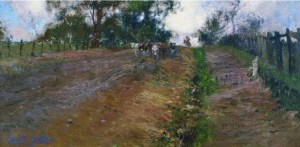
Heidelberg was about seven miles out from the centre of Melbourne, but generally viewed as being ‘in the country’.   There was a road out to Heidelberg by this time built from donations and public subscription lists by the Heidelberg Road Trust , representing the interests of  the gentlemen who lived there (Judge Willis himself, Verner, the Boldens, Wills, Porter etc).  Heidelberg Since 1836 describes the route as:

…an extension of the great Heidelberg Road, which commenced in present day Smith Street Collingwood, winding through the Edinburgh Gardens and then crossing a ford in the Merri Creek.  The track to the village was approximately along the present Heidelberg Road, along Upper Heidelberg Road, and then branched off down to the village from the top of the hill at Heidelberg.  The road continued on along the ridge of the hill, down to the Lower Plenty and then on to the Upper Yarra.  (p. 12)

heidelbergroad1

By 1842, over 500 pounds of local money had been spent on the road, and log bridges were built at the Darebin Creek and the Plenty River.  Late in 1842 the Government paid the wages of unemployed labourers to clear stones and stumps from the road.  From 1845, as a result of the deterioration of the road, a levy was placed on landowners and a toll was established.

Not that our “woman” (note- not a lady) would necessarily be using the road.  I’m astounded by the distances that even ladies would walk- Georgiana McCrae seemed to think nothing of walking across the paddocks into the city from her house ‘Mayfield’ near the corner of present-day Church and Victoria Streets Abbotsford.  Abbotsford is of course much closer to the city than Heidelberg, but even a lady of one of the most prominent families in Melbourne would be prepared to hoof it through the bush.

This is also a reminder that the “blacks” were not only up-country but relatively close to Melbourne .  In fact, there are fleeting mentions of aboriginal people still visible on the streets of Melbourne itself.  I’m not sure what the significance is- if any- of these two women accosting another woman. Would they, I wonder, have approached a man, who was more likely to defend himself?

References:

C. Cummins Heidelberg Since 1836: A Pictorial History.