Category Archives: Aborigines in Port Phillip

‘Good Men and True: The Aboriginal Police of the Port Phillip District 1837-1853’ by Marie Hansen Fels
1988, 227 p. plus appendices and notes

In her book, Marie Fels warns of a number of ethnocentric blindnesses and misconceptions, and I’m afraid that I’m guilty of at least three of them.  The first, she says, is to simply not see the presence of the Native Police and I’m certainly guilty of this.  I’ve been aware of them in my reading on Port Phillip, but hadn’t particularly considered what they might be doing there.  Then I noted that Jan Critchett attributed the turning point in aboriginal/settler “collisions” to their skill in pursuit and this notion fed, I suppose into my second misconception- that the Port Phillip Native Police Corps, like the Queensland Native Police Corps which was later modelled on it, was responsible for atrocities against aboriginal people.  And this, in turn, reflects my third ethnocentricity: the assumption that the act of joining the Native Police Corps was a form of treachery, undertaken only by marginal men who would be ostracized by their tribesmen because of their involvement .

Instead, Fels argues, the men who joined the Native Police Corps were leaders of clans or their heirs.  They willingly joined with Europeans in policing work: policing in its pre-Peelite manifestation as ‘keeping the peace’ rather than ‘upholding the law’, and certainly more than just tracking.

Joining the Native Police Corps is best seen as a strategy in the direction of sharing power and authority in the Port Phillip District, in the changed environment of the powerful and permanent European presence.  Besides the material things that police could see they would get, an opportunity was put before them of becoming men of standing within their transformed world.  They took it, and furthermore, they used it.  They bent it back, exploiting their acquired prestige and influence to operate within traditional group politics, to such effect that while the Corps was in existence, these men were the powerbrokers… Being a native policeman was a state of dual consciousness and divided loyalty; it appears not to have been a matter of rejecting Aboriginality, but rather of learning to live in two different worlds (p. 87)

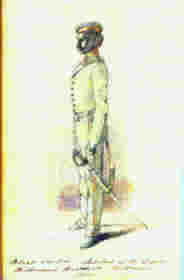
The men of the Native Police Corps were proud of their uniforms and they kept them in immaculate condition; they craved guns but rarely used them “on the side”;  they were able to read the nuances in status between white settlers, and they operated in a number of roles including escorting,  taking messages, guarding, search and rescue and a highly visible ceremonial role within white society.

Although men of  the Warwoorong and Bunerong tribes (her spelling) from around Melbourne initially formed the heart of the unit, they were not just 20 troopers drawn solely from those tribes, as it has been described in the past.  Instead she has identified over 140 individuals drawn from various tribes across Victoria- even, though to a lesser extent, from the Gippsland tribes who were the traditional enemies of the Warwoorong/Bunerong federation.  One of her appendices gives the biographical details of five such men, and she refers to the full 114 page version of the appendix that she attached to her thesis,  available at the University of Melbourne, which covers the other men.

Good men and true?  Dana, their commandant certainly thought so, and was staunch in his defence of his men.  For there were, and are, rumours that the Native Police Corps itself was involved in the slaughter of aboriginal people- indeed the Native Police themselves bragged of it.  Here Fels, likewise, springs to their defence, drawing on statistics about ammunition and weaponry to undercut the claims of multiple shootings; querying the motives of men who made the reports to La Trobe,  issuing cautions about the reliability of any Aboriginal evidence, and challenging the ready acceptance of Aboriginal reports of ‘many’ being killed.  While this may be true, it is an argument that must be balm to Windschuttle et. al who query the statistics over white atrocities as well.  Is there an ethical responsibility in using a line of argument that could be picked up and used to make a contrary, and possibly abhorrent point?  Or is there an intellectual responsibility NOT to resile from an argument out of fear that this might occur?   The line between challenging misconceptions and inaccuracies on the one hand, and defensiveness on the other  is a narrow one, and at times I felt that she over-reached a little.  But even she admitted her uneasiness about reports of the Native Police Corps in Gippsland, the territory of their enemies far from the reach of authority, and her credibility was strengthened by her caution here.

Top of the list of her acknowledgments is Greg Dening, and the book is dedicated to him.  I can see his influence here, in the way that she walks around an episode, reading against the record, stepping away and  reminding us:

Always the first question to be asked when examining the action of the Corps is ‘What was the nature of the traditional relationship?’ (p. 157)

I feel that the typesetting of her book did her a disservice, though.  The book is a densely woven argument and more white space would have given her reader a little more oxygen.  At times she launched into examination of an episode without warning and I’d screech to a halt wondering “Hold on- do I know about this? Has she talked about this earlier?” only to read on for a couple of paragraphs to realize that I’d been dropped into an episode for some close-up scrutiny.

In her introduction she stakes her claim:

Part of the task of the historian is to recognize that the issues which kindle interest and shape enquiry do emerge from the cultural present, but the written end-product succeeds or fails according to how well the historian has understood and explained the past on its own terms. (p. 5)

This book challenges our conceptions of the role of the Native Police Corps and its meaning for its participants and those who encountered it at the time.  I’ll leave the last word with her in her own closing paragraph, because it’s a strong argument:

To recognize that they were the victims of the European takeover of their land is one thing; to write a history of the origins and growth of the contemporary sense of oppression is another; but to impose the attitudes of the present on the evidence of the past is ahistorical, producing the effect of leaving out of our histories the evidence of creative and adaptive Aboriginal strategies such as this one- becoming a native policeman. (p. 227)

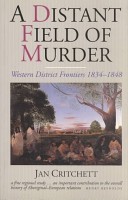
‘A distant field of murder’ by Jan Critchett

Critchett, Jan ‘A distant field of murder’: Western District Frontiers 1834-1848, Carlton Vic. Melbourne University Press, 1990, 219 p.

As you can tell from the title, Critchett’s book focuses on a specific district of Victoria over the short period of 14 years between 1834-1848.   For the aboriginal tribes of the Western district, it was  14 years of tumultuous and catastrophic change.  But even this 14 year period was just a small part of the life of Hissing Swan or Kaawirn Kuunawarn, the tribal man with whom this book starts and finishes.  Hissing Swan was born around 1822 and died in 1890 of a broken heart when he was moved from Framlingham mission when it was selected for closure. It was the second dispossession he had faced.  As the mission record shows:

“Old David (Hissing Swan) dead.  Idea of leaving home killed him; buried Thursday.” (p.192)

This book focusses on the Western District of Victoria, which under the Squatting Act was known as Portland Bay.  It was a huge territory that stretched from west of the Werribee River across to the South Australia border, with a line up to the Murray River. Of course, this was a white-man’s division for the purposes of administrative convenience.  The area of Portland Bay took in many clans and tribal groups, and a large part of this book is devoted to her appendices listing the different groups and individuals that Robinson and other missionaries and observers had counted in the district during the early days- a difficult task given the vagaries of pronunciation and orthography.   This might be seen as another attempt at head-counting, but I think that it’s more than this.  In the same way that she starts and finishes her book with an individual, named, person, this enumeration of  small, family groups is a way of giving a human identity and empirical presence to what was more often portrayed by white settlers as a brooding, shifting, often invisible presence. Settlement, as she notes, can take one of three forms-  slow expansion; a leapfrogging rush; then infilling of the vacant spaces between settlements.  In the second phase, white settlers moved into the district, often bringing with them their Aboriginal ‘boys’ from other areas.  The whites were largely oblivious to the clan boundaries they were crossing, but the aborigines who accompanied them were well aware of the boundary infringements they were committing.

By choosing to focus on the period 1834-1848 she takes in the period prior to the quasi-official ‘settlement’ of Victoria.  The aboriginal people of the Portland District had had long contact with white whalers and sealers, and Henty’s settlement in Portland predated the settlement of Melbourne.  She estimates that the chillingly-named Convincing Ground massacre probably took place around 1833 or 1834, but it was the influx of pastoralists after 1835 that heralded the greatest change.

There was a war in the Western District, she claims, but there were no great battles.  Instead, as she points out, the frontier was a personalized space:

The frontier was in fact a very local phenomenon, the disputed area being the very land each settler lived upon.  The enemy was not on the other side of neutral ground.  The frontier was represented by the woman who lived near by and was shared by her Aboriginal partner with a European or Europeans.  It was the group living down beside the creek or river, it was the ‘boy’ used as guide for exploring parties or for doing jobs now and then.  The ‘other side of the frontier’ was just down the yard or as close as the bed shared with an Aboriginal woman. (p. 23)

Although the white settler characterized clashes with Aboriginal people as “aggression”, “depredation” and “outrage”, most of the killings of whites involved prior violence or disputes over women, and often involved Aborigines known to them.  They were most often killed by blows to the head, rather than guns, suggesting that their Aboriginal attackers had been able to get close to them.   The nature of Aboriginal behaviour changed over time- groups combined forces, they used guerilla tactics, they took sheep and drove them long distances. The killings of aborigines most often involved Europeans seeking to recover their property, generally forming a small hunting party themselves, sometimes accompanied by a JP or the native police.

She sees 1842 as the turning point.  It was the worst year for inter-racial conflict and it was the year that white state power was most effectively demonstrated to the aborigines, partially through the hangings that took place then, but even more significantly through the deployment of the Border Police and especially the Native Police during that year.  As she notes:

In the end the Aborigines were dealt with on their own terms.  It was not necessary to have a large military force.  The enemy was really a series of enemies, each being a relatively small group of people.  They could be dealt with one by one or even simultaneously by a small number of individuals, providing they could follow the Aborigines to their camping places, normally inaccessible to Europeans.  Once a Native Police force was established the end of Aboriginal resistance was a possibility. (p 158)

Although 1842 was the turning point, the winter of 1843 was the worst period for ‘collisions’ between the Native Police and local aborigines, and even white authorities were uneasy about the lurid tales that the Native Police themselves told of their exploits.

There is much to be gained from a close-grained analysis of Aboriginal/White interaction based on a particular geographic region-  I know that Jim Belshaw has adopted this approach.  I think that her emphasis on the degree of contact, indeed sometimes intimacy, on the frontier is important.  This is a beautifully written history.  Its rather oblique chapter headings use quotations from the archive, and it is clearly structured without feeling contrived and constrained.  There are people here behind the numbers.

There is the hint in her work of an alternative ‘what-if’ history that shimmers just out of sight- the runs that were abandoned and remained empty because no settlers could withstand the violence; Gipps’ angry but unfulfilled threat to turn the whole district into an Aboriginal reserve and cancel all squatting licences-  but as Critchett points out, change was inevitable.  The murnong grass was no longer available because the sheep had eaten it; Aboriginal groups could no longer fire the grass to encourage its growth;  they were excluded from their waterholes, and had abandoned their permanent winter housing there.  Tribal and clan boundaries were weakened.  The district, as she says, was an extended convincing ground, and by 1848 when she draws her story to a close, the Aborigines had been convinced.

‘Memoirs recorded at Geelong by Foster Fyans’ ed. Phillip L Brown

“What is the use of a book, ” thought Alice “without pictures and conversations?”  I’m with you, Alice.  I  certainly wasn’t expecting conversations in Foster Fyan’s memoirs, and I very much appreciated the maps and illustrations.

Foster Fyans is well known in Geelong as the first police magistrate there (1837-40), then he became Crown Land Commissioner in the district.  The area just out of Geelong known as Fyansford is named after him, and there’s a Fyans Street in Geelong itself.  After visiting Geelong a fortnight ago for the Robert Dowling exhibition I seem to be rather Geelong-conscious at the moment, and I’ve been reading Fyans’ memoirs for a paper that I’ll be giving much later in the year.

As his entry in the Australian Dictionary of Biography suggests, there is not much known about his early life beyond that he was Irish and brought up by an uncle.  In these memoirs he springs from the page as a fully-formed army man, in charge of taking bringing a band of recruits to Portsmouth.  From the start he portrays army life full of masculine humour, eating and drinking, marching and high-jinks- almost a dead ringer for Lydia Bennett’s Mr Wickham and his mates.   His description of the Peninsular War likewise emphasizes life amongst his fellow soldiers, with more distress ascribed to the illness that swept through the camps rather than actual combat.  Then off to India for several years where again, life revolved around hunting and carousing and little mention of actual soldiering.  After a short time in Cape Colony (more parties and shooting), he arrived in Sydney where he spent a short, restless, lonely time before reporting to his regiment and joining his fellow soldiers at Parramatta.  Although he attended Government House, the jocular hail-fellow tone falters here, as the realities of convict settlement and official responsibilities become more apparent to him.  He is sent to the high-security  Norfolk Island where he eventually becomes Acting Commandant, and from there as commandant to Moreton Bay (now Brisbane) which was also a penal settlement at the time.  While  in Moreton Bay he oversaw the rescue of  Eliza Fraser.   His response to the convicts probably reflects the contradictions thrown up by the system- an uneasy wariness of violence that runs just below the surface co-existing with close day-to-day proximity with men not so different from oneself.

From there he was sent as Police Magistrate to Geelong, which is about fifty miles from Melbourne and rich pastoral land.  His memoirs become even quieter at this stage.  He spends quite a bit of time describing an expedition to the port settlement of  Portland, the first recognized land journey between the two settlements.  With only two mounted police and the surveyor Mr Smythe and no maps, they set off in what seemed to be atrocious weather, greeted each morning by the “flying jackass” (kookaburra), the “chanticleer of Australia”.   By 1840 he had been appointed Commissioner of Crown Lands, responsible for maintaining order among the squatters and investigating clashes between the settlers and the displaced aboriginal groups.  Here is a sad litany of violence,  where he mainly sides with the settlers in sympathy for what they perceive as needless stock loss. Like the settlers he is critical of the Aboriginal Protectors and the nearby mission station that he feels only attracts more aborigines to the area and imbues them with a misplaced sense of inviolability.

What started out as a military romp has become a nomadic police-like existence, accompanied mainly by his aboriginal “boy” Bon Jon (the purpose for my reading these memoirs).  It has become much quieter and more isolated.  Perhaps it’s the memoirist running out of puff too, because the memoirs stop abruptly in the bush in 1842.

The editor has written an introduction, where he describes the provenance of the manuscript and the various branches of the Fyans family tree, then gives a brief summary of the content of the memoirs.  I always enjoy hearing about how a manuscript comes to be published. The original, scrawled across five hundred foolscap pages had been typed up by Fyans’ great grand-son and it was donated by his descendants to the State Library of Victoria in 1962.   Although Fyans himself did not divide it into chapters, he did create sections by inserting a page with rough headings for the pages that follow. The  editor has created chapter headings and provided notes  at the end of each chapter.  These rather dour and punctilious annotations to the entries, which are painstaking in their detail, remind the reader of the fallibilities of memory and chronology, and the infelicities that arise when a raconteur is  telling a good story.

I think that it’s almost certain that anyone working exhaustively on an archive of memoirs, diaries or letters comes to build some sort of a relationship (albeit completely one-sided) with the author.  The editor, P. L. Brown (who also wrote the ADB entry) seems rather disenchanted by the many inconsistencies and errors he found

Fyan’s reminiscences had to be checked in order to assess their worth as historical material. This checking disclosed considerable and frequent divergence between actual and remembered events, and made it clear that the text, unless fully annotated, must be more entertaining than instructive. Hence the presentation of archives, both British and Australian, from the latter of which Fyans emerges as an energetic, conscientious public servant, rather let down by his rambling old self, who nevertheless conveys the authentic atmosphere of his historical period, and told few stories which lacked a germ of truth (p. xv)

The memoirs themselves ended abruptly, and the notes themselves end with the transcription of assorted letters and returns, and further details about wills and inheritances.  I found myself wishing that P.L. Brown had returned at this point to round out the picture somewhat and to help me, as reader, to bid farewell to Fyans.  After all, he’d been a rollicking companion for the first 100 pages or so, and despite infelicities and distortions in his retelling, he sure had a story to tell- Spain, India, Cape Colony and Australia- as did many of those peripatetic colonial civil servants.

Robert Dowling, Tasmanian Son of Empire.

If you put your skates on, you’ll catch the Robert Dowling, Tasmanian Son of Empire exhibition at the Geelong Art Gallery. But be quick- it finishes on 11 July.  There’s a beautiful NGA site about the exhibition here–  go have a look, it’s a stunning site and almost as good as being there.

Robert Dowling was born in 1827 in Colchester in England, the son of a Baptist preacher.  In 1834 he arrived in Tasmania with his parents, who followed their older sons who had emigrated to the colonies some time earlier.  This Evangelical background is important because it influenced the subjects he painted  for the rest of his life.  He was apprenticed as a saddle-maker but did not follow his trade. Instead he set himself up as a painter of commissioned portraits.  He travelled between Hobart and Launceston painting portraits of many prominent figures and personal friends, including John West the Congregationalist minister and other leading Evangelicals.  In 1854 he shifted across to Port Phillip in the hope of capitalizing on the post-Gold Rush prosperity.  However he found it difficult to gain patronage in Melbourne, so he shifted down to Geelong closer to his extended family, and where he was commissioned to paint portraits by the wealthy Western District pastoralists.

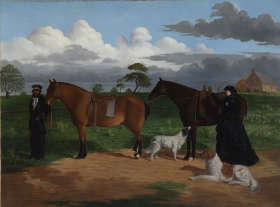
In every exhibition, there’s usually one painting that you linger in front of, and often return to in order to scrutinize it more closely.  For me, it was this painting: Mrs Adolphus Sceales with Black Jimmie on Merrang Station

The catalogue described this as a ‘mourning painting’.  The exhibition catalogue (a beautifully presented book by John Jones) tells me that  Adlophus Sceales died in 1855, leaving a young widow Jane and two young daughters.  Mrs Sceales commissioned the work, and how I wish that I could eavesdrop on the conversation between subject and artist when the painting was being planned!  The riderless horses remind me of the military funeral tradition, but I assume that they were portrayed because he must have loved riding, perhaps with the two dogs shown.  I wonder whose decision it was to include Jimmie, and what his clothes and stance indicate about his role on the station- it looks very formal attire, befitting a manservant for an Englishman.  The emptiness of the picture is striking: the house is not shown, only the stables and it looks rather bleak, empty and cold. The daughters are completely absent.

This was one of several paintings that show Aboriginal people in the Western Districts, sometimes in family groupings, and at other times in close proximity to the settler families with whom they lived.

These are the children of his brother-in-law’s family and I’m struck by the easy pose of the little girl draped innocently ( but not entirely appropriately to our eyes today) over the young  aboriginal man.  What does it say about his role in the family? He’s obviously much older than the children- does he have a carer role?

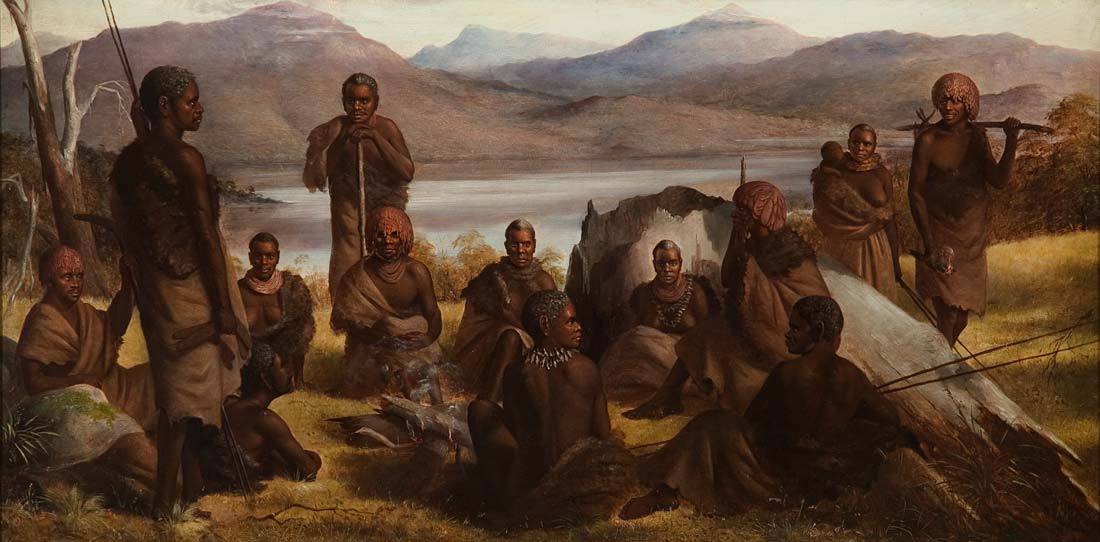
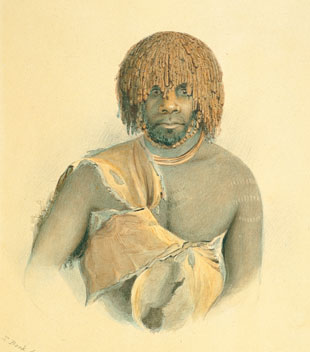
In 1857 Dowling travelled to London to study art, sponsored by the good citizens of Tasmania. He stayed there for nearly thirty years, improving his technique to be sure, and acting almost as a conduit of empire.   He made copies of British paintings for an antipodean audience- a portrait of Queen Victoria, for example was sent back to the colonies as an  important official painting. He sent images of empire home, and he brought images of the colony to the metropole. On the other side of the world, he worked up the paintings of Van Diemen’s Land aborigines painted by the ex-convict artist Thomas Bock, who had possibly instructed Dowling in painting many years earlier.  Bock had died by this time, and Dowling copied Bock’s paintings and inserted them into a range of landscape settings in grand History Paintings.  He made multiple copies, with the same central figures in different groupings and with different backgrounds.

Click on the NGV website about the Dowling exhibition for a zoomable close-up and explanation of the painting.

And, true to form, I can find six degrees of separation (even fewer!) from Judge Willis and this painting.  The smiling figure on the right hand side is Tunnerminnerwait, also known as Cape Grim Jack, who was one of the Van Diemen’s Land blacks who accompanied Protector Robinson across Bass  Strait. He was sentenced to death by Judge Willis and executed in January 1842.  If you have access to academic journals at all, there’s an excellent essay by Leonie Stevens in the June 2010 Victorian Historical Journal called “The Phenomenal Coolness of Tunnerminnerwait” ( a rather phenomenally cool title for the article, too!)

In a world where a few snatched bars of “Kookaburra Sits on the Old Gum Tree” can lead to a lawsuit, we might raise our eyebrows at Dowling’s appropriation of Bock’s images in this way. Here’s Bock’s version of Tunnerminnerwait on the left, and Woureddy on the right. You’ll be able to easily locate them in Dowling’s picture above.

Dowling’s re-presentations of Bock’s images found their way to the Ethnological Society of Britain and the Royal Academy where they fed the interest in anthropology and primitive societies.  Although these paintings were created in London, using sketches from Bock’s originals, they eventually found their way back to Australia as part of the swirl of cultural artefacts throughout the Empire.

Dowling returned to Australia in 1884 and set up a studio in Melbourne.  He returned to England two years later with the intention of packing up and moving permanently back to the colonies, but died suddenly.  As Jones points out, it’s interesting to speculate how he would have responded artistically to the Australian Impressionists and their take on Australian landscapes.

References

Jones, John.  Robert Dowling, Tasmanian son of Empire, Canberra, National Gallery of Australia c 2010

Stevens, Leonie  “The Phenomenal Coolness of Tunnerminnerwait” Victorian Historical Journal, Vol 8, No 1 June 2010 pp.18-40.

‘Aborigines and Colonists’ by R.H.W. Reece

Aborigines and Colonists: Aborigines and Colonial Society in New South Wales in the 1830s and 1840s

I was speaking to a fellow postgrad of close proximity (wave!)  the other day and he commented on the deluge of research amongst our postgraduate colleagues in Aboriginal history now, compared with the 1970s, when he first dipped his toes into the historical waters.   It brought home to me the distinctiveness of  Reece’s Aborigines and Colonists, published in 1974, where it joined a handful of books written after Stanner’s Boyer 1968 lectures that spoke of  “the great Australian silence”.  There was John Mulvaney’s work, and C.D. Rowley’s trilogy, and Henry Reynolds had published a book of sources and some journal articles- but not yet the books that he was later to become famous for.

In fact, it’s difficult to read Reece now without peering through the dust raised by Reynolds, Windschuttle etc. in the history wars of late last century.  There was such a heightened moral fervour in that debate that Reece’s work seems very cool and dispassionate in comparison.

The aim of his book, he says in the introduction, is to examine the “Aboriginal problem” as seen by philanthropists, squatters and colonial administrators, and so it locates itself very clearly on “one side of the frontier” as Reynolds might have characterized it.  The early chapters of the book explore the mindset of  “improvers” and “officials”.  Among the “improvers” he identifies those who wanted aborigines separated from white society as distinct from those who opposed segregation; those who thought that the introduction of Christianity was the main priority; those who saw “kindness” as a sign of weakness, and those who were repulsed by the sight, the smell and the sensational anecdotes that surrounded the Aborigines.  He traces through the changing emphases of official policy and the influence of evangelicals on Colonial Office policy, particularly in the mid 1830s, and the changes during Gipps’ tenure up until about 1844.  He sees the brief period between 1838 and 1844 as the time of genuine, but ill-informed attempts to bring Aboriginal and white relations under the framework of the law and to improve the spiritual and material welfare of Aboriginal people.

He focusses closely on the Myall Creek Massacre of 1838 which he contextualizes as one of a series of massacres in the Liverpool Plains district at the time.  It is here that I most clearly noticed the sober tone of his writing. He does not underplay the death and cruelty of Myall Creek but nor does he sensationalize it, and the writing is more powerful for it.  He also injects  field research (quite literally) when he writes of  Len Payne and Cecil Wall traipsing around what had been the Myall Creek stockyard, digging up hinges and fence posts.  Cecil Wall had been the last of a succession of Walls who had worked on Myall Creek.  You can read more about this here, in a rather idiosyncratic site.

Reece also spends quite a bit of time on the Port Phillip district, which was being newly settled at the time of the Myall Creek massacre.  It was in Port Phillip that the evangelical vision of Aboriginal Protectors was trialled, and found wanting.  He is particularly critical of La Trobe over his unfavourable reports of the Protectorate which made no recommendations to Gipps and provided little insight into the problems they faced.  I’d take issue with this: I see La Trobe as a benign but ultimately impotent figure in relation to the Protectorate.  Within the tenor of the deferential relationship he had with Gipps, I don’t think he could be anything else.

Nearly forty years after publication, this book still stands strong but it was a product of its time.  It would be wrong to chide it for the perspectives it does not explore- aboriginal resistance, aboriginal agency- because these historiographic themes did not emerge until decades later, and no doubt will be themselves overtaken.  As a trailblazer in its field, this book might well have been drowned out by the flood of later research, but its dispassionate tone serves it well.


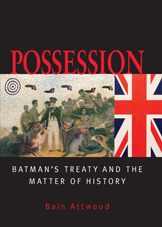
‘Possession: Batman’s Treaty and the Matter of History’ by Bain Attwood

2009, 323 p & notes

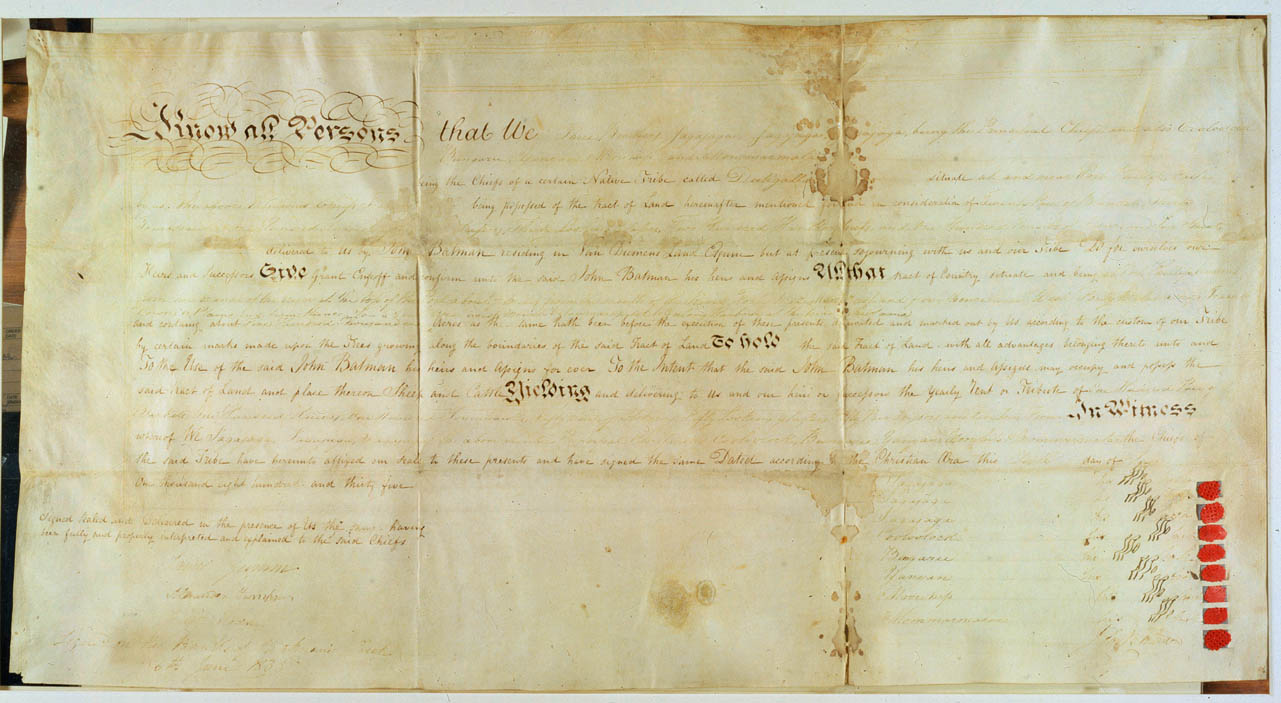
We will never really know how much of the [Port Phillip] Association’s narrative was true because of the paucity of contemporary sources.  Indeed, all we have are the few accounts created by these colonisers.  In respect of the famous treaty-making, we cannot even be sure it took place.  Arguably, it might simply be an imaginary event that never happened.  In the end, it probably doesn’t matter very much whether it occurred or not. (I assume that some parts of the treaty-making did take place.) What is more important historically are the stories that have been told about it. (p. 47)

As you might gather from this quote, this book is not just about Batman’s treaty.  In fact, looking at the book lying on my desk here with  “Possession” in large silver letters on the spine, I’m not really sure that the book is about possession at all.  The treaty itself could be a construction, and whatever ‘truth’ there is about it has been overlaid by boosterism, intentional forgetting and spin.

The treaty document itself was drawn up in Van Diemen’s Land before Batman arrived in Port Phillip; the ‘signatures’ have a suspicious similarity, and Batman did not, as he claimed, walk the boundaries of the land ‘traded’.  The motivations for the treaty and its subsequent quashing by the NSW goverment,  as Attwood explores, are best explained in terms of the time in which it was put forward – 1835- in the wake of the Black Wars in Tasmania, under the influence of the humanitarian lobbyists in London, and in light of the invention through the NSW courts during the 1830s and 1840s of a spurious ‘authorized’ history of British sovereignty in New South Wales, some 50 years after the event.

The creation and rejection of the treaty takes up only the first 100 pages of the book.  It then meanders into an exploration of the artistic depiction of the treaty over time and the change in emphasis on Batman’s treaty to Batman’s purported (and spurious) sailing up the river and declaration “This will be the place for a village!”.  I found the artwork fascinating.  Some time ago I had pooh-poohed the grand, commemorative American artwork tradition but here it is, alive and well in Melbourne- see here – it’s just not displayed in our art galleries any more.

The book moves into a discussion of history-writing in Victoria, with a string of antiquarian historians burnishing the Batman legend and feeding the Victorian (in both senses of the word) obsession with memorials and commemorations.  There was the Batman memorial over his putative grave; a memorial stone embedded in the footpath, Batman Park, Batman Avenue.  Then gradually the cracks in the image started appearing with questions over Batman’s parentage and sobriety and the championing of Fawkner’s settler history as an alternative story, pushed along by the tourism industry and latter-day Melbourne boosters and P.R. agents.  Gradually the memorials were shifted to quieter, less prominent locations, parks were renamed, and explanatory plaques were attached to statues qualifying some of the more gushing tributes to Batman and his activities. Just to add another layer to this already contorted history, it was Aboriginal people in Victoria who maintained the memory of Batman as the white man who dealt fairly with them, at a time when white history had consigned his treaty to the status of a curiosity.  The turn to politics becomes more weighty when Attwood takes on Henry Reynolds’ book The Law of the Land , which Attwood argues was a juridical history, intended to present sovereignty as a legal problem for 20th century political  purposes and one that, oddly, disregarded the Batman treaty entirely in the original edition of Reynolds’ book.

This is a richly illustrated book with coloured reproductions of the grand celebratory paintings, photographs of top-hatted men at yet another Batman memorial unveiling, reproductions of the string of illustrated histories that were published over the years and recent colour photographs of the now-discredited old memorials  and their newly-minted replacements.  It’s a book that takes us far beyond the treaty.

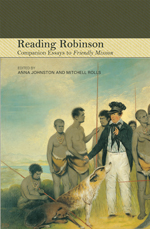
“Reading Mr Robinson” by Anna Johnston and Mitchell Rolls (eds.)

“Reading Mr Robinson: Companion Essays to Friendly Mission”, Anna Johnston and Mitchell Rolls (eds.)

reading_robinson_cover

2008, 188p. + notes.

N. J. B. Plomley’s Friendly Mission was published in 1966, with a reprint in 1971.  It’s a big book, close on 1000 pages and it has been out of print for over thirty years.  It has been recently re-released, and this companion book of essays has been published to accompany the new edition.

Friendly Mission is a transcription of the journals of the Aboriginal Protector George Augustus Robinson, with a lengthy introduction by Plomley.  Plomley’s work made the Van Diemen’s Land journals of George Augustus Robinson available and accessible- because  Robinson’s handwriting was truly wretched- for the first time to a wider audience.  This book of essays celebrates Plomley’s work and they testify to the importance of Friendly Mission as a contested and influential text that over 40 years ago encapsulated many of the debates still pertinent today about Aboriginal and Australian settler history.

There are three themes that run through the essays.  The first is consideration of Friendly Mission in is own right, as a text.   It is obviously a book that has deeply impressed the people who have read it, or chosen not to do so.  Lyndall Ryan speaks in her essay of  purchasing the book in its blue covers from the top shelf in a bookshop and reading it transfixed on public transport on the way home, and the encouragement she received from Manning Clark and Rhys Jones to explore it further.  A counterpoint to this enthusiasm is the response of three Palawa (Tasmanian Aboriginal ) contributors who write short reflections on their response to the book.  Some choose not to read it at all: others feel negated and angered by the perceived inevitability of ‘extinction’ and the self-aggrandisement and nonchalance of Robinson in the face of such tragedy.

N.J. B. or Norman James Brian Plomley- although known as Brian-  was a scientist and curator who wrote widely on a variety of natural history, medical, dentistry and museum studies issues.  His long introduction to Robinson’s diaries reflects the historiography of his times: he did not even consider the use of oral histories with living Tasmanian Aborigines- if, indeed he even considered them that at all- and his views on hybridity and purity of bloodline reflect attitudes towards aboriginality and identity that are not accepted today.  Rebe Taylor’s essay points out that there are oral history sources available, through the Westlake Papers collected by the geologist  Ernest Westlake (1855-1922) which among other things included interviews with the descendents of  the Bass Strait sealers and their Aboriginal women from 1908-10.   Plomley himself edited a collection of these interviews in 1991.

A second strand of these essays deals with the diarist George Augustus Robinson himself, the Great Conciliator with the Van Diemen’s Land tribes, and then Chief Protector in the Port Phillip Protectorate during the 1840s.   Alan Lester’s essay ‘George Augustus Robinson and Imperial Networks’ highlights Robinson’s religious and humanitarian motivation, and places him within the context of evangelical approaches being implemented by British and American missionaries across the Cape Colony, the West Indies, and American and Canadian frontiers.  Elizabeth Elbourne’s contribution ‘Between Van Diemen’s Land the the Cape Colony’ compares these two colonies, particularly in relation to the coercion of women and children, and links these to the small, but influential anti-Slavery lobby in the Colonial Office and the Aborigines Protection Society which itself was distancing itself from Robinson’s approach by the early 1840s.

Henry Reynolds in ‘George Augustus Robinson in Van Diemen’s Land: Race, Status and Religion’ embraces Robinson as a conscientious missionary, outraged by the injustices he witnessed.  The name-giving ceremonies, Reynolds claims, were an attempt to replace the derogatory names conferred by hostile settlers with more others with more dignity.  Robinson’s Christian belief in the brotherhood and equality of all men contrasted with the polygenetic views that were coming into currency whereby different branches of humanity were distinguished and ranked – with the British ascendant of course.  This is not to say that Robinson was unaffected by the early Victorian emphasis on status and respectability: his career was an perpetual struggle to maintain and boost his own standing both in the colonies and with the Colonial Office, and the seating arrangements in the church services he organized reflected an acute consciousness of gradations of status.

Cassandra Pybus’ essay ‘A Self Made Man’ is less complimentary, portraying Robinson as a vain-glorious, manipulative man who carefully massaged his own image.  She introduces as a counter-point Gilbert Robertson, the capital-strapped chief constable at Richmond in Tasmania, who claimed to have been the originator of the concept of a “Protector” and who put himself forward as an applicant.  As she says, it is an unedifying spectacle to see

these two colonial misfits scapping over the paltry financial benefit and dubious social advantage to be got in taking credit for the almost complete destruction of a whole people (p. 109)

The final theme involves the use of the Robinson diaries through Plomley’s publication by other historians over time.  Ian McFarlane in ‘N J B Plomley’s Contribution to North-West Tasmanian Regional History’  places Robinson’s account of the Cape Grim massacre against Curr’s rather self-serving account found in the Van Diemen’s Land Company papers, and finds that Robinson’s estimate of 40 deaths (rather than Curr’s admission to 3) is likely to be correct.   Patrick Brantlinger’s paper ‘King Billy’s Bones: Colonial Knowledge Production in Nineteenth-Century Tasmania’  compares Robinson’s account with James Bonwick’s history The Last of the Tasmanians written in 1870 and  overlaid by later-Victorian ideas of racial superiority, craniotomy and scientific measurement.  John Connor in ‘Recording the Human Face of War: Robinson and Frontier Conflict’ uses Robinson’s observations on warrior behaviour and weaponry to conceptualise Aboriginal resistance as ‘war’.   Rebe Taylor’s paper ‘Reliable Mr Robinson and the Controversial Dr Jones’ examines the archaeologist Rhys Jones’ development of the regression theory that Aborigines lost the ability to fish and light fires- a suggestion repeated more recently by Jared Diamond and Keith Windschuttle- a shadowy, rejected commentator whose influence (and notoriety) pervades the book.

I’m wary of celebratory and clear-cut history with simple “goodies” and “baddies”.  I’m glad that the Robinson diaries are ambiguous and contradictory, and that he himself is a flawed man who, even at the time, did not fit comfortably into his society. And I’m pleased too, that the discussion continues about what we as historians and Australians do with such a tragic, conflicted story.  Plomley’s Friendly Mission and the diaries it makes available are an ur-text that is mined again and again by authors- Richard Flanagan in Wanting, Robert Drewe in The Savage Crow, Mudrooroo in Doctor Wooreddy’s Prescription for Enduring the Ending of the World, Matthew Kneale in English Passengers; Nicholas Shakespeare In Tasmania; Cassandra Pybus in Community  of Thieves, among others.  It’s like a scab that we need to keep picking; an itch that we need to scratch; a wound that has not yet healed.

Mr Robinson reports

I’ve been reading the Port Phillip journals of George Augustus Robinson.  Note that these are the Port Phillip ones, not those that he wrote in Van Diemen’s Land which were edited by N.J.B.  Plomley.  Actually,  Plomley’s work has had a bit of renaissance lately, with the republishing of his Friendly Mission and the release of Reading Robinson,  a set of essays by various authors which extends Robinson’s work into a broader imperial context.   I have this book of essays on hold, and shall report anon.

Robinson himself seems to be undergoing a reconsideration.  Until recently, his main biography has been Black Robinson by Vivienne Rae-Ellis, a vehement portrayal that depicts him as an incompetent and dishonourable liar and cheat.   Rae-Ellis’ book had a troubled publication history and  received much critical comment on its publication (Pybus, 2003).   Keith Windschuttle in his Fabrication of Aboriginal History interprets this as an attack on Rae-Ellis for her negative depiction of Robinson, who has been treated more benignly by Henry Reynolds, Lyndall Ryan and other historians that he himself attacked for their depiction of Aboriginal history.  Perhaps it’s a matter of “the enemy of my enemy is my friend” because Windschuttle certainly did not extend the same level of scrutiny to Rae-Ellis as he did to Reynolds and Ryan.

Robinson’s Tasmanian journals have received most of the attention, but the ones I’ve been reading are his Port Phillip journals, written after he had spent several years on the blighted Flinders Island with his dwindling band of natives.   He took with him to Port Phillip  several Aborigines from Flinders Island, including Truganini and Wooredy.   He arrived in Melbourne in February 1839, prior to La Trobe.  His instructions were vague.  Glenelg at the Colonial Office in London sent a copy of the report of the 1837  parliamentary  Select Committee  to Gipps, with recommendations to protect, educate, provide religious education for and ‘civilize’ the aborigines.   Glenelg told Gipps to fill in the details, but Gipps was loathe to do so.  He argued that Robinson had been appointed Chief Protector on the strength of his “acquired experience superior to that which is possessed by any other individual in the Colony”, and he was left largely to define the role himself.  It seems that La Trobe was keen for Robinson to move around the District: he sent him on his trips to the Western District and was reluctant to appoint Robinson as a town magistrate lest it “seem to form the idea that his Duties lie in Melbourne instead of in the Bush” (Gipps to La Trobe 11 Feb 1843).  But his role did, indeed, involve both administration in Melbourne- in fact, he was appointed an office in Willis’  “old” Supreme Court building once the “new” courthouse was opened- and field work both supervising the Assistant Protectors and recording the language, names and habits of Aborigines throughout the District both as a form of ethnographic study and census.

This dual focus of  acting both as administrator and protector is reflected in his journals.  Inga Clendinnen tells us in her memoir Tiger’s Eye that she  drew on Robinson’s diary of his Western District  journey between 20 March and 15 August 1841 as her first step back into the academic waters after a long period of illness.  Her essay ‘Reading Mr Robinson’ focusses on Robinson’s  journey, but the George Augustus Robinson we see in the saddle, riding from tribe to tribe and outstation to outstation is not the same fussy, petty man that we see around the streets of Melbourne.  His role was not just to observe and count: he was also a minor bureaucrat puffed up with self-importance but ultimately impotent and compromised when the pointy end of the law intersected with the humanitarian aspects of his task.

Clendinnen admits “I have become very fond of Mr Robinson”.  I’m not quite as fulsome.  The ‘town’ Mr Robinson is rather wearing; in management-speak he is unable  ‘upwardly manage’ his relationship with his superiors (if indeed, he even perceives them as such), and he undermines and backstabs the assistant protectors under his supervision- although admittedly some of them were a rum lot too.  His attitude towards the Aborigines he brought over with him from Flinders Island is puzzling: he distances himself emotionally from the execution of  “Bob” and “Jack” for murder in January 1842, fulminating about process but oblivious to the tragedy; he goes into organiser-mode for the return of the women to Flinders Island without expressing any regret. The death of Peter Brune, who did not return to Flinders Island but remained with him as his native right-hand man, is brusque and matter-of-fact.

He doesn’t really seem to “get” Aboriginal communication, despite his compiling of long lists of words.  The whole idea of bringing the Van Diemen’s land natives over to smooth his path with the mainlain Aborigines highlights his lack of awareness of the distinctiveness of the Tasmanian tribes.   His interaction is often completely utilitarian on his own terms: he is dismissive of the context of communication wanting only the content:

When the natives appear I brake through all Aboriginal ceremony [sic] (which to observe would be a waste of time) and go forth and meet them  (10 May 1841)

There are several occasions of riding into a location incognito, and pumping people for information about “Robinson”- a curious way of gaining feedback, if that’s what he was doing.

Although, having said all this, there are times when the humanitarian breaks through, and I think that this side of him is what Clendinnen is responding to.  He is genuinely filled with admiration when he sees the construction of eel-traps, and acknowledges the ingenuity, strength and dedication of the men who created them, quite irrespective of race.  He is sceptical of the numbers of deaths reported by the settlers; he decries the preference for emancipated convicts as workers who, unlike new emigrants were not frightened of the natives.  He hears, and understands, the aboriginal claims on the land:

I should remark that, when Tung.bor.roong spoke of Borembeep and other localities of his own nativity he always added ‘that’s my country belonging to me!! That’s my country belonging to me!!” This language language is [plain] but not the less forcible on that account.  Some people have observed, in reference to the natives occupying their country, what could they do with it?  The answer is plain- they could live upon it and enjoy the pleasures of the chase as do the rich of our own nation (17 July 1841)

He is dismissive of the stories of cannibalism relayed to him by the settlers- “Fudge!”. And when he comes across a settler who freely admits murdering five natives,  he is chilled and repulsed by the man.  He is determined not to partake of the lonely man’s desperate hospitality:

Francis pressed me to sleep in his hut and it was evident the bed had been prepared, clean sheets and pillow case.  He entreated and said he would play me a tune on the fiddle and I was to make myself at home, &c.  I however had made up my mind to sleep in the van and got away.  I could not sleep in the place; I was disgusted and my heart sickened when I thought of the awful sacrifice of life done by this individual.  He acknowledged to five, the natives say seven.  (30 July 1841)

On leaving the man as quickly as he can, he passes a skull planted nearby- shades of Kurtz.  Robinson knows the message it is sending- and no doubt the local tribes do too

I cannot conceive why this skull was permitted to remain exposed in such a situation; it is doubtless best known to Francis. (30 July 1841)

With my almost endless ability to be diverted from actually writing my thesis (as distinct from wool-gathering about it), I’m looking forward to reading the new Robinson essays.  I’ve also borrowed a book of Sievwright, the assistant protector who was the cause of much scandal and criticism from all sides.  More on him anon too.

References:

Ian D. Clark  The Journals of George Augustus Robinson, Chief Protector, Port Phillip Aboriginal Protectorate, Volume Two: 1 October 1840-31 August 1841 Melbourne, Heritage Matters, 1998.

Ian D. Clark (Ed) The Journals of George Augustus Robinson, Chief Protector, Port Phillip Aboriginal Protectorate, Volume Three: 1 September 1841- 31 December 1843Melbourne, Heritage Matters, 1998

Inga Clendinnen Tigers Eye 2001 (includes the essay ‘Reading Mr Robinson’)

Anna Johnston and Mitchell Rolls (eds). Reading Robinson 2008

N.J.B. Plomley Friendly Mission 1966

Cassandra Pybus ‘Robinson and Robertson’   in R. Manne (ed) Whitewash: On Keith Windschuttle’s Fabrication of Aboriginal History, Black Inc, 2203

Vivienne Rae-Ellis Black Robinson: Protector of Aborigines 1988

A.G. L. Shaw  A History of the Port Phillip District: Victoria before Separation 1996

A.G.L. Shaw Gipps-La Trobe Correspondence

Keith Windshuttle  The Fabrication of Aboriginal History, 2002


The naming of names

If you watch almost any documentary on Aboriginal Australia, it is usually prefaced by a warning that the program will depict the names and images of people who have passed away.  The sensitivity about naming people who have died was also highlighted in Chloe Hooper’s book The Tall Man, which traces the events that followed the death of Cameron Doomadgee on Palm Island.  His name is no longer used in media and court reports: instead he is now referred to as Mulrunji, at his family’s request. This sensitivity is completely at odds with a Western view, where we yearn to have our name live on, even though we may have died.

I’ve been particularly aware of the naming of people while reading George Augustus Robinson‘s Journal as he travelled around the Western District of Victoria in the early 1840s.  The volume I am reading is part of a series edited by Ian D. Clark,  a true labour of love when you consider Robinson’s handwriting seen here.   I have commenced at Volume 2, as this covers the time that Judge Willis was in Victoria and so I have missed the specific details of  Robinson’s commission in the Port Phillip District but he, at least, interpreted it as among other things, a linguistic and ethnographic investigative task.  As he wrote on 10 May 1841:
My Aboriginal attendants, assured of my anxiety for information respecting themselves and the names of localities and animals, vegetables, insects, were at times extremely annoying in making this communication.

But he not only collects names of localities and animals, but also investigates and confers names on the natives he encounters as well.

robinson

It’s interesting to look at the names that he records.  On 11 October 1840 he records the original and conferred names of the Goulburn blacks under arrest at the time.

  1. Yar.mer.der.rook  – Long Bill
  2. You.ur.but.kalk, otherwise Pon.der.min – Lankey
  3. Yabbe – Billy Hamilton
  4. Kor.ram.mer.bil – Fuckumall
  5. Kan.nin.il.lum – the same appellation
  6. Pin.gin.quor, otherwise My. tit – the same
  7. Log.er.ma.koom  Jackey Jackey
  8. Nan. der.mil – John
  9. Kor.me.wor.rer.min -Charley
  10. Wor.gon.mil, otherwise Gine Gine – Mr Clarke
  11. Cow.in.gow.lit, otherwise Un.mo.war.in – William (I’ll skip a few here)
  12. Pee.beep – Mr Maclane
  13. Tare.rin.galk – Mr Langhorne
  14. Moor.in.bal –  Tom
  15. Tarm.bid.er.me  – Billy
  16. Won.gon.bul – Mr Clarke
  17. Cor.muth.er.gi – Mr White
  18. Bor.in.al.lok- No name conferred by settlers
  19. Mare.mil – Fuckemall
  20. Nili.gurn –  Mr. Murray

These were the names conferred by other settlers, prior to Robinson’s contact with the natives.  In April 1841 Robinson travelled down to Port Fairy where he came across

the wildest natives I have seen, that is, as their entire absence of all and everything connected with white people: they had not a word of English nor any of the manners or customs or the usual salutation of shaking hands.  …they had not any names from the English; all were pure, original  (28 April 1841)

He describes the process by which he gave them names:

I then took down their names &c. …I had some difficulty in inventing names for them.  They were not satisfied unless they had one; they wanted to be served all alike. (26 April 1841)

He then lists some of the names he bestowed:

  1. Tal.line.malk,    Mr Robinson
  2. Tin.gin.ne.arm.yo,  Bonenepart
  3. Tarn.be.cum.mer.rong,  Mungo Park
  4. Til.gid.de.an.u,  Franklin
  5. Un.gone.ne.ner,  Truggernonner
  6. Cor.rer.pe.wil.lap,  Jupiter
  7. Murm.rum.gid.de.yoor.nung,  Neptune
  8. Mee.pal,  Woorradedy  (28 April 1841)

In his book Aboriginal Victorians, Richard Broome discusses the significance of the name-giving ceremony.   Citing Jan Penney, he notes that “names possessed power and indicated relationships, which in turn carried obligatory rights and duties”.  He notes:

Before long new names were bestowed on the Aborigines.  This pleased Europeans, who were unable to master Aboriginal names and their tricky pronunciations, with soft ‘ng’ sounds and all syllables emphasized.  The bestowal of names also suited Aboriginal people for it established an attachment and avoided the use of traditional names that were hedged with protocols and strictures. (Broome, Aboriginal Victorians p. 57)

It’s interesting to note the names that were conferred by white settlers.  One of the most striking, and disturbing things about the list of names bestowed on the Goulburn River Blacks- widely feared for their ferocity- was the prevalence of the name “Fuckemall”.  Robinson decried it:

The names given to the natives by the stockeeepers [sic] and others is a proof of the depraved state of the community of those parts.  This boy mentioned a woman named ‘cunt’ and ‘arsehole”, and another ‘white cunt’.  Faithful [a settler]  said Mr Docker asked a black woman her name before him and she replied ‘white cunt’. I asked same woman and she gave me same answer. Her husband told me the same.  I gave her a fresh name.  (15 Feb 1841)

The names that Robinson himself conferred are interesting.  Perhaps as a response to young, well formed men, he seems to have often named a young man “Mr Robinson”, and on several occasions he named ‘Mungo Park‘ (the explorer of the African continent) and Napoleon.  Here we have Franklin (Benjamin? Sir John?), Jupiter and Neptune.  He also confers aboriginal names himself, even though they already have aboriginal names.  The aboriginal names are those of Van Diemens Land aborigines he knew- or is he just lacking imagination?-  Wooreddy (as in the fascinating fictional account of early VDL clashes Doctor Wooreddy’s Prescription for Enduring the Ending of the World) and Truggernonner, (Truganini) considered to be the last Aboriginal “full-blood” and who was brought over by Robinson himself from Flinders Island.

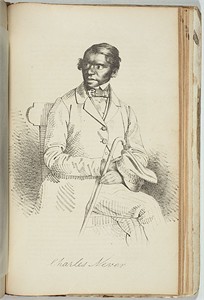
It’s interesting to note that several are given the names of white settlers, but in Robinson’s notation are given the designation “Mr”.  This does not always seem to be the case.  Broome tells the story of Charley, the aboriginal boy who wanted to become a gentleman, and managed to equip himself with all the accessories, including top hat and cane :

Charley realized that Europeans had two names and that gentlemen had formal ones, so he renamed himself Charles Never. (The other youths wanted two names as well, and with the help of the Edgars, became James White, Jacky Warren, Thomas Gurrenbook, and Kitty, Harry and Tommy Bungaleenee.) (Broome, p. 51)

charlesnever

As Broome points out, the conferring of a name did not necessarily have to denote ownership, but could be an act of affiliation that worked to Aboriginal advantage as well, either by a claim on the settler or as a way of deflecting white intrusion into private beliefs. It’s striking that prominent people in the Koorie community today often share surnames with 1840s settlers as well-  there are several prominent Koorie ‘Firebrace’ s for example,  probably named by Major William Firebrace, a prominent Port Phillip personality.  Likewise Pettits and Atkinsons – common Koorie surnames.  I had always assumed that this suggested that white men had consorted with Aboriginal women: it had not occurred to me that perhaps there was Aboriginal agency in adopting these names.

The naming went both ways.  Aboriginal people also named white people- for example, Robinson rather proudly announces that:

They conferred on me a new name namely Ar.rum.ar.rum.nare.nit, which in their language is great or big chief  (12 August 1841)

Robinson also reports on Glendinnon, a white man much respected by the natives he deals with.   Robinson arrived at Mt Emu

where the far famed among the Aborigines, Jaggy Jaggy, resides.  He is a white man and a lowland Scotchman named Glendinnon and whom the Aborigines have designated as Jaggy jaggy min min. (5 August 1841)

After Robinson’s description of many callous, brutal white settlers, Glendinnon stands out for his calm demeanour and humanity.  I don’t know what Jaggy jaggy min min meant, but I’m sure that it denoted more dignity, for both the namer and the named,  than ‘Fuckemall’.

References:

Richard Broome Aboriginal Victorians, 2005

Ian D. Clark The Journals of George Augustus Robinson, Chief Protector, Port Phillip Aboriginal Protectorate, Volume Two: 1 October 1840-31 August 1841.


The boys go to Port Phillip

As part of examining Judge Willis’ interaction with Port Phillip society, I’ve read folder after folder of official correspondence, column after column of newspapers, memoirs  and several diaries.  But one thing that I have barely dipped into is personal correspondence.  So it was armed with a few names that I headed into the State Library yesterday- off to read the correspondence of the Burchett brothers who arrived from 1839 onwards to their family ‘back home’, and a thesis based on the correspondence of  Alexander F. Mollison who visited Melbourne in its earliest days, then settled in the Port Phillip district from about 1837.

The survival of any cache of correspondence is  a mixture of luck, diligence, intent and circumstance.  There are those rare individuals who keep copies of all correspondence both sent and received, but it’s more likely that an archive of correspondence is likely to be largely one-sided, usually consisting of  letters received, with the letters sent reflected only obliquely.  The preservation of letters within a family depends largely on the importance placed on them by the recipient, and the custodians to whom they pass when the recipient dies.  Then there is another  step between private ownership and their availability to a wider public through a museum (where they can linger undiscovered and uncatalogued for years) or publication.

Moreover, the practice of mail correspondence between New South Wales and the metropole,  particularly during the 1840s, reflected the realities of a 4-6 month time lag with a swag of letters arriving in one dispatch, or likewise, no mail appearing at all.  No doubt the receipt of letters would trigger off a frenzy of response, with the minutae of day-to-day life telescoped into a potted narrative that would reassure loved ones who were totally unfamiliar with the sights, smells and local personalities on the other side of the world.  On both sides, the pictured recipients would be kept in a mental time-warp that kept them as they were when last seen, with shared acquaintances and memories given more prominence than perhaps they merited. I tend to think of this correspondence as similar to the word-processed  Christmas updates we all started to include in our Christmas cards a few years ago,  up until they fell out of favour for being homogenized, impersonalized and too cheery and cheesy.  (Mind you, I enjoy receiving them and still do send them- cheesy and impersonalized though they may be).

So, with these constraints in mind, how likely is it that any of this correspondence would mention Judge Willis?  I guess that it depends on how personally involved the writer was with the agitation to either remove or support him, which in turn might reflect the political engagement and interests of the intended recipient of the letter.  How much of any politics would filter through, say, into the Christmas Update we might send today?  I suspect that 2001 Christmas Updates reflected the shock of September 11;  we may have written to overseas correspondents about a change in government.  But, unless personally involved, it’s not likely that day-to-day politics is likely to find its way into correspondence intended for an overseas readership, even in our connected, globalized world, and probably even less so from 1843 New South Wales.

The Burchett Brothers

And so to the Burchett letters.  The copy of the letters I saw had been typewritten and photographed.  Now, there’s nothing quite like the pleasure of the looped, cursive script, the browning ink and the texture of the paper of the original.  But I’ve been there, and done that, and there’s also nothing quite like the regularity and ease of a typewritten transcript!!  They were catalogued under “Burchett family”, and the collection includes letters written by Charles Gowland Burchett (1817-1856), Henry Burchett (1820-1872), Frederick Burchett (1824-1861) and Alfred Burchett (1831-1888).   The boys arrived out here over a period of time, with the 22 year old Charles and 19 year old Henry arriving first in 1839, followed by their younger brother Frederick, aged 16, the following year.   I’m not sure when Alfred arrived.   There were obviously other children still left at home- Henry’s letters in particular are full of high-spirited and affection  in-jokes with his younger siblings.   All the same, it must have been hard to have your three eldest boys heading off across the globe at such young ages.

Charles, in particular, seems to have been of a slightly more political bent than his brothers.  In his letter to his father on 12 June 1841 he writes about a meeting to petition the Home Government for separation from New SouthWales, and mentions the Resident Judge obliquely in reference to Sydney’s neglect of Port Phillip- a comment by then obsolete given that Judge Willis had by that time arrived in Melbourne.

Even in Sydney they know little of us.  Fancy the wilful blindness of a tardy determination to allow us the services of a Supreme Judge three times in two years.

This was to be his only mention of Judge Willis.  He goes on:

The principal evidence of the moral advance of this place may be enumerated as follows- a Society lately formed on the plan of the “Highland Agricultural Society” for the promotion of Agriculture, Horticulture and Breeding, William Mackenzie Esq, the son of a Scottish Baronet is the Chairman.  Two or three hundred chapels; the church, however, on account of its ambitious pretensions, is at a standstill for want of funds, a considerable part of the edifice completed evidently exhibits the intention of the Trustees to make it a handsome structure- it is of stone.  And last, but not least, the Mechanics Institution.  Among the lectures at this last has been one “On the Influence of the Press in disseminating knowledge” by George Arden, the Editor of the Port Phillip Gazette.  This said G. A. (the Boy Editor, as he is called) I have known since my arrival here; he gave a splendid speech at the meeting.

The boys established a run called ‘The Gums’  near Mt Rouse in the Western District.  In a letter dated 1 Oct  1841,  Frederick was not pleased by the news that Charles Sievewright was to establish the Western District  Aboriginal Protectorate nearby:

There is a rumour that a Black protector is coming to take up his station at Mt Rouse, with his tail of 4 or 500 blacks, if he does we shall have to keep a sharp lookout, as the gentleman of his suits have been playing up a hurricane (colonial phrase) down below, and they are not very remarkable for their honesty

Five days later his brother Henry added:

How little do the good people at home, who are instigators of benevolent systems of civilization understand the character of these barbarous cannibals.

The financial depression of the early 1840s hit the Burchett boys badly, and Frederick returned home, followed by Charles who arrived back in England  on the Glenbervie on November 24 1843.  They obviously did not stay: Frederick returned to Van Diemens Land in March 1844 and the others must have returned at some stage too.  Charles died in 1856 at their property St Germain’s (near Echuca); Henry died in 1872 at “Albert Road, Regent Park” (not sure where); Frederick died in 1861 in Melbourne, and Alfred in 1888 at St Kilda.

Alexander Mollison

And so on to the second batch of letters from Alexander Mollison, this time as part of a thesis written by Marie Hyde who transcribed and annotated the letters as part of a Bachelor of Letters degree in 1988.  Alexander Fullerton Mollison (1805-55) has a higher profile that the Burchett brothers with a shared entry in the Australian Dictionary of Biography with his brother William Thomas.

Alexander arrived in Sydney in 1834 at the older age of 29, and did not ever marry.  After an exploratory trip to Port Phillip in 1836, he overlanded down from his property at Uriani (near present day Canberra) with his flock of 5000 sheep, 634 cattle, 28 bullocks and 22 horses, to establish Colliban Station, near Malmsbury.  He was joined by his brothers Patrick, who was based in Sydney, another brother Crawford, and William aged 22, who arrived in 1838 who joined Alexander at Colliban.   A fifth brother, James, aspired to be an artist and several of Alexander’s letters warn him specifically not to come to the colonies, as there were few prospects for artists here.   Two sisters were left at home: Jane, to whom many of the letters are addressed and for whom Alexander obviously had a great affection, and Elizabeth.  Again, I find myself thinking about the parents left back in England with their daughters, with the ‘boys’ of the family so far away.

The early letters reflect Alexander’s interest in the  zoological and botanical sciences- and I assume that sister Jane shared this interest too.  Although he didn’t send her actual specimens- as Judge Willis was wont to do with patrons he wanted particularly to impress- he did write long descriptions of rainbows he noticed at sea and his first sighting of a platypus.  Zoe Laidlaw, in her book Colonial Connections 1815-45:  Patronage, the Information Revolution and Colonial Government, highlights the importance of scientific networks, and the overlap between amateur colonial naturalists and visiting scientific professionals.  It also evokes for me the burgeoning interest in science more generally reflected in another book I’m reading at the moment- Richard Holmes’ The Age of Wonder: How the Romantic Generation Discovered the Beauty and Terror of Science.  It seems that Alexander was very much a man of his times.

As Hyde points out, the shipboard voyage

had positive benefits as an interlude between the old world and the new in helping to establish that network of connections with the well off and influential that would serve him well in years to come.(p. 5)

He travelled with the Rusden family, little realizing that the 12 year old son George would later become Clerk of the Executive Council and a member of the National Board of Education.   He became friends with Charles Nicholson, who was later become Sir Charles Nicholson,  statesman, landowner and businessman.

In an odd conjunction, he wrote to his father that Henry Burchett (of the letters above) had arrived at the station to learn sheep farming before striking out on his own.  The Burchett letters also resonate when the Aboriginal Protector Parker took up land on the Loddon to establish a Protectorate.  Unlike the Burchetts, Mollison willingly gave up land for the Aboriginal station, and assisted Parker in running it.

Alexander obviously spent some time in Melbourne where he mixed with the other ‘respectable’ pastoralists.  On 26 December 1839, he wrote to his sister Jane about the Melbourne Club:

I do not remember having told you about the Club House in Melbourne. The Inns were found to be so dirty and disordered that several respectable settlers and townsmen formed a club about 18 months ago.  William and I are members.  There are now eighty permanent members.  The house affords twelve bedrooms, a dining room, drawing room, library and smoking room or [?].  The bedrooms are rather small but exceedingly comfortable and well-kept.  Each member is allowed to occupy a bedroom one week and then must make way for another if required…The yearly subscription is five pounds and the charges are the same as at the inns.

His respectability gave him access to the political sphere.  Soon after La Trobe’s arrival in Melbourne,  Alexander and his brother Crawford called on him.  To his father, Alexander wrote:

Mr La Trobe arrived at Melbourne some weeks ago.  He told me that he had been introduced to you.  I called once at his offices with Crawford but came away as soon as our business was finished, as Mr La Trobe seemed to be very much occupied.  He is so far in public favor here and seems to be candid, sincere and unostentatious.

He also met with Governor Gipps when he visited Melbourne, and was one of the five men deputized to make a welcoming address to him.  In October 1841 Alexander wrote to his father:

We have had great doings this past week in honour of Governor Sir George Gipps’ first visit to this district, but I have not time to relate them.  I may however say that I was one of a deputation to draw up and present an address and also the president of a public dinner of one hundred and fifty people.  Sir George is frank, clever, and a ready and pleasing speaker.  I was introduced to him during my late short visit to Sydney.

When his friend Charles Nicholson put himself up for election as the Port Phillip member for the first District Council, Mollison seconded his nomination.   Nicholson was elected the representative for Port Phillip on the part-elected Legislative Council in 1843, served as Speaker in 1846 and twice more before the granting of responsible government.  Mollison was one of the inaugural members of the Melbourne branch of the Australian Immigration Society in 1840 (Garryowen p. 492); he addressed a meeting against the resumption of transportation (Garryowen p. 524); he presided over a Squatters Meeting in June 1844 and a committee member of the Separation Association (Garryowen p 907).  He was made a Justice of the Peace.

It’s not surprising, then, that Mollison does mention Judge Willis’ suspension, albeit briefly, with the terse comment that “he certainly deserved it”.  Mollison does not seem to have been particularly heavily involved in the movement against him, however, declining to sign the anti-Willis petitions.  Both Alexander and his brother William did , however, sign a letter in support of Lonsdale who was under attack by Judge Willis, and another letter on 14th June 1843 directly before Judge Willis’ amoval complaining about aspersions raised in the court in relation to the magistracy generally.

The sheer distance between the colonies and the family at home was reinforced for me by the report of Patrick’s illness in Sydney.  Charles Nicholson notified Alexander that Patrick was gravely ill, and within days Alexander was writing a second letter to say that he had died.  In his will, Patrick left his colonial assets to his sister Jane and Alexander, although they did not cover his debts.  Jane had obviously advanced money to Patrick, and Alexander later made an investment of Jane’s money in land on the portion bounded by Highett, Lennox and Erin Streets, Richmond.   Davidoff and Hall’s book Family Fortunes notes that the daughters of a family often made their inheritance available to their brothers for investment, in return for a roof over their head and keep.

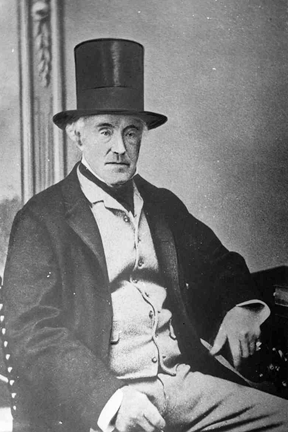
Although he suffered financially during the Depression, he did not go under, which is a testimony to his good management and frugality.  By 1845 he was writing “I now begin to feel that my home is here.”  He did return to London in 1850, where he stayed for 8 1/2 years.  A photograph held by the State Library of Victoria taken in London during this time, describes him as

Seated, wearing three-piece suit with fringed black and white paisley patterned tie (probably a scarf). He has a full brown and gingerish beard speckled with grey, and wears a light coloured top hat with a very high crown.

He returned briefly to Victoria, then went again to England where he lived for another 13 years.  After the death of his beloved sister Jane, he and his remaining sister Elizabeth returned to Victoria in 1873.  They settled together, unmarried brother and sister, until he died after years of ill-health in 1885.

References:

Leonore Davidoff and Catherine Hall Family Fortunes: Men and Women of the English Middle Class 1780-1850

Edmund Finn (Garryowen) The Chronicles of Early Melbourne

Richard Holmes The Age of Wonder: How the Romantic Generation Discovered the Beauty and Terror of Science

Marie Hyde Letters from Port Phillip:  the letters of Alexander Mollison 1833-1859 (thesis)

Zoe Laidlaw Colonial Connections 1815-1845: Patronage, the Information Revolution and Colonial Government

A. G. L. Shaw A History of the Port Phillip District