Author Archives: residentjudge

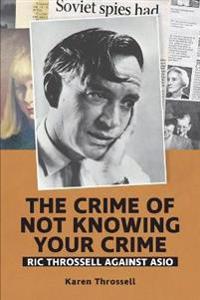
‘The Crime of Not Knowing Your Crime’ by Karen Throssell

2021, 301 p & essay

One of several very good things that the Labor government has done since taking power is to discontinue the case against Bernard Collaery, charged with helping his client Witness K who acted as a whistleblower over East Timor oil negotiations (I reviewed Collaery’s book here). This is not the only case that has been brought by the Australian government that is shrouded in secrecy and non-disclosure (indeed there may be others under way- how would we know?) Just recently we have learned that senior intelligence officer Witness J. was tried, sentenced and imprisoned in secret under s22 of the National Security Information (Criminal and Civil Proceedings) Act 2004. For the individuals involved, their cases might be discontinued, inquiries might be held, sentences may be commuted – but what happens afterwards?

Ric Throssell could tell you. The son of Australian writer Katharine Susannah Prichard (see review of Nathan Hobby’s biography here) and war hero Hugo Throssell, he found himself caught up in the surveillance of his openly-communist mother, was identified by Petrov as a spy, and was brought before the Royal Commission on Espionage 1954-55. He was cleared by this commission, but the allegations never went away. He had already been employed by the Department of Foreign Affairs before these accusations surfaced, and for the rest of his life he found himself passed over for promotion. The allegations continued to be promulgated by media figures and historians.

Karen Throssell, Ric’s daughter, takes up her father’s fight in this book that was shortlisted for the Dorothy Hewett Award for an Unpublished Manuscript It is very much a labour of love, as you see the adult daughter continue her father’s vigilance against repeated public accusations made by historians and commentators, balanced against her memories of a father, a familiar (in both senses of the word) presence in her life. There’s an element of the wounded child there too, as her father took his own life on the same day that her mother died.

The typesetting is very important in this book. There is a lot of white space, with a heading on each left-hand page and sometimes as little as a sentence on the right hand side. It is presented as a series of 103 “Items”, each numbered “Item #103” as a file might be. This evocation of the file is important, because Ric and his daughter’s fight was against files: files made, files with-held. The items comprise a range of genres: poetry, paragraphs, newspaper cuttings, letters, more extended writing over one or two pages.

I’m not particularly keen on a recent form of memoir where the author throws everything onto the table, leaving it to the reader to piece together a narrative (see here and, to a lesser extent, here). I’m old-fashioned enough to expect that the authors have a responsibility to structure the narrative. Throssell’s book does have a narrative, in that there is a roughly chronological order, and the book is divided into sections as the long campaign for justice moves forward. The “item” layout gives a sense of the fragmentary and disconnected.

However, the ordering of the book seems strange to me, although this possibly says as much about me as a reader as it does about the book. There is a system behind the typography, but you only discover the ‘key’ if you turn to the notes at the back of the book. There you learn that the white type on black boxes are Ric Throssell’s own writings, as distinct from Karen’s. Bold format within quotes denotes words written by the author. I would have appreciated this information at the start, because the white on black boxes particularly puzzled me – who is writing this? is this fictional or not? While I acknowledge that this confusion can be interpreted as a meta-comment about truth/allegation and the file as artifact, it did not contribute to my reading at the time.

The book finishes with an essay by historian Phillip Deery which gives the historical context to ASIO, the Royal Commission and the Venona Project but I felt that this would have been much better placed at the beginning. In fact, I’m a little surprised that the author didn’t want to have the last word, instead of turning it over to someone else- after all, the “last word” is what her father had fought for all his adult life.

And, as long as ‘secrecy’ trumps ‘justice’, he won’t be the last to do so.

My rating: 6.5

Sourced from: Yarra Plenty Regional Library

I hear with my little ear: Podcasts 25-31 August 2022

History of Rome. I’ve done it! I finished!! Episode 177 The Burning Ships sees the last attempt to tackle the Vandals in North Africa. Between 465 and 467 there was no emperor at all in the Western Empire after Severus died. Leo over in the East was too busy dealing with the Huns to pay much attention, and General Ricimer who was the real power behind the Western throne was happy for it to stay vacant. Once he turned his mind to it, Leo wanted Anthemius (who was a bit of a rival, and better off out of the way) while Genseric the Hun (over in North Africa) wanted Olybrius, probably as a way of using family connections to embed himself into the imperial family. Genseric recommenced pirate raids on Sicily and Italy, as a way of throwing his weight around. In response, Leo named Anthemius and sent him off to wage a big war of both the Western and Eastern empires against Genseric on three fronts. At first the Romans were victorious but then Genseric sent empty ships in amongst the Roman fleet and set them on fire. The Romans lost 600 ships in the resulting tumult. In 469CE Anthemius tried to retake Gaul, where the Goths were expanding their territory under King Euric. The Romano-British leader Riothamus was encouraged to invade from the Brittany Coast as part of the attack on the Goths- he may have been the legendary King Arthur (or not). Ricimer and Anthemius were on the brink of civil war, but they had a 12 month truce to fight the Goths unsuccessfully. When Civil War threatened again, Leo sent Olybrius to mediate between Athemius and Ricimer but, secretly, Leo was backing Anthemius and the letter exists to prove it.

Episode 178 Not with a Bang But a Whimper takes up when Leo’s secret letter was discovered. Finding that Leo was on Anthemius’ side, Ricimer and Olybrius killed Anthemius and Olybrius took his place. This made the Italian nobles and Genseric happy. But then Ricimer died, followed soon after by Olybrius. They were succeeded by Ricimer’s nephew Gundobad, King of the Burgundians, who killed Anthemius. Gundobad elevated Glycerius to the position of Western Roman Emperor, but he was not recognized by Emperor Leo in the East, who supported Julius Nepos as replacement instead. By now the Visigoths (Western Goths) and Ostrogoths (i.e. Eastern Goths) were getting restless. Then in 474 Emperor Leo, Julius Nepos’ backer, died and was succeeded by Leo II who was only six years old, with his father Zeno as the real power behind the throne. But then Leo II died too (was he murdered?) but Zeno was happy for Nepos to continue in his position. Glycerius surrendered in the face of overwhelming power and was made a Bishop (a favourite go-away measure). In 475CE came the rise of Orestes, a former Hun, who arranged a revolt against Nepos. Orestes’ son 14 year old son Romulus Augustulus was elevated but of course, he was a puppet too. There was a soldier uprising against Orestes, led by Odoacer. Orestes ended up dead with Romulus Augustulus deposed. And at that point it all got too hard and the Western Empire just faded away. So, in effect, we have gone full circle from Romulus (of Romulus and Remus fame) and ending with Romulus Augustulus.

Episode 179 The End! I got there! Or more to the point, Mike Duncan got there after recording an episode every Sunday for five years, generating 74 hours of content, after nearly faltering at Episode 33 (where he dealt with Marius and Sulla). The whole way through the series, he joked about ‘256 reasons why the Roman Empire fell’ but here he actually does give his summary of the reasons, under 6 (not 256) headings:

  1. Political factors. The Empire ended up a brittle farce, with poor emperors and a corrupt bureaucracy
  2. Economic factors. Inflation destroyed the middle class, and the poor began to see the State as a predator.
  3. Military factors. The Legions were in effect dead. Romans avoided military duty which means that the army was dependent on Germanic mercenaries
  4. Social factors (Mike Duncan’s personal favourite). Failure to integrate Germanic people, and the prejudice of the Italian aristocracy
  5. Religious factors. Duncan doesn’t accept Gibbons’ argument that Christianity led to the fall of the empire, but certainly there was increasing religious intolerance.
  6. Environmental factors. Between 250 and 550 CE there were fluctuations in the climate, with more famines and plagues.

So why didn’t the Eastern empire fall as well, instead surviving as the Byzantine Empire for the next 1000 years? Partially it was geography, with the Western Empire having to grapple with long Rhine and Danube frontiers. The East, on the other hand, dealt with the Sassanids who were at least a stable force. Second, the Eastern empire was wealthier because of its ties with India and China in the East. Third, there was the imperial apparatus itself. The East middle-class thrived, and imperial service was still seen as prestigious.

And there it ends. I can’t believe I’ve done it.

The Real Story. Salman Rushdie and the fatwa. I want to do something on this at our next Unitarian service in September, so I listened to this podcast carefully. Rushdie was born in ‘Bombay’ (which is the way he always refers to it) in 1947 and sent to England for his education. While a student at Cambridge University he first came across the story of the Satanic Verses, a set of verses disputed and later rejected by Islamic scholars. In his book The Satanic Verses he questions the sacred and divine, but he also gives the prophet and two of his wives pejorative names. However, he asks – how could one fictional book threaten Islam? The Prophet in Islam is a man, not a god. The fatwa was announced by a Shia cleric, and in itself is not consistent with Islam, where the only death sentence is for apostasy (i.e. a believer later rejecting the faith). One of the speakers in this program claims that the West has been naive about the proselytizing nature of Islam. In the UK, there was opposition to the book from the start, and the political response was interesting. The Labor Party announced that the book should not be reprinted: Margaret Thatcher, on the other hand, defended him. The speakers end by suggesting that the fatwa has become internalized amongst writers.

The Latin American History Podcast started a series on the conquest of Peru, but the last episode was in August 2021. I even wrote to the presenter (wondering if he was still even alive!) and yes, he is- but he is travelling in South America. So, Episode 3 The Conquest of Peru switched its focus from the Spaniards to the Inca, and here he called upon Nicholas Machinski from the A History of the Inca podcast. Unfortunately, the sound quality of Nicholas’ comments was really poor and hard to hear. Nonetheless, he clearly knows a great deal about Inca history. It was interesting to listen to this after just finishing the History of Rome podcast. In the 1520s, when the Spaniards arrived, the Inca were undergoing their own succession crisis after the death of the Emperor which culminated in a civil war between the claimants. The Inca Empire was at its largest at this time, stretching from parts of Colombia in the north, down to parts of Chile and from the Pacific Ocean to the Andes. As part of its expansion, if the leaders of conquered tribes pledged loyalty to the Inca ruler, they would be left in peace by the Inca authorities, but if they resisted they were forcibly shifted from their ancestral homes to another location. Nonetheless, there was a strong rebellious force underlying this Inca hegemony, and some groups were happy to join the Spaniards against the Inca. Smallpox was already present before the Spanish arrived. The Inca Army was huge (up to 100,000) and mobile because of its road network, but at the time of invasion it was poorly led and undisciplined. There was only one invading European force, so the Inca couldn’t play off European sides against each other as the Iroquois had done in North America with the English and French invaders.

Fifteen Minute History. Despite its name, this podcast from the University of Texas at Austin never quite manages to fit into fifteen minutes- twenty yes, but fifteen no. The Servant Girl Annihilator is a pretty old episode from 2018 where then-Ph D candidate Lauren Henly talks about a series of murders of several young women that occurred between Christmas 1884 and May 1885 in Austin Texas. They didn’t have the vocabulary to talk about a ‘serial murderer’ then, and it took a while for the concept of the same person committing a series of murders to catch on. At first, it was only Afro-American women who were killed, but then two white women were murdered as well. There was speculation that perhaps these were early murders committed by Jack the Ripper, who then migrated to England to continue his spree there (a largely discounted theory). Others have posited that the murderer was a young Afro American man called Nathan Elgin, exposed in a PBS special called “Solved” on account of a missing toe which matched a footprint with a missing toe. In her research, she does not describe the murders herself (instead using reports at the time) and concentrates on the victims and the vibrant African American community in which they lived.

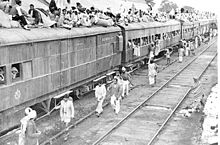
Wikimedia: A refugee special train at Ambala Station

History Hour (BBC) Seventy-Five Years since India’s Partition is a compilation of stories from an earlier series produced by the BBC to mark the seventieth anniversary. I’ve started listening to this earlier series too, called Partition Voices but I’m finding it a bit repetitive and you’re just as well off with the History Hour episode. The History Hour episode also discusses the death of Nehru and the Indian poet Rabindranath Tagore, became the first non-European to win a Nobel Prize for Literature. The stories about Partition are horrifying, on all sides, and although the migrants who fled to England didn’t particularly want to talk about it at the time (largely through shame), their children are more intent on finding out what happened. The attitudes of the British are appalling too, with one radio announcer declaring that both sides needed a “good hard smack on the nose” to stop the pre-Partition violence. Yes, that would do it.

Partition Voices (BBC) Actually, I take that back. I persevered with Partition Voices, and found it well worthwhile. However, I listened to it in the wrong order because that’s how it came out on BBC Sounds. The right order is: Division, Aftermath and Legacy. It’s quite sickening to hear the cossetted and oblivious views of English colonials living in India at the time in Episode 1; the violence is appalling in Episode 2 where both sides engage in ethnic cleansing; and Episode 3 shows the effect on later generations, a phenomenon noted with Holocaust survivor families, but not so much with ‘East Asians’ who, in British society, are lumped together despite this bloodied history.

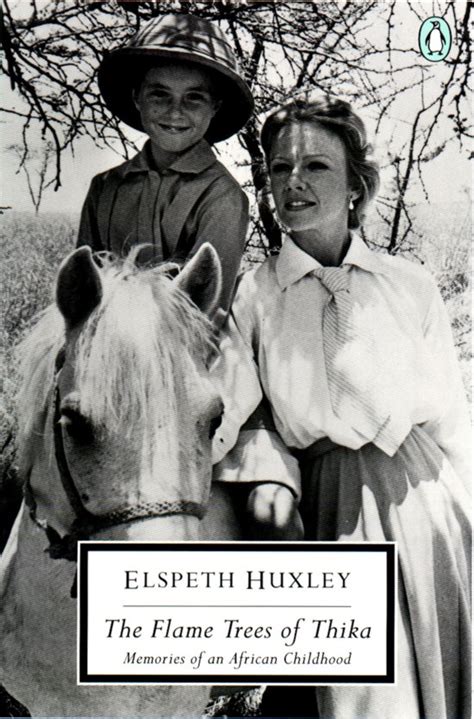
Six degrees of separation: from Flame Trees of Thika to…

It’s the first Saturday of the month, and so it’s Six Degrees of Separation Day. Kate, who hosts this meme at her blog Books Are My Favourite and Best has taken a different approach this month. Instead of her choosing the book, this month you start off with the book that you finished with last time and then link six other books that you associate together in some way.

Well, in August my last book in the chain was Elspeth Huxley’s memoir The Flame Trees of Thika. I read it a long time ago, and intended re-reading it on one of my several trips to Kenya to see my son, who was living in Nairobi at the time. So, my Six Degrees this month all revolve around Africa in one way or another.

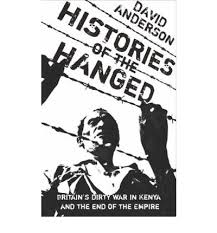
David Anderson’s History of the Hanged (2005) is a history of the Mau-Mau Rebellion which took place in Kenya between 1952 and 1960. He starts by contextualizing the rebellion in terms of colonization and de-colonization, then shifts to a more individual approach through his use of court reports, both from the Supreme Court and the Special Emergency Assize Courts. (My review here)

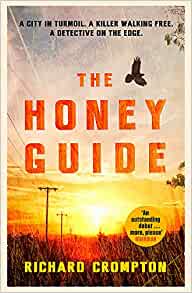
Another more recent troubled period in Kenya’s history occurred after the 2007 elections. The Honey Guide (2013) is set at that time. It’s actually a detective story, featuring Mollel, a Massai policeman amongst a police force notorious for its corruption made up of Kikuyus and Luos who clashed during this post-election violence. Mollel’s wife had died several years earlier in the 1998 bombing of the American embassy in Nairobi, leaving him to bring up their son. I’m not usually a fan of detective fiction, but I loved the real-life setting of this book.

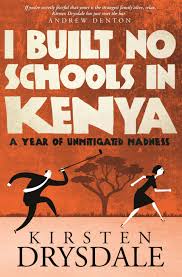
Let’s move away from violence in Kenya for a bit with Kirsten Drysdale’s memoir I Built No Schools in Kenya (2019). You may know her from ‘The Hungry Beast’ or ‘The Checkout’ on the ABC – come to think of it, I haven’t seen her for a while. In 2010, between shows, she shifted to Kenya for a year to care for an old man with dementia and became caught up in the family tensions. I found it laugh-out-loud funny at times, and I loved her descriptions of Nairobi. (My review here)

How about something going out of Africa (other than Karen Blixen)? Zafara by Michael Allin is the story of the giraffe donated to the King of France Charles X by Muhammed Ali, the Pasha of Egypt in the mid-1820s. In this book he traces Zafara’s journey from her original capture in Sudan, across to Khartoum strapped onto the back of a camel (I’m finding it quite hard to imagine this), then down (up?) the Nile to Alexandria, where she embarked a ship to Marseilles. On arrival at Marseilles, it was decided that after a winter lay-over, she would walk the 900 km to Paris. Her trip, which took 41 days, excited keen interest in the crowds that greeted her at each stop and indeed, the whole of France was convulsed with ‘giraffe-mania’. He tells the history of the fascination with ‘exotic’ animals, the effect of the Enlightenment and the fascination with Egyptology. It’s a real work of love. (My review here).

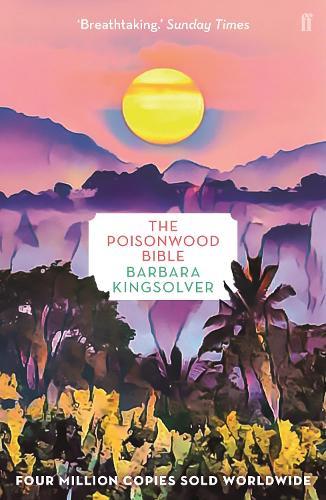
Or lets go the other way, into Africa. That’s where four young girls, Rachel, Leah, Adah and Ruth-May are taken by their rabidly evangelical father in The Poisonwood Bible by Barbara Kingsolver. Told alternately by each of the four girls and their mother, it captures well the grip of mania as their father is oblivious to the irrelevance of his message, and the effect on his family as they live as outsiders in a Congo village in the jungle.

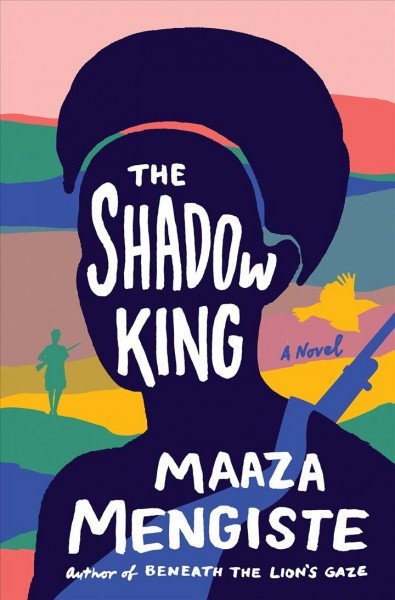
The Shadow King (2019) by Maaza Mengiste takes us to another African country – Ethiopia- during the Italian/Ethiopian war in 1935- something that I knew absolutely nothing about. There’s crazed violence in this book too, as Carlo Fucelli, the leader of those Italian troops, indulges in sadism, forcing a Jewish Italian photographer amongst his troops to photograph the atrocities that he commits. Meanwhile, The ‘Shadow King’ of the title is a peasant with an uncanny likeness to the now-exiled Emperor Haile Selassie. While Selassie frets in Bath UK, his ‘shadow’ appears, almost like a vision, before the Ethiopian troops to inspire them. This book was shortlisted for the Booker Prize in 2020 and was beaten (rather unjustly, I feel) by Shuggie Bain. (My review here).

So there we go – all in Africa – but moving from Kenya to Egypt, Congo and ending up in Ethiopia.

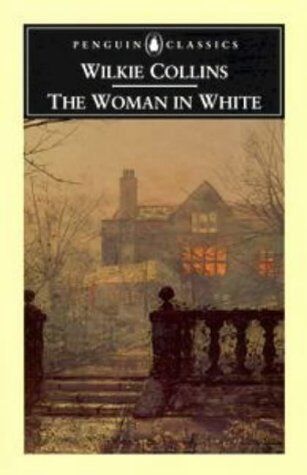
‘The Woman in White’ by Wilkie Collins

1985, 646p.

I can remember this book being on the shelves at my high school library, but I was never tempted to read it. Perhaps its length was off-putting then, and that’s probably just as true today at 640 small-print pages. (My Kobo estimates a reading time of 22-24 hours). Who has time to read such a lengthy book? But – oh, what we would miss out on!

The Woman in White was serialized in 1859-60 and first published in book form in 1860. It is pure Victoriana, with its grand houses, fortune hunters, madness, swapped identities, secrets, dastardly deeds, swirling fog and graveyards. It uses a favourite Victorian technique of doubles: two sisters; two houses; two villains. But it also comes over as quite modern with its multiple narrators, evoking the structure of a court case, with its steady accumulation of evidence and witnesses. It starts with a young drawing-master, Walter Hartright (is that a pun?) who helps a distressed young woman, dressed all in white, on a dark country road. When he is later appointed as a vacation art tutor to two sisters, he notices the similarity between the youngest sister, Laura, and the unknown Woman in White. He falls in love with her, despite the differences in their social standing, but Laura is already promised to Sir Percival Glyde, a man many years her senior. Sir Percival is not all that he seems, and Laura is the unwitting victim of a conspiracy to defraud her of her inheritance. And I’ll stop here….

It is easy to dismiss as “Victoriana” the concern with inheritance, and women’s financial powerlessness until the passing of the Married Women’s Property Act in 1870 in the UK. But the heiress kidnappings, and the ‘gas-lighting’ of women to the point of insanity were not just literary plot devices: they were real. In fact, Collins dedicated the book to Bryan Proctor, the Commissioner for Lunacy, who had championed Louisa Nottidge, whose real-life story encompasses many of these themes. Although an utterly evil, decisive bout of murder might have solved all the plot machinations, Collins maintains enough ambiguity about his characters – even the baddies- that as a reader you’re glad that the author hasn’t taken such a bloodied step (besides, that could finish the book in 200 pages, instead of 600!) He is a very visual writer, and although his language is convoluted, the accretion of small details helps the reader to ‘see’ the characters and setting. Although it was serialized, its careful plotting right from the start means that you don’t have whole chapters of ‘filler’ and implausible false-leads as you sometimes get in Dickens.

He sustains the tension so well over these 600 pages, so much so that I could hardly put it down at the end and kept sneaking away to snatch covert 15-page reads whenever I could. It has been described as a melodrama, but I prefer to think of it as a thriller, with mounting suspense and a sense of dread, ratcheted-up as the story proceeds. There’s nothing hard-boiled about it at all: instead, it is intricate, verbose, lush, formal – and a damned good read. Even at over 600 pages.

My rating: 9/10

Source: CAE bookgroup (aka The Ladies Who Say Oooh)

I hear with my little ear: Podcasts 17-24 August 2022

History of Rome Podcast. I’m getting so close to the end that I can almost taste it! Episode 174 The Sack of Rome Part II We left off with the ascension of Petronius Maximus as emperor in 455AD. He ruled for 77 days only, and his main effect was to provoke the Vandals to sack Rome. As a way of cementing his legitimacy, he forced Eudoxia to marry him (after murdering her husband Valentinian) and wanted to marry his son off to Eudoxia’s daughter who was already betrothed to the son of the Vandal king Genseric. Genseric was not amused. On hearing that the Vandals were heading towards Rome, Petronius Maximus advised the resident of Rome to “run away!”, which they did, murdering him on the way. The Vandals sacked Rome for the second time over a period of two weeks, and although the name ‘Vandal’ has gone down in history for thoughtless destruction, perhaps it wasn’t as bad as it sounds- there is no archaeological evidence for wanton obliteration. Genseric went back to North Africa, taking Eudoxia with him. Meanwhile, the Gallo-Roman Avitus, who had been sent by Petronius Maximus to Theodoric II to get the support of the Goths, learned about Maximus’ death, and Theodoric suggested that Avitus become emperor. Theodoric might have thought that this was a good idea, but Emperor Marcian in the East wasn’t sure; Genseric started raiding again and the Italians were resentful about the ascent of the “Gallo-Roman” emperor. So Ricamer and Majorian deposed Avitus, but didn’t kill him immediately, making him Bishop of Piacenza instead, perhaps because they didn’t want Marcian to get angry, or to keep Gothic support.But then Marcian died anyway, and Avitus was killed soon after.

Episode 175 Trying to Take it All Back sees Majorian marching around trying to reassert Imperial authority over the provinces while Ricimer remained in Italy. Ricimer knew that he couldn’t become emperor in his own right because of his Germanic background so Majorian was proclaimed emperor with Ricimer behind the scenes. They wanted to “make the empire great again” and they reinstituted the navy and Majorian invaded Gaul and defeated the Goths. The Gallic nobles acquiesced when they found out that their tax debts would be waived. Majorian then turned his eyes to Spain, as a step in his broader plan of invading North Africa. But Genseric, knowing that they were coming, destroyed his own province Mauritania in a scorched-earth policy that would make an invasion difficult and infiltrated the ship-building port to destroy Majorian’s navy. The North African invasion was shelved. Ricamer and Majorian had a falling out, and Majorian was murdered on Ricimer’s orders.

Episode 176 The Quote Unquote Emperor. Well, the murder of Majorian didn’t go down well with a number of generals (especially Aegidius in Gaul and Marsellinus in Dalmatia) or the Vandal King Genseric in North Africa. Ricamer sent off old Agrippinis to his native Gaul, where he offered the Goths the region of Narbonne, which they jumped at because they had been wanting a Mediterranean port for ages. The rebel general Aegidius and Agrippinis met in battle, and Aegidius won. Meanwhile, the Vandals were still skirmishing and Genseric was starting to make Attilla-the-Hun type demands on the fortune of the Theodosian women that Genseric had taken back to North Africa with him, claiming that because he was protecting them, the fortune should go to him. After the murder of Majorian, Ricamer wanted someone pliable, so he appointed Emperor Severus, who was very weak and ended up dying anyway (possibly at Ricamer’s hand too). Ricamer took his sweet time in appointing a replacement.

Lives Less Ordinary (BBC) The Family That Went to War with a Dictatorship tells the story of Moshood Abiola, also known as MKO, a wealthy businessman who stood as presidential candidate in 1993, in the brief hiatus between military dictatorships in Nigeria. He was arrested and imprisoned for his efforts. His daughter Hafsat Abiola Costello and her mother agitated for his release, but both women paid a price, in different ways. This reminded me a bit of Gillian Slovo’s Every Secret Thing (my review here) in that politics can extol a high price from the family- and it certainly happened here.

New Books Network. Australian and New Zealand books don’t often feature in the New Books Network, so when Alastair Paton’s Of Marsupials and Men was featured, I decided to listen. I must admit that I hadn’t heard of this book, which is marketed as “the fascinating and often hilarious history of the men and women who dedicated their lives to understanding Australia’s native animals.” The author is a journalist rather than historian, and it sounds a rather breezy read, full of anecdotes. It seems to cover early attempts to draw animals, the acclimatization movement, collecting and sale of ‘exotic’ animals, and chapters on platypuses, sharks and snakes (not all of which are marsupials, the last time I looked). It sounds a pretty light read.

A narrow boat on one of Birmingham’s canals when we visited in July 2011

Archive on 4 (BBC). With the holding of the now-completed Commonwealth Games, Brum Britain looks at Birmingham, whose citizens hate being called the “second city”. It touches on the history of Birmingham, especially during the Industrial Revolution, but focuses mainly on the contribution of performers and comedians from Birmingham, including Ozzy Osbourne, Tony Hancock, Lenny Henry, and Julie Walters. Also thrown into the mix are Tolkien and Heavy Metal (Black Sabbath, Judas Priest, Led Zeppelin) to Duran Duran, UB40, and Peaky Blinders.

File on 4. Dementia: The Final Indignity. There’s no dignity in dementia, and it is exacerbated by the haste with which dementia patients are bundled into adult nappies and incontinence pants, often to make life easier for the carers who do not have the time or availability to take a frail older person to the toilet. This is particularly true when an older person is admitted to hospital. But the person behind the wish to go to the toilet is ignored, and the last shreds of dignity are often discarded. Very depressing.

‘Elizabeth Finch’ by Julian Barnes

2022, 192 p.

There are many reasons why a reader might pick up Elizabeth Finch. After all, Julian Barnes is one of UK’s notable writers; each of his books tends to be quite different from the others; and he displays wit and erudition in his works. I’ve read quite a few of his books after being stunned by History of the World in 10 1/2 Chapters and Flaubert’s Parrot (both read before I started blogging), and all up I have read eight of his books.

But the real reason that I read this book was because, nestled between Parts I and Part III is an essay on Julian the Apostate. I should imagine that for many readers, this section on Julian was an obscure and boring distraction – after all, who has an essay in the middle of a novel, especially about a long-dead Roman emperor? But if you follow this blog, you’ll know that for the last 18 months I have been listening to Mike Duncan’s ‘History of Rome‘ podcast- a mighty 189-episode performance. I was fascinated by Julian, later designated ‘the Apostate’, who was the last non-Christian ruler of the Roman Empire and who tried to undo his uncle Constantine’s tolerance for -and indeed encouragement of- Christianity. I know that ‘good’ historians shouldn’t indulge in ‘what-if?’ history but -oh- alternative scenarios just unroll before your eyes when considering the suppression or withering away of Christianity before it really got started: no churches; no Popes; a whole range of gods to choose from. Perhaps. But ‘what if’ Julian didn’t die at just 31 years of age, but instead lived to become more intolerant and repressive and ended up ‘Julian the Cruel’ instead? This is one of the threads in the 48-page essay about Julian the Apostate in Part II of this book, an essay which may have led me to choose this book, but probably repelled many more readers than it attracted.

Parts I and III of the book return to the eponymous Elizabeth Finch, a quietly-spoken, demure lecturer in a Culture and Civilisation course for adult students. The narrator, Neil, is one of the older students in the class, and while he shares the fascination of his fellow students for this inscrutable, rather insipid, teacher, Part I is almost a love-letter to her and her effect on transforming his ‘paltry thoughtlets into something of fuller interest’ (p.15). The course completed – even though Neil didn’t get round to writing the required essay on a topic of his choice- he and Elizabeth (abbreviated to E. F.) continued to meet for lunch for the next twenty years. Pasta, one glass of white wine, coffee: she always paid and the meal always lasted seventy-five minutes. When she died, she left to him all her books and papers, although her only sibling Christopher was the executor of the rest of her estate. It was while going through her papers that Neil realized that E.F. (like me!) had been drawn to Emperor Julian, and it was now- 20 years later- that Neil wrote the essay that he had failed to write at the end of the course- and it is this essay that makes up Part II of the book. In Part III we return to Neil, who is by now trawling through E. F.’s life, trying to make small snippets fit, and recalling what Neil came to think of The Shaming, when a small public lecture for the London Review of Books given by E.F. blew up into a small but ultimately inconsequential controversy. Neil is making a dogged attempt to reconstruct her biography, but the pieces don’t fit. Her rather dull brother Christopher knows only ‘Liz’, his fellow students have had their own interactions with her, of which he was completely oblivious, and have made their own judgements. The hero-worship of Part I gives way in Part III to a rather bleak acknowledgment of the unknowability of any other person and the unrecoverability of the past.

I must say that I am rather puzzled by this book. It reminded me of J.M. Coetzee’s Elizabeth Costello in more ways than one. Barnes’ choice of title evokes Coetzee’s book, and both are about the research passions of middle-aged academic women (both written by middle-aged academic-type men).

As far as Elizabeth Finch is concerned, I don’t really know what it’s for. I wasn’t particularly convinced by Elizabeth Finch’s brilliance, I found Neil’s adoration rather mawkish and his attempts to trawl through her life intrusive, and his essay -his act of devotion- on Julian rather uninspiring. I don’t know whether to be disappointed or to wonder whether there was something I missed.

My rating: 6.5/10

Sourced from: Yarra Plenty Regional Library

Other reviews: Lisa at ANZLitLovers reviewed it and discovered that the front cover has been carefully designed to highlight the fragmentary nature of our knowledge of other people – something that was completely lost on me, because my library book had been covered in plastic! (E-book readers will miss it too)

I hear with my little ear: Podcasts 9-16 August 2022

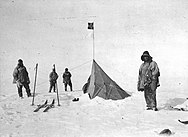
Robert F Scott. Wikimedia

The History Listen. Perhaps some things should only be on video, not audio. Like this podcast, Inexpressible Island, which has beautiful descriptions of Antarctica, but I wish I could actually see what they’re describing. I only know Raymond Priestly from the Uni of Melbourne building that bears his name, but he was one of the Northern Party that was part of Robert Falcon Scott’s ill-fated Terra Nova Expedition (1910–1913). Scott and his team perished, of course, but the Northern Party had a pretty rough time too, unable to be relieved because pack ice prevented ships reaching them, and spending literally months in a dark ice cave. They had to walk for five weeks to arrive back at their ship.

History of Rome. Episode 171 The Gathering Storm. The Huns were not so much about sacking the empire, but as extorting indemnity payments. Why would you wreck a functioning economic structure??- you’re better off leaving it there and just threatening them. Theodosius II agreed to pay the go-away money. Meanwhile, in the West, Aetius was determined to hold on to Gaul, Hispania and Italy. He defeated Theodoric the Goth, then the Frank king Clodio. Over in the east,Theodosius II died after falling from a horse, and his sister Pulcheria stepped into the vacuum (just as she had when he was a kid). This time she was forced to find a husband, so she chose Marcian, who was so nondescript that he wouldn’t cramp her style. In fact, she crowned him.

Episode 172 Showdown. Valentinian III’s older sister Honoria was supposed to be married off to Herculanus who was dull and predicatable. She was neither of these things, and she appealed to Attila the Hun to come and rescue her – well, that’s the story, anyway- it may well have been a pretext. Either way Attila invaded Gaul, and when Clodio died, Aetius and Attila backed different sons in the Frankish succession. Attila seemed to be playing mindgames with all sides, and sowing discontent amongst the different sides so that they wouldn’t unite against him. In 451 he crossed the Rhine and marched as far as Orleans until the people locked them out. Theodoric the Goth finally agreed that the Goths would join Aetius and perhaps 150,00 Roman/Goths and Huns faced off at the Battle of the Catalaunian Plains. The Huns had to retreat, and the Goths went home to choose a new King. After licking their wounds, the Huns invaded again in 452 this time, heading for the Po Valley. They razed Aquileia (a major town) completely and Emperor Valentinian fled from Ravenna back to Rome.

Episode 173 The Broken Bow. Attila headed for Milan and sacked it. Valentinian sent envoys, including Bishop Leo of Rome to seek peace and amazingly enough, Attila agreed to withdraw! Why? Well, the Huns didn’t really want land and they had to take all their plundered gold home, their supply lines were stretched, and Attila’s troops were suffering from disease. He was getting ready to invade the East when he died. Then there were a succession of deaths: Valentinian killed Aetius himself (even though he was the most successful general Rome had), perhaps as an act of pre-emptive self defence, then Valentinian was assassinated. Between 450 and 455 those indomitable women Galla Placidia and Aelia Pulcheria died too. Petronius Maximus, who had plotted Aetius’ death became Emperor. By now, it is the end of imperial dynasties in the West- now it’s just a series of “Last Emperors”. And at this point, Mike Duncan announces that he’s going to finish at 475 AD because it’s a good spot to finish AND because his wife is having a baby! (Who is, by now 10 years old, given that I’m listening to this 10 years too late!)

The Philosopher’s Zone (ABC) I don’t very often listen to this program but I was interested in this episode Simone de Beauvoir: becoming a woman that unpacks Simone de Beauvoir’s statement in The Second Sex that “One is not born, but rather becomes, a woman” – a statement that has acquired new meaning in recent years in transgender debates. The episode features Toril Moi, James B. Duke Professor of Literature and Romance Studies and Professor of English, Philosophy and Theatre Studies at Duke University. She points out that de Beauvoir personally never felt that she had been discriminated against, and it was only when she went back to the archives that she realized the historical discrimination against ‘the second sex’. The sex/gender distinction was a product of 1960s anglophone countries, and not even thought of in 1949 when she wrote The Second Sex. However, she thinks that de Beauvoir would be comfortable with the thought that all roles are evolving all the time.

History Hit Now that I’m drawing close to the end of my History of Rome series, I’m happy to backtrack on Roman history, and this episode of The Ancients: The Origins of Rome goes way, way back to Romulus and Remus.Professor Guy Bradley from Cardiff University points out that all of the sources that we have on early Rome were written seven centuries after the events in 8BCE, and so the distinction between mythology and history was muddied. Romulus and Remus were supposed to have been born in Alba Longa, but no evidence of the city prior to Rome exists, although there is pre-1000 BCE evidence of settlement in Rome itself, including walls and remains of the 8BCE Temple of Vesta. It is almost impossible to separate out Roman archaeological artefacts from those of surrounding cultures, and there are logistic difficulties in digging under Roman ruins to find anything from earlier settlement.

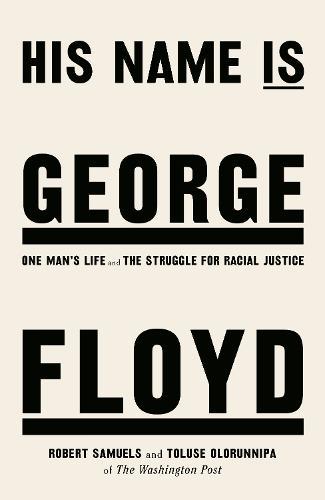
‘His Name is George Floyd’ by Robert Samuels and Toluse Olorunnipa

2022, 380 p

I must admit that I have not watched the video of the full 9 minutes and 29 seconds that it took George Floyd to die under Derek Chauvin’s knee as he was being arrested. I wonder how many people have: after all, nine minutes and 29 seconds doesn’t fit well into a half-hour news broadcast. But in that time a giant of a man, pinned down by a little, cocky man oblivious to the entreaties of George himself and the remonstrations of a small crowd of onlookers, exemplified what the Uluru Statement here in Australia identified as “the torment of our powerlessness”. Since his death on Memorial Day 25 May 2020, George Floyd’s image has been painted on walls, printed onto t-shirts, and the demand to ‘Say His Name’ echoed around the world, spawning protests across the world sparked by, but not restricted to, his death. This book, subtitled ‘One Man’s Life and the Struggle for Racial Justice’ looks at George Floyd as a person, but also the whole web of history, economics and politics that brought that knee down on his neck.

The book is based on more than 400 interviews with the people who were close to George Floyd. It is interwoven with explanations that knot together the specifics of Floyd’s life and wider historical movements. What this book lays out is the way that structural racism, built gradually by historical events both large and small, government policies and their intended and unintended consequences, and spoken and unspoken assumptions have constructed a web that held George Floyd under, just as surely as that knee did.

Although some of the interviewees, who knew him as Perry rather than George, imbue him with a posthumous sanctity that might not have been commented on while he was alive (a not uncommon phenomenon), there is no attempt here to hide the fact that George Floyd was struggling with poverty and addiction. A big man, he was very much aware that people were frightened of him. He had been a football and basketball player at school and college, in an educational sporting environment that prizes sporting prowess over educational achievement in a lottery of sporting contracts with little preparation for anything else. A string of eight minor crimes led to him accepting a plea bargain for a crime which he probably did not commit, and he spent four years in prison. He left Houston Texas and his extended family to go to Minneapolis, where he tried to start again but was drawn back into addiction.

But there’s a political and social background to all this. Turning back to Reconstruction after the Civil War, there was a deliberate policy of ‘take down’ as black families worked hard and some became successful, only to lose their properties through tax defaults and bureaucratic hurdles imposed on people who, when enslaved, were not permitted to learn how to read. Housing policies and red-lining saw neighbourhoods rise and fall economically; the state of Texas refused outright to desegregate their schools leading to a two-track education system; the plea-bargain system balances the possibilities of long and short sentences in a form of judicial gambling; employment possibilities narrowed once a prison sentence was served; State policies over health and welfare support acted as push factor (away from Texas) and pull factor (towards Minnesota) factors; the opioid epidemic linked the medical system and the street scene; the over-policing of his neighbourhood meant that a disputed $20.00 note ended up in death.

The authors are journalists, and certainly this book flows well. The backgrounding chapters give clear, historical information showing the almost inevitable conjunction of George’s death and the wider forces that had shaped his life. Although there are no footnotes as such, the page-number references at the back of the book give their sources, most with a web reference attached.

The book does not end optimistically. The Rev. Al Sharpton warned George’s brother Philonise that for every action there is a reaction, and this has proven to be true. The conservative uproar about Critical Race Theory and the ‘White Lives Matter’ rhetoric is a pushback and an attempt to silence. But I don’t think that you could finish reading this book without having a better grasp of the sequence of small events that constitutes structural racism, and its almost inevitable aftermath.

My rating: 8/10

Sourced from: Yarra Plenty Regional Library

I hear with my little ear: Podcasts 1-8 August 2022

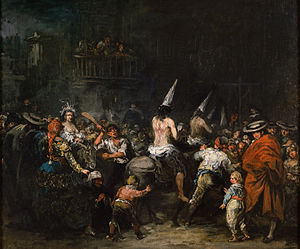
Source: Condenados por la Inquisición, de Eugenio Lucas (siglo XIX, Museo del Prado). Wikimedia

History This Week Convert or Leave goes back to July 31, 1492 when the Alhambra decree came into effect, requiring all Spanish Jews to either convert to Catholicism or leave Spain. The process actually started 100 years earlier when a program of ‘conversion’ began, whereby Jews were singled out for specific tax treatment unless they converted to Christianity. In a way, it was a victim of its own success, as huge numbers did convert, but they often continued to follow family practices that, while Jewish in origin, were not recognized as such- as far as they were concerned, it wasn’t religious: it was just the way they did things in their family. People were suspicious over whether they really had converted, and the tax base shrank because there were fewer Jews. The Inquisition had been around for a long time, but in the 1470s Ferdinand and Isabella put it under the control of the crown – literally, the ‘Spanish’ inquisition, rather than the papal one. In 1491 Torquemada went to Ferdinand and Isabella and suggested expulsion of the remaining Jews to solve the problem. The Alhambra decree was framed as a way of protecting the conversos (i.e. converted Jews) from the bad influence of continuing Jews- huh! The program finished off by talking about immigration and the way that fear is engendered whenever you have a large group of people who continue to congregate together, and doubts are cast on the authenticity of their new status.

Adelaide Writers Festival. The Ivanhoe Reading Circle read Gideon Haigh’s The Brilliant Boy this month. I read it only a few months ago, and I didn’t have time to re-read it. So I listened to Gideon Haigh instead, talking at the Adelaide Writers Festival. I was a bit disappointed, though, that so much time was spent chatting about cricket and Shane Warne. Still, a good way of reminding myself about the book without re-reading it.

Afternoon Light (Menzies Research Centre) I can hardly believe that I went to this website for this second podcast by Gideon Haigh The Brilliant Boy: Remembering the Achievements of Dr H. V. Evatt. True to its name, the Menzies Research Centre is a Liberal/Conservative centre, whose self-proclaimed mission is to “uphold and promote Sir Robert’s legacy and vision for Australia as a country of freedom, opportunity, enterprise, and individual dignity.” Menzies and Evatt were contemporaries in many ways: both of fairly humble origins, both scholarship boys, both lawyers, both politicians. But for many years, Evatt was Menzies’ punching-bag in Parliament, never becoming Prime Minister (as he expected he would do) let alone PM for a total of 19 years as Menzies did. Here Gideon Haigh is interviewed by Georgina Downer in an intelligent but rather gloating interview.

History of Rome Episode 168 The Rise of Aetius This is all getting terribly confusing, but let’s just take stock. In 425 the six-year old Valentinian III became the Western Emperor, a position he shared with the Eastern Emperor, his cousin Theodosius II. This looked united, but it wasn’t really- instead it was a series of different rival power centres. The Eastern empire based in Constantinople seemed more stable, but it still had the Sassanids to the East and the Huns to the north. The Western Empire was a mess, with the Franks in North East Gaul, the Goths in South West Gaul, the Vandals in Hispania, and Bonifatius acting like an independent warlord in North Africa. Valentinian and Theodosius were emperors, but the real power lay in the hands of two women, Valentinian’s mother Placidia in the west, and Theodosius’ sister Pulcheria in the east. Meanwhile, Aetius controlled tens of thousands of troops, and his loyalty was suspect. Aetius was a Roman general, who had an an ‘interesting’ start to his military career. Born in 391, between 405 and 408 he was kept as hostage at the court of Alaric I, king of the Visigoths, then after that was sent to the court of Uldin, king of the Huns. He seemed to swap sides a bit, and seemed to be rather devious in seeding false rumours to Valentinian’s mother and regent Galla Placidia, at the expense of another Roman general Bonifatius, who was based in North Africa, and a rival power with access to Galla Placidia’s ear. Bonifatius was busy dealing with the Vandals in North Africa (they used to say that he invited them in, but there’s doubt about that now) and the Vandals laid siege to Hippo, during which St Augustine, who was living there, died. Then Aetius and Bonfatius ended up fighting each other: Aetius was beaten and ran away to the Huns where he plotted his revenge with Rua, the King of the Huns. Bonifacius died of his injuries, and Aetius returned to Ravenna with his Hun army and took over all of Bonifacius’ lands, and married his widow (!). So now he was the most powerful soldier in the Western Empire – and one of the most important men in Roman history, at the last phase of its history.

Episode 169 Huns and Vandals and Goths, Oh My. For a number of years now the Huns had been a destabilizing force, but they pretty much stayed where they were. However, in the mid 420s under the new leadership of Attila and his brother Bleda, the Huns began issuing threats to invade Constantinople unless they received go-away money. It wasn’t just the Romans who were subject to this extortion: they threatened the Sassanids as well. In 431 Theodosius II sent his troops to North Africa to pacify the Vandals (which was really Valentinian’s problem) and then used them to kill the Burgundians. While they were off fighting, Theodosian issued the Theodosian Code, which codified all the laws since 331 AD (i.e. since Christian times), and this was to later form the basis of the Justinian Code. Meanwhile, the Goth king Theodoric wanted a Mediterranean port, and so he embarked on war again. In 439 the Vandals invaded Africa again and took over Carthage. Genseric (a Vandal) was accepted by the North Africans because the Romans had pretty much neglected North Africa anyway. The Vandals formed a navy and conquered the Mediterranean, and meanwhile the Huns were arising again.

Episode 179 Attila Cometh. Up until now, most of the pressure had been on the Western Empire, but now the Eastern Empire faced the rise of Attila the Hun. Theodosius had sent most of his troops off to Africa, and the Sassanids (briefly) and Huns took advantage of their absence. In 441 the Huns invaded as a way of extorting more money from the empire. Led by Attila and Bleda, their troops were good at besieging cities, and walls were now barrier. But the brothers fought, and Bleda ended up dead (at Attila’s hand??) and so, counting on Hun disunity, the Romans refused to pay the go-away money. In 447 Attila decided to march on Constantinople, where the Theodosian Walls had been damaged by an earthquake. The walls were rebuilt in an amazing two months, and they held and Constaninople avoided being invaded- but all the other Roman troops were just blown away. Meanwhile, Aetius was forced to recognize the Vandals in North Africa. Genseric continued to provide food for the empire (which was the main reason that the Romans wanted North Africa) but did not pay taxes. There were rebel bands everywhere, and Aetius did well to hold it all together as much as he did.

The Documentary (BBC) My Granny the Slave. British journalist Claire Hynes travelled to Antigua to learn more about an Antiguan foremother, who is thought to be one of the first women to flee a slave plantation in the Caribbean island of Antigua. Claire grew up learning a 200 year-old story passed down through generations about her enslaved ancestor known as Missy Williams. As a young woman Missy risked her life to escape the physical and sexual brutality of plantation life, hiding out in a cave. Although she had been told that her family “The Williams” were important, she found that only the white Williams’ were documented, and that there were virtually no records of enslaved Africans. She learned more about the hard life on a sugar plantation, and the use of violence to prevent escape. She reflects at the end on the importance of the search for identity not for the people who have always lived in Barbados, but more for those who emigrated to Britain and have lost all connection

Tides of History and Al Franken Podcast With all this History of Rome listening, I’m finding myself increasingly interested in Alaric the Goth, and especially a recent biography written by Douglas Boin. I’ve found that the ‘New Books Network’ podcasts have been a good way of getting the flavour of a book without actually having to read it, so I thought I might be able to do the same with Boin’s Alaric the Goth: An Outsider’s History of the Fall of Rome. Not so- and it made me realize how carefully the New Books Network podcasts trace out the argument of the book for someone who hasn’t read it while at the same time engaging with the debate. I listened to Tides of History, which had a good discussion about the problems of writing with a thin and one-side historiography but assumed too much familiarity with the book. But even worse was the interview on The Al Franken podcast, where the host spent far too long making partisan links to today’s politics (the connections are there, to be sure, but let’s take the history on its own terms) and really didn’t seem to know much. Really, I don’t know how Boin could be bothered.

The Daily (NYT) It was possible to take some comfort from the recent rejection in Kansas of a referendum that would have added a constitutional prohibition to seeking abortion in Kansas. In How to Interpret the Kansas Referendum on Abortion, the presenters point out that Kansas, where abortions can still be carried out, is surrounded by states where it will now be illegal. Some of their interviewees opposed abortion personally, but did not feel that they could impose that on others. If only more people felt that way.

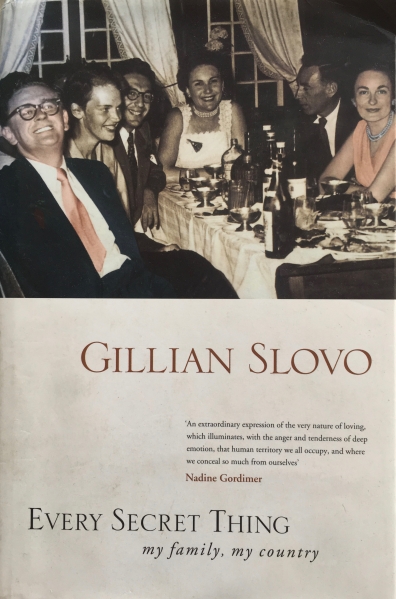
‘Every Secret Thing: My Family, My Country’ by Gillian Slovo

1997,282 p.

Gillian Slovo, the daughter of white anti-Apartheid activists Joe Slovo and Ruth First, was standing with her siblings at just one of the many public events surrounding her father’s funeral. Nelson Mandela came in.

[Mandela] told us how one day when he had gone to hug his grown-up daughter she had flinched away from him, and burst out “You are the father to all our people, but you have never had the time to be a father to me.”

He let that last sentence hover before speaking again. This, he said, was his greatest, perhaps his only regret: that his children, and the children of his comrades, had been the ones to pay the price of their parents’ commitment…

They knew it somewhere, all their generation: as the state poured out its wrath, they had watched their children suffer. And yet, and yet- what else could they have done?

p.214

What else could they have done? This is the question that lies at the heart of Gillian Slovo’s memoir Every Secret Thing. The answer she would give, I think, is “more”. More time, more contact, more honesty, more love. As the child of two committed, White anti-Apartheid activists, Slovo and her sisters shared their parents with a broader political project, as suggested by the title. Their family and their country were indivisible, even though they spent many years living elsewhere. They had grown up with secrets, with whispered conversations between heads almost touching, with a succession of fleeting and shadowy contacts and the knowledge that, as far as their parents were concerned, they always took second place to the larger struggle. Their father Joe Slovo and mother Ruth First were the glamour couple of the anti-Apartheid movement, born themselves to Communist parents, and active members of the South African Communist Party. They resisted apartheid right from the late 1940s, with Joe an advocate at the Johannesburg Bar, acting as a defence lawyer in political trials. Both were under surveillance, and both spent years in exile in UK, Mozambique, Swaziland and Zambia. Ruth was detained under consecutive 90-day detention periods while the government played cat-and-mouse with activists, while Joe spent decades out of South Africa. She was assassinated in 1982 in Zambia through a letter-bomb. Her father lived until 1995, by which time the ANC had been elected through democratic elections and he had become the Minister for Housing in Nelson Mandela’s government- an almost unimaginable change of events from the perspective of the 1950s and 1960s.

Throughout all this, their daughters were observers: told little, kept safe but also kept at arms-length emotionally. In the weeks before his death from cancer, Gillian asked her father about his life, but he furiously exploded “You can write what you want to, but I won’t tell you.” After he died, Gillian returned to South Africa, to try to uncover the secrets that her parents had held from her and the last third of the book revolves around this search. She wants to know the circumstances and the perpetrators of her mother’s murder, and this brings her face-to-face with more secrets – the power apparatus that lent force to the apartheid regime but which has also managed to shapeshift and insinuate itself into the present security structures. She uncovers secrets about her parents as well, secrets which make her question her parents’ marriage and their fidelity and which serve further to underscore the children’s marginality to their parents’ lives.

Her parents were public figures, excoriated by the apartheid regime, but embraced as part of the struggle by the ANC – indeed, Joe Slovo is buried in a formerly-black only Avalon cemetery in Soweto. Their daughters did not know where they fitted in. They were white, had black servants, spent much of their life in England, and yet they stood, almost as ornaments, at the huge funeral celebrations held when their father died. But Gillian also knew that she and her family were not part of that white silence that pervaded the fifty years of apartheid – as she wryly remarked, it has been impossible now to find anyone who owns up to supporting it- and she bridled at the comment of a White driver that he “didn’t hold grudges”, as if he were the victim. Yet, Gillian feels that she has been a victim in that the larger struggle made her inconsequential to the people to whom she most wanted to matter.

As it turns out, I have read two memoirs written by daughters about their parents, one after the other. This memoir, and Swimming Home are similar in that daughters are holding their parents (especially their mothers) to account, and both share a broadly chronological narrative with multiple digressions and time shifts. What I really admire in this memoir is Slovo’s honesty in her motives and her expressions of disappointment in both parents and her frankness in stating that her parents’ commitment came at her expense. But how to measure the contribution of people passionate about huge events and conditions that affect millions, against the demands of three daughters? I don’t know, and at the end, I don’t think that Slovo does either. She will never find out ‘every secret thing’ – an impossible goal- but she concludes that

I, a child of secrets, had done something that I had needed to do. I had laid to rest some of the ghosts that had stalked my life, and in doing so, I’d found a kind of peace.

p. 281

Perhaps, a “kind of peace” is the best that any of us can hope for.

My rating: 8/10

Sourced from: CAE bookgroups