I only have two more days left on my pass, so time to watch some longer films.
My DACA Life (69 minutes)
DACA means Deferred Action for Child Arrivals, which was a Obama-era program which put a hold on deportation of young people who had arrived in America as children when their parents moved there. Because their parents did not receive official entry, their children had no documents either. This meant that they could not get a driving licence, obtain scholarships, or travel out of America. Maribel was born in Mexico, but had never been there. There she meets her extended family for the first time. Being given a one-off work permit, she is allowed to travel to Mexico and by being registered returning to America, to finally receive entry documentation. But then Trump gets in, and everything changes.
I Come from Away (58 minutes) Nyamoun Nguany Machar (aka Moon) is a 30-year old African woman who arrived in Portland, Maine with her Ethiopian mother and Sudanese father as a refugee in 1995. Portland is the second whitest state in America. She experiences racism, but nonetheless Portland manages to accommodate 600 asylum seekers arriving from the Congo, under the influence of progressive activists, churches and communities which make them welcome. One of these asylum seekers, David Zwahila Mota, tells of his six month journey from Africa to Central America, up through Mexico and into Maine.
Los Hermanos/ The Brothers (84 minutes)
This was so good. Cuban pianist Aldo López-Gavilán stayed in Cuba while his older brother, violinist Ilmar travelled to Russia as a 14 year old and ended up in the United States. Until Obama, they could not perform together but for just a few years they could. All brought undone by Trump.
Mango House (58 minutes)
What a truly good man. Dr PJ! is a general practitioner who developed Mango House, a combined health/dental clinic, meeting space and food court/mall where refugees could start their own businesses. The documentary covers the clinic’s activity during the COVID pandemic, and shows the myriad ways in which Mango House meets the needs of refugees.
The Garcia Family (28 minutes).‘Stop Time’ looked at the Sanctuary movement from the point of view of the refugee seeking sanctuary. This documentary looks instead at the family outside, supporting and agitating for refugee law reform. Alex Garcia has spent over 700 days in sanctuary at the United Church of Christ in St Louis, Missouri. His wife Carly is American, and they have had five years together. There is no pathway for him to get citizenship, even if he returns to Honduras for 10-15 years. It is only with the Biden administration that the law is changed on Feb 21 2021 and Alex can finally step outside onto the church steps to thank his supporters.
Ocean Wings (12 minutes)
A man and his daughter are walking away from war-torn Syria to join people-smugglers who will take them by sea. But the journey does not turn out as they thought it would.
And so finishes the Immigrant Film Fest 2022. There were far more films there than I could watch, but I feel that I received sufficient value for my $100 (damn you, AUD/US exchange rate!) Given that this was such an issue-based film festival, I guess the ultimate test would be whether I did anything new as a result of it. Yes, I did. Asylum Seeker Resource Centre (https://asrc.org.au/)
Stop Time. Plenty of Spanish in this one! Lucio is the father of four who has sought sanctuary in the First Congregational Church at Amherst, Massachusetts. He was born in Guatemala, left school early, and then went to pick coffee in Mexico at the age of 15. He left for America at the end of 1999 but was arrested as an undocumented migrant while in Dunkin’ Donuts on a trip with his children. He lived in the church for 1128 days, until the court gave him a stay on his deportation while his case was heard. He was one of 70 undocumented migrants who sought sanctuary in churches during Trump’s presidency.
One, If By Land (14 minutes) looks at the journey of three undocumented immigrants. One is a woman travelling with a coyote across the Mexican border, for the sake of her five year old son who she has left behind. Second is a Chinese migrant who arrives by ship, jumping into the water near New York only to find himself handcuffed in a hospital when he regains consciousness. Third is the imagined story of the Angolan migrant who stowed away on a plane flying to London, who fell to his death from the wheel well.
Crisis. A short (15 minutes) film about a young Korean man working in his father’s restaurant in Croatia during the COVID lockdown. As he rides around Zagreb making home deliveries, he encounters various people who look down on him but he still has dreams of enrolling to study, rather than taking over his father’s restaurant as his father wants him to do.
Voices and Locks. This 20 minute Turkish film has two children, one Armenian and one Turkish, growing up in a remote village. Gaspar (I think the Armenian boy) returns back home after 40 years in America, suffering from what looks like Parkinson’s Disease, hoping to recapture his childhood memories. But the village has been taken over by the Turkish authorities, who confiscate their land and search for gold that they (incorrectly) assume the impoverished Armenians have buried.
Un barco para mi mamá. A very short (6 minutes) black and white film where a mother recounts her two attempts to get into the United States. They are caught and deported after the first one, and the second time they go through a tunnel to get across. I don’t know whether the second time was successful or not.
Revisionist History I’ve telling everyone I meet about a three-part series of podcasts on Malcolm Gladwell’s Revisionist History program about the Minnesota Starvation Project. In the first episode, The Department of Physiological Hygiene, he describes what this experiment was about: during the last year of WWII 36 men volunteered to undertake a year-long experiment in what happens when you are put on a starvation diet that results in a loss of 25% of your body weight? Three months were spent measuring and regulating calorific intake and output, then six months on a very stringent diet and exercise regime, then three months to return to health. In Episode Two, The Rise of the Guinea Pigs, Gladwell challenges the scientific consensus that such an experiment would never be conducted today for ethical reasons. He digs deeper into the process by which the experiment was set up, and found that the volunteers were genuinely volunteers- they were conscientious objectors who wanted to do something for the war effort but did not want to fight. Most of what we know about nutrition and starvation comes from this experiment, why not repeat it with genuine volunteers (as these men were) now that we could monitor what was happening with much more precision than was done sixty years ago? (I don’t agree). Episode Three The Mennonite National Anthem looks more closely at the volunteers’ motivations for enlisting in the experiment, many of which related to their religious beliefs. They look at one volunteer, Lester Glick, who kept a diary throughout, and using the oral histories provided by many of the participants, note that none of them regretted their involvement. This is really good.
The History Listen (ABC)The Loveday Trilogy Part I looks at German Oskar Speck, who decided in 1932 to paddle his kayak single-handed to Cyprus but then kept on going- all the way to Australia. By now, Hitler’s National Socialist Party was the government of Germany so his relationship with Nazism is confused but either way, he ended up in Loveday Internment Camp as an enemy alien. Fancy going all that way, only to end up interned!
Now and Then When the news came out that Rudy Giuliani was drunk on election night, Heather Cox Richardson and Joanne Freeman dive back into American history to see other times when the tide and tenor of American politics may have been affected by alcohol. Alcohol in American Politics starts with Franklin Pierce (never heard of him), but moves onto Warren Harding’s hypocrisy during Prohibition, Teddy Kennedy’s alcoholism that led to Chappaquiddick and Gerald Ford hiding his addictions under the cover of his wife Betty.
The Ancients Much as I might want it, it’s almost impossible for me to even conceive of a mindset where race is completely irrelevant. But in this episode Race in Antiquity it seems that this might have been the case in Egyptian, Greek and Roman cultures. The Kushite pharaohs, Septimus Severus, Peter the Great’s son – being ‘black’ was described much the same way that being ‘blonde’ might be described today. Features Luke Pepera who is writing a book Motherland: 500,000 Years of African History, Cultures, and Identity (big topic!) which will be published next year.
History Hit In Russia Falters in Ukraine: Parallels with World War I historian Alexander Watson, author of the award-winning book The Fortress: The Great Siege of Przemysl, talks about the Eastern front during WWI- the one that we hear less about. Although he is cautious not to say “history is repeating”, there certainly are parallels. After the Russo-Japanese war, Russia made a huge investment in its army in an attempt to project great-power status. The Russian people were never as enthusiastic about the war as the political elites were, and there were draft riots in 1914 (I think of the lines of cars leaving Russia in the wake of its recent draft). Russia came into WWI ostensibly to protect Serbia (I think of Putin designating Ukraine “Little Russia” and the need to “defend” the territories annexed through his recent “referendum”). Because of the huge size of the Russian army, people thought that its force would be overwhelming (just as many thought would be the case with Ukraine). The parallels (so far) stop once the elites lose legitimacy after 1916 and a string of defeats, and once revolution breaks out. Dare we hope?
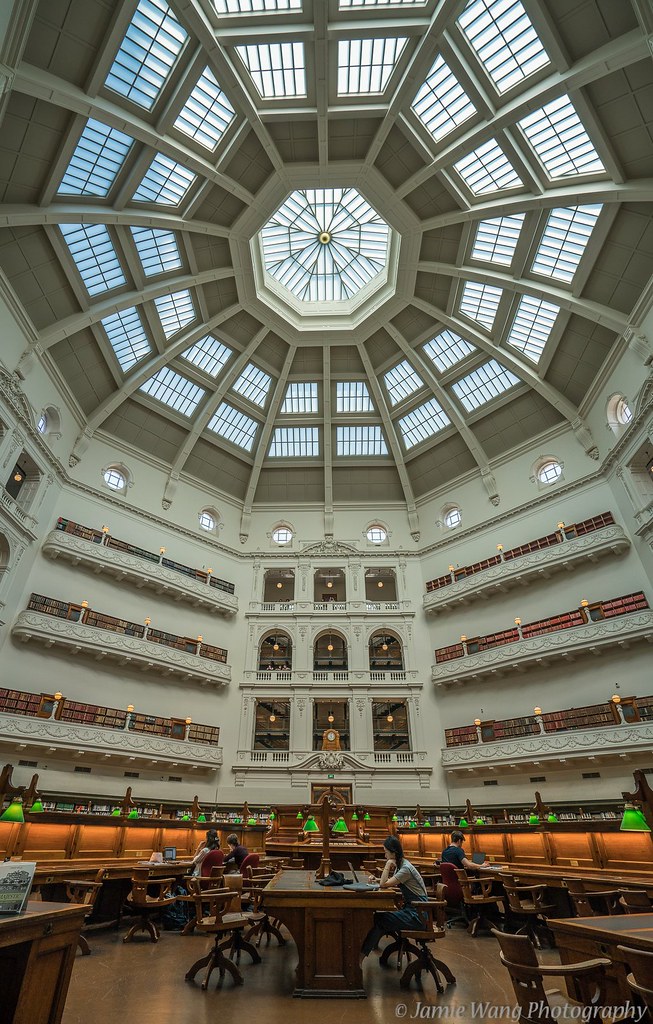
Inside the SLV. Jamie Wang Flickr CCCC BY-SA 2.0
Nothing on TV It’s time to hear a good Aussie voice, and who better than Robyn Annear. She hasn’t done a podcast for ages, so I’m having to delve into her back catalogue. Clean Hands starts off with the theft of soap from the front entrance to the Melbourne Public Library (now State Library of Victoria) – the soap was carefully cut into small pieces the size of a domino, but people were quite annoyed by the thefts. But not as outraged as they were when people stole the books, cutting out the Melbourne Public Library stamp on p. 91 (always), and erasing the stamp on the front and back pages. The Melbourne Public Library was open to everyone, which was a principle quite unusual at the time, and one which Redmond Barry vigorously defended. There were suggestions that there be a special room for people who just came into the library to lounge instead of read, but that never happened either. Although thinking back to nights at SLV, before the roof was opened up and everything was plunged into an eternal twilight lit by little green lamps, I think that there were many people there then too, in overcoats and smelling of alcohol, who were not actually ‘reading’.
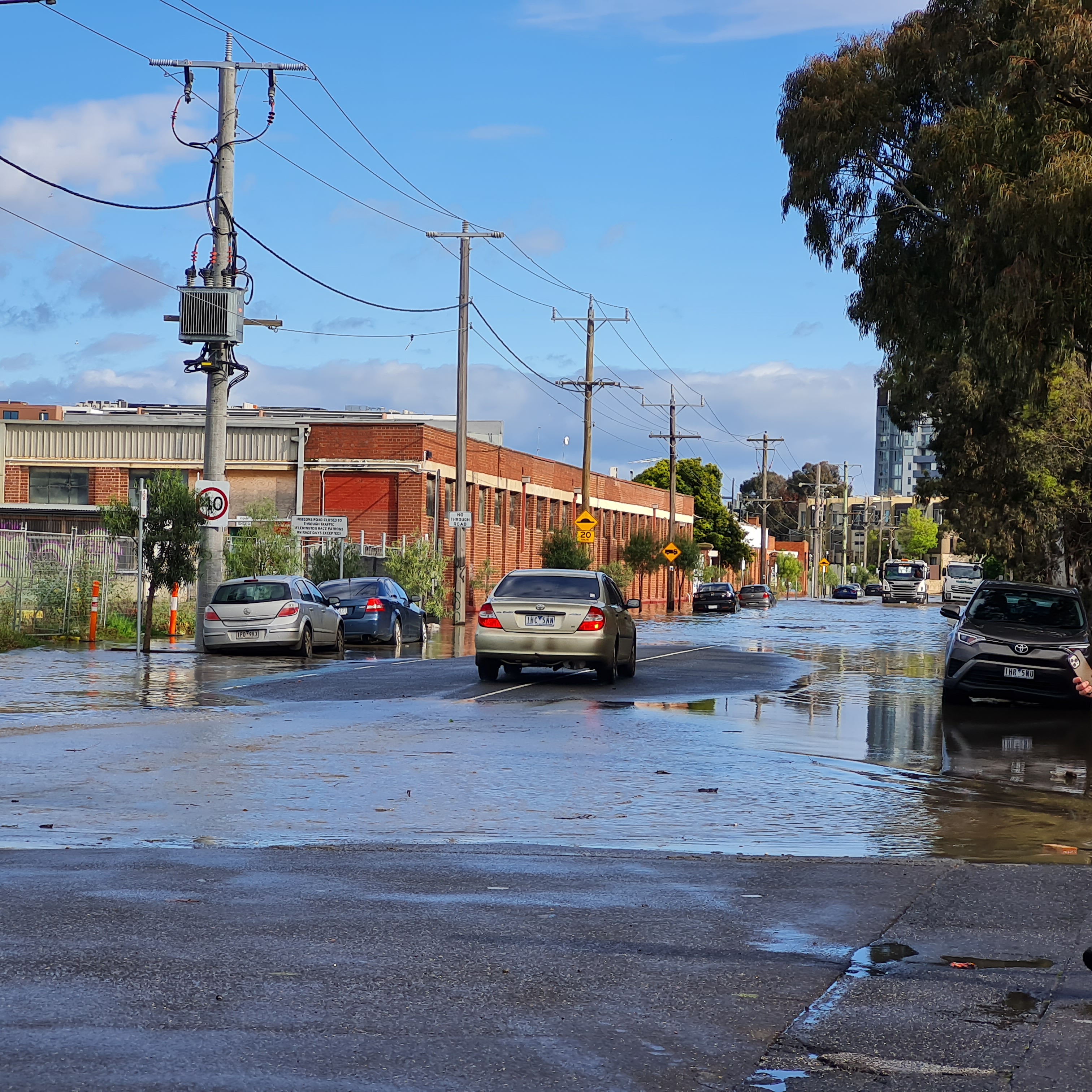
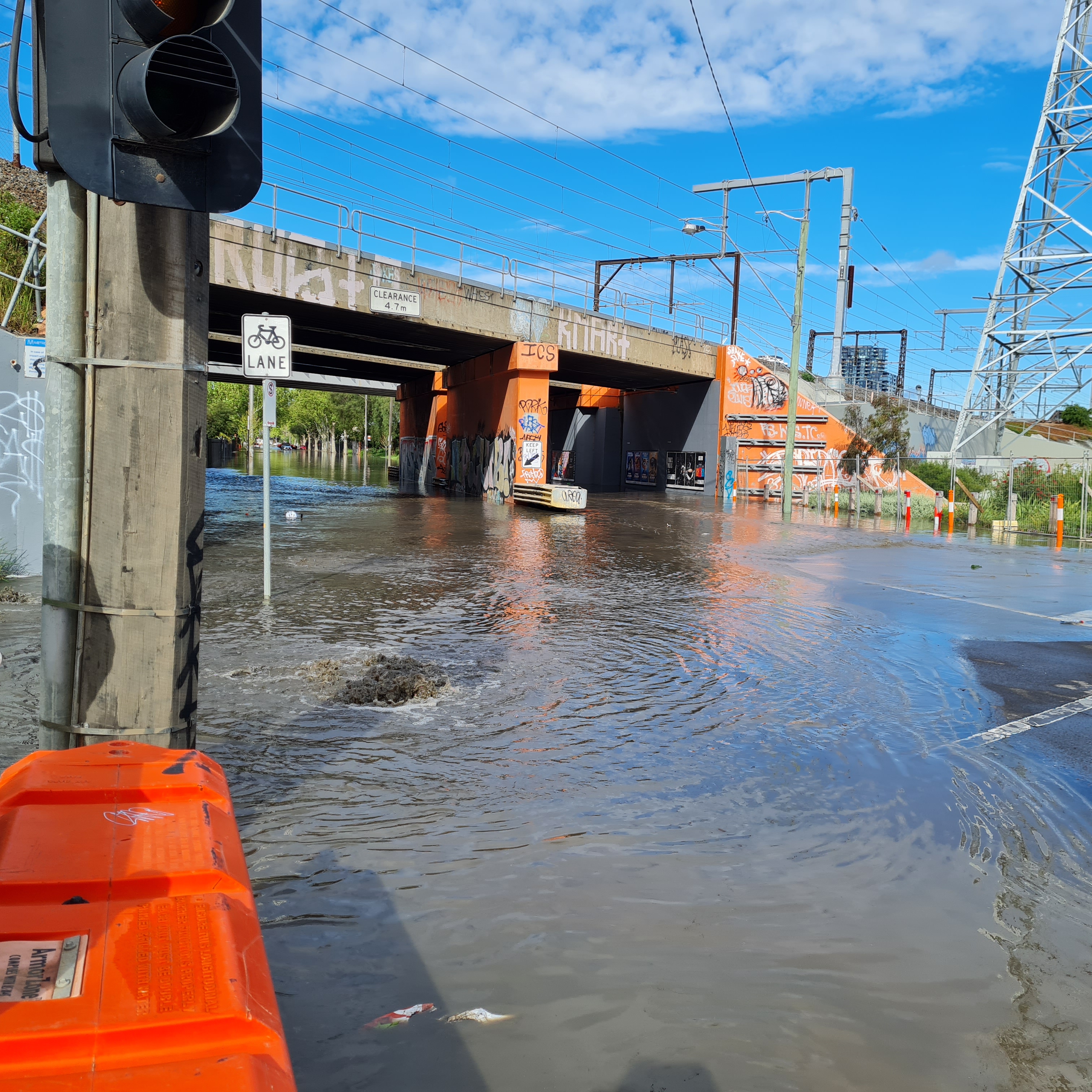
On Fridays, I usually volunteer down at Brotherhood Books in Kensington. I catch the train to the very sparse Kensington South station and walk along Childers St./Hobsons Rd, crossing Kensington Road. But as I left the station last Friday, a passerby warned me that I wouldn’t be able to cross Kensington Road. He was right. I looked up Hobsons Rd and thought “no-one’s going to be working there today”. And I was right. Brotherhood Books has been closed all week, after the Maribrynong river washed through our warehouse. (If you click on the images, you can see a larger version).
Along Hobsons Rd. No work for me todayThe underpass at Kensington Rd/Hobsons Rd. It never occurred to me that floods come up through the gutters and manhole covers, like the bubbling geyser on the left hand side.
So, I had the rare experience (for this year) of a free Friday. It felt like a holiday! We decided to go in to see the ‘Lust Love Loss’ exhibition at the Shrine of Remembrance, then to pop in to the NGV International.
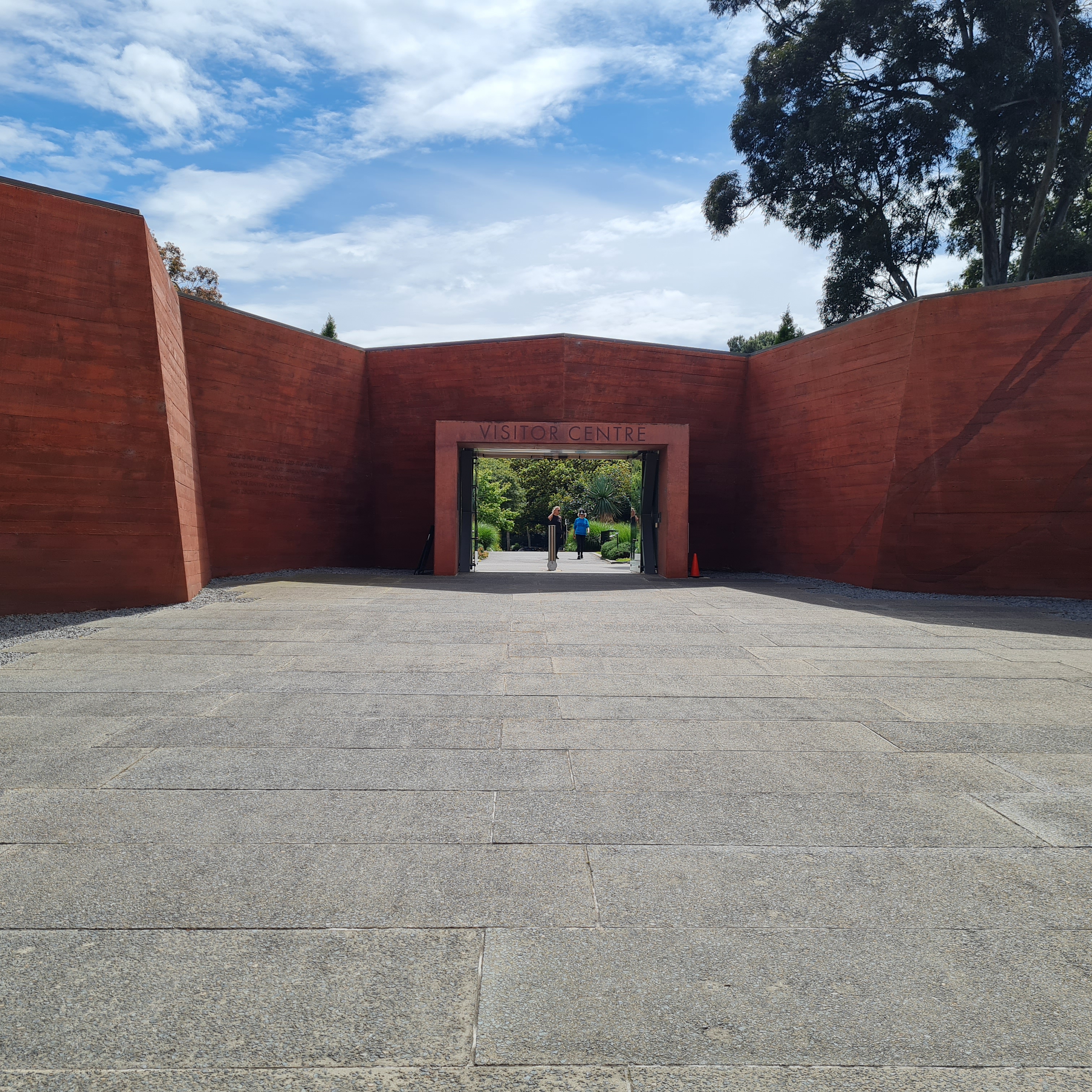
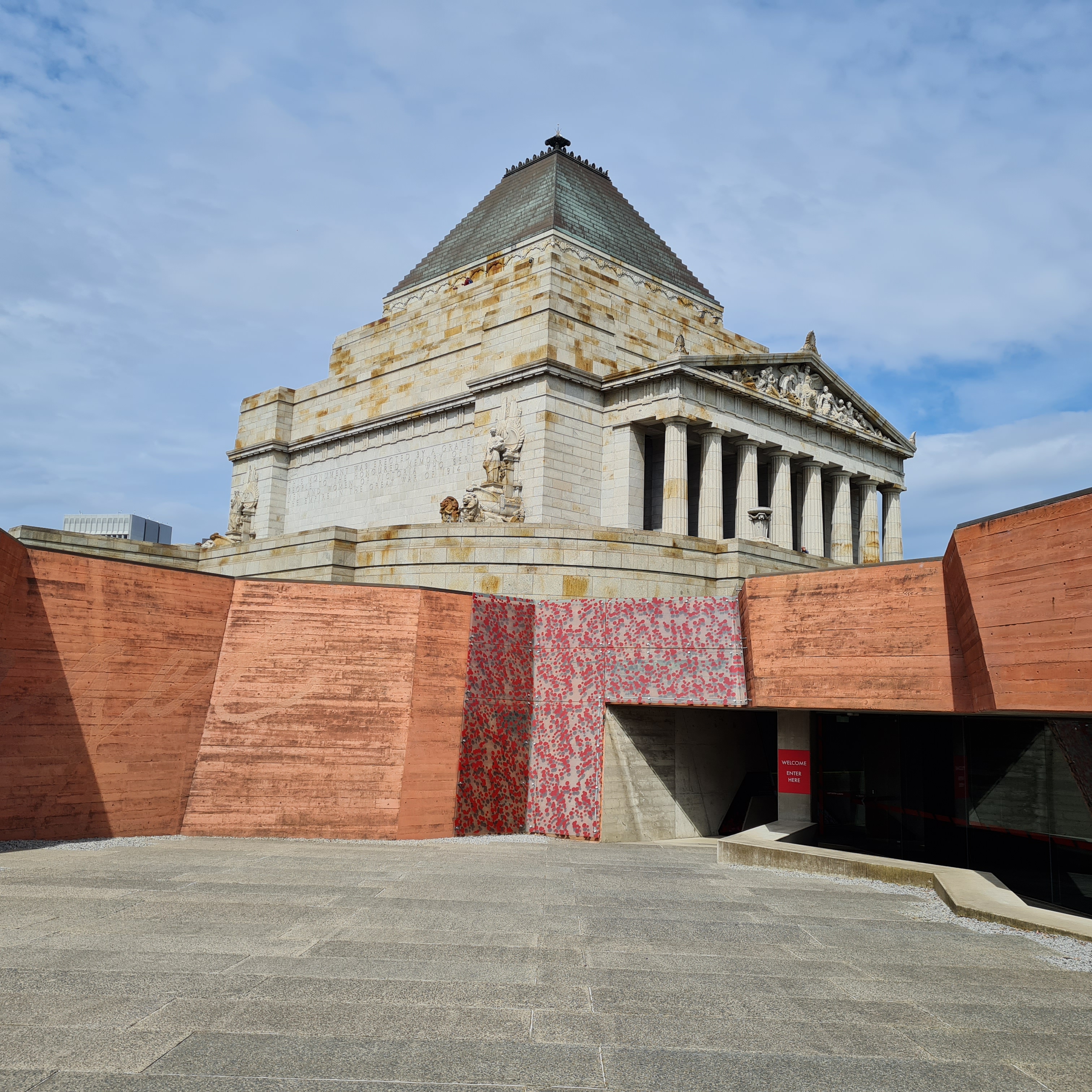
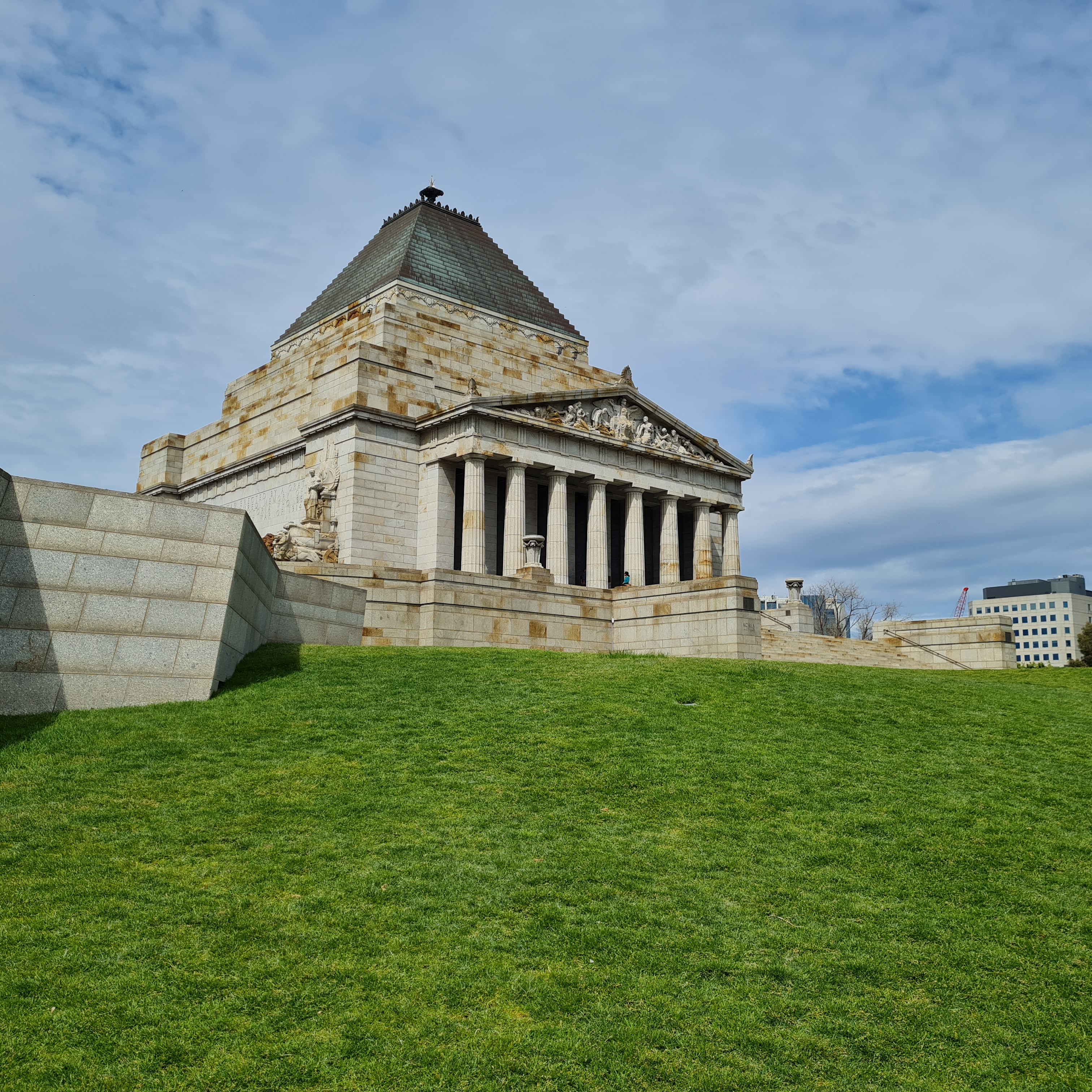
I haven’t been to the Shrine for probably 30 years. Its new galleries underneath the hill on which the Shrine is placed and the unobtrusive entrance received well-deserved architectural acclaim. The Shrine is such a strange place: built to last for hundreds of years in stone and marble, with lots of Egyptian references combined with classical figures and marble reliefs of battles (which reminds me that I really must read Ken Inglis’ Sacred Places one day).
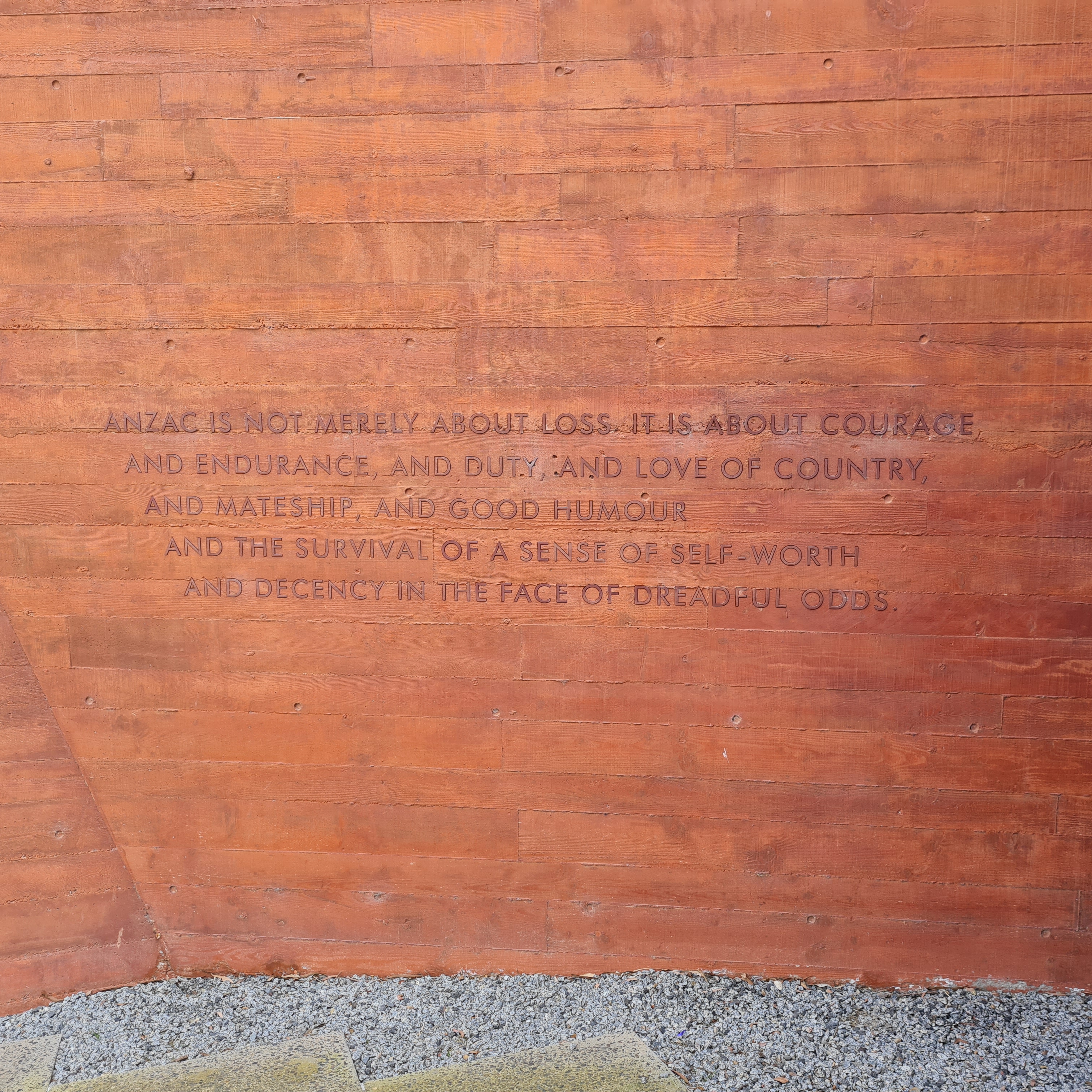
The new visitors entranceTaken from inside the visitors entrance, which is intended to convey the feeling of a trenchExcept for the new wall on the left hand side, you wouldn’t be particularly aware that there was a new entrance
I was impressed with the three exhibitions: Lust Love Loss (which closes 20 November 2022), Defending with Pride, the first of its kind for an Australian war memorial (closes July 2023) and For Kin and Country (until 26 March 2023) the history of First Peoples’ service in the Australian Defence Force, a display which makes you feel angry and ashamed of the discriminatory treatment that they received on returning home.
I really liked the human scale of these exhibitions, with none of the big-boys-toys approach being pushed by Brendan Nelson at the Australian War Memorial. But I am mystified that with all the ‘professionalism’ of the GLAM sector, so many signs were difficult/impossible to read. Why would you put black print on a dark khaki background in a dimly lit gallery? I don’t want to go through a gallery with the catalogue on my phone, drawing my eyes constantly to a 15 cm screen that pings messages at me: I want to look at the exhibition. The artworks and photographs had only rudimentary signage beside them on the walls, and there were only two printed catalogues available (which we returned for someone else to use).
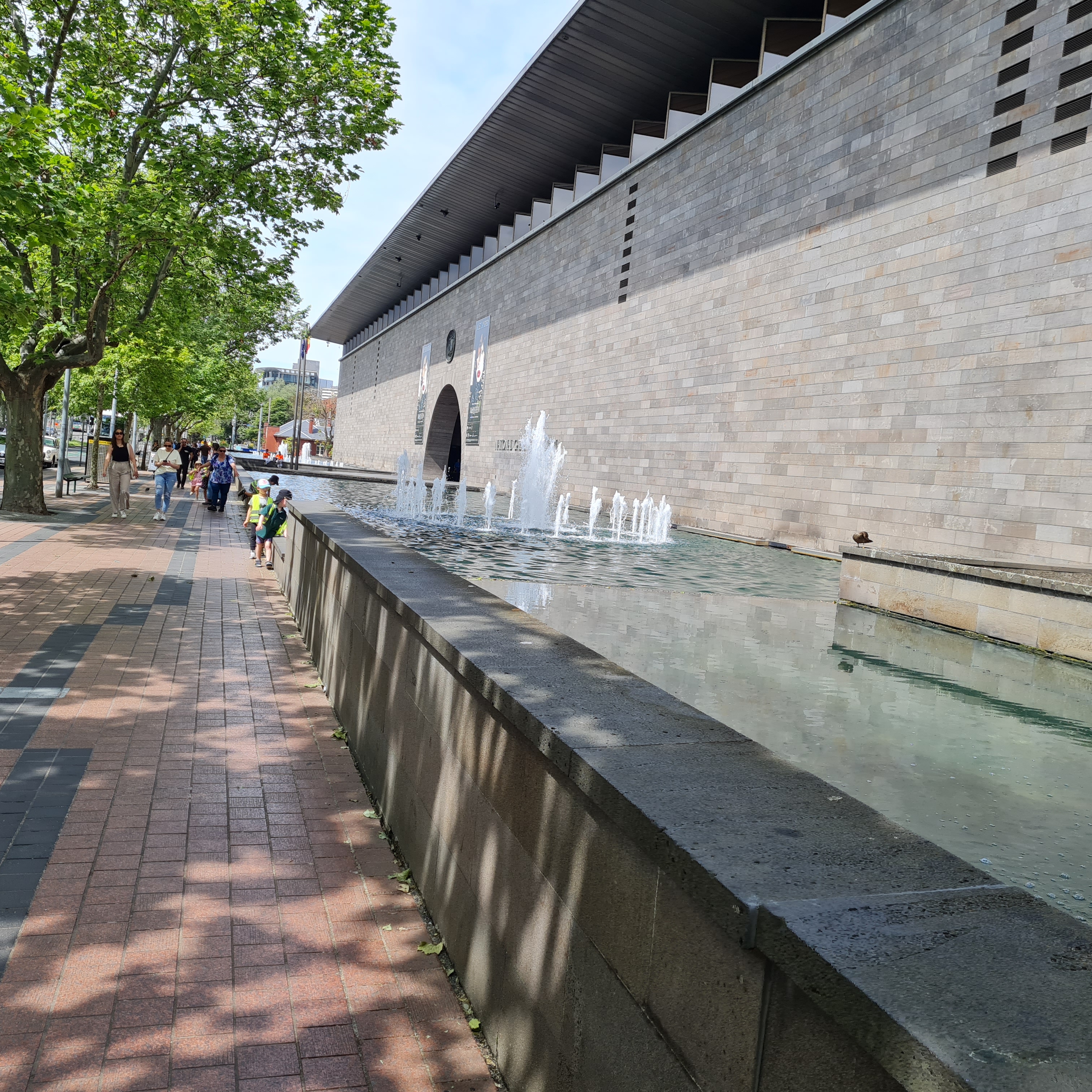
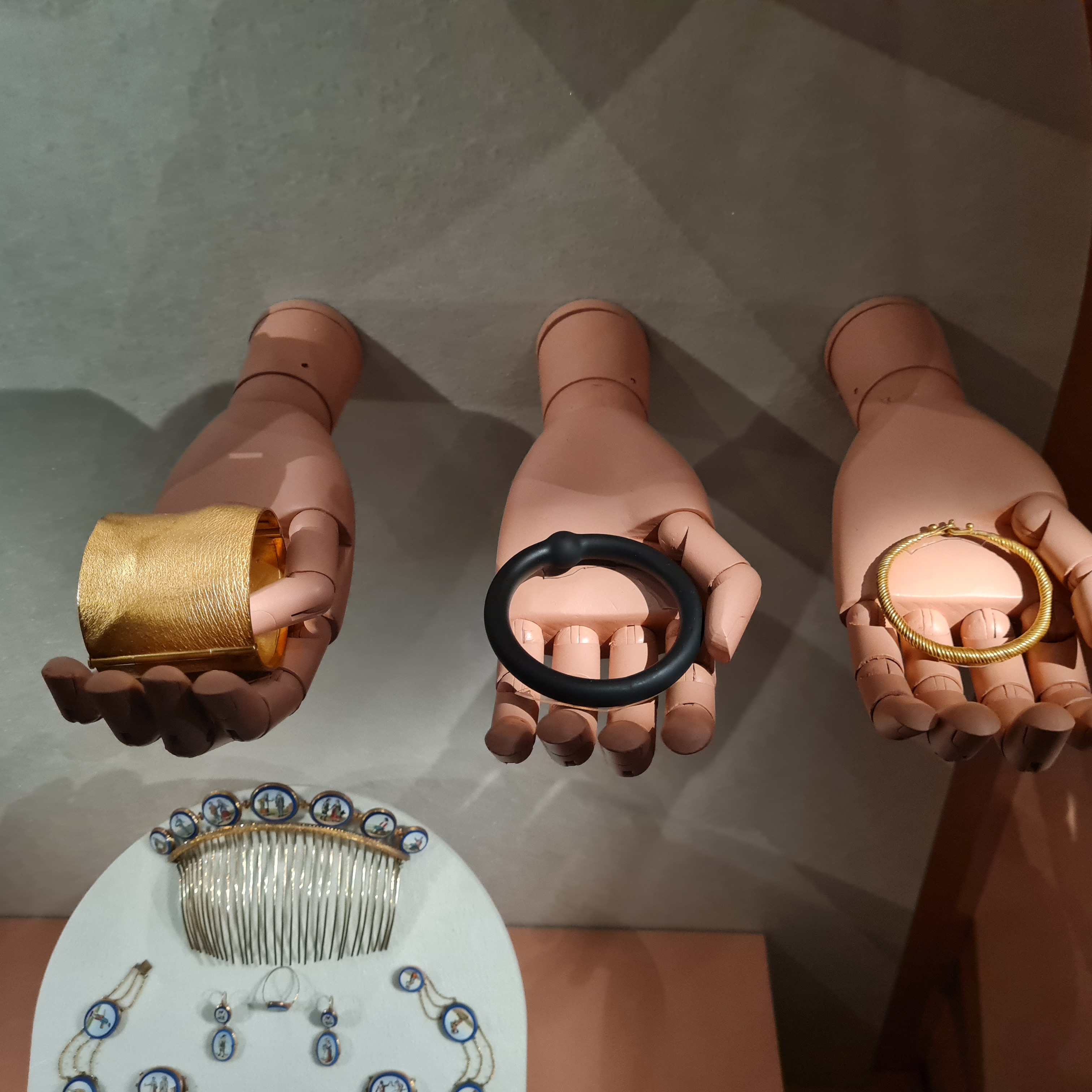
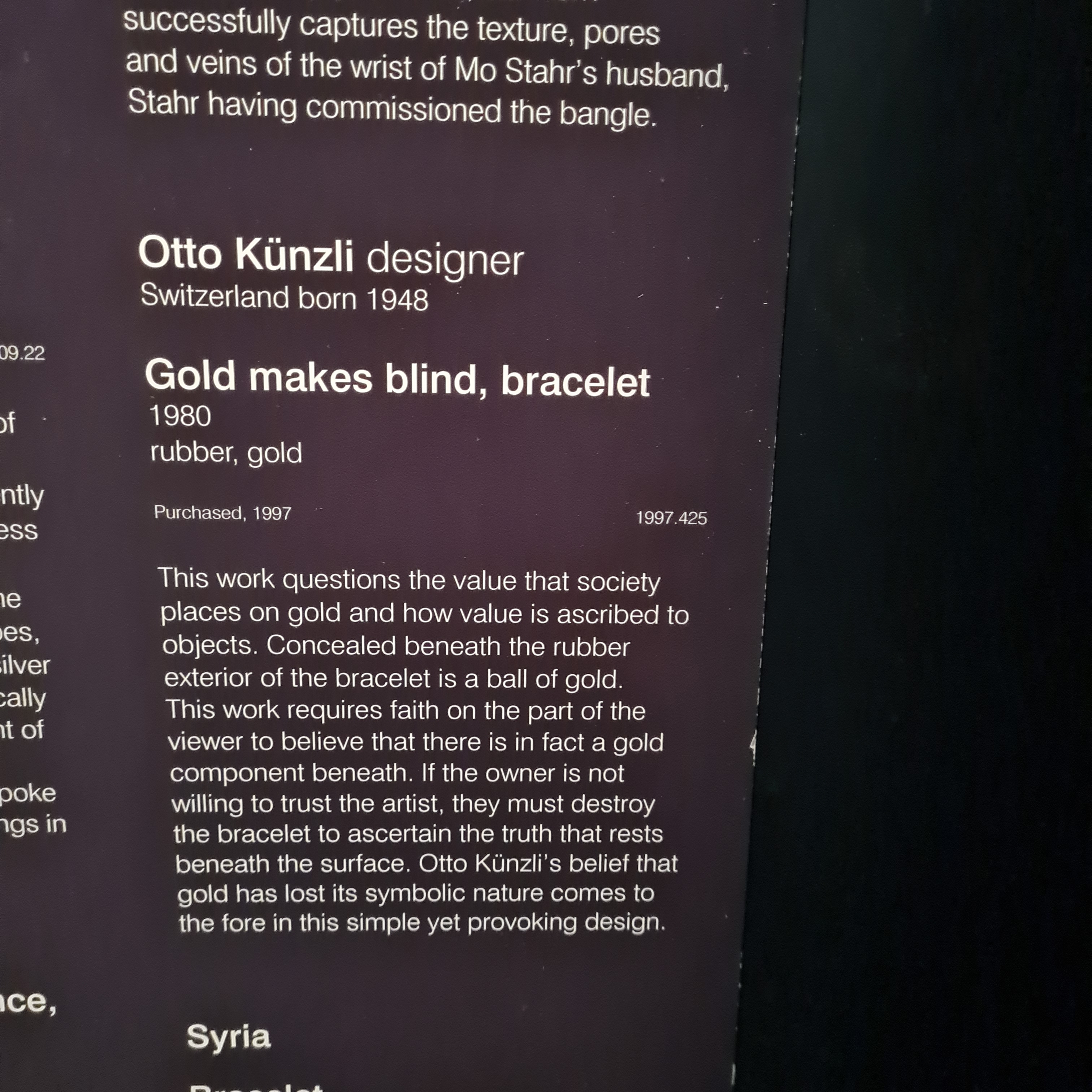
Then off to the NGV International. When was Deborah Halpern’s Angel sculpture moved out of the moat? (Ooops! 2006. Why hadn’t I noticed earlier?) I was keen to see Richard Mosse’s Broken Spectre but it was so loud and dark – and the chairs at the back were taken and it was too dark to see if there were any other chairs there, and no way was I going to sit on the floor in the dark for 74 minutes…..and yes, I’m sounding like a grumpy old lady. So we went up to the Jewellery and Body Adornment display on the balcony which was interesting, although again with rather baffling signage. I liked the malicious glee of the Gold Makes Blind, Bracelet (the middle bracelet). Covered in rubber, there is (supposedly) a gold bracelet underneath the rubber, but you need to destroy the bracelet to see if it is really there.
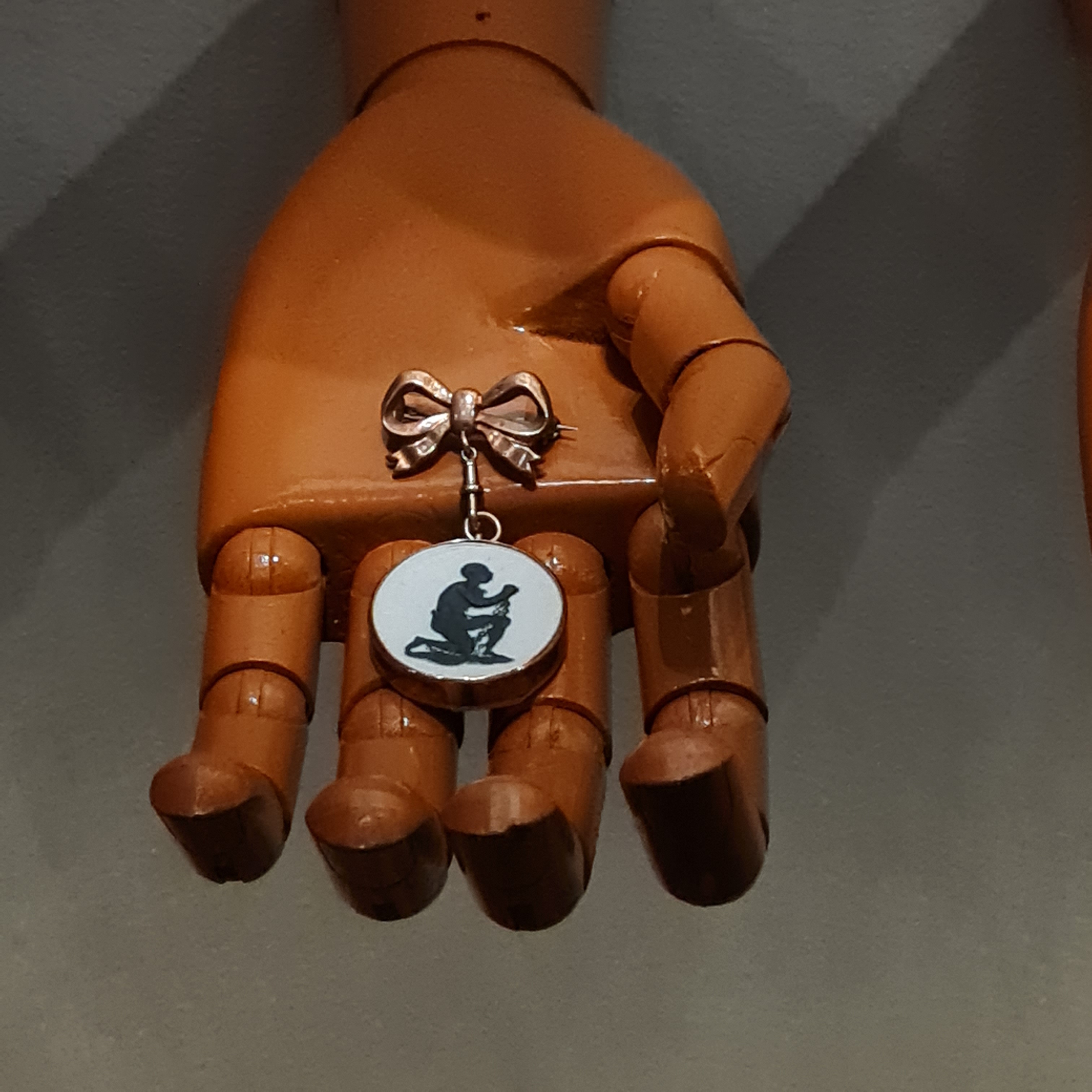
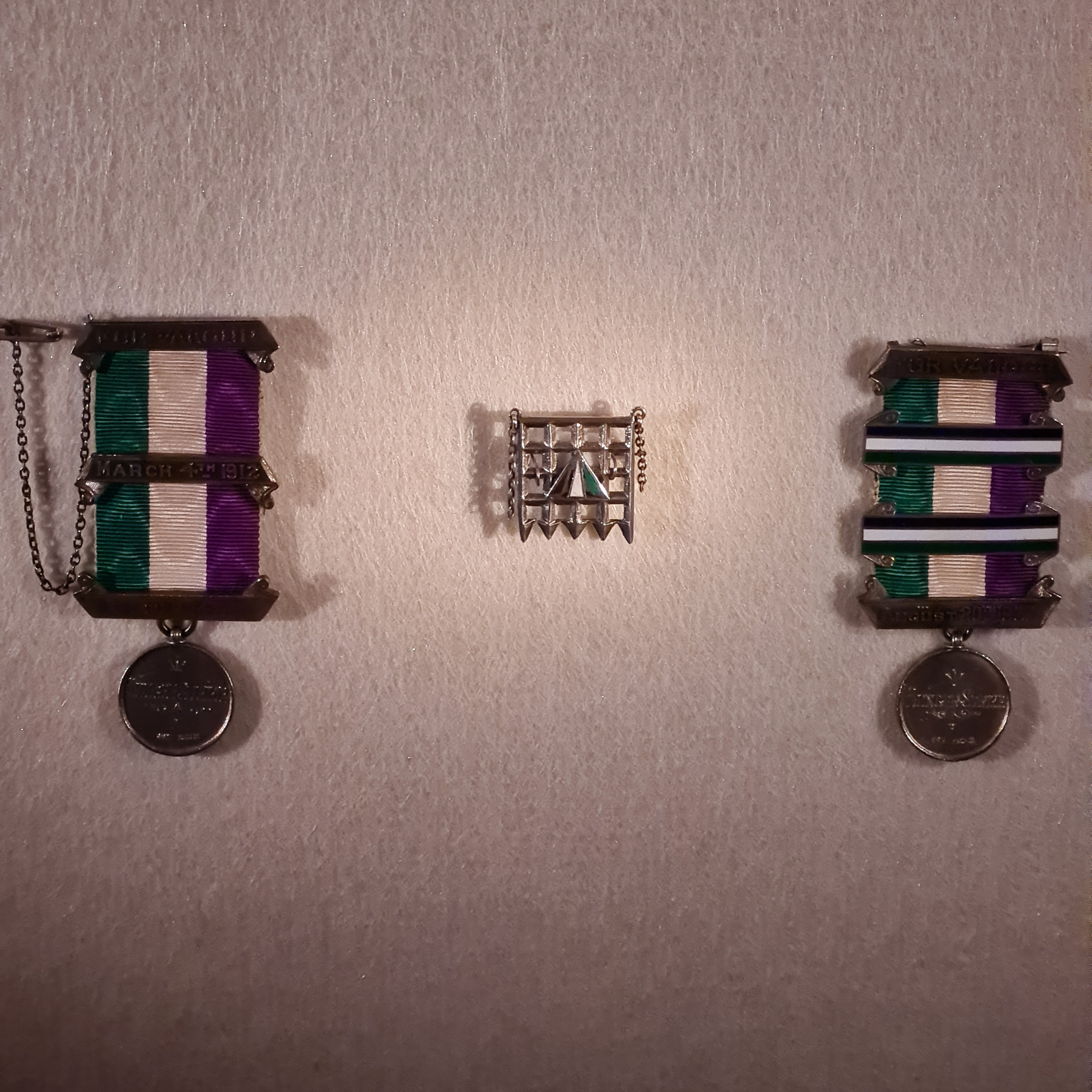
I liked the pieces that had some social history attached to them. I had heard of Josiah Wedgwood’s Anti-Slavery medallion, but never seen one. I was rather taken with Sylvia Pankhurst’s Holloway Brooch (in the middle in the image below) which was awarded to women who had been imprisoned. The two medals with the green, white and purple ribbons were awarded by the Women’s Social and Political Union to women who had endured hunger strikes while in prison. Fewer than 100 of these medals were awarded.
Off to lunch at Roule Galette in Flinders Lane- and yes, the city still is much quieter than it used to be- then back home for a grand-daughter pick up from school. I haven’t ever done the pick-up run because I’m usually down at the Brotherhood- and hopefully, things will have dried out enough that I can be down there again next Friday. Says she, with thunder rumbling outside.
This was absolutely beautiful. Set in rural Ireland in the 1980s, Cait lives in a squalid farmhouse with her parents and her many siblings. She is not coping at school, and she just goes into herself to escape life. Distant middle-aged relatives, whom she had never met, offer to take her for the summer holidays, and she just unfurls with their gentle treatment. Although she is told that there are no secrets in their house because secrets spring from shame, she does find that there is an unspoken fact that lies under their quiet life. The last scene brought me to (copious) tears, and I kept hoping that the film might start again after the credits so that I could learn what happened next.
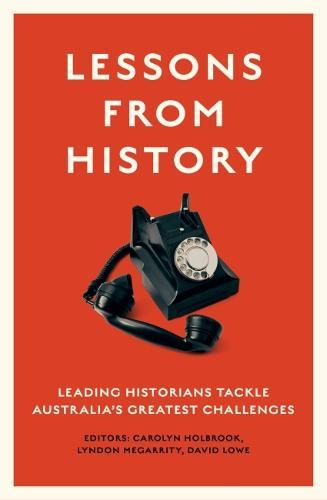
It’s a big claim: that historians can tackle Australia’s greatest challenges. Despite Santayana’s rather facile aphorism “Those who cannot remember the past are condemned to repeat it”, the humanities -and history in particular- have been largely left behind in the trample of lobbyists, think-tanks and policy advisors who direct political decisions from a more presentist and futurist perspective. I’m not sure that it’s a historian, rolling up her sleeves, who is on the end of the old phone depicted on the front cover,
This book, written during the COVID pandemic, responds to the feeling, that I share with many others, that we seem to be living in particularly historically fraught times. It aims to:
[provide] a roadmap for this vital knowledge, laying bare how history can and, indeed, should inform public debate. It is a book for politicians, policymakers, community workers, journalists and engaged citizens, as well as historians. Far from seeking to offer crude historical ‘lessons’ or rigid templates that might be imposed upon contemporary problems, instead we are interested in history’s capacity to enlarge and contextualise public debates…. Historical literacy may not always lead to better policy, but we maintain that history is fundamental to understanding context- which, from its Latin roots, means weaving together or drawing on surrounding circumstances.
p.2
The chapters that follow, mostly about 12-20 pages in length, deal with the major ‘hot-button’ challenges of the early 2020s: climate, China, foreign aid and investment, equality, water and power policy, refugees, war crime, the far right, First Nations issues, women and childcare, domestic violence, the Northern Territory, federation. Each chapter chooses its own time parameters, informed by the issue at hand, and closes with a summary statement: “Lessons from history” with the main policy ‘takeaway’ in a couple of short paragraphs, giving the book a somewhat managerial flavour. The chapters reflect the methodologies and ‘schools’ of the authors: economic historians provide statistics; oral historians provide snapshots from interviews.
The book is in two parts, which work almost at odds with each other. Part I: How a Knowledge of History Makes Better Policy seems to challenge the idea that historians, specifically amongst other public intellectuals, have anything particular to offer, and whether what they offer is used accurately or usefully. Graeme Davison champions, as a historian, the intellectual and social commentator Hugh Stretton, who published books like Ideas for Australian Cities (1970);Capitalism, Socialism and the Environment (1978) and his final work Economics: a New Introduction (2015). These do not sound like the work of a historian and indeed, Stretton himself doubted whether he was a historian but, as Davison says
..from first to last, his thinking about public policy was deeply historical. He was not a policy wonk who taught history on the side; everything he wrote about public policy drew on his understanding of history
p.19
Stretton did not look to history for specific information, or analogies, but instead for a way of reasoning and a capacity to think about problems in a certain way. Frank Bongiorno warns in his chapter that politicians, exhorted to look to the past, can take the wrong lesson -e.g. by conceptualizing anything in diplomacy other than bristling belligerence as Chamberlain-esque ‘appeasement’ – or can subscribe too uncritically to an orthodox reading of economics – e.g. that Australia’s economic decline of the 20th century was caused by the flabbiness encouraged by the Australian Settlement, that only rigorous market reforms by governments of the 1980s and 90s could reverse. James Walter challenges the idea that historians are necessarily ‘outsiders’ by looking at historians who have worked ‘inside the tent’ of government policy, like the feminist historians in the 1970s/1980s and civic historians like Stuart Macintyre and John Hirst, and the policy pressure exerted by Gideon Haigh and Graeme Davison to secure funding for the National Archives of Australia.
Part II Lessons from History then turns its attention to the ‘challenges’. The challenges very much reflect the year in which the book has been compiled. While this contributes to its timeliness, it does also cast some -not all- chapters as more like commentary than analysis, giving the book the feeling of being an extended Monthly magazine or other Schwartz Media publication. Indeed, many of the better-known authors have featured in Quarterly Essays, and in some other chapters where the writer was not known to me, I found myself being able to predict what the “Lessons for History” were going to be after reading just one or two pages. I even found myself double checking to see if these were really historians (yes, most but not all were) and not lobbyists or spokespeople.
I was mystified by the short time spans and limited parameters that some authors chose for themselves. Several chapters reached back onto to the 1970s and 80s, as if the issues underpinning the current challenges started only then. For example, Mia Martin Hobbs’ chapter ‘Why soldiers commit war crimes- and what we can do about it’ looked only at the Vietnam and Afghan wars; the multiply-authored chapter ‘Urban water policy in a drying continent’ looked mainly from the 1990s’ onwards. ‘We need to hear the voices of refugees: citizen engagement for reforming refugee policy’ focussed on Tamil refugees, surely just one of the many refugee groups in Australia today.
The chapters I enjoyed most had a broader span, and surprised me by some of their conclusions. I was surprised that Claire E. W. Wright agreed with Graeme Samuel’s contention that an ‘impenetrable club’ of women was keeping other women out of the boardroom, before unpacking the reasons why this might be- although Wright, too, confined her analysis to post 1980s. I enjoyed Joan Beaumont’s chapter ‘Governing during economic crisis: the importance of memory’ which looked at the recent references to the 1930s Depression as a point of comparison during the COVID epidemic, and the power of the Great Depression in collective memory. I found Caroline Holbrook’s chapter on ‘How To Fix our Federation’, with its comparison of Commonwealth Day (1 January 1901) and Australia Day fascinating. I give my tick of approval to her suggestion of 29-30 March, the anniversary of the first elections for federal parliament, as an alternative to Australia Day, a choice that engenders pride in democracy itself and Australia’s contribution internationally. (For myself, better still if it could include a successful Voice referendum on that day too.)
As you might expect in a book of this type, some essays are more likely to appeal than others. For me, I like the ones that stretched further back in time than 1980, and I felt short-changed by those that ended with a policy prescription that could be found just as easily in a Saturday-paper article. There were others, however, that combined a concise sweep of events with an analysis of their meaning, and a critique of how they could be used or misused in policy formulation. These were the ones that left me wanting to hear more.
I didn’t get to go to the Spanish Film Festival this year because I was still a bit anxious about COVID. But I know that I will find lots of Spanish in this US-based Immigration Film Fest, while learning about immigration issues around the world. So I’ve signed up to their ten-day virtual festival. Now I just have to find the time to watch them. It runs from October 13- October 23 (American dates) and it worked out at about $100 AUD for access.
The first documentary I saw was called Docked. It starts off with a dictionary definition of ‘to dock’. To cut off an animal’s tail; to bring into a port; to cut off someone’s pay; to bring to justice. This definition works at several levels in this exploration of Peruvian and Chilean indentured labourers being brought to work as sheep-herders in the Rocky Mountains in Colorado. Unable to speak English, scared of losing their jobs, unaware of their rights, they are in a vulnerable position. Tom Acker, a human rights activist, travels around with a former sheep-herder to pressure for better wages and conditions and generally keeping the bastards (ranchers) honest.
The second documentary The Aliens only went for 14 minutes. Essam Soltan, Sherein Mohamed, and Sheri Soltan emigrated from Egypt when Sheri was very young. They went on to have other children who were born in America, and they were waiting for these children to reach 21 so that they would be able to apply for their parents’ residency visas. They started living off living in a basement, and both parents worked incredibly hard for just $4.00 an hour in a supermarket- no dodgy little corner store, but a legitimate big business. For me it just highlighted how big industry in America colludes with illegal immigration as a source of cheap and submissive labour. It also showed the effect of 9/11 on American attitudes towards anyone from the Middle East.
This issue of American-born children applying for residency for their parents once they turn 21 is a key plot point in G.I. Jose, where an ICE agent and a policeman raid a house where an ‘illegal’ mother and her 20 year old son and 10? year old daughter are living. The son has served in the U.S. Army but has not yet reached the magic age of 21. The police officer bails the son up in the bedroom where his mother is hiding, and he has the choice to arrest them or show mercy. Another short one at only 11 minutes.
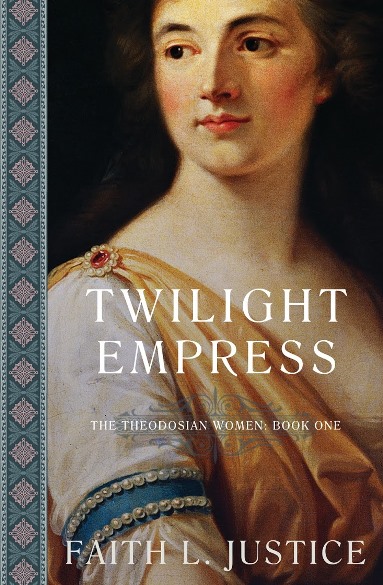
I have just finished listening to Mike Duncan’s very lengthy podcast series on A History of Rome. The last decades of the Empire were such a mess, but my attention was arrested by the prominence of two women, Placidia and Pulcheria, who despite their differences, became powerful in their own right in the Western and Eastern Roman Empires around the turn of the 5th century C.E. In his podcast, Mike Duncan suggested that someone should write a joint biography of these two contemporaneous women. I’m not sure if anyone has written a biography as such, but Faith L. Justice has embarked upon a fictional telling of the lives of three Theodosian Women – Placidia, Pulcheria and Athenais.
I’m a historian of Australian history, but I don’t often read historical fiction based on real, historical figures. Histories from the viewpoint of an invented character, yes; invented characters based on real ones, yes; histories told from the viewpoint on an onlooker, yes; but less often fiction focussing on and fleshing out real characters, using real events and timelines. In fact, I just abandoned reading Annie Garthwaite’s Cecily, about Cecily Neville, the wife of Richard, Duke of York and the mother of Edward IV and Richard III because I just didn’t know enough Plantagenet history to make sense of it, and I wasn’t prepared to put in the hard yards. One notable exception to this is Hilary Mantel’s work, especially her Wolf Hall Trilogy, and her excellent A Place of Greater Safety about the French Revolution, which no-one ever seems to mention. But even with Mantel’s work, I started each book feeling paralysed by my lack of knowledge until I took a deep breath and trusted that, with her emphasis on character, the events would fall into place.
This is the dilemma for a historical novelist, I suppose: knowing the context and events backwards as author, but writing in such a way that you bring a reader who does not know them along with you. In this, Faith L. Justice (surely not her real name!) gives as much support as she can, with a family tree and a list of characters as they appear chronologically in the book, with helpful italicizing of the names of those she invented.
So who was Galla Placidia? This entry from Justice’s blog gives the background to Placidia’s childhood and upbringing. Born in 388-89 or 392–93 CE (how wonderful that she has a 5 year age range!), she was the daughter of the Roman emperor Theodosius I and the paternal half-sister of emperors Arcadius and Honorius. She became empress consort to emperor Constantius II and was the mother and powerful advisor of emperor Valentinian III. So, definitely, completely entwined in imperial politics.
But the book Twilight Empress starts with her being taken hostage by Alaric, the king of the Goths, prior to the fall of Rome. She was taken to Gaul, where after 5 years she married Alaric’s son Ataulf, with whom she had genuinely fallen in love. However, her half-brother Honorius rebuffed their appeals to recognize the marriage, and sent his trusted general, Constantius to bring her home. He did so, and married her himself, having been in love with her for many years, although she did not reciprocate. She had two surviving children to Constantius (having lost her earlier child that she had with Ataulf) before Constantius died. She then threw herself into the lives of her children, forming a separate power base behind her rather insipid son Valentinian, and acting as an intermediary between the Eastern and Western Emperors. The author did well here, showing her as an active and intelligent political operator, but always within circumscribed limits. Meanwhile, her daughter Justa Grata Honoria (known as Honoria – one of the many Honorias) was misbehaving, much to her mother and brother’s embarrassment. The author has fun with Honoria, inventing an ending for her in the vacuum of information about what really happened to her.
I wonder if I would have gleaned all this from the book alone, had I not known some of it from other sources? I’m not sure. My awareness of the emotional resonances of Placidia’s story came solely from this book because the other sources do not provide them, and because there is space for a fictional author to explore the emotional realm. But I don’t think that I would have detected the broader factual events of her life from this book alone, something that could have been remedied with a timeline of major events, perhaps, and a few maps.
Of course, the emotional realm is where an author can exercise their imagination, but the historiographical field of ‘History of the Emotions’ signals to us that emotions are not constant across time and societies. Some emotional responses will always be impenetrable to us as 21st century readers and this would be even more true of classical times. So the ‘romantic’ scenes in the book, which had a decidedly modern tenor, did not sit well with me, veering at times into Mills and Boon territory.
However, one of my motivations for reading this book was to reinforce what I have learned about Ancient Rome recently in a less weighty form, and in that, the book succeeded well. Faith L. Justice gave Placidia agency, -albeit limited- both in her emotional life and in her political behaviour, providing a good counter to all those histories of battles and betrayals amongst the men of Rome.
Finally, I am venturing back into picture theatres! (In fact, in October 2022 I have finally had to make a category for ‘Movies 2022). This documentary ‘Clean’ did very well at the Melbourne International Film Festival, and it is on limited release here in Melbourne. It is about Sandra Pankhurst, who featured in Sarah Krasnostein’s book The Trauma Cleaner (click link for my review), but this documentary is not associated with the book. It picks up on Sandra after the book has been published, with its attendant publicity, and as her health deteriorates. Sandra’s terrible childhood was alluded to, but not really explored in as much detail as in the book. How little we know about other people’s lives.
The Ancients. The Rise and Fall of Roman London. This episode features Professor Dominic Perring, Director of the UCL Centre for Applied Archaeology, who discusses what the archaeology studies conducted as part of the constant rebuilding of London have told us about the Roman phase of London’s History. I had listened and read to histories of London before (e.g. Peter Ackroyd’s London) but I tended to skip over the Roman bit to get to the 16th century parts. Now having finished my History of Rome podcasts, I have much more context to understand the ebb and flow of Roman London, and how it meshed with developments in the Roman Empire more generally. He starts off in AD43 as the first fort was constructed. Emperor Claudius came along for a 16 day trip, but did not linger in London but instead marched to Colchester. With the Boudiccan revolt of 60-61CE , London was burnt to the ground, but Vespasian embarked on a big rebuilding program as a way of asserting his legitimacy. However, there were fires in 125-6 CE, and possibly plague in 165-180 CE, which led to London growing and contracting. By the 3rd century, when the whole Roman Empire was in crisis, Britain became a good source of rebellious emperors e.g. Constantine. By the 5th century when the Roman Empire ‘fell’, London was smaller and less active because of the loss of trade and people, while other towns prospered. In effect, London had been invented by Rome and discarded by Rome
History This Week. This week in 1788, William Brodie was hanged in Edinburgh. He was the source material for R.L. Stevenson’s Strange Case of Dr. Jekyll and Mr. Hyde and this episode The Hanging of Jekyll and Hyde goes through the story of this outwardly respectable church member and cabinet maker, who led a gang of thieves who became increasingly brazen.
Duolingo I don’t very often include my Spanish podcasts in these lists, but I do make an exception for Duolingo, which uses both Spanish and English in their episodes. You would be able to follow the podcast, even if you don’t speak Spanish. In Mexico City- Tenochtitlan, un ciudad oculta we are taken on a tour of the remains of the Aztec city that is covered over by the modern Mexico City. In the podcast, we travel to the Zocalo, and to ruins that were uncovered while constructing the Metro. I would LOVE to go to Mexico City.
History Hit The Energy Crisis: 2022 vs 1973 compares the mining strikes and Arab-Israeli was that led to energy shortages in 1973, compared with the crisis that is facing Britain and Europe this coming winter. In 1973, it was not so much prices that were the problem as a worldwide scarcity of oil, exacerbated in England by coal strike action. It would seem that in 2022, governments are cautious of telling people what to do anymore (burnt, no doubt, by COVID) and there is less sense of communal struggle and national unity. The episode features historian Alwyn Turner, who has a new book about crises in the 1970s called Crisis, What Crisis?
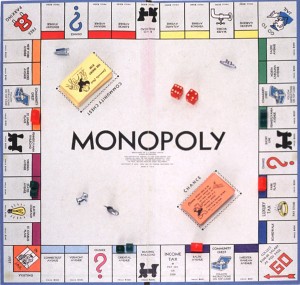
Now and Then features historians Heather Cox Richardson and Joanne Freeman. In the episode From Monopoly to Mystery Date they’re feeling a bit summery (they are from America after all), so they are looking at board games- in particular those where you throw and dice and move back and forward. I hadn’t heard of them all, but the story of Monopoly was fascinating. It was invented by a woman who wanted to demonstrate the principles of Henry George’s Single Tax theory, whereby the value of land was not intrinsic, but only a reflection of the social value ascribed to it and the status of the people who lived nearby. It wasn’t called Monopoly, but instead The Landlord’s Game. She was fairly badly ripped off (how ironic) and the game lost its political commentary in the Parker Bros. version. Then there was ‘Chutzpah’, a Jewish Monopoly game, which 50 years later looks very racist, and Mystery Date, an appallingly sexist and demeaning dating game.

 The Resident Judge of Port Phillip