Author Archives: residentjudge

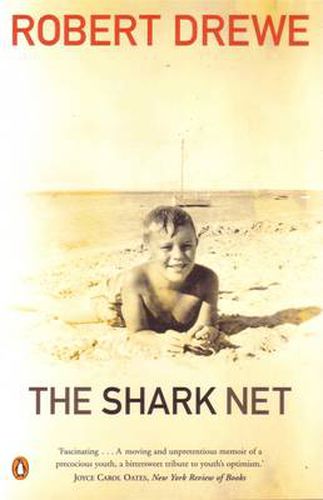
‘The Shark Net’ by Robert Drewe/

2003, 384 p

It’s funny how particular crimes permeate your consciousness of growing up in a particular place and time. I suspect that every child growing up during the 1960s was touched in some way by the disappearance of the Beaumont children, and I know that the disappearance of Eloise Worledge in the 1970s made me frightened to sleep beside the window when it was open on an airless hot summer night, as windows always were before the days of airconditioning. (Apparently later research found that the small hole in the flywire screen in her room had nothing to do with her abduction. All that worry for nothing.)

For Robert Drewe, growing up in Perth during the early 1960s, the crime that shaped his consciousness was the multiple murders committed by Eric Edgar Cooke, who was eventually hanged at Fremantle jail in October 1964. His family had shifted to Perth from Melbourne when Robert was six, on account of his father’s promotion at Dunlop Rubber, one of those 1960s brands embedded in Australian consciousness through tyres, tennis balls and Dunlopillo pillows and mattresses. His father was a Dunlop Man, who had married ‘a girl in the office’, and just like expatriates, the staff who had transferred from ‘over east’ formed a male-dominated Dunlop Family who met socially in the smaller white-collar social world of Perth.

Written from a child’s-eye point of view, both his parents were opaque to him. His father, Royce, ever the company man is depicted as a strict, slightly menacing, emotionally distant philanderer who leaned more towards his daughter than his sons. His mother, who he names ‘Dorothy’ when she was in ‘company wife’ mode, or ‘Dot’ when she was relaxed and truly herself, is a more complex character. She was never completely happy in Perth and maintained her family links with Melbourne independently of her husband and children. As Robert grows older, and his life trajectory branches out in ways that his mother disapproves of, we see the judgmental and rigid ‘Dorothy’ at work. The family splinters, under varying degrees of guilt and self-centredness.

Running alongside this memoir of family life is the story of Eric Edgar Cooke, a serial murderer who lurked around the well-to-do streets in which the Drewe family lived. A small man, often overlooked because of his cleft lip and palate, he lived on the edges of society, rebuffed by girls, married with seven children, an itinerant labourer. His life brushed up against Robert Drewe’s life in multiple ways, perhaps coincidentally or perhaps as a characteristic of life in a relatively small city. Cooke worked for Dunlop, he visited the Drewe household as part of his work, one of his victims was known to Robert Drewe, and one of Cooke’s murder implements belonged to a friend of Robert’s. There are faces at the window that may, or may not, have been Eric Cooke; he walked the streets of Dalkieth and Peppermint Grove. Later, the journalist Drewe attends the committal and murder trials that end in Cooke’s execution.

The memoir is interrupted by three independent chapters ‘Saturday Night Boy I, II and III’ which give us a glimpse of Eric Cooke. These are beautifully written, and while not exactly sympathetic and silent on his motivation, do try to explain Cooke’s life from the outside. The famed ‘light’ of Western Australian sunshine is juxtaposed against the darkness in which Cooke operated. There is a sense of menace that bubbles underneath. On driving home from being fingerprinted, as many Perth men were in the dogged search for the ‘Night Caller’, Robert’s father begins to sing the Bing Crosby song:

Where the blue of the night

Meets the gold of the sky

Someone waits for me.

Preface

He falls silent when both father and son realize the menace implicit in the words.

So, too, the image of the shark net which gives the book its title. Drewe was always frightened by sharks, and wished that the Perth beaches had been netted as some eastern beaches were:

I favoured the idea of shark nets…It wasn’t just that the nets trapped sharks, but they prevented them setting up a habitat. Intruders were kept out. A shark never got to feel at home and establish territory. I liked the certainty of nets. If our beaches were netted I knew I’d be a more confident person, happier and calmer. Then again, I might lose the shark-attack scoop of my life

p.299-300

This tension between looking for death and peril, and the desire to avoid it, runs throughout the book. He does, indeed, miss a journalistic scoop involving a friend, but it is because he is looking for sharks and not at what is directly around him. The idea that danger is amongst us, and not netted off, permeates the book.

This is a beautifully crafted memoir, with its juxtaposition of memoir and true crime, which avoids both sentimentality and prurience. It reminded me, in a way, of George Johnson’s My Brother Jack. It has the feel of being the first in a series of memoir, but as far as I know Drewe has never continued with a second book. Instead, it is a slice of life from the late 50s/early 60s rendered faithfully and lovingly but always with a sense that the sunshine and heat is coexisting with darkness and danger. Excellent.

My rating: 9/10

Read because: CAE bookgroup. I had read it back in 2002 and was impressed with it then, too.
Six degrees of separation: from I Capture the Castle to….

Finally, I have actually read the book that Kate chose as part of the Six Degrees of Separation meme for this month. The idea of Six Degrees of Separation is that Kate chooses the starting book, and then you nominate six books that are linked in some way to that title.

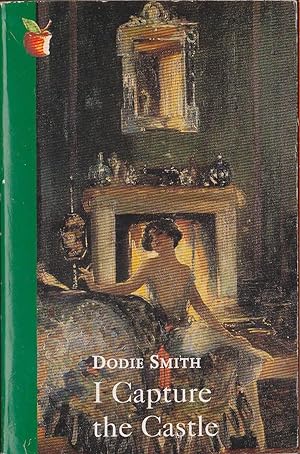
In fact, I just didn’t read the starting book I Capture the Castle (1949) just once: I read it many, many times as a teenager. In my family, we didn’t tend to buy books, even though I was an inveterate reader, and so I borrowed this book from Banyule High School library over and over and over again. Strangely, I can’t remember if this was the cover or not, but it looks vaguely familiar.

In keeping with the retro nature of the starting book, I’ve tried to show the book covers as I remember them. I read many of these books before I started blogging, so there’s only one link to my review.

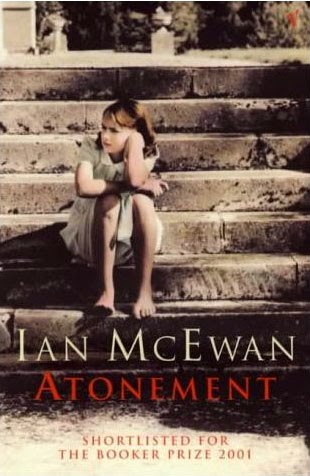
I Capture the Castle by Dodie Smith (who also wrote One Hundred and One Dalmations) was about two sisters, and is told from the perspective of the younger sister, Cassandra. It reminded me of Ian McEwan’s Atonement. In both cases the narrator is a young aspiring author living in a ‘big house’, who is romanticizing her older sister’s love life.

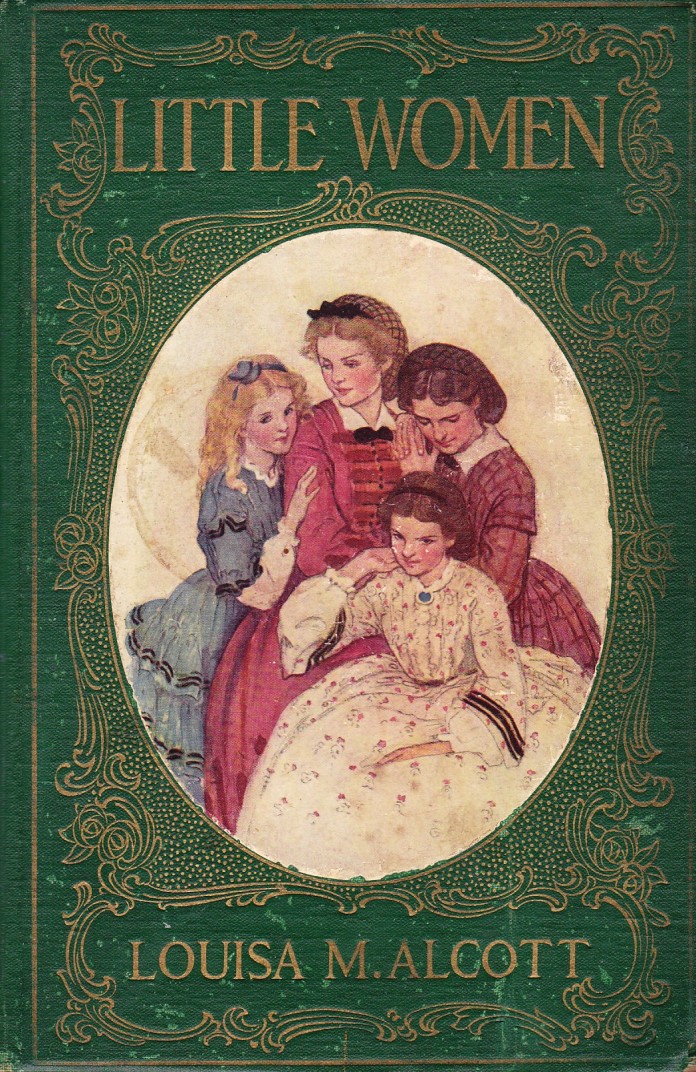
Another book about sisters, of course, is Louisa May Alcott’s Little Women – another book that I just loved as an adolescent. Part of me still wants to be Jo March, writing books in my attic, even though I am now probably older than Aunt March!

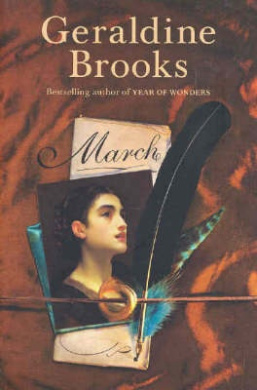
My love for Little Women meant that I just loved Geraldine Brooks’ March as well, where she writes herself into the character of Mr March, the absent father who is off as a chaplain in the American Civil War. Brooks takes a much loved story, but she makes it her own, spiking it up with Marmee’s perspectives as well.

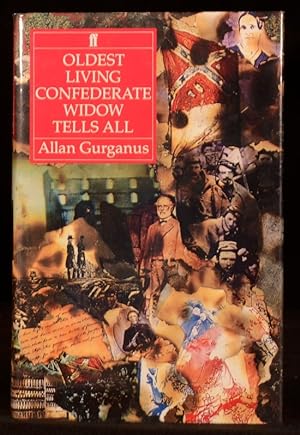
It was probably Little Women that spurred my love for American Civil War books as well. I really enjoyed Alan Gurganus’ Oldest Living Confederate Widow Tells All which, set in the present (it was written in 1989) was presented as the memoirs of an old lady who at the age of 15 married a much older Confederate veteran in 1900.

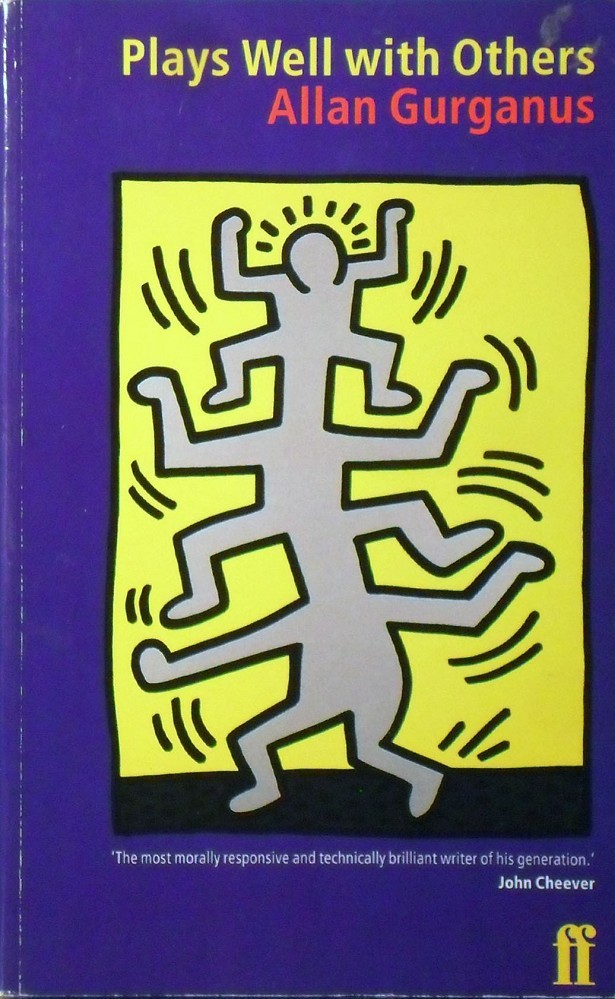
In fact, so much did I enjoy it that I purchased Alan Gurganus’ Plays Well With Others, which wasn’t about the civil war at all. Instead, it was about AIDS cutting a swathe through the artists and writers in New York during the 1980s.

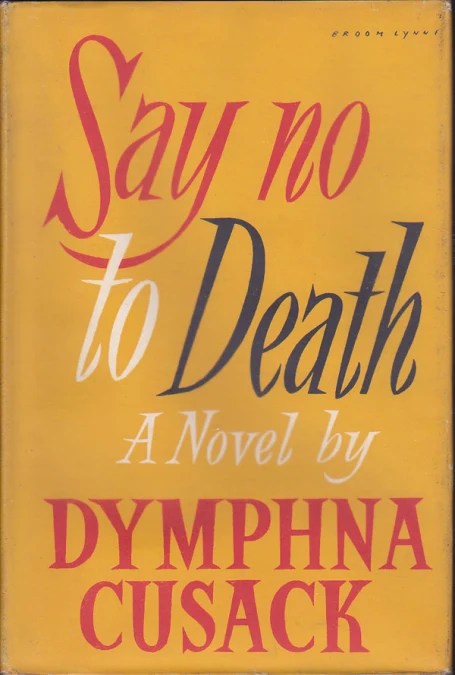
Tuberculosis was another disease which cut down young people in their prime. Say No to Death by Dymphna Cusack is the story of two sisters (sisters again!) in post-war Sydney when Jan contracts TB. It was a contemporary book when it was written (1951) but now it’s a fascinating slice of social history and critique. My review is here.

My Six Degrees this month has taken me back to older books that I read ages ago, but obviously they made enough of an impression to spring to mind again now. Where did I Capture the Castle take you?

I hear with my little ear: Podcasts 8-15 September 2023

Some rather belated podcast listening reports.

Reflecting History Episode 12 The Social War- The Tyranny of Deterioration. This is the final of the three-parter on the Social War, which has drawn heavily on Philip Matyszak’s work. He focuses on Marius- the quintessential politician, who appeared to be populist but behind the scenes was a great underminer, and Sulla, respected by patricians but also ruthless. Marius and Salpicius fomented riots, which gave them the excuse to take over, but Sulla saw Marius’ actions as unconstitutional and turned his troops towards Rome, took the city easily and established himself as dictator. It’s hard to tell whether this was opportunism, or from a deep sense of honour. Cinna was elected consul, but as soon as Sulla left to fight Mithridates, he brought Marius back and together they embarked on revenge against Sulla’s supporters. But then Marius died, so the showdown between Marius and Sulla never occurred. Sulla joined forced with the young Pompey and his private army and Crassus with his wealth. In 82 BCE the Social Wars finally came to an end when Sulla marched on Rome and revived the role of Dictator which had been in abeyance for 120 years and killed 5000 people on the proscription list to wipe out any opposition (and take their wealth while he was at it). But the underlying issues never went away, and now there was a precedent for violence if your own private army was big enough. Overall there was a loss of faith in the system- so perhaps this can be seen as the end of the Roman Republic.

History Extra Great Reputations Oliver Cromwell. I’m on a bit of an Oliver Cromwell kick at the moment. This episode features Ronald Hutton (author of The Making of Oliver Cromwell 2021) and Mark Stoyle, who has worked on the English Civil Wars. I couldn’t really distinguish between the two guests’ voices, but one of them described Cromwell as a ‘puritan Jihadist’, whose religious zeal and desire to keep up with the radical fringe of the movement – especially the army- kept pushing him on. The Battle of Marston Moor in 1644 was a turning point in his career, although one of the historians suggested that the Parliamentary forces probably would have won without him. Cromwell took a huge army to Ireland, where they undertook two huge massacres, although there is only inconclusive evidence that the battle of Siege of Drogheda was the bloodbath that myth claims it to be- he certainly killed soldiers, but maybe not all the women and children. He was not trusted by his contemporaries because his zealotry always outpaced that of the nation. Even the Puritans were worried about his radicalization. His regime crashed six months after his death, but his reputation was rehabilitated with the publication of his letters and writing by Thomas Carlyle in the 1840s, and some twenty years ago he was voted the 3rd greatest Englishman (after Elizabeth [not sure which one- Elizabeth I or II] and Churchill.

History Hit Europe’s 1848 Revolutions looks at the continent-wide revolutions of that year, some of which brought permanent change; others not. Even though we identify 1848 as THE year, there was actually turmoil in the preceding decade, brought about by a literate population exposed to a new public sphere through the press, economic changes and the long-term effects of the Napoleonic Wars, which saw nations mobilized for some time afterwards. Nationalism was a progressive force at that time, with the desire that ethnic and geographical borders should be the same, and based on emotion and knowledge (especially knowledge of language). Women were included in nationalism, especially compared with liberalism which was male-dominated. Europe at the time was still dynastic, and in some of the revolutionary movements we see a form of pre-Marxian socialism. The decade of unrest had started with a wave of revolutions in the 1830s (cue ‘Les Miserables’) when through a thickening of communication channels, there arose a sense of Europe. There was a revolution in Switzerland (Switzerland!) in 1847, and it spread to Sicily, Paris and Berlin. At first the waves of revolution were very successful. However, the liberals, students, peasants etc. had differing demands, which became even harder to reconcile once the revolution was successful. Conservative forces dealt themselves back into the equation by playing radicals and liberals (who actually feared the radicals themselves) off against each other. In other places, the monarchy regained its nerve and imposed its authority. Some constitutions survived e.g. Switzerland, Denmark, the Netherlands, Prussia and Piedmont. In other places, defeat was instructive. It led to the rise of Marxism and the advent of social democracy. Even where monarchy triumphed, it wasn’t the same- no longer could it refuse constitutional change outright. The episode features Christopher Clark, author of Revolutionary Spring.

The History Listen (ABC) The Missing Magdalens Being a northern-suburbs Melbourne girl, I’ve long been aware of the Magdalen laundry at Abbotsford Convent, but the presenter of this podcast, Donna Abela, was completely unaware of the Magdalen laundry at Tempe, on the Cooks River in Sydney. Here she talks with Dr Kellie Toole from Adelaide Law School, whose M.A. thesis ‘Innocence and Penitence Hand Clasped In Hand Australian Catholic Refuges For Penitent Women, 1848-1914’ (2010) is available online. (Could be an interesting read). The pastoral station Tempe was purchased in 1885 by the Catholic Church as a refuge for ‘penitents’, located on the outskirts of the town. It only closed in 1983, although its emphasis had changed after changes to the Child Welfare legislation.

The Fall of Civilizations. I’m off to Cambodia very soon, and I don’t want my only knowledge of Cambodia to be the Killing Fields. So, I’m listing to Paul M. M. Cooper’s podcast The Kymer Empire: Fall of the God Kings It’s long, but excellent. He starts with the ‘discovery’ of Angkor Wat by Portuguese missionaries Antonia de Madalena in 1586, who although he died in a shipwreck before returning to Europe with the news, wrote about this magnificent, deserted ruin. The people might have left it in the mid-15th century, but it was never ‘lost’ as such because monks and farmers still lived there. Even then, it was more magnificent than anything that could be found in Europe. They were more advanced in other ways too, with an alphabet, and concepts of zero (something I have always struggled with, alas). There were three factors that led to the success of the Kymer empire 1. The concept of a God-King, which drew on Indianized ideas of the organization of society 2. efficient taxation, where elites competed against each other to raise taxes, some of which they kept for themselves 3. skill in water engineering, leading to the creation of two huge reservoirs. But each of these strengths was to carry the seed of failure. 1. To maintain the God-King authority, they had to maintain the Hindu religion, an Indian import, against the Buddhism of the common people. King Jayavarman VII introduced Buddhism, which was reflected in Angkor Wat where earlier Hindu iconography was replaced with Buddhist sculpture. 2. Both the people and the land were over-taxed. 3. The water system failed. This could have been prompted by the Little Ice Age in the 15th century which caused long 30 year droughts, interspersed with devastating floods. Here’s a cautionary tale for us: during the first 30 year drought- absolutely unheard of- they changed the meandering design of their canals to avoid evaporation and bring water direct to the city, but when the floods came they just rushed down, bursting the reservoirs (and we’ve seen with Libya what that means). We can’t know whether people left because the infrastructure failed, or whether the infrastructure failed because the people left it untended. Either way, by 1431 during the final siege of Angkor Wat by Thai troops, the city was abandoned. The jungle, and particularly the destructive banyan tree, soon took over the city. This was a fantastic podcast – and it whets my appetite to visit Angkor Wat (next trip, perhaps)

Off again…

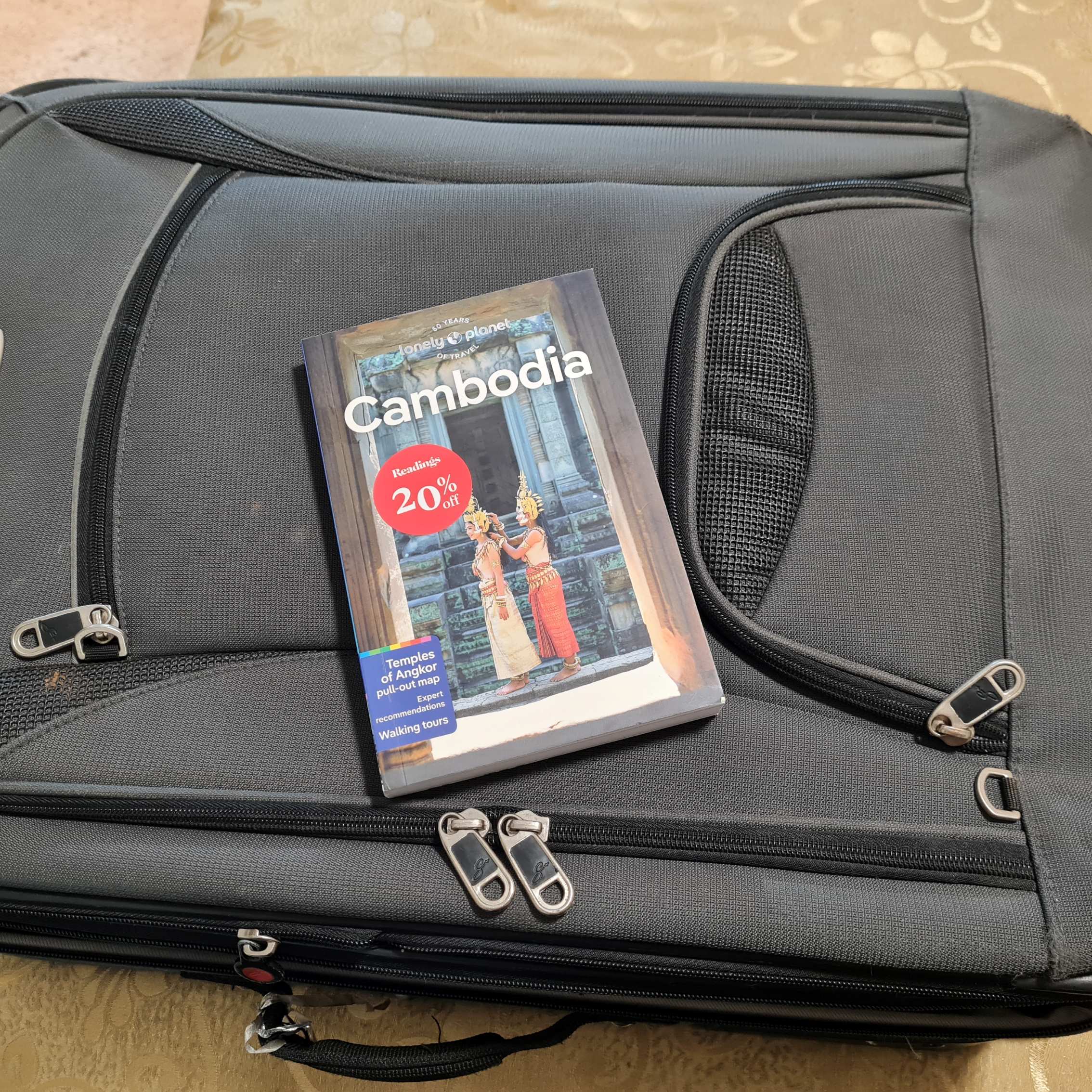
I’m off again, this time to Cambodia to see my little granddaughters (and my son and daughter-in-law too)

And once again, you can follow my adventures at

https://landofincreasingsunshine.wordpress.com/

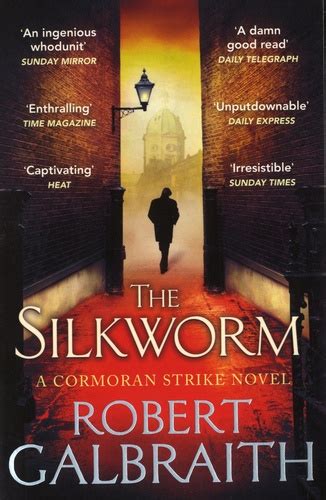
‘The Silkworm’ by Robert Galbraith

2015, 576 p.

After ‘discovering’ Robert Galbraith through my bookgroup’s selection of The Cuckoo Calling, and after thoroughly enjoying the first season of the BBC series Strike, I resolved that I would read more of Galbraith’s books. And so I did- the second book in the series The Silkworm.

I’m always interested to see how an author picks up when continuing a successful novel into succeeding books after a gap of a year or more. The author can’t assume that the reader has read the first book/s and so some background needs to be repeated, but the narrow line has to be trod where readers of the earlier book are re-introduced to familiar and loved characters, without being bored witless. But of course, J. R. Rowling who uses the nom-de-plume Robert Galbraith, would be a past master of treading this narrow line, having sustained the Harry Potter series over a whole generation’s coming-of-age.

And so we meet again Cormoran Strike – and here we learn that ‘Cormoran’ is a Cornish name for ‘Giant’- an ex-military Special Investigations Branch private investigator, who lost his leg in Afghanistan. His assistant Robin Ellacott has stayed with him after the widely-publicized success of solving the murder in the first book in the series, although her fiance Matthew is still not happy with her working in a lowly-paid position with a scruffy private detective who now lives in the small flat above his office. Business has picked up since his earlier success, and one of the cases which comes through his door is the mousy, unprepossessing Leonora Quine, the rather unexpected wife of literary personality Owen Quine, who has not returned home for several nights. Owen Quine had achieved early literary success amongst the tightly-held and toxic group of English literary alpha-males, but the manuscript for his latest book Bombyx Mori, the Latin name for the silkworm, had been leaked after being deemed unpublishable for its violence, necrophilia and the venomous parodies of literary figures it contained. When Owen is found murdered in a ghastly scene foreshadowed in his book, suspicion falls on his wife and his associates who had read Bombyx Mori. The literary figures here are an unlovely group: insular and incestuous, jealous, egotistical and holders of long public and private grudges. (I can imagine J.R. Rowling having great fun writing these characters).

As with her earlier book, The Silkworm is embedded in a minutely-drawn London, this time blanketed in heavy pre-Christmas snow. And as with her earlier book, you are given some rather obvious but much appreciated checklists of possible suspects, and left with a clear sense of who- and why- dunnit by the end of the book. But I really don’t know how much longer she can draw out the obvious attraction between Cormoran and Robin, and I really do wish that Cormoran would go get some proper medical advice about his inflamed leg stump. All up, thoroughly satisfying and I’m up for the next one in a couple of months.

My rating: 9/10

Sourced from: Yarra Plenty Regional Library.

Movie: Past Lives

Set over decades, this is the story of childhood sweethearts in Seoul who are separated when Nora’s parents emigrate to America. It starts in the present day as Nora sits in a bar between two men, one Hae Sung who has travelled to America to see her, and her husband Arthur, a fellow-writer whom she married, partially to obtain a green card. An unseen narrator speculates about the relationship between the woman and the two men, and we are then taken back to her childhood friendship with Hae Sung. They had re-established contact through an internet connection twelve years ago which she brought to an end to concentrate on her career. Now, in the present day, Hae Sung has come to visit her. Meeting up with him in person, she realizes how Korean he still is, how much he is still invested in that childhood relationship, and how much she has changed. Her husband Arthur can only watch on, uncertain of whether she will stay or go. It reminded me a bit of the beautiful film Brooklyn in that both deal with emigration, the pull of the past and choices but it was much quieter than that film, with none of the main characters seeming to have friendships or connections beyond each other. It was a bit slow, but the ending made up for its languid pace.

My rating: 3.5 stars

I hear with my little ear: Podcasts 1-7 September 2023

The Daily (NYT) A Plane Crash, 10 Dead People and a Question: Was this Putin’s revenge? For two months, Yevgeny Prigozhin, the boss of the Wagner militia, seemed to have gotten away with his short-lived mutiny even though he shot down Russian planes and killed Russian soldiers. So why kill him now – if indeed that’s what has happened? In this episode Anton Troianovski, the Moscow bureau chief for The Times, suggests that Putin might now be more confident about seeing off Ukraine’s counter-offensive, and having already crushed the liberal opposition in Russia, he’s now looking to crush the ultra-nationalist opposition (of whom Prigozhin was one). Probably the perception that Putin could arrange this assassination is probably more important than whether he did or not.

Reflecting History. Episode 11: The Social War- When Conversation Fails is part of my back-track to look at the Social War of 91BCE. There were two issues at the time: first, the Allies’ (i.e. the other Italian city-states) demands for citizenship and second, the land displacement which saw small farmers kicked off their land. Marius had introduced reforms that allowed Allies into the army, with the result that loyalty accrued to successful generals who could seize enough land from defeated regions in order to rewards his soldiers later. However, in 95BCE the Senate passed a law expelling non-citizens from Rome, which further fueled the Allies’ discontent. As Tribune of the Plebs, Marcus Livius Drusus was a populare, but in reality he was a stooge for the Senate who disallowed any of the laws he introduced, prompting the Social War. Was the war justified? There was no hard and fast battlelines: they were fighting men of the same religion, the same race, the same language: it was just the matter of citizenship. The first year of the war went badly for the Romans, and Marius brought the dead bodies back to Rome, which prompted the people and the Senate to change their minds about the war. Legislation was introduced to bring the war to a close, by allowing anyone living in Italy could now vote and apply for citizenship. It was not so much that the Italian allies were defeated, because they got what they wanted. Sulla went to mop up the remaining rebels.

History Extra To mark the centenary of the 1923 Tokyo earthquake, this episode Tokyo’s devastating 1923 Earthquake features Dr Christopher Harding. He explains that some commentators saw it as a reality check on the 50 years of modernization that preceded it: conservatives interpreted it as a divine reprimand. It was an unfolding disaster: the shake itself, followed by a fire, massive homelessness and a resultant food and water shortage. The quake elicited anti-Korean feeling, and more than 6000 Koreans were killed in the resulting riots. There were big plans to rebuild Tokyo, but property rights and quibbles got in the way. People looked back to pre-earthquake times as a happier society, and militarization increased after it.

The Ancients (History Hit) Homo Floresiensis: Early Human ‘Hobbit’ It wasn’t exactly a JFK moment for me personally, but amongst many paleoanthropologists, they can remember where they were when they heard about the discovery of a new species of human on Flores Island in the Indonesia archipelago. Dr Adam Brumm from Griffith University worked under Dr Michael Morwood, who discovered the remains of a small female dating from 38,000 to 13,000 years ago in a cave which had been excavated to a depth of four metres under a volcanic layer in 2006. This unleashed a bitter debate amongst paleoanthropologists over whether it was a new species, or just a disabled, small girl. Brumm says that now most accept the remains as those of a separate human species, although no other remains of that type have been found. She had a very small brain, long arms and feet, and hands for climbing. They have found remains of much older hominid-like people (?) and million-year old evidence of stone tools, but they don’t know who or what these older people were. Fragments of a jaw and six teeth suggest Homo Erectus but this is not certain. It is thought that modern humans arrived there 47,000 years ago.

Full Story (The Guardian) Why top execs are leaving the mining company with a ‘green vision’. What on earth is going on at Fortescue Metal? The CEO Fiona Hick left after six months; CFO Christine Morris left after three months, both from the mining division. The CFO of the Energy business, Guy Debelle, left after 17 months. I’m not sure that the podcast answers the question. Certainly Forrest, as executive chairman, has a vision for the green division to rival and overtake in size the mineral division of Fortescue Metal, and he has been forthright that business is responsible for climate change and needs to be held to account. The company is playing hardball with the Yindjibarndi people in a Native Title case in the Pilbara, and it’s not clear yet what the breakup of Forrest’s marriage will mean for the company.

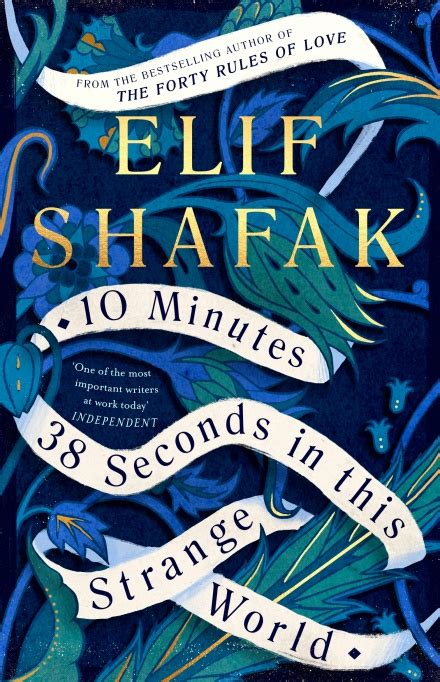
‘Ten Minutes 38 Seconds in This Strange World’ by Elif Shafak

2019, 308 p

I had read somewhere – as has this author, obviously- that the mind does not shut down immediately upon death. As the morgue technician inspecting the body of a woman found in a garbage bin observes:

When exactly did a living being turn into a corpse? As a young graduate fresh out of medical school, he had had a clear answer, but he wasn’t so sure these days….Researchers at various world renowned institutions had observed persistent brain activity in people who had just died; in some cases this had lasted for only a few minutes. In others, for as much as ten minutes and thirty-eight seconds. What happened during that time? Did the dead remember the past, and, if so, which parts of it, and in what order?…If that were true, shouldn’t human beings be considered semi-alive as long as the memories that shaped them were still rippling, still part of this world?

p.190,191

This, then, is the premise by which the first part of the book is organized. Ten minutes and thirty eight seconds, counted off chapter by chapter as Leila’s murdered body, stuffed into a rubbish bin, gradually shuts down. Minute by minute she remembers impressions, smells and senses that convey us through her life, not necessarily chronologically, as a young girl growing up in post-WW2 Turkey until her death in 1990. The opening chapter sees her slip as a baby from her mother’s body, into the arms of her father’s infertile first wife who claims the title of mother, relegating the second wife and birth mother to ‘auntie’. We see a child drawn into secrets – those of her own mother, and other more devastating secrets- that make her guilt-ridden and wary. When her father becomes increasingly religious, Leila rebels against him and ends up working in the brothels of Istanbul. It is this work that sees her violently murdered by religious zealots who cruise the streets of Istanbul, collecting angel figurines on the dashboard as they murder prostitutes in the name of ‘cleansing’ the streets. Along the way, Leila collects five friends – a childhood friend who always loved her, and four female friends, one of whom was trans-sexual- and these friends, and their stories, are numbered off in turn, with a chapter giving their own backstories.

All of this is embedded within the twentieth-century history of Turkey. In her birth city of Van, in east Turkey, the family lives in a house that had previously been owned by Armenians. The arrival of the Sixth Fleet of the U.S. Navy in 1968, the opening of the Bosphorus Bridge in 1973, the Taksin Square massacre of 1 May 1977 and the endemic corruption and string-pulling of the 1990s frame the story, sometimes a little too self-consciously. What did ring true was the increasing hardening of religious influence over daily life, giving a sharper sectarian edge to the already patriarchal and abusive treatment of women.

I loved the first part of this book, titled ‘The Mind’, and the creative (if somewhat ghoulish) device of counting down the minutes to her eventual shutdown. I was less enamoured of Parts II (The Body) and Part III (The Soul) which comprised the final third of the book. Here her friends rally around to take custodianship of her body, which had been consigned as to the bleak and distant Cemetery of the Companionless, in a form of paupers’ funeral. Leila was not companionless and her five friends embark on an attempt to remove her to a different cemetery. Unfortunately, this Keystone Kops farce detracted from the strong first 2/3 of the book although the final section, which is more evocative of Part I does rescue it somewhat. I had enjoyed Part I so much: perhaps I should have left it there.

My rating: 8/10 (would have been higher without Part II)

Sourced from: Yarra Plenty Regional Library. I think that I must have read a review of it somewhere.

I hear with my little ear: Podcasts 24-31 August 2023

Reflecting History Who presents this program? I have no idea. Anyway, in looking at his Fall of the Roman Republic series, he mentioned that he did some episodes on The Social War earlier on in his podcast, so I thought I’d go back and find them. Episode 10: The Social War: The Beginning of the End takes us back to 140 BCE and the end of the Punic Wars. There were three main issues festering away. First the question of citizenship. Rome’s practice up until then was to conquer, wait two or three generations, and then grant a form of citizenship. The second issue was land displacement. Generals wanted to be able to give land to their soldiers as a reward, but the liberalization of land tenure meant that aristocrats could buy up land and slaves, transforming small-scale agriculture into a large cash crop enterprise. Thirdly, the Senate had been corrupted by the inflow of wealth through expansion. Politics divided into the optimates and the populares. Tiberius Gracchus was criticized by the Senate for the peace terms he contracted to bring the Numantine War to an end in Spain, and when he became Tribune of the Plebs, he was determined to get his revenge. He proposed land reform, which was blocked by the Senate, leading to gridlock. In the end, it was passed, but it didn’t apply to the Italian city-states allies. But the Senate arranged for Tiberius to be killed. After a while, his brother Gaius Gracchus stepped into his place – probably the worst guy for the job because he wanted revenge and would not compromise. He proposed a “Latin rite” whereby all the benefits of citizenship except the vote would be extended to the Allies. This was sensible, but the Senate refused it, first because it was Gracchus who suggested it, and second because they feared being swamped. The Senate and Consuls decided to purge all the Graccan supporters, and Gaius committed suicide. The Gracchus brothers might be gone, but the problems were still there.

If You’re Listening (ABC) Why is Russia Meddling in West Africa? This is only a 15 minute podcast, so it doesn’t go into much detail. Niger had a coup a couple of years ago, and it has happened again as Gen Omar Tchiani took power before he could be fired by the president President Bazoum. Niger has huge reserves of uranium, and this attracted French companies. There has been unrest across the Sahal (i.e. the shoreline of the Sahara). In Mali, the French invaded to repel Islamic extremists, but this led to huge waves of refugees which France didn’t want to end up in France, so the French stayed there and called for NATO assistance. Waves of jihadist uprisings began in Mali which were put down by the military generals who had seized power, with “white men” soldiers arriving by helicopters- Wagner mercenaries which were called in by the military government, paid for by gold. In 5 months there were military coups in Guinea, Sudan and Burkina Faso, and they now all have deals with Wagner or the Russian government . Niger was the last to have a democratic government, but recently it had a coup too, not orchestrated by Russia or Wagner, but where people waved Russian flags and attacked the . Eleven surrounding pro-Western countries threatened to invade if the president wasn’t reinstated. Mali and Burkina Faso have declared that they will fight to defend the coup leaders. This podcast is also presented as a video, found here (actually it’s worth watching the video version for the old footage)

Rear Vision (ABC) Rear Vision had a segment on Niger as well. Niger and the Legacy of Colonization looked at French colonialism more generally. Under de Gaulle, France embarked upon a relationship of ‘cooperation’ with its former colonies including Niger, Mali and Burkina Faso whereby technological, medical provision and defence would be provided by France, in return for military bases and access to mineral resources. Needless to say, this arrangement worked more in France’s favour than Niger’s. Also, currency was tied to the French franc, which provided a form of economic stability but also led to economic dependence on France, and the flow of wealth outwards. In the 1990s, there was a movement towards democracy, and the erstwhile President Bazoum’s party has been in power since 2011, with increasing levels of corruption and economic instability. Niger’s economic woes were exacerbated by COVID, and intensified by the increasing population, the youngest and fastest growing in the world. Islamic extremism in Mali saw French and US troops stationed there, and the Sahal has become a hotbed of Islamic terrorism. There have been five coups in former French colonies in recent years. ECOWAS (The Economic Community of West African States) at first threatened intervention, but is now having second thoughts and looking to dialogue instead. The former French colonies are looking for alternative support through Russia and China.

New Books Network Australian and New Zealand Studies Tanya Evans talks about her new book in an episode of the same name: Family history, historical consciousness and citizenship: a new social history. Evans, who is now at Macquarie University, started her academic life in the UK where she studied non-conventional families (e.g. unmarried mothers in the 18th and then in the 20th centuries). As part of this work, she became aware of the importance of family histories, and when she wrote her book on the NSW Benevolent Society (Fractured Families – see my review here), she collaborated with family historians. Family history started off as being about ‘pedigree’ but changed during the 1970s, especially in settler colonies. She argues that family history transforms people in the present e.g. in their attitudes towards refugees, sexism and classism that they seen in their own family, and that family historians see themselves as professionals, with qualifications and peer review. In the past, people were embarrassed about convicts and illegitimacy in their families – a situation that has certainly changed, but this does not extend to mental illness, which is still seen as a source of shame. She speaks about the sniffyness amongst academic historians towards family historians (guilty as charged) and then launches into a rather lame argument about the economic value of family history. She suggests that family history is often derided as being for ‘mature women’, but then talks about generativity, the feeling of wanting to leave a legacy, that Erikson’s (1959) psychosocial stages of development identified between the ages between 40 and 65.

Sydney Writers Festival. If this festival is anything to go by, then we sure need an infusion of new blood in talking about politics. Same old people talking to each other. In This is Their Life, Laura Tingle interviews Paddy Manning, Niki Savva and Margaret Simons, all of whom have written recent political biographies.

Now and Then. The recent publication of Donald Trump’s mugshot arose from the charges he is facing in Georgia, and as Heather Cox Richardson and Joanne Freeman explain in Pardons: Politics and Power, this Georgia case is the one that might actually land him in jail. Georgia is one of only 6 states in the US that has an independent pardons board, which only swings into action when someone has been jailed for 5 years. They then go through different times when pardons were offered e.g. George Washington with the Whisky Rebellion, and post Civil War when Democrat Vice-President Jackson offered pardons to Confederate soldiers. Georgia instituted its board when E. D. Rivers, a New Deal democrat during the 1930s sold off pardons to prisoners and friends of his black chauffeur. It was so corrupt that even Georgia set up a pardons board. Pardons are an expression of power, which was the central question of the constitution.

99% Invisible Melanie Speaks. In the days before the internet, it was harder to access ‘self-help’ about beyond a book, cassettes and then later video. This was particularly true of voice-training. For trans women in the 1990s salvation came through a videotape where ‘Melanie’ gave advice on how to achieve a more feminine voice. While doing so she was aware that it was anti-feminist, but she encouraged her listening to “become the stereotype” of a woman. The trans presenter of the program and her cismale producer decided to try and track down ‘Melanie’, but they later agreed among themselves not proceed, given that ‘Melanie’, despite being a prolific writer, had adopted a separate, private identity. The episode finishes with an interview with Roman Mars, where they discuss voices and the way that we all adapt our voices over time. I wish the presenter would stop saying “like” every second sentence. It’s bad enough hearing it on the train: surely a podcast should be free of it.

Movie: Barbie

This was such good fun. Visually it was stunning, with its plastic pinks and shiny surfaces, and I loved the way that Robbie and Gosling’s faces became more expressive as the film went on. You could take a 7 year old to see it, although much of the rather obvious commentary would go over their heads. I loved it.

My score: 4.5 stars