Author Archives: residentjudge

‘Far From the Madding Crowd’ by Thomas Hardy

480 p. 1874

I didn’t read Far From the Madding Crowd at school, even though many people of my age did. It seemed to be a perennial of the Year 12 (HSC) English reading list. I hadn’t read any Hardy at all until I read Tess of the D’Urbervilles at university, which I remember enjoying although now, having read Far From the Madding Crowd, I wonder whether I would still do so.

Like Hardy’s other Wessex novels, Far From the Madding Crowd is set in rural England, harking back to an agricultural past and village life that had been largely eclipsed by the time the book was written in 1874. Although the novel is peopled with stock characters from tales of rural life- the chortling peasants in the local pub, the perfidious army officer, the worthy but stodgy landowner next door- the two main characters, Bathsheba Everdene and Gabriel Oak are of a more complicated economic and social milieu. When we first meet Bathsheba, she is a young, well-educated, independent but young woman without her own financial resources, confident enough in her own opinions to reject the marriage proposal of the hard-working and earnest Gabriel Oak. By the next time we meet her, she has inherited property from her aunt and is determined to manage the farm by herself, without the assistance of a bailiff. Gabriel Oak suffers a reversal in fortune and is now forced to work on Bathsheba’s farm, undertaking the tasks of a bailiff without the title.

Clever but impetuous Bathsheba sends a Valentine to her older, rather stodgy neighbour Mr Boldwood, daring him to ‘Marry Me’. He takes Bathsheba at her word, and tries to woo her but Bathsheba, who wants more passion in a relationship than she could ever feel with Mr Boldwood, rebuffs him. Gabriel, aware of the hopelessness of his love, continues to care for Bathsheba. He tries to warn Bathsheba against the perfidious Sgt. Troy, but she plunges into a hasty marriage with him anyway, only to find that he is gambling away all her inheritance. When Troy disappears after his illicit relationship with servant-girl Fanny becomes public, Bathsheba is in a holding pattern, still legally married to Troy and having to bat away Mr Boldwood’s renewed wooing. It is only after Troy is finally killed, and Mr Boldwood taken away as his murderer, that Bathsheba and Gabriel are free to marry. Unusually for Hardy, there is a happily-ever-after-ending.

I grant that Hardy’s depiction of Bathsheba is nuanced and complex. In some ways she is an air-head, toying with men and their emotions, self-centred and wilful. However, she is also independent and principled, although she is exposed to almost intolerable emotional coercion by both Troy and Boldwood. The timeless theme of a woman surrounded by eager suitors, of differing degrees of integrity and suitability, reappears in different guises throughout film and literature.

But each time the book got bogged down in yet another pub-scene or drowned the reader in its lush descriptions of sunrises and fields, I found myself thinking “How on earth would you interest a Year 12 boy in THIS?” I was relieved to hear in the discussion at the Ivanhoe Reading Circle that this book is no longer on reading lists for secondary students, and thank God for that. I may roll my eyes at yet the recently-published but ultimately forgettable fiction books drenched in current politics and sensibilities that are assigned to students today, but some “classics” are too heavily freighted with the politics, sensibilities and stylistics of their own earlier time to become virtually unreadable without a strong reason for doing so.

My rating: 6/10

Read because: Ivanhoe Reading Circle July selection.

I hear with my little ear: Podcasts 16-23 August 2024

History Hour (BBC) History Hour is a compilation of segments from the shorter BBC program ‘Witness History’, featuring interviews with people who actually witnessed an event. This episode American Presidents sticks pretty much to this format, and it looks at several events, all related to American Presidents (given that this is all we can think about at the moment) . It starts with the first televised press encounter – it wasn’t actually a debate- between Eleanor Roosevelt (Democrat) and Margaret Chase Smith (Republican) on ‘Face the Nation’. It was a question and answer session until their final statements when Smith went the attack, much to Eleanor Roosevelt’s surprise and displeasure. Segment No. 2 was the Nixon/Kennedy debate which led to a long hiatus of sixteen years between debates, largely because Nixon was so pissed-off about the debate and how badly he came over in it, and it led to the creation of the Commission of Election Debates in 1987. As one of the contributors points out, social media has changed the nature of electoral debates because the political commentary now happens in real time, without waiting for the media pundits to review the debate later. Segment No. 3 was the rise of the Moral Majority led by Jerry Falwell which united Jews, Catholics and Evangelical Christians, who used direct mail to make their presence felt on American politics. Segment No. 4 was the Gore/Bush election, which took weeks to resolve with the ‘hanging chads’ and butterfly-voting systems. The seat of Florida was first called for Gore, but as time went on it became less clear and was eventually resolved by the Supreme Court suspending the vote recount (and with Trump’s stacking of the Supreme Court even further, how would that play out today?). The final segment was an interview with Pete Souza, the Chief Official White House Photographer during Barack Obama’s presidency, who was present during the briefing room meeting where politicians and generals sat around the table, watching the raid that led to the killing of Osama Bin Laden. I hadn’t realized that Barack Obama had attended the Press Dinner the night before, where he delivered his comedy routine. Apparently there was a gag in that about Bin Laden, and he asked to leave that one out, but no-one knew why at the time and the whole operation was a tightly held secret.

In the Shadows of Utopia Episode 2: The Early Khmer Empire Much though I am very much enjoying this podcast, I found myself rather frustrated at how long Lachlan took to get going with this story. Lots of definitions and goal-settings and objectives: just start, man! Anyway, one interesting distinction from all the defining terminology with which he starts is the observation that ‘Angkor’ can be used in much the same way as ‘Rome’ or ‘Washington’ can be used: i.e. as a geographical city location; as an empire; as an intellectual milieu. Kymer is a word for the dominant people in the space between India and China. He talks about the two periods which preceded Angkor and uses the analogy of Windows operating systems to describe the similarities and differences between these Kingdoms. The Funan period from about 100BCE to 600 CE was more a loose assembly of kingdoms. The Chenla Era operated between about 600 and 800 CE, and we don’t know much about that one either. Located between India and China, there were strong cultural influences from both sides, but with the emergence of hereditary Kings, there was a stronger leaning towards Hinduism (i.e. India). Temples became part of the economy and part of kingly power. In around 800CE we had the first God King Jayavarman who relied on the support of smaller kingdoms to gain political and cultural independence from Javanese domination. The rise of the ‘Devaraja cult’ saw him worshiped as a manifestation of Vishnu. He established the capital at Angkor and built temples and lakes, and mastered the water system of the East Baray river to establish canals and reservoirs. There’s an adage that it goes ‘water, land, rice and power’, and it played out here: mastery of waters through reservoirs and canals meant that they could double or triple the amount of rice grown (something that Pol Pot would later aspire to), which freed up labour for building and the army. This made Angkor the largest pre-industrial city in the world, with the West Baray still the largest hand-dug reservoir.

Episode 3: The Kymer Empire Part II brings us to King Suryavarman II in 1113, who constructed the temple at Angkor Wat in homage to Vishnu. The sandstone to construct the temple was floated from 40 kms away, in a quarry which was itself a sacred place. Present-day Angkor Wat consists of these stone structures, but the city that surrounded it has been lost until LIDAR technology has made it possible to trace its outlines. Over the next 100 years, they were attacked by the Champa from the Vietnam region, who even controlled Angkor for a while. It was Jayavarman VII who defeated the Champa and brought the Kymer empire to its zenith. He embarked on a thirty-year building program, and built more than the rest of the previous Kymer kings combined. A practising Buddhist, he saw himself as someone who deferred enlightenment in order to help others. He built hospitals and rest-stops, but it cannot be denied that the pace of the building he ordered was brutal. The decline of the empire is dated to the 13th century, but this is a rather slippery number. It was still impressive when it was described in writing by Chinese diplomat Zhou Daguan at a time when supposedly the decline had begun. Zhou’s remnant writings (about 1/3 of the original) are now published as ‘The Customs of Cambodia’. His work has made it possible for us to see some of the lives and culture of the time. Zhou mentions in his book the ongoing wars, and by 1431 it was considered that the golden era of the Kymer Empire was at an end. Why? First, the rise of stronger empires from Thailand; second, the spread of the more severe form of Theravada Buddhism which changed the relationship between the people and their king. Finally, there was environmental change when the monsoons stopped, then returned with a vengeance. However, although 1431 is seen as the end of the empire, people continued to live at Angkor.

History Hit The Real Moriarty Conan Doyle’s Moriarty character was inspired by German-born Adam Worth (1844-1902) who emigrated to America as a child and first popped up during the Civil War. He faked his own death at the Battle of Bull Run and drifted to the New York underworld. Small and intelligent, he soon graduated to bigger crime and moved from country to country. He set up a bar in Paris, with gambling upstairs, and in 1890 moved to London where he was known as “Henry J. Raymond”. In a situation reminiscent of Butch Cassidy and the Sundance Kid, he was accompanied by Piano Charlie (Charles Bullard) and Kitty Flynn, and both men seem to have been her lovers at times. In London, he was responsible for the theft of the Gainsborough painting of the Duchess of Devonshire, which he ended up returning. The Pinkerton Detective Agency was on his trail, and he had an odd relationship with them- they organized the return of the Gainsborough and his son ended up working for them. What an odd story.

History Extra The Far Right: History Behind the Headlines. This ‘History behind the Headlines’ feature in History Extra gets two historians to talk about current events. In this case, the discussion was held after the UK race riots following the stabbing of the young girls at a dance class. Rather oddly, they had medieval historian Hannah Skoda on the show, along with a historian of fascism Nigel Copsey. Skoda, of course, could only really draw on the Peasants Revolts from her expertise in medieval history, but she drew out examples where mobs forced people to say ‘bread and cheese’ to unveil whether they were Flemish through their accents (and then they bashed them), or when the Peasants described themselves as the ‘true commons’ as distinct from the ‘beasts’. Violence was seen as a political tool, and part of the political process during the Middle ages. As a historian of fascism, Copsey had more to draw on of course. He notes that the early 20th century people were happy to describe themselves as ‘fascists’, but now they use the term ‘nationalists’ instead. He notes that the term “far right” was stigmatized by its association with Nazism and skinheads, so now they distinguish themselves between the ‘radical right’ and the ‘extreme right’ in a mixture of ethnic and cultural nationalism. He points out that Oswald Moseley originally came from the Labor Party and embraced a form of radical Keynesianism. In a slightly hopeful ending, Skoda points out that the Peasants Riots provoked a backlash of mutual support for the groups that had been targetted- I wonder if that is true of today too. Will there be a wave of kindness and solidarity?

Happy Wattle Day

I live in what was once known as was once known as the “Wattle District”. Once the railway was put through to Heidelberg in 1888, a popular Sunday outing on a spring day in August or September was to come out to Heidelberg to gather armloads of wattle.

The people of Heidelberg weren’t too happy about it, though: Mr Wallis from the Agriculture Department said at a meeting of the Heidelberg Progress Association in September 1917 ” On Sundays people are seen laden with the golden wattle which they have ruthlessly torn from the trees. They act like barbarians, and if they don’t know any better they should be taught to know. After they have torn the wattle down it is dead before they get home.”

The Wattle Day League was formed in 1909 in Sydney and the first Wattle Day was celebrated on 1 September 1910. In 1912 it became associated in Melbourne with charitable collections, and women dressed in white sold blossoms and badges in city streets. From the 1920s onward, it became associated with fund-raising for children’s charities.

Over the years, Wattle Day became less important until it was almost forgotten. It was revived in 1992 when it was declared that “1 September in each year shall be observed as ‘National Wattle Day’ throughout Australia and in the external Territories of Australia”.

I love walking through Rosanna Parklands on the way to the museum at this time of the year, when the wattles are in bloom along Salt Creek. It makes you feel as if the weather has turned, and that summer is on the way.

Essay: ‘Such, Such Were the Joys’ by George Orwell

I enjoy reading essays and articles, and so I’ve decided to write about them on my blog. Apart from the fact that they interest me, one of my criteria for selection is that they are available online or through a
State Library library card.

Available online at: George Orwell: Such, Such Were the Joys published in Partisan Review Sept-October 1952.

I became aware of this essay through a Guardian article by Zoe Williams commenting on British broadcaster Kirstie Allsopp’s social media post about allowing her 15-year old son to go Interrailing in Europe by himself. Being on the other side of the world, I am of course unaware of the debate and the personalities and their social class, but I was attracted to Williams’ reflection on the child-rearing habits of “the posh” and her reference to George Orwell’s essay. I started reading it, and was transfixed by the honesty of Orwell’s essay, the bleakness of the boarding-school experience he describes, and the links Orwell draws between power, resistance and the British class system.

St Cyprian’s School was founded in 1899 on the Muscular Christianity principles of ‘character development’. As a prep school, its reputation rested on its success in getting its students into public schools like Eton and Harrow. It provided scholarships for ‘deserving cases’ which is how Orwell got to attend, and was never allowed to forget that his parents couldn’t afford such an education. And what an education it was: bullying, cramming to pass the entrance exams, corporal punishment, obsession over ‘beastliness’ (masturbation) and the minute gradations of class of which all students were acutely aware. The British Boarding School story is familiar to Australians of my age through the books we read as children, and books and films like Tom Brown’s Schooldays but Orwell’s first-person, perceptive account is compelling reading.

Orwell was aware that his account was too libelous to be published while the people he describes were still alive, particularly the headmistress Mrs Wilkes (whom the students called ‘Mum’ as a contraction of ‘Ma’am’ rather than any sense of affection). As a result, the essay was not published until 1952 some five years after it was thought to be written, and then only in America with the name of the school changed: it was not published in UK until 1968. Of course, old boys leapt to St Cyprian’s defence, rebutting Orwell’s portrayal.

You can see a photograph of St Cyprian’s as Orwell knew it, before it burned down in 1939 here.

Movie: The Teacher Who Promised the Sea (El maestro que prometio el mar)

This film was shown as part of the Spanish Film Festival, and it made it into the theatres afterwards, as the most popular films from the language festivals tend to do. The frame story is a woman looking to find out what happened to her great-grandfather during and after the Spanish Civil War, which takes her to the disinterment of many bodies (on both sides) of people who died during the war, a process that continues today. The film then flashes back to a small village in 1935, and Antoni Benaiges, an idealistic and innovative teacher who takes over the school and introduces new methods (most particularly the Freinet method- a forerunner of whole language?). His teaching and relationship with the children provoke the ire of the local Catholic priest and his supporters in the village. You can pick up most of the plot from the trailer, and you can probably imagine the ending.

It’s a beautiful, sad film and the actor playing the teacher (Enric Auquer) is just lovely. It is based on a true story, and in the closing shots of the film you see real objects that miraculously survived – most particularly a notebook called ‘The Sea, as seen by some children who have never seen it‘ created and handprinted by the children themselves.

My rating: 4.5 stars

I hear with my little ear: Podcasts 8-15 August 2024

In the Shadows of Utopia. My son has been raving about this podcast for ages, and now I know why. It’s excellent. I didn’t particularly want to listen to another genocide podcast, and I find it frustrating that books on Cambodia seem to concentrate on either the Angkor period, or else Pol Pot as if nothing else happened between those two events. Looking through the list of episodes, it seems that my yearning for the ‘in-between’ might be met, even though the emphasis of the project as a whole might be on the 20th century. The first episode Introducing the Cambodian Nightmare starts by asking you to imagine how you would cope with the expulsion from Phnom Penh on 17 April 1975, then backtracks to 1969 and the Vietnam War. He starts with Sihanouk, who was playing both sides a bit until he was voted out in 1970 and replaced by the fervently U.S. Lon Nol who was rewarded when US were pumping $1million per day into Cambodia. But then Nixon decided to withdraw U.S. troops from Vietnam and encourage the ‘Vietnamization’ of the fighting. But the U.S. had been secretly bombing Cambodia for years, trying to get rid of the ‘sanctuaries’ where the Viet Cong could slip across the border, move south, then go back into South Vietnam. By 1973 all U.S. troops had withdrawn, and by 1975 the U.S. withdrew completely. Lon Nol fled with millions of dollars, and the fighting came to Phnom Penh. On 17 April 1975 first the Chief Monk got onto the radio and told people to calm down, then the chief of Kymer Republic army told them to lay down their arms. The Kymer Rouge troops were at first greeted as liberators, then that afternoon they evacuated Phnom Penh, ostensibly for three days, because they said that the U.S. was going to bomb them. Then followed almost four years of the Kymer Rouge nightmare until the Vietnamese Army took Phnom Penh in January 1970. Photographer Ho Van Tay was the first to see the Tuol Svay Prey High School, and to document the horror. This is an imaginative, well-told, and wide-ranging episode. I’m impressed.

The Rest is History Lord Byron: Death of a Vampire (Episode 4) Back into European exile, Byron revisited the sites he had previously visited when writing Child Harolde, comparing his current situation with Napoleon. In May 1816 he met up with Shelley and stepsisters Mary Godwin and Claire Claremont, who was pregnant with Byron’s child. They spent the summer together in Geneva where the bad weather caused by the eruption of Krakatoa forced them inside to tell vampire and horror stories- hence Frankenstein. Even though Byron had claimed that he wanted nothing to do with Claremont’s baby, when it was born it was agreed that the parents would have shared custody but Bryon was still moving around. In Ravenna he fell in love with a 19 year old married woman Theresa. He was becoming increasingly involved in British and Italian politics, and ended up getting expelled from Tuscany. Shelley drowned, and the circle of radicals broke up. By now Byron was getting bored, and became obsessed with Greece again. Greece was a cause celebre amongst many British intellectuals and society people, and he became a type of Ambassador, raising money for the cause. He went to Missalongi to raise the profile of the war, but fell ill there and died.

Embedded (NPR) This was an interesting experience. Tested is a six-part series looking at the history of sex testing in sports over the past 100 years. This controversial topic raised its head again in the recent Olympic boxing match, but this podcast series had been completed before then. As part of my own echo-chamber of media, I usually only listen to podcasts that are slightly left-leaning and which I’m generally in agreement with. However, with my somewhat ‘TERF’y views, I found this series rather challenging. (Not that I support J.R. Rowling’s very spiky and unnecessarily hostile response to the boxing match, either). Certainly the presenter of this podcast opposes to testing and hormonal management (she would call it manipulation) and it shows in her questions and approach. When women were first permitted to compete in the Olympic Games in 1928, it was feared that competitive sport would make them ‘unwomanly’, and that strenuous exercise would make you a man. The first transgender athlete was the Czech runner Zdeněk Koubek, who transitioned from female to male, prompting the issuing of a rule permitting physical examination of athletes, which by 1966 resulted in the mandatory inspection of all female athletes. In 1968 genetic testing was introduced, and tested female athletes were issued with a card testifying that they were women. By 2011 the testing focus shifted to hyperandrogenism and testosterone levels, and individual sports issued their own guidelines. In the case of athletics, the permitted testosterone level has been progressively reduced. The series focuses on two athletes: Namibian runner Christine Mboma, who took hormone drugs to reduce her testosterone level, and who has struggled to achieve her earlier results, and Kenyan sprinter Maximila Imali who refused to take drugs or undergo surgery to meet the testosterone criteria. Instead, she has taken up her cause in the courts, but a delay in the findings meant that she could not compete in the Paris Olympic Games. The issue has bounced back and forth in the courts, with competing medical claims, and accusations of Western racism against the global South (especially Africa runners) and denial of human rights. The last episode raises a number of possible scenarios for women’s sport: to continue testing; to have a special category; and to have no testing at all. I know that the last option fills me with trepidation. Interesting, but I found it a rather challenging listen.

Emperors of Rome Episode CCXXII A Stolen Election (The Catiline Conspiracy III) In 64BCE Catiline fronted up for his third attempt to be elected Consul, and he lost yet again. Catiline was angry, but he decided to run the following year at the 63BCE elections. He ran on a plank of debt cancellation, which would have been very convenient for him, as he was heavily indebted, and he was supported by quite a few other people who had run up large debts as well. By this time, Cicero was firmly in the Optimate political grouping, even though he was strictly speaking a ‘new man’, and Catiline was in the Populares (even though he had long aristocratic family ties). He lost yet again, and by now he was broke and a social outcast. The other accusations of a ‘conspiracy’ earlier on are a bit dodgy, but this is really into conspiracy territory now as there were accusations of women riling up the slaves to rebel. Although Catiline might have been the spark, there was general discontent building up over many years since the Gracchi tried to implement land reform 60 years earlier. Perhaps now was the time!

Being Roman (BBC) Death on the Nile In this episode, historian Mary Beard takes us on Emperor Hadrian’s trip down the Nile to see the ‘singing’ Colossus of Memnon (actually, it was a statue of a Pharoah but somehow the legend had changed to link it with Greek and Roman mythology). Hadrian was an inveterate traveller, accompanied by about 5000 other people. On the way, Hadrian’s young male lover Antinous drowned in the Nile (did he jump, was he pushed, or was he just making a spectacle of himself?). Heartbroken, Hadrian continued on his journey, and the poet Julia Balbilla (a friend of Hadrian’s wife) had poetry inscribed on the bottom of the Colossus, praising Hadrian and his wife.

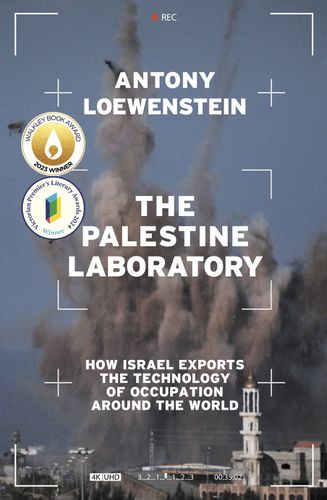
‘The Palestine Laboratory’ by Antony Loewenstein

2023, 214 pages & notes

It’s strange that this book is at the same both aposite and urgent on the one hand, and rather overtaken by events on the other. It was written in 2023, before October 7 at a time of blithe confidence on the part of the Israeli government that Palestine had been ‘contained’ and when, Loewenstein would argue, it benefited Israel to have a proving ground for their technologies of surveillance and repression. I’m not sure that it’s still the case now. The supremacy of these technologies was found lacking on October 7, when men on motorbikes proved the vulnerabilities in high-tech solutions, and although the Israeli response demonstrates the sophistication of their weapons, the outcomes are just as blunt and primitive as war has ever been over centuries.

In this book Loewenstein argues that:

Israel is still often framed as a thriving if beleaguerered democracy and a key ally in the battle against extremism. Its status as a leading defense exporter is legendary, willing to militarily assist, arm, or train the majority of nations on earth…. Israel has perfected and led the “global pacification industry”, a term coined by Israeli-American writer and academic Jeff Halper in his book War against the People: Israel, the Palestinians and Global Pacification. He explains that the occupation is not a financial burden on the state but the exact opposite, both in terms of Palestine being an invaluable testing ground for new equipment on behalf of a global military hegemon serving other militaries across the globe (p. 206, 207)

He argues that Palestine has acted as a type of laboratory in which technologies and strategies can be ‘tried out’ on a subject population and then exported to other countries. Missile technology, facial recognition surveillance, software infiltration, concrete walls, drones – all have been tested on Gaza and the West Bank and their “success” has bolstered the Israeli arms industry. Israeli ubiquity across the whole arms manufacturing chain means that even countries wishing to distance themselves from it are implicated by the inclusion of small components in their technology purchases, as the Australian government tried to claim . The ‘War on Terror’ turbo-charged Western anxieties about terrorism, softening resistance amongst governments and their electors to surveillance and border militarization technologies that would have been rejected in the past. At the same time, Israel has been willing to sell their technology to any government that wished to purchase it, with no questions asked about the purpose to which it would be deployed.

The book ranges widely over different governments and regimes in order to bolster its argument. I found myself rather confused by the chapter titles, which seemed to signpost a progression of the argument, but which bore little relation to the material in the chapter. There are seven chapters:

  1. Selling Weapons to Anybody Who Wants Them
  2. September 11 Was Good for Business
  3. Preventing an Outbreak of Peace
  4. Selling Israel Occupation to the World
  5. The Enduring Appeal of Israeli Domination
  6. Israeli Mass Surveillance in the Brain of Your Phone
  7. Social Media Companies Don’t Like Palestinians.

Of these chapters, Chapters 1, 2 4 and 5 were all variations on the same theme: that Israel could boast of the success of its military industry through its deployment against Palestinians, and it was prepared to sell it to anyone who wanted it. He draws on evidence from all over the world, but all to the same end. Chapters 6 and 7 were probably the most closely related to their titles, where he describes Israeli software development and its influence over social media companies to shut down Palestinian voices. I think that Chapter 3 ‘Preventing an Outbreak of Peace’ is probably the most pertinent to recent events as we see the implacability of the right wing of the Israeli government against any form of ceasefire, and Loewenstein’s book has caused me to see that there is an economic, as well as political, impetus for this. But the actual chapter 3 in his book said nothing about Palestine or peace, instead it was just a repetition of the preceding chapters, using other countries as examples.

There was one insight in particular that I took from the book. I had often wondered why far-right demonstrations in recent years have featured Israeli flags. Loewenstein argues that this is not through any affinity with Israel or Judaism – in fact, the opposite- but because Israel is a prime example of an ethnostate which has succeeded in emasculating a minority (or so they thought) through technology, brute force and surveillance without attracting world censure. And this is the methodology and example that Israel is exporting to dictators throughout the world.

So, an interesting book, exhaustively researched and exhausting to read, that was let down by a structure that promised a more nuanced argument than it delivered.

My rating: 7/10

Sourced from: Yarra Plenty Regional Library.

I hear with my little ear: Podcasts 1-7 August 2024

The Rest is History Byron: Dangerous Liaisons (Part 3) By now, Byron had developed his celebrity image- pale, sickly, bulimic and romantic- and given that women were falling over themselves to be with him, he had to suppress his homosexual tendencies. My God, what a mess. There was the androgynous Lady Caroline Lamb, the wife of the man who would later become Lord Melbourne, who became obsessed with him. On the suggestion of her mother-in-law Lady Melbourne aka The Spider, Byron had an on-and-off relationship with the mathematician Annabella Milbanke but, on the side, he was having an affair with his half-sister Augusta. This is all sick, and cruel and when he finally, resentfully, marries Annabella, he has not given up Augusta. Indeed, when Annabella falls pregnant, he names the girl Augusta, although Annabella herself always referred to her as Ada. (In fact, she became Ada Lovelace the mathematician). Eventually Annabella leaves him, but Caroline Lamb is on the rampage again, this time spreading rumours about incest and sodomy. Even though both were true to a certain extent, Byron agreed to flee England again to avoid the scandal.

Emperors of Rome Episode CCXXI – An Entire Farrago (The Catiline Conspiracy II) Some people call the Catiline Conspiracy the ‘second Catiline Conspiracy’. So what was the first conspiracy? Maybe it didn’t even happen and we’re not even sure if Catiline was involved in it anyway. The main source for the ‘first’ conspiracy is Sallust, who wrote it as a flashback when the real Catiline Conspiracy occurred. It seemed to have just fizzled out, as a form of proto-conspiracy. The REAL Catiline Conspiracy, which occured in 63 BC was when Catiline wanted another tilt at being consul, after being thwarted last time. Cicero got the backing of the Optimates compared with Catiline who was seen as a Populare, most of whom he had bribed. But was this really a conspiracy if it happened before the election was even held? Was it just part of Catiline’s pre-election schtick? In his speeches to the men he hoped would support him, he went on about lost liberties and Making Rome Great Again (all sounds very familiar). The whole thing might just be a Sallust invention.

The Documentary (BBC) Assignment: A Slogan and a Land. This is the two-part podcast that I vowed to listen to after hearing the presenter interviewed. He starts off on the banks of the River Jordan, heading for the Sea, which is only 80 km away crossing Israeli settlements and Palestinian villages. Although he intended walking, he soon found that he had to have drivers (one Jewish, one Palestinian) that he alternated between, depending on the nature of the village he was driving through. Quite apart from settlements, the use of animals (sheep, goats) etc and carving out land for nature reserves are all compromising Palestinian land. At the same time there is a demographic battle going on with settler and orthodox Jewish families having many children, as do many Palestinian families. Many of his interviewees are hard-line on both sides. I found myself becoming particularly incensed by the Israeli settler who jeered that the Palestinians didn’t even know how to farm, because the green parts are all Israeli, and the arid parts all Palestinian – with no acknowledgement of the settler water policies that are leading to desertification of Palestinian land. In the second episode, he is more than half-way, and he comes across less strident opinions, with more intermingling of Jewish and Palestinian people, although on the Jewish side October 7 has changed everything. There has been an economic impact on the Palestinian people as well, with wide-scale sacking of Palestinian employees in the wake of the attack. Very interesting and well worth listening to.

History Extra Kindness and Hostility: refugees in wartime Britain. There’s certainly plenty of hostility coming out of peacetime Britain at the moment. Hostility towards refugees in Britain was fairly low-key until the Russian pogroms in 1905 saw an influx of Jewish refugees. Prior to WW2 and Kindertransport notwithstanding, there was a general reluctance to take Jewish refugees from Austria and Germany, largely because there was a fear that huge numbers of Eastern European Jews would follow suit. The Evian Conference of 1938 was a form of refugee ‘green-washing’ with Palestine and the US not even included as options. There was Arab resistance to large-scale emigration, so the UK didn’t push the matter. Until a change in attitude in 1941, there was internment of Jewish refugees during WW2, (even though they were refugees because of Hitler), because of fears that many Jewish refugees working as domestic servants would be ‘spies in the kitchen’. After the war, the British government accepted Polish refugees, but refugees heading for Palestine were intercepted by the British navy and interned until Israel was created and large-scale Jewish emigration began.

I hear with my little ear: Podcasts 24-31 July 2024

I am so behind in posting about my listening! Not that anyone really cares, but I like to keep a record of what I’ve listened to so that I can go back and find things if I need them.

Sudan: All the news is full of Gaza and Ukraine, but I’ve been aware of Sudan bubbling away in the corner. I did listen to a few podcasts about Sudan last year, but I decided to catch up. Sudan’s Forgotten War (23 April 2024) takes up the most recent news. The long history of the Sudan conflict is that when Sudan achieved independence in 1956, the government was composed of northern and eastern elites and the military. This caused huge resentment elsewhere, and so the government turned to the Arab Janjaweed militia to suppress rebellion by amalgamating the army with Hemedti’s forces to become the Rapid Support Forces (RSF). But when Omar Al-Bashir was toppled as part of the washup from the Arab Spring, the military (SAF) would not cede power and the partnership between the armed forces and the RSF collapsed in 2023. Outside forces are involved: the RSF gets support from the United Arab Republic in troops and gold. The Sudanese Armed Forces (SAF) gain support from Egypt, Saudi Arabia and perhaps Iran, as part of a long game. We are currently at a stalemate, with neither side able to defeat the other, and no wish for peace. There is no clear David and Goliath- instead it is a falling out between two powerful militarized bodies. There is no single front line, and neither side will allow humanitarian aid to get through.

I followed this with Nesrine Malik’s ‘All that we had is gone’: my lament for war-torn Khartoum’ which was nominated for a 2024 European Press Prize and you can read it here . It was actually from 2023, and it captures the grief that followed the conflict that came to Khartoum, which had previously been fairly immune from violence. It’s a beautiful piece of work.

The Global Story (BBC) The Most Contested Land in World? Admittedly, I did listen to this in the middle of the night, but it’s one of the best podcasts I’ve heard about ‘from the river to the sea’, and the multiple meanings that it holds for both Israelis and Palestinians. BBC Current Affairs journalist Tin Whewell talks about his journey from the River Jordan to the Meditteranean Sea- such a small piece of land and so much bloodshed. Actually, I think there’s a two-parter on BBC Assignment about the trip itself. I might listen to them as well.

Background Briefing. Notorious 8 My Friend the Cop Killer. I heard some of this while I was in the car, so I listened to the rest on podcast. It’s the background story of Nathaniel Train, one of the three Wieambilla conspiracy-theorists who killed two policemen and their neighbour. It’s presented by a journalist who was a schoolmate of Nathaniel, and it goes through the family rift between Gavin and Nathaniel and their parents, and the COVID vaccine mandate that seemed to have pushed them over the edge. But really, it’s pretty tabloid and sensationalist, and not really worth of Background Briefing.

History Hit Harris vs Trump: How We Got Here. As the name suggests, History Hit usually deals with things that have already happened, but in this case Dan Snow is inviting his guest, Ben Rhodes, (a Former Deputy National Security Advisor for Obama and host of Pod Save the World,) to take a first draft of history about the Harris vs. Trump election. Rhodes points out that the ‘strongman’ is a part of a global trend of backlash to globalization: someone who will tell you who you are and who to blame. He regrets that perhaps Barack Obama should have been a bit more of a strong-man. Presidents need to narrate what is happening, and Joe Biden didn’t do that. He suggests that the US looking for its identity, and that now the enemy is each other.

‘A Complicated Kindness’ by Miriam Toews

2004, 256 p

This is a strange book in that, by the end of it, you have experienced a nuanced and sad story and yet the first-person narrator didn’t actually tell you. The narrator in this case is sixteen-year-old Nomi Nickel, who lives in East Town, a small Mennonite town in Manitoba. On the first page she tells us that both her mother and her sister have disappeared, and that she is living with her father, Ray, who is engulfed by grief at the loss of his wife. The Mennonite church and her uncle Hans, whom she nicknames ‘The Mouth’ are dominant in the town, with the school, the local doctor and the school counsellor all members of the church. Nomi and her generation are the first Mennonite cohort to grow up with English as their first language: her parents and their generation continue to speak in low German. The community world view is shaped by their heritage, and the story of Menno Simons who formed his group out of the Anabaptists during the sixteenth century, leading to waves of emigration out of Europe to countries more accepting of their religion. East Town is a tourist attraction to American and Canadian travellers, and the Mennonite community plays along with its ‘living’ Heritage museum. Yet despite the town’s apparent devoutness, the teenagers in East Town are unruly and out of control, with alcohol, drug use and premarital and underage sex all rampant. Nomi is too, just like her older sister Tash was, and her father Ray is powerless to rein her in.

At first I thought that this was going to be a mystery: what did happen to Nomi’s mother Trudie, who left suddenly and taking nothing with her? It is only gradually that we learn the back-story of Nomi’s family, with her sister Tash’s rejection by the church and her father once she escapes the community with her boyfriend. We see Nomi embark on a similar trajectory, with her father making a surprising sacrifice at the end which leaves options open for Nomi to chart her own course.

The structure of the book is intriguing. It is only at the end that we realize that the narrative is a school assignment, written for her cantankerous English teacher Mr Quiring, with whom she clashes frequently. We gradually learn that Mr Quiring has had more of an effect on Nomi’s family situation than she realizes.

I chose this book for our bookgroup read, but it wasn’t actually the book I meant to choose! I had intended to suggest Women Talking, also by Miriam Toews, but we enjoyed this book nonetheless.

My rating: 8/10

Read because: CAE bookgroup selection.