
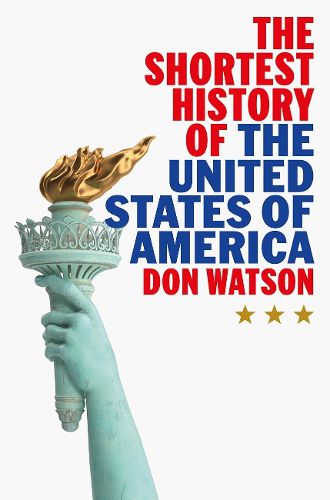
I’ve always been a bit puzzled by the ‘Shortest History’ part of the title of this series of books published by Black Inc dealing with world history, many written by Australian authors. Declaring to be the shortest history seems rather definitive and pugnacious, and almost a challenge to later authors to become even shorter. The blurb for the series claims that the books can be read in an afternoon -something that I doubt, in this case – but certainly they are a work of concision and discipline on the part of the author, in being able to confidently assert a fact or event in a single paragraph instead of hedging with qualifications, nuances and debates. Of course, much is elided in such an approach, but there is also a bracing forthrightness about a sweeping history that needs to tie together so many small details into an overarching narrative.
Don Watson comes to the task as a historian in his own right, political speechwriter, and a commentator on current-day American society and political culture. As well as his American Journeys published in 2008 (my review here), he has been a regular contributor to the Black Inc./Schwartz stable on American politics with three Quarterly Essays: No.4 Rabbit Syndrome: Australia and America (2001), No 63 Enemy Within: American Politics in the time of Trump (2016) (my review here) and most recently in 2024 with No. 95High Noon: Trump, Harris and America on the Brink, which I reviewed here. With The Shortest History…. he is writing as an outsider, and a long-term, well-informed watcher as well.
His outsider status is most apparent in the opening chapters of the book, where he makes clear that there were competing European powers – England, France, Spain, Netherlands, Sweden- that put ‘boots on the ground’ on what was to become American territory. Drawing the distinction between the 1776 establishment of the United States, and the history of ‘America’ starting in 1492, he goes even further back 20,000 years to the first peoples, and the early introduction of enslavement that followed early European ‘discovery’. In what, perhaps, might be characterized as ‘black armband history’, he continues to turn the spotlight around onto First Nations and Black experience as the narrative of United States history marches forward…always forward.
The book progresses chronologically, but the chapters are thematic. In his introduction Watson notes that:
While the history of the United States is to an uncommon degree a history of ideas, it is equally the story of men and women testing the truth of those ideas against experience: in politics, in churches, on frontiers, in cities, in industries, in battle, in homes, in schools, in Hollywood, in literature and in music. (p. xiv)
Watson places strong emphasis on ideas: on the intertwined Puritan ideas of harsh punishment and discipline set against competing ideals of individualistic self-reliance, which in turn existed alongside traditions of social justice, education, communitarianism and democracy. He notes the influence of Enlightenment philosophers and the scientific revolution in providing an intellectual framework for their grievances and the language to express it through the Declaration of Independence, Constitution and the Federalists papers. He puts his historian hat on to discuss Turner’s Frontier thesis on the ‘freedom’ of the frontier in the popular imagination and he notes the recurrent waves of religious ‘awakenings’ and the struggle between order and chaos-‘ the American id and the American superego’ (p 58). Challenging these were the ‘maniacal appetite for wealth’ whetted by the financial opportunities following the Civil War, and especially during the ‘Gilded Age’ of the 1890s which pushed aside “the restraining influences of conscience and religion, or the egalitarian principles implied in the country’s democratic creed” (p.94) The Civil War, in his telling, had a long advent of compromises on the part of the North, which was well aware of the incompatibility of slavery with the ideals espoused in the republic’s founding documents.
Although we know the political landscape in the United (huh!) States today as being Republican and Democrat, the meaning of both words has changed over time. To be ‘republican’ was to champion the idea of the American republic, and it was not necessarily democratic. The nature of the parties changed over time, with the immigrant influx between 1890 and 1920 shaping the cultural and political evolution of urban America:
The Democratic Party evolved into the party of both the burgeoning multiethnic cities and the reactionary South, while the Republicans remained the voice of white Protestant provincial America. (p. 112)
Looking at the policies of Presidents over time, particularly in the Progressive era, it is not easy to distinguish to which party the president belonged. For example Woodrow Wilson was a southerner from the Democratic Party, and a progressive as well as a segregationalist. Kennedy did not like Martin Luther King, and he had little interest in domestic politics. Nixon was mad, but he was the most liberal republican of the century excluding Teddy Roosevelt (p. 187). Some Presidents receive more attention than others. Probably because of current-day parallels, President Andrew Jackson receives more attention than he might have in a book written 30 years ago. For a former speechwriter for Labor Prime Minister Paul Keating, I was surprised that he was so critical of FDR. It seemed to me that the emphasis on presidential personality and actions received more emphasis in the latter part of the book, within the time of Watson’s own memory, I would guess. Interestingly for a historian, he ascribes ‘luck’ as an important factor that determined a President’s actions and reputation.
This is not just a political history because Watson interweaves popular culture, including music, Hollywood and literature, as well as broader social movements including Communism and anti-Communism, evangelical religion and protest movements. However, the political emphasis does mean that it is a predominantly male history, with political actors Eleanor Roosevelt and Hillary Clinton receiving more attention than other women in his narrative. As the book moves on, the early emphasis on indigenous and Black history is muted and where it is mentioned it is mainly in political terms. Particularly in the post-WW2 years, he integrates conformity, consumerism and commercialization into the “American Dream”, which was very much restricted to white America:
Nothing spoke more eloquently of the American dream than the bustling heartland towns, their Main Streets lined with mom-and-pop stores, barber shops, diners, ice cream parlours, theatres and movie houses, with Fords and Chryslers and De Soto Coronados parked in rows; and, just beyond them, unlikely numbers of regularly attended churches, schools, sports stadiums and public swimming pools (p. 154)
Watson started his book in the introduction, with the attack on the Capitol building on 6 January 2021. At first, I thought that this reflected Watson’s own expertise and reputation as a commentator on American affairs, but when he returns to 6 January at the end of the book as part of his argument, it is as a historian.
The United States was born with one foot in the Christian church and the other in commerce. It might equally be said that it had a foot in the high ideals of religion and the Enlightenment and a foot in the frontier philosophy of whatever it takes. The loathing felt for the liberal elites, and for intellectuals in general, was an old one, and the failure of liberals and intellectuals to understand either the people who loathed them or the degree of their loathing was just as old. The ‘Washington swamp’ was not new [and] …the coonskin hats and the shaman’s horns in the Capitol building were as if lifted from a picture in my childhood Davy Crockett book…All these gestures to contemporary grievance connected to threads of belief and myth, and patterns of ideological dispute, that are as old as the country itself. Extraordinary, even ‘unprecedented’ as the insurrection of 6 January 2021 seemed, it occurred in the same grindhouse of uncrossable divides and undying fixations.” p. 261
I guess that only time will tell if Watson’s decision to start and finish the book with Trump was a narrative framing, or whether it is a historical analysis in its own right. Only in coming years will we know whether Trump II marks a whole new phase, or whether as Watson suggests in 2025, the Trump presidency reflects a continuity that flows across the United States’ history. By its very nature, a ‘short history’ with its abridgments and encapsulation, is probably best placed to provide an answer.
My rating: 8/10
Sourced from: review copy from Black Inc.
 The Resident Judge of Port Phillip