
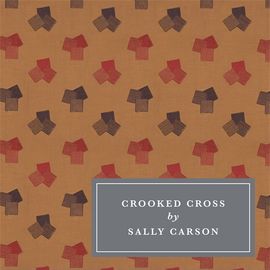
It’s happened a couple of times that I have read two books in close succession, only to find that the books speak to each other, and are long afterwards fused together as a reading experience in my mind. This was the case with Crooked Cross, first published in 1934 and recently re-released by Persephone Books this year. It might be 90 years old, but it soon became a publishing phenomenon- and I can see why.
It must have been as close as possible to being contemporary when it was published in 1934, as it deals with a six-month period between Christmas Eve 1932 and Midsummer night 1933. Of course, we know what is going to happen, but neither the characters in this book nor its author do. As it is, there is something queasily anxious about Christmas Eve in a small mountain town in the Bavarian mountains, where the Kluger family – parents and three young adult children eldest son Helmy, daughter Lexa and much-indulged younger son Erich- are celebrating Christmas. The family has been in straitened circumstances: the father’s wages have been reduced and eldest son Helmy has been unemployed for several years. Giddy with the prospect of soon marrying her fiance Moritz, Lexa has resigned her job, while Erich has returned for Christmas from his seasonal job as a ski-instructor, with the occasional dalliances with clients on the side. In amongst the carols and the snow and the midnight church service, there is a photo of Hitler on the piano, adorned with holly. Just a mention, an aside, but National Socialism is to embed itself within the family, and change the trajectory of their lives.
Lexa finds herself forced to choose when her fiance Moritz, a converted Jew, is sacked from his position at the hospital, and is increasingly confined to a small flat where he lives with his father. Meanwhile, her two brothers, and eventually her father too, join the Nazi party which provides jobs and identity to a generation of men who were emasculated by the years after WWI. The party becomes more and more embedded and normalized in everyday life, and the cost of being outside the party and its ideology becomes steeper.
It is impossible not to draw parallels with current events, which is no doubt why this book has been republished now. It ended on a cliff-hanger, and I was excited to find the next book, The Prisoner, which was published in 1936, followed by A Traveller Came By which appeared in 1938. Unfortunately these books, which like Crooked Cross were published almost in real time, have not yet been re-released. As it is, they form a little time capsule of contemporary awareness, shaped only by events and perceptions at the time rather than historical fact seen in retrospect. They came to an end with the author’s death of breast cancer in 1941 at the age of just 38. She was not to know just how prescient she had been.
My rating: 9/10
Read because: Lisa at ANZLitLovers reviewed it.
Sourced from: Kobo ebook.
 The Resident Judge of Port Phillip