
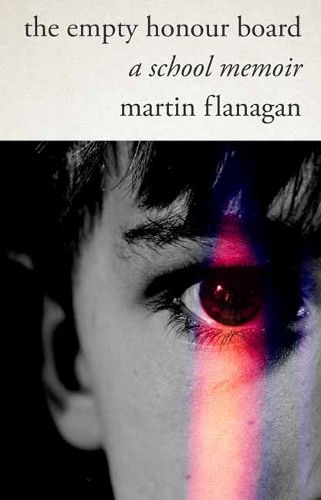
When it comes to the Catholic Church and sexual abuse of children, there is little space for nuance without it being mischaracterized. However, nuance is what we find in Martin Flanagan’s memoir of his school days at an un-named Tasmanian Catholic boarding school between 1966-1971. As he says in his opening line “I was warned against writing this”. Not only was there the danger of stirring up pain and controversy, but there was the danger of being forced to rethink one’s own story that had seemed certain.
By the time you get to my age-67 at the time of writing- people’s sense of their personal history has taken a mythological turn. Most of us cling to the notion that there is meaning in our lives and, whether we know it or not, arrange the furniture in our minds- our memories- accordingly. We acquire a personal mythology, and personal mythologies, when they clash can do so violently. This is a region where demons lurk. (p. 2)
But as a stream of claims from former student from his school surfaced, the demons found him:
Each disclosure took me back to a time in my life when I thought I inhabited a concrete reality. Now that concrete reality was bending and breaking like buildings in an earthquake. (p.3)… Behind the issue of what actually went on at my school on an island off the southern coast of the world’s most southern continent, global forces were at play- ancient controversies to do with the Catholic church, the Pope, the authority of priests, celibacy, the Vatican’s exclusive maleness and the epidemic of sexual abuse that has followed it around the world. Somewhere inside all that of that, being thrown about like a leaf in a storm, was me, my story. (p.8)
Flanagan was not sexually abused himself – or at least, he did not perceive that he had been sexually abused. But at the age of sixteen he was invited into the room of one of the priests where the priest, Eric, gave him a massage with his pyjama bottoms removed, face down on the priest’s single bed, nude from the waist down. After a vigorous massage of his legs with oil, he rolled over and the priest glanced at his limp and uninterested cock. “End of story” (p. 86)
Completely inappropriate though this clearly is, Flanagan did not consider himself to have been sexually abused, even though other people thought that he had been. As far as he is concerned, “to be abused you must surely feel as if you’ve been abused”. He feels that he was inoculated from a strong response because he never did believe in the Catholic church, and because by then he was already quite certain in his own sexuality.
However, he knew other boys who were sexually abused by the priests. At much the same time as this happened to him, he was the school captain, and he was led by another boy to where he found a 12 year old shaking and shuddering in his pyjamas, with a spray of semen up his back. He and other boys reported the priest to the school rector. Some thirty years later, he gave evidence against one of the three priests from the school who were charged with sex crimes.
Flanagan may not have been sexually abused but he was abused by the ingrained cruelty of the school that filtered down through the priests and bubbled up among the boys themselves. He felt ashamed of many things: his abject begging not to get the cuts for some minor misdemeanour, his failure to intervene when he saw other boys being bullied, his desperation to appease the bullies who had decided that he was a ‘teller of stories’ as a ‘fear like a sort of radiation illness infiltrated my being’. (p.74). Years later, he began having panic attacks at night. For about six months he was in mental tumult until
In the end, one hot day I was standing beside a blackwood tree in the paddock beside our little home, when a shadow hurried across the grass towards me. With it came a great fear that I was about to be extinguished or swallowed up, and I cried out ‘I have a right to be!’. Pure madness, I know, but I’m glad I did it. Glad I shouted at my shadow. At the negative imprint of those early years. I have a right to be, everybody has a right to be. What do I believe in? Human dignity. (p.102)
What saved him was sport, especially football, and writing about sport. It was through sport and writing that the boys he had gone to school with, now men, circulated back into his adult life. These men came with their own stories, their own pain and the author’s response and reconciliation with this shared, and yet so private, experience takes up the last third of the book. The report that he had made as school captain on discovering the shivering boy in his pyjamas all those years ago resurfaced as part of the controversy over the school 43 years later. He reads the letter from the rector to the head of the order detailing the report that Flanagan himself had made, which the rector described as ‘fooling around’. Here he learns about the evasions and plans to withdraw the priest from classes, to move him around the state, or divert him into working on the school magazine. As a result of the Royal Commission into Institutional Sexual Abuse that he learns about ‘Father GMG’, sent to his school to avoid the repercussions of another interaction of a sexual nature, who is moved from one school to another. There is a pattern here.
Over the years, the author attends three Catholic ceremonies. The first was a vigil at St Ignatius, Richmond as 25 year old Van Tuong Nguyen was hanged in a Singapore jail for drug running. The second was Ned Kelly’s funeral in a Catholic Church in Wangaratta in January 2013. The third was a Ritual of Lament in 2021 run by his old school. He struggled over whether to go: he didn’t like ceremonies; he feared inauthentic emotion; he feared doing it the ‘wrong way’. He went.
What is striking about this book is the way that Flanagan holds many things in tension: acknowledgement that the same men who whipped him also imbued in him a love of literature and writing; disgust at the sexual abuse and yet compassion for the situation that, at least for the priest that he gave evidence against, he
could be well described as a maladjusted, sexually immature, lonely individual… [who] had virtually no possibility of a sexual relationship with a woman given his living circumstances. (p. 7)
He accepted the word that two of the priests at the school were unaware of what was going on amongst their brother priests. He did not characterize what he observed at his school as a long display of cynical behaviour. Instead,
[W]what I see at the core of this whole business is abject human isolation surrounded by a floundering belief system. (p. 142)
The book is not divided into chapters, and although it moves forward chronologically, it is divided into dozens of small shards, separated by asterisks. It’s almost as if the truth he is grappling to explain is also fragmentary, without an overarching structure that can be imposed onto it. There is some sort of resolution – not ‘closure’- with the Ritual of Lament performed by the now-coeducational school, no longer an all-boys boarding school. He sees this book, which was almost finished at the time of the Ritual of Lament, as his way of honoring the experience from 40 years ago as he sees it now. He speaks only for himself.
The old school’s honour board doesn’t have an entry for my last year. Perhaps it’s because the following year the school started a new era by going co-ed, perhaps it’s because my last year ended in a scandal. The tide of golden print records the year – 1971- but after that are empty spaces of varnished wood. The real names in this book are my honour board, although the list, I must add, is far from complete. (p.11)
My rating: 8/10
Read because: Ivanhoe Reading Circle August selection
Sourced from: own copy
 The Resident Judge of Port Phillip