
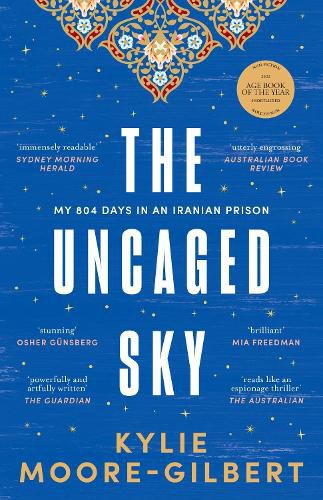
It is a paradox that repressive penal systems try to break an individual in two opposed ways. Either they quash the individual through impossible labour in a mass dehumanizing project (I’m thinking here of the long-ago-read The Gulag Archipelago or One Day in the Life of Ivan Denisovich) or they annihilate prisoners’ identity through enforced idleness and solitary confinement. University of Melbourne academic Kylie Moore-Gilbert was arrested in September 2018 on charges of espionage, and spent over a year in solitary confinement during her 804 days in the Iranian Evin and Qarchak prisons.
By its very nature, it’s hard to write about solitary confinement, because just like the space and the endless nothingness, there’s only so many words in which to express it. When the stream of days is broken by Ramadan for a second time, she is struck by the waste of her life:
Thinking about Ramadan a year later meant the unbearable realisation that I had wasted another twelve months of my life in 2A. Twelve months in a world whose total inhabitants could be counted on both hands. Twelve months in a world which had to be navigated in darkness, via touch and sound and slivers of light through the edges of a blindfold. Twelve months in which time did not exist, in which each day was both a minute and a decade, in which each week was both a second and a hundred years. Last Ramadan felt like it was only yesterday, because so little had happened in the interim. But then again, everything had happened. Everything and nothing. (p. 249-50)
I seem to have read or watched a couple of accounts of imprisonment lately (the film The Correspondent – review here– and books and articles about Jose Mujica). What comes over strongly with both Peter Greste and Kylie Moore-Gilbert is their utter bewilderment as the framing of charges seems to change over time and comes long after the initial arrest. Both Australians feel poorly served by many of the embassy officials dealing with them at first (although this seems to shift with time) and both feel that nothing is being done at an inter-government level to seek their release. The advice given to families at home to keep quiet and leave it to the government flies in the face of what both Greste and Moore-Gilbert felt they needed in the situation, and in both cases hunger striking and intransigence attracted more attention – not always welcome- than compliance and silence.
For Moore-Gilbert, the experience of solitary confinement, and having to return to it for a promised 96 hours that stretched into months, was almost intolerable. At times she urged that her behaviour, which at times was unwise, be considered as a symptom of mental illness and she was certainly dosed up with anti-depressants and sleeping tablets.
The most unnerving and treacherous aspect of her imprisonment was the complex relationship she had with her main interrogator Qazi Zadeh from the Iranian Islamic Revolutionary Guard. Saturnine and powerful, she claims that he began flirting with her, while incredibly having his wife appointed to supervise her. She needed to walk the tightrope of resisting his advances, while trying to leverage them to her advantage. Just as freedom was within her grasp, she found herself blocked by him, in a bizarre attempt to keep her in jail so that he could continue to contact her. It must have been a lonely, high-stakes situation where she could trust no-one, and in a mis-step she told his wife that the relationship was not of her volition. It only made it worse for her.
What made it possible to continue with the book was the knowledge that she did, eventually, gain release in exchange for three Iranian prisoners held by the Thai government. Was everything possible done by the Australian government for her? At the end of the book she is grateful to Nick Warner and the Australian ambassador Lyndall Sachs, although she has raised questions about the softly-softly approach.
She notes that 43 years of Islamic Republic rule has plunged Iran into a “crisis of human rights of unfathomable proportions” with the country becoming an open-air prison of 84 million people (p. 403). As occurred with Peter Greste, and with other political prisoners, she finishes the book with a plea for other political prisoners who have not been released.
I can’t help but be profoundly affected by what I witnessed inside some of Iran’s worst prisons. I feel it is my duty to speak up for my friends, as it is to tell the truth about what happened to me. If the events I have recounted in this book have similarly touched you, dear reader, I ask you, too, to use your voice. When you are a prisoner, knowing that there are people on the outside who support you and care about your plight truly can be the difference between giving up or continuing the fight. (p. 403)
We can only take her word for it.
My rating: 8/10
Read because: I had been aware of her imprisonment and wanted to learn about the experience from her perspective as an academic.
 The Resident Judge of Port Phillip