
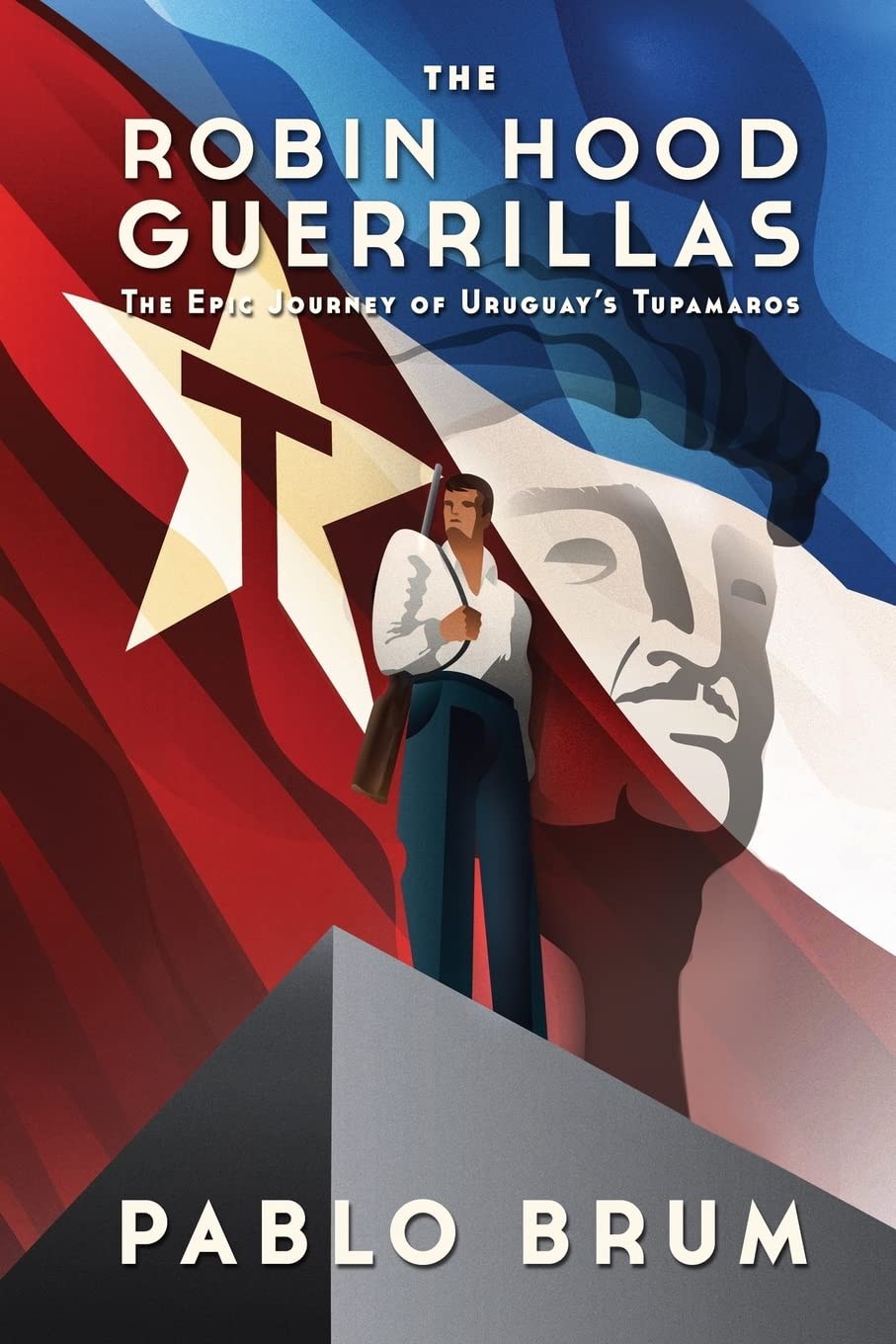
2014, 402 p.
I’ve been dipping into books about Uruguay- a place I’ve never been- and about Jose (‘Pepe’) Mujica, the ex-President of Uruguay who died recently. I haven’t been able to find many English-language books about the Tupamaros, especially recent ones, and this book, written in 2014, seemed to be as recent as I was going to find. I know little about the historiography of Latin America, and Uruguay in particular, or the author (who was/is an American international security analyst – whatever that is) so I can only take the book on its own terms. To my admittedly untrained eye, the book seemed to be fairly even-handed, and easily read by a newcomer to the area, although an index for the huge range of characters would have been useful.
So the Tupamaros- what a strange name. This Marxist-Leninist urban guerilla group took its name from Tupac Amaru II, the leader of a failed Andean rebellion against the Spanish in Peru, who was executed in 1781. The group, more properly known as Movimiento de Liberación Nacional – Tupamaros, MLN-T formed in the early 1960s, and one of their first acts was to steal weapons and ammunition from the Tiro Suizo, a shooting range in Colonia, Uruguay. The weapons, supplemented by stolen police uniforms, enabled them to conduct a range of audacious hold-ups and kidnappings which earned them the sobriquet ‘The Robin Hood Guerillas’. Their mode was ‘armed propaganda’ which combined the mostly harmless brandishing of weapons with a healthy (if somewhat tedious) dose of ideology and propaganda to which they subjected their victims. At first there was, indeed, a Robin Hood element, when they combined social justice and retribution against corruption in their criminal activities, often undertaken both as a form of armed propaganda and in order to procure more weapons, ammunition and money to conduct further raids.
Despite admiration of both the Cuban and Chinese revolutions, and the sympathy the leaders had for the agricultural workers (particularly by Raul Sendic and Jose Mujica) it was decided that they would eschew the examples of other peasant-based revolutions and instead undertaken urban guerilla action. This was largely a result of geography: as a small, flat country there were none of the mountain hideaways that guerillas could melt into, and at times when both Brazil and Argentina had right-wing governments, they could not count on fleeing over the border.
At first, they seemed to have widespread, if often tacit support. They could call on doctors to repair their injuries, and lawyers, bank officials, government employees and others enabled them to infiltrate and provide intelligence about their targets. Brum reveals a grudging admiration for the audacity of their raids, and their sheer ingenuity and logistical planning of escapes when the police rounded them up. Their escapes- especially when 100 prisoners tunnelled out of the Punta Carretas – made them seem invincible (in much the same way, unfortunately, as the drug cartels in South America have seemed inthe past).
Brum spends some time on Alejandro Otero, the police commissioner with formidable MLN-hunting skills, who in a Javier/Jean Valjean type of struggle with the Tupumaros, exhibited a mixture of fixation and grudging admiration, as did the Tupumaros with him.
But over time, as more of the original Tupamaros were arrested or fled into exile, the movement became more violent. They lost support when their kidnap hostages were murdered, rather than set free after a few months, and in many ways their actions prompted the takeover of the military, albeit with the acquiescence of the civil authorities. The murder of rural labourer, Pascasio Baez, by lethal injection of penothal also cost them support.
Once popular support leached away from them, and the grip of the military hardened, the Tupumaros disappeared from the headlines. But Brum follows them into their imprisonment, divided into groups of three, held in prisons with varying degrees of cruelty.
I gather that Brum makes some contested points in this book. He argues that it was not certain-indeed, he leans towards refuting- that U.S. government official Dan Mitrione, who was murdered in 1970, actually trained the police in torture methods. He suggests that during 1972 and 1985, when the nine most prominent Tupamaros were imprisoned, and moved from one military base to another, the Tupamaros themselves sent out feelers to the very military that was imprisoning them, to see if they could work together.
He finishes his book with a ‘where-are-they-now’ survey, current as of 2014. Raul Sendic, the icon of the Tupamaros, suffered appalling facial injuries in a shoot-out, and died in 1989. Some, like Jorge Zabalaz and Mauricio Rosencof retained their radicalism. Brum is bemused, and amused, by the popularity of Jose Mujica that saw him become no less than President. As he points out, a surprising number of the players in the 1970s still had sons involved in politics fifty years later.
Brum criticizes the barbarity on both sides- on the part of the Tupamaros who drifted away from the somewhat romantic (and romanticized) view of the Robin Hood guerilla, and on the part of the military who honed their cruelty on the nine Tupamaros leaders under their control. Despite the audacity and logistic brilliance of their early exploits, Brum’s linking of them with their ideological descendants like the Californian Symbionese Liberation Army who kidnapped Patty Hearst, or the Weather Underground, or the urban guerilla Rote Armee Fraktion in Germany, or the Italian Brigate Rosse is rather chilling. He closes his book with the observation that, despite Mujica’s proclamation that he “fought for a fatherland for all”
…many individuals were left behind in shootings, executions, and torture chambers: civilians, insurgents, policemen, and soldiers. For them there really was no more fatherland.
I enjoyed this book, although I was mystified by the curious insertions of #### and ++++++ to denote endnotes, as well as nearly 600 footnotes throughout the text. It was supportive of a reader with little knowledge, and he established the major characters sufficiently clearly that you could trace them throughout the narrative, although they threatened to be swamped by so many minor characters mentioned in person. Jose Mujica, whom I admire, once said
I am still a Tupumaro. I never stopped being one. A Tupumaro is someone who rebels against injustice.
After reading this book, I think I understand a little better what he meant.
My rating: 8/10
Sourced from: purchased Kindle book
 The Resident Judge of Port Phillip