
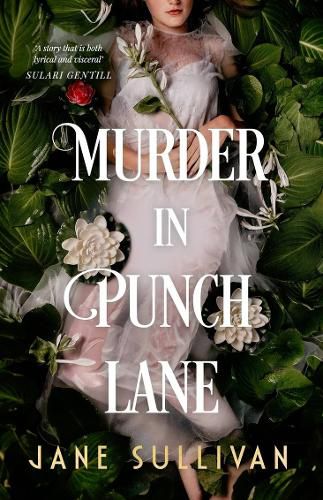
There’s a particular frisson of delight when you’re reading a novel set in your own town. You recognize the streets and you have a mental landscape painting of the setting, even if it is set 160 years earlier. Jane Sullivan, herself now a Melbourne resident after emigrating from England decades ago, takes us to post-Gold Rush Melbourne, and in a way not unlike Kerry Greenwood with her Phrynne Fisher novels, introduces us to a feisty, intelligent amateur detective who is less sidekick and more spur to her co-investigator Magnus Scott, a journalist who styles himself as ‘The Walking Gentleman’.
The novel starts in a bedroom, as a doctor tries to revive a beautiful young actress Marie St Denis from what appears to be, and is later characterized as, an accidental laudanum overdose. Her closest friend, aspiring actress Lola Sanchez, is not satisfied by such a neat explanation, and she enlists the help of journalist Magnus Scott, one of the few people who wrote a sympathetic obituary for Miss Dennis, to investigate. Fired up by the techniques and success of the detectives in the penny-dreadful crime literature she enjoys, Lola undertakes some amateur sleuthing to uncover multiple footprints in Miss Dennis’ room- but to whom do they belong? Lola devises a list of possible suspects, many of whom belong to the highest echelons of Melbourne society, and disguising herself as a young boy, breaks into houses and sneaks around bedrooms looking for clues. In the meantime, Magnus himself is on a rollercoaster of financial events, and it seems that indeed, there are shadowy forces at work, who may or may not be the same men that Lola is suspecting.
I was thinking about 19th and early 20th century crime fiction, and its reliance on plot, coincidence and red herrings, especially compared with the detective stories of the 21st century and their emphasis on the character and motivations of the detective, just as much as of the perpetrator. This book is truly in the former category, complete with cliff-hangers and diversions that at times strain credulity.
For the historian of Melbourne, it is gratifying to see that Sullivan has done her research, and acknowledges the assistance and friendship of writers like Lucy Sussex, whose recent Outrageous Fortunes: The Adventures of Mary Fortune, Crime-writer, and Her Criminal Son George is dealing with a similar time-span and genre. I found myself thinking of Barbara Minchinton’s work on Madame Brussells and The Women of Little Lon, although these both look at a later date. A couple of times I found myself raising a sceptical eyebrow, only to find that Sullivan was right: cold cream in 1868? ( Yes, and before then too), the Menzies Hotel? (Yes, opened in 1867) and so, yes, Sullivan has done her work.
I enjoyed Sullivan’s playful tweaking of real-life characters in creating her own Lola Sanchez and Magnus Scott. The name Lola Sanchez of course evokes the Gold-Rush performer Lola Montez, and Magnus Scott as ‘The Wandering Gentleman’ and editor of the New Bohemian bears more than a passing resemblance to Marcus Clarke. She integrates historical figures as well, most notably the enigmatic Redmond Barry, patriarch of Melbourne’s cultural scene but with his own domestic ambiguities, and Dr Nield, the coroner. She takes us to Redmond Barry’s house in Rathdowne St Carlton that later became integrated into the Royal Childrens Hospital, the Theatre Royal, Chinatown and the eponymous Punch Lane, running between the current-day Exhibition and Spring Streets. And as Sullivan explained in a talk that she gave to the Ivanhoe Reading Circle in April, there was indeed an actress Marie St Denis who died of laudanum poisoning, and the story sprang from historical events, with equally heavy doses of research and imagination.
I wonder if this is the first in a series? There’s scope, and plenty of other Melbourne murders to explore…
My rating: 8/10
Sourced from: Purchased e-book
Read because: Ivanhoe Reading Circle Open Meeting
 The Resident Judge of Port Phillip