
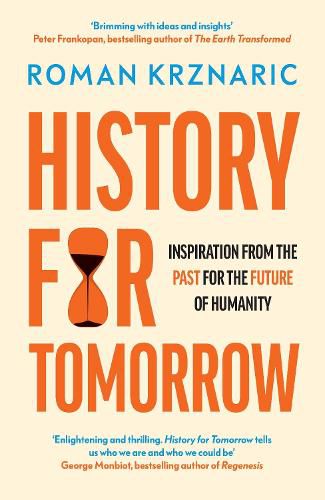
Just recently I listened to an interview by the New York Times with Curtis Yarvin, who has been name-checked by a lot of Trump’s acolytes. He talks quickly and rather disjointedly, and is fond of throwing out historical references to defend his views and give them the sheen of academe. People are quick to bring out the old saw “Those who cannot remember the past are condemned to repeat it” and there’s a danger of cherry-picking when computer engineers (in Yarvin’s case) and social philosophers (in Krznaric’s case) look back to history to bolster a present day argument. But that is unfair to Krznaric: unlike Yarvin, he admits that he is not a historian, and he acknowledges that he is very much standing on their shoulders while surveying present-day society. His book has footnotes, references and an index, and he includes in his footnotes references that make a different argument to the one that he is making. And unlike Yarvin, this is a quiet, considered, optimistic (too optimistic, I fear) book that piques your interest rather than bludgeoning you into silence with names and dates that you have no way of challenging.
Krznaric acknowledges the dangers of cherry-picking but argues that:
All writing of history is selective- requiring choices about topics, time periods, relevant actors, the importance of race and gender, the role of culture and technology, the use of quantitative data and other methodological issues. What matters is being clear about the approach. From the myriad of historical contexts, I have consciously selected events and stories that offer inspiration for tackling the ten major crises facing humanity in the twenty-first century, and actively focus on the collective struggles and initiatives of everyday people, since this is the realm in which we have the greatest potential agency. (p.7)
So what are these ten major crises, and what historical events does he use to discuss them? His opening chapter ‘Breaking the Fossil Fuel Addiction’ draws parallels between the vested interests supporting the continuation of slavery in Britain in the early 19th century, and the fossil fuel interests that are undercutting action on climate change. I’ve though about this connection previously, and the distasteful thought that, as with slavery, it may be necessary to ‘buy out’ fossil fuel interests, in the same way that the compensation for slavery went not to the enslaved, but to their enslavers. As well as emphasizing the importance of creating coalitions across party lines and the potency of the ‘radical flank’ to make the comparatively moderate thinkable, he also notes the place of violence. The Captain Swing civil disobedience led to the 1832 Reform Act, which diluted the power of the slavers and their lobbyists in British Parliament; while the Caribbean slave revolts made continued enslavement unattainable. I think that this chapter was the strongest in the book, and it stands alone well.
Question Two involves the nurturing of tolerance. He starts off with his own family story, with his father arriving in Melbourne from Poland in 1951 as part of Australia’s post-war migration, a story which seems from the distance of 70 years to have been successful but which may not have felt so rose-tinted at the time. He looks back to the Islamic kingdom of Al-Andalus, where Muslims, Jews and Christians co-existed, although the backlash of the Reconquista is a salutary warning, I think. He looks to the early years of Chinese immigration when, as Marilyn Lake and Henry Reynolds note, Australia led the world in ‘drawing the global colour line’ at the turn of the 20th century (a reference that he should have referenced, but did not). He also looks at Ghana and the post-independence leader Kwame Nkrumah, who came to power in 1957 and embarked on a series of policies and programs to create a unifying Ghanaian national identity. He talks about the importance of city design in nurturing tolerance, looking at Singapore’s public housing which even today has a quota system where each estate must reflect the national percentage of Singapore’s main racial groups.
The third question is that of over-consumption in ‘Kicking the Consumer Habit’ where he turns to the Edo period of Japan between 1603 and 1868, which ran on a circular economy where almost everything was reused, repaired, repurposes or eventually recycled. Rationing during WWII prompted similar behaviour.
Chapter 4 ‘Taming Social Media’ looks back to the printing revolution and the rise of the coffee house culture in Georgian times as examples of disruptive technologies that drove political change. He notes that the development of print formed the ‘typographic brain’ that is linear, sequential and rationalist; and suggests that the digital age could prompt changes in the way we connect ideas and organize information.
Chapter 5 ‘Securing Water for All’ is subtitled ‘Water Wars and the Genius of the Commons’, and it’s an important chapter, warning in its opening sentence that “we are a civilisation heading towards aquacide”. He looks back to China’s Qing dynasty in the mid-18th century where Chen Hongmou, a government official, managed the building of irrigation and drainage systems. He championed the construction of water wheels and ensured regular repair work on ditches, dams and wells (p. 109). But his work could not survive the Opium Wars, the Taiping Rebellion, and the El Nino of 1876-8. He looks to Valencia’s Tribunal of Waters, which meets every Wednesday outside the Cathedral to resolve water conflicts as it has since the fifteenth century. However, water can be used as a tool of war, like the Cochabamba Water War in Bolivia in 2000 which led to civil unrest when the water services were privatized in 1999 under pressure from the World Bank and the IMF. Israel has long used water as a tool against Palestinians in the territories that they occupy, but he looks to initiatives like the Good Water Neighbours Program in the Lower Jordan Valley as cause for hope (although I wonder how it’s holding up now) and the International Commission for the Protections of the Danube River. However, seeing the debacle that our own Murray River scheme in Australia has become, I am not hopeful.
Chapter 6 ‘Reviving Faith in Democracy’ involves rediscovering the communal democracy of the past, and he goes way back to Djenné in West Africa between 250 BCE and 1400 CE, a complex trading centre which at its height was home to 40,000 people. He points out that the modern ideal of representative government was designed to prevent democratic politics, not enable it. He goes back to Athenian democracy and the Rhaetian Free State which emerged between 1524 and 1799 in what is now Switzerland, and even Kurdish confederations and the Rojava Revolution in Syria- although I’m not sure what the status is since the fall of Al-Assad. I see that their jailed revolutionary leader Abdullah Ocalan has declared a ceasefire of the PKK against Turkey- one of the problems with writing a topical book!
‘Managing the Genetic Revolution’ looks back to medieval alchemy, in essence returned as genetic engineering. He sees the genetic revolution as one of the rare turning points in history that fundamentally changes the trajectory of the human journey (p. 153). He turns to the past for warnings, looking first at the Eugenics movement and the Better Babies Contest, and Nazi Germany’s adoption of eugenics as the basis for its race-based state in Germany. Rather more hopefully, he looks at the March of Dimes and the crusade against polio where medical innovation was directed towards the common good. He warns of the ‘enclosure movement’ related to biodata, and the Wild West commercialization of the US biotech sector.
‘Bridging the Inequality Gap’ starts with the Black Death, which brought about such huge economic changes. But as he notes, the idea that substantive reductions in wealth inequality can only be brought about by warfare, state failure and pandemics is depressing and disempowering, because it suggests that all well-intentioned peaceful attempts to tackle inequality are unlikely to change the status quo. He looks to the Indian state of Kerala which was a global pioneer of mass education in the 19th century, with women at the forefront. Its government has alternated between a Communist Party and a Congress Party generally supportive of social democracy. In the Global North, the spotlight usually falls on Scandinavia, and especially Finland, which has also been at the forefront of women’s education and egalitarianism.
Chapter 9 ‘Keeping the Machines Under Control’ looks at the rise of capitalism and the extraordinary capabilities of AI- two phenomena that have deep connections. He looks to financial capitalism with the Dutch East India Company, Scottish financier John Law and his schemes under King Louis XIV of France. He argues that both financial capitalism and AI develop into a vast, complex supersystem, with the risk of contagion where any problem in one area spills over into other areas, especially with fake information, mass technological unemployment, and the potential for military use. The final similarity is that both are non-sentient human creations. He looks to the early distributed ownership models like the co-operative movement and mutual aid societies, although he admits the difficulty of breaking the ownership model of the AI industry- even worse since Trump came to power.
His final chapter ‘Averting Civilizational Breakdown’ ( a rather gloomy title) tells us that we face the Great Simplification, where too many ecological limits have been breached. Will society bend or break? He admits that we are currently facing the break scenario. He reminds us that
No civilization lasts forever: empires and dynasties are born, they flower and then die, sometimes abruptly but usually over decades or centuries. (p. 223)
He suggests that there are three broad features that are likely to give a civilization the ability to adopt and transform over time. The first is asabiya, or the power of collective solidarity, which was described in 1375 by an Arab scholar Ibn Khaldun. We see this in the wake of natural disasters (when every country proclaims that the united action of its citizens reflects that specific nationality and its ‘spirit’). It thrives on competition between states, but the problem is that the ecological emergency does not have an external enemy that we can act in solidarity against. The second is biophilia where we develop a sense of ecological stewardship for the whole web of life (or as the 7th principle of Unitarian Universalism puts it “respect for the interdependent web of all existence”). He looks back to the mass planting that took place after the publication of John Evelyn’s book Sylva in 1664 and the vestiges of pagan traditions of nature worship, as well as indigenous worldviews of intimacy and independence between humankind, the land and the living world (p. 230). The third feature is crisis response, when we think historically about the meaning of ‘crisis’ itself, popularized by Malcolm Gladwell’s popularization of the idea of a ‘tipping point’. He looks to radical change undertaken during war (e.g. WW2 industralization), in the wake of disasters (the Dutch government response to the floods in 1953), and in the context of revolution (Chinese land reform- not a good example; the Cuban National Literacy Campaign).
Krznaric makes no secret of his politics or his priorities. He has been personally involved in Extinction Rebellion, which he characterizes as the ‘radical flank’ of the environmental movement, and he himself was involved in citizens’ assemblies on Biodiversity Loss, even though he ended up being rather disenchanted with them. He calls for ‘radical hope’ because
- Disruptive movements can change the system (e.g. slavery, the women’s movement)
- ‘We’ can prevail over ‘me’ (e.g. Valencia’s Tribunal of Waters, al-Andalus, soup kitchens in the wake of the San Francisco earthquake)
- There are alternatives to capitalism (e.g. Edo Japan, the ‘entrepreneurial state’)
- Humans are social innovators
- Other futures are possible (classical Athens, the West African city of Djenné-Djeno, and the Raetian Free State in Switzerland.
At a personal level, history can do much more than help us realise that there is hope for transformative change: it can also spur us to become one of the changemakers ourselves. Whether in our communities, or workplaces, or anywhere else where we may want to make a difference, we can look to the past as an array of possibilities. From joining a protest movement or setting up a cooperative enterprise to taking part in a citizens’ assembly, history reminds us that we are part of the great traditions of active citizenship that stretch back into the past. (p. 253)
I wish that I shared his ‘radical hope’. While I acknowledge that the past does give examples of alternatives, using them as templates is fraught with contradictions and impossibilities. They can only be shards of hope, and the fact that so many of his examples are drawn from societies than no longer exist is not encouraging. As he admits, no civilization lasts forever, and I’m very much aware that our epoch of industrialization, democracy, and post WW2 peace is just a fleeting smudge on the timeline of human existence. I’m reading this in early March 2025, when the world is becoming a darker place, and at the moment those forces of untrammeled power wielded by strongmen, tech bros and lobbyists seem too strong for ‘radical hope’.
My rating: 8/10
Sourced from: Yarra Plenty Regional Library
A personal aside: Krznaric grew up in Sydney and Hong Kong, and he’s a player of real tennis. My brother’s family is very involved in real tennis too. I wonder how the real tennis fraternity deal with this colonial’s radical views?
 The Resident Judge of Port Phillip