
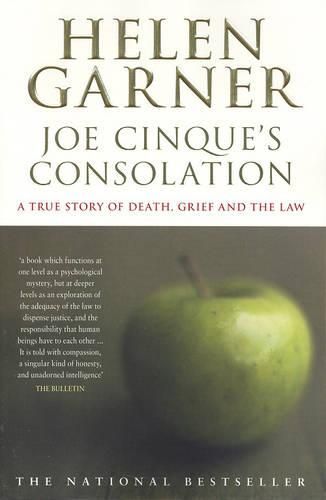
Near the end of her book, Helen Garner writes: “I longed to write a lament for Joe Cinque” (p.281).
And she has done so, because as she tells us many times, to keep front of mind, “Joe Cinque is dead”.
This is the third time that I have read Joe Cinque’s Consolation, and each time I see it somewhat differently.
It was published in 2004, when the term “intimate partner violence” wasn’t as common as it is today. When I read it earlier, I think that I saw it more as a deliberate murder, rather than as a manifestation of domestic or intimate partner violence. But I find myself wondering whether “intimate partner violence” which disproportionately involves a female victim, is the right description. Even though Joe Cinque and Anu Singh were intimate partners, the murder doesn’t appear to have been committed within an environment of violence or intimidation. Somehow “intimate partner violence” doesn’t do justice to the self-centredness and premeditation of Joe’s murder. Nonetheless, it something that is more visible in 2025 than it was in 2004.
When you return to a book after 20 years, you are a different reader too. I now read this book as the mother of adult children who themselves have young children. When on the news I see the stricken family of the murder victim outside the court, it seems to me to be the ultimate betrayal, and a crime that I don’t think I could forgive. How dare that person take the life of my child, and all the future that was ahead? As Garner keeps reminding us, Anu Singh and Madhavi Rao’s lives went on; they woke each morning to another day; but Joe Cinque was dead. The knowledge that Singh went on to write a PhD thesis on “Offending Women: Toward a Greater Understanding of Women’s Pathways Into and Out of Crime in Australia” is even more galling. Apparently she doesn’t write about her own case in her thesis, but it’s still all about her.
Garner’s response to Anu Singh is hostile from the start, drawing largely on the visceral dislike of some other women that develops from girlhood. There is, too, a generational aspect to it as well: an impatience with the self-centredness of ‘young people these days’. There’s an irony that it’s Helen Garner who is writing this; the same Helen Garner who wrote of her junkie friend Javo in Monkey Grip; the same Helen Garner who inhabited the world of university share-houses and parties. The Canberra Garner depicts is a meaner, edgier drug world than the inner-Melbourne 1960s drug haze of her novel, and she herself is aware that she is not the same person. Her third marriage had just broken up in 1999 when she first learned of the case, and she was living in Sydney. There is a strong element of the more mature woman here, although she finds her certainties about justice, memory and truth being shaken as she follows the case. She measures both Singh and Rao against what she thinks she would have done in the same circumstances, but finds herself unable to identify with Singh. Alongside her quickly-established empathy for and with Joe Cinque’s mother, in particular, she draws on her own moral, as distinct from legal, compass. Like Maria Cinque, Garner can scarcely believe that Singh receives an effective sentence of only four years.
I had forgotten about the Madhavi Rao case that followed Anu’s sentencing for manslaughter. She does not have the same knee-jerk reaction to her as she did to Singh- indeed, she sees her as largely invisible and pliable- but because Rao seems to be more comprehensible, that same moral compass makes Rao seem culpable because Garner can envisage what she would have done had she seen Joe Cinque lying, blue and breathing shallowly, on the bed. Yet, given that Singh has evaded the verdict of ‘murder’ (being found guilty of manslaughter instead), surely the two women’s actions are not comparable. Justice clearly cannot lie in the degree to which you can identify with the accused, and yet at gut-level Garner baulks at the clinically logical approach undertaken by Rao’s defence lawyer, Lex Lasry, that sees her acquitted of any charges.
In spite of this being my third reading of Joe Cinque’s Consolation, I found myself instantly drawn into conversation with Helen Garner. I can even see her in my mind’s eye, head cocked to one side, like a small sparrow, simultaneously morally certain and yet scrabbling to find her feet in a quicksand of competing arguments, judgements and ‘shoulds’. I want to sit beside her, to talk with her. I do find myself wondering about the title though. Consolation? Certainly, a lament for Joe Cinque; a tribute to Joe Cinque; or her own consolation for Maria Cinque? Joe Cinque is dead: he can not console, or be consoled by, anyone.
My rating: 9/10
Read because: CAE bookgroup – although it’s not CAE anymore and this is one of the ‘left-over’ CAE books.
 The Resident Judge of Port Phillip