
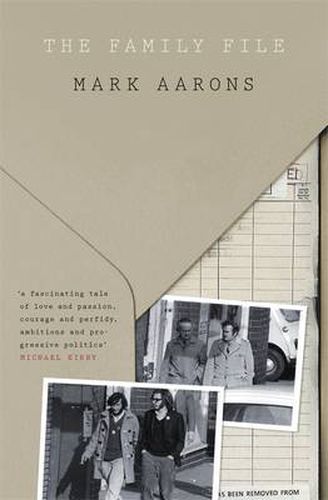
Some years ago I was attending the Melbourne Unitarian Peace Memorial Church when someone mentioned the almost certain presence of ASIO spies at the service. I really don’t know if they were there or not – (certainly this church and its attendees would have been under surveillance over many years, I’m sure)- but it had just never crossed my mind to think that they would be there amongst the silver-haired people in the pews that day. I have wondered about the presence of ASIO agents when I’ve attended rallies, but the whole world of ASIO and espionage is something completely outside my consciousness.
Not so for the Aarons family though, with four generations of Communist activity under their belt. When Mark Aarons finally got access to the ASIO files on his family (including him!), they amounted to 209 volumes and 32,000 pages. Carefully noted was where they went, with whom, and what was said- for a family researcher, almost like one long home-movie over several generations.
Aarons’ great-grandparents Louis and Jane Aarons were founding members of the Communist Party of Australia. Louis had grown up in Whitechapel, part of the influx of Russian, Polish and East European Jews who flooded into Britain in the wake of the Russian pogroms of the late 1880s. He had arrived in Australia in November 1889. His wife, Jane, was from Brooklyn. In Melbourne, they lived in Carlton, where there was a large poor working-class Jewish population, then they moved to Sandringham and Balwyn, which would have been very outer suburbs at the time. Like many radical socialists of the day, Jane could speak Esperanto fluently, and they joined the Sandringham branch of the Labor Party around 1910. Their children attended the Victorian Socialist Party Sunday School, and during WWI Jane and Louis threw themselves in with the revolutionary socialists, joining the Victorian Socialist Party as active members, leading to Jane’s arrest for flying the Red Flag. They were foundation members of the Melbourne Communist Party of Australia in 1921 and Jane travelled to the Soviet Union to join a May Day parade in 1932.
Their son, Sam, was very involved in the Western Australian CPA, and drifted in and out of the Melbourne and Sydney branches when visiting. After his first marriage ended, he moved to Sydney and opened a While-U-Wait shoe repair business in Pitt Street near Martin Place. He was fired up by a speech by a CPA member after the execution of American anarchists Sacco and Vanzetti, and rejoined the Sydney CPA branch in late 1929. He travelled overseas, and was part of the International Brigade in the Spanish Civil War.
His son Laurie was born in Sydney in 1917 to Sam and his first wife. The family had moved to Melbourne, but then returned to Sydney after Sam’s marriage broke up in the early 1920s. At the age of 14, Laurie decided to become a professional revolutionary. He was the head of the Young Pioneer’s Section of the Communist Party. He was a prominent paid member of the CPA for 33 years, and probably the most notorious of the Aarons family.
His son and the author of this book, Mark Aarons was what was known as a “red-diaper baby”, born and bred in the Communist Party. His brother Brian campaigned against the Vietnam War, supported the environment and advocated for Indigenous rights and reconciliation. In 1965 Brian was involved in the Freedom Ride for Aboriginal Rights (in fact, I read about him just the other day now that it’s the 60th anniversary). When conscripted to fight in the Vietnam War, he became a draft resister. Mark himself was also a member of the Communist Party until 1978, and ended up a journalist and senior advisor to the NSW Labor government between 1996 and 2007.
I found myself wondering about family interests handed on for four generations. Do families still ‘hand on’ organizational affiliations like this? I suppose that church affiliation runs between families, as does private school affiliation (a good argument for State education, I reckon). Professions and football affiliations run in families too. Military involvement tends to run in families too, but that might be a reflection of the times, rather than personal choice. But, given the propensity for 20th century children to run a mile from anything their parents are involved in, I find it quite remarkable that the CPA was able to ‘hold’ four generations. Its Socialist Sunday School and the Eureka Young League made membership a family affair.
The book focuses on the Aarons family, and ASIO’s interest in them, but running alongside it is a history of Australian left radicalism as well. Right from his great-grandparents’ involvement in WWI anti-conscription and suffrage politics, his family was involved in the radical edge of mainstream Australian politics. The influence of the Soviet Union on Communist parties internationally was overpowering, which became problematic during WWII when, at first, the Soviet Union and Germany were in alliance. For Jewish families like the Aarons – albeit Jewish by heritage rather than religious practice- this was a challenging choice to be forced to make. Once Russia had joined with Britain and France, members of the Communist Party were freed up to enlist, and members of the Aarons family now did.
Post War, the Communist Party was particularly targeted by Prime Minister Menzies, epitomized by the photograph of Evdokia Petrov being escorted from the country by burly Russian embassy minders. The Communist Party was declared illegal in 1940. There were many accusations of Soviet agents in the Communist Party of Australia, and although he was never charged with treason, party member Walter Clayton later finally admitted to Laurie Aarons in an oral history, that he had been a Soviet agent. It’s rather odd having Laurie Aarons bursting into the narrative as an oral historian in his own right, juxtaposed against the secret service surveillance which covered his whole life.
A further challenge to lifelong Communist Party members came when Kruschev distanced himself from Stalinism, and when the Soviet Union invaded Hungary and Czechoslovakia. Just as generational Catholics had to confront their church’s covering-up of sexual abuse in recent years, Communists whose families had been aligned with the Communist Party for generations, needed to decide where they stood. The Aarons family had to do that, too, and Mark in particular found himself returning to the Labor Party that his great-grandparents had joined at the start of the 19th century.
There are lots of names in this book, and I’m sure that people involved in radical politics would see agendas and paybacks running through this book to which I’m oblivious. I could only read it against my knowledge of the broader sweep of Australian history, not the minutiae of Communist/Socialist Party politics.
But as a family narrative, it is a satisfying one, particularly with the closing of the circle when Michael Thwaites, who had been the head of counter-espionage organization that had tracked Laurie Aarons for over 20 years, wrote to Laurie in 1987. He told him that he had enjoyed an interview that Laurie Aarons had given to Caroline Jones’ The Search for Meaning, telling him that he admired his honesty about the influence of Czechoslovakia on his thinking, and wishing him success in the book he was writing. Likewise, in old age,Laurie mended bridges with Jack McPhillips, with whom he had feuded for decades. So much scrutiny, so many arguments… and in the end, they were all old men facing their inevitable ends. As are we all.
My rating: 8/10
Sourced from: purchased e-book
 The Resident Judge of Port Phillip