
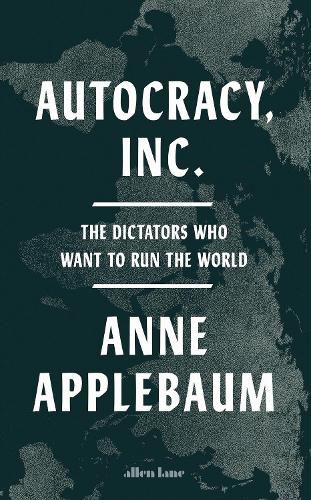
I’ve had this book reserved at the library for some time, and when I finally received it I was disappointed that it seemed to be a rehash of the excellent podcast series that I mentioned back in November 2024, before this whole Trump 2.0 nightmare began. But it isn’t. Her podcast was called ‘Autocracy in America’, and in the podcast she applies the principles that she spells out in this book Autocracy Inc to the American context, with much prescience, I’m afraid.
She notes that the old cartoon image of the ‘bad man’ autocrat is outdated.
Nowadays, autocracies are run not by one bad guy but by sophisticated networks relying on kleptocratic financial structures, a complex of security services- military, paramilitary, police- and technological experts who provide surveillance, propaganda, and disinformation. The members of these networks are connected not only to one another within a given autocracy, but also to networks in other autocratic countries, and sometimes in democracies too. Corrupt, state-controlled companies in one dictatorship do business with corrupt, state-controlled companies in another. The police in one country may arm, equip, and train the police in many others. The propagandists share resources- the troll farms and media networks that promote one dictator’s propaganda can also be used to promote another’s- as well as themes: the degeneracy of democracy, the stability of autocracy, the evil of America. (p.2)
In this book, she sweeps her searchlight onto the strongmen who lead Russia, China, Iran, North Korea, Venezuela, Nicaragua, Angola, Myanmar, Cuba, Syria (possibly outdated), Zimbabwe, Mali, Belarus, Sudan, Azerbaijan in particular- although she mentions some three dozen others. What a depressingly large list! Autocracy Inc, as she calls them, collaborate to keep their members in power by ignoring multiple international agencies, buoyed by a conviction that the outside world cannot touch them.
Her opening chapter ‘The Greed That Binds’ looks particularly at Putin, and the schemes he established to enrich oligarchs in the breakup of the Soviet Union. These oligarchs have invested in America and Britain.
Her second chapter ‘Kleptocracy Metastasizes’ turns to Chavez’s Venezuela, where Autocracy Inc. stepped in after Chavez’s death in 2013, where Russian and Chinese money poured into the country to enable Chavez and then Maduro to postpone any kind of financial reckoning as they destroyed the economy. Cuba joined with Venezuela in an anti-American agenda, and Maduro and Turkey’s Recep Tayyip Erdogan share a dislike of democracy and anti corruption movements in their own countries. Improbably, Venezuela and Iran, despite their many differences, relate on the basis of shared grievance, with Iranians buying Venezuelan gold, and sending food and gasoline in return and assisting with the repair of Venezuelan oil refineries. She looks at Uebert Angel, an evangelical pastor and British-Zimbabwean businessman who is involved in gold-smuggling schemes, some associated with Zimbabwe’s ruling party and its president Emmerson Mnangagwa. The ruling party has a long standing relationship with the Chinese Community Party and Putin’s Russia.
Chapter 3, ‘Controlling the Narrative’ looks at cybersecurity and firewalls as a way of rewriting history, as for example, in China with Tiananmen Square. Spyware and surveillance is a way of autocracies justifying their abuse of electronic technologies. Domestic propaganda in Russian state television devotes huge slabs of time to America’s culture wars. China has made an enormous investment in international media, which makes possible the spread of misinformation internationally, and RT (Russia Today) has sites which writes material, is translated into other languages, and published on ‘native’ sites to make them seem local. Yala News, run by a Syrian businessman for example, has taken material from Russian state media and spread it through Arabic news sites. As we know, websites and videos can be fake.
Chapter 4 ‘Changing the Operating System’ looks at the ‘rules-based order’ (something that powerful countries feel themselves exempt from) and the removal of language that constrains Autocracy Inc from the international arena altogether. Instead of ‘human rights’, China wants to prioritize the ‘right to development’. The term ‘sovereignty’ is used in different ways. ‘Multipolarity’, a word preferred by the Russian information networks, is meant to be fair and equitable, but is now the basis of a whole campaign systematically spread on Russia Today in English, French, Spanish and Arabic, and repeated by information-laundering sites such as Yala News. Alternative institutions in a ‘multipolar’ world agree to recognize each other’s ‘sovereignty’, not to criticize each others’ autocratic behaviour and not to intervene in each other’s internal politics. Not every member of BRICS and the Shanghai Cooperation Organization is an autocrat, but she asserts that
…if the old system was designed to inculcate the “rule of law”, these new institutions are meant to promote “rule by law”- the belief that “law” is whatever the current autocrat or ruling party leader says it is, whether inside Iran, Cuba, or anywhere else in the world. (p. 107)
She looks particularly at the Syrian Civil War and the Russian-led campaign against the White Helmets, and the involvement of the Wagner Group.
Chapter 5 ‘Smearing the Democrats’ looks at ways that the people have fought back in Poland, Venezuela, Burma and Hong Kong- although this is a very discouraging list (except for Poland). The response of autocratic government to challenge is to mount smear campaigns and make accusations of foreign interference. More sophisticated autocracies have moved beyond just killing their opponents, and now prepare legal and propaganda campaigns in advance, designed to catch democracy activists before they gain credibility or popularity.
Applebaum’s book is dedicated “for the optimists” but it’s hard to find much cause for optimism here. Her epilogue ‘Democrats United’ brings the book even more up to date by looking at Ukraine and Israel. She emphasizes that in no sense is the modern competition between autocratic and democratic ideas and practices a direct replica of the 20th century cold war. Many countries do not fit neatly into the category of either democracy or autocracy and divisions run inside countries as well. She urges a reconceptualization of the struggle for freedom as not against specific states or countries, but against autocratic behaviours, where-ever they are found- in Russia, China, Europe and the United States. She spells out a number of steps
- Put an end to transnational kleptocracy through ending the whole financial system that makes it possible e.g. in real estate transactions and money-laundering and through an international anti-kleptocracy network.
- Don’t Fight the Information War- Undermine it by challenging the information systems at a government level (fat chance, with Musk in power) and joining forces to make Reuters, the Associated Press and other reliable outlets the standard source of global news instead of Zinhua (China) and R.T. (Russia)
- Decouple, De-risk and Rebuild – ensure that countries do not remain dependent on other autocracies
She finishes by noting that:
There is no liberal world order any more, and the aspiration to create one no longer seems real. But there are liberal societies, open and free countries that offer a better chance for people to live useful lives than closed dictatorships do. They are hardly perfect. Those that exist have deep flaws, profound divisions, and terrible historical scars. But that’s all the more reason to defend and protect them….They can be destroyed from the outside and from the inside,too, by division and demagogues. Or they can be saved. But only if those of us who live in them are willing to make the effort to save them (p. 176)
I feel as if much of this book has been superseded by recent events in America, which is really demonstrating where these links between autocracies are operating. There is one serious omission. Until the afterword, she is largely silent on Israel (I think that she herself is of reform Jewish heritage) and its provision of surveillance and military technologies to autocracies, that was described in Antony Loewenstein’s The Palestine Laboratory (which I see is now a documentary). There are other chapters earlier in the book when she could have looked at Israel earlier.
However, particularly since Trump’s inauguration, her articles in The Atlantic, bring her analysis to current events at both the American and international level, and she is an active and articulate participant in current political commentary. This book ranges over a huge number of countries and their leaders, and she told us quite clearly how Trump fits into the Autocracy Inc. model in her recent podcast. Americans can’t say that they weren’t warned, and the whole word is bearing the consequences.
 The Resident Judge of Port Phillip