The Rest is Politics (US edition) With Trump’s pardoning of the January 6 rioters, it’s even more important than ever to resist his re-branding of the Capitol riots as a “day of love”. Anthony Scaramucci (who I don’t think I like very much) and the BBC’s correspondent Katty Kay are running a series, similar to the one they did on the 2016 election, How Trump Won the White House eight years after the event. In this present series, they are looking at the 2020 election which was won by Joe Biden, and which led to January 6 2021. Episode 1: Trump’s Insurrection: The Collapse of his Presidency looks at the circumstances that led to Trump’s defeat when a year earlier he looked invincible. First there was COVID, which Trump downplayed at first, delaying for 6 weeks which let to a million deaths. (A million!) Trump was a natural conspiracy theory fueller, and like a crazy uncle, he embraced the idea of bleach. Then there was the death of George Floyd which led to huge mobs of protestors on both sides, at a time when people were supposed to be isolating. In the midst of the riots Trump was sent to a “safe room” which led to accusations of being a scaredy-cat, which he countered by his walk to St John’s Chapel flanked by the military and bearing a bible. His instinct was to order police and troops to shoot at protestors- something to bear in mind as we head into his second presidency. Trump began calling for the elections to be delayed, but this didn’t happen. After the election Pelosi formed a secret committee to investigate possible scenarios where Trump would cause problems, and January 6th was identified as a problematic date then. After an initial flush of votes for Trump, the postal votes began to be tallied and Trump’s lead disappeared. Nonetheless, he went out in the early morning and claimed victory prematurely.
The History Listen The ABC is recycling its programs over the summer break, and this episode on John Friedrich Friedrich the Fraud was originally aired on 9 December 2023. From the ABC website “the former head of the Victorian Division of National Safety Council of Australia, was also once called Australia’s greatest conman. Back in the 1980s, he famously made $293 million of investors’ money disappear. When his fraud was uncovered, he went missing himself for sixteen days, prompting a nationwide manhunt and a media storm that reported both facts and the fictions.” In my mind, the controversy over Friedrich and the National Safety Council all gets mixed up with the mess that Victoria was in at the time. It seems incredible that Friedrich had this whole constructed persona that saw him able to apply for huge amounts of money fraudulently – and yet no-one can say where the money actually went.
Global Roaming I nearly always listen to Global Roaming each week, but I don’t usually record it here because most of the episodes are too current and ephemeral for me to want to recall them later. But over the summer break, Geraldine Doogue and Hamish Macdonald have been hosting a 6-part series AUKUS Investigated which leaves me thinking that we have been absolutely sold a pup that sees us paying US to beef up its submarine capacity for submarines that they could easily withhold from us because they find that they need them themselves. Episode 1 investigates how AUKUS came about – who spoke to who, what the true motivation was for going nuclear and whether the total secrecy around the deal was justified. (I can’t believe that a nuclear submarine is going to remain ‘invisible’ forever, which gets rid of that argument). Episode 2 Bang for Buck? explores what the scheme involves, what the key challenges are to making it work, and we get some cold hard facts about what it is really going to cost us. Episode 3: The China Question addresses the elephant in the room, which is that this whole thing is actually about China. Episode 4: The 51st American State? asks whether we are getting the short end of the stick with this deal, and sacrificing our sovereignty to boot (my answer- yes. We’re opening up for two big army bases on our soil just like Pine Gap) Episode 5: Radioactive Ripples what happens to the waste that will remain dangerous for generations of Australians to come? Is this just the introduction of Australia as nuclear dump for the rest of the AUKUS partnership? I bet the nuclear industry is salivating over this. Episode 6: Premier Peter Malinauskas is very enthusiastic about AUKUS, as he should be given that in theory the submarines will be built there. While I agree that we should have sovereign ship building capacity (just like we should have sovereign pharmaceutical-manafucturing capacity, too) I think that we should bite the bullet, devote more money to defence, and go it alone. This is a really good series, which raises lots of questions.
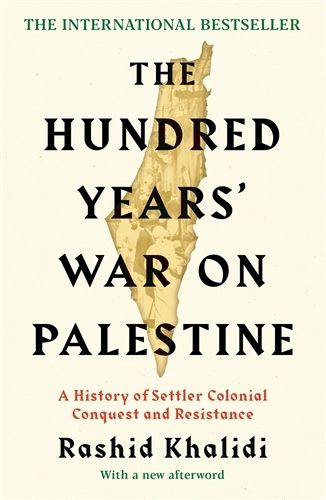
Before Christmas, a number of Australian writers put together a bundle on books on the Israeli/Palestinian conflict, parcelled them up and gave them to Australian politicians for their summer reading. The books were endorsed by both Australia Palestine Advocacy Network (APAN) and the Jewish Council of Australia (JCA), and sent with a letter signed by more than 50 writers including Tim Winton, Michelle de Kretser, Charlotte Wood, Benjamin Law, Anna Funder, Trent Dalton and Hannah Kent. This book, written by historian and Arab scholar Rashid Khalidi, was one of the five books chosen, with other titles by John Lyons, Ilan Pappé, Kate Thompson, and Sara Haddad. Apparently, the parcel was opened by the staff of Liberal politican Dave Sharma, who re-packaged them and returned them to sender. It is his loss, but it is our loss too, as a voting public dependent on the knowledge and mindset of our politicians.
In the Afterword, written in April 2024 and post-October 7, Khalidi summarizes the thesis of the book, which he feels has been validated by current events:
…events in Palestine since 1917 resulted essentially from a multi-stage war waged on the indigenous Palestinian population by various great powers allied with the Zionist movement- a movement that was both settler colonialist and nationalist, and that aimed to replace the Palestinian people in their ancestral homeland. These powers later allied with the Israeli nation-state that grew out of that movement. Throughout this hundred years’ war, the Palestinians have fiercely resisted the usurpation of their country. … It is not a age-old struggle between Arabs and Jews, it has not been going on since time immemorial, and it is not simply a conflict between two national groups, two peoples. It is a recent product of the iruption of imperialism into the Middle East; the rise of modern nation-state nationalisms, both Arab and Jewish; of the necessarily violence European-style settler-colonial methods employed by the Zionist movement to “transform Palestine into the land of Israel”… and of Palestinian resistance, both non-violent and violent, to these methods. Moreover, this war has never been just between Zionism and Israel on one side and the Palestinians on the other, with the latter occasionally supported by Arab and other actors. It has always involved the massive intervention of the greatest powers of the age on the side of the Zionist movement and Israel: Britain until World War II, and the United States and others since then….Given these facts, in this war between colonizer and colonized, oppressor and oppressed there has been nothing remotely approaching equivalence between the two sides, but instead a vast imbalance in favour of Zionism and Israel. (p. 256, 257)
Khalidi divides his book into six declarations of war against Palestine, not all of which involved actual troops on the ground. The First Declaration of War 1917-1939 goes through the lead-up to the Balfour Declaration of 1917, which emerged from the philosemitic desire to ‘return’ the Hebrews to their biblical homeland (a sentiment which still animates Evangelical Christians today), and a rather more pragmatic desire to stop Jewish emigration to Britain. The people of Palestine had had their expectations raised for the possibility of Arab independence and self determination, promised by the British in 1916. But now they were to be ruled under British governance in the 1922 Mandate for Palestine, which incorporated the text of the Balfour Declaration verbatim, and amplified its commitments. It allowed for the creation of a Zionist administration parallel to that of the British mandatory government, tasked with exercising many of the functions of the sovereign state for the Jewish part of the population. However, as war threatened in 1939, there was a shift in London’s policy away from Zionism because Britain needed the support of Islamic countries in fighting the war. The United States took up the role of providing diplomatic cover and arms to Israel instead- a stance that it has maintained to this day.
The Second Declaration of War 1947-1948 describes the immediate aftermath of the Nakba, willed by the Zionist state-in-waiting, and caused by foreign interference and fierce inter-Arab rivalries (p. 58). The Zionist movement had mobilized American politicians and public opinion, prompted further by widespread horror at the Holocaust. The Palestinians
entered this fateful contest woefully unprepared both politically and militarily, and with fragmented and dispersed leadership. Moreover, they had little external support except from the deeply divided and unstable Arab states, still under the influence of the old colonial powers, and which had poor and largely illiterate populations. This was in stark contrast to the international standing and the strong, modern para-state built up by the Zionist movement over several decades. (p.70)
The Third Declaration of War in 1967- or the Six Day War- was prompted by the rise of militant Palestinian commando groups within the context of what has been called “the Arab Cold War”, where Egypt led a coalition of radical Arab nationalist regimes opposed to the conservative Saudi Arabia bloc. After a lightning first strike by the Israeli airforce, which destroyed most Egyptian, Syrian and Jordanian warplanes on the ground, the Israeli forces decisively defeated the Egyptian and Jordanian armies, and occupied the Gaza Strip, the Sinai Peninsula, the West Bank and Arab East Jerusalem. This defeat was followed by U.N. Security Council Resolution 242, drafted by the British permanent representative but actually crafted by the United States, which allowed for expanded Israeli boundaries on grounds of security (a stance that we are seeing played out on all sides of Israel today), walking away from the more limited boundaries in the 1949 agreement. It led to the rise of Fatah, founded in 1959 by a group of Palestinian engineers, teachers and other professionals, headed by Yasser Arafat. To co-opt and control this rising tide of Palestinian nationalism, the Arab League founded the PLO in 1964 , under Egypt’s leadership, but it was soon taken over by Fatah. By 1979 the Egyptians signed the Camp David agreement with the PLO. It’s interesting that Jimmy Carter who orchestrated the Camp David Accords initially called for a homeland for the Palestinians, but was pressured by Begin’s government, Sadat and local Jewish interests to abandon this push for a comprehensive settlement.
The Fourth Declaration of War was Israel’s invasion of Lebanon in 1982 which, although it bombed Lebanon, had as its primary focus the Palestinians living there and the larger goal of changing the situation inside Palestine. Israel wanted to destroy the PLO in Lebanon and to weaken the Palestinian situation in West Bank, Gaza and East Jerusalem so that they could be annexed. The United States lent support to Israel, and the Arab regimes succumbed to American pressure by doing nothing practical to help the PLO beyond declaring their support. The PLO found itself isolated, largely because of the PLO’s own heavy handedness which led to the loss of support amongst Lebanese citizens who were caught up in the war. As a result, the PLO agreed to withdraw from Beirut. Even though the US government promised to protect Palestinian refugees remaining in Lebanon, the international forces supervising the evacuation withdrew as the last ship left. Massacres at the Sabra and Shatila refugee camps ensued. The lasting results of this 1982 war were the rise of Hezbollah (or Hizballah) and the first significant shift in opinions about Israel in the international media, and negative perceptions in America and Europe.
The Fifth Declaration of War took place between 1987 and 1995, sparked by the first intifada which started in Gazan refugee camps in December 1987. In response, Israel’s “iron fist” policy provided further vision of violence and brutality, leading to a further erosion of support in the West. Spontaneous and bottom-up, like the 1936-9 revolt, it was local and flexible, and Khalidi considers it “an outstanding example of popular resistance against oppression and [it] can be considered as being the first unmitigated victory for the Palestinians in the long colonial war that began in 1917” (p.174) But the PLO leadership in exile in Tunisia tried to dominate this grassroots movement from a distance, and did not take advantage of the Palestinian presence at the United Nations. In 1988 the PLO issued the Palestinian Declaration of Independence which formally abandoned the PLO’s claim to the entireity of Palestine, accepted the principles of partition, a two-state solution and a peaceful resolution to the conflict. It accepted SC 242 and SC338 as the basis for a peace conference, but it didn’t go anywhere. The PLO did not understand the significance of Camp David, or the implications of the decline of USSR. During the Gulf War in 1990-91, the PLO supported Iraq, which made it a pariah amongst the other Arab states. At peace talks in Madrid in 1991 the PLO acquiesced to the Israeli insistence that there be no independent Palestinian representation, and Israeli control over what topics could be discussed. Further attempts in 1992 were stymied by the tension between the PLO based in Tunisia, and Palestinians from the Occupied Territories. However in 1993 a secret track of negotiations resulted in the Declaration of Principle between Israel and the PLO that was signed on the White House lawn in September 1993. With this Declaration, Israel recognized the PLO (but importantly, NOT Palestine- just the PLO) and the PLO recognized the State of Israel. At the Oslo I accords the Palestinian negotiators were out of their depth, and signed up to what Khalidi characterizes as
a highly restricted form of self-rule in a fragment of the Occupied Territories, and without control of land, water, borders, or much else (p. 200)
An Interim Agreement on the West Bank and the Gaza Strip, or Oslo II, completed this ruinous work by dividing both regions into a patchwork of areas A B and C, with over 60% of the territory Area C under complete, direct and unfettered Israeli control. Khalidi believes that this was a trap, because Israel was able to control PLO movements and held all the power. The PLO was made responsible for security for Israel and the US continued to provide most of the diplomatic muscle.
The Sixth Declaration of War between 2000 and 2014 saw the establishment of roads, permits and checkpoints within the fragmented West Bank. Hamas had been established in 1987, promoting itself as a more militant Islamist alternative to the PLO, and claiming again the whole of Palestine, not just the occupied area. Hamas emerged out of the Muslim Brotherhood, and at first Israel was happy to indulge it as a way of splitting the Palestinian national movement. The Second Intifada erupted in 2000, caused by the worsening situation for Palestinians after Oslo and the intense rivalry between the PLO and Hamas, but prompted by Sharon’s visit to the Haram al-Sharif (Temple Mount). Violence soon escalated, and Hamas and Islamic Jihad suicide bombers attacked inside Israel. As the body responsible for security, the PLO suppressed the Hamas attacks, leading to further enmity between the two groups. It was a setback for the Palestinian cause, and Israeli troops re-occupied. In 2005 Arafat died, and was replaced by Mahmoud Abbas. There were further Israeli ground offensives in 2008-9, 2012 and 2014 and regular Israeli incursions into Palestinian areas of the West Bank and East Jerusalem. At the parliamentary elections in January 2006, Hamas ran candidates, emphasizing reform and changes. Hamas gained control of the Legislative Assembly, but both Israel and the Us rejected any Hamas participation in a Palestinian Authority government. Hamas violated the rules of war by using imprecise missiles shot from Gaza into civilian areas in Israel. In response, Israel’s third attack on Gaza in 2014 followed the Dahiya doctrine that the sources of missiles were not to be considered as villages, but as military bases, against which disproportionate force, damage and destruction could be applied.
I’ve gone into this much detail because firstly, I needed to summarize it for my own purposes, and secondly because the Israeli/Palestinian conflict seems to be just one continuous, undifferentiated war. In his conclusion, Khalidi talks about three approaches which can expand the way in which the reality in Palestine can be understood. The first is to compare it with other settler-colonial experiences e.g. Native Americans, South Africans, (Australian indigenous peoples, although he doesn’t mention it) or the Irish. Of course, it is hard to establish this colonial nature, given the Biblical dimension of Zionism, particularly in America where terms like “colonial”, “settler” and “pioneer” have particular resonance. The second lens involves focusing on the gross imbalance of power between Israel and the Palestinians, a characteristic of all colonial encounters. Khalidi rejects the ‘David vs Goliath’ characterization of the conflict, where Israel wants peace but claims that “there is no partner for peace”. Instead, he points out that the Zionist movement and the state of Israel have always had the big battalions on their side (Britain before 1939, US and Soviet support 1947-8; France and Britain in the 1950s and 1060s, and unlimited US support from the 1970s to today). The third, and perhaps most important lens, is that of inequality. There is a contradiction in modern Zionism in that a modern, democratic Zionism has an illiberal and discriminatory essence against the Palestinians. Under Trump the United States became the mouthpiece of the most extreme government in Israel’s history. Khalidi argues that any future negotiations must reject the formula of United States control of the process, and that henceforth the US must be treated as Israel’s partner. He suggests that in the future, China and India may have more say, and that Europe and Russia, which are both geographically closer to the Middle East than America is, may play a larger role.
Khalidi is not just a commentator: he and his family have been participants in the events that he describes here. As a member of the Palestinian educated elite, he includes first-person narratives and his own recollections of events. In this regard, the book is quite similar to Raja Shehadeh’s We Could Have Been Friends My Father and I (my review here). However, this book is more analytical than Shehadeh’s in his division of six separate declarations of wars as a framing structure, and less shaped by his own family history. Khalidi himself was involved in creating the proposal for a Palestinian Interim Self-Governing Authority (PISGA) in 1992, elected by the Palestinian residents of the West Bank, Jerusalem, the Gaza Strip and those displaced and deported by Israel. It did not proceed at the time because it challenged the exclusive Jewish right to the entirety of Israel, and was further hampered by the tepid response of the PLO leadership at the time. Who knows- perhaps its time will come yet, and Khalidi would be a good midwife. He sees shortcomings on both sides: he is critical of Hamas’ actions against citizens, and even more critical of the PLO’s internal politicking and compromised position after the Oslo Accords.
Moreover, he is conscious of Jewish sensibilities- though he does not share them- as well. He argues that any future resolution of the conflict will necessarily and inevitably fail unless it is based on the principle of equality. However, he recognizes that the Israeli attachment to inequality as far as Palestinians are concerned is rooted in a real history of insecurity and persecution, and that Palestinians too need to be weaned from the delusion that Jewish Israelis are not a “real” people with national rights.
While it is true that Zionism has transmuted the Jewish religion and the historic peoplehood of the Jews into something quite different- a modern nationalism- this does not erase the fact that Israeli Jews today consider themselves a people with a sense of national belonging in Palestine, which they think of as the Land of Israel, no matter how this transmutation came about. Palestinians, too, today consider themselves a people with national links to what is indeed their ancestral homeland, for reasons that are as arbitrary and as conjunctural as those that led to Zionism, as arbitrary as any of the reasons that led to the emergence of scores of modern national movements. … While the fundamentally colonial nature of the Palestinian-Israel encounter must be acknowledged, there are now two peoples in Palestine, irrespective of how they came into being, and the conflict between them cannot be resolved as long as the national existence of each is denied by the other. Their mutual acceptance can only be based on complete equality of rights, including national rights, notwithstanding the crucial historical differences between the two. (p.247)
This is a dense, but well-written book. It moves chronologically, but its six-part structure gives shape to what could otherwise be a long list of battles and political moves. For me, it highlights the century-long process of larger powers dictating the Palestinian destiny – as indeed, the recent ceasefire negotiations illustrate yet again with the prominence of outside powers- but also the absolute necessity for an equitable solution if this conflict is ever to come to an end.

 The Resident Judge of Port Phillip