
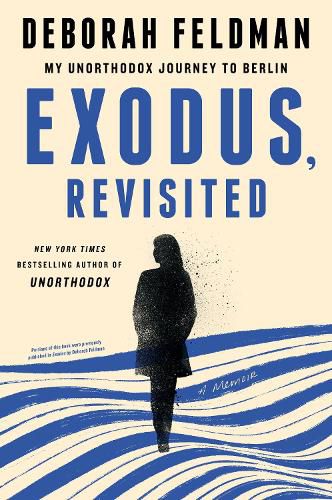
I read this fairly soon after finishing Deborah Feldman’s Unorthodox, written in 2009 which I reviewed here. It is an updating and enlargement of her second memoir Exodus, which was published in 2014 (which I have not read). She could, in no way, be accused of having an ‘unexamined life’ as it has served as the grist for all her writing output to now (in English, at least). I wonder how many memoirs she has left in her: I’m not sure that her life is significant enough to merit three memoirs.
But here we are in 2021, and she’s writing again. The last part of Unorthodox felt rushed, as she bolted towards her present day in 2009. In this book she slows down, and backtracks to describe the process of leaving her marriage and attending college to take her place in the ‘outside’ world. It was difficult for her, and much of the early part of the book involves her tracing through her insecurities and difficulties in establishing a new identity, separate from her family. She does not ever feel properly ‘American’, having been raised in a community with a different language and starkly different lifestyle and religious practices. In order to share custody of her son Isaac, she still needs to live close to her ex-husband Eli, so she exists in an in-between space, separated but still tethered to her previous life through her son. Once her divorce is granted, she can shift further away from New York, still sharing custody of her son, whom she still wants to embrace his own Jewish identity, but without all the rules and prohibitions that curtailed her own life.
It is because she has shared custody that she can carve out large periods of time to travel overseas to Europe, where her American identity is reinforced, but she herself feels more at home. Part of this is the vicarious trauma that she felt she absorbed from her beloved grandmother, who was a concentration camp survivor. She embarks on a bit of a ‘Who Do You Think You Are’ genealogical search, visiting places important to her grandmother’s life, a genre of writing that doesn’t particularly appeal to me, I’m afraid. Nor is the writing is as tight in this follow-up, and her use of adjectives is particularly cloying.
After a succession of relationships with European men (particularly German men), it is as if she is deliberately putting her hand into the flame by being drawn to Germany, the source of the Holocaust. She seeks out anti-semitism and is outraged when she finds it, and is judgmental of societies which she feels have not condemned it sufficiently.
I must admit that at this point, her book runs into present-day politics that did not exist when she wrote it. She follows closely a court-case against an offensively tattooed neo-Nazi whom she saw in her local swimming pool who receives a lenient sentence under Germany’s anti-Nazi laws. She is only satisfied when the court case is appealed by the state prosecution all the way up through the court system until the man is finally jailed (albeit for a short period of time). While she is no Zionist (in fact, she bridled against the theocracy in Israel that prohibited everywhere the consumption of bread during a religious festival), I wonder if she would be as critical of Germany today given what I see as its determination not to condemn Israel’s actions in Gaza. The rise and possible coming to power of AfD perhaps vindicates her consciousness of latent antisemitism : on the other hand, perhaps Germany’s determination to make antisemitism unacceptable has itself given rise to AfD? It’s complicated, and I think that her own attitudes towards Germany and Germans are complicated, and somewhat distorted, too.
It says much about the stringency of the rules of the Satmar community that she leaves her family so completely, even though they are living in the same city. Her determination to pay homage to her grandmother’s experience takes her to the other side of the world, but she seems to have made no effort to see her grandmother again, even from a distance. Is she even still alive? Perhaps she knows that any attempt at contact is futile.
Even more than the first book, this one is very, very different from the Netflix program. She must be quite sure that her ex-husband, Eli, isn’t of a suing disposition because he is not at all the driven, possessive man depicted in the series. On the contrary, he accepted shared custody, and seems to have been a perfectly competent and engaged father. Certainly, she could say that Unorthodox is only based on her life, and that the producers went off on a frolic of their own at the end (something that they admit to in the accompanying Netflix documentary), but the series is unfair and just plain wrong about her ex-husband’s actions and attitudes. But someone seeing only the Netflix version, without reading this book, would be oblivious to that.
All in all, I think I’ve had enough of Ms. Feldman’s memoirs.
My rating: 6.5/10
Sourced from: Yarra Plenty Regional Library
Read because: I enjoyed Unorthodox and wanted to know what happened next.
 The Resident Judge of Port Phillip
The book “Unorthodox” is a fictionalized biography by Deborah Feldman. I can poke many holes in it, but I don’t bother. People believe what they want to. Deborah, due to an abusive mother, felt trauma, wanted attention and created new, false memories that she truly believes.