
SPOILER ALERT
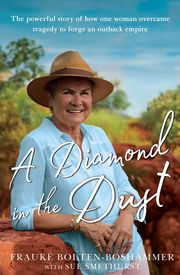
Is it wrong to judge a book by a cover? Sometimes, but bear in mind that the publisher chooses a cover that will attract what they perceive to be the audience. I don’t think that I’m this audience. As soon as I saw the picture of the woman in the Akubra hat against a background of the Australian outback, I thought of all those rural romances and inspirational biographies (Sara Henderson et al) that I avoid like the plague.
German-born Frauke Bolten was a reluctant migrant to Australia. She arrived at a small outback airstrip in blistering heat at Kununurra in northern Western Australia with her children, her husband Friedrich having purchased a property on the Ord River Scheme without even discussing it with her. As a woman of faith who believed in her wedding vow to “obey”, she negotiated a two-year trial of living there with her husband (which turned out to be forty years) and the company of a nanny to assist with the children. She and her husband had previously farmed in Rhodesia, before returning to Germany to establish a farm and family which she thought would establish them back home forever. This new endeavour in Western Australia, grudgingly undertaken on her part, threw up many challenges at first, largely through her husband’s pigheadedness and ill-advised innovation, then as the children left home for boarding school in the city and the financial problems mounted, Friedrich’s depression increased.
And then her husband committed suicide. Shocked and heartbroken, she found herself resisting the assumption by the families ‘back home’ that she would of course return home: the widow, the daughter, the daughter-in-law forever. Her children did not want to return to Germany either, and so they stayed. She remarried Robert Robert Boshammer, ten years her junior and of similar German heritage. From a small-scale backyard tourist venture she started selling diamonds from the nearby Argyle Diamond mine, gradually increasing the business to a large tourist enterprise in the town. Further tragedy was to come, with her son Peter committing suicide too, and the suicide of Doris, who managed the shop for her. As her children married and went on to have children, Frauke herself had to confront cancer.
The book is co-written with journalist Sue Smethurst, and I found myself wondering what Smethurst added to the book because the prose itself is very clichéd and pedestrian. Perhaps her assistance came in negotiating the narration of the suicides, a subject that needs to be treated carefully.
This is Bolten-Boshammer’s story, but it a very blinkered and shallow one. Both in Rhodesia and Kununurra, she lived in a German-centred community, seemingly oblivious to the social and political environment in which she was living. There is not a word of the bubbling tension that will emerge with independent Zimbabwe, or the edgy relationship in Kununarra between its large indigenous population and its white community, attracted by the technological hubris of the Ord River Scheme. It felt a bit like reading of the British ex-pats in Happy Valley in Kenya, with their own self-contained world that tried to re-create ‘home’ in a starkly different environment that existed in a bubble, completely independent of the country around them. Their Christmas customs, the gap year holidays back in Germany for her children where they clearly had enough German language to communicate with their family, the values she drew from her religion and from her culture- these are all German.
The writing itself was flat and banal. It felt like a series of photocopied Christmas letters, with their forced jollity, catching up with the children’s latest ventures, the marriages, the grandchildren, the celebrations. I know that English is Frauke’s second language, but there’s no idiosyncrasy of phrase here: it’s just turgid sludge.
I complained the whole way through.
My rating: 4/10
Read because: It was an Ivanhoe Reading Circle selection. I am really surprised that this book was on the program because the books are usually of much better quality than this. The presenter for the night did a wonderful job in extracting the few good points about it.
Sourced from: purchased e-book. Thank God I didn’t spend the money on trying to track down a hard copy.
 The Resident Judge of Port Phillip