
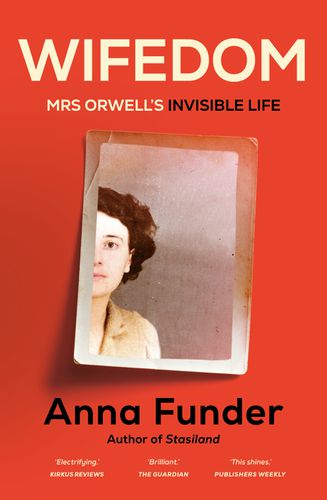
Sometimes a writer takes on a task, knowing that it is risky. Funder did, and in a way, Orwell himself made her do it. After the age of 30, he writes, people almost abandon the sense of being individuals at all, and live for others or are smothered under drudgery. Not writers, however, who belong to a minority class of gifted, wilful people who are determined to live their own lives to the end. Was this true of Funder herself? An award-winning Australian writer and historian, she knew that despite intending to share the responsibilities of life and parenthood with her husband Craig, she had been doing the lion’s share. As a writer and a wife, she found herself envying the titantic male writers for the
…unpaid, invisible work of a woman [to create] the time and -neat, warmed and cushion-plumped- space for their work….To benefit from the work of someone who is invisible and unpaid and whom it is not necessary to thank because it is their inescapable purpose in life to attend to you, is to be able to imagine that you accomplished what you did alone and unaided…Invisible workers require no pay or gratitude, beyond perhaps an entire, heartfelt sentence in a preface, thanking ‘my wife’. ..As a writer, the unseen work of a great writer’s wife fascinates me, as I say- out of envy. I would like a wife like Eileen, I think, and then I realise that to think like a writer is to think like a man…But as a woman and a wife her life terrifies me. (p. 53, p.55)
When she read a piece that Orwell had written in his private notebook, close to his final illness, she recoiled from the misogyny and repugnance that he showed towards his wife: that same wife who had made his writing possible. She turned her attention from Orwell to his wife Eileen. She had thought of fictionalizing her picture of their marriage, but the publication of Sylvia Topp’s Eileen: The Making of George Orwell in 2005 and the recent discovery of six letters from Eileen to her friend Norah caused her to change her mind. Eileen’s voice had been suppressed for so long, and she didn’t want these six, so rare, letters to be swallowed up into the maw of source material. And so she writes this book as a ‘counter-fiction’, marking out Eileen’s words in italics so that they keep their own integrity and distinctiveness, but fictionalizing the context in which they are written as she traces their marriage from 1935 and their first meeting through to Orwell’s death in January 1950.
A long-time admirer of George Orwell’s work, Anna Funder had immersed herself in Orwell scholarship, reveling in his essays, combing through his six biographies, doing the Orwell Pilgrimage to Catalonia and Jura, and revisiting his books. She is aware of the risk she is running, in these ‘cancel culture’ times
…Orwell’s work is precious to me. I didn’t want to take it, or him, down in any way. I worried he might risk being ‘cancelled’ by the story I’m telling. Though she, of course, has been cancelled already- by patriarchy. I needed to find a way to hold them all- work, man and wife- in a constellation in my mind, each part keeping the other in place. (p. 23)
There is a lot going on in this book. She mounts a feminist attack against patriarchy; she reflects on the writing process and the needs of writers; she combines Orwell’s biography and her own autobiography; she trails Orwell and Eileen through their marriage chronologically, and she takes Orwell’s other (male) biographers to task for their unthinking acceptance of the minor role of “my wife”. Is there too much going on here? Perhaps, although by drawing on her own reflections on the writing process and the role of her partner in a prize-winning, internationally recognized writing career is to provide a new perspective on this other writing career of a largely-ignored writer nearly one hundred years ago.
As it happens, I read this book immediately after reading Orwell’s Homage to Catalonia. I had been disconcerted by Orwell’s erasure of Eileen through the sparing references to “my wife”, but having now read Funder’s account of their time in Spain, I feel angry that his account stands unchallenged. All those passive sentences of how urgently-needed supplies miraculously appeared or arrangements were made, suddenly made sense. Even the scene in which Eileen appears in the hotel lobby to warn Blair that he was in danger elides completely the fact that she had been waiting literally days for him and downplays the very real peril that Eileen herself was facing. That self-deprecating humour and false humility is all a charade.
Like Funder, I am angered too by the manipulation of quotes and shuffling of facts by his earlier biographers in lionizing the man and expunging Eileen. Funder has obviously read these biographies with one finger holding open the footnotes page, and she has followed up each one.
From a 21st century perspective, in the light of ‘me too’ and awareness of ‘coercive control’, Orwell does not come out of her analysis well. As his late-life reflection on the “incorrigible dirtiness” and “terrible, devouring sexuality” of women (p.11) shows, he had a deeply embedded repugnance for women. He was constantly unfaithful, and by immuring themselves away in a dishevelled cottage in the country – at his insistence- far from the city, he separated her from her friends and their milieu. He thought nothing of going off to follow his own desires and interests: over to Spain to report on the Civil War, off to Europe while Eileen is dying, absent again when she was facing court to gain custody of their adopted son. She was his typist, his editor, his sounding board; she cooked, she gave up her comforts for his. She pandered to his ‘bronchitis’ while he largely ignored her pain from cancer. He was jealous of their friend Georges’ infatuation with her, yet he revelled in the ‘permission’ she granted for him to have affairs – a permission harangued and co-erced from her, or freely given? He pursues her friends (because they are her friends?) and “pounces” on women, after her death, in order replace her and the day-to-day burdens she had carried, as quickly as possible.
But without wanting to excuse him- who knows what goes on in a marriage? The story goes that Orwell instantly declared on meeting her “Eileen O’Shaughnessy is the girl I want to marry”. Conversely, Eileen told her friend “I told myself that when I was thirty, I would accept the first man who asked me to marry him.” What was her attraction to him? She had won a scholarship to Oxford where she read English alongside Auden, Spender and MacNeice, but failed to get a first (no women were given firsts in 1927, the year she graduated), and she relinquished her own writing. She was undertaking a Master Of Psychology at University College London, but this too was sublimated to Orwell’s demands for quiet, food, the country lifestyle. She seemed heedless to her own safety during the Blitz, and opted for the cheapest treatment of her cancer, a treatment that killed her. People and relationships are complex.
I enjoyed this book a great deal. I appreciated Funder’s rigour in interrogating Orwell’s biographies and biographers, I liked the respect with which she treated Eileen’s own words in the letters. Once you move beyond a slavish chronology, all biographies are an argument, and Funder’s argument is right there on the cover with the title “Wifedom: Mrs Orwell’s Invisible Life”. I could have had a little less of Funder’s 21st century writerly angst, but it comes from a place of knowledge and identification. Reading it immediately after Homage to Catalonia convinced me completely of Funder’s thesis: that “my wife” was a real, living, intelligent woman who was a fundamental, and completely obscured, part of one of the most lionized literary marriages.
My rating: 9/10
Read because: Ivanhoe Reading Circle September selection. It was an open meeting, and the paper presented by Meredith Churchyard was excellent.
Sourced from: purchased.
 The Resident Judge of Port Phillip
This does sound good. Thanks.