
Daily Archives: October 31, 2024

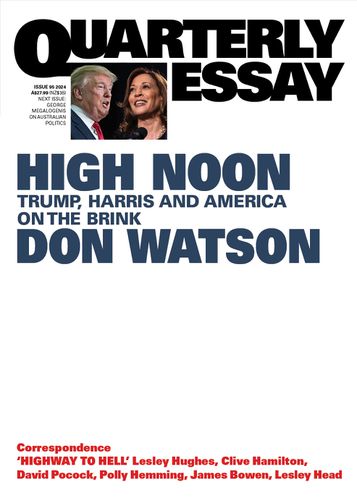
‘Quarterly Essay No. 95: High Noon: Trump, Harris and America on the Brink’ by Don Watson

2024, 90 p

As my son could no doubt tell you, I have a bad habit of leaving journals and magazine unread and wrapped up in their plastic for months…well, years… but with the US election bearing down on us next week, I thought that I’d better read Don Watson’s most recent Quarterly Essay before it was completely out of date.

Don Watson has been writing about America for some time, and he wrote his Quarterly Essay 63 ‘The Enemy Within’ in 2016, deploring the prospect of a Trump victory the first time around. In fact, how ironic that Trump is using the phrase ‘The Enemy Within’ during this campaign to describe the people he will target after becoming president.

In this most recent Quarterly Essay he adopts a similar methodology to the one he used in his earlier essay, and in his book American Journeys where he travels to American cities to talk with voters of both Republican and Democratic persuasions. In Enemy Within he focussed on Wisconsin, and in this most recent iteration he focusses on Detroit and Kalamazoo. The essay is dated 23 August, and the narrative moves as events unfold, including the assassination attempt and Joe Biden’s withdrawal from the candidacy, opening the way for Kamala Harris. Just as in his earlier essay, he has nothing but contempt for Trump, but recognizes that people’s motivations for supporting him have to be at least acknowledged.

Could there possibly be anything left to say about Trump? Probably not, at this stage of the game although events continue to highlight some of the points that he makes in this essay, most of which have been also made by other people. Most particularly, he talks about Trump’s connection with wrestling:

Trump has turned Republican politics, and therefore much of American politics, into the wildly adversarial and addictive world of TV wrestling, an entertainment he used to make money and forge his public persona…TV wrestling involves a lot of boasting, posturing and abusing, as well as body slamming. The wrestlers are real, but not real…. Fans enter the world of TV wrestling as they enter any other fiction, knowing it’s make-believe but open to its seduction. They boo and hiss and shout, much as kids used to at Punch and Judy shows, much as we all do during elections. By making politics like TV wrestling, Trump created a fictional setting for his fictions. He can be as abusive and as untruthful as he likes. In a fictional world, to lie and keep on lying is a requirement…You can sound demented, might even be demented; the more demented you are the more you blend with the environment. (p. 4)

When I saw Trump at Madison Square, with the audience brandishing their signs behind him on cue, it certainly evoked a wrestling match. Not just the presence of Hulk Hogan on stage with him, but also the booing and braying of an audience looking for goodies and baddies and enjoying the ‘show’. Don Watson is not the only person to note the Trump/wrestling connection, but it certainly sprang to mind after reading his essay so recently.

It’s rather discouraging to think that by the time the next Quarterly Essay hits the shelves, with the correspondence responding to this essay, we’ll know the outcome. For better or worse.

Rating: 7/10 (I’ve read it all before….)

Sourced from: own copy from subscription

I hear with my little ear: Podcasts 8-15 October 2024

Shell Game This is a six-part series hosted by journalist Evan Ratliff, although you’re never really sure whether you’re listening to HIM or not. He created a voice clone using AI which pretty much sounds like him, except for the long pauses between utterances: something that I’m sure will be overcome in the future. He has great fun trying it out on cold-callers until he starts to feel a bit guilty, given that it’s someone’s job, so he then turns to scammers without any feelings of guilt. Ironically, the scammers are happy to play along because they’re just paid to keep people on the line. The rise of therapy-language (“thank you for reaching out” etc) makes it fairly easy to give the appearance of sincerity, and he tries it out with AI-generated therapists, and then with a ‘real’ therapist through Better Help. But even though he’s having fun with all this, even he draws the line with using his voice clone with his father who is battling cancer. Ironically, his father embraces the whole idea of a voice clone and embarks on some cloning of his own. Shell Game was named one of the the best podcasts of 2024 by New York Magazine, and it’s good.

In the Shadows of Utopia From Cambodge to Kampuchea I’m really enjoying this series, but the length of episodes is becoming ridiculous. This one went for 2 hrs and 45 minutes. It covers the period 1930 – 1945 and I learned just so much. After 75 years of French rule, there was little appetite in Cambodia to rebel against the French (unlike in Vietnam). In Vietnam Ho Chi Minh was part of Comintern, itself under Russian influence, but rather resentful that he was forced to call his party the Indo-Chinese Communist Party, even though there was virtually no activity anywhere other than Vietnam. Indo-China generally was affected by both the Japanese expansionism and the fall of the French government to become the Nazi-endorsed Vichy Government. In both Vichy France and in Cambodia itself, there was a harking back to the glories of the past: in France it was Joan of Arc, and in Cambodia it was Angkor. After yet another Thai/Cambodian war, where territory was lost once again, Japan stepped in and gave both Battambang and Siem Reap back to the Thai government (but not Angkor itself). In 1941 King Monivon lay dying at Bokor Hill Station (which I didn’t get round to seeing- but next time!), humiliated by the loss of his territory, and on his death, the French chose his grandson, Nordom Sihanouk to be King. He was only 19 years old and a bit of a playboy. Meanwhile, in 1936 the first Khmer-language newspaper started, edited by Son Ngoc Thanh. It increasingly took a pro-Japanese and anti-colonial line. In 1942 the French tried to impose the Gregorian calendar and a romanized alphabet (Oh! if only they had succeeded!!) and this led to strong resistance from the Monks. On 20 July 1942 the newspaper led a protest of perhaps 1000-2000 people, of whom about half were monks. The editor was arrested, along with 200 other people, including members of the Indo-Chinese community party. The editor Thanh escaped jail, but his letters reveal his naivete and lack of meaningful support for an uprising against the French, looking to Japan as the saviour of the “yellow nations”. The US bombed Phnom Penh as the war turned against the Japanese. In response, the Japanese began training local militias and they interned French officials (a bit of a surprise because these were Vichy French officials). Sihanouk declared independence at the request of the Japanese. Six weeks later, Thanh returned and was made foreign minister, and later Prime Minister after the defeat of the Japanese. There was strong distrust between Thanh and Sihanouk, and by now the French were talking about coming back. Thanh was arrested, and Sihanouk welcomed the French back. There was now a split between those nationalists who saw their future allied with Vietnam, and others who were keen to claim Khmer identity.

Meanwhile, in Vietnam, Ho Chi Minh declared Vietnamese independence. The Indo-Chinese Communist Party embedded itself within the peasantry, who were suffering from a Japanese-induced famine. The Viet Minh arose after a series of brutal repressions, and soon after the Japanese defeat, Ho Chi Minh declared independence from the Japanese, hoping that the Allies wouldn’t oppose it. But the French are coming back.

Phew- a lot there! While I was in Phnom Penh I saw where the director of the National Museum died at the hands of Japanese interrogators, and I just assumed that the Japanese had taken over as part of their sweep down through Asia. It had never occurred to me that Cambodia would welcome the Japanese, as a way of freeing themselves from the French.